


 Скачать презентацию New Laws Affecting CINA Cases MARFY Conference MELISSA
e60c349a762b2d2c2f34f4dc62dae6b5.ppt
- Количество слайдов: 32
 New Laws Affecting CINA Cases: MARFY Conference MELISSA ROCK CHILD WELFARE DIRECTOR
 ADVOCATES FOR CHILDREN AND YOUTH (ACY) JUVENILE JUSTICE EDUCATION • Every child’s ally • Improving the lives of children for generations to come • Independent research and proven best practices • Conveners and leaders HEALTH CHILD WELFARE
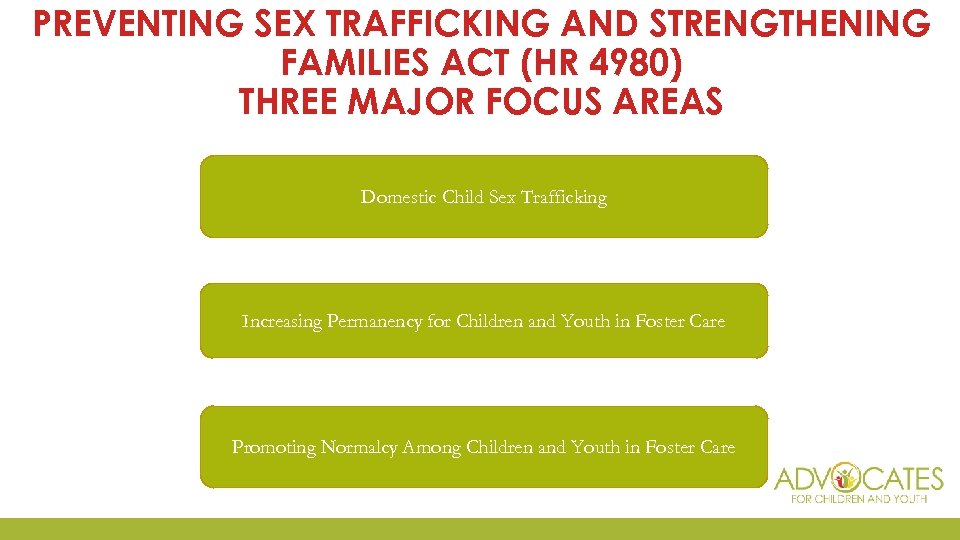 PREVENTING SEX TRAFFICKING AND STRENGTHENING FAMILIES ACT (HR 4980) THREE MAJOR FOCUS AREAS Domestic Child Sex Trafficking Increasing Permanency for Children and Youth in Foster Care Promoting Normalcy Among Children and Youth in Foster Care
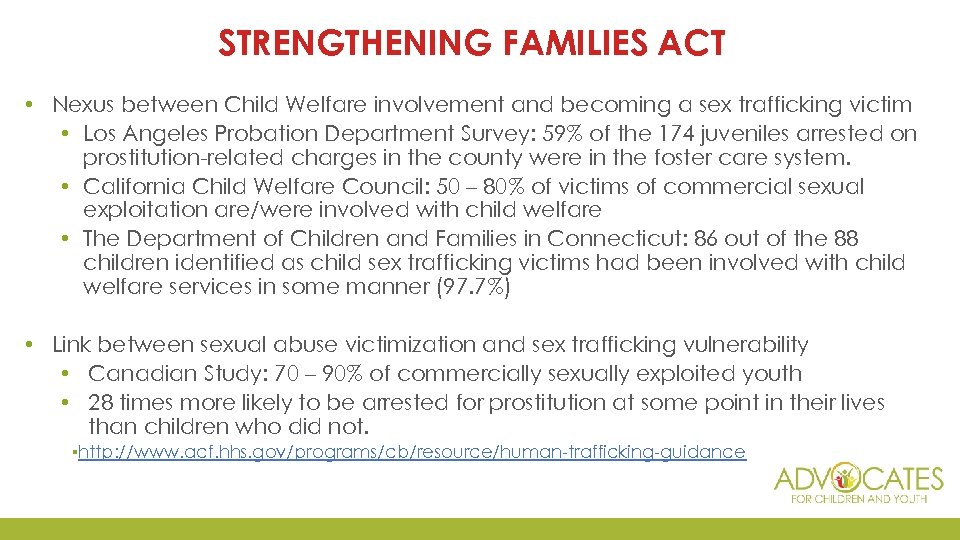 STRENGTHENING FAMILIES ACT • Nexus between Child Welfare involvement and becoming a sex trafficking victim • Los Angeles Probation Department Survey: 59% of the 174 juveniles arrested on prostitution-related charges in the county were in the foster care system. • California Child Welfare Council: 50 – 80% of victims of commercial sexual exploitation are/were involved with child welfare • The Department of Children and Families in Connecticut: 86 out of the 88 children identified as child sex trafficking victims had been involved with child welfare services in some manner (97. 7%) • Link between sexual abuse victimization and sex trafficking vulnerability • Canadian Study: 70 – 90% of commercially sexually exploited youth • 28 times more likely to be arrested for prostitution at some point in their lives than children who did not. ▪http: //www. acf. hhs. gov/programs/cb/resource/human-trafficking-guidance
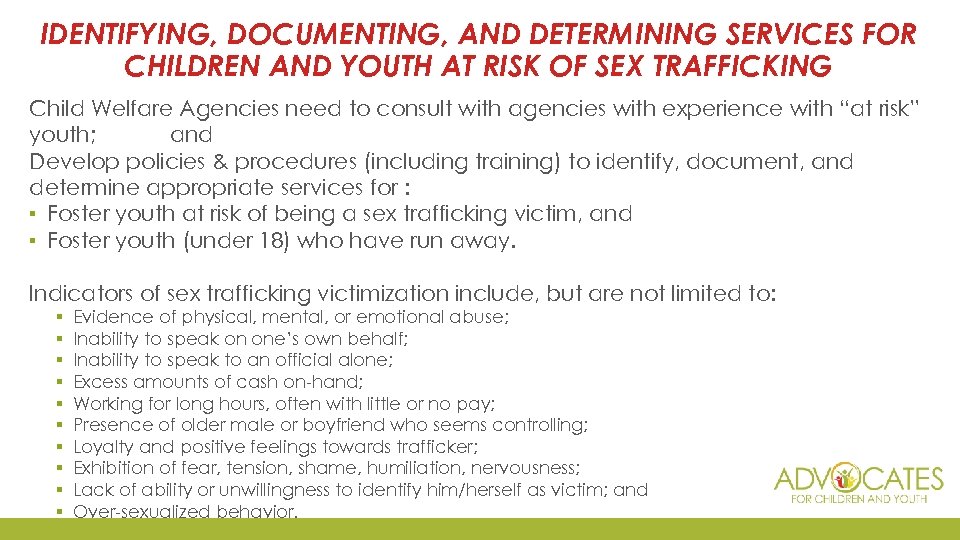 IDENTIFYING, DOCUMENTING, AND DETERMINING SERVICES FOR CHILDREN AND YOUTH AT RISK OF SEX TRAFFICKING Child Welfare Agencies need to consult with agencies with experience with “at risk” youth; and Develop policies & procedures (including training) to identify, document, and determine appropriate services for : ▪ Foster youth at risk of being a sex trafficking victim, and ▪ Foster youth (under 18) who have run away. Indicators of sex trafficking victimization include, but are not limited to: § § § § § Evidence of physical, mental, or emotional abuse; Inability to speak on one’s own behalf; Inability to speak to an official alone; Excess amounts of cash on-hand; Working for long hours, often with little or no pay; Presence of older male or boyfriend who seems controlling; Loyalty and positive feelings towards trafficker; Exhibition of fear, tension, shame, humiliation, nervousness; Lack of ability or unwillingness to identify him/herself as victim; and Over-sexualized behavior.
 IDENTIFYING, DOCUMENTING, AND DETERMINING SERVICES FOR CHILDREN AND YOUTH AT RISK OF SEX TRAFFICKING • State models: MN, CT, CA, NC • Collaboration with other systems: Runaway and Homeless youth shelters, Mental Health, Education • Implementing effective screening tools • Training for key stakeholders (CA, CT, FL): • Law enforcement • Child welfare personnel • Foster parents and kinship caregivers • Health care workers, school employees • CA: comprehensive screening tools for service providers • CT: Human Trafficking Liaison department & protocol when victims are identified ▪ Services for victims ▪ Access to safe and stable housing • Safety plans to keep perpetrators away • Access to mental and physical health services and legal services • Rehabilitative services including counseling, education and job training, and mentorships • Placement in Therapeutic Foster Care
 WHAT IS HUMAN TRAFFICKING? Trafficking means recruiting, abducting, facilitating, transferring, harboring, or transporting a person, by threat or use of force, coercion, fraud or deception or by the purchase, sale, trade, transfer or receipt of a person, for purpose of subjecting that person to involuntary servitude, peonage, slavery, slavelike practices, sex trafficking, or forced or bonded labor services. Trafficking Victims Protection Act of 2000, Sec. 103(8)(A-B); Public Law 106 -386 (2000)
 RISK FACTORS FOR YOUTH ▪ Poverty ▪ Desire to Improve Income or Incomes of Family ▪ Adventure /Opportunity ▪ Child Welfare history ▪ Abuse history ▪ LGBTQ ▪ Runaway/Homeless Youth
 SOME SIGNS OF TRAFFICKING § Under 18 and engaged in commercial sex acts § Signs of gang involvement § Little knowledge of whereabouts, what city he/she is § Chronic runaways, gone for extended periods (indicates staying in hotels, attending hotel parties, or in, disoriented traveling long distances) § Has access to money or material items that does not fit § Uses prostitution terminology, significant tattoos (initials their situation (hair, nails, clothing, shoes, electronics) of boyfriend, brands), nickname is prostitution related § Not in control of own money or identification § Arrested for prostitution or related masking charges documents § Social media posts that are sexually provocative, show § Claims of just visiting, inability to say where he/she is pictures of cash, or show youth staying in hotel staying § Described as “promiscuous”, number of sexual partners not consistent with age or development § Has numerous inconsistencies in his/her story, reluctant to share information § Romantic partner is significantly older, seems overly interested or controlling § Reported recent sexual assault § Is fearful, anxious, depressed, submissive, tense, or nervous/paranoid, avoids eye contact, especially regarding law enforcement § Moderate to severe substance abuse § Not allowed to speak for themselves (3 rd party insists on being present)
 DHR SCREENING QUESTIONS ▪ Have you ever run away or left home or foster care? About how many times? (If youth has difficulty, ask if only 1 time, 2 -3 times, 4 -6 times, 7 -10 times, more than 10) ▪ How long do you usually stay away? (If youth has difficulty, ask 1 -2 days, 3 -5 days, 7 days (week), more than 7 days) ▪ Can you tell me more about what made you leave? ▪ How do you take care of yourself while away? ▪ Can you tell me what you did when you needed food, clothing, shelter, a ride, etc. while you are away from home/foster home? Did you have friends that helped you with these things? ▪ Where did you spend the night while you were gone? ▪ Can you tell me about who you were staying with and what is your relationship to them? ▪ Who else was staying there with you?
 DHR SCREENING QUESTIONS (CONT’D) ▪ Did you feel safe there? ▪ While you were away from home/foster home, did anything keep you from going back? Examples might include being afraid of getting in trouble, something wrong at home, didn’t have transportation home, etc. ▪ Do you have a special person in your life, boyfriend, girlfriend? If yes, can you tell me about this person? ▪ Is this person your age or older? If older ask: How much older? (If 5 or more years difference, this is a risk factor) ▪ What do you like about this special friend? ▪ Does he/she give you nice things, take you places, do special things for you? ▪ Has anyone asked you to do anything that has made you feel uncomfortable in exchange for something that you needed? (ex: food, shelter, clothing, water, a ride?
 DHR SCREENING QUESTIONS (CONT’D) ▪ Do you have any tattoos? If yes, what is your tattoo of and what does it/they mean to you? (romantic partner, gang, or involvement in prostitution) ▪ Have you had contact with the police in the last year? Where? (multiple cities or states is a risk factor) ▪ Did the contact with the police result in an arrest? ▪ What was the arrest for? prostitution or related charges (loitering, trespassing, drug offenses, shoplifting, solicitation)
 RESOURCES FOR VICTIMS AND SURVIVORS OF HUMAN TRAFFICKING ▪ Turnaround, Inc. , Baltimore area ▪ Courtney’s House, Washington, D. C. / Prince George’s County, MD ▪ SAFE Center for Human Trafficking Survivors, College Park, MD ▪ Araminta Freedom, Baltimore, MD
 TURNAROUND, INC. (WWW. TURNAROUNDINC. ORG) ▪ Located in Baltimore, Turnaround’s mission is to provide counseling and support services to victims of rape, incest and domestic violence and to increase community awareness and understanding of these problems. ▪ In addition to the services they provide, which includes counseling, emergency shelter, temporary housing, legal assistance, and community referrals, among other services, they have an Anti-Sex Trafficking Program which addresses the specific needs of domestic sex trafficking victims. ▪ 24 -Hour Helpline: (443) 279 -0379 ▪ 3 Locations: ▪ 401 Washington Ave. , Ste. 300, Towson, MD 21204 (410) 377 -8111 ▪ 1800 N. Charles St. , Ste. 404, Baltimore, MD 21201 (410) 837 -700 ▪ 9100 Franklin Square Dr. , Room 317, Baltimore, MD 21237 (410) 391 -2396
 COURTNEY’S HOUSE (WWW. COURTNEYSHOUSE. ORG) ▪ Founded in 2008 by Tina Frundt, a survivor of domestic sex trafficking. She is a member of the Washington, D. C. Anti-Trafficking Task Force, and Prince George's County, Human Trafficking Task Force. ▪ Courtney’s House provides survivor-focused, trauma-informed, holistic services. Members of the organization spend every Friday and Saturday night on the streets to reach out to victims, targeting specific areas where girls, boys, and women are trafficked or at high risk of being trafficked and handing out unassuming items that carry the Survivor Hotline phone number. ▪ Once at Courtney’s House a preliminary sex trafficking screening is conducted and a specialized intake process takes place. Counseling, therapy, and support groups are part of the recovery process. The support groups are open to boys, girls and transgender survivors. They focus on trauma recovery, education and life skills along with fun, therapeutic activities like dance, art, yoga, etc. ▪ Tina, the founder, also trains law enforcement and other non-profit groups to help and provide resources to victims. ▪ http: //www. courtneyshouse. org/ 202 -525 -1426
 S. A. F. E. CENTER FOR HUMAN TRAFFICKING SURVIVORS ▪ Standing for the words Support, Advocacy, Freedom, Empowerment, the SAFE Center, located in College Park, MD, is an initiative of the University of Maryland, Baltimore and the University of Maryland, College Park, through the MPower program. ▪ The program provides direct services, research, as well as advocacy all in one place. By combining the capabilities of each institution, they maximize the research capabilities to study human trafficking, in an effort to become experts both the fight against trafficking and the care and treatment of survivors. ▪ Services include case management services, legal services, mental health services, basic primary medical care, and economic empowerment services; and are available to women, girls, boys, transgender individuals, foreign nationals, and U. S. citizens who have been exploited by trafficking are all eligible for services. ▪ www. umdsafecenter. org
 ARAMINTA FREEDOM ▪ Named for Harriett Tubman’s given name, Araminta Freedom located in Baltimore, MD, provides support for victims of human trafficking through the work of volunteers. ▪ These volunteers support the work of other community resources, including Turnaround, Inc. , and collaborate with professionals including psychologists, social workers, and attorneys to ensure that victims get the services they need. ▪ By relying on volunteers, Araminta Freedom hopes to reach as many victims as possible and connect them to partner agencies and community resources. ▪ They also provides education and training for members of the community. ▪ http: //aramintafreedom. org/
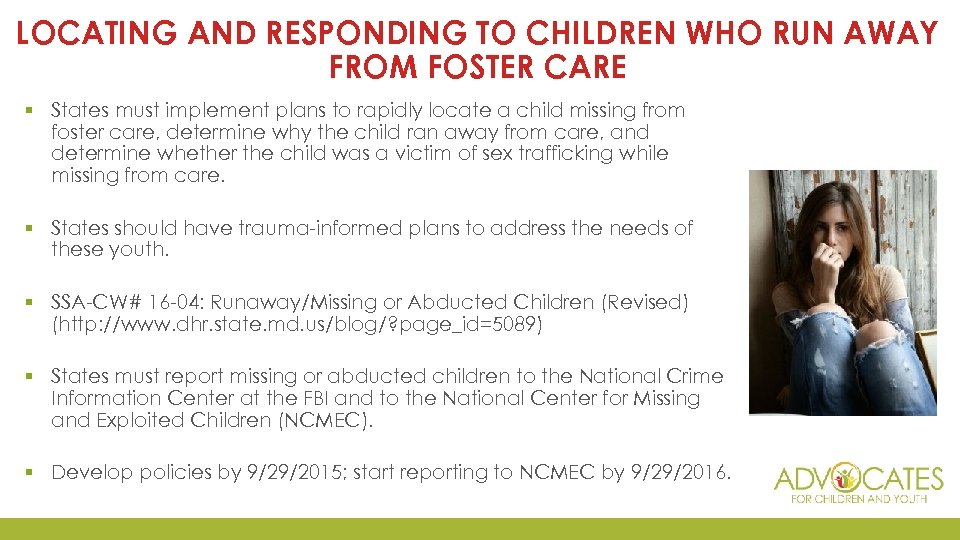 LOCATING AND RESPONDING TO CHILDREN WHO RUN AWAY FROM FOSTER CARE § States must implement plans to rapidly locate a child missing from foster care, determine why the child ran away from care, and determine whether the child was a victim of sex trafficking while missing from care. § States should have trauma-informed plans to address the needs of these youth. § SSA-CW# 16 -04: Runaway/Missing or Abducted Children (Revised) (http: //www. dhr. state. md. us/blog/? page_id=5089) § States must report missing or abducted children to the National Crime Information Center at the FBI and to the National Center for Missing and Exploited Children (NCMEC). § Develop policies by 9/29/2015; start reporting to NCMEC by 9/29/2016.
 SUPPORTING NORMALCY FOR CHILDREN IN FOSTER CARE § States must implement a “reasonable and prudent parent standard” allowing foster parents and residential care providers to make more day-today decisions for youth in their care (such as allowing them to play sports or spend time with friends). (Effective 9/29/2015) § See SSA Policy Directive #16 -17: Reasonable and Prudent Parenting Standard (http: //www. dhr. state. md. us/blog/? page_id=5089) See Also: 9/29/15 Memo from Darlene Ham, Executive Director, Office of Licensing and Monitoring to All Residential Child Care Programs § Training, Training! http: //www. acy. org/policies/child-welfare/conduct-training-of-child-welfarestakeholders-to-facilitate-implementation-of-the-strengthening-families-act/
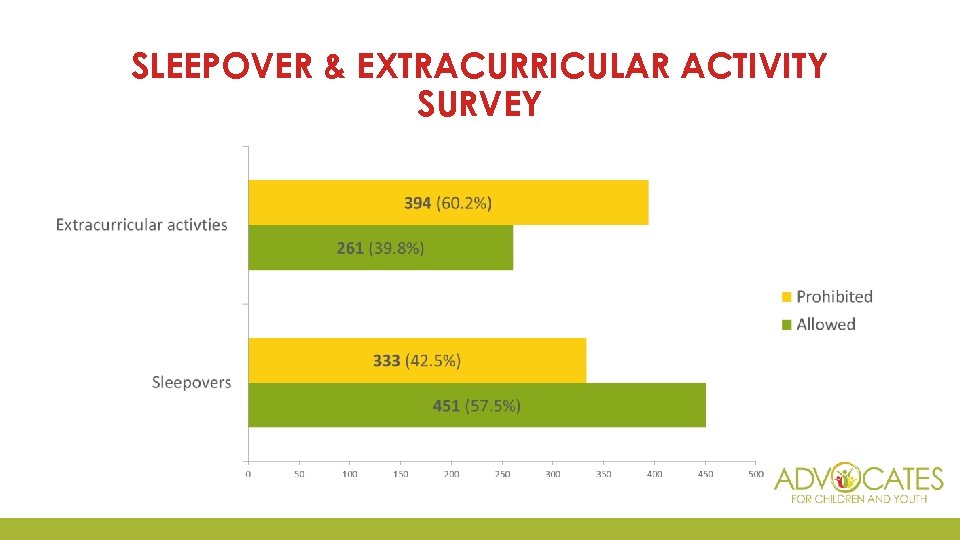 SLEEPOVER & EXTRACURRICULAR ACTIVITY SURVEY
 IMPLEMENTING THE REASONABLE PRUDENT PARENTING STANDARD ▪ State models: CA, FL, OH, UT, WA ▪ Working with special populations: LGBTQ youth, pregnant and/or parenting youth in foster care ▪ How will congregate care facilities implement the RPPS? ▪ What types of decisions will the RPPS cover? What factors should a caregiver consider in exercising the decision? ▪ How to ensure that the RPPS isn’t misused? ▪ How do we continue to build foster parent capacity, recruitment, and retention in light of the RPPS? http: //www. acy. org/policies/child-welfare/conduct-training-of-childwelfare-stakeholders-to-facilitate-implementation-of-the-strengtheningfamilies-act/
 IMPLEMENTING THE REASONABLE PRUDENT PARENTING STANDARD Questions to Ask from the Bench: ▪ What extracurricular activities is the child involved in? ▪ What opportunities has the child had to socialize with his or her peers? ▪ Has the child traveled at all? ▪ Does the child have a job? ▪ What activities does the child wish to participate in? ▪ What barriers has the caregiver experienced in connecting the youth to extracurricular and social activities? ▪ Ask the child if he/she is participating in all of the activities he/she would like to participate in, and if not, why not?
 Improving Another Planned Permanent Living Arrangement as a Permanency Option ▪ For children under age 16, States can no longer designate the child as having a case goal of “Another Planned Permanent Living Arrangement” or APPLA, which has become a catchall category effectively meaning “long-term foster care. ” This means that the case goal for all children in foster care under age 16 must be returning home or being placed with an adoptive parent, guardian, or relative. ▪ For children age 16 and older (who may continue to have APPLA as a goal), States must document their ongoing efforts to place such children in a permanent home and explain why other options are not in the best interests of the child. ▪ See SSA-CW #16 -10: Another Planned Permanent Living Arrangement http: //www. dhr. state. md. us/blog/? page_id=5089 ▪ Md Cts & Jud. Proc. § 3 -823(e)(1)(i)(5) “For a child at least 16…”
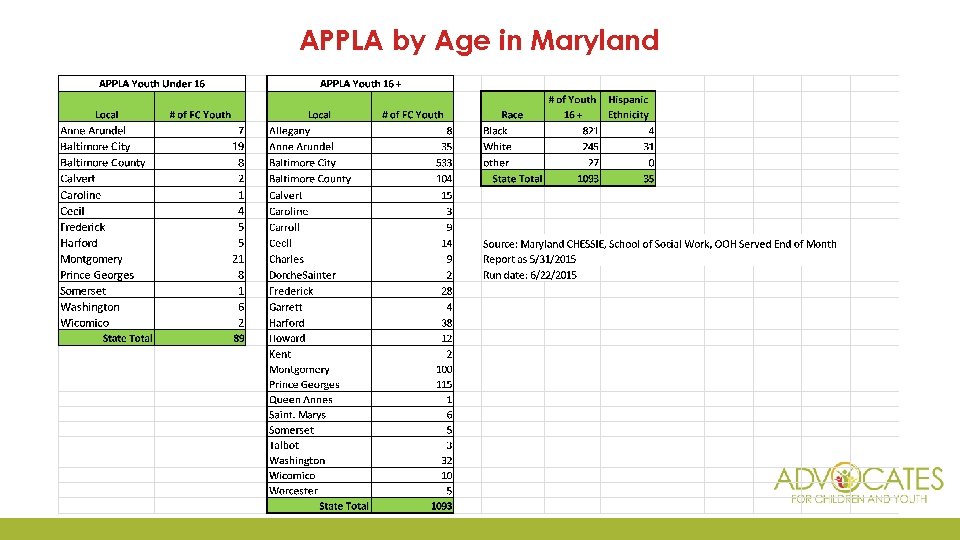 APPLA by Age in Maryland
 STRENGTHENING FAMILIES ACT APPLA REQUIREMENTS ▪ APPLA can only be used for youth 16 and older ▪ Md Cts & Jud. Proc. § 3 -823(e)(1)(i)(5) “For a child at least 16 years old, another planned permanent living arrangement that: A. Addresses individualized needs of the child, including the child’s educational plan, emotional stability, physical placement, and socialization needs; and B. Includes goals that promote the continuity of relations with individuals who will fill a lasting and significant role in the child’s life; ” ▪ When the plan is APPLA, LDSS shall document: ▪ Ongoing efforts to place the child permanency with a parent or relative or in a guardianship or an adoptive placement; and ▪ Steps LDSS is taking to ensure that: ▪ The child’s resource provider is following the reasonable and prudent parent standard; and ▪ The child has regular opportunities to engage in age or developmentally appropriate activities
 IMPROVING APPLA AS A PERMANENCY OPTION Questions to Ask from the Bench: ▪ What is the youth’s desired permanency outcome? ▪ What efforts has the child welfare agency made for family placement? ▪ Has the caseworker contacted family members? Which ones? ▪ [If APPLA is listed as the permanency goal: ] Is the permanency goal of APPLA in the best interest of the child? If so, why? Why is it not in the child’s best interest to be returned home, adopted, placed with a legal guardian or with a fit and willing relative? ▪ What steps is the child welfare agency taking to ensure that the reasonable and prudent parenting standard is being followed? ▪ What opportunities does the youth have to engage in age- or developmentally appropriate activities?
 Empowering Foster Children Age 14 and Older in the Development of Their Own Case Plan and Transition Planning for a Successful Adulthood § Youth in foster care age 14 or older will be allowed to help develop their own case plan, including selecting trusted adults to be part of the team preparing their plan, and would receive a list of their rights while in foster care regarding education, health, visitation, court participation, and other matters. (Effective 9/29/2015) § Questions to Ask from the Bench: • Is the youth involved in the development of his/her case plan? How? • Which individuals did the youth choose to be part of his/her case planning team? • Has the youth received a copy of his/her rights? • Has the agency conducted a credit report for the youth? Were there any inaccuracies on the report? If so, were they resolved? How?
 ENSURING FOSTER YOUTH HAVE ESSENTIAL DOCUMENTS ▪ Foster youth must be given: ▪ Birth Certificate ▪ Social Security Card ▪ Health Insurance information ▪ Medical Records ▪ Driver’s License (or equivalent state-issued ID) ▪ Maryland Family Law § 5 -525(j)(7): Ensure that all children in foster care who are at least 18 years of age have a birth certificate, a social security card, health insurance information, medical records, and a driver’s license or state-issued identification card at emancipation. (Effective 10/1/2015)
 TUITION WAIVER EDUCATION § 15 -106. 1 ▪ Tuition is waived at Maryland’s public colleges & universities for current and some former foster youth AND unaccompanied homeless youth ▪ Eligibility: ▪ Foster youth in out-of-home placement when he/she turned 18 [graduated high school/ earned GED]; OR ▪ Former foster youth who was adopted/placed into guardianship at age 13 or older ▪ Younger sibling who was adopted/placed into guardianship with sibling above; AND ▪ Former foster youth who was in an out-of-home placement for at least 1 year at age 13 or older and then returned home ▪ Former foster youth must be enrolled before he/she is 25 years old; AND ▪ Completed Free Application for Federal Student Aid (FAFSA) [ by March 1 st]; AND ▪ Eligibility continues for 5 years after initially enrolling; OR ▪ Until the young person receives his/her Bachelor’s degree. ▪ [Italics bracketed text has been deleted. ]
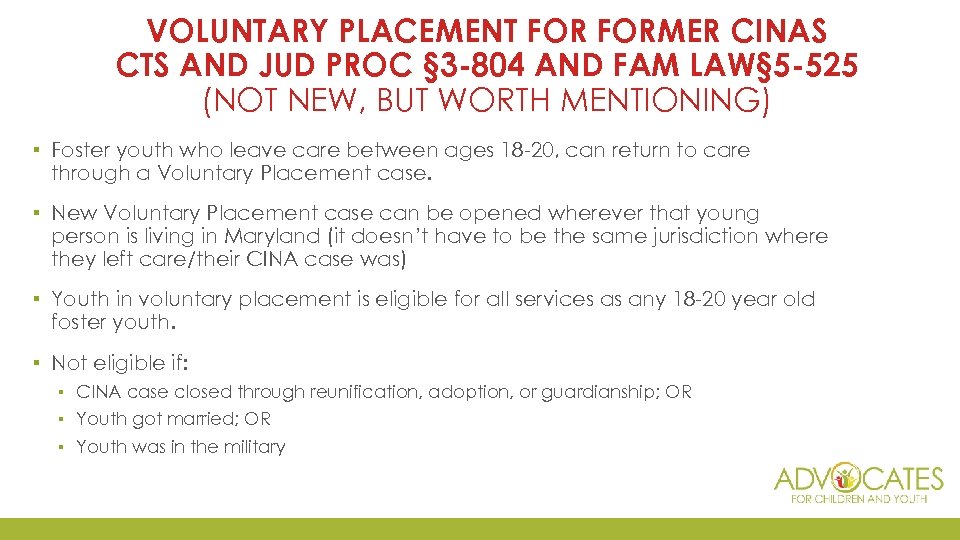 VOLUNTARY PLACEMENT FORMER CINAS CTS AND JUD PROC § 3 -804 AND FAM LAW§ 5 -525 (NOT NEW, BUT WORTH MENTIONING) ▪ Foster youth who leave care between ages 18 -20, can return to care through a Voluntary Placement case. ▪ New Voluntary Placement case can be opened wherever that young person is living in Maryland (it doesn’t have to be the same jurisdiction where they left care/their CINA case was) ▪ Youth in voluntary placement is eligible for all services as any 18 -20 year old foster youth. ▪ Not eligible if: ▪ CINA case closed through reunification, adoption, or guardianship; OR ▪ Youth got married; OR ▪ Youth was in the military
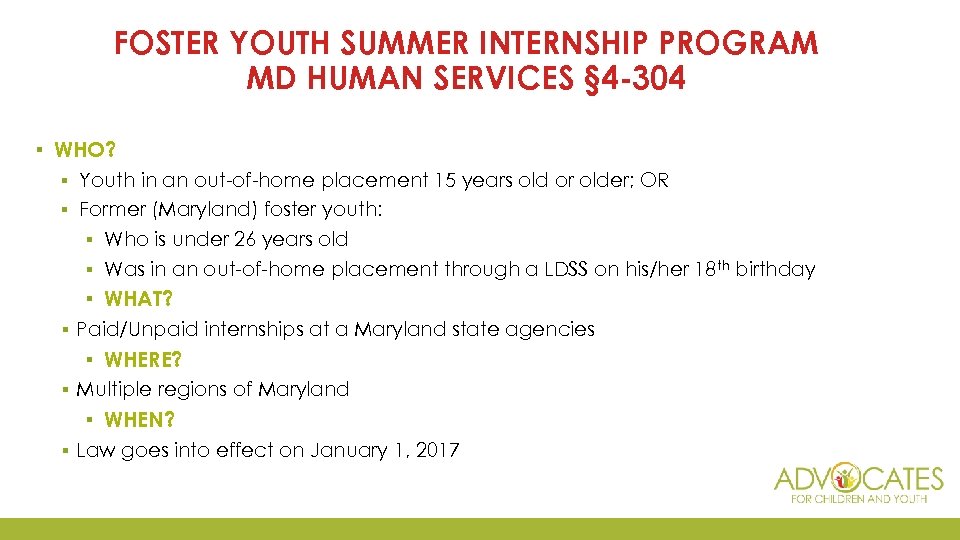 FOSTER YOUTH SUMMER INTERNSHIP PROGRAM MD HUMAN SERVICES § 4 -304 ▪ WHO? ▪ Youth in an out-of-home placement 15 years old or older; OR ▪ Former (Maryland) foster youth: ▪ Who is under 26 years old ▪ Was in an out-of-home placement through a LDSS on his/her 18 th birthday ▪ WHAT? ▪ Paid/Unpaid internships at a Maryland state agencies ▪ WHERE? ▪ Multiple regions of Maryland ▪ WHEN? ▪ Law goes into effect on January 1, 2017
 We are every child’s ally. One North Charles Street, Suite 2400 Baltimore, Maryland 21201 410 -547 -9200 www. acy. org