 Скачать презентацию New Kids On The Block Fundraising in the
e6376d8524573baeadce1648893c4a76.ppt
- Количество слайдов: 30



New Kids On The Block Fundraising in the New World Order Mike Muchilwa
Who are the worlds largest ODA donors? ? ?
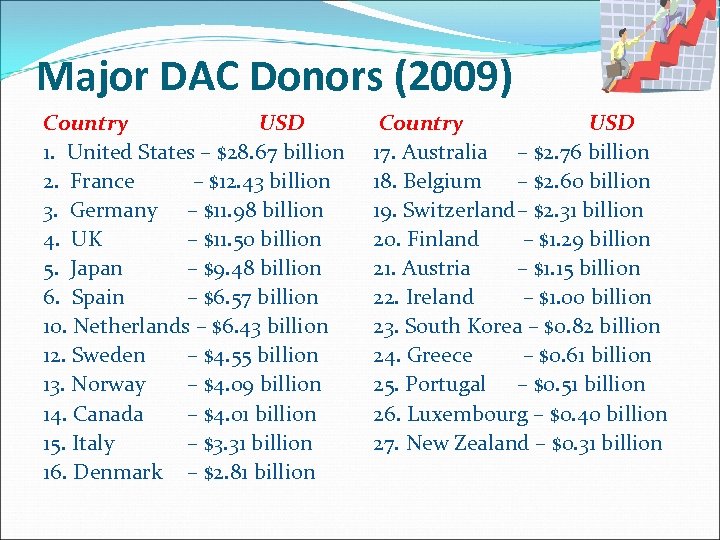
Major DAC Donors (2009) Country USD 1. United States – $28. 67 billion 2. France – $12. 43 billion 3. Germany – $11. 98 billion 4. UK – $11. 50 billion 5. Japan – $9. 48 billion 6. Spain – $6. 57 billion 10. Netherlands – $6. 43 billion 12. Sweden – $4. 55 billion 13. Norway – $4. 09 billion 14. Canada – $4. 01 billion 15. Italy – $3. 31 billion 16. Denmark – $2. 81 billion Country USD 17. Australia – $2. 76 billion 18. Belgium – $2. 60 billion 19. Switzerland– $2. 31 billion 20. Finland – $1. 29 billion 21. Austria – $1. 15 billion 22. Ireland – $1. 00 billion 23. South Korea – $0. 82 billion 24. Greece – $0. 61 billion 25. Portugal – $0. 51 billion 26. Luxembourg – $0. 40 billion 27. New Zealand – $0. 31 billion
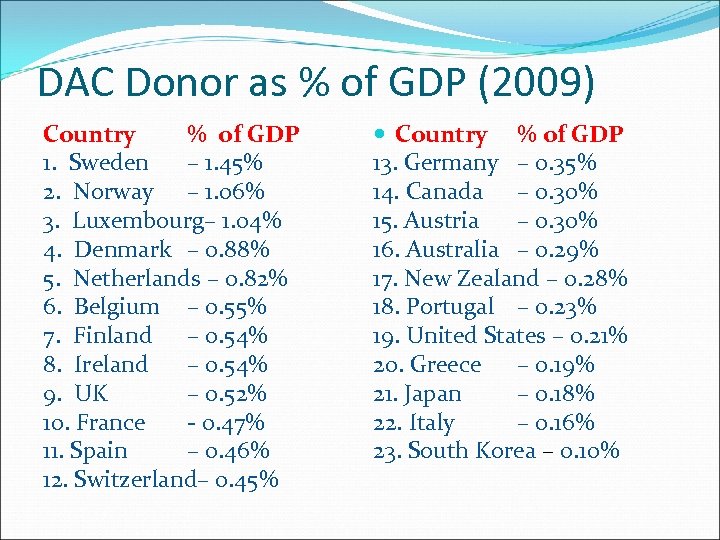
DAC Donor as % of GDP (2009) Country % of GDP 1. Sweden – 1. 45% 2. Norway – 1. 06% 3. Luxembourg– 1. 04% 4. Denmark – 0. 88% 5. Netherlands – 0. 82% 6. Belgium – 0. 55% 7. Finland – 0. 54% 8. Ireland – 0. 54% 9. UK – 0. 52% 10. France - 0. 47% 11. Spain – 0. 46% 12. Switzerland– 0. 45% Country % of GDP 13. Germany – 0. 35% 14. Canada – 0. 30% 15. Austria – 0. 30% 16. Australia – 0. 29% 17. New Zealand – 0. 28% 18. Portugal – 0. 23% 19. United States – 0. 21% 20. Greece – 0. 19% 21. Japan – 0. 18% 22. Italy – 0. 16% 23. South Korea – 0. 10%
DAC Donors Richest countries provide the largest aid. The EU contributes $80, 655 billion out of worlds $120 billion (ODA) US contributes$ $28. 67 billion per year. Next 4 industrial nations (Japan, France, Germany, UK) are the next biggest donors. Italy is a small donor despite economic size
Humanitarian Assistance –Non DAC (2009) Country 1. Saudi Arabia 2. UAE 3. Kuwait 4. Russia 5. India 6. South Korea 7. Qatar 8. Turkey 9. Czech Republic 10. Hong Kong 11. Others US$ – 51. 8 million ` – 35. 3 million – 34. 2 million – 32. 5 million – 14. 6 million – 13. 2 million – 12. 9 million – 4. 8 million – 4. 3 million Contribution breakdown U. N 83. 6% – 4. 0 million Gov 7. 3% – 16. 5 million NGOs Others 3. 3% 5. 8%
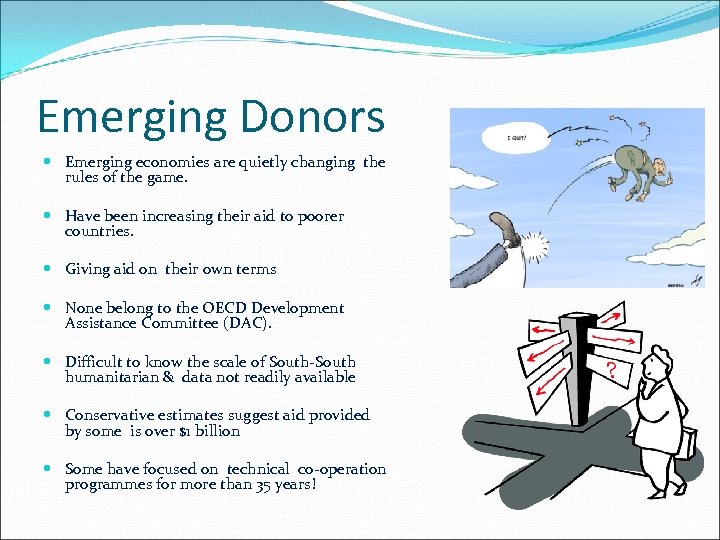
Emerging Donors Emerging economies are quietly changing the rules of the game. Have been increasing their aid to poorer countries. Giving aid on their own terms None belong to the OECD Development Assistance Committee (DAC). Difficult to know the scale of South-South humanitarian & data not readily available Conservative estimates suggest aid provided by some is over $1 billion Some have focused on technical co-operation programmes for more than 35 years!
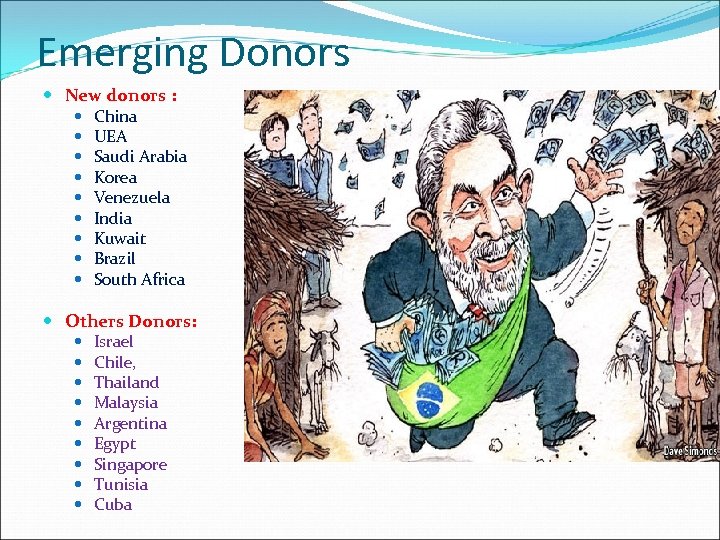
Emerging Donors New donors : China UEA Saudi Arabia Korea Venezuela India Kuwait Brazil South Africa Others Donors: Israel Chile, Thailand Malaysia Argentina Egypt Singapore Tunisia Cuba
Emerging Donors South Africa Launched the South African Development Partnership Agency (SADPA) Brazil Doubled between 2007 & 2008 and tripled from 2009 to 2010 to 50 million dollars. 53% given to Africa, rest to Latin America Funds through the Brazilian Co-operation Agency (ABC), UNDP WFP (support from US$1 million in 2008 to US$ 27 M in 2011 Trade flows between Brazil & Africa, growing to $27. 6 billion in 2011 from $4. 3 billion in 2002. Indian Development coop exceeds $2 billion annually 50% goes to Afghanistan. Recently created a Development Partnership Administration within the Ministry of External Affairs. Has followed China into Africa.
Emerging Donors - China Channels most of its aid through the Ministry of Commerce. Recently announced a US$20 B 3 year package to Africa Does not insist on human rights-related preconditions In 2011, published its first official foreign aid policy report, or “white papers. ” It has 3 different types of aid: grant based loans, interest-free loans, and concessional loans. Grant packages encompass social welfare programs & other human development related projects. Interest-free loans include grace periods and repayment plans. These loans are mainly issued to assist in building and expanding public works facilities. The concessional loans category provides aid to medium and large infrastructural projects
Emerging Donors Southern contributors have responded to catastrophic events, e. g The tsunami Bangladesh floods Latin American contributors also provided significant assistance Hurricane Mitch Floods in Guyana and Bolivia South Africa has delivered humanitarian assistance to the Southern African subregion at times of natural disasters (e. g. cyclones, droughts and floods). Arab Countries provide Aid to: Lebanon The West Bank and Gaza
The Emergence of Non-State Actors Philanthropic foundations e. g Rockefeller Foundation Ford Foundation Bill and Melinda Gates Foundation) Corporate philanthropic or Corporate Social Responsibility (CSR) Safaricom Equity Bank Global funds e. g. The Global Fund to fight HIV/Aids, Tuberculosis and Malaria Private organizations have priorities that: May not correspond to donor objectives Have different implementation mechanisms Private actors are financial heavy-weights in particular sectors or regions & can Shape agendas mobilise partnerships
Which were the worlds largest economies in 2010? Which will be the largest in 2020?
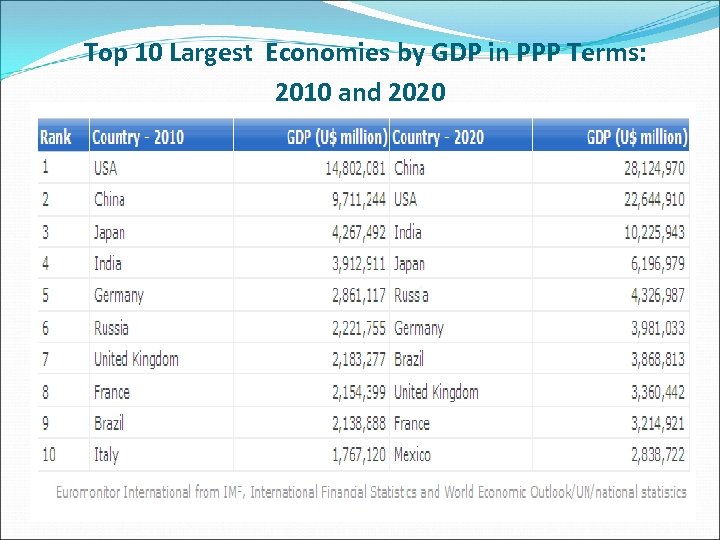
Top 10 Largest Economies by GDP in PPP Terms: 2010 and 2020
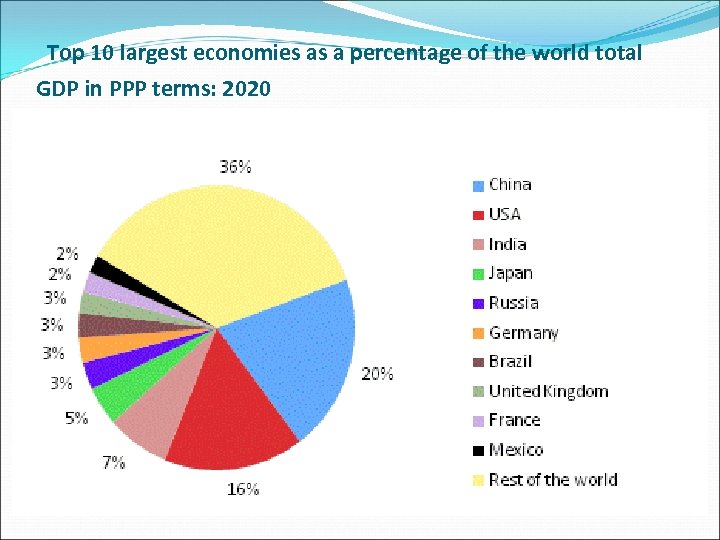
Top 10 largest economies as a percentage of the world total GDP in PPP terms: 2020
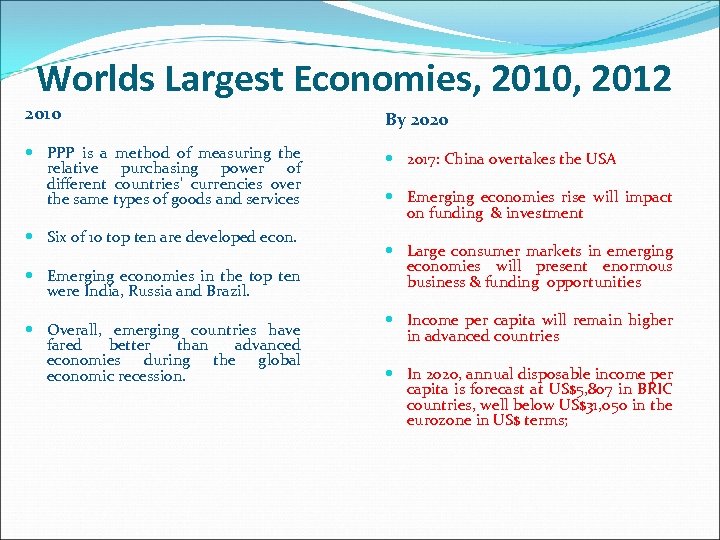
Worlds Largest Economies, 2010, 2012 2010 By 2020 PPP is a method of measuring the relative purchasing power of different countries' currencies over the same types of goods and services 2017: China overtakes the USA Six of 10 top ten are developed econ. Emerging economies in the top ten were India, Russia and Brazil. Overall, emerging countries have fared better than advanced economies during the global economic recession. Emerging economies rise will impact on funding & investment Large consumer markets in emerging economies will present enormous business & funding opportunities Income per capita will remain higher in advanced countries In 2020, annual disposable income per capita is forecast at US$5, 807 in BRIC countries, well below US$31, 050 in the eurozone in US$ terms;
Advanced Economies are Slowing Down Since the 1990 s, advanced economies have experienced much slower growth compared to the developing world Declining trend of advanced economies accelerated by global financial crisis The USA share in world GDP in PPP terms has declined from 23. 7% in 2000 to 20. 2% in 2010. The USA real GDP contracted by 2. 4% in the USA in 2009. Japan's economy recovered slightly in the mid-2000 s after a prolonged period of stagnation due to inefficient investments, global financial crisis and aging population Japan’s annual real GDP shrank by 5. 2% in 2009 In 2010, the European Union (EU) economies account for 20. 6% of world GDP measured at PPP terms, down from 25. 1% in 2000. Population ageing and rising unemployment have contributed to EU slowdown Annual real GDP growth of advanced economies was 2. 3% in 2010 and 2. 4% in 2011 after a contraction of 3. 2% in 2009. Asian countries achieve d 8. 7% in 2010 and 2011 Many advanced economies face the challenge of reducing public debts & government budget deficits
Emerging Countries are Catching up and Will Overtake Five emerging countries will be join the top 10 economies creating a new world order by 2020 China's share in world total GDP in PPP terms has increased from 7. 1% in 2000 to 13. 3% in 2010. By 2020, it will reach 20. 7%. China will become the world's largest economy in 2017; India is the fourth largest economy in 2010. By 2014 it will have overtaken Japan to become the world's third largest economy By 2020, Russia will rank higher than Germany and become the fifth largest economy. Brazil will have overtaken both the UK and France to become the seventh largest economy in 2020. By 2020, Mexico will have overtaken Italy to be the world's 10 th largest economy. A growing population and proximity to the USA aid the country's economic development;
Implications of economic shift towards emerging economies With a huge population and rising household incomes, emerging economies will provide enormous opportunities for fundraising In China, the number of households with an annual disposable income above US$10, 000 (in nominal terms) will increase from 57. 1 million in 2010 to 222 million households by 2020; In 2010, the total population of BRIC countries stood at 2, 856 million people, compared to 737 million people in the G 7; Emerging countries will be important foreign investors , influencing the global economy. Since the early 2000 s, China and India have become major foreign investors in Africa speeding up development
Emerging Economies - Implications There is a continuing shift in power, in which new economic powers are emerging Developing economies contracting. . Emerging countries are growing Reflected in the changes to the size of foreign aid budgets. A broader base of donors with a diversity of development experience & competing interests will favor recipient countries. The West is loosing “soft power, ” especially where it disagree with emerging market country commitments to democracy and human rights. Some institutions e. g World Bank, loosing influence The rise in economic importance of emerging countries will lead to a rise in their global political influence. China, for example, has since 2010 become third largest shareholder in the World Bank;
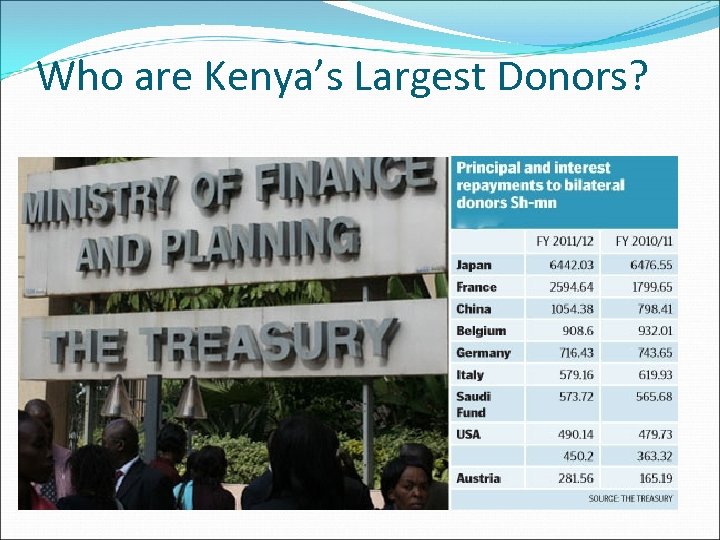
Who are Kenya’s Largest Donors?
What are the Implications? Some have greater focus on business rather than social issues e. g China, India, Brazil. Funding models beginning to change…. Increasing focus on infrastructure Increasing shift to concessional loans Focus on value for money Focus on opportunities for local businesses E. g Dutch, business cofunding programs (Swedish, British, Dutch)
Getting Strategic Getting greater visibility on-line Inviting emerging donors to your activities Sharing experiences/publications Seeking twins/partners in their countries Visit the countries/Projects Bill gates in China, Mexico Exchange visits Attend conferences/Workshops in new donor countries.
Africa - Rise of the Middleclass According to the ADB, Africa’s middleclass was 313 million people as of 2010. Represented 34 % of the continents population. Predicts that it will grow to 42% of the population or 1. 1 billion people by 2060. According to consultants Merrill Lynch and Capgemini, there are now 100, 000 Africans with at least $ 1 million to invest
Emerging Africa MNCs South, West & East African companies are spreading their wings across the continent Sectors include banking, retail, insurance, fast foods, and manufacturing. Grown into African Multinationals in their own right. KCB, Equity, ECO, & UBA Banks, Shoprite, Nakumatt, Uchumi and Tuskies supermarkets Castle & East African Breweries, Castle Breweries, MTN, Econet Wireless Nandos, Steers amongst other restaurants Donating funds to build new markets. Established foundations to support their work & are changing the investment face of the continent. Include the Safaricom Foundation, East African Breweries Foundation and KCB Foundations.
Emerging Africa Nollywood Produces 200 films weekly. World’s third largest film industry Employs 200, 000 people. NGOs going international e. g AMREF Churches going international e. g Winners Chapel
South African Philanthropists Others Include: Francois van Niekerk gave $170 million, (70 Cyril Ramaphosa percent equity) of Mertech Group, to the Mergon Foundation. Tokyo Sexwale Patrice Motsepe Allan Gray bestowed $150 million to the Allan Gray Jay Naidoo Orbis Foundation. Donald Gordon donated $50 million to charities including the Donald Gordon Teaching Medical Centre at the University of Witwatersrand British nonprofit, the Royal Opera House Wales Millennium Centre. Founder of the Donald Gordon Foundation Mark Shuttleworth Famed for his $20 million trip to space, Spent $25 million in support of Ubuntu, a free open source software. Committed US$ 20 m to Shuttleworth Foundation
Emerging Africa - Philanthropists Theophilus Yakubu Danjuma, granted $100 million to TY Danjuma Foundation. Manu Chandaria Reginald Mengi SM Macharia
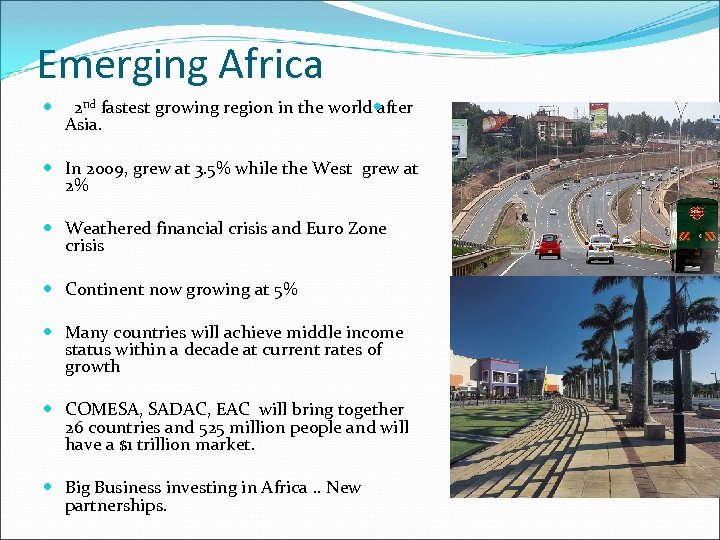
Emerging Africa 2 nd fastest growing region in the world after Asia. In 2009, grew at 3. 5% while the West grew at 2% Weathered financial crisis and Euro Zone crisis Continent now growing at 5% Many countries will achieve middle income status within a decade at current rates of growth COMESA, SADAC, EAC will bring together 26 countries and 525 million people and will have a $1 trillion market. Big Business investing in Africa. . New partnerships.
In a Nutshell Growing opportunities for aid from Africa SA Kenya to S. Sudan Kenya to Somalia Egypt Tunisia Opportunities to tap individual philanthropy Mpesa On-line Special Events Social media Opportunity to tap corporates National African MNC Others National Governments
Скачать презентацию New Kids On The Block Fundraising in the
e6376d8524573baeadce1648893c4a76.ppt