


 Скачать презентацию New Internet and Networking Technologies and Their Application
f11c30abfe39fcfebf754606a64f7bc0.ppt
- Количество слайдов: 65
 New Internet and Networking Technologies and Their Application on Computational Sciences COSCI 2004 Dai Hoc Bach Khoa, Ho Chi Minh City, Vietnam, March 3, 2004 C. Pham University Lyon, France LIP (CNRS-INRIA-ENS-UCBL)
 Computational Sciences Use of computers to solve complex problems Modelling techniques Simulation tehniques Analytic & Mathematic methods … Large problems require huge amount of processing power: supercomputers, highperformance clusters, etc.
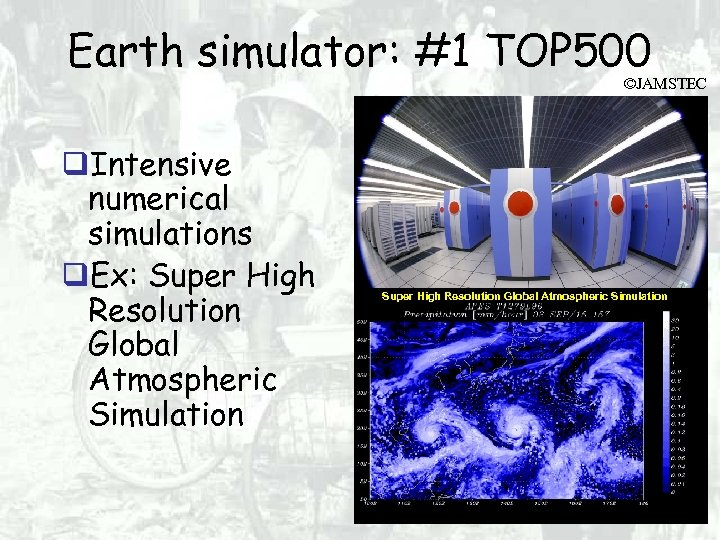 Earth simulator: #1 TOP 500 ©JAMSTEC Intensive numerical simulations Ex: Super High Resolution Global Atmospheric Simulation
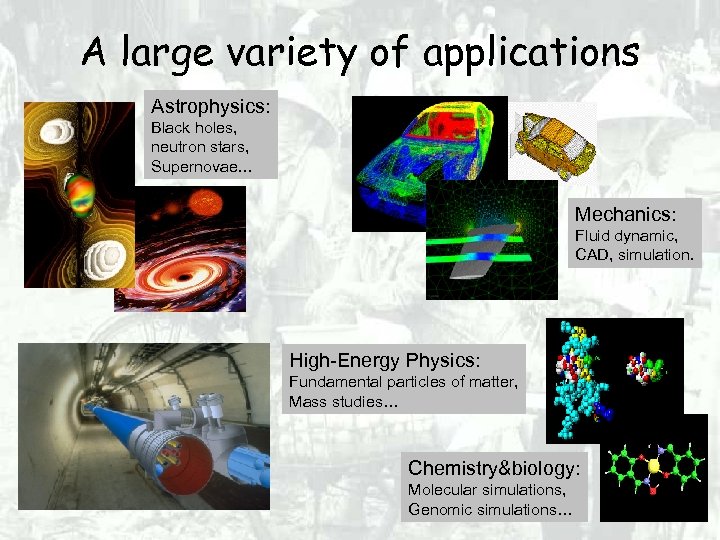 A large variety of applications Astrophysics: Black holes, neutron stars, Supernovae… Mechanics: Fluid dynamic, CAD, simulation. High-Energy Physics: Fundamental particles of matter, Mass studies… Chemistry&biology: Molecular simulations, Genomic simulations…
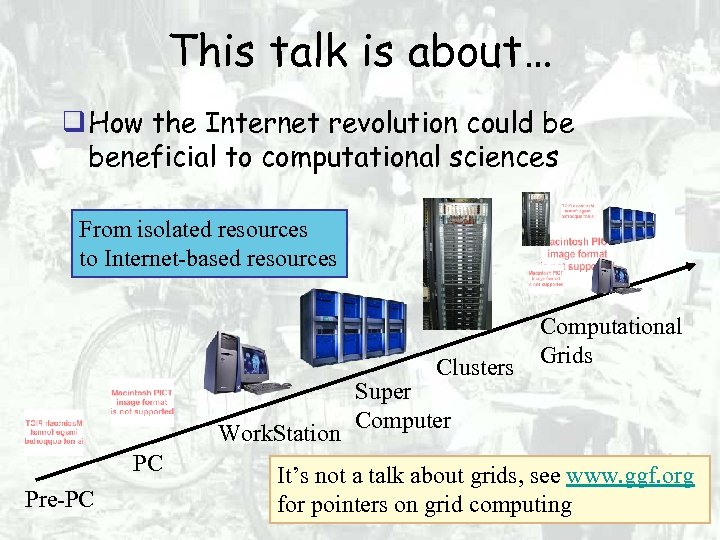 This talk is about… How the Internet revolution could be beneficial to computational sciences From isolated resources to Internet-based resources Clusters Work. Station PC Pre-PC Computational Grids Super Computer It’s not a talk about grids, see www. ggf. org for pointers on grid computing
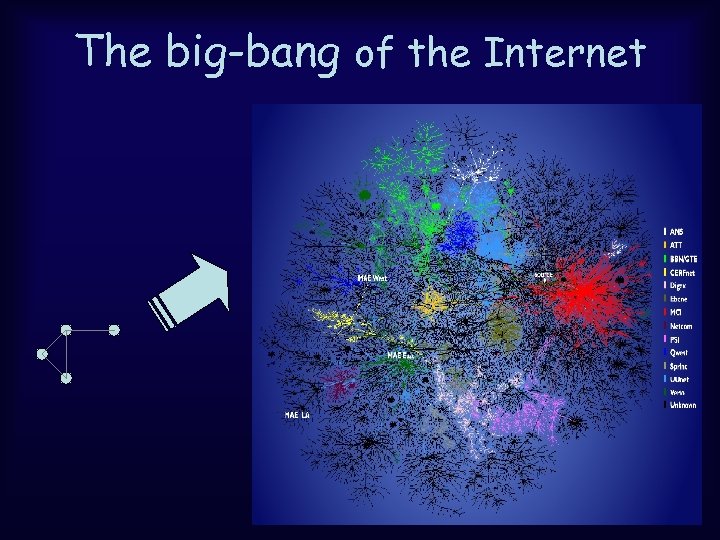 The big-bang of the Internet
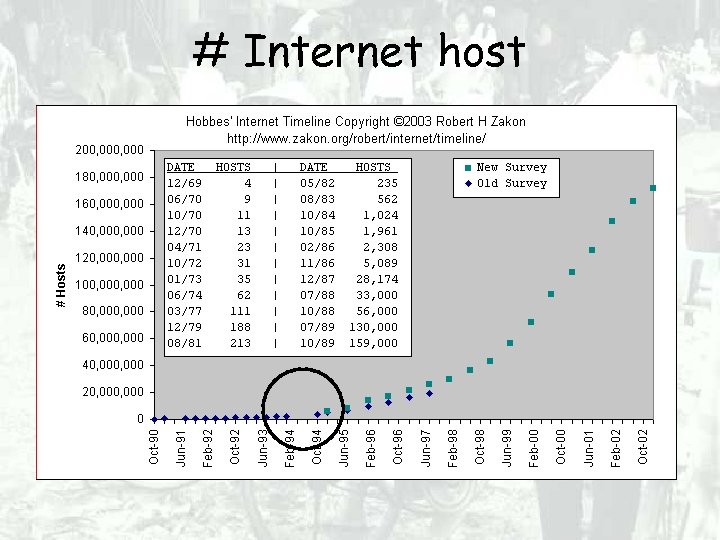 # Internet host
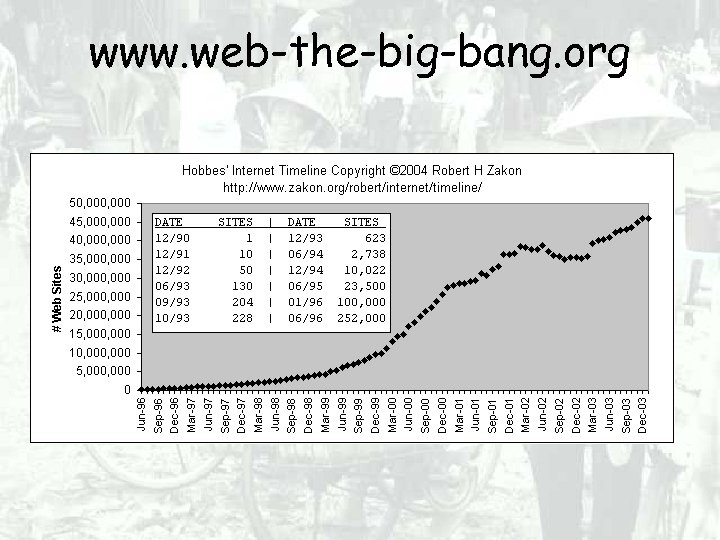 www. web-the-big-bang. org
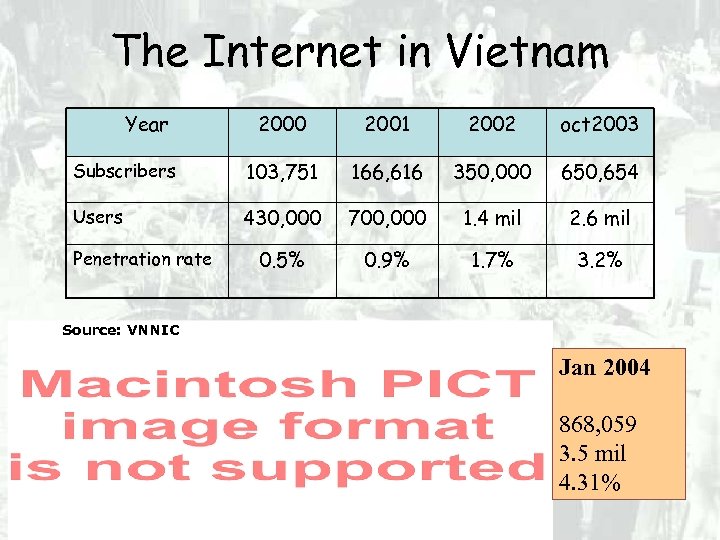 The Internet in Vietnam Year 2000 2001 2002 oct 2003 Subscribers 103, 751 166, 616 350, 000 650, 654 Users 430, 000 700, 000 1. 4 mil 2. 6 mil 0. 5% 0. 9% 1. 7% 3. 2% Penetration rate Source: VNNIC Jan 2004 868, 059 3. 5 mil 4. 31%
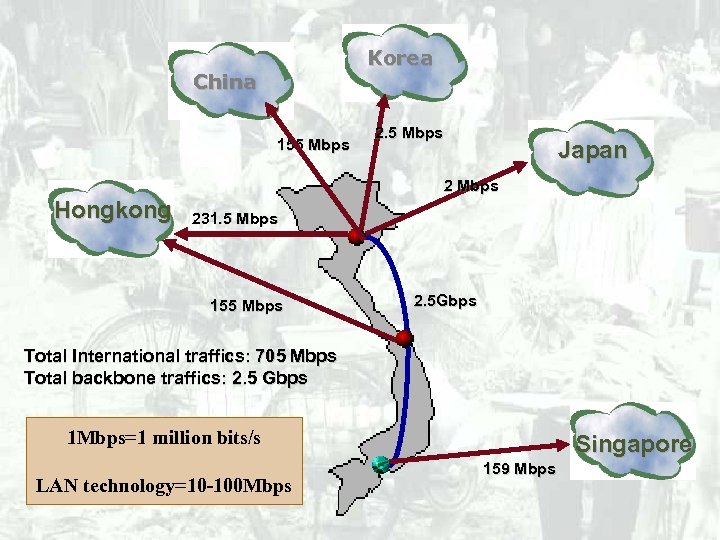 Korea China 155 Mbps 2. 5 Mbps Japan 2 Mbps Hongkong 231. 5 Mbps 155 Mbps 2. 5 Gbps Total International traffics: 705 Mbps Total backbone traffics: 2. 5 Gbps 1 Mbps=1 million bits/s LAN technology=10 -100 Mbps Singapore 159 Mbps
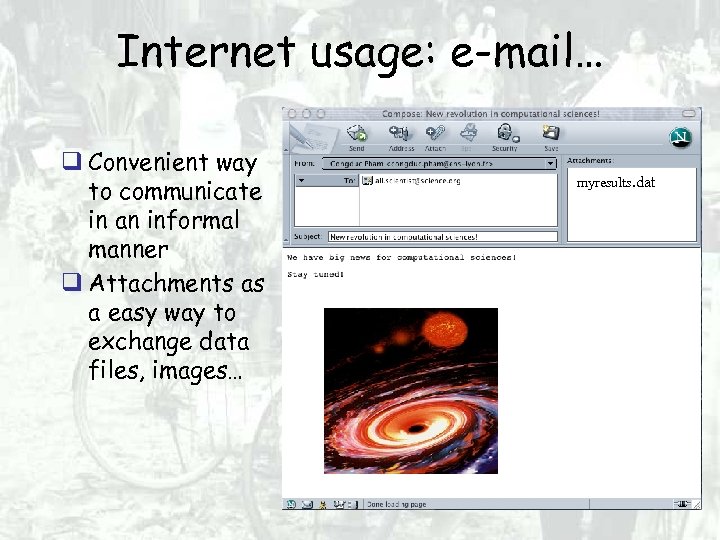 Internet usage: e-mail… Convenient way to communicate in an informal manner Attachments as a easy way to exchange data files, images… myresults. dat
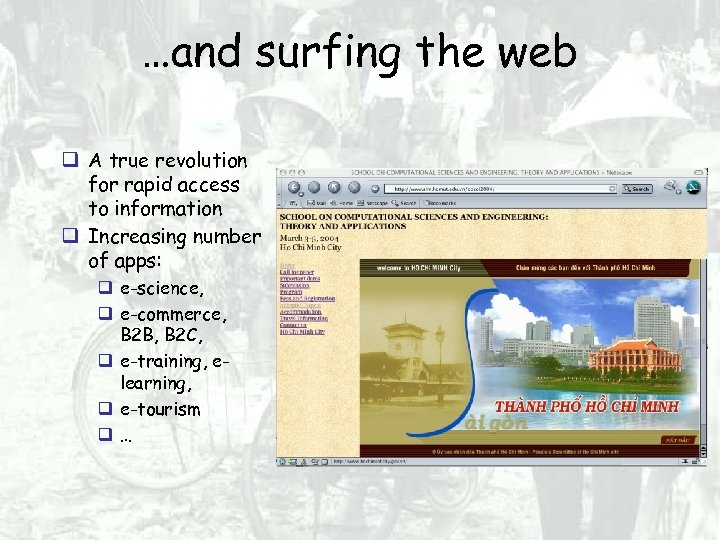 …and surfing the web A true revolution for rapid access to information Increasing number of apps: e-science, e-commerce, B 2 B, B 2 C, e-training, elearning, e-tourism …
 Towards all IP From Jim Kurose
 A whole new world for IP
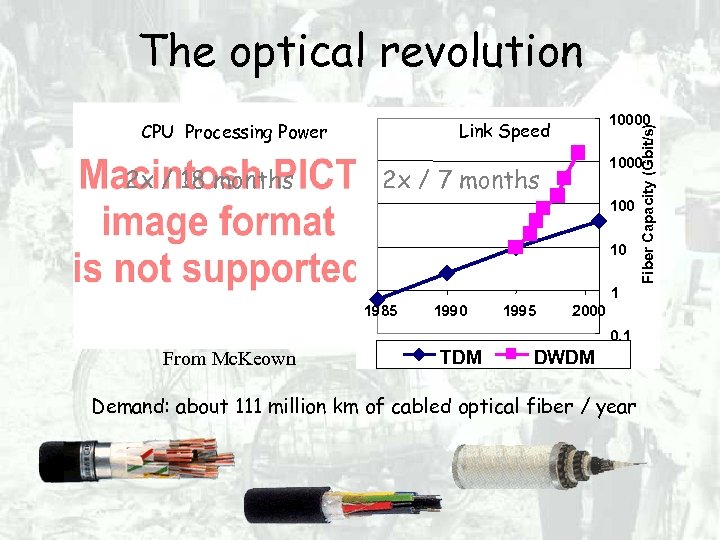 The optical revolution 1000 2 x / 7 months 100 10 1 1985 1990 1995 2000 0, 1 From Mc. Keown TDM Fiber Capacity (Gbit/s) 2 x / 18 months 10000 Link Speed CPU Processing Power DWDM Demand: about 111 million km of cabled optical fiber / year
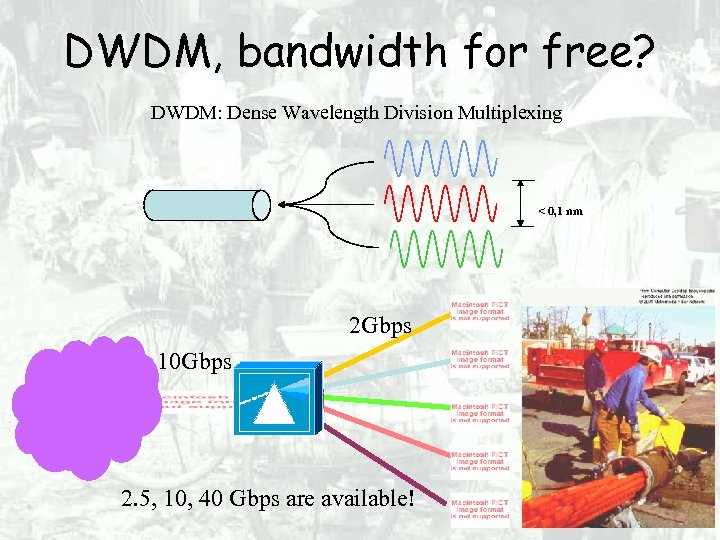 DWDM, bandwidth for free? DWDM: Dense Wavelength Division Multiplexing < 0, 1 nm 2 Gbps 10 Gbps 2. 5, 10, 40 Gbps are available!
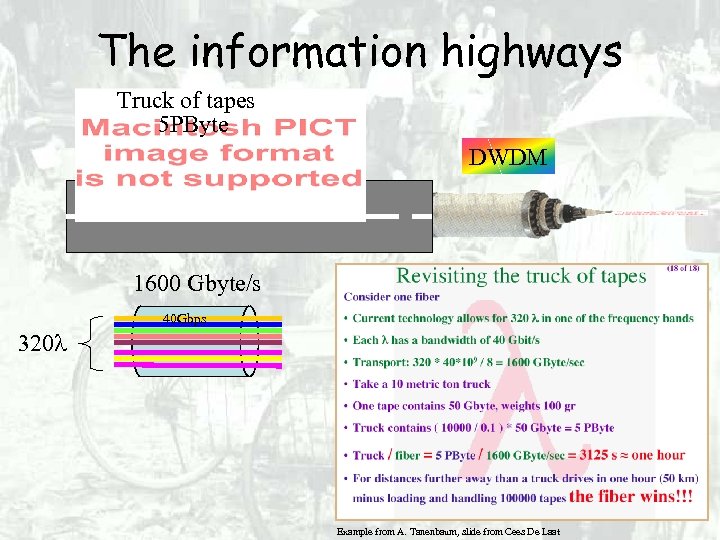 The information highways Truck of tapes 5 PByte DWDM 1600 Gbyte/s 40 Gbps 320 Example from A. Tanenbaum, slide from Cees De Laat
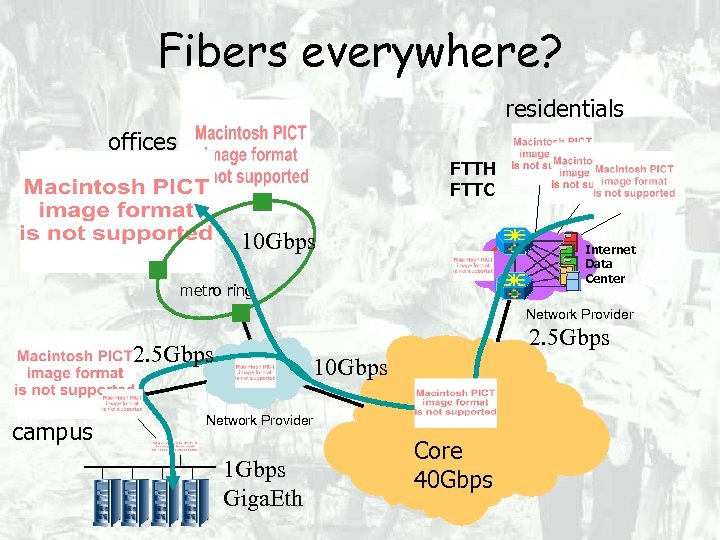 Fibers everywhere? residentials offices FTTH FTTC 10 Gbps Internet Data Center metro ring Network Provider 2. 5 Gbps campus 10 Gbps Network Provider 1 Gbps Giga. Eth Core 40 Gbps
 High Performance Routers IP packet ©Juniper IP packet ©Procket Networks ©cisco ©Lucent ©Alcatel and more… ©Nortel Networks
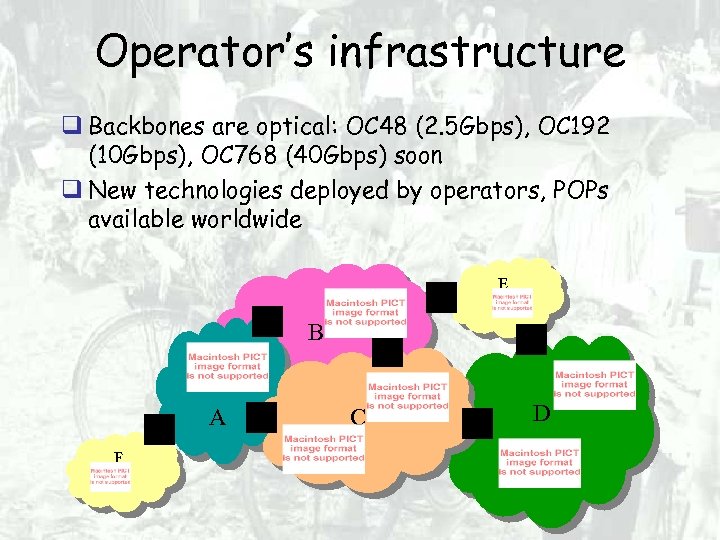 Operator’s infrastructure Backbones are optical: OC 48 (2. 5 Gbps), OC 192 (10 Gbps), OC 768 (40 Gbps) soon New technologies deployed by operators, POPs available worldwide E B A F C D
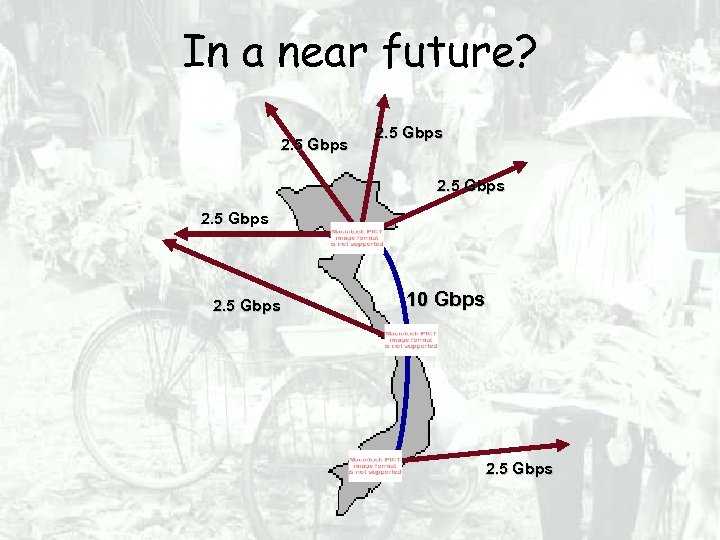 In a near future? 2. 5 Gbps 10 Gbps 2. 5 Gbps
 New applications on the information highways Think about… video-conferencing video-on-demand interactive TV programs remote archival systems tele-medecine virtual reality, immersion systems high-performance computing, grids distributed interactive simulations
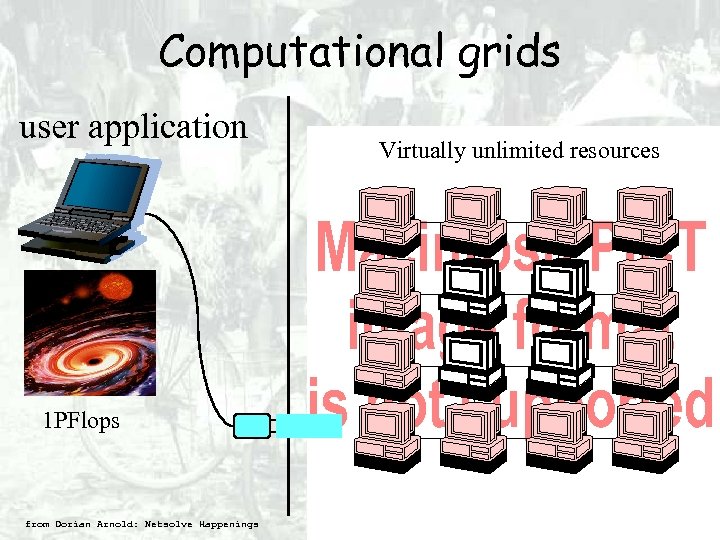 Computational grids user application 1 PFlops from Dorian Arnold: Netsolve Happenings Virtually unlimited resources
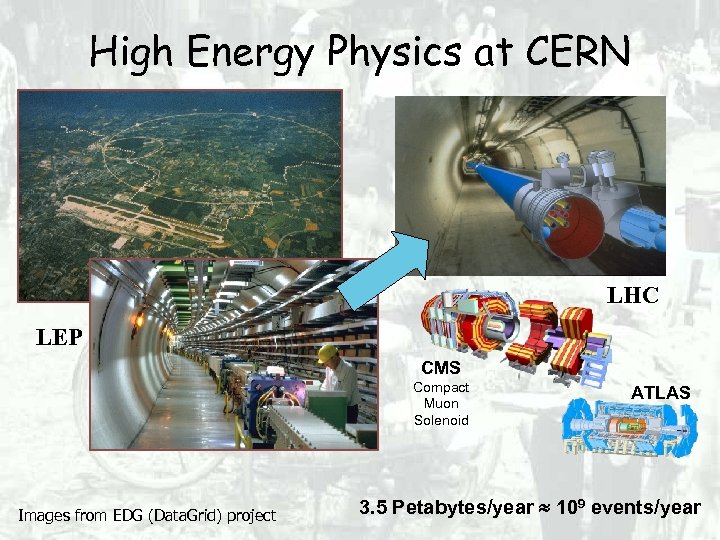 High Energy Physics at CERN LHC LEP CMS Compact Muon Solenoid Images from EDG (Data. Grid) project ATLAS 3. 5 Petabytes/year 109 events/year
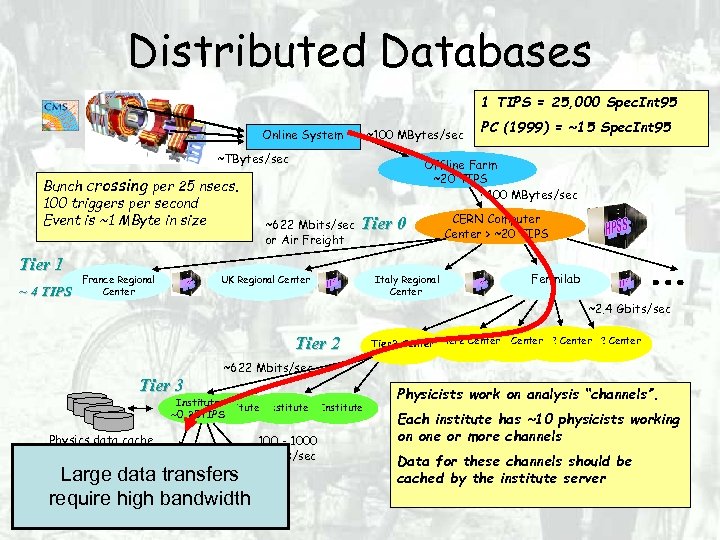 Distributed Databases 1 TIPS = 25, 000 Spec. Int 95 Online System ~100 MBytes/sec ~TBytes/sec Bunch crossing per 25 nsecs. 100 triggers per second Event is ~1 MByte in size Tier 1 ~ 4 TIPS France Regional Center PC (1999) = ~15 Spec. Int 95 Offline Farm ~20 TIPS ~100 MBytes/sec ~622 Mbits/sec or Air Freight Tier 0 UK Regional Center Italy Regional Center CERN Computer Center > ~20 TIPS Fermilab ~2. 4 Gbits/sec Tier 2 Tier 3 ~622 Mbits/sec Institute ~0. 25 TIPS Physics data cache Workstations Large data transfers require high bandwidth source Data. Grid Tier 2 Center Tier 2 Center 100 - 1000 Mbits/sec Institute Physicists work on analysis “channels”. Each institute has ~10 physicists working on one or more channels Data for these channels should be cached by the institute server
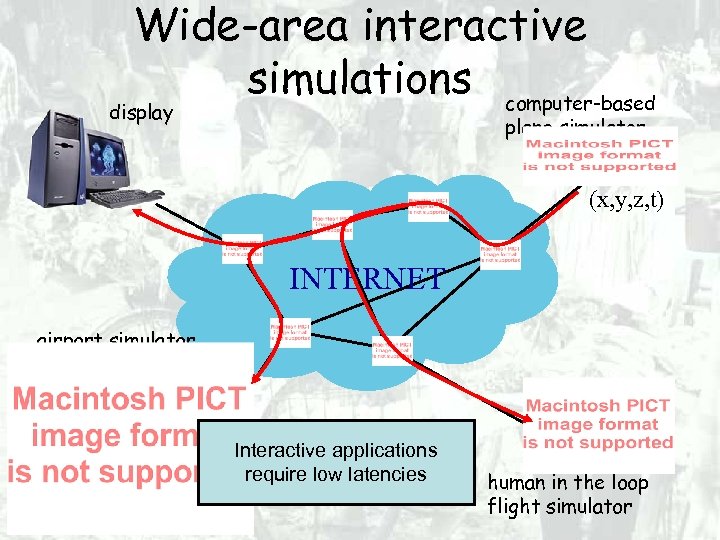 Wide-area interactive simulations computer-based display plane simulator (x, y, z, t) INTERNET airport simulator Interactive applications require low latencies human in the loop flight simulator
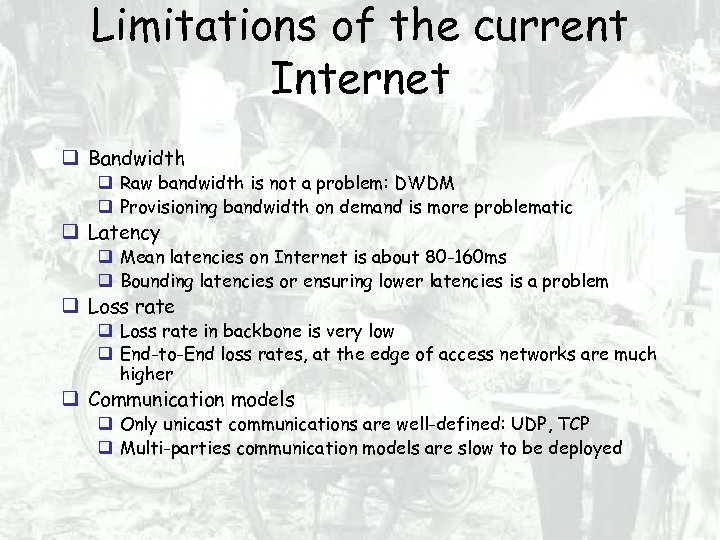 Limitations of the current Internet Bandwidth Raw bandwidth is not a problem: DWDM Provisioning bandwidth on demand is more problematic Latency Mean latencies on Internet is about 80 -160 ms Bounding latencies or ensuring lower latencies is a problem Loss rate in backbone is very low End-to-End loss rates, at the edge of access networks are much higher Communication models Only unicast communications are well-defined: UDP, TCP Multi-parties communication models are slow to be deployed
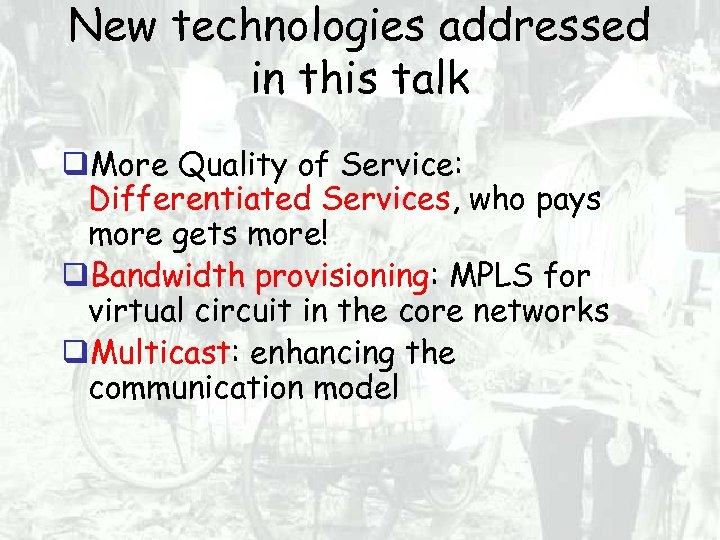 New technologies addressed in this talk More Quality of Service: Differentiated Services, who pays more gets more! Bandwidth provisioning: MPLS for virtual circuit in the core networks Multicast: enhancing the communication model
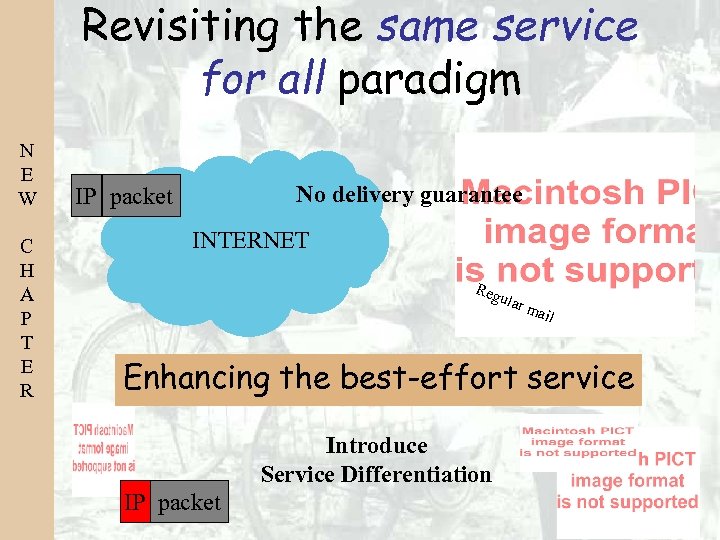 Revisiting the same service for all paradigm N E W C H A P T E R No delivery guarantee IP packet INTERNET Reg u lar m ail Enhancing the best-effort service Introduce Service Differentiation IP packet
 Service Differentiation The real question is to choose which packets shall be dropped. The first definition of differential service is something like "not mine. ” -- Christian Huitema Differentiated services provide a way to specify the relative priority of packets Some data is more important than other People who pay for better service get it! SLA Service Level Agreement
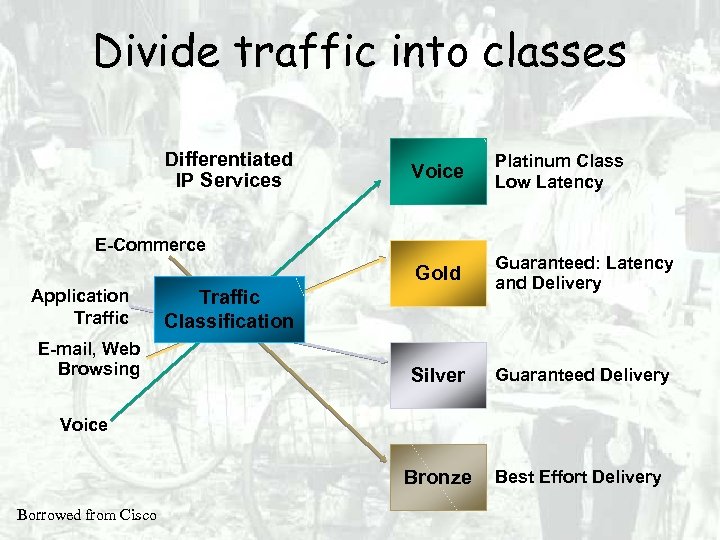 Divide traffic into classes Differentiated IP Services Voice Platinum Class Low Latency Gold Guaranteed: Latency and Delivery Silver Guaranteed Delivery Bronze Best Effort Delivery E-Commerce Application Traffic E-mail, Web Browsing Traffic Classification Voice Borrowed from Cisco
 Design Goals/Challenges Ability to charge differently for different services No per flow state or per flow signaling All policy decisions made at network boundaries Boundary routers implement policy decisions by tagging packets with appropriate priority tag Traffic policing at network boundaries Deploy incrementally, then evolve Build simple system at first, expand if needed in future
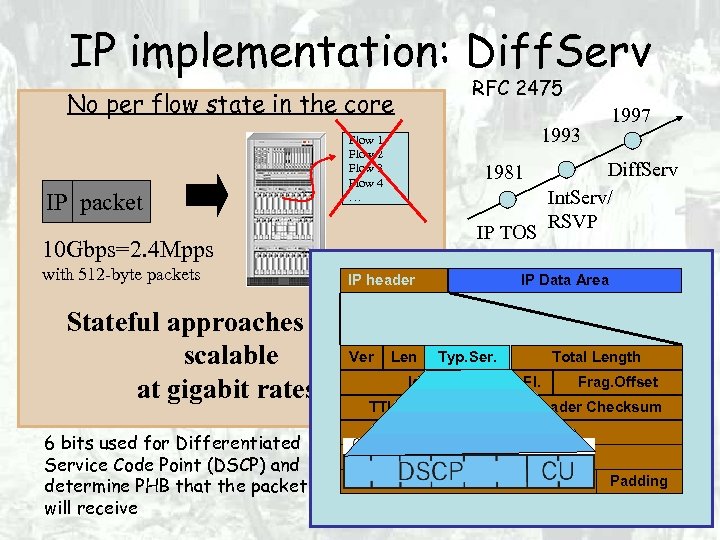 IP implementation: Diff. Serv No per flow state in the core IP packet Flow 1 Flow 2 Flow 3 Flow 4 … 1993 1981 IP TOS 10 Gbps=2. 4 Mpps with 512 -byte packets RFC 2475 IP header Diff. Serv Int. Serv/ RSVP IP Data Area Stateful approaches are not Ver Len Typ. Ser. scalable Ident at gigabit rates! TTL Proto 6 bits used for Differentiated Service Code Point (DSCP) and determine PHB that the packet will receive 1997 Total Length Fl. Frag. Offset Header Checksum Source IP Address Destination IP Address Options Padding
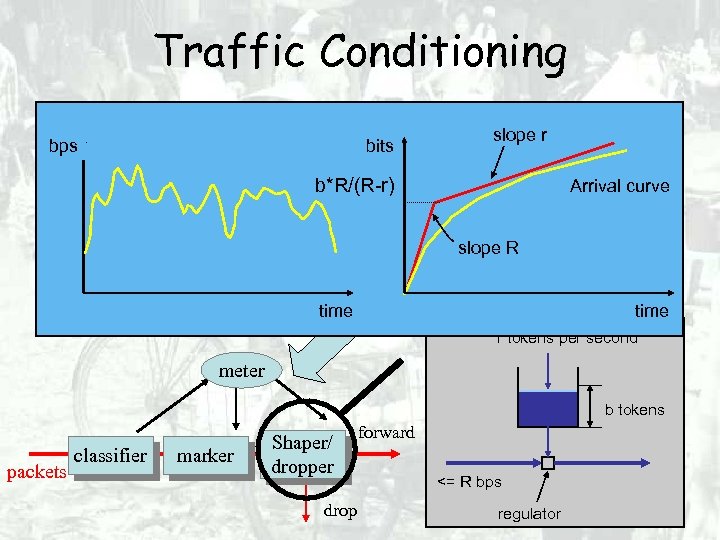 Traffic Conditioning bps User slope r declares traffic bits profile (eg, rate and burst size); traffic is metered and shaped Arrival curve b*R/(R-r) if non-conforming 5 Mbps SLA 2 Mbps slope R Service Level Agreement time r tokens per second meter b tokens packets classifier marker Shaper/ dropper drop forward <= R bps regulator
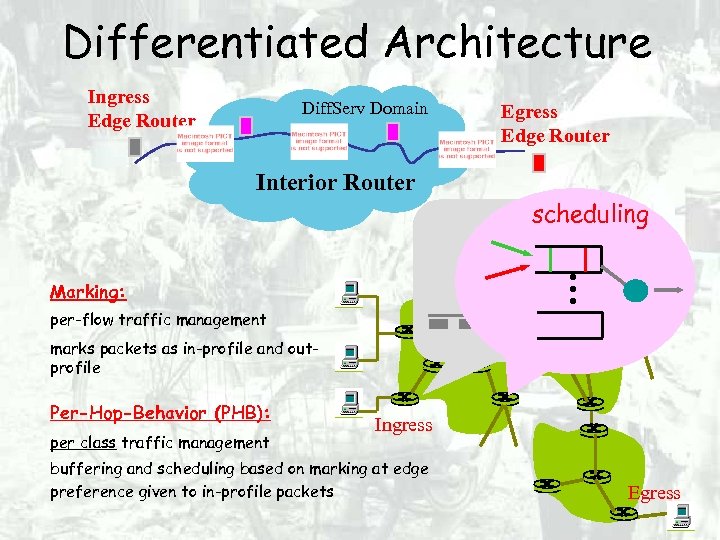 Differentiated Architecture Ingress Edge Router Diff. Serv Domain Egress Edge Router Interior Router scheduling r marking b Marking: per-flow traffic management . . . marks packets as in-profile and outprofile Per-Hop-Behavior (PHB): per class traffic management Ingress buffering and scheduling based on marking at edge preference given to in-profile packets Egress
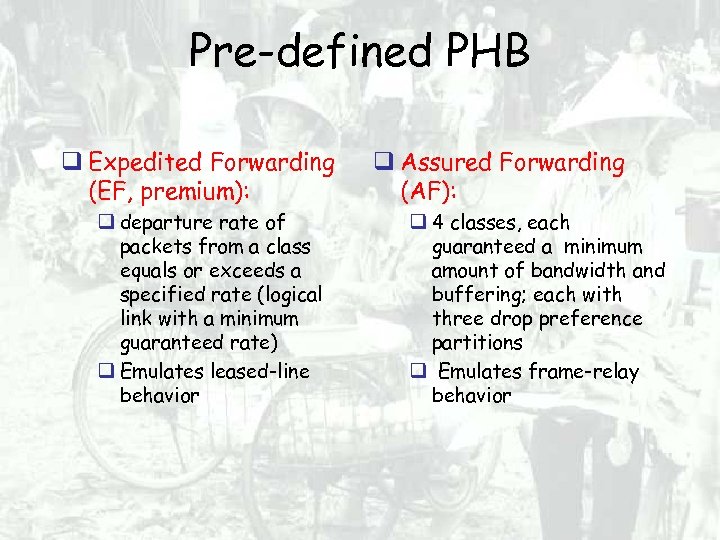 Pre-defined PHB Expedited Forwarding (EF, premium): departure rate of packets from a class equals or exceeds a specified rate (logical link with a minimum guaranteed rate) Emulates leased-line behavior Assured Forwarding (AF): 4 classes, each guaranteed a minimum amount of bandwidth and buffering; each with three drop preference partitions Emulates frame-relay behavior
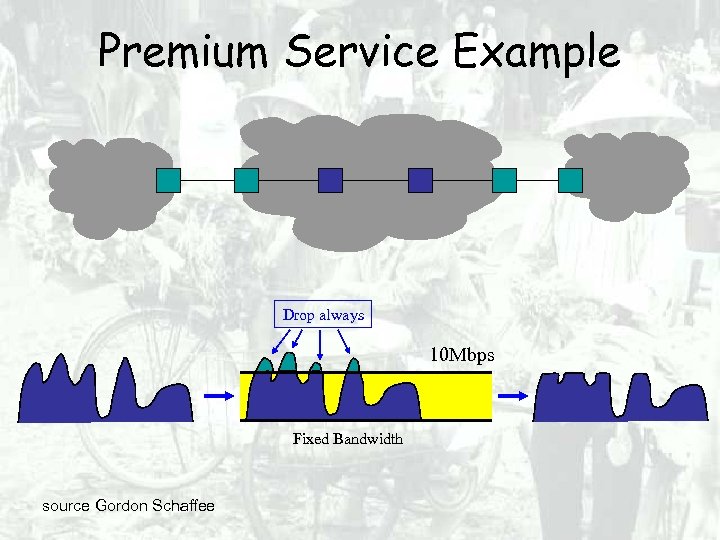 Premium Service Example Drop always 10 Mbps Fixed Bandwidth source Gordon Schaffee
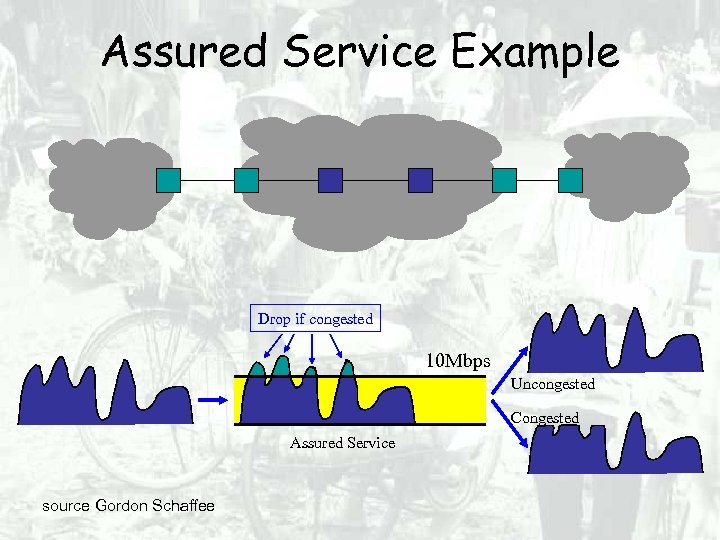 Assured Service Example Drop if congested 10 Mbps Uncongested Congested Assured Service source Gordon Schaffee
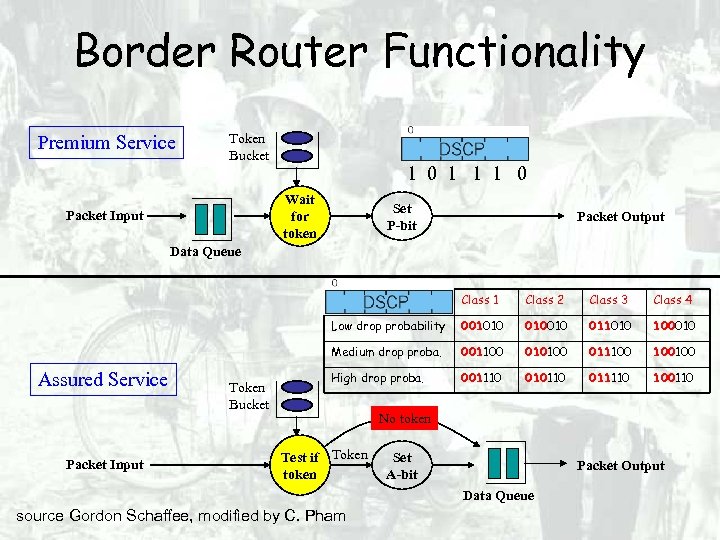 Border Router Functionality Premium Service Token Bucket 1 0 1 1 1 0 Wait for token Packet Input Set P-bit Packet Output Data Queue Class 1 Packet Input Class 4 001010 010010 011010 100010 Medium drop proba. Token Bucket Class 3 Low drop probability Assured Service Class 2 001100 010100 011100 100100 High drop proba. 001110 010110 011110 100110 No token Test if Token token Set A-bit Packet Output Data Queue source Gordon Schaffee, modified by C. Pham
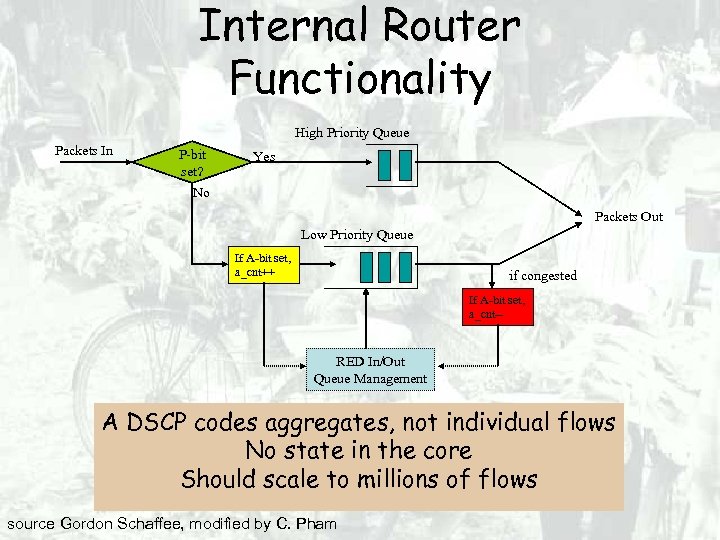 Internal Router Functionality High Priority Queue Packets In P-bit set? Yes No Packets Out Low Priority Queue If A-bit set, a_cnt++ if congested If A-bit set, a_cnt-- RED In/Out Queue Management A DSCP codes aggregates, not individual flows No state in the core Should scale to millions of flows source Gordon Schaffee, modified by C. Pham
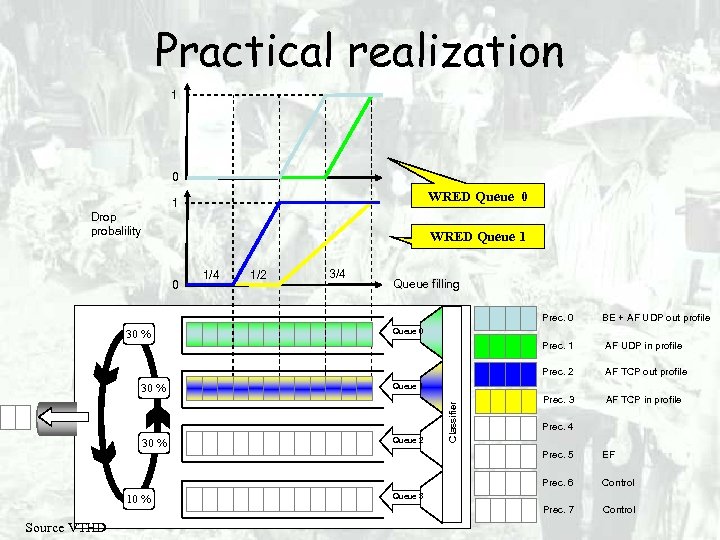 Practical realization 1 0 WRED Queue 0 1 Drop probalility WRED Queue 1 0 1/4 1/2 3/4 Queue filling Prec. 0 Prec. 1 AF UDP in profile Prec. 2 30 % BE + AF UDP out profile AF TCP out profile Prec. 3 AF TCP in profile Queue 0 Queue 1 30 % Queue 2 Classifier 30 % Prec. 4 Source VTHD EF Prec. 6 10 % Prec. 5 Control Prec. 7 Control Queue 3
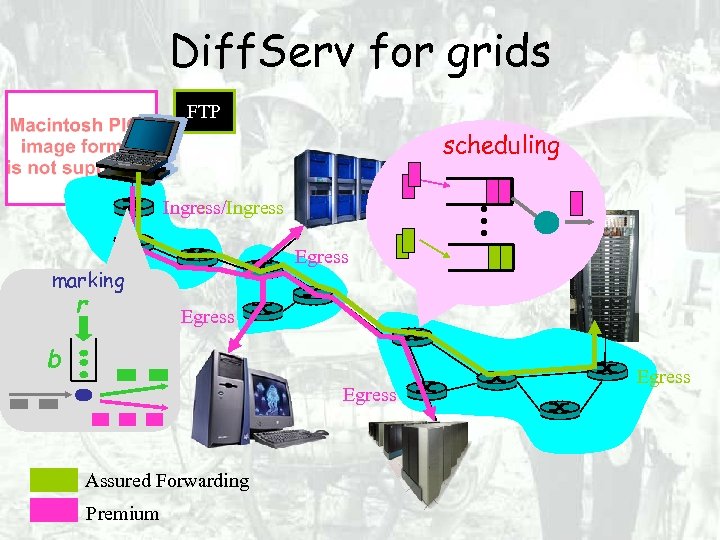 Diff. Serv for grids FTP scheduling . . . Ingress/Ingress Egress marking r Egress b Egress Assured Forwarding Premium Egress
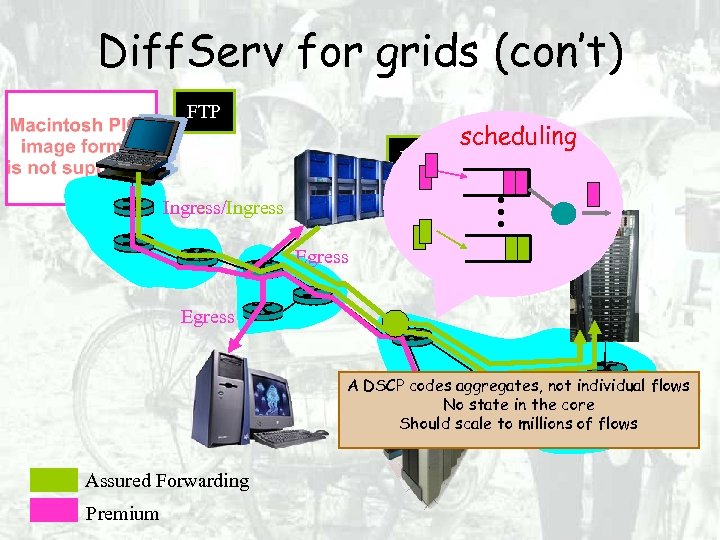 Diff. Serv for grids (con’t) FTP scheduling . . . Ingress/Ingress Egress A DSCP codes aggregates, not individual flows Egress No state in the core Should scale to millions of flows Assured Forwarding Premium
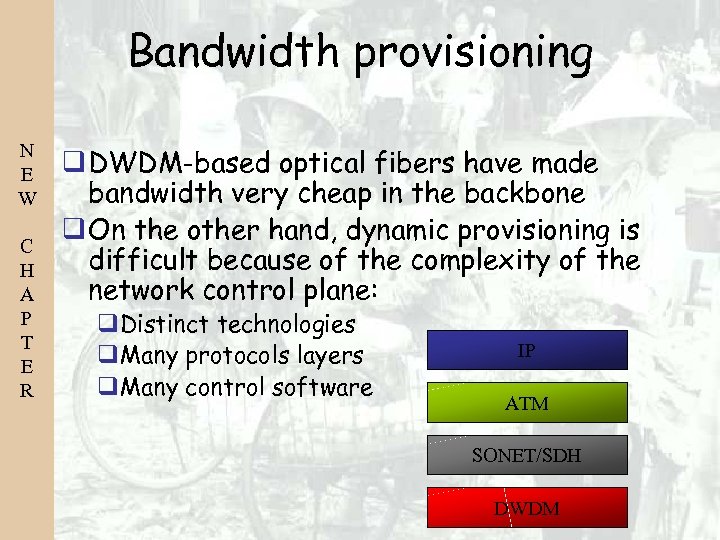 Bandwidth provisioning N E W C H A P T E R DWDM-based optical fibers have made bandwidth very cheap in the backbone On the other hand, dynamic provisioning is difficult because of the complexity of the network control plane: Distinct technologies Many protocols layers Many control software IP ATM SONET/SDH DWDM
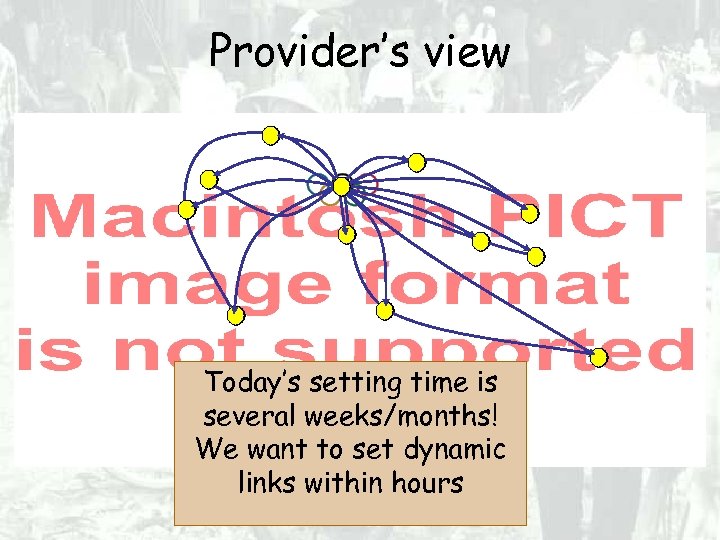 Provider’s view Today’s setting time is several weeks/months! We want to set dynamic links within hours
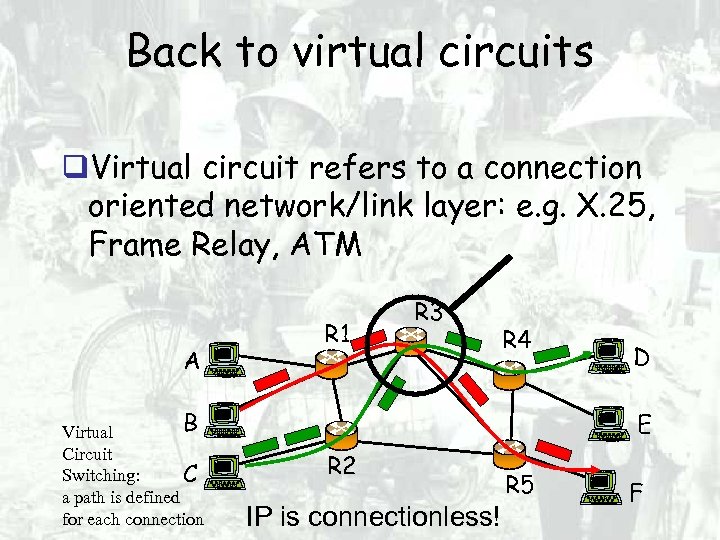 Back to virtual circuits Virtual circuit refers to a connection oriented network/link layer: e. g. X. 25, Frame Relay, ATM A B Virtual Circuit Switching: C a path is defined for each connection R 1 R 3 R 4 D E R 2 IP is connectionless! R 5 F
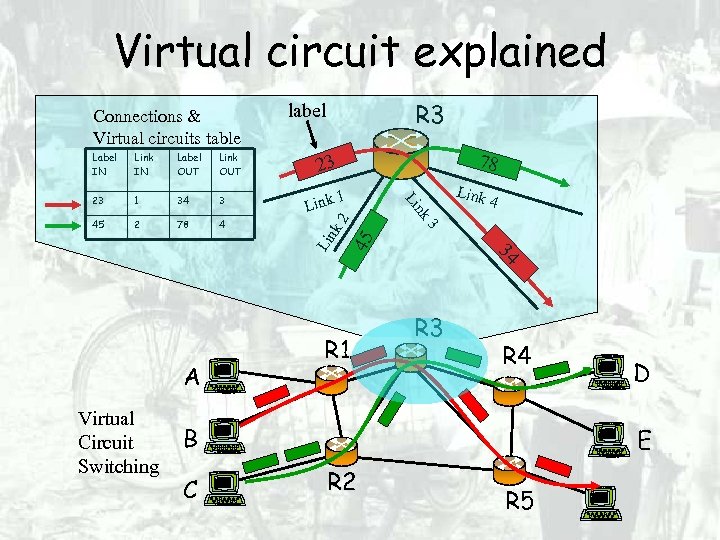 Virtual circuit explained 34 3 45 2 78 4 1 Link Virtual Circuit Switching R 1 Link 4 34 A 45 1 2 23 78 23 Li Link OUT 3 Label OUT nk Link IN Li Label IN R 3 label nk Connections & Virtual circuits table R 3 R 4 B C D E R 2 R 5
 Why virtual circuit? Initially to speed up router forwarding tasks: X. 25, Frame Relay, ATM. We’re fast enough! Now: Virtual circuits for bandwidth provisioning!
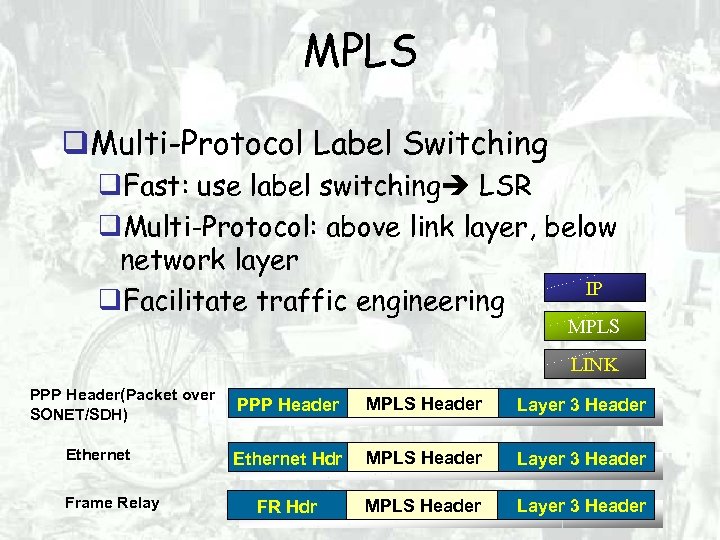 MPLS Multi-Protocol Label Switching Fast: use label switching LSR Multi-Protocol: above link layer, below network layer IP Facilitate traffic engineering MPLS LINK PPP Header(Packet over SONET/SDH) Ethernet Frame Relay PPP Header MPLS Header Layer 3 Header Ethernet Hdr MPLS Header Layer 3 Header FR Hdr MPLS Header Layer 3 Header
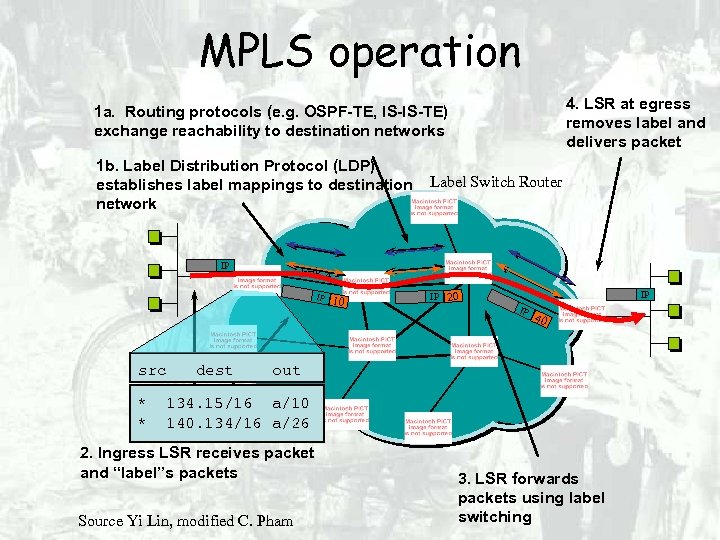 MPLS operation 4. LSR at egress removes label and delivers packet 1 a. Routing protocols (e. g. OSPF-TE, IS-IS-TE) exchange reachability to destination networks 1 b. Label Distribution Protocol (LDP) establishes label mappings to destination network IP link a IP 10 src * * dest Label Switch Router IP IP 20 IP 40 out 134. 15/16 a/10 140. 134/16 a/26 2. Ingress LSR receives packet and “label”s packets Source Yi Lin, modified C. Pham 3. LSR forwards packets using label switching
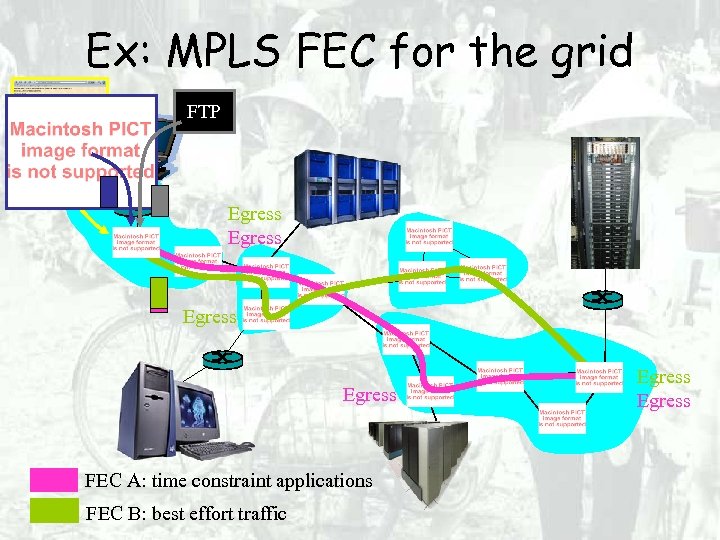
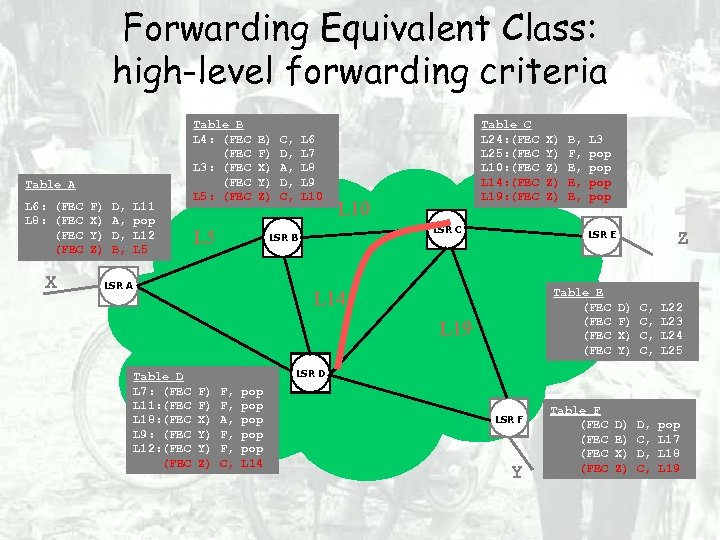 Forwarding Equivalent Class: high-level forwarding criteria Table A L 6: (FEC F) L 8: (FEC X) (FEC Y) (FEC Z) X D, A, D, B, L 11 pop L 12 L 5 Table B L 4: (FEC L 3: (FEC L 5: (FEC E) F) X) Y) Z) L 5 C, D, A, D, C, L 6 L 7 L 8 L 9 L 10 LSR C LSR B LSR A Table C L 24: (FEC L 25: (FEC L 10: (FEC L 14: (FEC L 19: (FEC B, F, E, E, E, L 3 pop pop Z LSR E Table E (FEC L 14 L 19 Table D L 7: (FEC L 11: (FEC L 18: (FEC L 9: (FEC L 12: (FEC X) Y) Z) Z) Z) D) F) X) Y) C, C, L 22 L 23 L 24 L 25 Table F (FEC D) E) X) Z) D, C, pop L 17 L 18 L 19 LSR D F) F) X) Y) Y) Z) F, F, A, F, F, C, pop pop pop L 14 LSR F Y
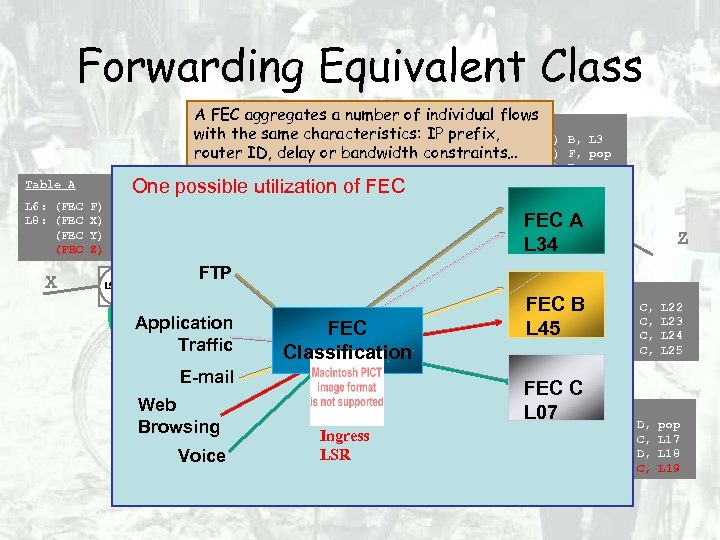 Forwarding Equivalent Class A FEC aggregates a number of individual flows Table A L 6: (FEC F) L 8: (FEC X) (FEC Y) (FEC Z) X Table B Table C with the same characteristics: IP prefix, L 4: (FEC E) C, L 6 L 24: (FEC F) D, L 7 L 25: (FEC router ID, delay or bandwidth constraints… L 3: (FEC X) A, L 8 L 10: (FEC Y) D, L 9 L 14: (FEC Pre-defined. C, L 10 establish preferential paths FEC L 5: (FEC Z) L 19: (FEC X) Y) Z) Z) Z) B, F, E, E, E, L 3 pop pop One possible utilization of FEC D, L 11 L 10 in the backbone network, thus allowing some A, pop FEC A LSR C form of traffic engineering/control. LSR E D, L 12 LSR B L 5 L 34 B, L 5 LSR A Z FTP Table E L 14 Application Traffic Table D E-mail L 7: (FEC F) F, L 11: (FEC F) F, Web L 18: (FEC X) A, Browsing L 9: (FEC Y) F, L 12: (FEC Y) F, Voice (FEC Z) C, FEC Classification LSR D pop pop pop L 14 Ingress LSR FEC B(FEC L 45 (FEC D) F) X) (FEC Y) L 19 FEC C Table F LSR FL 07 (FEC Y C, C, L 22 L 23 L 24 L 25 D) D, pop (FEC E) C, L 17 (FEC X) D, L 18 (FEC Z) C, L 19
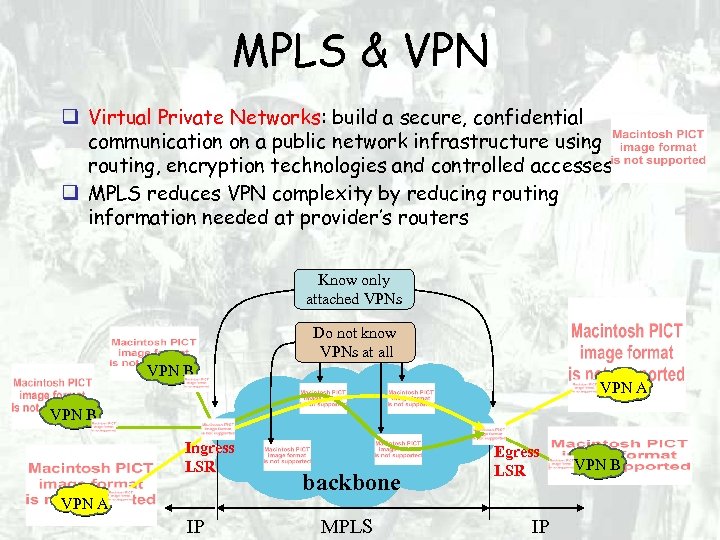 MPLS & VPN Virtual Private Networks: build a secure, confidential communication on a public network infrastructure using routing, encryption technologies and controlled accesses MPLS reduces VPN complexity by reducing routing information needed at provider’s routers Know only attached VPNs Do not know VPNs at all VPN B VPN A VPN B Ingress LSR VPN A IP backbone MPLS Egress LSR IP VPN B
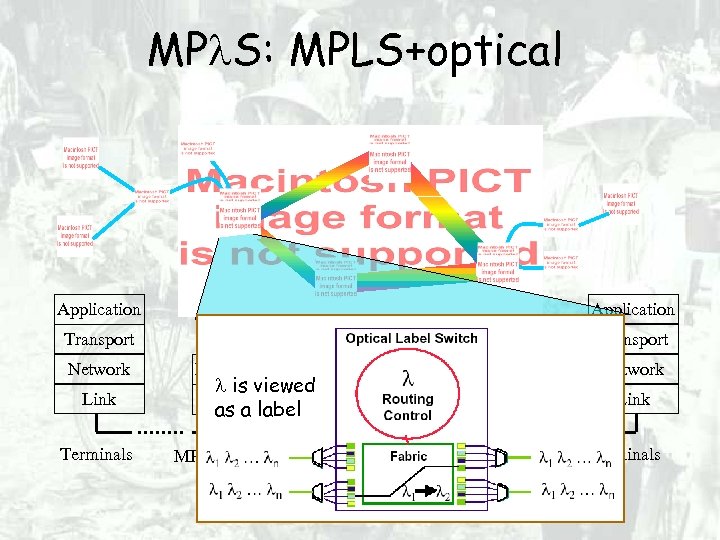 MP S: MPLS+optical Application Transport Network Link Terminals Network(IP) MP S is viewed WDM as a label MP S enabled LSR Network(IP) Network WDM Link MP S enabled LSR Source J. Wang, B. Mukherjee, B. Yoo Terminals
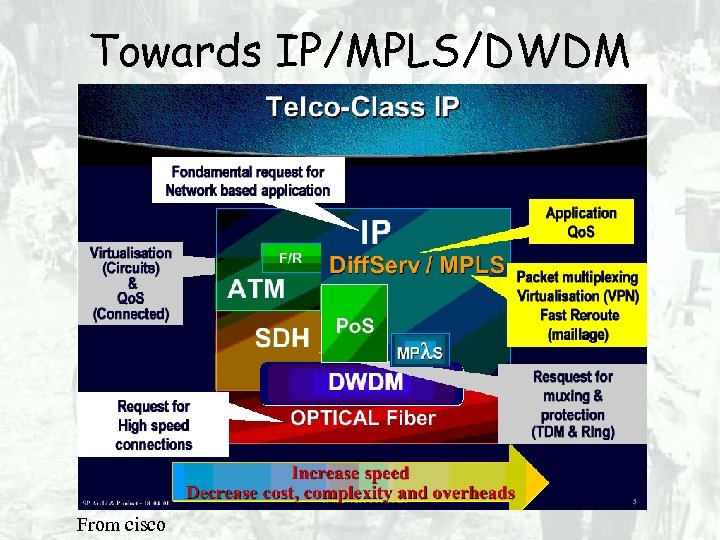 Towards IP/MPLS/DWDM From cisco
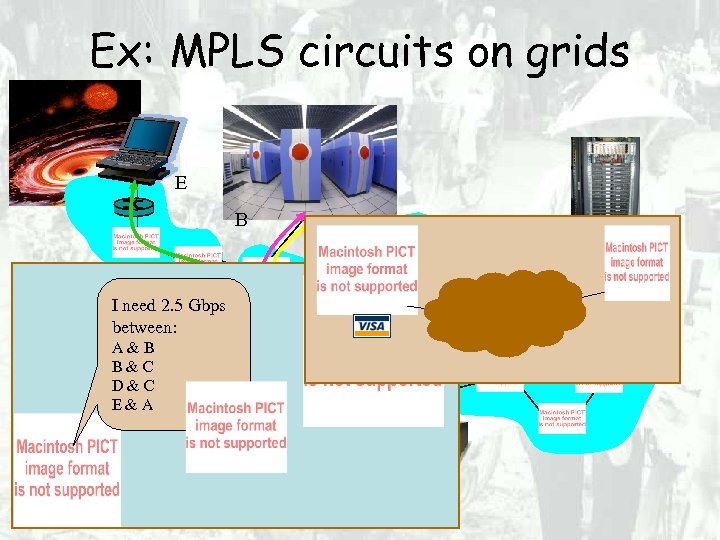 Ex: MPLS circuits on grids E B C I need 2. 5 Gbps between: A&B B&C D&C E&A A D
 Ex: MPLS FEC for the grid FTP Egress FEC A: time constraint applications FEC B: best effort traffic Egress
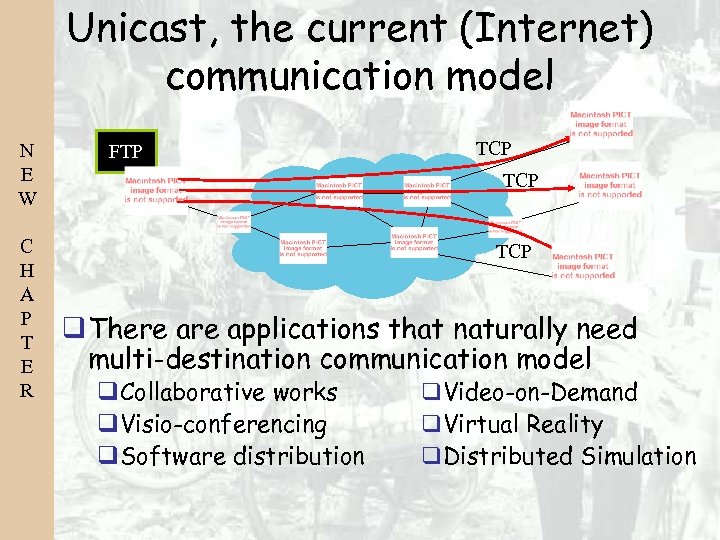 Unicast, the current (Internet) communication model N E W C H A P T E R FTP TCP TCP There applications that naturally need multi-destination communication model Collaborative works Visio-conferencing Software distribution Video-on-Demand Virtual Reality Distributed Simulation
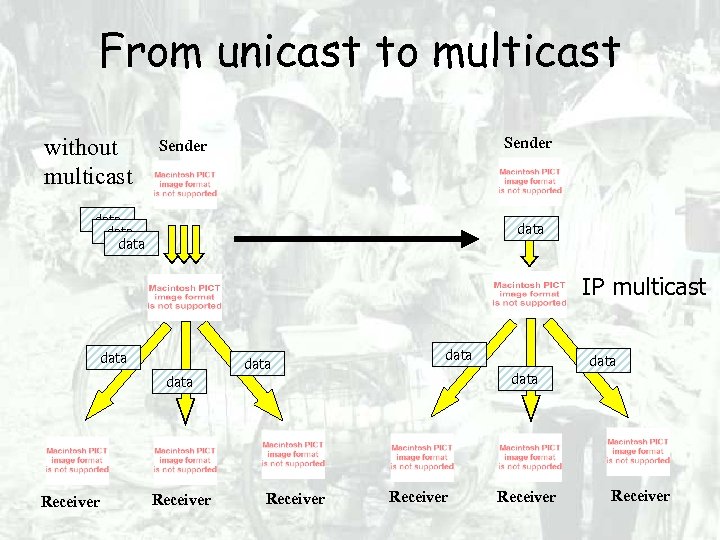 From unicast to multicast without multicast Sender data IP multicast data data Receiver Receiver
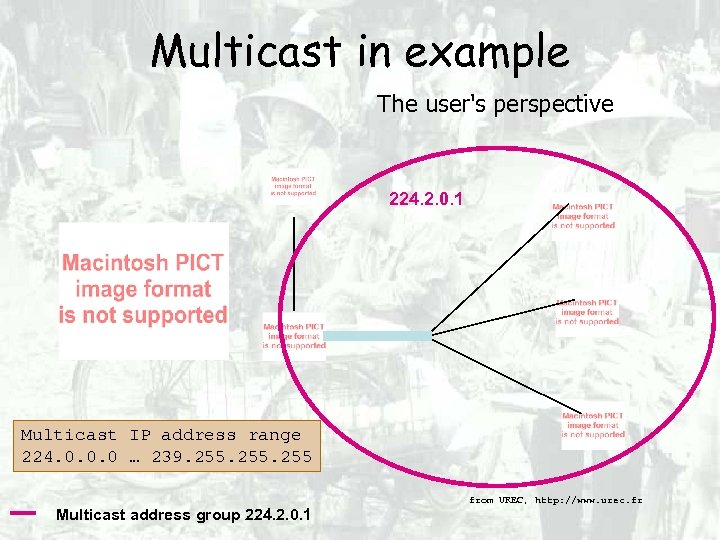 Multicast in example The user's perspective 224. 2. 0. 1 Multicast IP address range 224. 0. 0. 0 … 239. 255 Multicast address group 224. 2. 0. 1 from UREC, http: //www. urec. fr
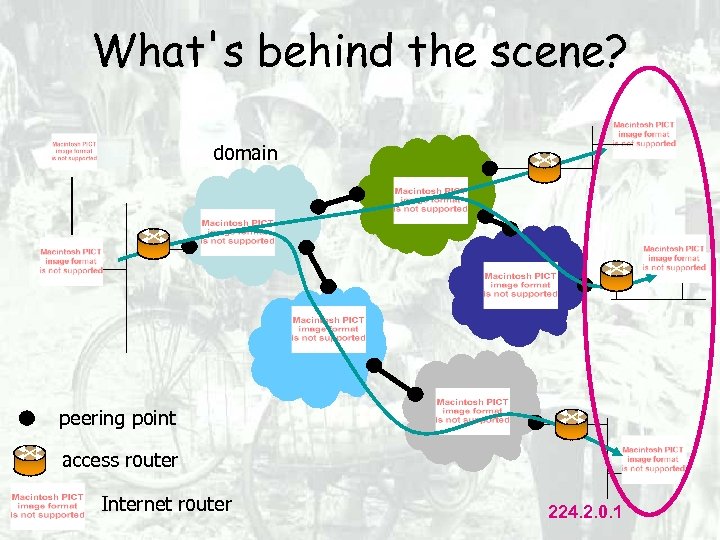 What's behind the scene? domain peering point access router Internet router 224. 2. 0. 1
 IP multicast TODO list ü Receivers must be able to subscribe to groups, need group management facilities ü A communication tree must be built from the source to the receivers ü Branching points in the tree must keep multicast state information ü Inter-domain routing must be reconsidered for multicast traffic ü Need to consider non-multicast clouds
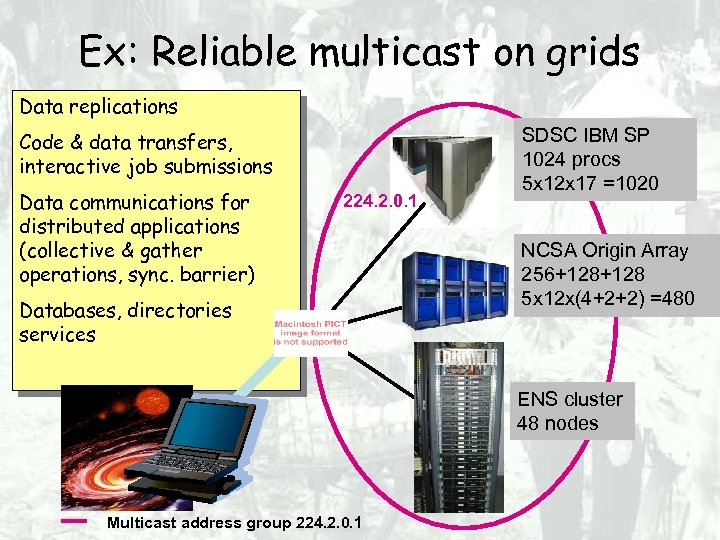 Ex: Reliable multicast on grids Data replications Code & data transfers, interactive job submissions Data communications for distributed applications (collective & gather operations, sync. barrier) 224. 2. 0. 1 Databases, directories services SDSC IBM SP 1024 procs 5 x 12 x 17 =1020 NCSA Origin Array 256+128 5 x 12 x(4+2+2) =480 ENS cluster 48 nodes Multicast address group 224. 2. 0. 1
 Conclusions There’s a lot more technologies going on that have impact on computational science Pure optical networks, broadband wireless Peer-to-Peer, Overlays Web services… The future will be all connected, all IP, anytime, anywhere, for more…
 …fun in computational sciences!! Scientist working… …it could be you!