 Скачать презентацию New Interaction Techniques Access Control Key-typing biometrics
96537cc23a8cac0be799b1714249e553.ppt
- Количество слайдов: 9



New Interaction Techniques ** Access Control Key-typing biometrics Grigori Evreinov Department of Computer Sciences University of Tampere, Finland www. cs. uta. fi/~grse/ ** http: //www. lfe. mw. tum. de/~marstaller/links. html September – December, 2003
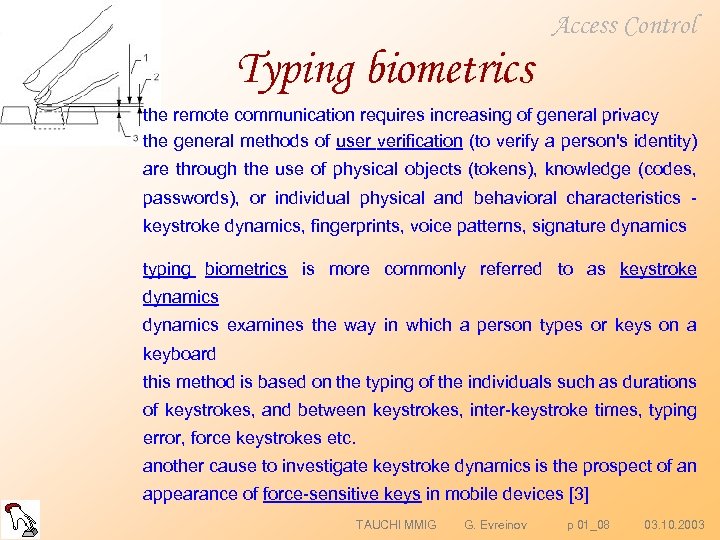
Access Control Typing biometrics the remote communication requires increasing of general privacy the general methods of user verification (to verify a person's identity) are through the use of physical objects (tokens), knowledge (codes, passwords), or individual physical and behavioral characteristics - keystroke dynamics, fingerprints, voice patterns, signature dynamics typing biometrics is more commonly referred to as keystroke dynamics examines the way in which a person types or keys on a keyboard this method is based on the typing of the individuals such as durations of keystrokes, and between keystrokes, inter-keystroke times, typing error, force keystrokes etc. another cause to investigate keystroke dynamics is the prospect of an appearance of force-sensitive keys in mobile devices [3] TAUCHI MMIG G. Evreinov p 01_08 03. 10. 2003
Access Control A Personal Authentication with Keystroke Timing Patterns Toshimitsu YAMAGUCHI, Kazuhiro Notomi, Hiroaki Ishii personal authentication can be built on features analysis of the temporal structure of user behavior authors presented a method and a prototype system based on SOM* algorithm and keystroke timing patterns as input vectors for the learning PIN – 4 numerical characters, 8 trials for creating maps 40 trials for evaluation, 7 persons the result of experiment showed the system keeps a ration of False Acceptance Rate to False Rejection Rate on the maps about 25% * Self-Organizing Maps – neural network model, which is a general unsupervised learning method for ordering high-dimensional stat. data TAUCHI MMIG G. Evreinov p 02_08 03. 10. 2003
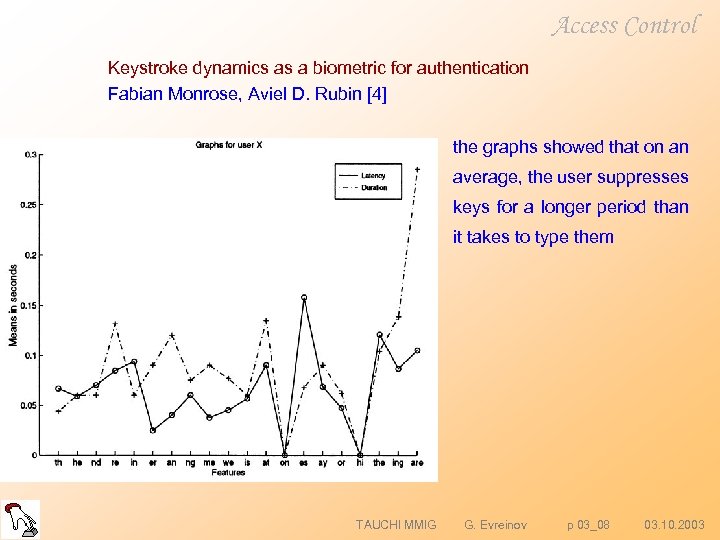
Access Control Keystroke dynamics as a biometric for authentication Fabian Monrose, Aviel D. Rubin [4] the graphs showed that on an average, the user suppresses keys for a longer period than it takes to type them TAUCHI MMIG G. Evreinov p 03_08 03. 10. 2003
Access Control Longitudinal Characteristics of Proprioceptive Memory on Keystrokes: Designing for an Enhanced Authentication System Using Pressures of Keystroke Kentaro KOTANI, Ken Horii empirical verification was demonstrated for the use of pressures of keystroke incorporated with the keystroke dynamics profile for secured authentication results revealed that multi-modal approach was more effective than the conventional authentication using keystroke latencies a numerical keypad was made such that a 5 mm-diameter force-sensitive resistor was equipped at the surface of each pad for the measurement of keystroke force TAUCHI MMIG G. Evreinov p 04_08 03. 10. 2003
![Access Control Demo [1, 2] TAUCHI MMIG G. Evreinov p 05_08 03. 10. 2003](https://present5.com/presentation/96537cc23a8cac0be799b1714249e553/image-6.jpg "Access Control Demo [1, 2] TAUCHI MMIG G. Evreinov p 05_08 03. 10. 2003")
Access Control Demo [1, 2] TAUCHI MMIG G. Evreinov p 05_08 03. 10. 2003
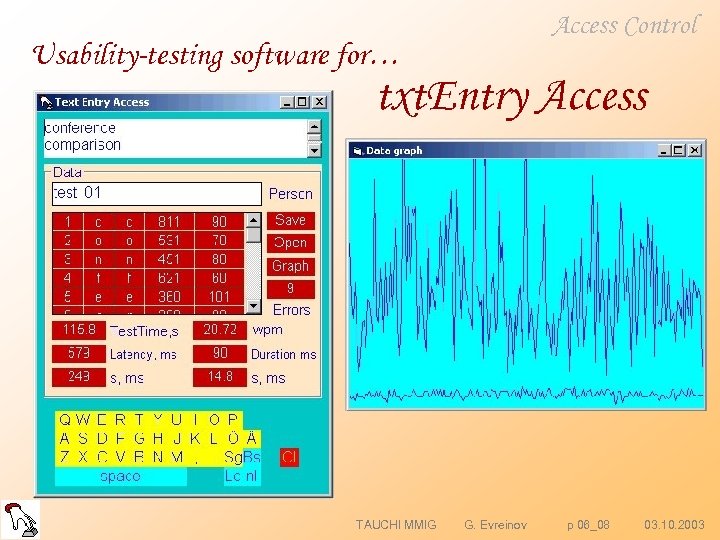
Usability-testing software for… Access Control txt. Entry Access TAUCHI MMIG G. Evreinov p 06_08 03. 10. 2003
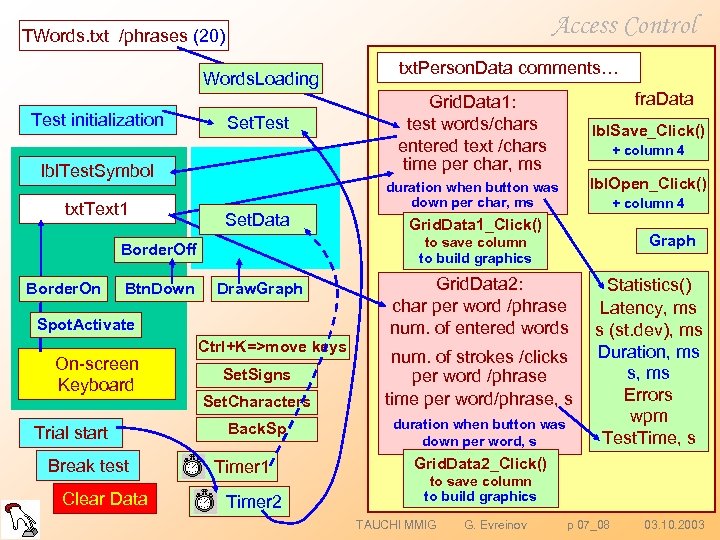
Access Control TWords. txt /phrases (20) Words. Loading Test initialization Set. Test lbl. Test. Symbol txt. Text 1 Set. Data Btn. Down Draw. Graph Spot. Activate On-screen Keyboard Trial start Break test Clear Data Grid. Data 1: test words/chars entered text /chars time per char, ms duration when button was down per char, ms fra. Data lbl. Save_Click() + column 4 lbl. Open_Click() + column 4 Grid. Data 1_Click() Graph to save column to build graphics Border. Off Border. On txt. Person. Data comments… Ctrl+K=>move keys Set. Signs Set. Characters Back. Sp Timer 1 Timer 2 Grid. Data 2: char per word /phrase num. of entered words num. of strokes /clicks per word /phrase time per word/phrase, s duration when button was down per word, s Statistics() Latency, ms s (st. dev), ms Duration, ms s, ms Errors wpm Test. Time, s Grid. Data 2_Click() to save column to build graphics TAUCHI MMIG G. Evreinov p 07_08 03. 10. 2003
![Access Control References [1] Bio. Password FAQ, http: //www. lfca. net/bp_faq. htm http: //www.](https://present5.com/presentation/96537cc23a8cac0be799b1714249e553/image-9.jpg "Access Control References [1] Bio. Password FAQ, http: //www. lfca. net/bp_faq. htm http: //www.")
Access Control References [1] Bio. Password FAQ, http: //www. lfca. net/bp_faq. htm http: //www. biopassword. com/home/technology/biometrics. asp or http: //www. cs. uta. fi/~grse/NIT_2003/NIT_Practice/Access. Control/Software/biodemo. zip [2] BP-127 Bio. Password Logon Protection v 4. 5 http: //www. lfca. net/bp_127. htm http: //www. biopassword. com/home/technology/BP%204. 5%20 Technical%20 Paper. pdf http: //www. biopassword. com/home/products/BP_SDK 2. 0_021502. pdf [3] New opportunities with flat sensors http: //www. tech 21. de/en/sensor. html [4] Monrose, F. , Rubin, A. D. Keystroke dynamics as a biometric for authentication. Future Generation Computer Systems 16 (2000) 351– 359 http: //citeseer. nj. nec. com/monrose 99 keystroke. html http: //citeseer. nj. nec. com/monrose 97 authentication. html [5] e. Pad™ electronic signature tablets, http: //www. steadlands. com/epad. htm [6] Pressure Sensing Technology, http: //www. steadlands. com/pst. htm [7] Mascaro, S. A. and Asada, H. H. Photoplethysmograph Fingernail Sensors for Measuring Finger Forces Without Haptic Obstruction. IEEE Transactions on Robotics and Automation, 17 (5), October 2001 [8] An introduction to biometrics. http: //www. biometrics. org/html/introduction. html TAUCHI MMIG G. Evreinov p 08_08 03. 10. 2003
Скачать презентацию New Interaction Techniques Access Control Key-typing biometrics
96537cc23a8cac0be799b1714249e553.ppt