


 Скачать презентацию New Framework for the Progressive Development of Staff
8c4f2b3274a0cb9ccb9e424d38ac3b17.ppt
- Количество слайдов: 11
 New Framework for the Progressive Development of Staff with respect to Education Shelley Parr s. j. parr@soton. ac. uk Ian Giles, Andrew Gravell, Judith Holloway, Athina Vlachantoni & Paul Riddy Framework based upon original version developed by Denis Berthiaume and Mary Morrison 1
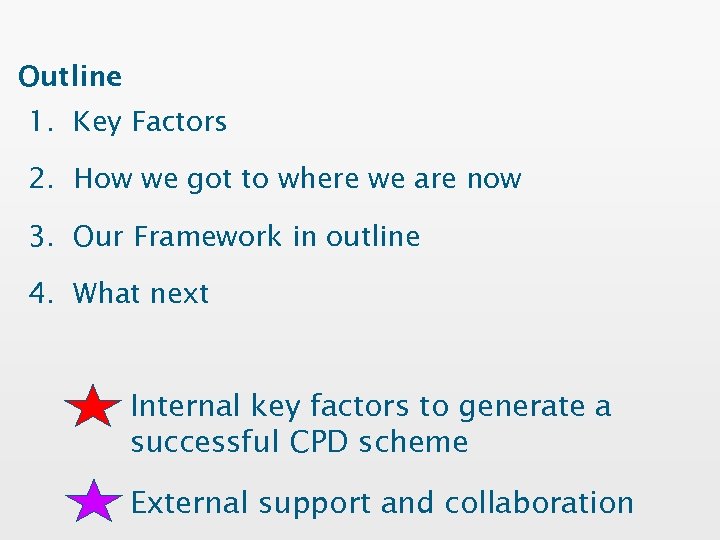 Outline 1. Key Factors 2. How we got to where we are now 3. Our Framework in outline 4. What next § Internal key factors to generate a successful CPD scheme § External support and collaboration
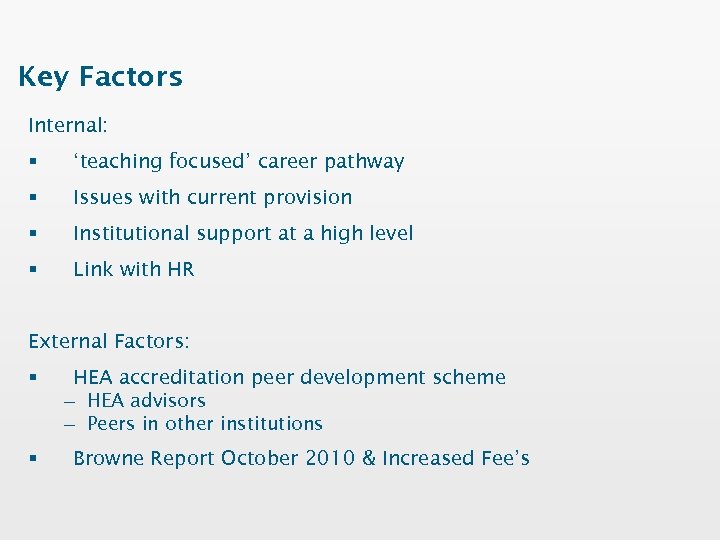 Key Factors Internal: § ‘teaching focused’ career pathway § Issues with current provision § Institutional support at a high level § Link with HR External Factors: § § HEA accreditation peer development scheme – HEA advisors – Peers in other institutions Browne Report October 2010 & Increased Fee’s
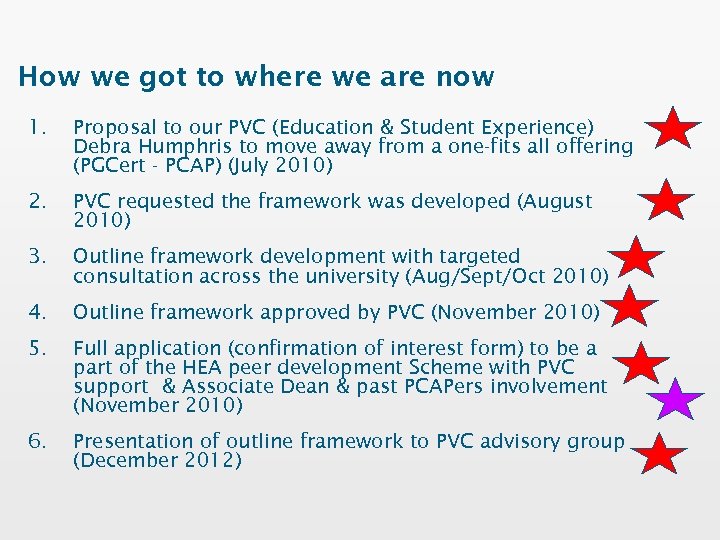 How we got to where we are now 1. Proposal to our PVC (Education & Student Experience) Debra Humphris to move away from a one-fits all offering (PGCert - PCAP) (July 2010) 2. PVC requested the framework was developed (August 2010) 3. Outline framework development with targeted consultation across the university (Aug/Sept/Oct 2010) 4. Outline framework approved by PVC (November 2010) 5. Full application (confirmation of interest form) to be a part of the HEA peer development Scheme with PVC support & Associate Dean & past PCAPers involvement (November 2010) 6. Presentation of outline framework to PVC advisory group (December 2012)
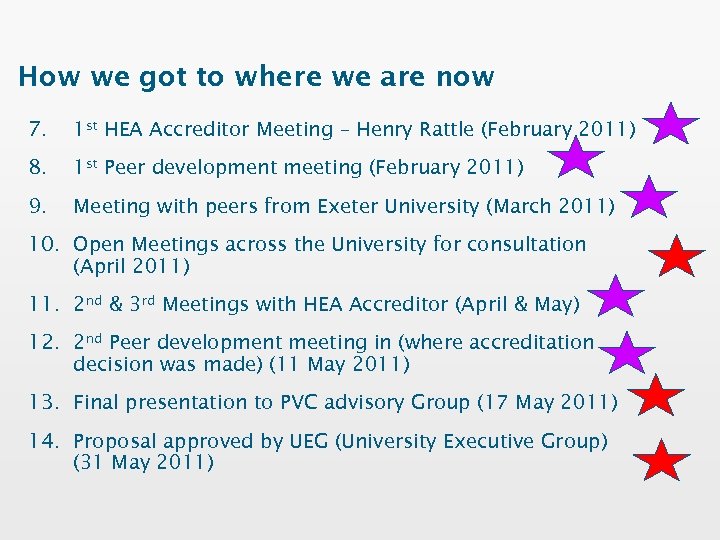 How we got to where we are now 7. 1 st HEA Accreditor Meeting – Henry Rattle (February 2011) 8. 1 st Peer development meeting (February 2011) 9. Meeting with peers from Exeter University (March 2011) 10. Open Meetings across the University for consultation (April 2011) 11. 2 nd & 3 rd Meetings with HEA Accreditor (April & May) 12. 2 nd Peer development meeting in (where accreditation decision was made) (11 May 2011) 13. Final presentation to PVC advisory Group (17 May 2011) 14. Proposal approved by UEG (University Executive Group) (31 May 2011)
 CPD Framework at Southampton 1. A guide to developing and evidencing CPD education in using the UKPSF. 2. Directly and explicitly mapped to the UKPSF. 3. HEA accreditedat SD levels 1, 2 & 3 currently and hopefully 4 in future 4. HEA accredited in 2011 via HEA peer development CPD accreditation programme 2010/11
 Principles of the Framework 1. 2. 3. 4. Everyone educating our students should be suitably trained to undertake the role asked of them and they should be able to evidence their competence and commitment to achieving an excellent student learning experience. ‘Educating our students’ includes any activity supporting UG, PGT & PGR students their student learning in experience, and any educator from PGRs through to the VC. The required training and competence is based on the role, responsibilities and experience each individual. of The framework should map to externally recognised reference points (i. e. the UK Professional Standards Framework – the UKPSF ).
 Principles of the Framework 5. 6. 7. 8. It should be possible to develop and evidence knowledge and skills through a variety of routes including practicebased activities and completing appropriate courses. Skills may not need to be demonstrated at Masters Level for all staff (although the option to demonstrate skills at this level will be made available to all staff). Requirements will be made throughout a career as appropriate. HR processes and policies will be aligned with this frameworke. g. induction probation, PPDR and promotion.
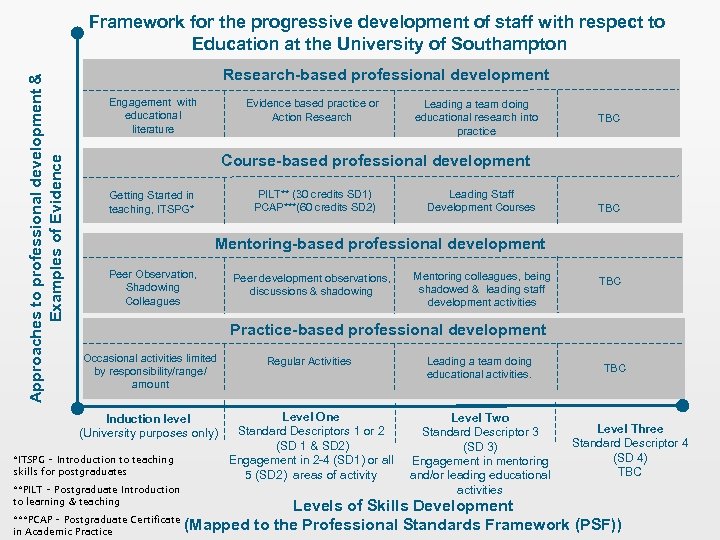 Approaches to professional development & Examples of Evidence Framework for the progressive development of staff with respect to Education at the University of Southampton Research-based professional development Engagement with educational literature Evidence based practice or Action Research Leading a team doing educational research into practice TBC Course-based professional development PILT** (30 credits SD 1) PCAP***(60 credits SD 2) Getting Started in teaching, ITSPG* Leading Staff Development Courses TBC Mentoring-based professional development Peer Observation, Shadowing Colleagues Peer development observations, discussions & shadowing Mentoring colleagues, being shadowed & leading staff development activities TBC Practice-based professional development Occasional activities limited by responsibility/range/ amount Regular Activities Leading a team doing educational activities. Induction level (University purposes only) Level One Standard Descriptors 1 or 2 (SD 1 & SD 2) Engagement in 2 -4 (SD 1) or all 5 (SD 2) areas of activity Level Two Standard Descriptor 3 (SD 3) Engagement in mentoring and/or leading educational activities *ITSPG – Introduction to teaching skills for postgraduates **PILT – Postgraduate Introduction to learning & teaching ***PCAP – Postgraduate Certificate in Academic Practice TBC Level Three Standard Descriptor 4 (SD 4) TBC Levels of Skills Development (Mapped to the Professional Standards Framework (PSF))
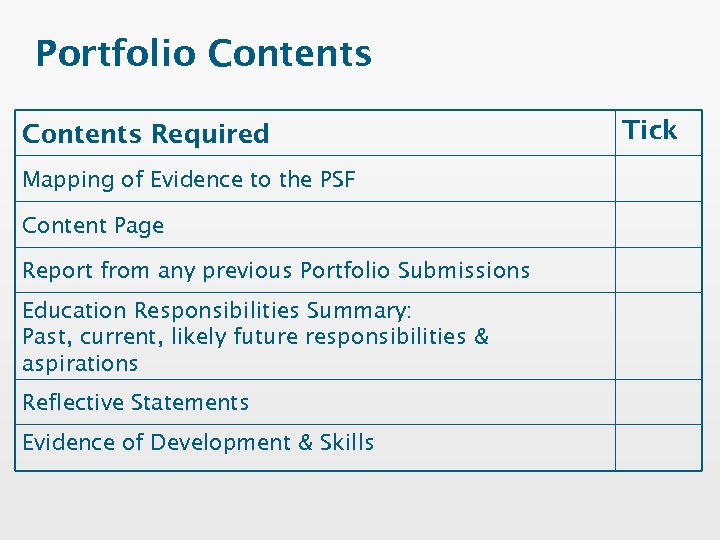 Portfolio Contents Required Mapping of Evidence to the PSF Content Page Report from any previous Portfolio Submissions Education Responsibilities Summary: Past, current, likely future responsibilities & aspirations Reflective Statements Evidence of Development & Skills Tick
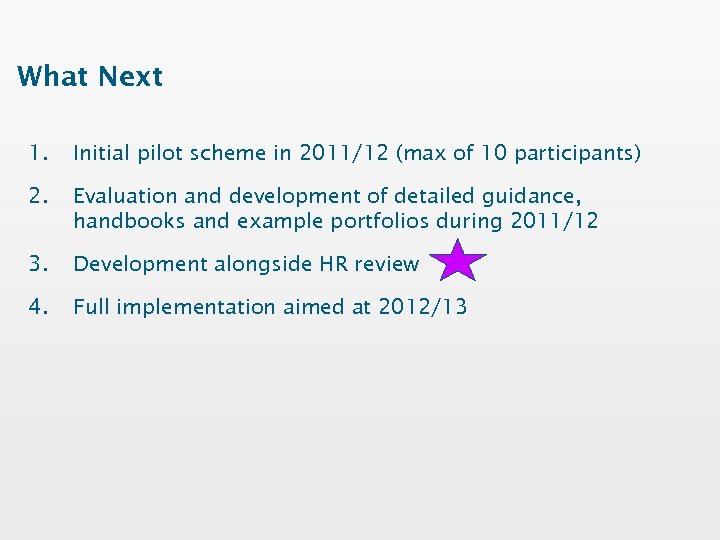 What Next 1. Initial pilot scheme in 2011/12 (max of 10 participants) 2. Evaluation and development of detailed guidance, handbooks and example portfolios during 2011/12 3. Development alongside HR review 4. Full implementation aimed at 2012/13