 Скачать презентацию New forms of funding The Non-Profit Distributing
e8fd01d1b2ab8ff96c2f2d58afea9d31.ppt
- Количество слайдов: 13



New forms of funding – The Non-Profit Distributing Model Simon Mc. Cann (Partner, Projects)
NPD – not all that new! • Developed in Scotland 2008 (and before) • Over 20 schemes since (further education, health, transport) • Welsh Assembly Finance Committee report into alternatives to PFI/PPP 2008/9 – considered range of models - NPD was one of recommendations • Model is therefore relatively tried and tested and wellunderstood by funders and infrastructure companies 2
What is NPD? • Similar risk profile and structure to “traditional” PFI/PPP • BUT capped return to private sector (competed) • Operating surpluses returned to public sector or reinvested – no distribution to equity shareholders • Enhanced control / stakeholder involvement in management of the project • Similarities to PFI/PPP in whole-life costing, maintenance cycle planning, performance based service payments, single point of delivery 3
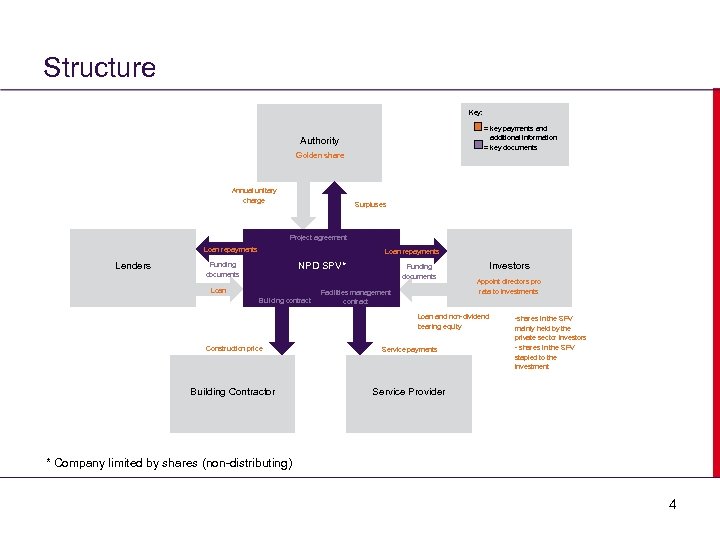
Structure Key: = key payments and additional information = key documents Authority Golden share Annual unitary charge Surpluses Project agreement Loan repayments Lenders Loan repayments NPD SPV* Funding documents Loan Building contract Funding documents Facilities management contract Investors Appoint directors pro rata to investments Loan and non-dividend bearing equity Construction price Service payments Building Contractor -shares in the SPV mainly held by the private sector investors - shares in the SPV stapled to the investment Service Provider * Company limited by shares (non-distributing) 4
Governance • Ownership and control rests with those whose lending is at risk – i. e. junior lenders • “Public Interest Director” – appointed by Scottish Futures Trust (arm of Scottish Government) – not the authority – Compliance with good governance and NPD principles – Independent view – Re-financing opportunities and efficiency savings (nondistribution reduces incentive on shareholders to do this) • “Golden share”- held by authority - veto over certain key strategic areas 5
Welsh projects • Various announcements Mar – Sept 2015 – Welsh Government committed to using NPD for three projects – – Velindre Cancer Centre (£ 210 M) – A 465 “Heads of Valleys” dualling – 21 st Century Schools 6
What went wrong? • July 2015 - ONS classification of Aberdeen Western Peripheral Route as “on balance sheet” – i. e. publicowned asset rather than private • Effects – – capital spend on asset has to be taken into account against capital budget – reduces overall amount available (devolved government, NHS) – capital charges against revenue budget • Chilling effect on NPD 7
What were the reasons for ONS’ decision? • Specific to AWPR - but created general issues for NPD that need to be addressed • “Golden share” – degree of control over project indicated public ownership • 100% of surpluses went back to public sector (early NPD projects – surpluses went to charity or reinvested) – indicated ownership of rewards of project 8
How can we get round this? • Need to focus on reducing level of public control (whilst keeping key NPD benefit of stakeholder involvement); and • Reducing public sector share of surpluses – possibly returning to passing to charity or reinvestment in project 9
Scottish Hub solution • Scottish “Hub” model (smaller community-based NPD projects, design/build/finance/manage) accepted by ONS in November 2015 as being off balance sheet. Shared ownership of SPV – – – 60% private sector 20% charity 10% Scottish Futures Trust 10% procuring authority • Welsh Government liaising with SFT re: solution for Velindre – business case approval currently pending 10
Does Brexit affect any of this? • General impact on investor confidence – only time will tell. Much depends on Autumn Statement • ESA 10 accounting rules re: public/private sector classification – will remain in force until Brexit happens (at least 3 years). Many countries outside EU have similar standards so unlikely to change significantly • Procurement – major infrastructure projects notoriously slow & expensive to procure. Rules will stay same until Brexit happens and then international obligations (WTO) require us to have some form of transparent public procurement – so again, little likely to change • Though NB greater flexibility under Public Contracts Regulations 2015 – particularly competitive negotiated procedure – may speed things up / cut cost, depending on how authorities use it 11
Some alternatives (particularly for HE sector) • “Off balance sheet” treatment not as much of a concern for Universities. Wider scope to consider other methods • “Asset backed” or “pension fund” route – e. g. Aberystwyth University £ 40 M accommodation PPP with Balfour Beatty – freehold land transferred to lender, leaseback for service period • Bond issue – e. g. Cardiff University £ 300 million, 3%, due 2055. “General” purposes, so not limited to specific projects. 12
The Non-Profit Distributing Model – Questions? Simon Mc. Cann (Partner, Projects) simon. mccann@blakemorgan. co. uk DD: 029 20 686146 Mob: 07795 968750
Скачать презентацию New forms of funding The Non-Profit Distributing
e8fd01d1b2ab8ff96c2f2d58afea9d31.ppt