


 Скачать презентацию New Directions in Software Testing Automation Test Oracle
fed823695d26f2bbc789d55ea0486860.ppt
- Количество слайдов: 55
 New Directions in Software Testing Automation, Test Oracle Design, and Safety Assessment Mikhail Auguston Computer Science Department Naval Postgraduate School, Monterey, California maugusto@nps. edu
 Software testing is a challenge… FThe goal of testing is to expose yet undiscovered errors. A successful test is one that “catches” an error… FTesting cannot prove the correctness of a software; it can only demonstrate the presence of a bug… Example: a program that is intended to check the equality of three input numbers. if (a + b + c)/3 == a then print “equal” else print “not equal” FExhaustive testing is practically unfeasible (the number of executable paths may be astronomic) FTesting and debugging of a software system requires more than 50% of total time and effort (Brooks’ rule) 2
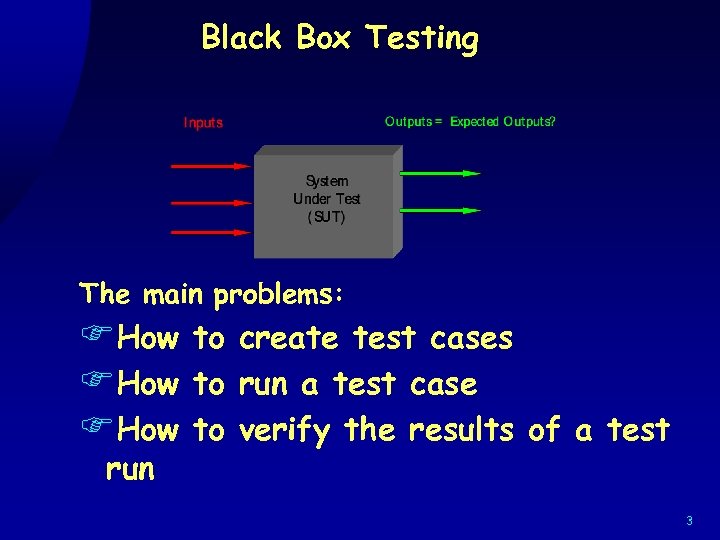 Black Box Testing The main problems: FHow to create test cases FHow to run a test case FHow to verify the results of a test run 3
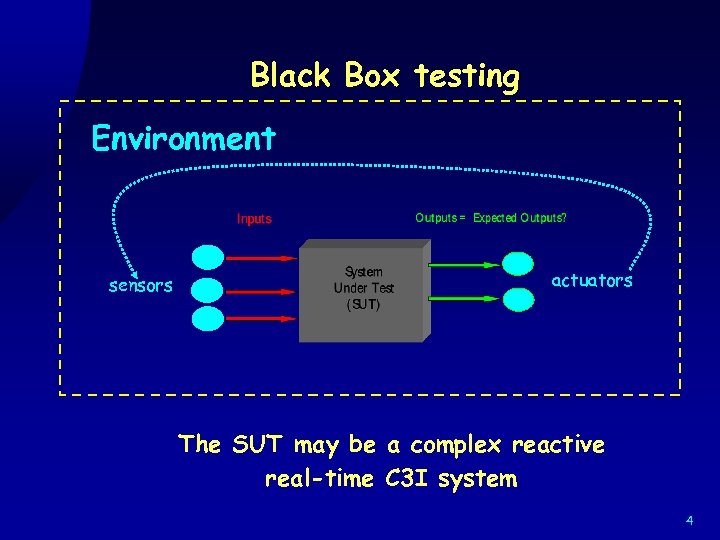 Black Box testing Environment sensors actuators The SUT may be a complex reactive real-time C 3 I system 4
 Outlook of this presentation Chapter 1. Automated test generation based on environment models (How to create test cases) Chapter 2. Software safety assessment Chapter 3. Implementation (How to run a test case) Chapter 4. Program monitoring and test oracles (How to verify the results of a test run) 5
 Chapter 1 Automated test generation based on environment models (How to create test cases) 6
 Testing methodology F Test cases should be carefully designed using “white box” (e. g. , branch coverage) or “black box” (e. g. , equivalence partition, boundary conditions) methods. This is like “sharp-shooting” for bugs… F Test cases may be generated at random. This is like a “machine gun” approach… FWe suggest an “intelligent” random generation based on the environment models. It is best suited for a very special class of programs: reactive and real-time. These programs are of special interest for Do. D-related applications. 7
 The model of environment (a novel approach to behavior modeling) An event is any detectable action that is executed in the “black box” environment ¨ An event is a time interval ¨ An event has attributes; e. g. , type, timing attributes, etc. ¨ There are two basic relations for events: precedence and inclusion ¨ The behavior of environment can be represented as a set of events (event trace) 8
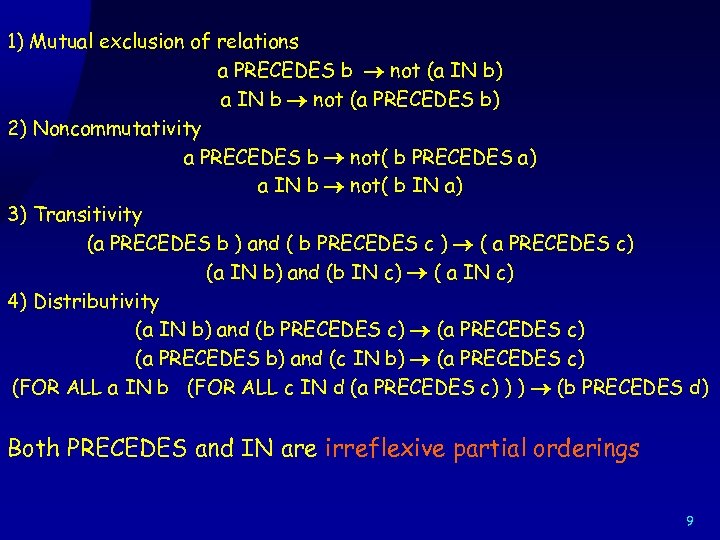 1) Mutual exclusion of relations a PRECEDES b not (a IN b) a IN b not (a PRECEDES b) 2) Noncommutativity a PRECEDES b not( b PRECEDES a) a IN b not( b IN a) 3) Transitivity (a PRECEDES b ) and ( b PRECEDES c ) ( a PRECEDES c) (a IN b) and (b IN c) ( a IN c) 4) Distributivity (a IN b) and (b PRECEDES c) (a PRECEDES c) (a PRECEDES b) and (c IN b) (a PRECEDES c) (FOR ALL a IN b (FOR ALL c IN d (a PRECEDES c) ) ) (b PRECEDES d) Both PRECEDES and IN are irreflexive partial orderings 9
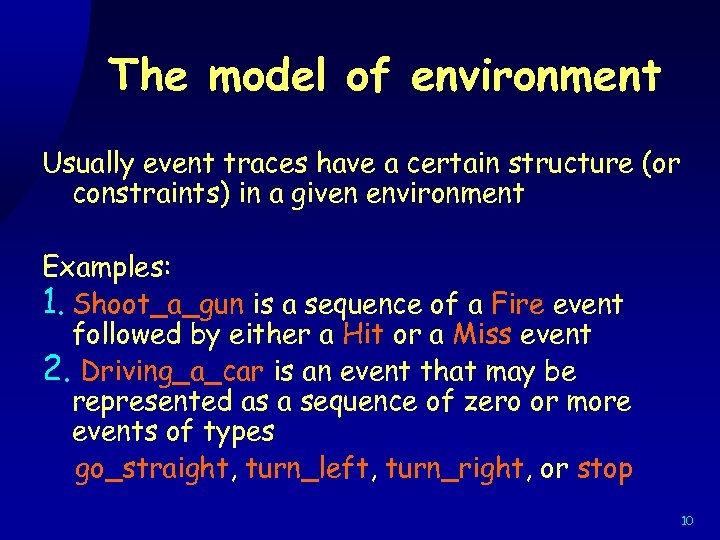 The model of environment Usually event traces have a certain structure (or constraints) in a given environment Examples: 1. Shoot_a_gun is a sequence of a Fire event followed by either a Hit or a Miss event 2. Driving_a_car is an event that may be represented as a sequence of zero or more events of types go_straight, turn_left, turn_right, or stop 10
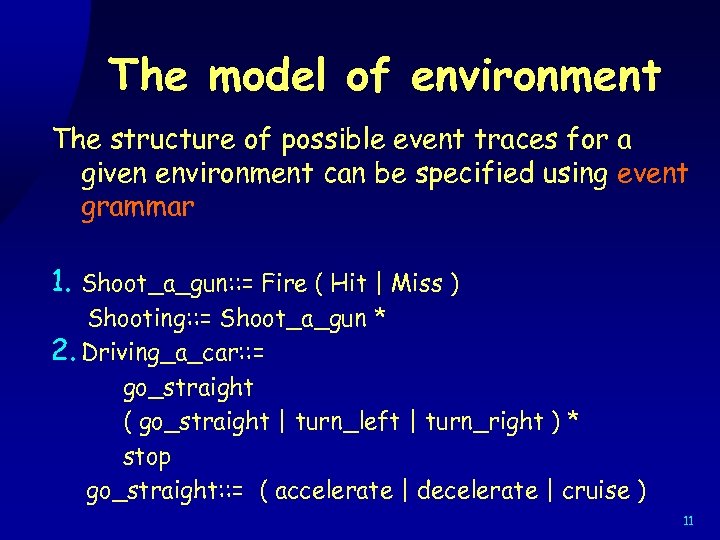 The model of environment The structure of possible event traces for a given environment can be specified using event grammar 1. Shoot_a_gun: : = Fire ( Hit | Miss ) Shooting: : = Shoot_a_gun * 2. Driving_a_car: : = go_straight ( go_straight | turn_left | turn_right ) * stop go_straight: : = ( accelerate | decelerate | cruise ) 11
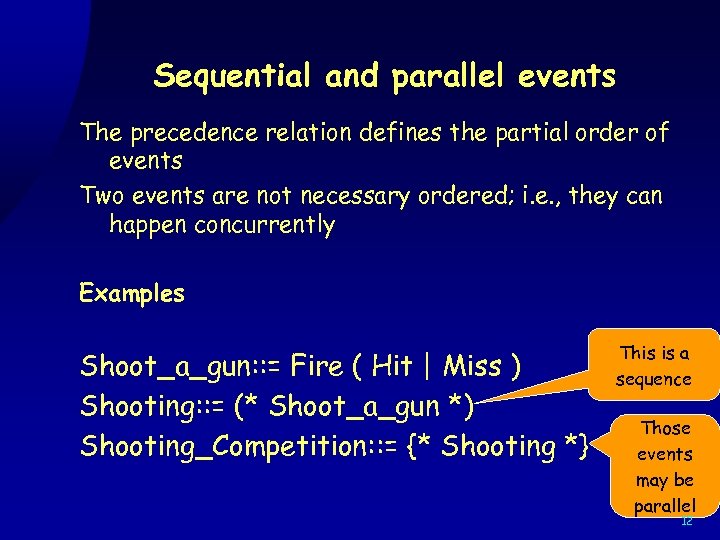 Sequential and parallel events The precedence relation defines the partial order of events Two events are not necessary ordered; i. e. , they can happen concurrently Examples Shoot_a_gun: : = Fire ( Hit | Miss ) Shooting: : = (* Shoot_a_gun *) Shooting_Competition: : = {* Shooting *} This is a sequence Those events may be parallel 12
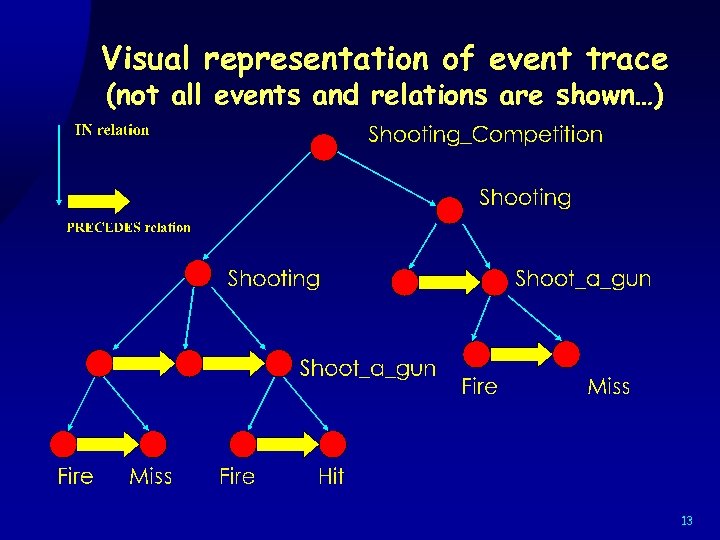 Visual representation of event trace (not all events and relations are shown…) 13
![Event attributes Shoot_a_gun: : = Fire (Hit /Shoot_a_gun. points = Rand[1. . 10]; ENCLOSING](https://present5.com/presentation/fed823695d26f2bbc789d55ea0486860/image-14.jpg "Event attributes Shoot_a_gun: : = Fire (Hit /Shoot_a_gun. points = Rand[1. . 10]; ENCLOSING") Event attributes Shoot_a_gun: : = Fire (Hit /Shoot_a_gun. points = Rand[1. . 10]; ENCLOSING Shooting. points += Shoot_a_gun. points; / | Miss /Shoot_a_gun. points = 0; /) Shooting: : = / Shooting. points = 0; / (* Shoot_a_gun /Shooting. ammo -=1; / *) While (Shooting. ammo > 0) Shooting_Competition : : = /num = 0; / {* /Shooting. id = num++; Shooting. ammo =10; / Shooting *} (Rand[2. . 100]) 14
Event attributes Shoot_a_gun: : = Fire (Hit /Shoot_a_gun. points = Rand[1. . 10]; ENCLOSING Shooting. points += Shoot_a_gun. points; / | Miss /Shoot_a_gun. points = 0; /) Shooting: : = / Shooting. points = 0; / (* Shoot_a_gun /Shooting. ammo -=1; / *) While (Shooting. ammo > 0) Shooting_Competition : : = /num = 0; / {* /Shooting. id = num++; Shooting. ammo =10; / Shooting *} (Rand[2. . 100]) 14
 Production grammars FAttribute event grammars (AEG) are intended to be used as a vehicle for automated random event trace generation FIt is assumed that the AEG is traversed top-down and left-to-right and only once to produce a particular event trace FRandomized decisions about what alternative to take and how many times to perform the iteration should be made during the trace generation FAttribute values are evaluated during this traversal 15
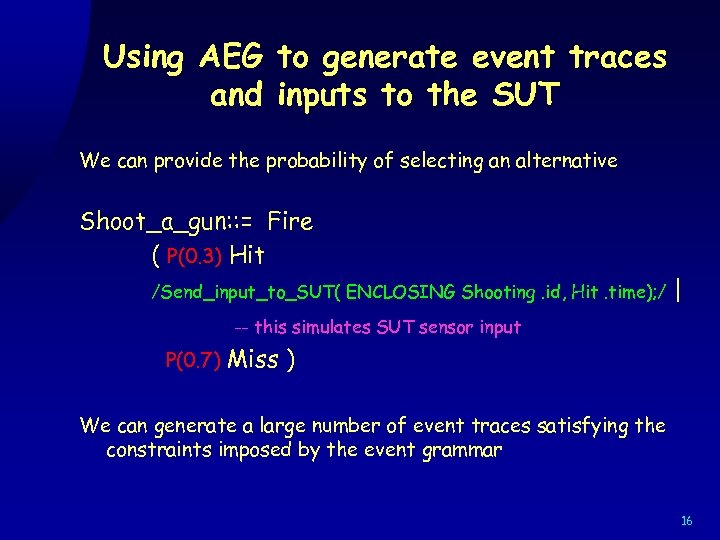 Using AEG to generate event traces and inputs to the SUT We can provide the probability of selecting an alternative Shoot_a_gun: : = Fire ( P(0. 3) Hit /Send_input_to_SUT( ENCLOSING Shooting. id, Hit. time); / | -- this simulates SUT sensor input P(0. 7) Miss ) We can generate a large number of event traces satisfying the constraints imposed by the event grammar 16
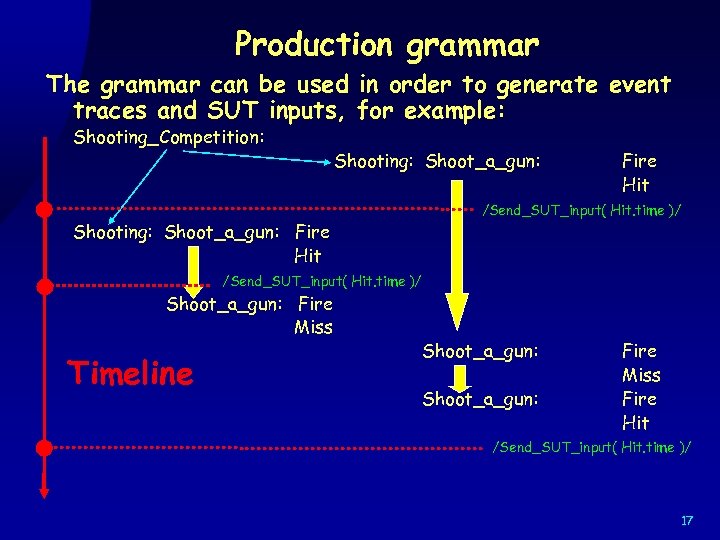 Production grammar The grammar can be used in order to generate event traces and SUT inputs, for example: Shooting_Competition: Shooting: Shoot_a_gun: Fire Hit /Send_SUT_input( Hit. time )/ Shoot_a_gun: Fire Miss Timeline Shoot_a_gun: Fire Miss Fire Hit /Send_SUT_input( Hit. time )/ 17
 Use cases FEvent traces are essentially use cases FExamples of event traces can be useful for requirements engineering, prototyping, and system documentation 18
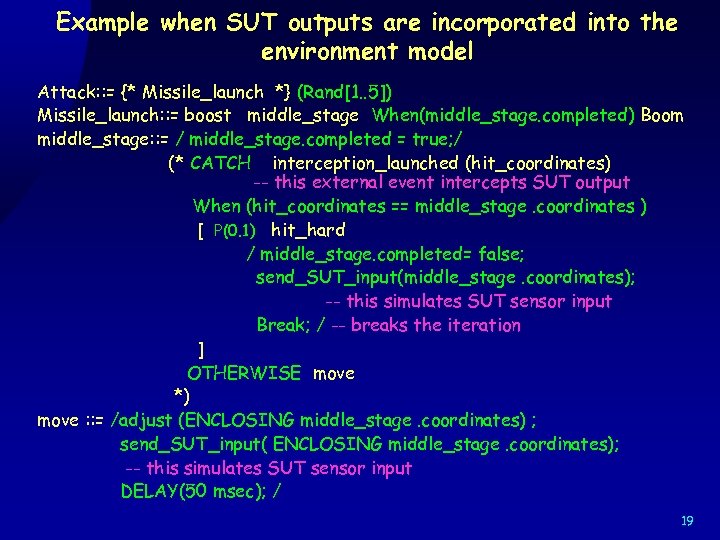 Example when SUT outputs are incorporated into the environment model Attack: : = {* Missile_launch *} (Rand[1. . 5]) Missile_launch: : = boost middle_stage When(middle_stage. completed) Boom middle_stage: : = / middle_stage. completed = true; / (* CATCH interception_launched (hit_coordinates) -- this external event intercepts SUT output When (hit_coordinates == middle_stage. coordinates ) [ P(0. 1) hit_hard / middle_stage. completed= false; send_SUT_input(middle_stage. coordinates); -- this simulates SUT sensor input Break; / -- breaks the iteration ] OTHERWISE move *) move : : = /adjust (ENCLOSING middle_stage. coordinates) ; send_SUT_input( ENCLOSING middle_stage. coordinates); -- this simulates SUT sensor input DELAY(50 msec); / 19
 Chapter 2 Software safety assessment 20
 Risk Analysis FIn the previous example, the Boom event will occur in certain scenarios depending on the SUT outputs received by the test driver and random choices determined by the given probabilities FIf we run large enough number of (automatically generated) tests, the statistics gathered gives some approximation for the risk of getting to the hazardous state. This becomes a very constructive process of performing experiments with SUT behavior within the given environment model 21
 Qualitative Risk Analysis F The environment model can contain description of hazardous states in which system could arrive, and which can not be easily retrieved from SUT requirements specifications F We can do qualitative analysis as well… It is possible to ask questions, such as “what has contributed to this outcome? ” F We can change some probabilities in the environment model, or change some parameters in the SUT and repeat the whole set of tests. If the frequency of reaching a hazardous state changes, we can answer the question asked… F The changes in the model could be done automatically in a some systematic way 22
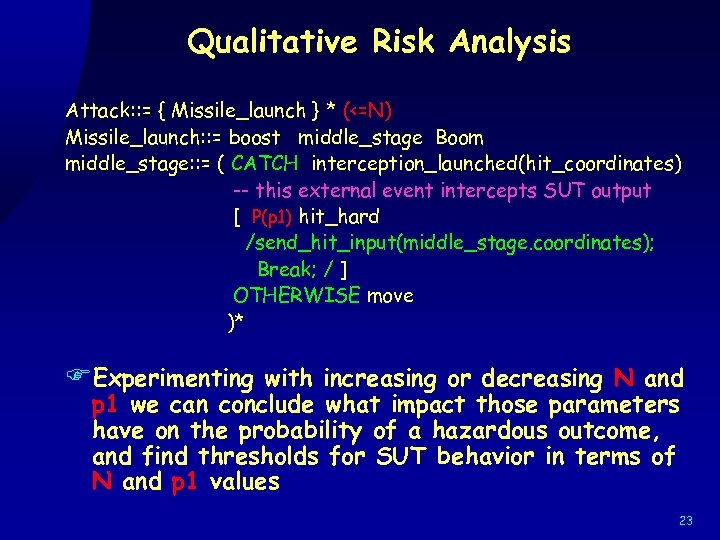 Qualitative Risk Analysis Attack: : = { Missile_launch } * (<=N) Missile_launch: : = boost middle_stage Boom middle_stage: : = ( CATCH interception_launched(hit_coordinates) -- this external event intercepts SUT output [ P(p 1) hit_hard /send_hit_input(middle_stage. coordinates); Break; / ] OTHERWISE move )* FExperimenting with increasing or decreasing N and p 1 we can conclude what impact those parameters have on the probability of a hazardous outcome, and find thresholds for SUT behavior in terms of N and p 1 values 23
 Chapter 3 Implementation (How to run a test case) 24
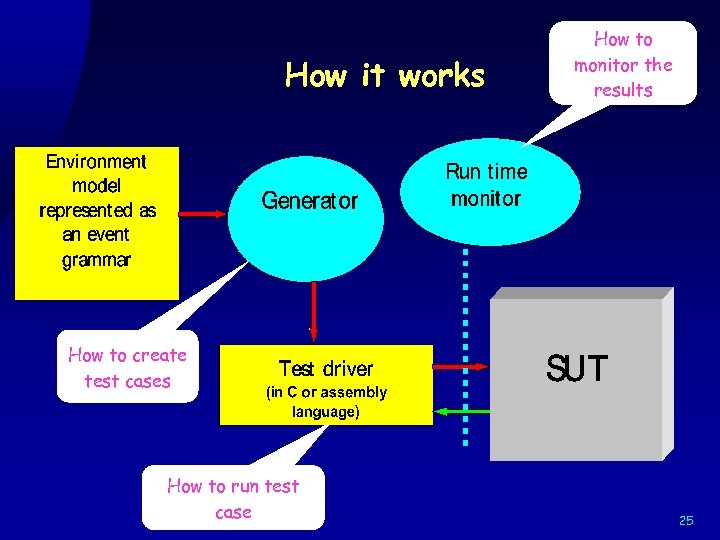 How it works How to monitor the results How to create test cases How to run test case 25
 Prototype implementation outlook The first automated test generator based on attribute event grammars has been implemented at NPS. It takes an AEG and generates a test driver in C. Some highlights: F Parallel event threads are implemented by interleaving F Attributes are evaluated mostly at the generation time, but those dependent on SUT outputs (on CATCH clauses) are postponed until the run time F The driver contains only simple assignment statements and C subroutine calls for interface with the SUT, guarded by simple flags, hence is very efficient and can be used for real time SUT testing 26
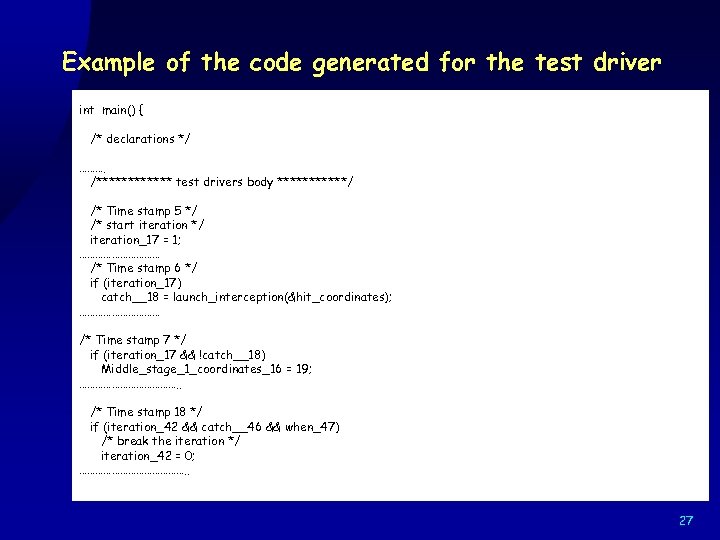 Example of the code generated for the test driver int main() { /* declarations */ ………. /****** test drivers body ******/ /* Time stamp 5 */ /* start iteration */ iteration_17 = 1; …………… /* Time stamp 6 */ if (iteration_17) catch__18 = launch_interception(&hit_coordinates); …………… /* Time stamp 7 */ if (iteration_17 && !catch__18) Middle_stage_1_coordinates_16 = 19; ………………. . /* Time stamp 18 */ if (iteration_42 && catch__46 && when_47) /* break the iteration */ iteration_42 = 0; …………………. . 27
 The main advantages FThe whole testing process can be automated FThe AEG formalism provides powerful high-level abstractions for environment modeling FIt is possible to run many more test cases with better chances to succeed in exposing an error FIt addresses the regression testing problem – generated test drivers can be saved and reused. FAEG is well structured, hierarchical, and scalable FThe environment model itself is an asset and could be reused 28
 Why it will fly F Environment model specified by AEG provides for high-level domain-specific formalism for testing automation F The generated test driver is efficient and could be used for realtime test cases F Different environment models can be designed; e. g. , for testing extreme scenarios by increasing probabilities of certain events, or for load testing F Experiments running SUT with the environment model provide a constructive method for quantitative and even qualitative software safety assessment F Environment models can be designed on early stages of system design, can provide environment simulation scenarios or use cases, and can be used for tuning the requirements and for prototyping efforts 29
 Frequently Asked Questions F Q: How to design the environment model? A: It is similar to the OOA/OOD process. We analyze use cases, requirements, apply Abbot’s method, interview experts about environment behavior and related attributes, then gradually build the model. The generator may be helpful in order to test and debug the model: we can generate traces and verify them. The strongly hierarchical nature of event grammar also helps. The good news is that the environment model could be reused. FQ: Can the model capture synchronization events? A: Yes, an event (e. g. , the synchronization event) can be shared by two or more other events. For example, two cars can be represented by two parallel event threads; if they collide, both threads share the collision event. 30
 Potential topics for future work (plenty…) F For the interface between the test driver and the SUT a special set of wrappers or bridges should be provided F The test driver generator can enforce grammar branch coverage to ensure that all grammar alternatives have been traversed (a good candidate for test metrics) F The generated test driver can receive inputs from the SUT, or even from the user; i. e. , could implement an interactive test case F The generated test driver can interact also with the test oracle or the run time monitor to support the integrity of the testing process F Automated software safety assessment both quantitative and qualitative F Environment models can be reused 31
 Chapter 4 Program monitoring and test oracles (How to verify the results of a test run) 32
 Objective: to develop unifying principles for program monitoring activities Suggested solution: to define a precise model of program behavior as a set of events – event trace Monitoring activities in software design can be implemented as computations over program execution traces. Examples: Ø Ø Ø Assertion checking (test oracles) Debugging queries Profiles Performance measurements Behavior visualization 33
 Program Behavior Models FProgram monitoring activities can be specified in a uniform way using program behavior models based on the event notion FAn event corresponds to any detectable action; e. g. , subroutine call, expression evaluation, message passing, etc. An event corresponds to a time interval FTwo partial order binary relations are defined for events: precedence and inclusion FAn event has attributes: type, duration, program state at beginning or end of the event, value, … 34
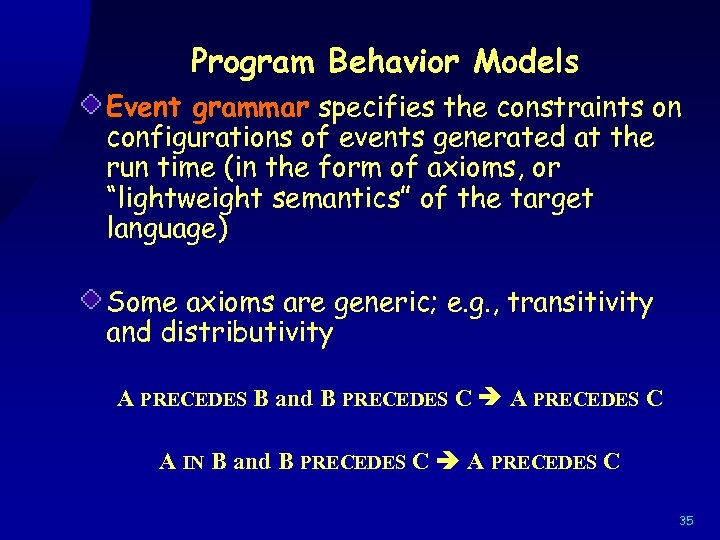 Program Behavior Models Event grammar specifies the constraints on configurations of events generated at the run time (in the form of axioms, or “lightweight semantics” of the target language) Some axioms are generic; e. g. , transitivity and distributivity A PRECEDES B and B PRECEDES C A PRECEDES C A IN B and B PRECEDES C A PRECEDES C 35
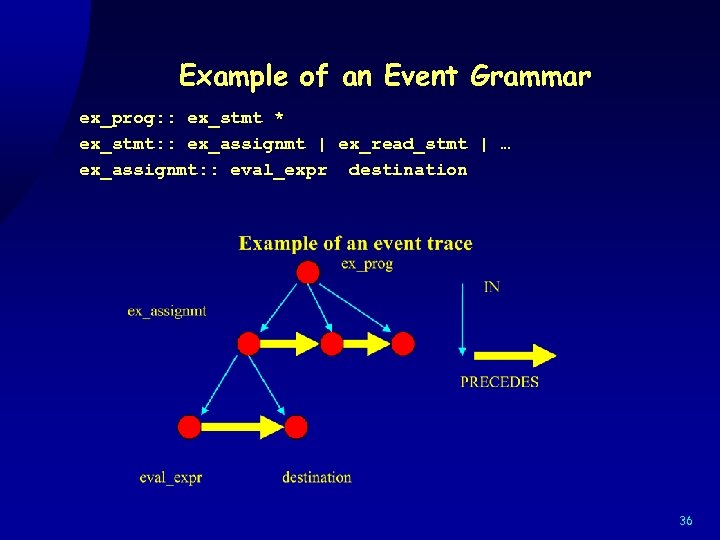 Example of an Event Grammar ex_prog: : ex_stmt * ex_stmt: : ex_assignmt | ex_read_stmt | … ex_assignmt: : eval_expr destination 36
 Program Monitoring activities: assertion checking, profiles, performance measurements, dynamic Qo. S metrics, visualization, debugging queries, intrusion detection Program monitoring can be specified in terms of computations over event traces We introduce a specific language FORMAN to describe computations over event traces (based on event patterns and aggregate operations over events) 37
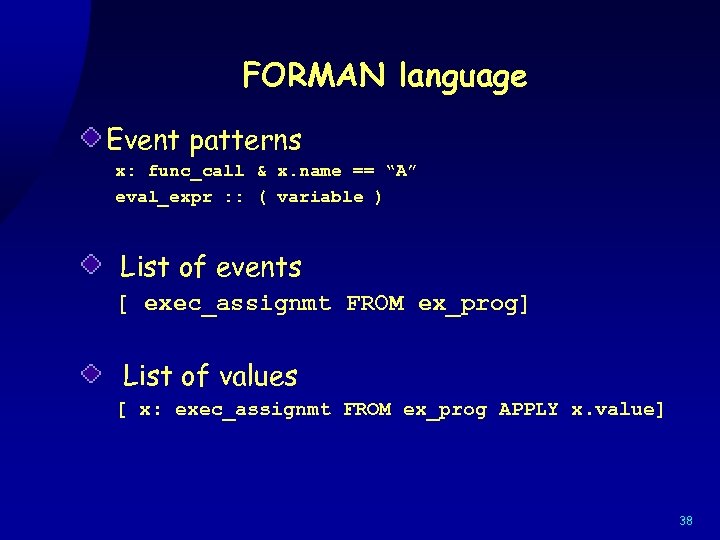 FORMAN language Event patterns x: func_call & x. name == “A” eval_expr : : ( variable ) List of events [ exec_assignmt FROM ex_prog] List of values [ x: exec_assignmt FROM ex_prog APPLY x. value] 38
![FORMAN language Ø Aggregate Operations MAX/[ x: exec_assignmt FROM ex_prog APPLY x. value] AND/[](https://present5.com/presentation/fed823695d26f2bbc789d55ea0486860/image-39.jpg "FORMAN language Ø Aggregate Operations MAX/[ x: exec_assignmt FROM ex_prog APPLY x. value] AND/[") FORMAN language Ø Aggregate Operations MAX/[ x: exec_assignmt FROM ex_prog APPLY x. value] AND/[ x: exec_assignmt FROM ex_prog APPLY x. value > 17] Or FOREACH x: exec_assignmt FROM ex_prog x. value > 17 39
FORMAN language Ø Aggregate Operations MAX/[ x: exec_assignmt FROM ex_prog APPLY x. value] AND/[ x: exec_assignmt FROM ex_prog APPLY x. value > 17] Or FOREACH x: exec_assignmt FROM ex_prog x. value > 17 39
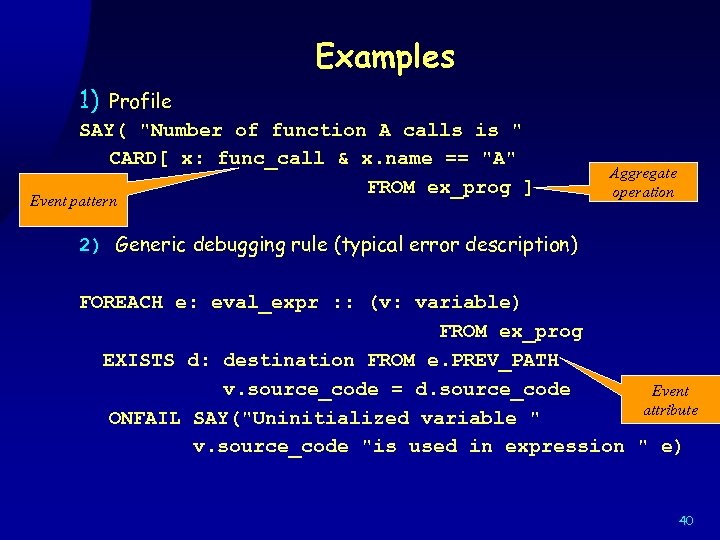 Examples 1) Profile SAY( "Number of function A calls is " CARD[ x: func_call & x. name == "A" FROM ex_prog ] Event pattern Aggregate operation 2) Generic debugging rule (typical error description) FOREACH e: eval_expr : : (v: variable) FROM ex_prog EXISTS d: destination FROM e. PREV_PATH v. source_code = d. source_code Event attribute ONFAIL SAY("Uninitialized variable " v. source_code "is used in expression " e) 40
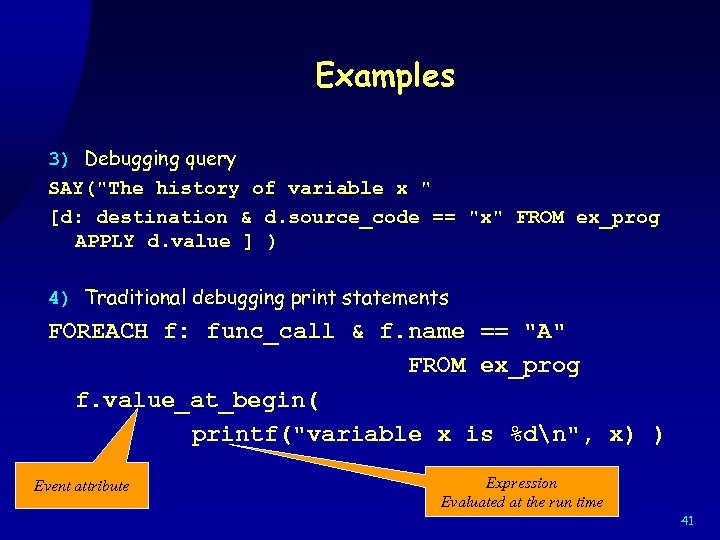 Examples 3) Debugging query SAY("The history of variable x " [d: destination & d. source_code == "x" FROM ex_prog APPLY d. value ] ) 4) Traditional debugging print statements FOREACH f: func_call & f. name == "A" FROM ex_prog f. value_at_begin( printf("variable x is %dn", x) ) Event attribute Expression Evaluated at the run time 41
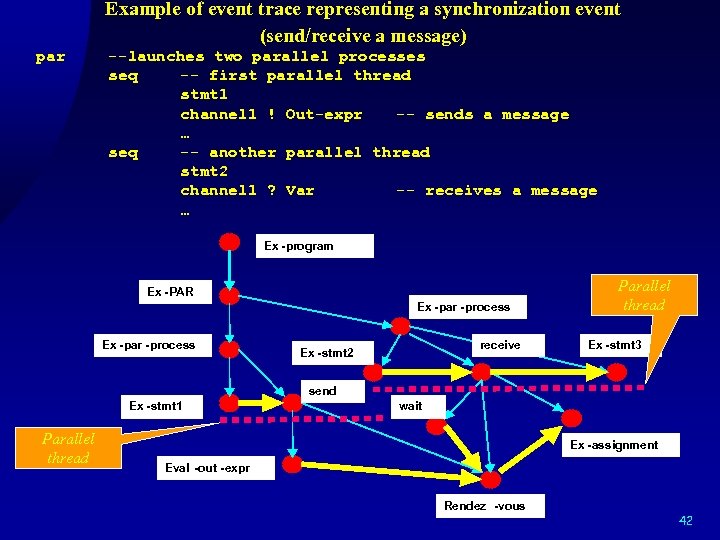 Example of event trace representing a synchronization event (send/receive a message) par --launches two parallel processes seq -- first parallel thread stmt 1 channel 1 ! Out-expr -- sends a message … seq -- another parallel thread stmt 2 channel 1 ? Var -- receives a message … Ex -program Ex -PAR Ex -par -process receive Ex -stmt 2 Parallel thread Ex -stmt 3 send Ex -stmt 1 Parallel thread wait Ex -assignment Eval -out -expr Rendez -vous 42
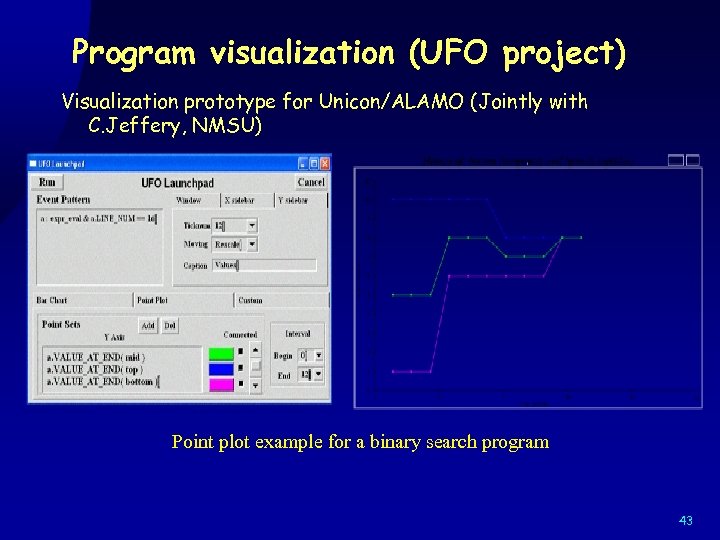 Program visualization (UFO project) Visualization prototype for Unicon/ALAMO (Jointly with C. Jeffery, NMSU) Point plot example for a binary search program 43
 The novelty claims of our approach Uniform framework for program monitoring based on precise behavior models and event trace computations Computations on the event traces can be implemented in a nondestructive way via automatic instrumentation of the source code or even of the executables (Dyninst approach) Can specify generic trace computations: typical bug detection, dynamic Qo. S metrics, profiles, visualization, … Both functional and non-functional requirements can be monitored Yet another approach to the aspect-oriented paradigm 44
 Accomplished projects and work in progress Assertion checker for a Pascal subset (via interpreter) Assertion checker for the C language (via source code instrumentation) Assertion checker and visualization tool for the Unicon language (via Virtual Machine monitors) Dynamic Qo. S metrics, Uni. Frame project (via glue and wrapper instrumentation), funded by ONR Intrusion detection and countermeasures (via Linux kernel library instrumentation using NAI GSWTK), funded by the Department of Justice Homeland Security Program Ongoing project: C/C++ program monitoring (via Dyninst/DPCL toolset), achieved performance is adequate for monitoring real size programs Automated test driver generator for reactive real time systems based on AEG environment models, funded by Missile Defense Agency 45
 Some publications M. Auguston, Program Behavior Model Based on Event Grammar and its Application for Debugging Automation, 2 nd Int’l Workshop on Automated and Algorithmic Debugging, AADEBUG'95, Saint-Malo, May 1995, pp. 277 -291. M. Auguston, A. Gates, M. Lujan, Defining a Program Behavior Model for Dynamic Analyzers, 9 th International Conference on Software Engineering and Knowledge Engineering, SEKE'97, Madrid, June 1997, pp. 257 -262. M. Auguston, Assertion Checker for the C Programming Language based on computations over event traces, in Proceedings of the Fourth International Workshop on Algorithmic and Automatic Debugging, AADEBUG'2000, Munich, August 28 -30, 2000, pp. 90 -99 on-line proceedings at http: //www. irisa. fr/lande/ducasse/aadebug 2000/proceedings. html M. Auguston, C. Jeffery and S. Underwood. A Framework for Automatic Debugging. Proceedings of the IEEE 17 th International Conference on Automated Software Engineering, ASE'02, Edinburgh, September 2002, IEEE Computer Society Press, pp. 217222. Mikhail Auguston, James Bret Michael, Man-Tak Shing, Environment Behavior Models for Scenario Generation and Testing Automation, in Proceedings of the First International Workshop on Advances in Model-Based Software Testing (A-MOST'05), the 27 th International Conference on Software Engineering ICSE’ 05, May 15 -16, 2005, St. Louis, USA, http: //a-most. argreenhouse. com, also to appear in the ACM Digital Library 46
 Summary of the event grammar approach FBehavior models based on event grammars provide a uniform framework for software testing and debugging automation FCan be implemented in a nondestructive way via automatic instrumentation FAutomated tools can be built to support all phases of the testing process FProvides a good potential for reuse: environment models, generic debugging rules, test drivers for regression testing FProvides high-level abstractions for testing and debugging tasks, hence is easy to learn and use FWell suited for reactive real-time system testing 47
 Why bother? Testing and debugging consume more than 50% of total software development cost. If the proposed research is transferred into practice and reduces costs by 1% of the 50% of the $400 billion software industry, the potential economic impact would be around $2 billion per year. 48
 Questions, please! 49
 Backup slides 50
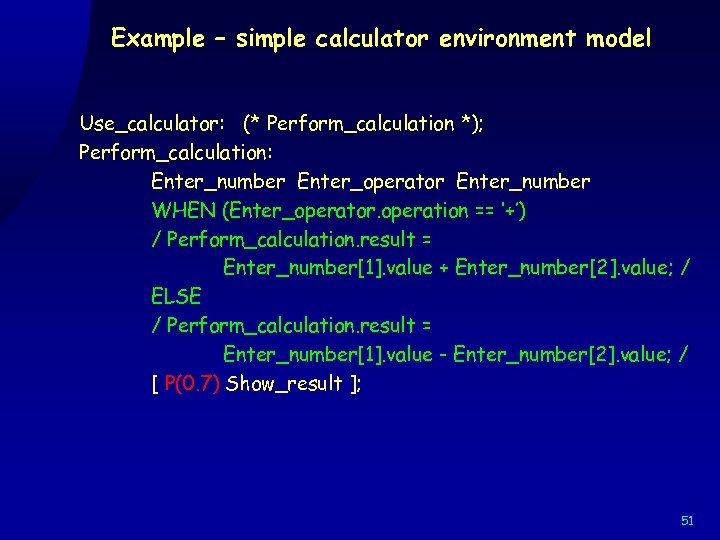 Example – simple calculator environment model Use_calculator: (* Perform_calculation *); Perform_calculation: Enter_number Enter_operator Enter_number WHEN (Enter_operator. operation == ‘+’) / Perform_calculation. result = Enter_number[1]. value + Enter_number[2]. value; / ELSE / Perform_calculation. result = Enter_number[1]. value - Enter_number[2]. value; / [ P(0. 7) Show_result ]; 51
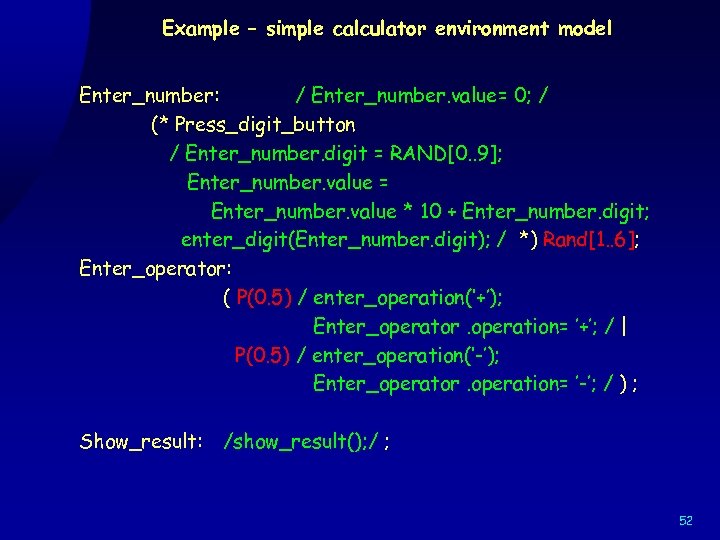 Example – simple calculator environment model Enter_number: / Enter_number. value= 0; / (* Press_digit_button / Enter_number. digit = RAND[0. . 9]; Enter_number. value = Enter_number. value * 10 + Enter_number. digit; enter_digit(Enter_number. digit); / *) Rand[1. . 6]; Enter_operator: ( P(0. 5) / enter_operation(‘+’); Enter_operator. operation= ’+’; / | P(0. 5) / enter_operation(‘-’); Enter_operator. operation= ’-’; / ) ; Show_result: /show_result(); / ; 52
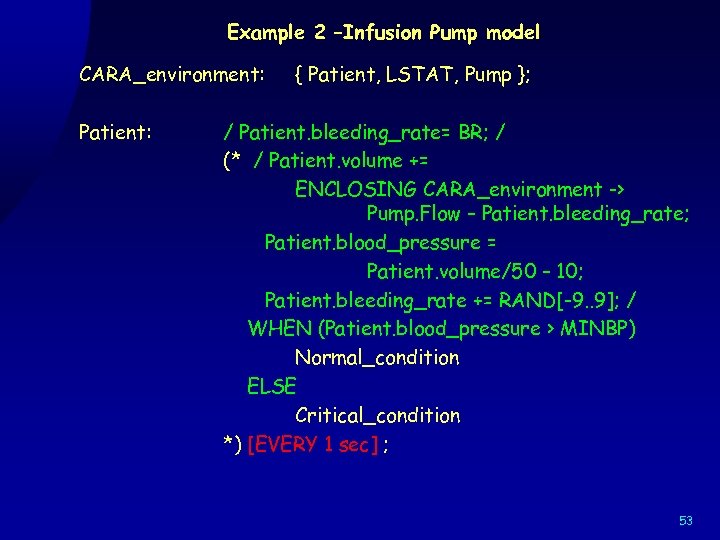 Example 2 –Infusion Pump model CARA_environment: Patient: { Patient, LSTAT, Pump }; / Patient. bleeding_rate= BR; / (* / Patient. volume += ENCLOSING CARA_environment -> Pump. Flow – Patient. bleeding_rate; Patient. blood_pressure = Patient. volume/50 – 10; Patient. bleeding_rate += RAND[-9. . 9]; / WHEN (Patient. blood_pressure > MINBP) Normal_condition ELSE Critical_condition *) [EVERY 1 sec] ; 53
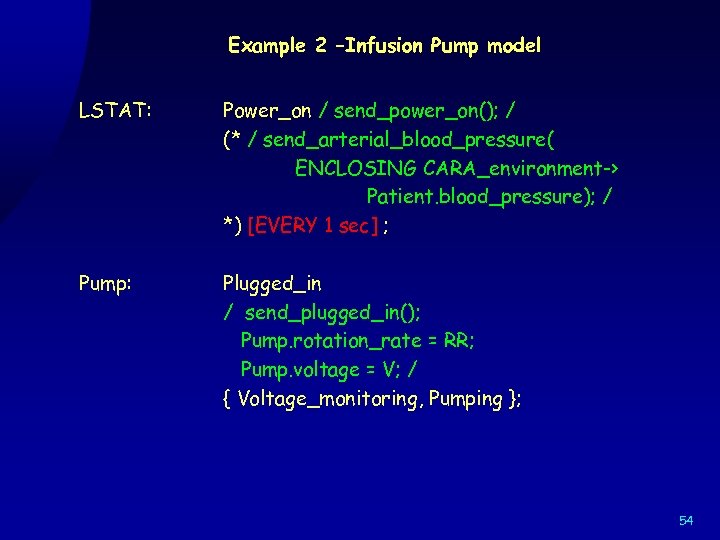 Example 2 –Infusion Pump model LSTAT: Power_on / send_power_on(); / (* / send_arterial_blood_pressure( ENCLOSING CARA_environment-> Patient. blood_pressure); / *) [EVERY 1 sec] ; Pump: Plugged_in / send_plugged_in(); Pump. rotation_rate = RR; Pump. voltage = V; / { Voltage_monitoring, Pumping }; 54
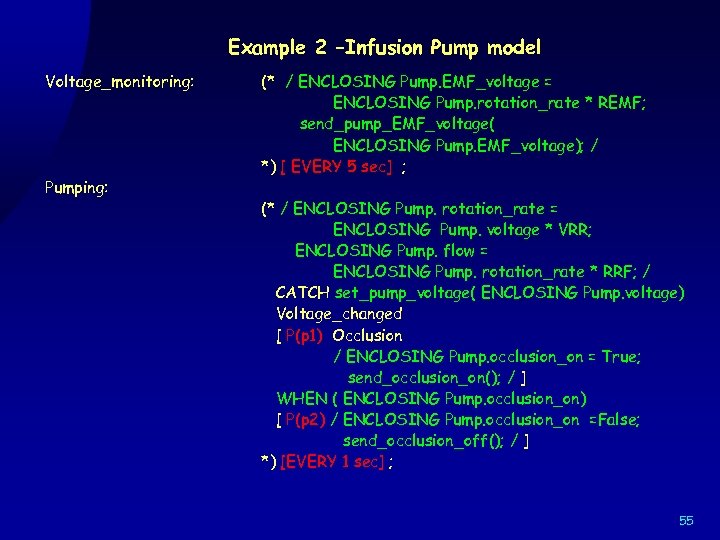 Example 2 –Infusion Pump model Voltage_monitoring: Pumping: (* / ENCLOSING Pump. EMF_voltage = ENCLOSING Pump. rotation_rate * REMF; send_pump_EMF_voltage( ENCLOSING Pump. EMF_voltage); / *) [ EVERY 5 sec] ; (* / ENCLOSING Pump. rotation_rate = ENCLOSING Pump. voltage * VRR; ENCLOSING Pump. flow = ENCLOSING Pump. rotation_rate * RRF; / CATCH set_pump_voltage( ENCLOSING Pump. voltage) Voltage_changed [ P(p 1) Occlusion / ENCLOSING Pump. occlusion_on = True; send_occlusion_on(); / ] WHEN ( ENCLOSING Pump. occlusion_on) [ P(p 2) / ENCLOSING Pump. occlusion_on =False; send_occlusion_off(); / ] *) [EVERY 1 sec] ; 55