 Скачать презентацию New Country New Problems When Washington took office
008e8c71a9162a7591121e78f838ad2c.ppt
- Количество слайдов: 37



New Country, New Problems When Washington took office: many still against the Constitution Rhode Island North Carolina hadn’t ratified Vermont threatening to join Canada War debt still unpaid and growing National currency not backed, so worthless Britain occupying forts throughout NW Territory Spain won’t let Americans west of Mississippi River, or use it for transport
Washington creates the cabinet departments of government within the executive branch. • First three-State, Treasury, War • Justice added later. • Sec of state-Thomas Jefferson, • Sec. Of Treasury-Alexander Hamilton, Sec. Of War-Henry Knox. • Edmund Randolph as Attorney General Eventually started meeting, excluded VP Adams, set precedent.
The First Party System Develops • At the beginning of Washington’s presidency, Hamilton and Jefferson were two people who hated each other. • By the end of Washington’s presidency, several controversies and issues led to the creation of two political parties, based on and around the ideas and personalities of the two men.
• Hamiltonianism - Federalist, strong central govt • -born in British West Indies (Caribbean), no strong State loyalty • -distrustful of common man, didn’t believe they were capable of governing themselves (ex-Shays’ rebellion) • strong central govt to keep the masses in check • Wanted to tie elites to the federal govt, through $. • “make it in the immediate interest of the moneyed men to cooperate with government in its support. ” • Jeffersonianism - Anti-federalist, weak central govt, strong state and local govts. • “nation of farmers, ” freedom through landownership • believed industrialization was akin to slavery, wage workers were easily manipulated, no satisfaction in life, incapable of thinking for themselves and acting independently.
1 st Big Problem: National Debt • $54 million national, $25 million by states • believes it is important to pay ENTIRE debt to est. the credit of the fed. gov’t. • Proposal-Funding and Assumption Plan • -the federal gov’t assumes all the debt, principal and interest, of the fed. and states. • Basically consolidating debt.
The Controversy • Maryland, Pennsylvania, North Carolina and Virginia had already paid off their debt • Didn’t want to be taxed to pay off debt of other states. • huge profits for speculators, who bought war bonds from veterans for 10 to 15 cents on the dollar. • Many speculators were friends of Hamilton, or in Congress, so they knew about the plan.
Compromise & Success • Compromise by Madison and Jefferson • To get southern votes for the F/A plan, Hamilton agreed to back plan for locating new capital on the Potomac, border between 2 southern states, Virginia and Maryland. • Successful • By paying debt, Europe has faith in new country and its currency. • Good credit risk, brought in a lot of foreign investment. • Important for industrialization efforts, build up economy
Next Big Issue-Banking Bank Bill, to create a Bank of the United States, modeled after Bank of England. • issue currency, collect taxes, hold govt funds, make loans to govt and borrowers. • Controversy: • Undermine republican values by encouraging speculation and corruption. • Too much foreign influence, b/c foreigners would have to buy a high % of bank stock • Too much power to elites in shaping fiscal policies, b/c private investors would control the board of directors.
Constitutional Issues • Jefferson & Madison argue for a Strict Interpretation of the Constitution • not an expressively given power in the constitution, therefore, unconstitutional • Hamilton’s response: • Bank not unconstitutional b/c of implied powers, given in the “necessary and proper” clause, which allowed the federal govt to do anything it deemed “necessary and proper” to carry out its constitutional functions. • Loose Interpretation of the Constitution
Article I, section 8 • “Congress shall have Power…To make all Laws which shall be necessary and proper for carrying into Execution the foregoing Powers, and all other Powers vested by the Constitution in the Government of the United States…”
Banking Issue • 1791 -bill passed creating a national bank for 20 yrs. • Constitutionality question left up to Washington. • Reluctantly signed b/c he believed it was necessary for nation’s financial well-being • Bank of the United States • Successful: regulated currency of private banks, reserve funds for govt and private investors and helped attract foreign investors. • Was not renewed in 1811, due mostly to jealousy from private commercial banks.
Hamilton’s Industrialization Plan • Wants diversified economy, need more industry, would no longer be dependent on Britain for manufactured goods. • -high tariffs (taxes) on foreign goods • -govt bounties and subsidies • -internal improvements in transportation (cheaper to ship goods within US) Controversy: • -might cut federal revenue by discouraging imports. • -Shippers/merchants feared it would reduce foreign trade • -Farmers feared other countries would enact high taxes on American ag. products in retribution • -Southerners saw it as promoting northern industry at their expense, since it provided no aid to agriculture. • Jefferson-directly against notion of a “nation of farmers”
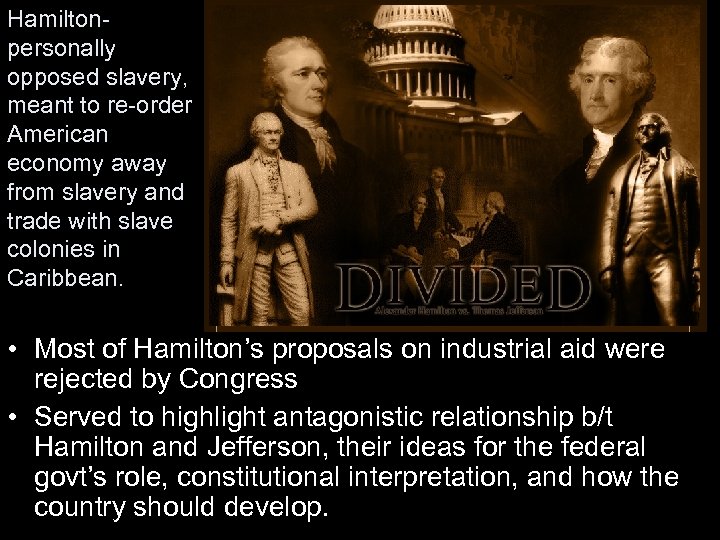
Hamiltonpersonally opposed slavery, meant to re-order American economy away from slavery and trade with slave colonies in Caribbean. • Most of Hamilton’s proposals on industrial aid were rejected by Congress • Served to highlight antagonistic relationship b/t Hamilton and Jefferson, their ideas for the federal govt’s role, constitutional interpretation, and how the country should develop.
First Big “Test” of the Federal Govt • Whiskey Tax enacted in March 1791 to create revenue for fed. govt. • Hamilton knew it made whiskey distilling/sale unprofitable, didn’t seem to care • attitude made worse when one of the tax collectors made comments about the “moral and personal weakness of the lesser folk” and called farmers “greatly depraved” and shopkeepers “sordid. ” • Rumblings in the summer of 1792, worse by 1794. • People refusing to pay the tax, tarring and feathering tax collectors, armed conflict b/t farmers/distillers and tax collectors/troops.
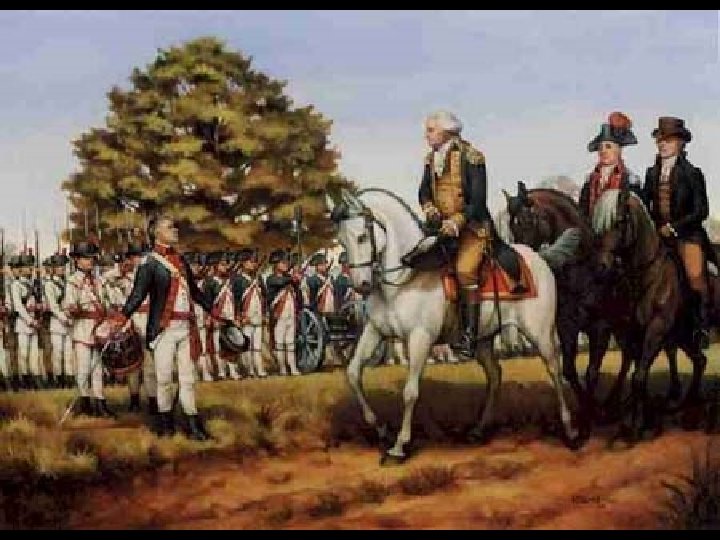
The Whiskey Rebellion • Washington understood he needed to make a strong statement. • Called up several state militias, about 13, 000 men, personally led them into back country to put down rebellion. • Rebellion had dispersed by the time they got there. • About 20 arrests, 2 tried/convicted of treason, to be hanged, later pardoned. • Washington had made his statement.
The First Two Parties • The Federalists & the Democratic. Republicans • Federalists, centered around Hamilton, strong federal govt, much support from govt officials • Democratic-Republicans, centered around Jefferson (and Madison), claimed Hamilton’s ideas too much like Britain: huge public debt, standing army, high taxes, govt subsidies of businesses, creating monopolies.
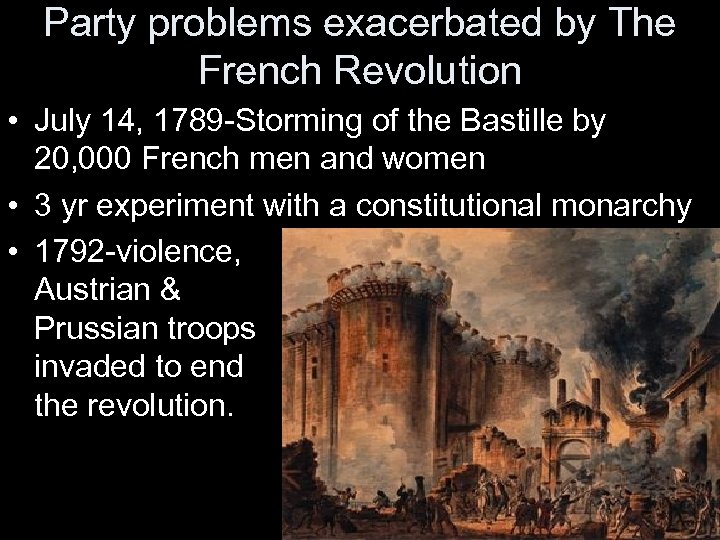
Party problems exacerbated by The French Revolution • July 14, 1789 -Storming of the Bastille by 20, 000 French men and women • 3 yr experiment with a constitutional monarchy • 1792 -violence, Austrian & Prussian troops invaded to end the revolution.
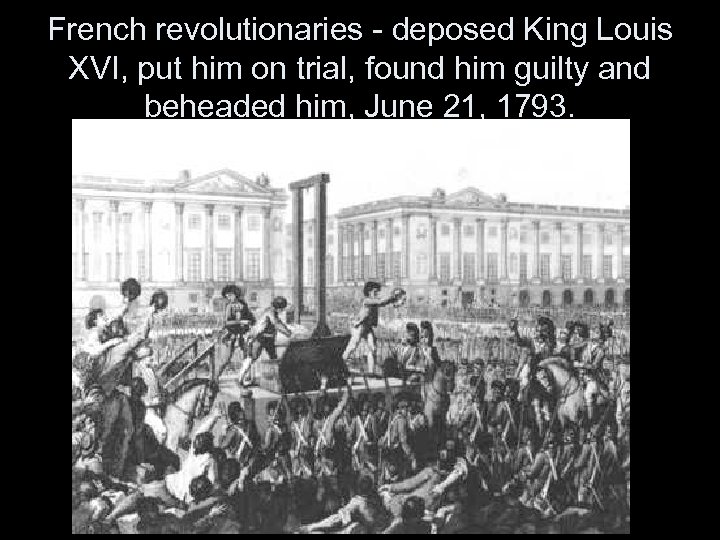
French revolutionaries - deposed King Louis XVI, put him on trial, found him guilty and beheaded him, June 21, 1793.
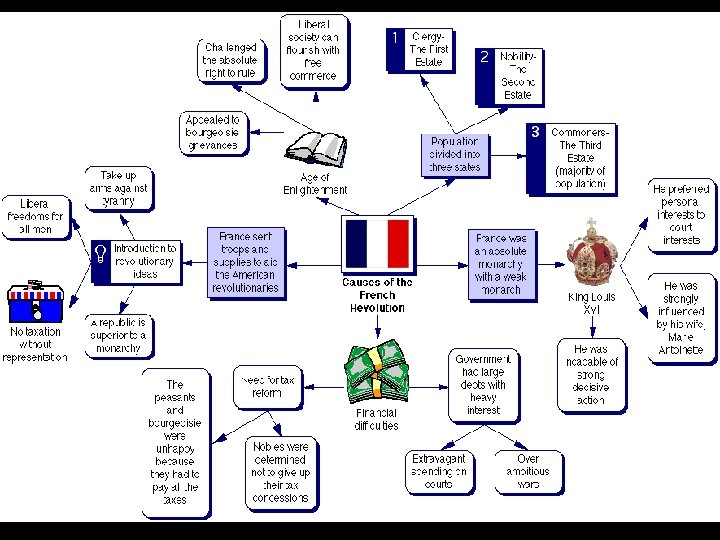
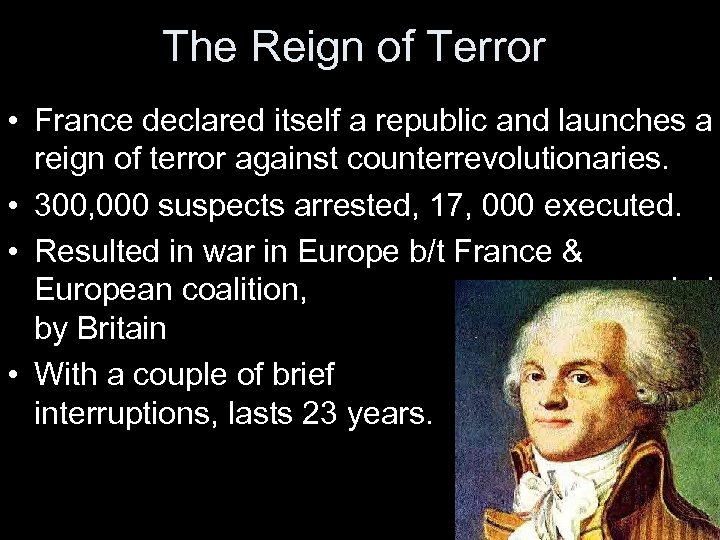
The Reign of Terror • France declared itself a republic and launches a reign of terror against counterrevolutionaries. • 300, 000 suspects arrested, 17, 000 executed. • Resulted in war in Europe b/t France & European coalition, led by Britain • With a couple of brief interruptions, lasts 23 years.
Factions in U. S. • Pro-France: same as U. S. revolution, overthrowing king, tyranny, oppression, aristocratic privilege • Pro-England: French revolution goes too far, assault on property and Christianity • Washington: involvement in Europe would weaken the new nation b/f it had a chance to est. its own independence. • Proposed to keep the country “free from political connections with every other country, to see them independent of all, and under the influence of none. ” • Problem: French aid during US Revolution • Solution: continue to pay French war debt, but not support the war directly • Neutrality: U. S. will be “Friendly and impartial toward
The Citizen Genet Affair • April 1793 • Edmund Charles Genet, minister of the French Republic, came to U. S. • Goal-to persuade American citizens to join in France’s “War of all peoples against all kings. ” • Passed out military commissions as part of a plan of attack on Spanish New Orleans • Letters authorizing Americans to attack British commercial vessels. • Washington demands Genet be recalled to France. • Genet fears for his life, request and is granted political asylum in U. S.
“The Party Line” • Democratic-Republican clubs sprung up to celebrate the triumphs of the French Revolution • Hamilton charged they were just to stir up opposition to Washington’s administration at the grass roots level. • Jefferson vehemently denied the charge, but it further divided the two fledgling parties.
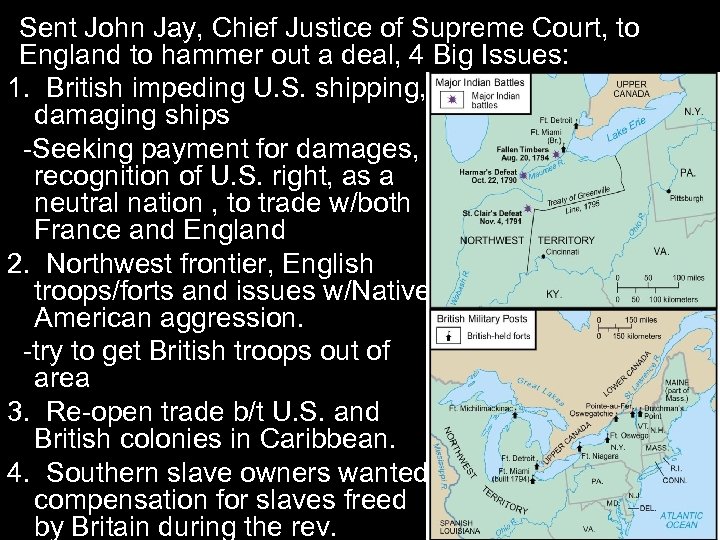
Sent John Jay, Chief Justice of Supreme Court, to England to hammer out a deal, 4 Big Issues: 1. British impeding U. S. shipping, damaging ships -Seeking payment for damages, recognition of U. S. right, as a neutral nation , to trade w/both France and England 2. Northwest frontier, English troops/forts and issues w/Native American aggression. -try to get British troops out of area 3. Re-open trade b/t U. S. and British colonies in Caribbean. 4. Southern slave owners wanted compensation for slaves freed by Britain during the rev.
Jay’s Treaty Jay, negotiating from a position of weakness got: -withdrawal of British troops over a 2 yr. Period -limited trade w/British colonies in India and the Caribbean. • Treaty ratified by Senate in secret, Washington signed it. • Southerners, merchants, debtors from before the Rev. upset. Madison tried to defeat it in House. Madison argued it had to be approved by House too. Lost debate.
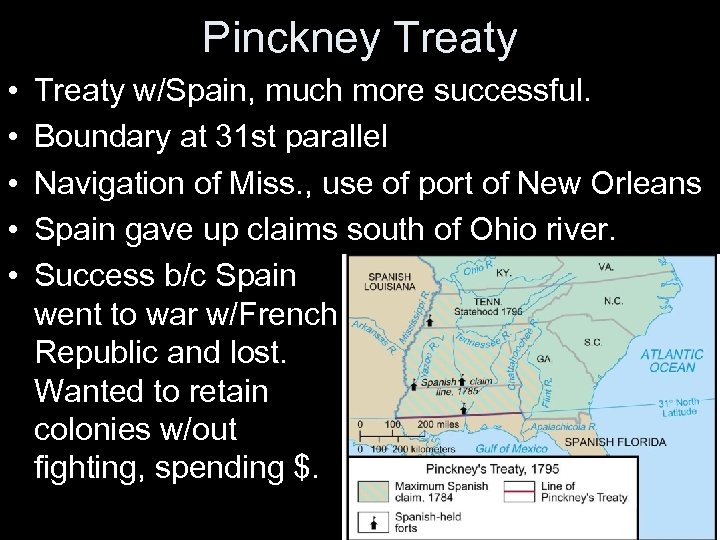
Pinckney Treaty • • • Treaty w/Spain, much more successful. Boundary at 31 st parallel Navigation of Miss. , use of port of New Orleans Spain gave up claims south of Ohio river. Success b/c Spain went to war w/French Republic and lost. Wanted to retain colonies w/out fighting, spending $.
Washington’s Farewell Address • sets precedent of only serving 2 terms • Foreign policy - trade w/other nations w/out est. close political ties, avoid permanent entangling alliances. • Domestic - warned against the dangers of political parties, should put Union first.
1796 Election • Dem-Reps - Thomas Jefferson, w/Aaron Burr as V. P. • Federalists - John Adams, Thomas Pinckney. • Because of strange nature of electoral voting (set up based on idea of NO Political Parties) Adams becomes Pres and Jefferson his VP. • Different parties meant divided govt.
The XYZ Affair • France didn’t like the outcome of the election, or Jay’s treaty, suspended diplomatic relations and started attacking U. S. ships. • B/t 1796 -98, France captured over 300 U. S. ships and 20 million worth of cargo. • Adams sent diplomats to France, they were met by three French diplomats who demanded a huge loan from the U. S. and a £ 50, 000 bribe before allowing a meeting w/French foreign minister Talleyrand.
The XYZ Affair • Dem-Reps, trying to make Adams look bad, pushed him to release diplomatic correspondences. • Adams does so, after replacing French diplomats with X, Y, Z (why it becomes known as the XYZ Affair) • Their refusal to bribe the diplomats made Adams look better, turned people away from France.
Adams goes to Congress to deal w/France • • • Adams proposes to Congress: Arm U. S. merchant ships Create a new navy or enlarge the old one Build forts to defend harbors Create new alliances w/neutral nations.
Adams goes to Congress to deal w/France • Congress only goes along w/ arming merchant ships. • But, after the XYZ Affair comes out, Congress: • increased the number of troops in the army • created a reserve army • named George Washington commander, Alexander Hamilton as second (at Washington’s insistence) • Created Dept. of Navy, Cabinet-level, new warships • nullified treaty w/France.
The Quasi-War • 1798 to 1800 - U. S. and France fought an undeclared naval war. • Adams resists official declaration of war, as he knew the U. S. was still too weak. • France made extensive use of privateers. • 12 New American frigates in the Navy
During the Quasi-War: Series of very controversial acts at home. • Naturalization Act: increased residency requirement for immigrants to become citizens from 5 to 14 years. • Alien Act: president can expel “all such aliens as he shall judge dangerous to the peace and safety of the U. S. ” People who disobeyed could be imprisoned and banned from citizenship. • Alien Enemies Act: president can arrest, imprison, or expel citizens of enemy nations w/out charging them or providing appeals process. • Sedition Act: illegal for anyone to write, say or do anything that brought “the govt, Congress, or the Pres. Into disrepute. ”
Reactions to Adams’ Acts • The Virginia and Kentucky Resolutions • Democratic-Republican reaction • If the federal govt threatened individual liberty, states have the right to disregard federal laws • If federal the govt misuses federal power, states have the right to nullify unconstitutional laws. • Early declaration of States’ Rights
Huge splits in the country France finally open to peace negotiations, Adams sends envoys - U. S. and France hammer out an alliance, U. S. dismissal of $20 million worth of damages. • Peace split Federalists, Hamiltonians unhappy. Impact on election of 1800.
Скачать презентацию New Country New Problems When Washington took office
008e8c71a9162a7591121e78f838ad2c.ppt