 Скачать презентацию New Challenges in High Penetration Renewable Energy Sources
ea3bc700a83d00004d122bc5725736fe.ppt
- Количество слайдов: 18



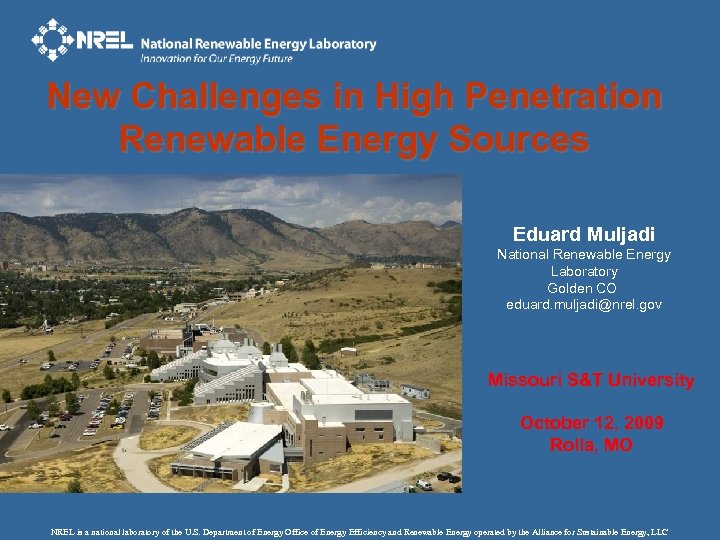
New Challenges in High Penetration Renewable Energy Sources Eduard Muljadi National Renewable Energy Laboratory Golden CO eduard. muljadi@nrel. gov Missouri S&T University October 12, 2009 Rolla, MO NREL is a national laboratory of the U. S. Department of Energy Office of Energy Efficiency and Renewable Energy operated by the Alliance for Sustainable Energy, LLC
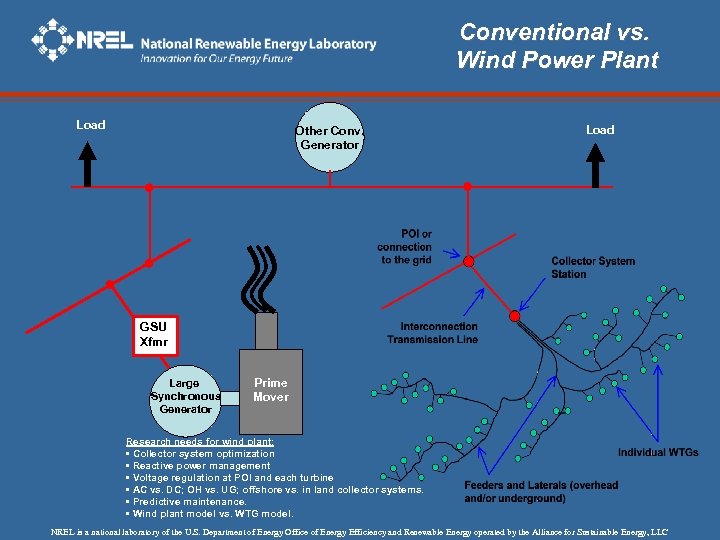
Conventional vs. Wind Power Plant Load Other Conv. Generator Load GSU Xfmr Large Synchronous Generator Prime Mover Research needs for wind plant: • Collector system optimization • Reactive power management • Voltage regulation at POI and each turbine • AC vs. DC; OH vs. UG; offshore vs. in land collector systems. • Predictive maintenance. • Wind plant model vs. WTG model. NREL is a national laboratory of the U. S. Department of Energy Office of Energy Efficiency and Renewable Energy operated by the Alliance for Sustainable Energy, LLC
Power Generation Conventional Power Plant • Single or multiple large (100 MW) generators. • Prime mover: steam, combustion engine – non-renewable fuel affected by fuel cost, politics, and pollution restrictions. • Controllability: adjustable up to max limit and down to min limit. • Predictability: preplanned generation based on load forecasting, influenced by human operation based on optimum operation (scheduled operation). • Located relatively close to the load center. • Generator: synchronous generator • Fixed speed – no slip: flux is controlled via exciter winding. Flux and rotor rotate synchronously. NREL is a national laboratory of the U. S. Department of Energy Office of Energy Efficiency and Renewable Energy operated by the Alliance for Sustainable Energy, LLC
Power Generation • • Wind Power Plant Many (hundreds) of wind turbines (1 MW – 5 MW each) Prime mover: wind (wind turbine) –renewable (free, natural, pollution free) Controllability: curtailment Predictability: wind variability based on wind forecasting, influenced more by nature (wind) than human, based on maximizing energy production (unscheduled operation). Located at wind resource, it may be far from the load center. Generator: Four different types (fixed speed, variable slip, variable speed, full converter) – non synchronous generation Type 3 & 4: variable speed with flux oriented controller (FOC) via power converter. Rotor does not have to rotate synchronously. NREL is a national laboratory of the U. S. Department of Energy Office of Energy Efficiency and Renewable Energy operated by the Alliance for Sustainable Energy, LLC
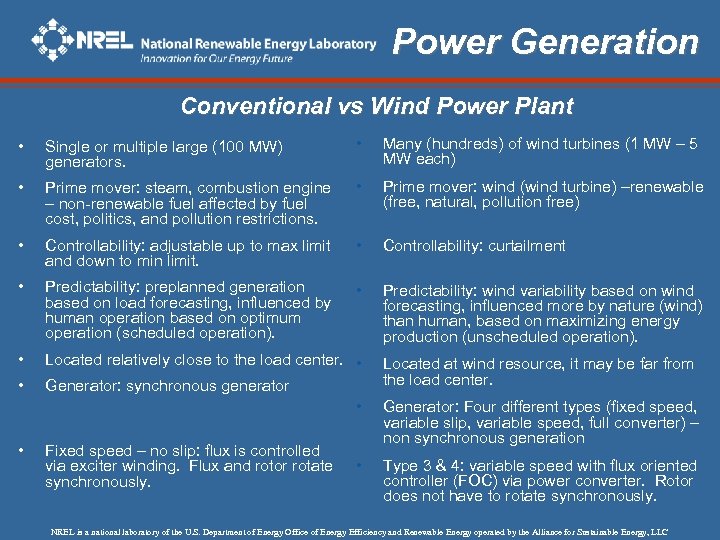
Power Generation Conventional vs Wind Power Plant • Single or multiple large (100 MW) generators. • Many (hundreds) of wind turbines (1 MW – 5 MW each) • Prime mover: steam, combustion engine – non-renewable fuel affected by fuel cost, politics, and pollution restrictions. • Prime mover: wind (wind turbine) –renewable (free, natural, pollution free) • Controllability: adjustable up to max limit and down to min limit. • Controllability: curtailment • Predictability: preplanned generation based on load forecasting, influenced by human operation based on optimum operation (scheduled operation). • Predictability: wind variability based on wind forecasting, influenced more by nature (wind) than human, based on maximizing energy production (unscheduled operation). • Located relatively close to the load center. • Generator: synchronous generator • • • Fixed speed – no slip: flux is controlled via exciter winding. Flux and rotor rotate synchronously. • Located at wind resource, it may be far from the load center. Generator: Four different types (fixed speed, variable slip, variable speed, full converter) – non synchronous generation Type 3 & 4: variable speed with flux oriented controller (FOC) via power converter. Rotor does not have to rotate synchronously. NREL is a national laboratory of the U. S. Department of Energy Office of Energy Efficiency and Renewable Energy operated by the Alliance for Sustainable Energy, LLC
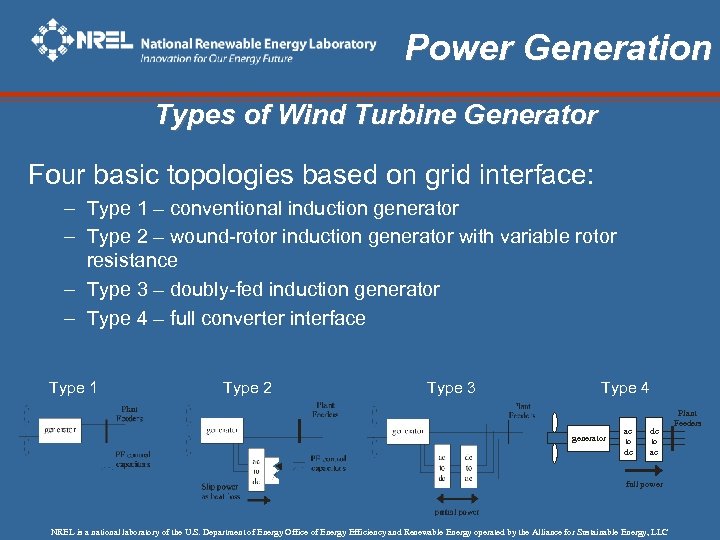
Power Generation Types of Wind Turbine Generator Four basic topologies based on grid interface: – Type 1 – conventional induction generator – Type 2 – wound-rotor induction generator with variable rotor resistance – Type 3 – doubly-fed induction generator – Type 4 – full converter interface Type 1 Type 2 Type 3 Type 4 generator ac to dc dc to ac full power NREL is a national laboratory of the U. S. Department of Energy Office of Energy Efficiency and Renewable Energy operated by the Alliance for Sustainable Energy, LLC Plant Feeders
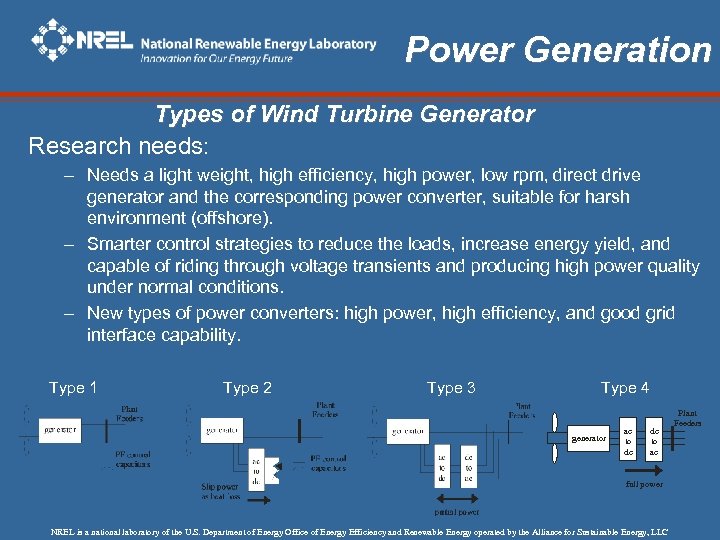
Power Generation Types of Wind Turbine Generator Research needs: – Needs a light weight, high efficiency, high power, low rpm, direct drive generator and the corresponding power converter, suitable for harsh environment (offshore). – Smarter control strategies to reduce the loads, increase energy yield, and capable of riding through voltage transients and producing high power quality under normal conditions. – New types of power converters: high power, high efficiency, and good grid interface capability. Type 1 Type 2 Type 3 Type 4 generator ac to dc dc to ac full power NREL is a national laboratory of the U. S. Department of Energy Office of Energy Efficiency and Renewable Energy operated by the Alliance for Sustainable Energy, LLC Plant Feeders
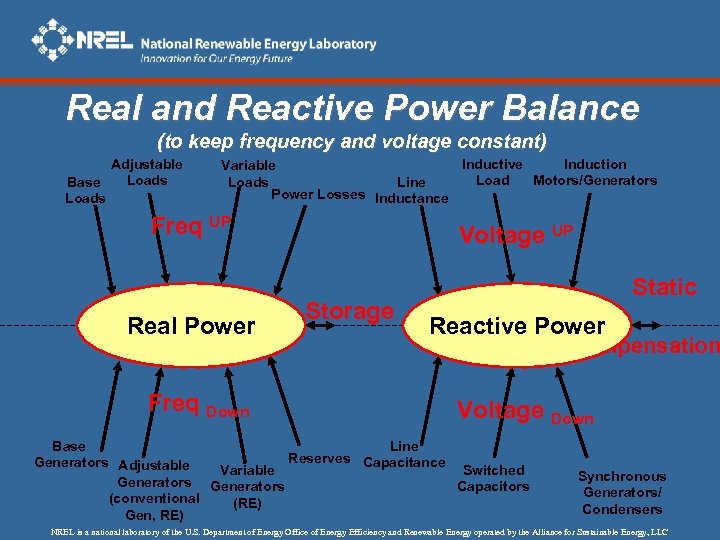
Real and Reactive Power Balance (to keep frequency and voltage constant) Adjustable Loads Base Loads Inductive Induction Variable Load Motors/Generators Line Loads Power Losses Inductance Freq UP Real Power Freq Down Voltage UP Storage Static Reactive Power Compensation Voltage Down Base Line Reserves Capacitance Generators Adjustable Variable Switched Generators Capacitors (conventional (RE) Gen, RE) Synchronous Generators/ Condensers NREL is a national laboratory of the U. S. Department of Energy Office of Energy Efficiency and Renewable Energy operated by the Alliance for Sustainable Energy, LLC
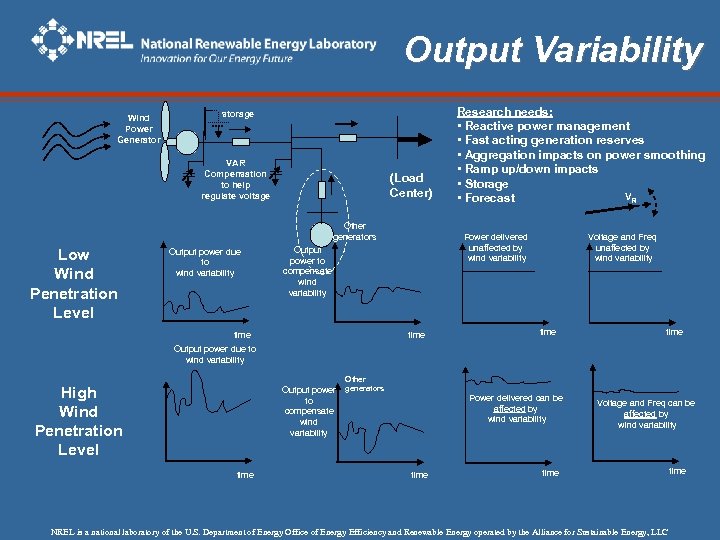
Output Variability Wind Power Generator storage VAR Compensation to help regulate voltage (Load Center) Other generators Low Wind Penetration Level Output power due to wind variability Power delivered unaffected by wind variability Output power to compensate wind variability time Research needs: • Reactive power management • Fast acting generation reserves • Aggregation impacts on power smoothing • Ramp up/down impacts • Storage VR • Forecast time Voltage and Freq unaffected by wind variability time Output power due to wind variability Other High Wind Penetration Level Output power generators to compensate wind variability time Power delivered can be affected by wind variability time Voltage and Freq can be affected by wind variability time NREL is a national laboratory of the U. S. Department of Energy Office of Energy Efficiency and Renewable Energy operated by the Alliance for Sustainable Energy, LLC time
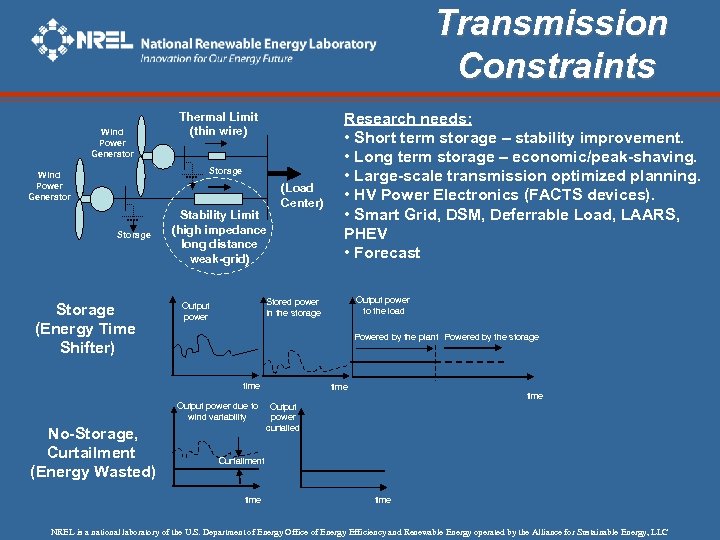
Transmission Constraints Wind Power Generator Thermal Limit (thin wire) Storage Wind Power Generator Storage (Energy Time Shifter) Stability Limit (high impedance long distance weak-grid) (Load Center) Output power to the load Stored power in the storage Output power Powered by the plant Powered by the storage time Output power due to wind variability No-Storage, Curtailment (Energy Wasted) Research needs: • Short term storage – stability improvement. • Long term storage – economic/peak-shaving. • Large-scale transmission optimized planning. • HV Power Electronics (FACTS devices). • Smart Grid, DSM, Deferrable Load, LAARS, PHEV • Forecast time Output power curtailed Curtailment time NREL is a national laboratory of the U. S. Department of Energy Office of Energy Efficiency and Renewable Energy operated by the Alliance for Sustainable Energy, LLC
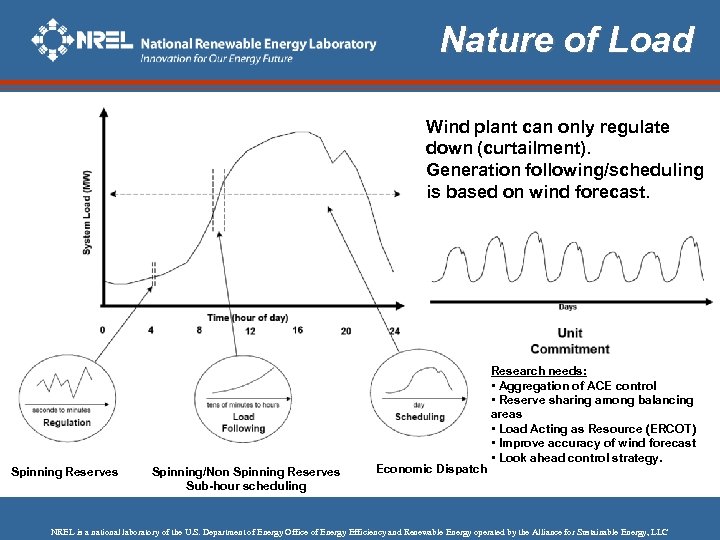
Nature of Load Wind plant can only regulate down (curtailment). Generation following/scheduling is based on wind forecast. Spinning Reserves Spinning/Non Spinning Reserves Sub-hour scheduling Economic Dispatch Research needs: • Aggregation of ACE control • Reserve sharing among balancing areas • Load Acting as Resource (ERCOT) • Improve accuracy of wind forecast • Look ahead control strategy. NREL is a national laboratory of the U. S. Department of Energy Office of Energy Efficiency and Renewable Energy operated by the Alliance for Sustainable Energy, LLC
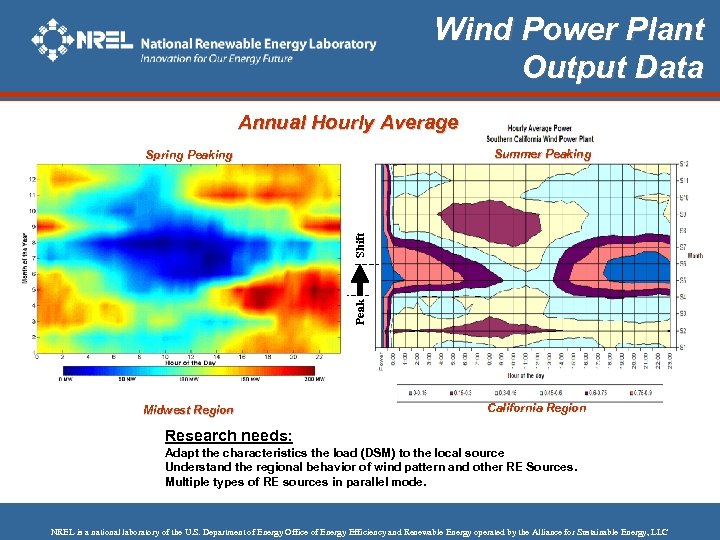
Wind Power Plant Output Data Annual Hourly Average Summer Peaking Peak Shift Spring Peaking Midwest Region California Region Research needs: Adapt the characteristics the load (DSM) to the local source Understand the regional behavior of wind pattern and other RE Sources. Multiple types of RE sources in parallel mode. NREL is a national laboratory of the U. S. Department of Energy Office of Energy Efficiency and Renewable Energy operated by the Alliance for Sustainable Energy, LLC
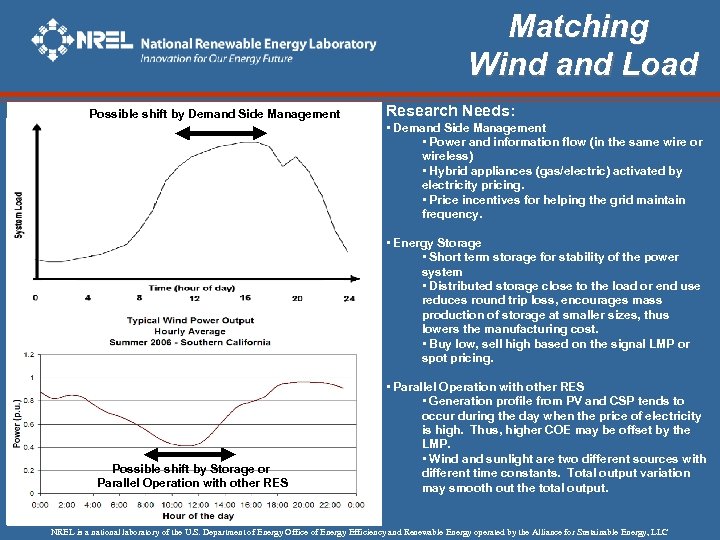
Matching Wind and Load Possible shift by Demand Side Management Research Needs: • Demand Side Management • Power and information flow (in the same wire or wireless) • Hybrid appliances (gas/electric) activated by electricity pricing. • Price incentives for helping the grid maintain frequency. • Energy Storage • Short term storage for stability of the power system • Distributed storage close to the load or end use reduces round trip loss, encourages mass production of storage at smaller sizes, thus lowers the manufacturing cost. • Buy low, sell high based on the signal LMP or spot pricing. Possible shift by Storage or Parallel Operation with other RES • Parallel Operation with other RES • Generation profile from PV and CSP tends to occur during the day when the price of electricity is high. Thus, higher COE may be offset by the LMP. • Wind and sunlight are two different sources with different time constants. Total output variation may smooth out the total output. NREL is a national laboratory of the U. S. Department of Energy Office of Energy Efficiency and Renewable Energy operated by the Alliance for Sustainable Energy, LLC
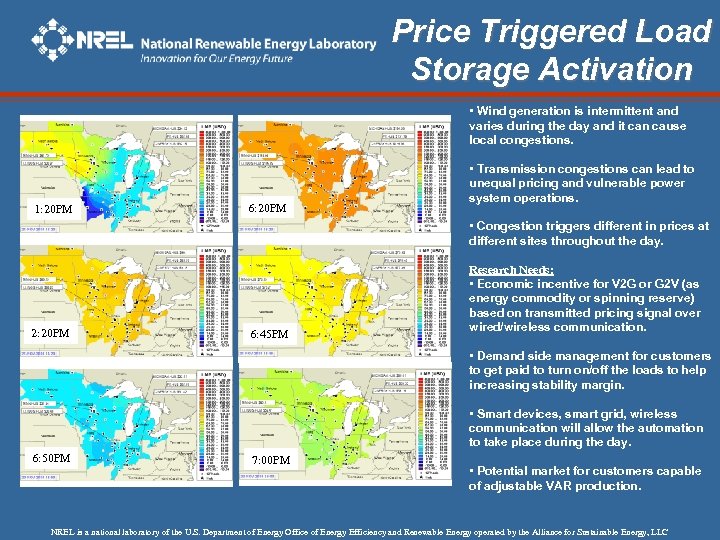
Price Triggered Load Storage Activation • Wind generation is intermittent and varies during the day and it can cause local congestions. 1: 20 PM 6: 20 PM • Transmission congestions can lead to unequal pricing and vulnerable power system operations. • Congestion triggers different in prices at different sites throughout the day. 2: 20 PM 6: 45 PM Research Needs: • Economic incentive for V 2 G or G 2 V (as energy commodity or spinning reserve) based on transmitted pricing signal over wired/wireless communication. • Demand side management for customers to get paid to turn on/off the loads to help increasing stability margin. • Smart devices, smart grid, wireless communication will allow the automation to take place during the day. 6: 50 PM 7: 00 PM • Potential market for customers capable of adjustable VAR production. NREL is a national laboratory of the U. S. Department of Energy Office of Energy Efficiency and Renewable Energy operated by the Alliance for Sustainable Energy, LLC
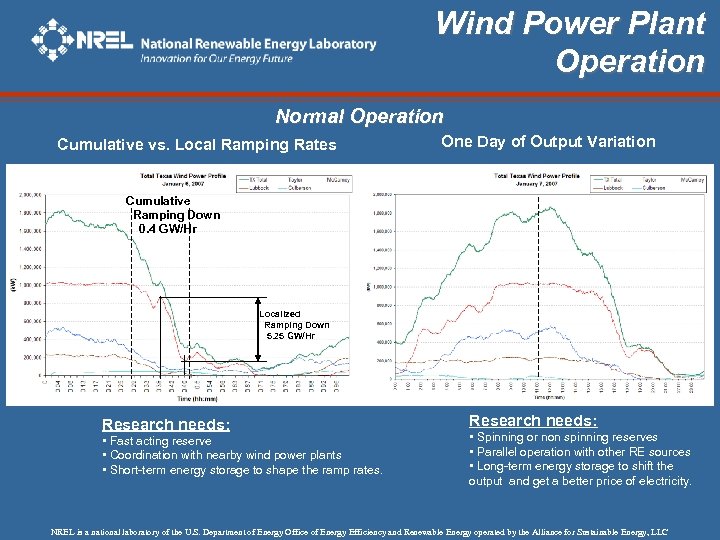
Wind Power Plant Operation Normal Operation Cumulative vs. Local Ramping Rates One Day of Output Variation Cumulative Ramping Down 0. 4 GW/Hr Localized Ramping Down 5. 25 GW/Hr Research needs: • Fast acting reserve • Coordination with nearby wind power plants • Short-term energy storage to shape the ramp rates. Research needs: • Spinning or non spinning reserves • Parallel operation with other RE sources • Long-term energy storage to shift the output and get a better price of electricity. NREL is a national laboratory of the U. S. Department of Energy Office of Energy Efficiency and Renewable Energy operated by the Alliance for Sustainable Energy, LLC
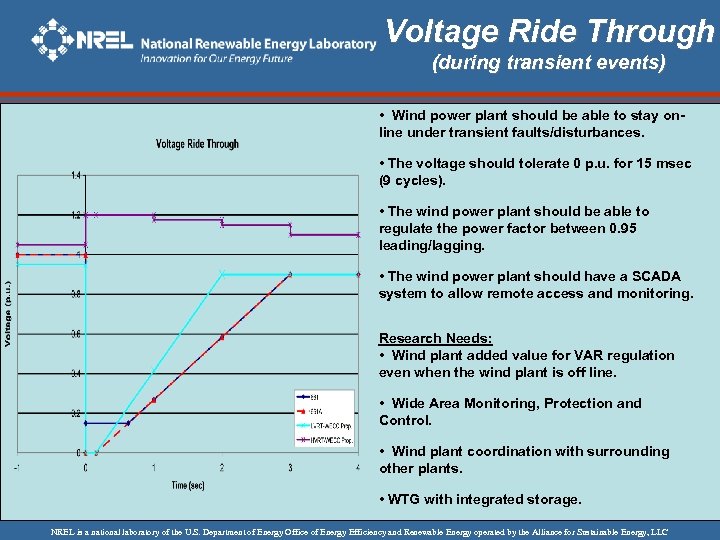
Voltage Ride Through (during transient events) • Wind power plant should be able to stay online under transient faults/disturbances. • The voltage should tolerate 0 p. u. for 15 msec (9 cycles). • The wind power plant should be able to regulate the power factor between 0. 95 leading/lagging. • The wind power plant should have a SCADA system to allow remote access and monitoring. Research Needs: • Wind plant added value for VAR regulation even when the wind plant is off line. • Wide Area Monitoring, Protection and Control. • Wind plant coordination with surrounding other plants. • WTG with integrated storage. NREL is a national laboratory of the U. S. Department of Energy Office of Energy Efficiency and Renewable Energy operated by the Alliance for Sustainable Energy, LLC
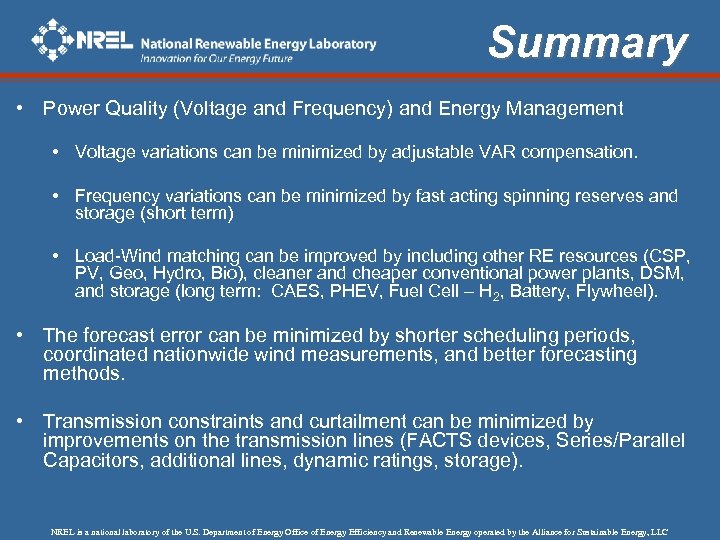
Summary • Power Quality (Voltage and Frequency) and Energy Management • Voltage variations can be minimized by adjustable VAR compensation. • Frequency variations can be minimized by fast acting spinning reserves and storage (short term) • Load-Wind matching can be improved by including other RE resources (CSP, PV, Geo, Hydro, Bio), cleaner and cheaper conventional power plants, DSM, and storage (long term: CAES, PHEV, Fuel Cell – H 2, Battery, Flywheel). • The forecast error can be minimized by shorter scheduling periods, coordinated nationwide wind measurements, and better forecasting methods. • Transmission constraints and curtailment can be minimized by improvements on the transmission lines (FACTS devices, Series/Parallel Capacitors, additional lines, dynamic ratings, storage). NREL is a national laboratory of the U. S. Department of Energy Office of Energy Efficiency and Renewable Energy operated by the Alliance for Sustainable Energy, LLC
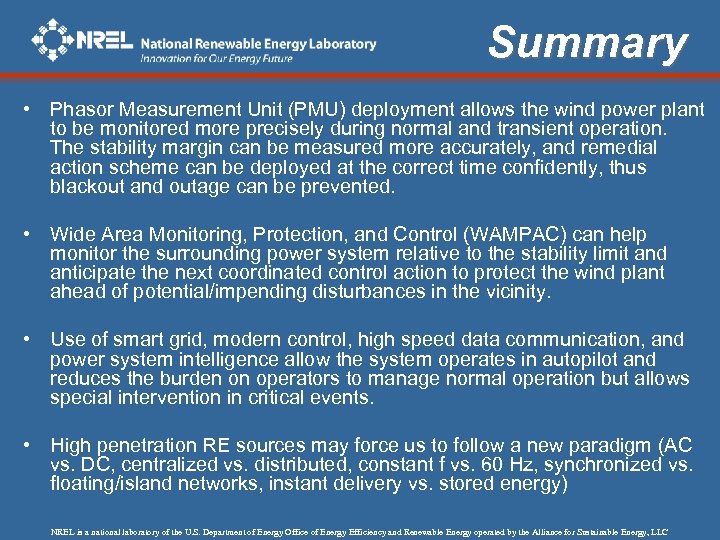
Summary • Phasor Measurement Unit (PMU) deployment allows the wind power plant to be monitored more precisely during normal and transient operation. The stability margin can be measured more accurately, and remedial action scheme can be deployed at the correct time confidently, thus blackout and outage can be prevented. • Wide Area Monitoring, Protection, and Control (WAMPAC) can help monitor the surrounding power system relative to the stability limit and anticipate the next coordinated control action to protect the wind plant ahead of potential/impending disturbances in the vicinity. • Use of smart grid, modern control, high speed data communication, and power system intelligence allow the system operates in autopilot and reduces the burden on operators to manage normal operation but allows special intervention in critical events. • High penetration RE sources may force us to follow a new paradigm (AC vs. DC, centralized vs. distributed, constant f vs. 60 Hz, synchronized vs. floating/island networks, instant delivery vs. stored energy) NREL is a national laboratory of the U. S. Department of Energy Office of Energy Efficiency and Renewable Energy operated by the Alliance for Sustainable Energy, LLC
Скачать презентацию New Challenges in High Penetration Renewable Energy Sources
ea3bc700a83d00004d122bc5725736fe.ppt