


 Скачать презентацию New approaches to the study of the nucleus
b331e915ae8ecef92ee8b3155a8a5b01.ppt
- Количество слайдов: 22
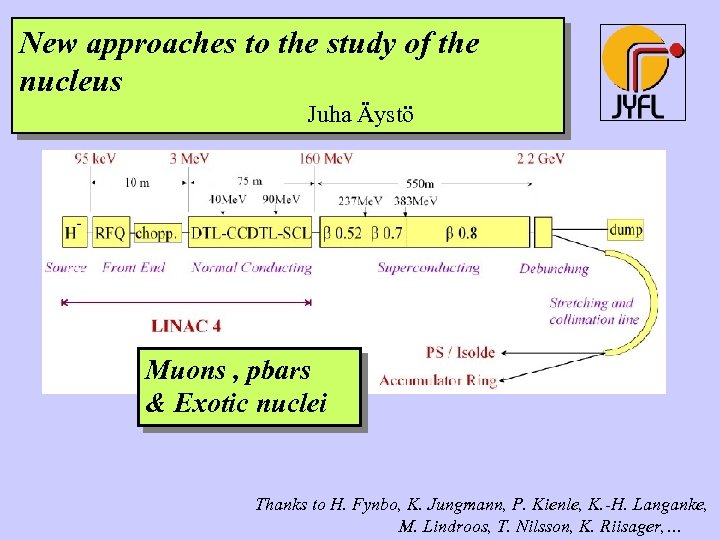 New approaches to the study of the nucleus Juha Äystö Muons , pbars & Exotic nuclei Thanks to H. Fynbo, K. Jungmann, P. Kienle, K. -H. Langanke, M. Lindroos, T. Nilsson, K. Riisager, …
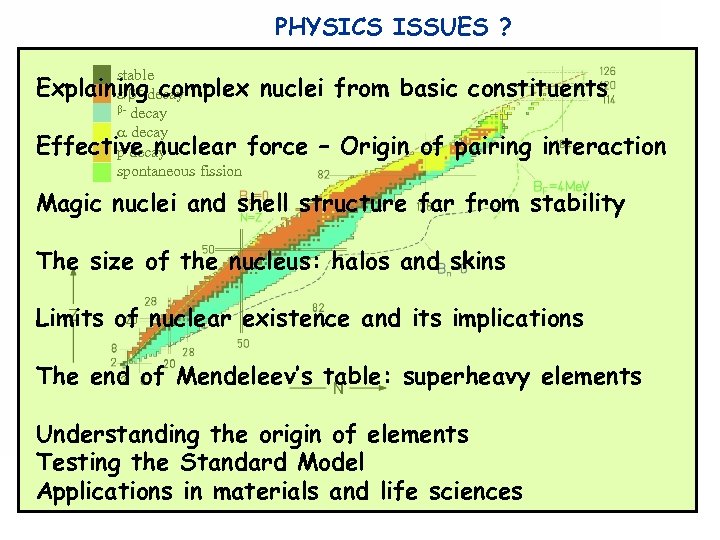 PHYSICS ISSUES ? stable Explainingdecay + complex nuclei from basic constituents - decay Effective nuclear force – Origin of pairing interaction p decay spontaneous fission Magic nuclei and shell structure far from stability The size of the nucleus: halos and skins Limits of nuclear existence and its implications The end of Mendeleev’s table: superheavy elements Understanding the origin of elements Testing the Standard Model Applications in materials and life sciences
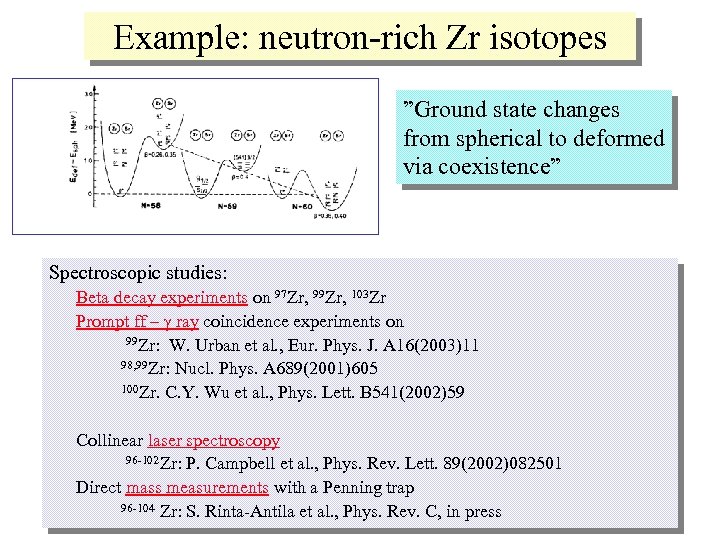 Example: neutron-rich Zr isotopes ”Ground state changes from spherical to deformed via coexistence” Spectroscopic studies: Beta decay experiments on 97 Zr, 99 Zr, 103 Zr Prompt ff – g ray coincidence experiments on 99 Zr: W. Urban et al. , Eur. Phys. J. A 16(2003)11 98, 99 Zr: Nucl. Phys. A 689(2001)605 100 Zr. C. Y. Wu et al. , Phys. Lett. B 541(2002)59 Collinear laser spectroscopy 96 -102 Zr: P. Campbell et al. , Phys. Rev. Lett. 89(2002)082501 Direct mass measurements with a Penning trap 96 -104 Zr: S. Rinta-Antila et al. , Phys. Rev. C, in press
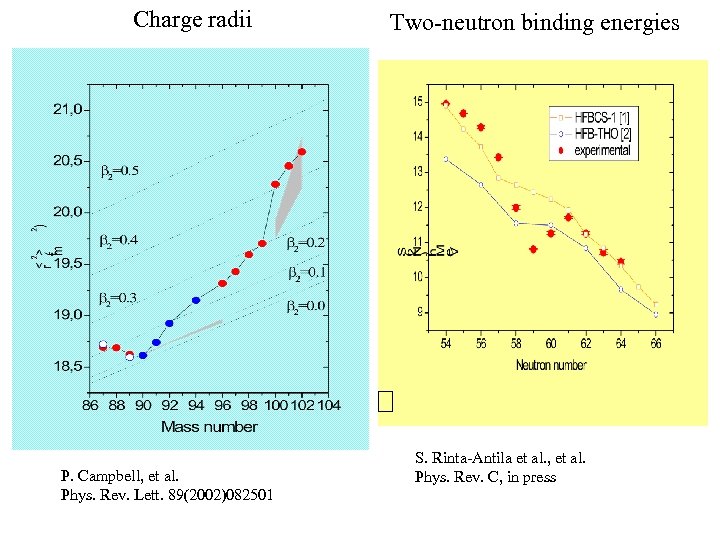 Charge radii P. Campbell, et al. Phys. Rev. Lett. 89(2002)082501 Two-neutron binding energies S. Rinta-Antila et al. , et al. Phys. Rev. C, in press
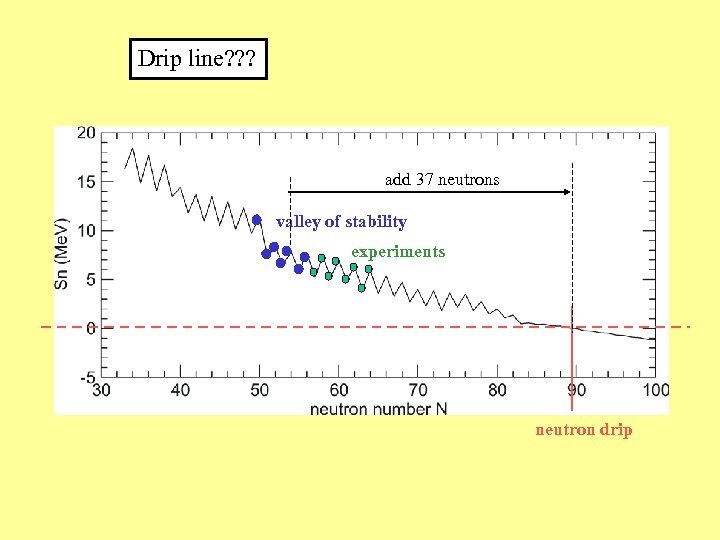 Drip line? ? ? add 37 neutrons valley of stability experiments neutron drip
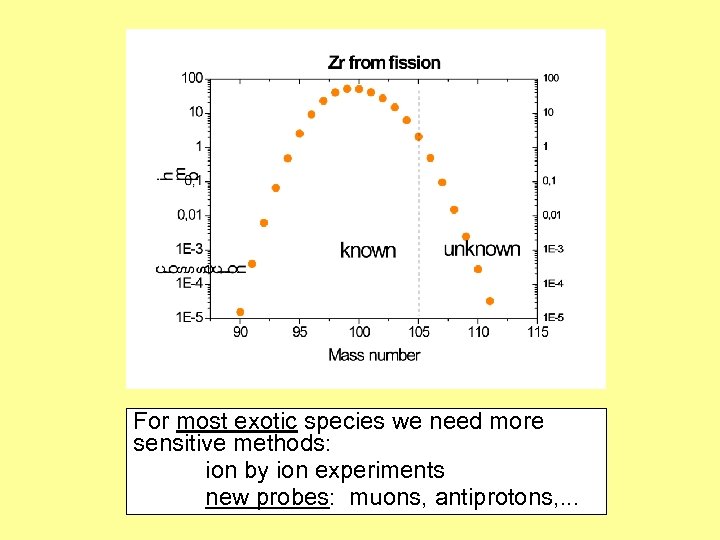 For most exotic species we need more sensitive methods: ion by ion experiments new probes: muons, antiprotons, . . .
 Standard probes of nuclei Mass, size and electromagnetic moments Radioactive decays Nuclear reactions elastic scattering Coulomb excitation Fusion Transfer Electron scattering Interaction cross sections < 1 mbarn !
 Muons (m- ) and radioactive atoms/ions Formation of m- atoms (tfree m ~ 2. 2 ms) Slowing down in matter (~ ns) Atomic capture in high-l state (n~14) Bohr radius ~ n 2/(Zm) Binding energy ~ (Z 2 m)/n 2 Cascade down to nm=1=muonic 1 s orbit (<< ns) Auger electrons muonic X-rays (ke. V Me. V) Large cross section (~ 10 -16 cm 2 ~ 108 b !!!)
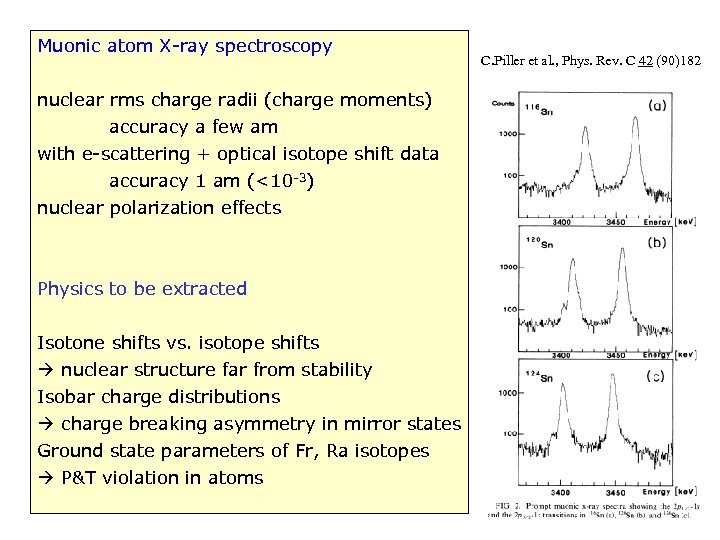 Muonic atom X-ray spectroscopy nuclear rms charge radii (charge moments) accuracy a few am with e-scattering + optical isotope shift data accuracy 1 am (<10 -3) nuclear polarization effects Physics to be extracted Isotone shifts vs. isotope shifts nuclear structure far from stability Isobar charge distributions charge breaking asymmetry in mirror states Ground state parameters of Fr, Ra isotopes P&T violation in atoms C. Piller et al. , Phys. Rev. C 42 (90)182
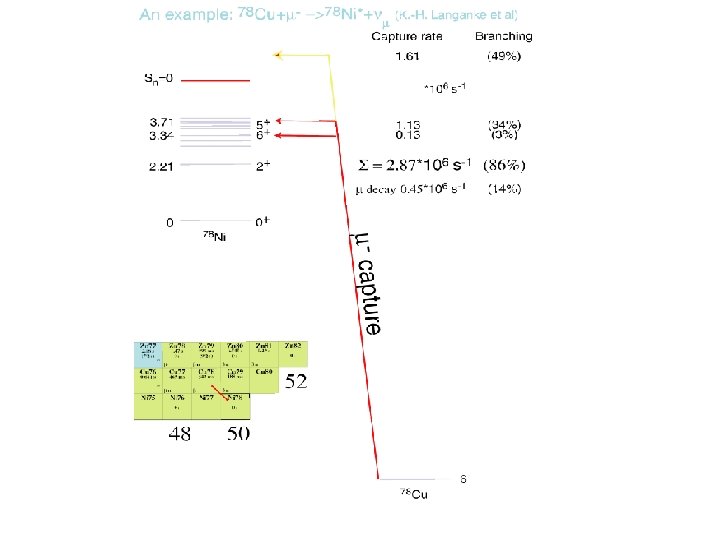
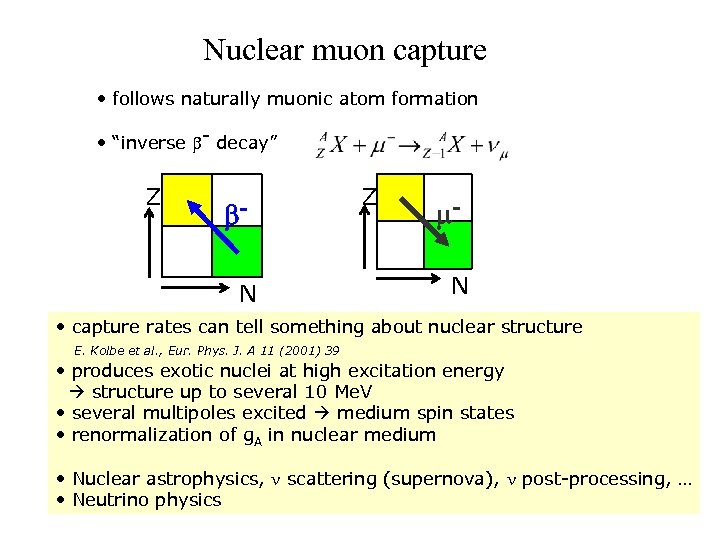 Nuclear muon capture • follows naturally muonic atom formation • “inverse - decay” Z b. N Z m. N • capture rates can tell something about nuclear structure E. Kolbe et al. , Eur. Phys. J. A 11 (2001) 39 • produces exotic nuclei at high excitation energy structure up to several 10 Me. V • several multipoles excited medium spin states • renormalization of g. A in nuclear medium • Nuclear astrophysics, n scattering (supernova), n post-processing, … • Neutrino physics
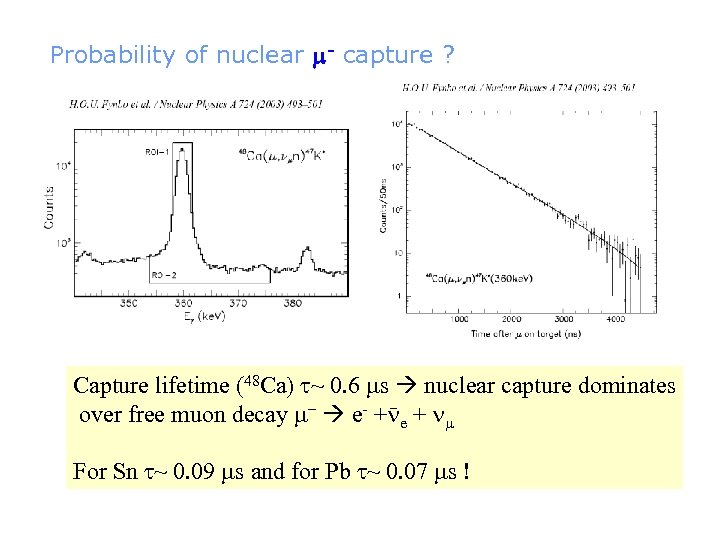 Probability of nuclear m- capture ? Capture lifetime (48 Ca) t~ 0. 6 ms nuclear capture dominates over free muon decay m- e- +ne + nm For Sn t~ 0. 09 ms and for Pb t~ 0. 07 ms !
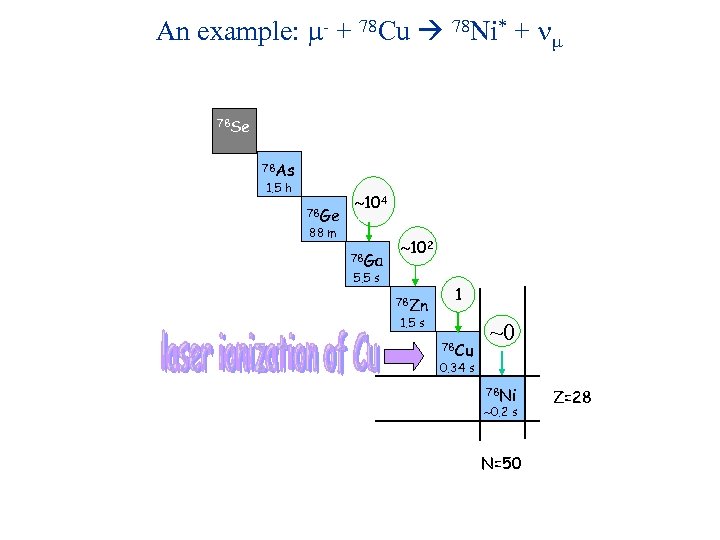 An example: m- + 78 Cu 78 Ni* + nm 78 Se 78 As 1. 5 h 78 Ge 104 88 m 78 Ga 102 5. 5 s 78 Zn 1 1. 5 s 78 Cu ~0 0. 34 s 78 Ni 0. 2 s N=50 Z=28
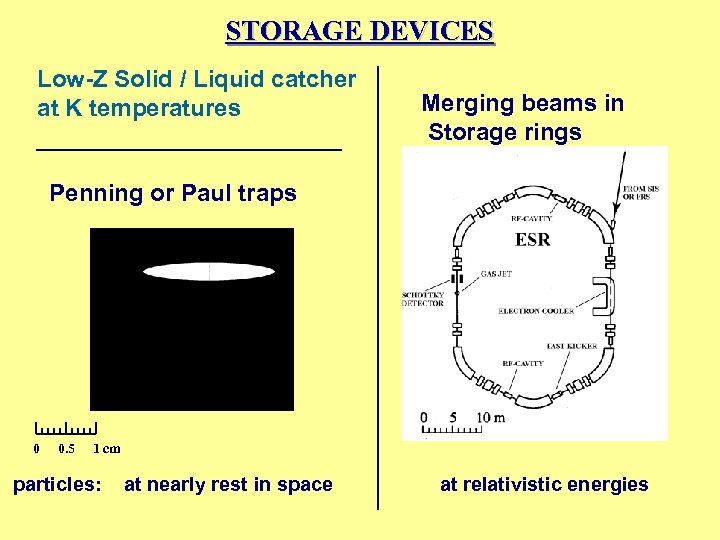 STORAGE DEVICES Low-Z Solid / Liquid catcher at K temperatures Merging beams in Storage rings Penning or Paul traps 0 0. 5 1 cm particles: at nearly rest in space at relativistic energies
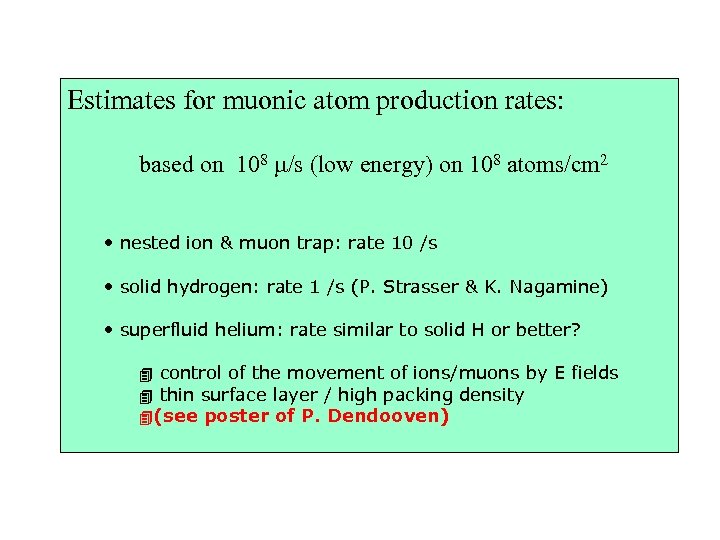 Estimates for muonic atom production rates: based on 108 m/s (low energy) on 108 atoms/cm 2 • nested ion & muon trap: rate 10 /s • solid hydrogen: rate 1 /s (P. Strasser & K. Nagamine) • superfluid helium: rate similar to solid H or better? 4 control of the movement of ions/muons by E fields 4 thin surface layer / high packing density 4(see poster of P. Dendooven)
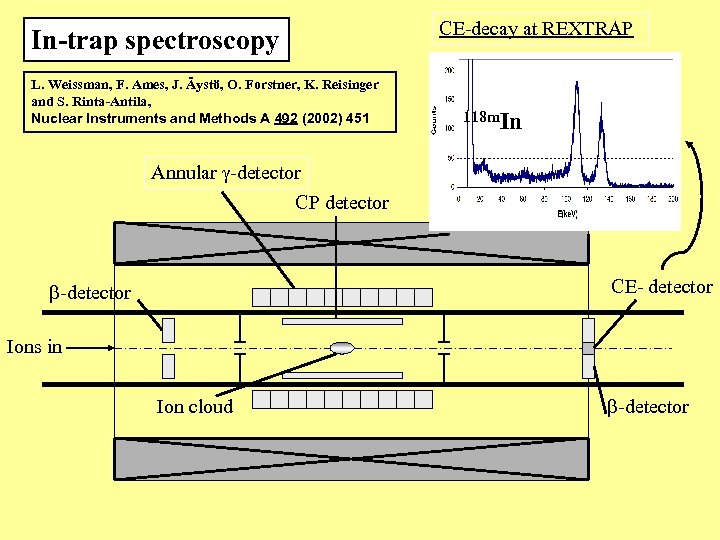 In-trap spectroscopy L. Weissman, F. Ames, J. Äystö, O. Forstner, K. Reisinger and S. Rinta-Antila, Nuclear Instruments and Methods A 492 (2002) 451 CE-decay at REXTRAP 118 m. In Annular g-detector CP detector CE- detector -detector Ions in Ion cloud -detector
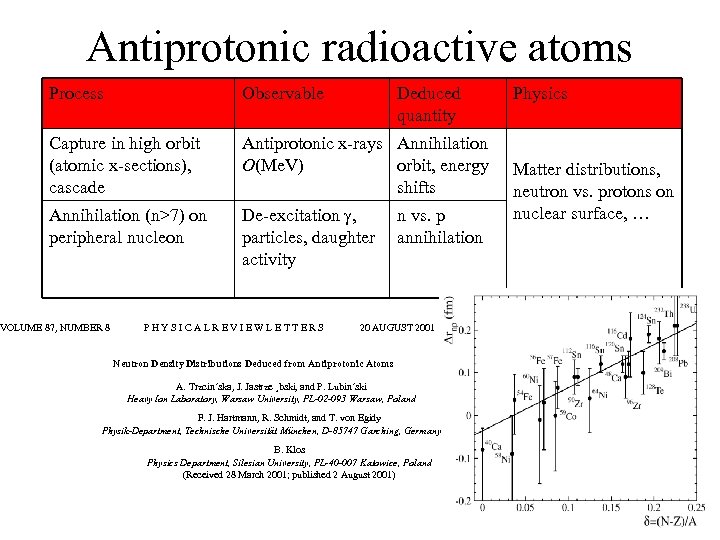 Antiprotonic radioactive atoms Process Observable Capture in high orbit (atomic x-sections), cascade Antiprotonic x-rays Annihilation O(Me. V) orbit, energy shifts Annihilation (n>7) on peripheral nucleon De-excitation g, particles, daughter activity VOLUME 87, NUMBER 8 PHYSICALREVIEWLETTERS Deduced quantity n vs. p annihilation 20 AUGUST 2001 Neutron Density Distributions Deduced from Antiprotonic Atoms A. Trzcin´ska, J. Jastrze ¸bski, and P. Lubin´ski Heavy Ion Laboratory, Warsaw University, PL-02 -093 Warsaw, Poland F. J. Hartmann, R. Schmidt, and T. von Egidy Physik-Department, Technische Universität München, D-85747 Garching, Germany B. Klos Physics Department, Silesian University, PL-40 -007 Katowice, Poland (Received 28 March 2001; published 2 August 2001) Physics Matter distributions, neutron vs. protons on nuclear surface, …
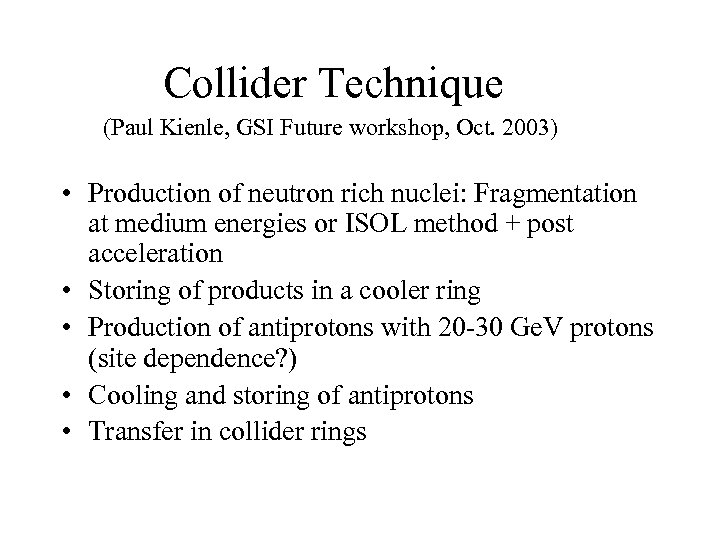 Collider Technique (Paul Kienle, GSI Future workshop, Oct. 2003) • Production of neutron rich nuclei: Fragmentation at medium energies or ISOL method + post acceleration • Storing of products in a cooler ring • Production of antiprotons with 20 -30 Ge. V protons (site dependence? ) • Cooling and storing of antiprotons • Transfer in collider rings
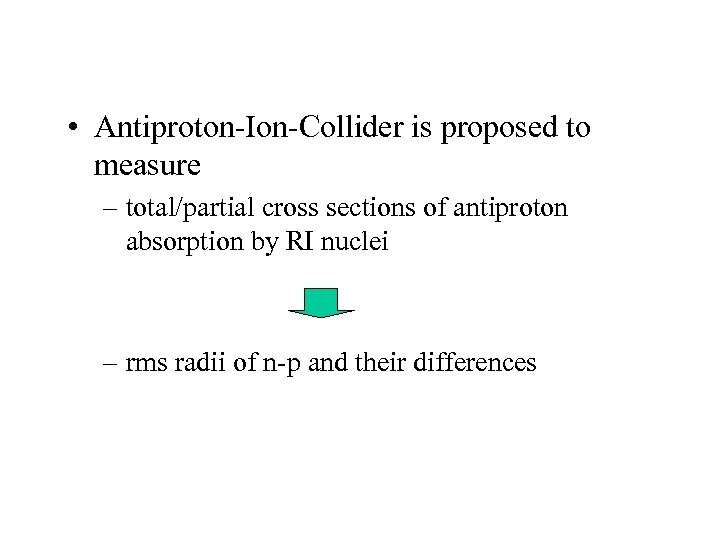 • Antiproton-Ion-Collider is proposed to measure – total/partial cross sections of antiproton absorption by RI nuclei – rms radii of n-p and their differences
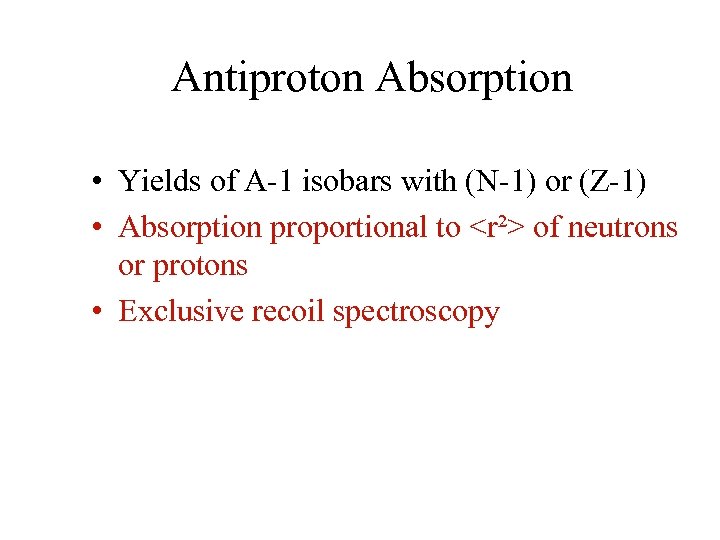 Antiproton Absorption • Yields of A-1 isobars with (N-1) or (Z-1) • Absorption proportional to
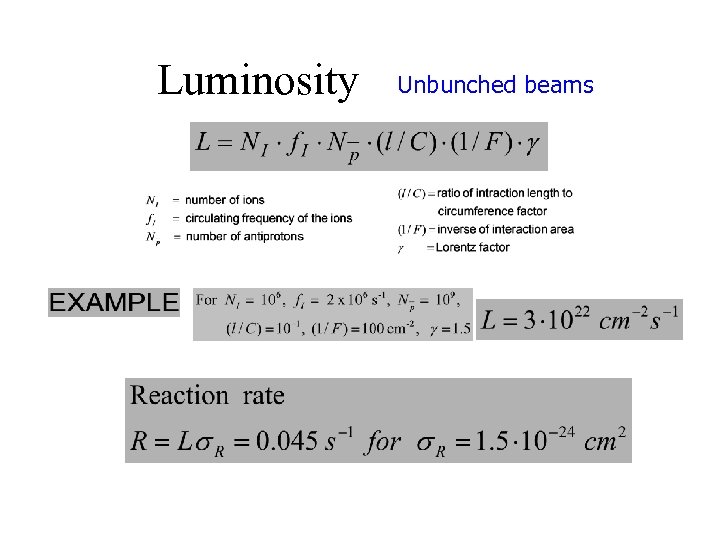 Luminosity Unbunched beams
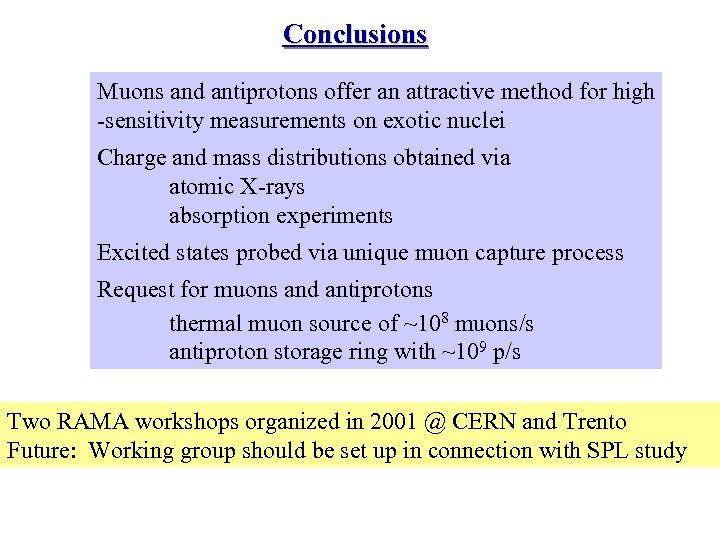 Conclusions Muons and antiprotons offer an attractive method for high -sensitivity measurements on exotic nuclei Charge and mass distributions obtained via atomic X-rays absorption experiments Excited states probed via unique muon capture process Request for muons and antiprotons thermal muon source of ~108 muons/s antiproton storage ring with ~109 p/s Two RAMA workshops organized in 2001 @ CERN and Trento Future: Working group should be set up in connection with SPL study