



 New 7 Wonders of the World.
 New 7 Wonders 1 of the World (2001 -2007) was an initiative started in 2001 to choose Wonders of the World from a selection of 200 existing monuments. The popularity poll was organized by the New Open World Corporation. Winners announced on July 7, 2007 in Lisbon. They were: 1. Wonder – чудо
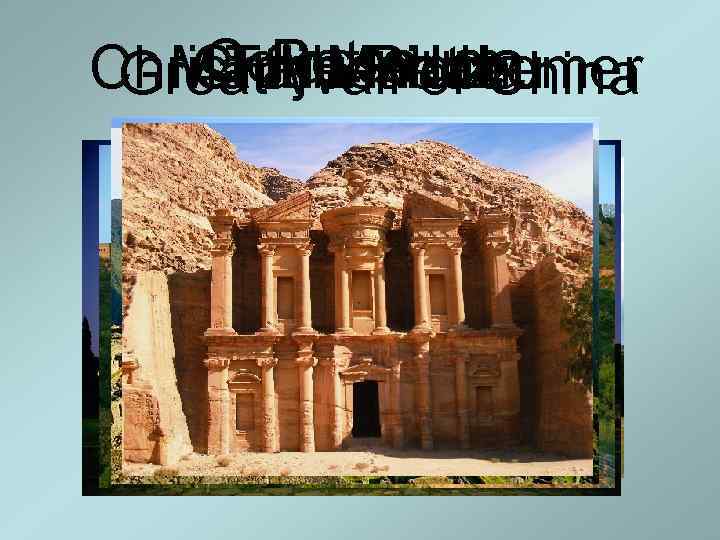 Colosseum Christ the Redeemer Machu Picchu Chichen Itza Taj Mahal Great Petra of China Wall
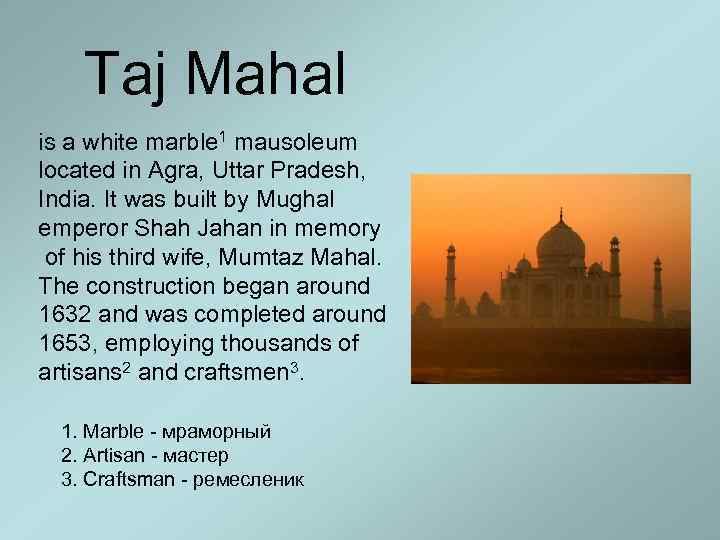 Taj Mahal is a white marble 1 mausoleum located in Agra, Uttar Pradesh, India. It was built by Mughal emperor Shah Jahan in memory of his third wife, Mumtaz Mahal. The construction began around 1632 and was completed around 1653, employing thousands of artisans 2 and craftsmen 3. 1. Marble - мраморный 2. Artisan - мастер 3. Сraftsmаn - ремесленик
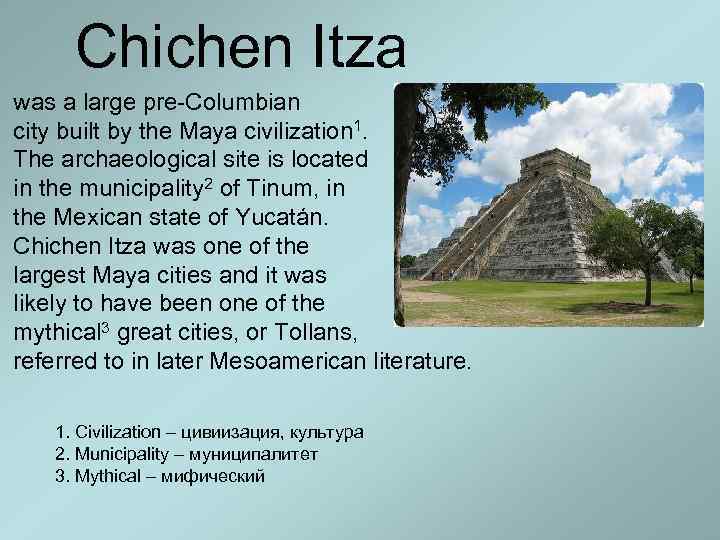 Chichen Itza was a large pre-Columbian city built by the Maya civilization 1. The archaeological site is located in the municipality 2 of Tinum, in the Mexican state of Yucatán. Chichen Itza was one of the largest Maya cities and it was likely to have been one of the mythical 3 great cities, or Tollans, referred to in later Mesoamerican literature. 1. Civilization – цивиизация, культура 2. Municipality – муниципалитет 3. Mythical – мифический
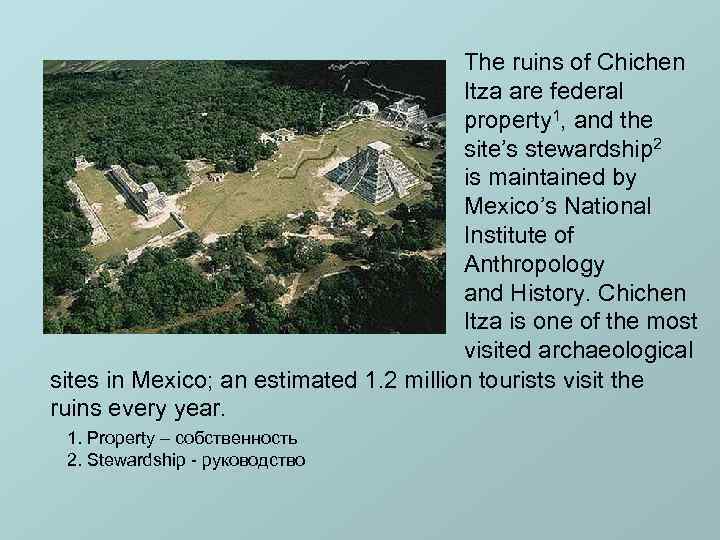 The ruins of Chichen Itza are federal property 1, and the site’s stewardship 2 is maintained by Mexico’s National Institute of Anthropology and History. Chichen Itza is one of the most visited archaeological sites in Mexico; an estimated 1. 2 million tourists visit the ruins every year. 1. Property – собственность 2. Stewardship - руководство
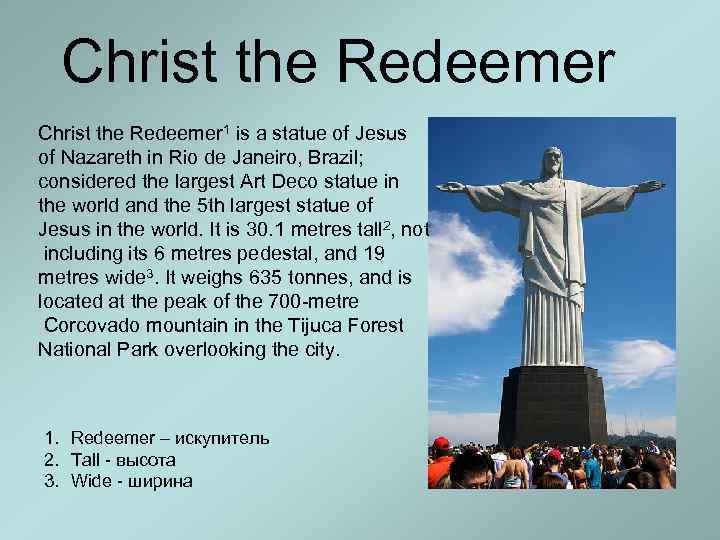 Christ the Redeemer 1 is a statue of Jesus of Nazareth in Rio de Janeiro, Brazil; considered the largest Art Deco statue in the world and the 5 th largest statue of Jesus in the world. It is 30. 1 metres tall 2, not including its 6 metres pedestal, and 19 metres wide 3. It weighs 635 tonnes, and is located at the peak of the 700 -metre Corcovado mountain in the Tijuca Forest National Park overlooking the city. 1. Redeemer – искупитель 2. Tall - высота 3. Wide - ширина
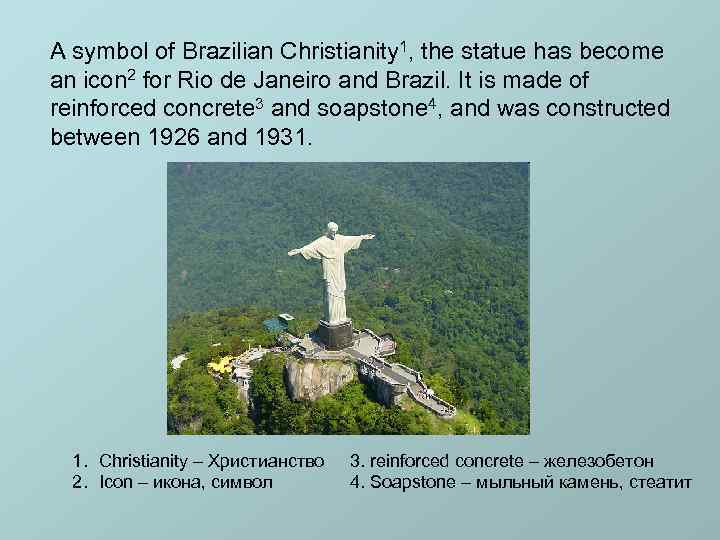 A symbol of Brazilian Christianity 1, the statue has become an icon 2 for Rio de Janeiro and Brazil. It is made of reinforced concrete 3 and soapstone 4, and was constructed between 1926 and 1931. 1. Christianity – Христианство 2. Icon – икона, символ 3. reinforced concrete – железобетон 4. Soapstone – мыльный камень, стеатит
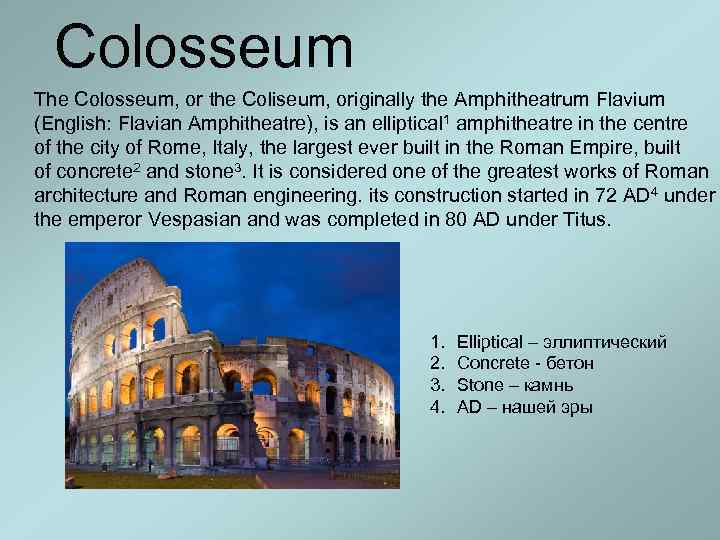 Colosseum The Colosseum, or the Coliseum, originally the Amphitheatrum Flavium (English: Flavian Amphitheatre), is an elliptical 1 amphitheatre in the centre of the city of Rome, Italy, the largest ever built in the Roman Empire, built of concrete 2 and stone 3. It is considered one of the greatest works of Roman architecture and Roman engineering. its construction started in 72 AD 4 under the emperor Vespasian and was completed in 80 AD under Titus. 1. 2. 3. 4. Elliptical – эллиптический Concrete - бетон Stone – камнь AD – нашей эры
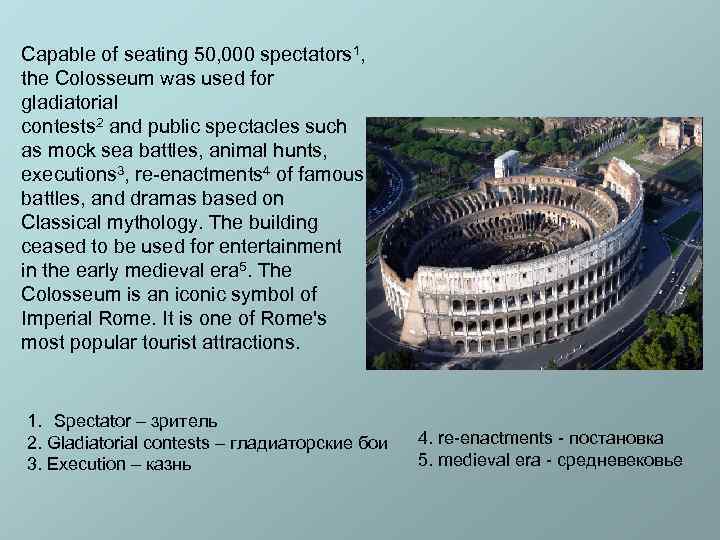 Capable of seating 50, 000 spectators 1, the Colosseum was used for gladiatorial contests 2 and public spectacles such as mock sea battles, animal hunts, executions 3, re-enactments 4 of famous battles, and dramas based on Classical mythology. The building ceased to be used for entertainment in the early medieval era 5. The Colosseum is an iconic symbol of Imperial Rome. It is one of Rome's most popular tourist attractions. 1. Spectator – зритель 2. Gladiatorial contests – гладиаторские бои 3. Execution – казнь 4. re-enactments - постановка 5. medieval era - средневековье
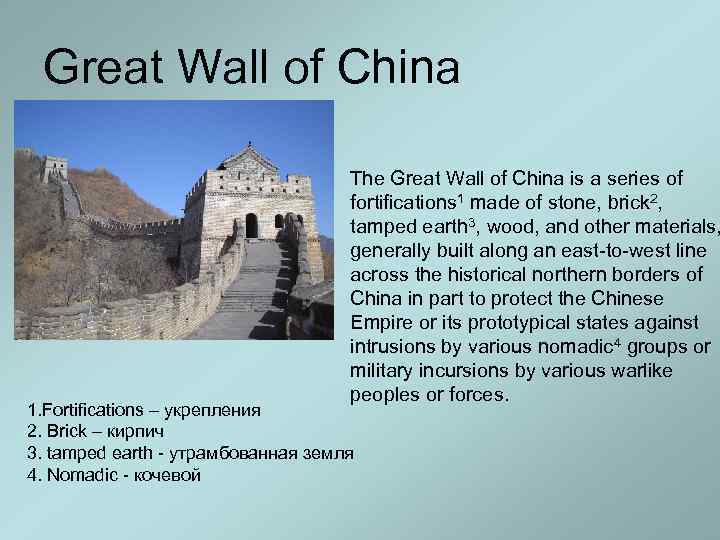 Great Wall of China The Great Wall of China is a series of fortifications 1 made of stone, brick 2, tamped earth 3, wood, and other materials, generally built along an east-to-west line across the historical northern borders of China in part to protect the Chinese Empire or its prototypical states against intrusions by various nomadic 4 groups or military incursions by various warlike peoples or forces. 1. Fortifications – укрепления 2. Brick – кирпич 3. tamped earth - утрамбованная земля 4. Nomadic - кочевой
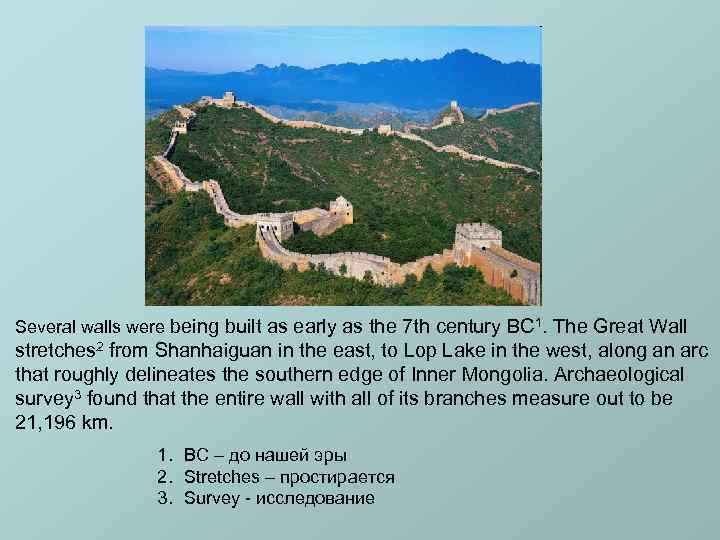 Several walls were being built as early as the 7 th century BC 1. The Great Wall stretches 2 from Shanhaiguan in the east, to Lop Lake in the west, along an arc that roughly delineates the southern edge of Inner Mongolia. Archaeological survey 3 found that the entire wall with all of its branches measure out to be 21, 196 km. 1. BC – до нашей эры 2. Stretches – простирается 3. Survey - исследование
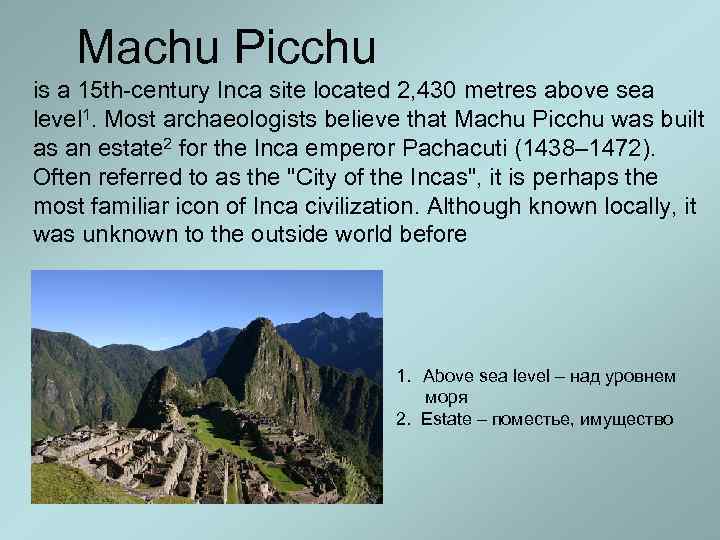 Machu Picchu is a 15 th-century Inca site located 2, 430 metres above sea level 1. Most archaeologists believe that Machu Picchu was built as an estate 2 for the Inca emperor Pachacuti (1438– 1472). Often referred to as the "City of the Incas", it is perhaps the most familiar icon of Inca civilization. Although known locally, it was unknown to the outside world before 1. Аbove sea level – над уровнем моря 2. Estate – поместье, имущество
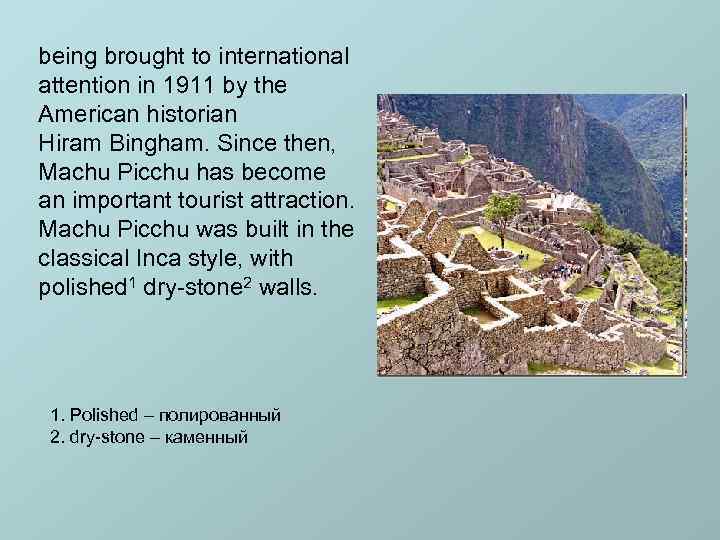 being brought to international attention in 1911 by the American historian Hiram Bingham. Since then, Machu Picchu has become an important tourist attraction. Machu Picchu was built in the classical Inca style, with polished 1 dry-stone 2 walls. 1. Polished – полированный 2. dry-stone – каменный
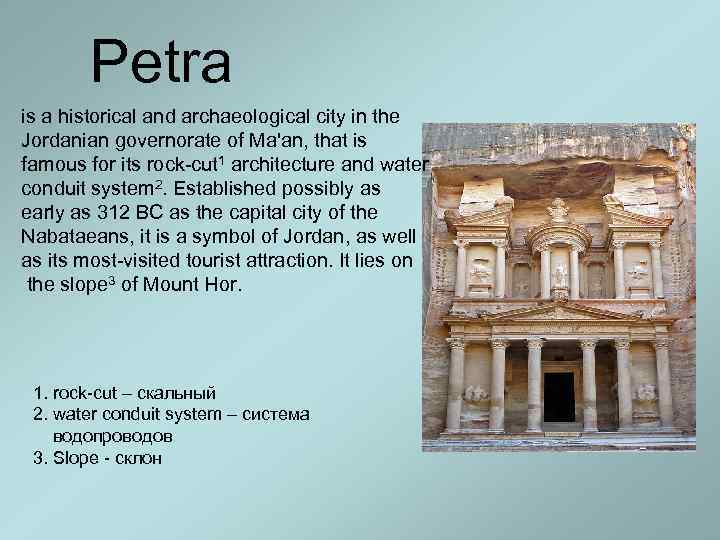 Petra is a historical and archaeological city in the Jordanian governorate of Ma'an, that is famous for its rock-cut 1 architecture and water conduit system 2. Established possibly as early as 312 BC as the capital city of the Nabataeans, it is a symbol of Jordan, as well as its most-visited tourist attraction. It lies on the slope 3 of Mount Hor. 1. rock-cut – скальный 2. water conduit system – система водопроводов 3. Slope - склон
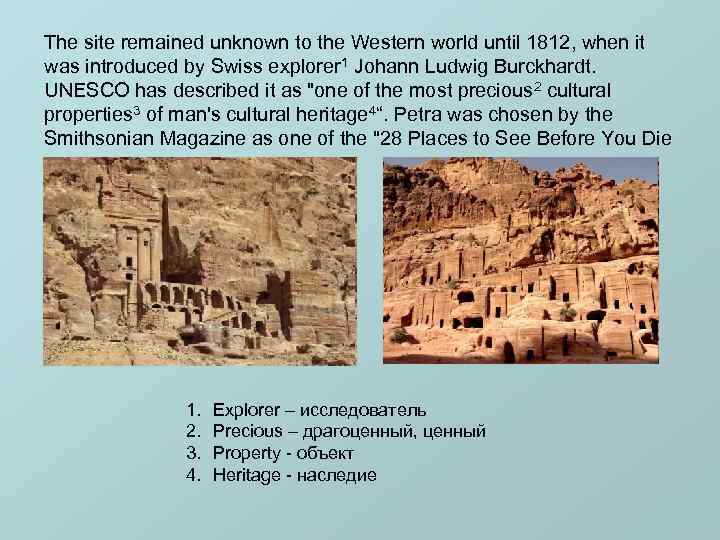 The site remained unknown to the Western world until 1812, when it was introduced by Swiss explorer 1 Johann Ludwig Burckhardt. UNESCO has described it as "one of the most precious 2 cultural properties 3 of man's cultural heritage 4“. Petra was chosen by the Smithsonian Magazine as one of the "28 Places to See Before You Die 1. 2. 3. 4. Explorer – исследователь Precious – драгоценный, ценный Propertу - объект Heritage - наследие
 Test: 1. When were the names of new 7 wonders of the world was announced? a) on June 7, 2007 b) on July 7, 2007 c) on January 7, 2007
 2. List the 7 new wonders of the world. 3. Where is Taj Mahal situated? a) Agra b) Rio de Janeiro c) Yucatán
 4. What civilization built Chichen Itza? a) Maya b) Inca
 5. What place does Christ the Redeemer take among the statues of Jesus in the world? a) 5 th b) 1 st c) 3 rd
 7. How many people can take place in the Colosseum? a) 10000 b) 50000 c) 5000
 8. How long is the Great Wall of China? a) 21196 km b) 37526 km c) 28467 km
 9. What is the most often used name of Machu Picchu? a) Village of the Incas b) Country of the Incas c) City of the Incas
 10. What is Petra famous for? a) Its big houses b) its rock-cut architecture and water conduit system c) Its length