


 Скачать презентацию Neutron Stars Gradual compression of a stellar
cb42d3067cedfadc644d5455882d9090.ppt
- Количество слайдов: 17
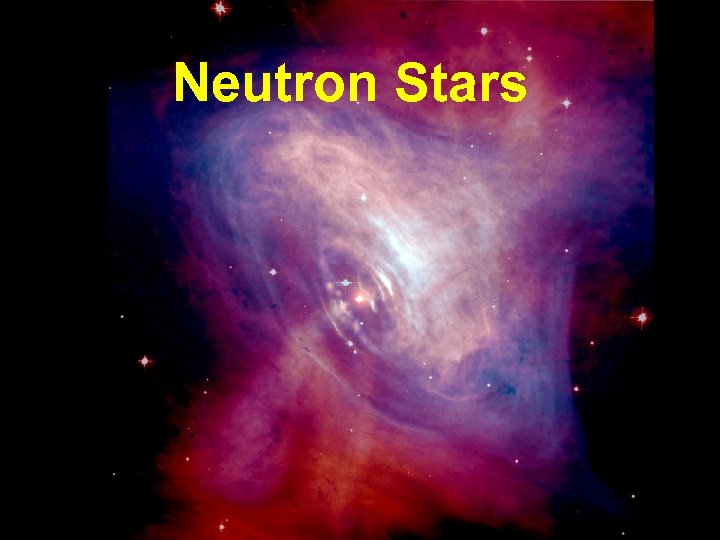 Neutron Stars
![Gradual compression of a stellar iron core rtrans. [g cm-3] Degen. pressure Iron nuclei;](https://present5.com/presentation/cb42d3067cedfadc644d5455882d9090/image-2.jpg "Gradual compression of a stellar iron core rtrans. [g cm-3] Degen. pressure Iron nuclei;") Gradual compression of a stellar iron core rtrans. [g cm-3] Degen. pressure Iron nuclei; nonrel. free e~ 106 Composition nonrel. e- Electrons become relativ. Iron nuclei; relativ. free e- ~ 109 ~ 4 x 10¹¹ relativ. ee. Fe ~ (mn – mp - me) c 2 p + e - → n + ne relativ. e- neutron drip Neutron-rich nuclei; free n; free rel. e- ~4 x 10¹² p. F e ~ m e c neutronization Neutron-rich nuclei (6228 Ni, 6428 Ni, 6628 Ni); rel. free e- Remarks n become degen. and stable outside of nuclei relativ. e- Neutron degen. pressure dominates Neutron-rich nuclei; superfluid free n; rel. free e- 2 x 10¹⁴ Superfluid free n; superconducting free p; rel. free e- 4 x 10¹⁴ n form bosonic pairs → superfluidity neutron p form bosonic pairs → superfl. & supercond. Nuclei dissolve ~ rat. nucl. neutron pion production free n, p, e, other elem. particles (p, …) neutron
Gradual compression of a stellar iron core rtrans. [g cm-3] Degen. pressure Iron nuclei; nonrel. free e~ 106 Composition nonrel. e- Electrons become relativ. Iron nuclei; relativ. free e- ~ 109 ~ 4 x 10¹¹ relativ. ee. Fe ~ (mn – mp - me) c 2 p + e - → n + ne relativ. e- neutron drip Neutron-rich nuclei; free n; free rel. e- ~4 x 10¹² p. F e ~ m e c neutronization Neutron-rich nuclei (6228 Ni, 6428 Ni, 6628 Ni); rel. free e- Remarks n become degen. and stable outside of nuclei relativ. e- Neutron degen. pressure dominates Neutron-rich nuclei; superfluid free n; rel. free e- 2 x 10¹⁴ Superfluid free n; superconducting free p; rel. free e- 4 x 10¹⁴ n form bosonic pairs → superfluidity neutron p form bosonic pairs → superfl. & supercond. Nuclei dissolve ~ rat. nucl. neutron pion production free n, p, e, other elem. particles (p, …) neutron
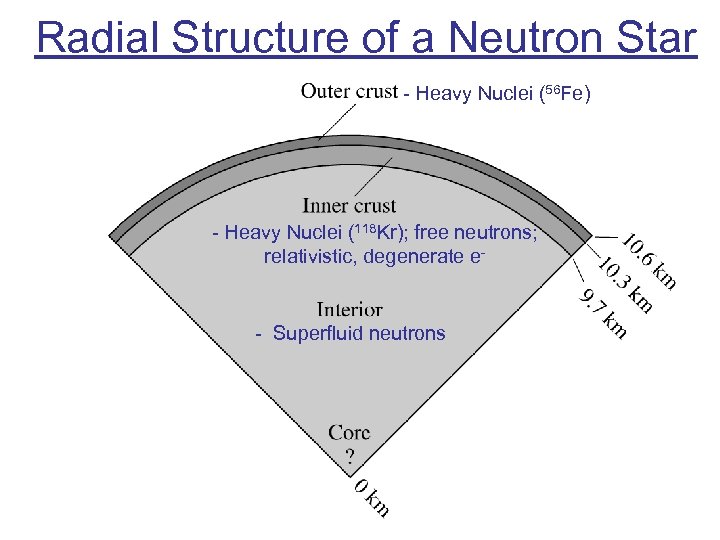 Radial Structure of a Neutron Star - Heavy Nuclei (56 Fe) - Heavy Nuclei (118 Kr); free neutrons; relativistic, degenerate e- - Superfluid neutrons
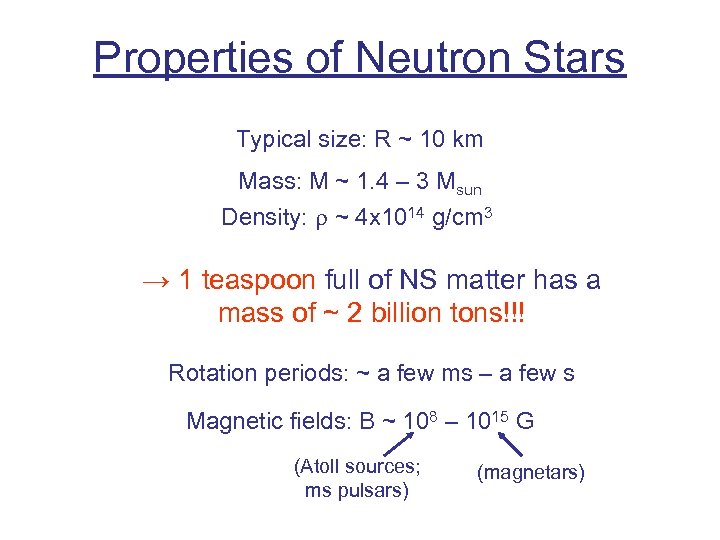 Properties of Neutron Stars Typical size: R ~ 10 km Mass: M ~ 1. 4 – 3 Msun Density: r ~ 4 x 10¹⁴ g/cm 3 → 1 teaspoon full of NS matter has a mass of ~ 2 billion tons!!! Rotation periods: ~ a few ms – a few s Magnetic fields: B ~ 108 – 1015 G (Atoll sources; ms pulsars) (magnetars)
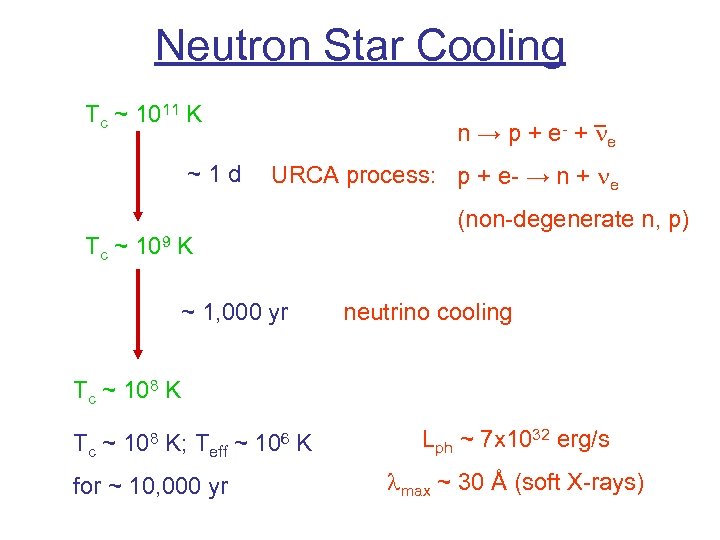 Neutron Star Cooling Tc ~ 1011 K ~1 d n → p + e - + ne URCA process: p + e- → n + ne Tc ~ 109 K ~ 1, 000 yr (non-degenerate n, p) neutrino cooling Tc ~ 108 K; Teff ~ 106 K for ~ 10, 000 yr Lph ~ 7 x 1032 erg/s lmax ~ 30 Å (soft X-rays)
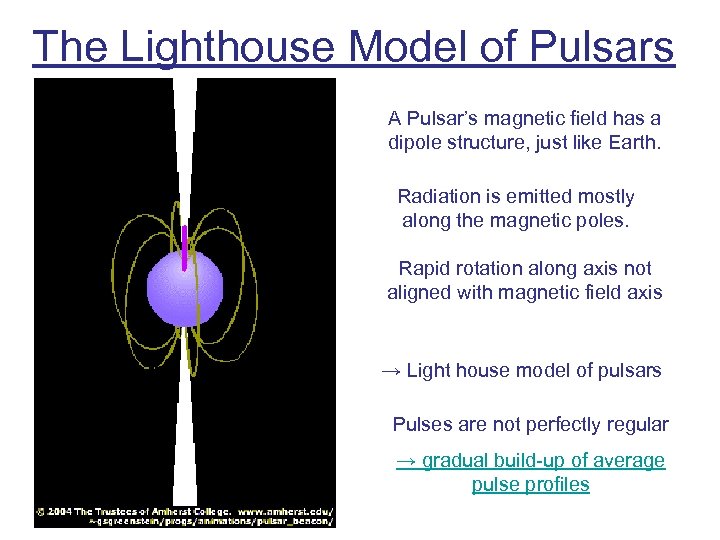 The Lighthouse Model of Pulsars A Pulsar’s magnetic field has a dipole structure, just like Earth. Radiation is emitted mostly along the magnetic poles. Rapid rotation along axis not aligned with magnetic field axis → Light house model of pulsars Pulses are not perfectly regular → gradual build-up of average pulse profiles
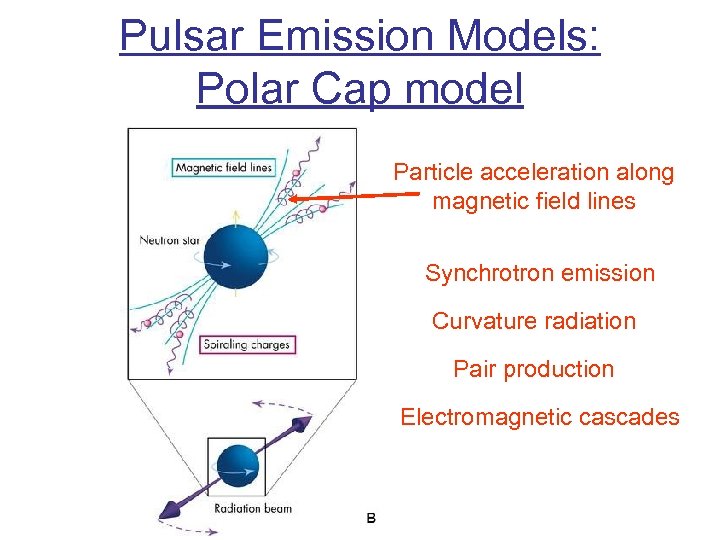 Pulsar Emission Models: Polar Cap model Particle acceleration along magnetic field lines Synchrotron emission Curvature radiation Pair production Electromagnetic cascades
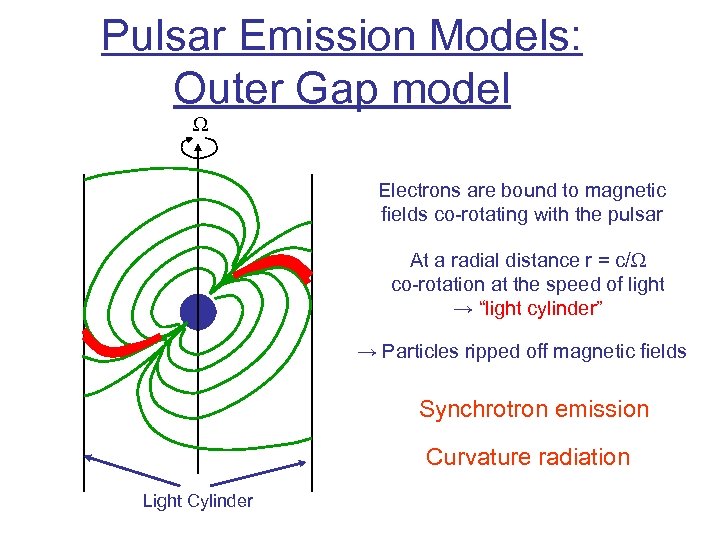 Pulsar Emission Models: Outer Gap model W Electrons are bound to magnetic fields co-rotating with the pulsar At a radial distance r = c/W co-rotation at the speed of light → “light cylinder” → Particles ripped off magnetic fields Synchrotron emission Curvature radiation Light Cylinder
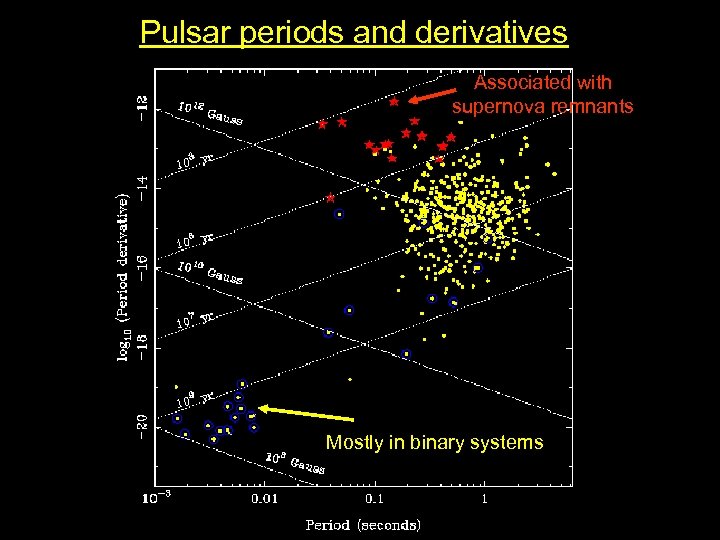 Pulsar periods and derivatives Associated with supernova remnants Mostly in binary systems
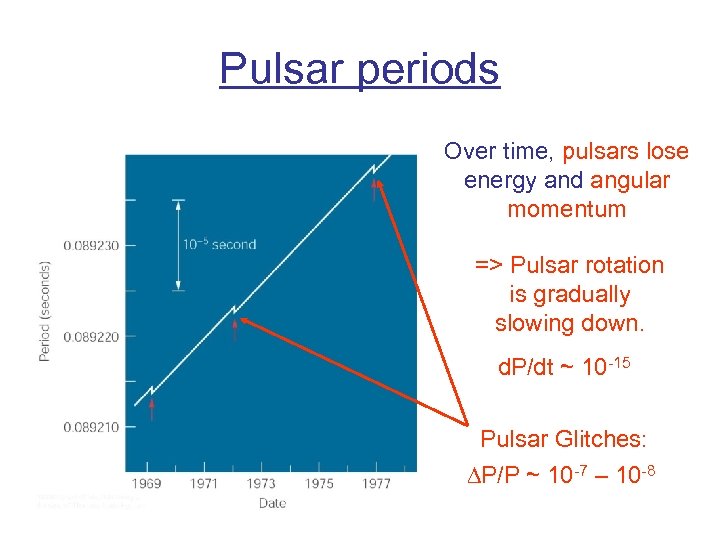 Pulsar periods Over time, pulsars lose energy and angular momentum => Pulsar rotation is gradually slowing down. d. P/dt ~ 10 -15 Pulsar Glitches: DP/P ~ 10 -7 – 10 -8
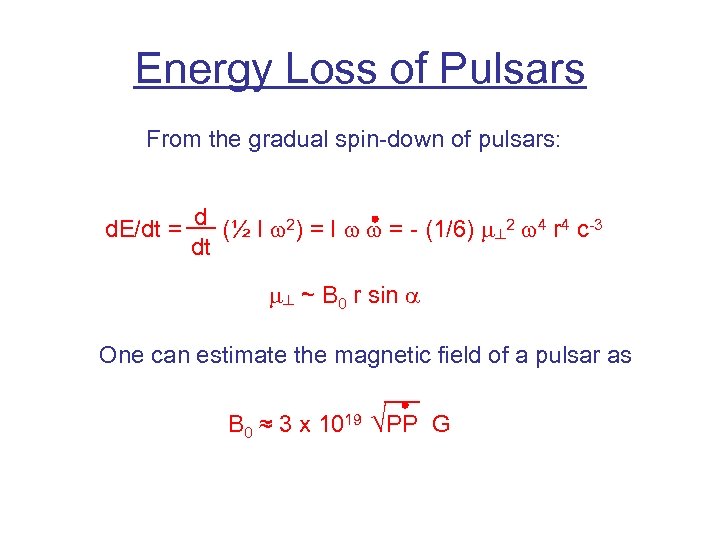 Energy Loss of Pulsars From the gradual spin-down of pulsars: d. E/dt = d (½ I w 2) = I w w = - (1/6) m┴ 2 w 4 r 4 c-3 dt m┴ ~ B 0 r sin a One can estimate the magnetic field of a pulsar as B 0 ≈ 3 x 10¹⁹ √PP G
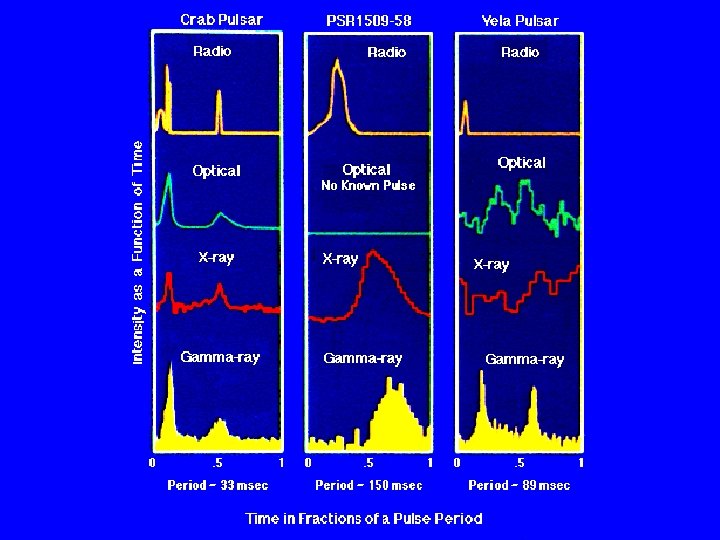
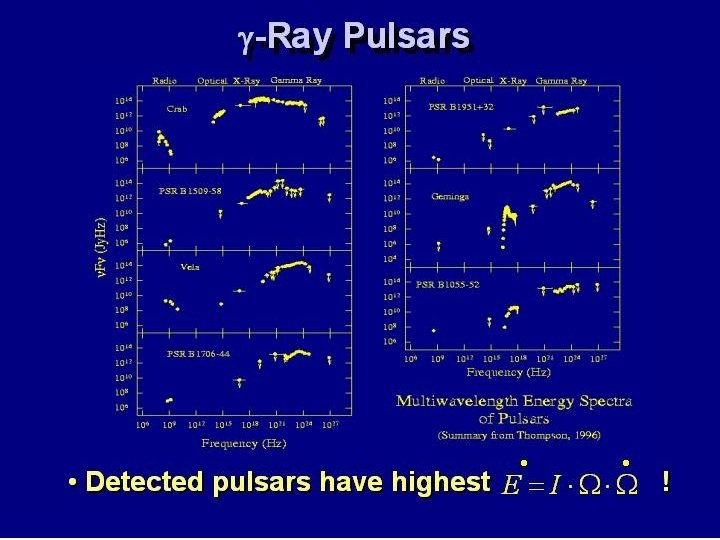
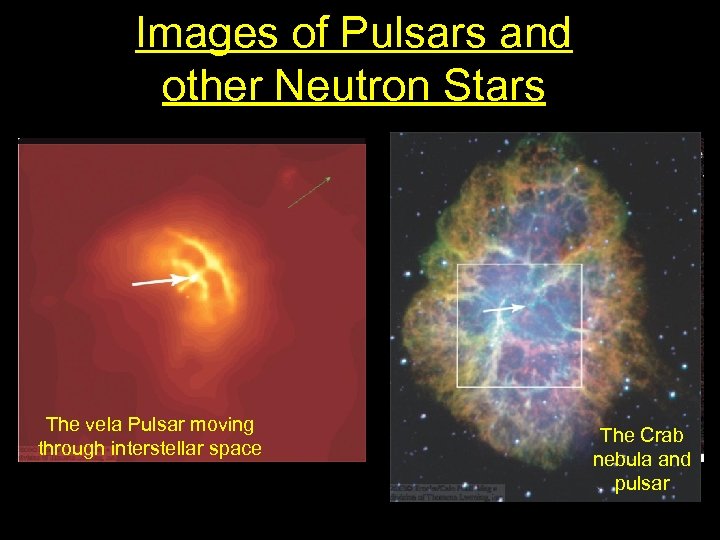 Images of Pulsars and other Neutron Stars The vela Pulsar moving through interstellar space The Crab nebula and pulsar
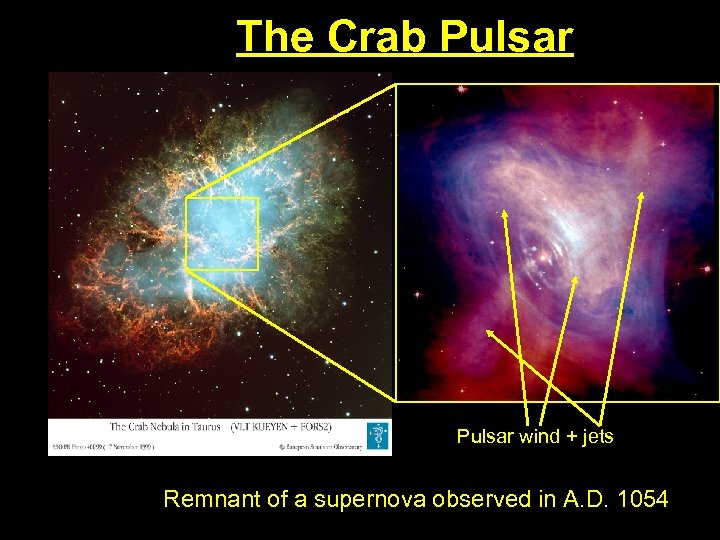 The Crab Pulsar wind + jets Remnant of a supernova observed in A. D. 1054
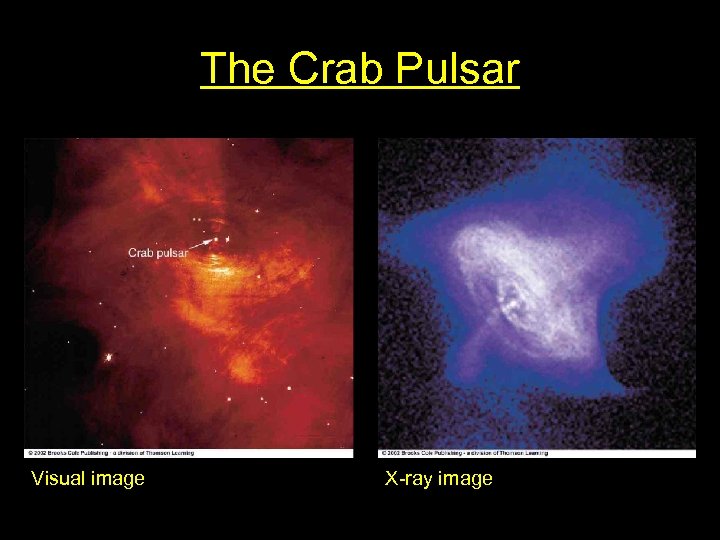 The Crab Pulsar Visual image X-ray image
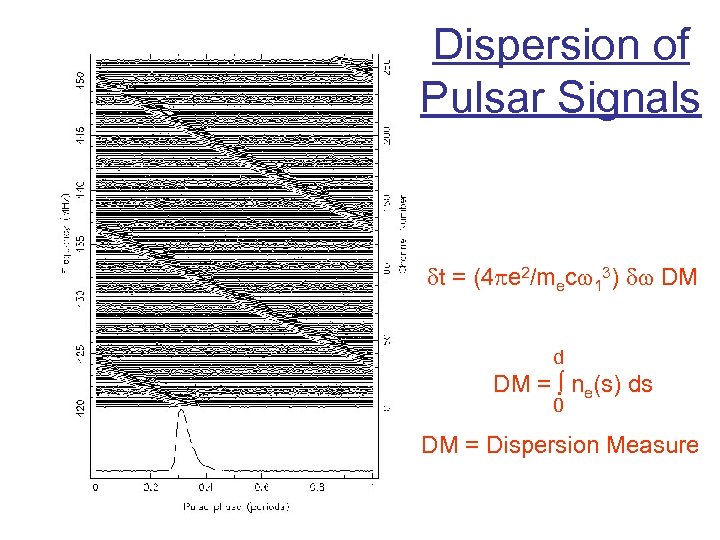 Dispersion of Pulsar Signals dt = (4 pe 2/mecw 13) dw DM d DM = ∫ ne(s) ds 0 DM = Dispersion Measure