Скачать презентацию Neutrino Town Meeting CERN May 14 -16
848419bcbeeee0274aae62e856898c1f.ppt
- Количество слайдов: 41
 Neutrino Town Meeting CERN – May 14 -16, 2012 SPL R&D and Potential Applications R. Garoby for the SPL team* O. Brunner, S. Calatroni, O. Capatina, E. Ciapala, F. Gerigk, E. Montesinos, V. Parma, K. M. Schirm, + I. Aviles Santillana **, R. Bonomi **, J. Chambrillon, P. Coelho Azevedo**, K. Liao, N. Valverde Alonso** ** supported by ESS
 HP-SPL: R&D Management
 Resources • R & D for a High Power SPL formally supported at CERN in view of multiple future potential applications Þ ~1. 7 MCHF and 6 FTEs / year • Collaboration with ESS Þ Fellows and procurement of klystron modulator for SM 18 • French in-kind contribution Þ Tuners, Helium tanks, use of Saclay 704 MHz high power test place… • EC-supported programmes • Eu. CARD (WP 10) Þ Development and test of beta=1 (CEA) and beta=0. 65 (IN 2 P 3) 5 cells cavities • CRISP (WP 4) Þ Joint work with ESS and DESY Þ EC-supported manpower for upgrading and exploiting the SM 18 test place • LAGUNA-LBNO Þ EC-supported fellow for studying proton drivers at CERN using LP- or HP-SPL • DOE-supported programme • BNL Þ Development and test of a b=1 cavity Ø SPL documentation in EDMS [ https: //edms. cern. ch/nav/SLHC-000008 ] Ø SPL meetings in Indico [ http: //indico. cern. ch/category. Display. py? categ. Id=1893 ] R. G. – 15/05/2012 3
 Organization (at CERN) Guideline «Project-like» structure aimed at meeting the objectives of the HP-SPL R&D: • • • Building and testing a prototype cryomodule with 4 cavities Updating CERN infrastructure and competence in superconducting RF technology Preparing submission of future subjects of R&D [design and construction of a full-size cryomodule, high power RF sources, HIPIMS (High Power Impulse Magnetron Sputtering)…] Work Units - Design, construction and test of the prototype cryomodule (Leader: V. Parma) - Components: Cryomodule, Cavities, RF items (Couplers, tuners, …), cryogenics equipment… - Assembly (with adequate tools): cavities string in clean room, inclusion in cryomodule - Tests: cavities in vertical cryostat, assembled cryomodule in bunker. - Upgrade of the SM 18 infrastructure - - (Leader: O. Brunner) HP water rinsing system and upgraded clean roon Cryogenics for efficient operation at 2 K High power RF at 704 MHz (klystron, modulator, high power distribution) Low Level RF and controls SC RF cavities technology (Leader: E. Ciapala) - Fabrication and processing - Test, diagnostics and analysis R. G. – 15/05/2012 4
 HP-SPL: Baseline Design Parameters
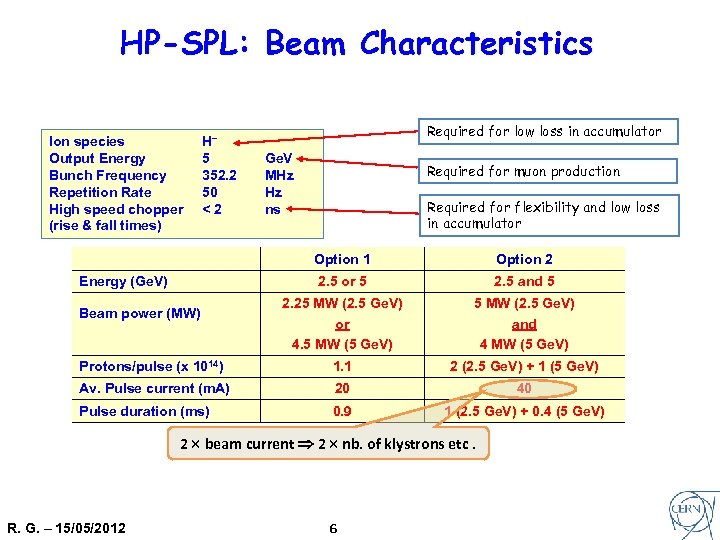 HP-SPL: Beam Characteristics Ion species Output Energy Bunch Frequency Repetition Rate High speed chopper (rise & fall times) H− 5 352. 2 50 <2 Required for low loss in accumulator Ge. V MHz Hz ns Required for muon production Required for flexibility and low loss in accumulator Option 1 Option 2 2. 5 or 5 2. 5 and 5 2. 25 MW (2. 5 Ge. V) or 4. 5 MW (5 Ge. V) 5 MW (2. 5 Ge. V) and 4 MW (5 Ge. V) Protons/pulse (x 1014) 1. 1 2 (2. 5 Ge. V) + 1 (5 Ge. V) Av. Pulse current (m. A) 20 40 Pulse duration (ms) 0. 9 1 (2. 5 Ge. V) + 0. 4 (5 Ge. V) Energy (Ge. V) Beam power (MW) 2 ´ beam current Þ 2 ´ nb. of klystrons etc. R. G. – 15/05/2012 6
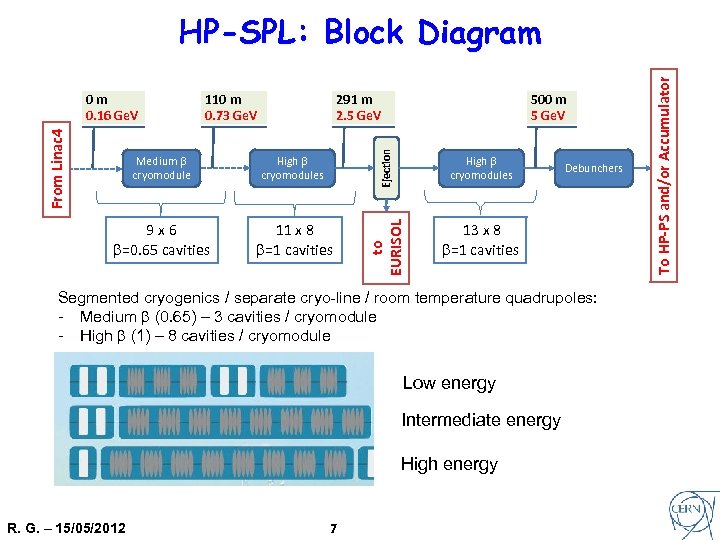 291 m 2. 5 Ge. V 500 m 5 Ge. V Medium b cryomodule High b cryomodules Ejection 110 m 0. 73 Ge. V High b cryomodules 9 x 6 b=0. 65 cavities 11 x 8 b=1 cavities to EURISOL From Linac 4 0 m 0. 16 Ge. V 13 x 8 b=1 cavities Debunchers Segmented cryogenics / separate cryo-line / room temperature quadrupoles: - Medium b (0. 65) – 3 cavities / cryomodule - High b (1) – 8 cavities / cryomodule Low energy Intermediate energy High energy R. G. – 15/05/2012 7 To HP-PS and/or Accumulator HP-SPL: Block Diagram
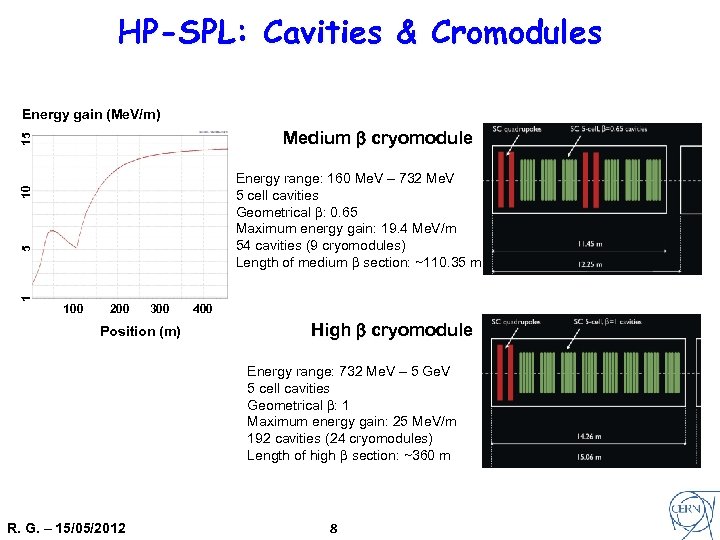 HP-SPL: Cavities & Cromodules Energy gain (Me. V/m) 15 Medium b cryomodule 1 5 10 Energy range: 160 Me. V – 732 Me. V 5 cell cavities Geometrical b: 0. 65 Maximum energy gain: 19. 4 Me. V/m 54 cavities (9 cryomodules) Length of medium b section: ~110. 35 m 100 200 300 Position (m) 400 High b cryomodule Energy range: 732 Me. V – 5 Ge. V 5 cell cavities Geometrical b: 1 Maximum energy gain: 25 Me. V/m 192 cavities (24 cryomodules) Length of high b section: ~360 m R. G. – 15/05/2012 8
 Status and Plans of R&D
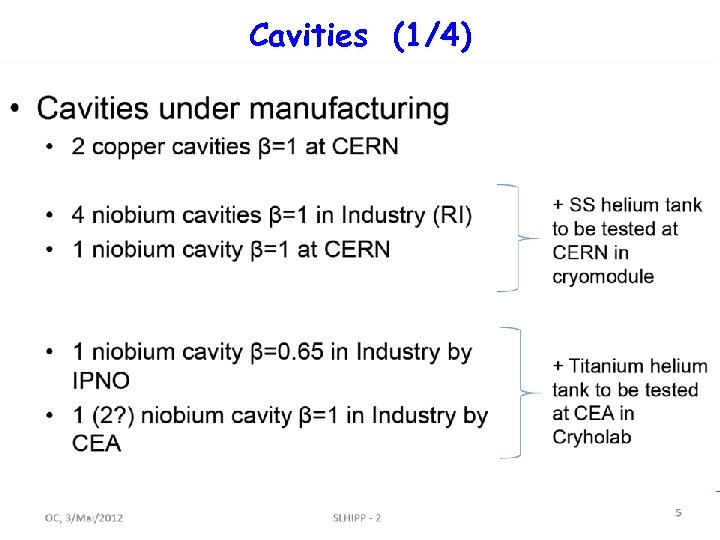 Cavities (1/4) R. G. – 15/05/2012 10
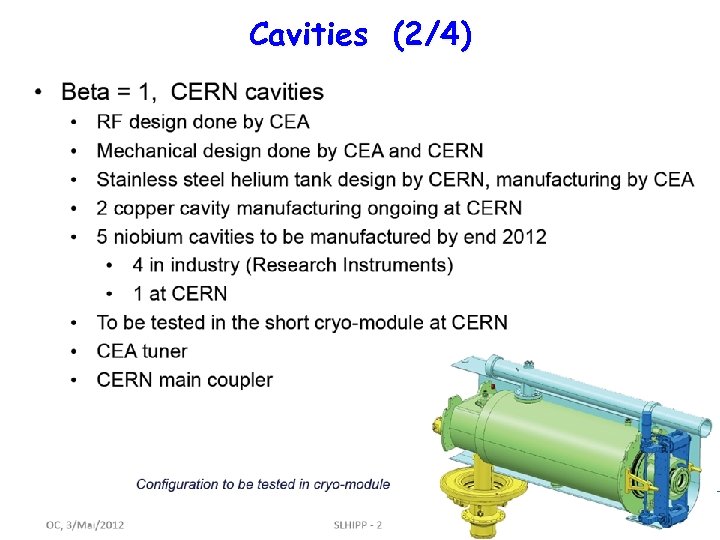 Cavities (2/4) R. G. – 15/05/2012 11
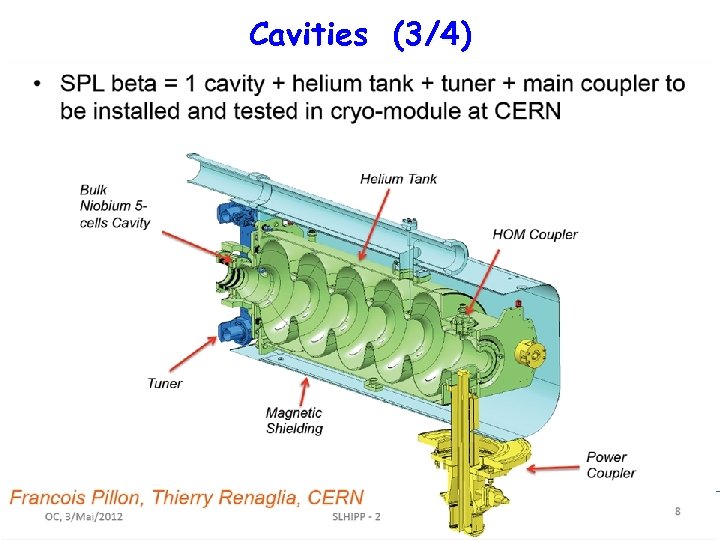 Cavities (3/4) R. G. – 15/05/2012 12
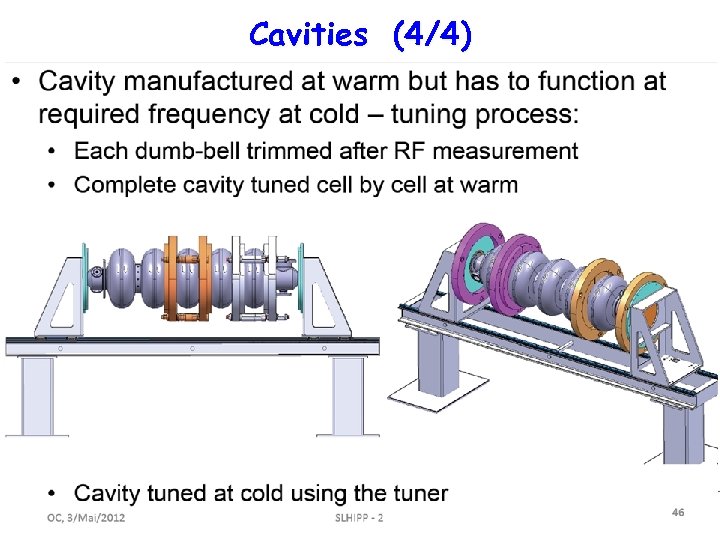 Cavities (4/4) R. G. – 15/05/2012 13
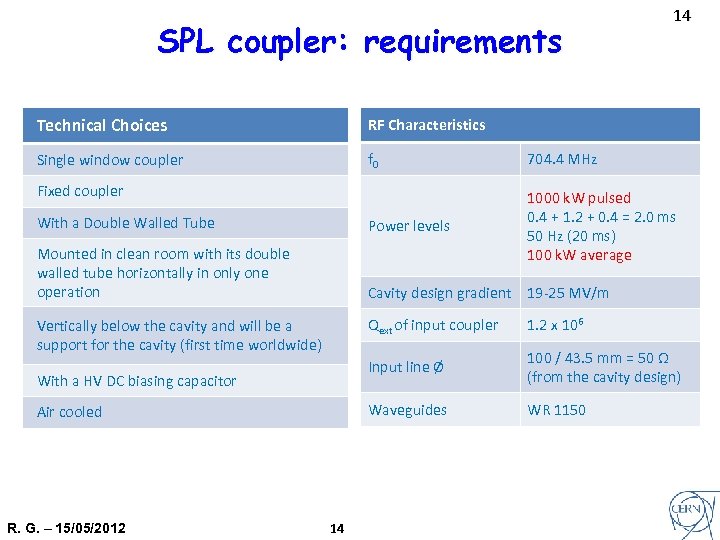 SPL coupler: requirements 14 Technical Choices RF Characteristics Single window coupler f 0 704. 4 MHz With a Double Walled Tube Power levels Mounted in clean room with its double walled tube horizontally in only one operation 1000 k. W pulsed 0. 4 + 1. 2 + 0. 4 = 2. 0 ms 50 Hz (20 ms) 100 k. W average Cavity design gradient 19 -25 MV/m Fixed coupler Qext of input coupler Air cooled R. G. – 15/05/2012 14 100 / 43. 5 mm = 50 Ω (from the cavity design) Waveguides With a HV DC biasing capacitor 1. 2 x 10⁶ Input line Ø Vertically below the cavity and will be a support for the cavity (first time worldwide) WR 1150
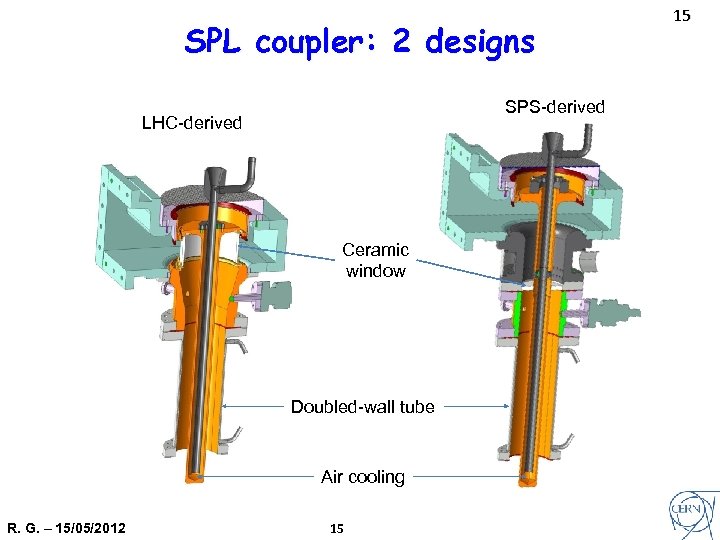 SPL coupler: 2 designs SPS-derived LHC-derived Ceramic window Doubled-wall tube Air cooling R. G. – 15/05/2012 15 15
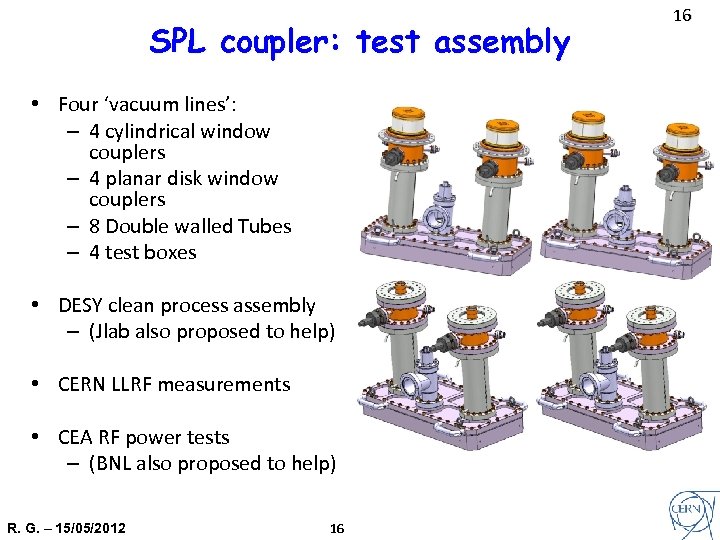 SPL coupler: test assembly • Four ‘vacuum lines’: – 4 cylindrical window couplers – 4 planar disk window couplers – 8 Double walled Tubes – 4 test boxes • DESY clean process assembly – (Jlab also proposed to help) • CERN LLRF measurements • CEA RF power tests – (BNL also proposed to help) R. G. – 15/05/2012 16 16
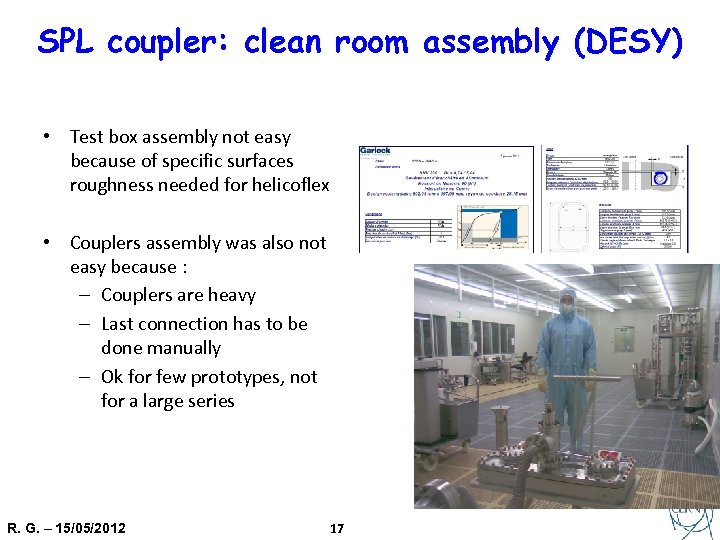 SPL coupler: clean room assembly (DESY) • Test box assembly not easy because of specific surfaces roughness needed for helicoflex • Couplers assembly was also not easy because : – Couplers are heavy – Last connection has to be done manually – Ok for few prototypes, not for a large series R. G. – 15/05/2012 17
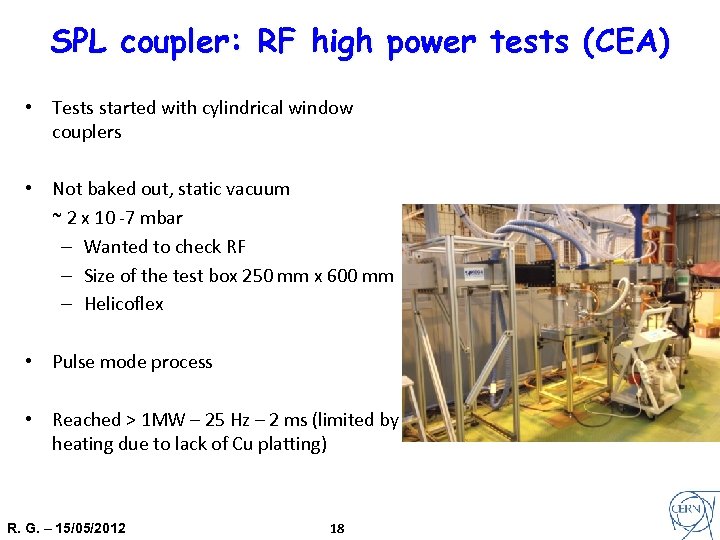 SPL coupler: RF high power tests (CEA) • Tests started with cylindrical window couplers • Not baked out, static vacuum ~ 2 x 10 -7 mbar – Wanted to check RF – Size of the test box 250 mm x 600 mm – Helicoflex • Pulse mode process • Reached > 1 MW – 25 Hz – 2 ms (limited by heating due to lack of Cu platting) R. G. – 15/05/2012 18
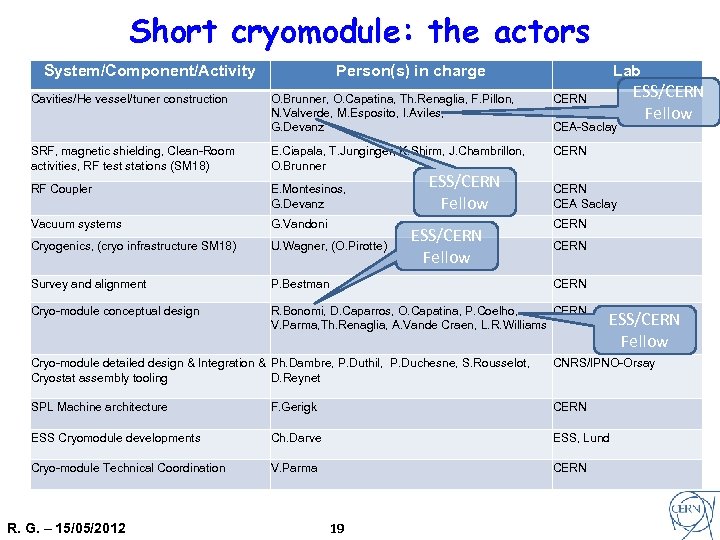 Short cryomodule: the actors System/Component/Activity Cavities/He vessel/tuner construction Person(s) in charge Lab O. Brunner, O. Capatina, Th. Renaglia, F. Pillon, N. Valverde, M. Esposito, I. Aviles, G. Devanz CERN SRF, magnetic shielding, Clean-Room activities, RF test stations (SM 18) E. Ciapala, T. Junginger, K. Shirm, J. Chambrillon, O. Brunner CERN RF Coupler E. Montesinos, G. Devanz CERN CEA Saclay Vacuum systems G. Vandoni Cryogenics, (cryo infrastructure SM 18) U. Wagner, (O. Pirotte) Survey and alignment P. Bestman Cryo-module conceptual design R. Bonomi, D. Caparros, O. Capatina, P. Coelho, CERN V. Parma, Th. Renaglia, A. Vande Craen, L. R. Williams ESS/CERN Fellow CEA-Saclay CERN ESS/CERN Fellow Cryo-module detailed design & Integration & Ph. Dambre, P. Duthil, P. Duchesne, S. Rousselot, Cryostat assembly tooling D. Reynet CNRS/IPNO-Orsay SPL Machine architecture F. Gerigk CERN ESS Cryomodule developments Ch. Darve ESS, Lund Cryo-module Technical Coordination V. Parma CERN R. G. – 15/05/2012 19
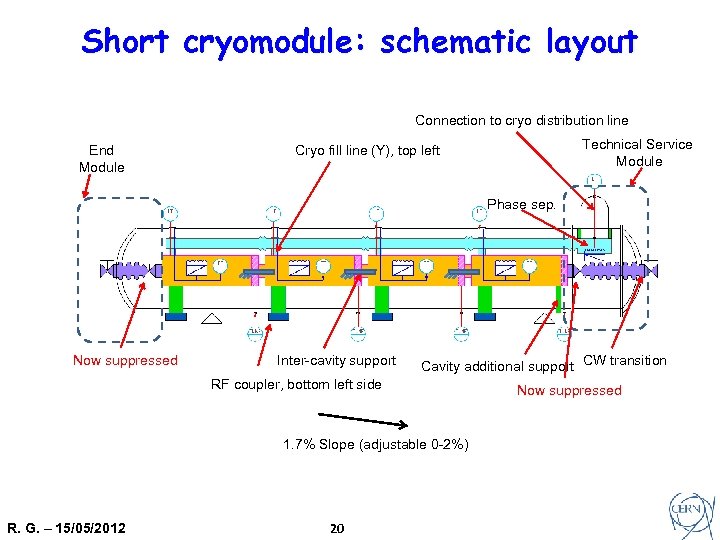 Short cryomodule: schematic layout Connection to cryo distribution line End Module Technical Service Module Cryo fill line (Y), top left Phase sep. Now suppressed Inter-cavity support Cavity additional support CW transition RF coupler, bottom left side 1. 7% Slope (adjustable 0 -2%) R. G. – 15/05/2012 20 Now suppressed
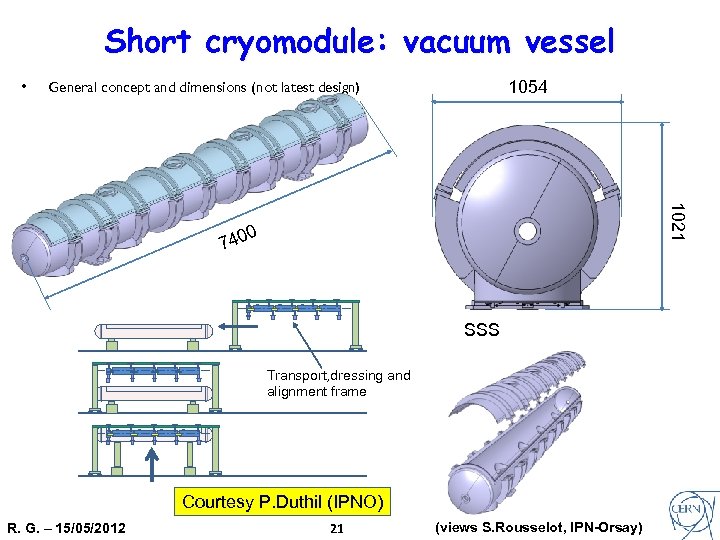 Short cryomodule: vacuum vessel • 1054 General concept and dimensions (not latest design) 1021 0 740 SSS Transport, dressing and alignment frame Courtesy P. Duthil (IPNO) R. G. – 15/05/2012 21 (views S. Rousselot, IPN-Orsay)
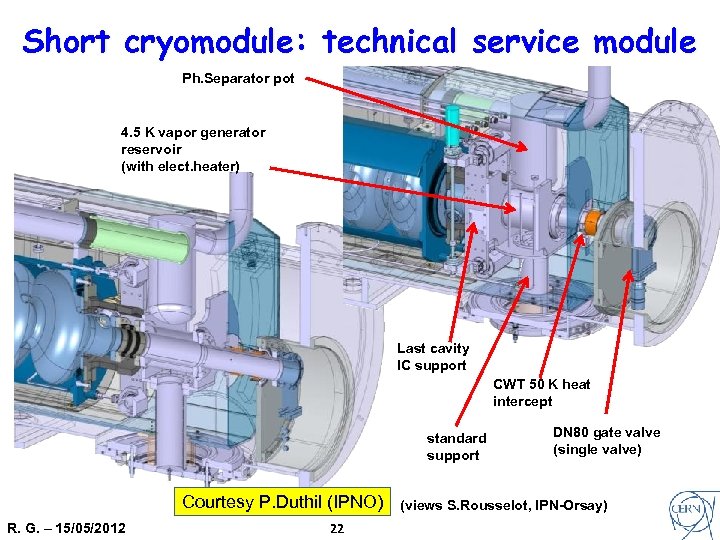 Short cryomodule: technical service module Ph. Separator pot 4. 5 K vapor generator reservoir (with elect. heater) Last cavity IC support CWT 50 K heat intercept standard support Courtesy P. Duthil (IPNO) R. G. – 15/05/2012 22 DN 80 gate valve (single valve) (views S. Rousselot, IPN-Orsay)
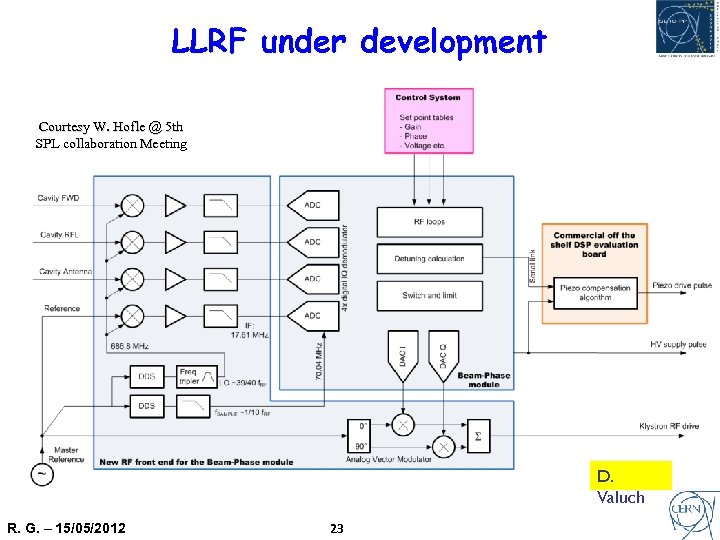 LLRF under development Courtesy W. Hofle @ 5 th SPL collaboration Meeting D. Valuch R. G. – 15/05/2012 23
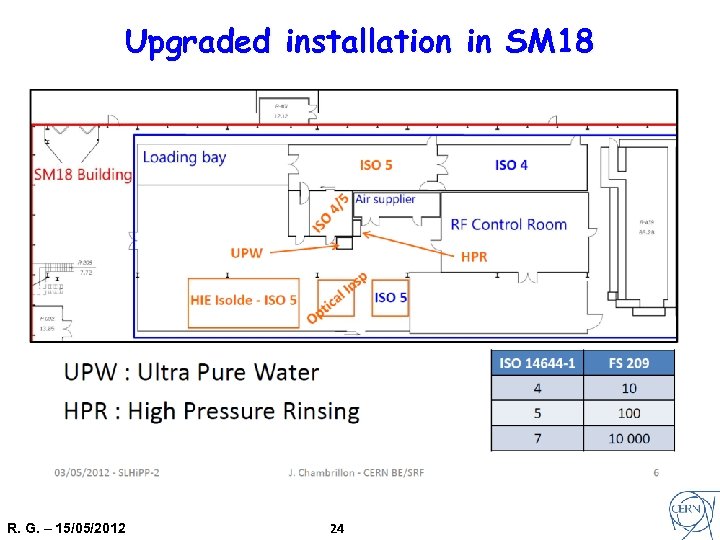 Upgraded installation in SM 18 R. G. – 15/05/2012 24
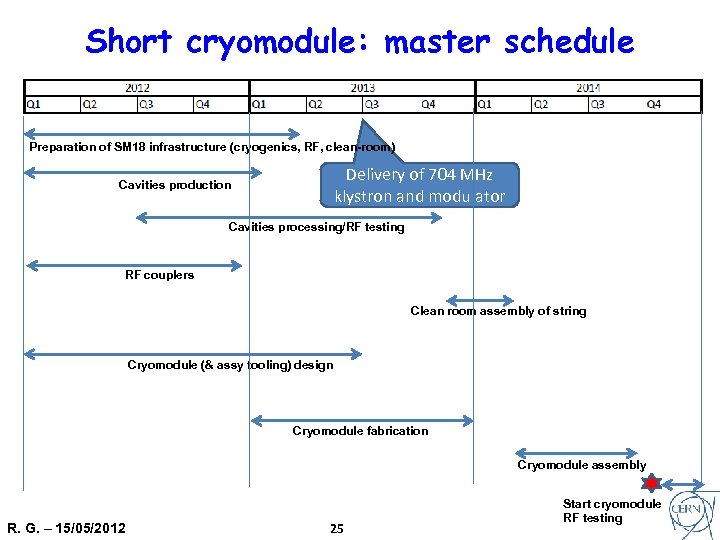 Short cryomodule: master schedule Preparation of SM 18 infrastructure (cryogenics, RF, clean-room) Delivery of 704 MHz klystron and modulator Cavities production Cavities processing/RF testing RF couplers Clean room assembly of string Cryomodule (& assy tooling) design Cryomodule fabrication Cryomodule assembly R. G. – 15/05/2012 25 Start cryomodule RF testing
 Related R & D Nb coating of Cu cavities, using the HIPIMS (High Power Impulse Magnetron Sputtering) technology – In collaboration with Sheffield Hallam University (UK). – Supported in the context of the construction of LHC spare cavities. – Potentially very attractive technology for the SPL (raw material cost, mechanical stiffness). – First results on low beta 704 MHz cavity: end 2012 R. G. – 15/05/2012 26
 SPL Applications to Proton Drivers
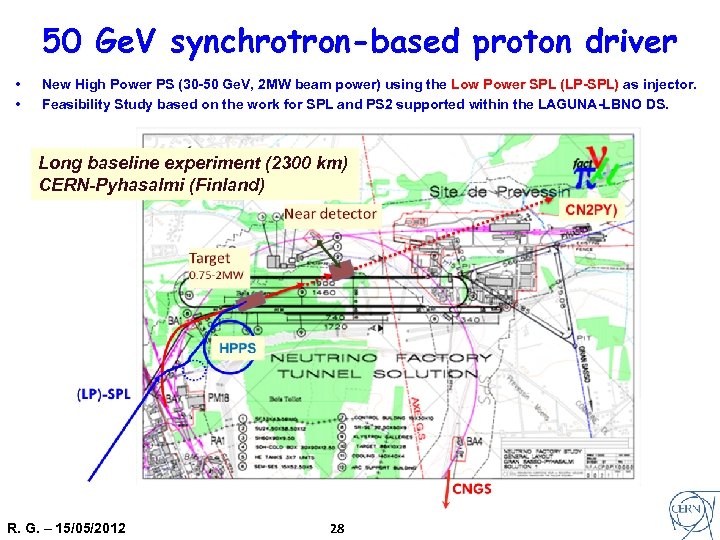 50 Ge. V synchrotron-based proton driver • • New High Power PS (30 -50 Ge. V, 2 MW beam power) using the Low Power SPL (LP-SPL) as injector. Feasibility Study based on the work for SPL and PS 2 supported within the LAGUNA-LBNO DS. Long baseline experiment (2300 km) CERN-Pyhasalmi (Finland) R. G. – 15/05/2012 28
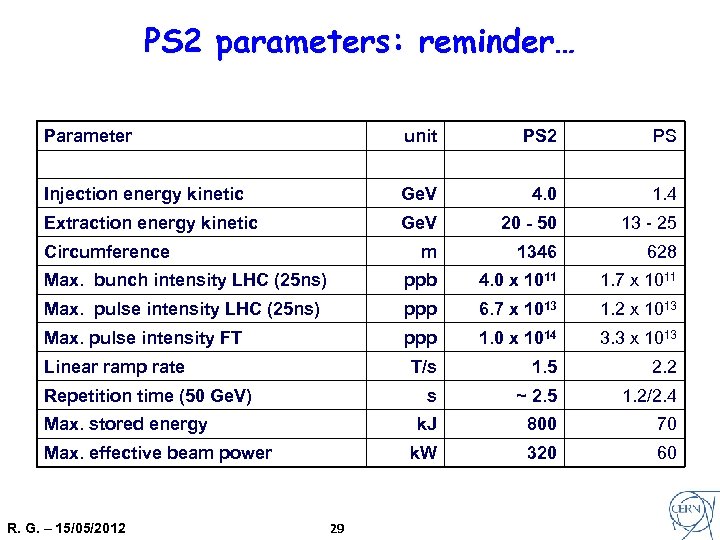 PS 2 parameters: reminder… Parameter unit PS 2 PS Injection energy kinetic Ge. V 4. 0 1. 4 Extraction energy kinetic Ge. V 20 - 50 13 - 25 m 1346 628 Max. bunch intensity LHC (25 ns) ppb 4. 0 x 1011 1. 7 x 10¹¹ Max. pulse intensity LHC (25 ns) ppp 6. 7 x 10¹³ 1. 2 x 10¹³ Max. pulse intensity FT ppp 1. 0 x 1014 3. 3 x 10¹³ T/s 1. 5 2. 2 s ~ 2. 5 1. 2/2. 4 k. J 800 70 k. W 320 60 Circumference Linear ramp rate Repetition time (50 Ge. V) Max. stored energy Max. effective beam power R. G. – 15/05/2012 29 29
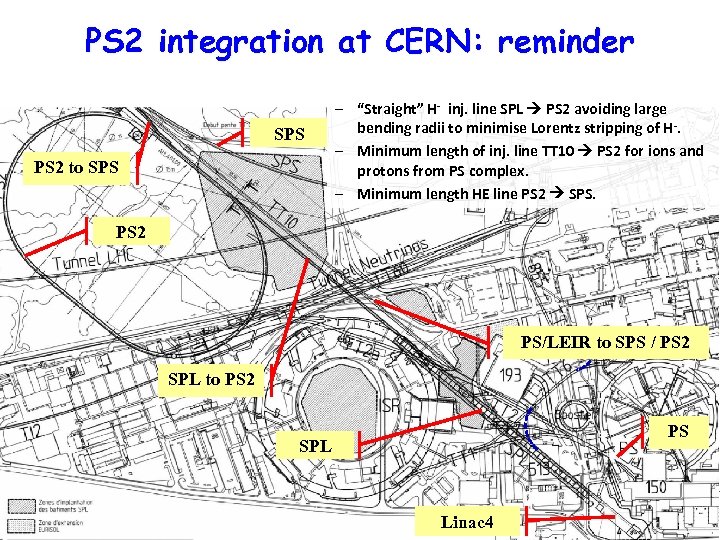 PS 2 integration at CERN: reminder SPS PS 2 to SPS – “Straight” H- inj. line SPL PS 2 avoiding large bending radii to minimise Lorentz stripping of H-. – Minimum length of inj. line TT 10 PS 2 for ions and protons from PS complex. – Minimum length HE line PS 2 SPS. PS 2 PS/LEIR to SPS / PS 2 SPL to PS 2 PS SPL R. G. – 15/05/2012 PAC 2009 Vancouver Linac 4 30 PS 2 Design Optimization, M. Benedikt 30
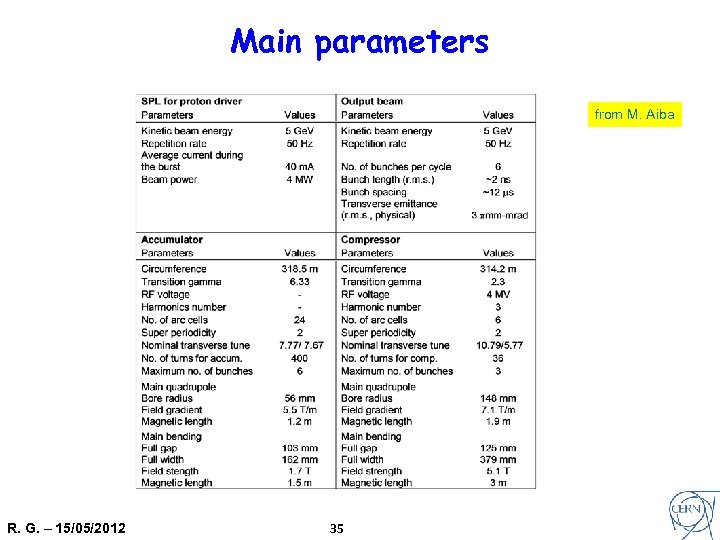
![HP-SPL based proton driver: principle (1/2) Parameter Range Beam energy [Ge. V] 10 5](https://present5.com/presentation/848419bcbeeee0274aae62e856898c1f/image-31.jpg "HP-SPL based proton driver: principle (1/2) Parameter Range Beam energy [Ge. V] 10 5") HP-SPL based proton driver: principle (1/2) Parameter Range Beam energy [Ge. V] 10 5 - 15 Burst repetition rate [Hz] 50 ? Number of bunches per burst (n) 4 1– 6? ~ 50 40 - 60 Time interval between bunches [ms] (tint) 16 ~ 50/(n-1) Bunch length [ns] Specifications (from ISS report) Basic value 2 1 -3 Total duration of the burst [ms] SPL-based 5 Ge. V – 4 MW proton drivers have been designed [SPL + 2 fixed energy rings (accumulator & compressor)] which meet these requirements References: – SPL based proton driver/ R. Garoby, talk at Nu. Fact 06, http: //nufact 06. physics. uci. edu/Workshop/Slides/RGaroby_SPL 3_Pdriver. ppt – Feasibility Study of Accumulator and Compressor for the 6 -bunches SPL-based Proton Driver / M. Aiba, CERN-AB-2008 -060 – A first analysis of 3 -bunches and 1 -bunch scenario for the SPL-based Proton Driver / M. Aiba, CERN-ABNote-2008 -048 -BI – Beam Stability in the SPL Proton Driver Accumulator for a Neutrino Factory at CERN / E. Benedetto, http: //nufact 09. iit. edu/wg 3_benedetto-splstability. ppt, to be published – SPL-based Proton Driver for a Neutrino Factory at CERN, M. Aiba, E. Benedetto, R. Garoby, M. Meddahi, poster nb. 25 (this workshop) R. G. – 15/05/2012 31
HP-SPL based proton driver: principle (1/2) Parameter Range Beam energy [Ge. V] 10 5 - 15 Burst repetition rate [Hz] 50 ? Number of bunches per burst (n) 4 1– 6? ~ 50 40 - 60 Time interval between bunches [ms] (tint) 16 ~ 50/(n-1) Bunch length [ns] Specifications (from ISS report) Basic value 2 1 -3 Total duration of the burst [ms] SPL-based 5 Ge. V – 4 MW proton drivers have been designed [SPL + 2 fixed energy rings (accumulator & compressor)] which meet these requirements References: – SPL based proton driver/ R. Garoby, talk at Nu. Fact 06, http: //nufact 06. physics. uci. edu/Workshop/Slides/RGaroby_SPL 3_Pdriver. ppt – Feasibility Study of Accumulator and Compressor for the 6 -bunches SPL-based Proton Driver / M. Aiba, CERN-AB-2008 -060 – A first analysis of 3 -bunches and 1 -bunch scenario for the SPL-based Proton Driver / M. Aiba, CERN-ABNote-2008 -048 -BI – Beam Stability in the SPL Proton Driver Accumulator for a Neutrino Factory at CERN / E. Benedetto, http: //nufact 09. iit. edu/wg 3_benedetto-splstability. ppt, to be published – SPL-based Proton Driver for a Neutrino Factory at CERN, M. Aiba, E. Benedetto, R. Garoby, M. Meddahi, poster nb. 25 (this workshop) R. G. – 15/05/2012 31
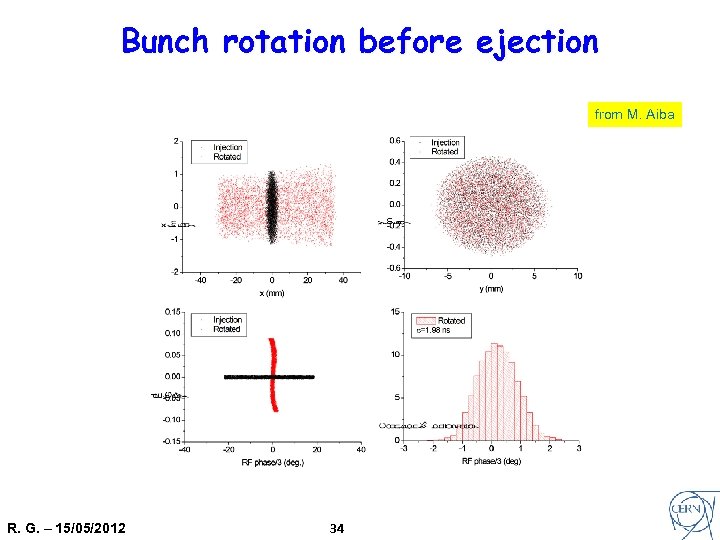
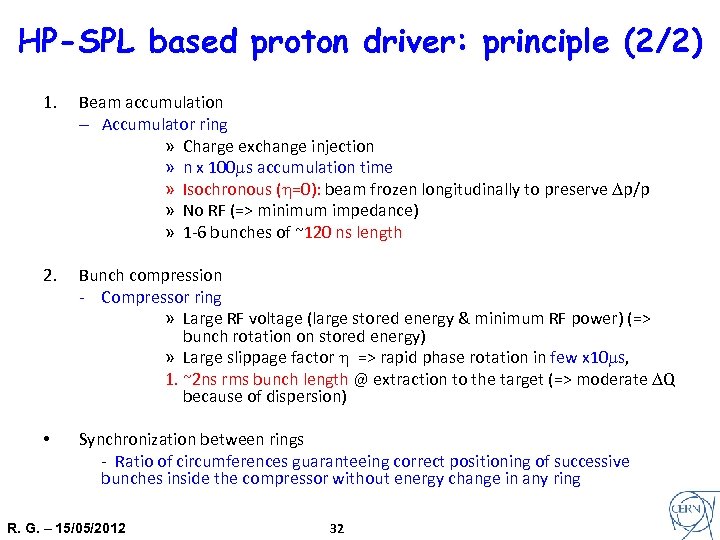 HP-SPL based proton driver: principle (2/2) 1. Beam accumulation – Accumulator ring » Charge exchange injection » n x 100 ms accumulation time » Isochronous (h=0): beam frozen longitudinally to preserve Dp/p » No RF (=> minimum impedance) » 1 -6 bunches of ~120 ns length 2. Bunch compression - Compressor ring » Large RF voltage (large stored energy & minimum RF power) (=> bunch rotation on stored energy) » Large slippage factor h => rapid phase rotation in few x 10 ms, 1. ~2 ns rms bunch length @ extraction to the target (=> moderate DQ because of dispersion) • Synchronization between rings - Ratio of circumferences guaranteeing correct positioning of successive bunches inside the compressor without energy change in any ring R. G. – 15/05/2012 32
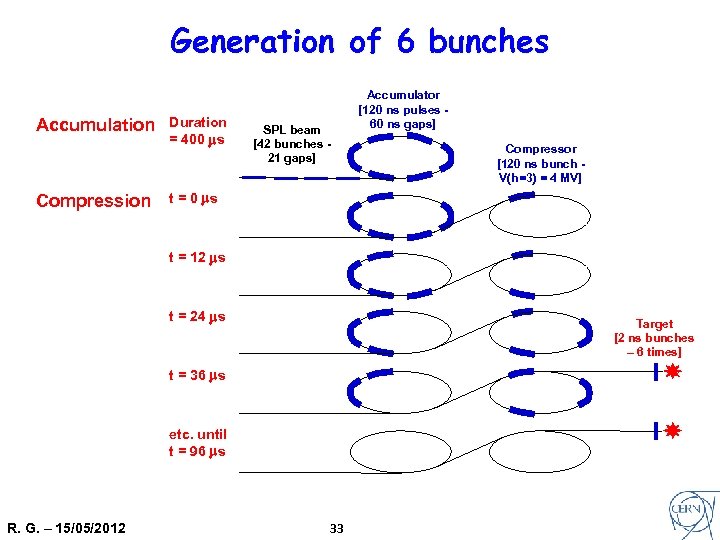 Generation of 6 bunches Accumulation Compression Duration = 400 ms SPL beam [42 bunches 21 gaps] Accumulator [120 ns pulses 60 ns gaps] Compressor [120 ns bunch V(h=3) = 4 MV] t = 0 ms t = 12 ms t = 24 ms Target [2 ns bunches – 6 times] t = 36 ms etc. until t = 96 ms R. G. – 15/05/2012 33
 Bunch rotation before ejection from M. Aiba R. G. – 15/05/2012 34
 Main parameters from M. Aiba R. G. – 15/05/2012 35
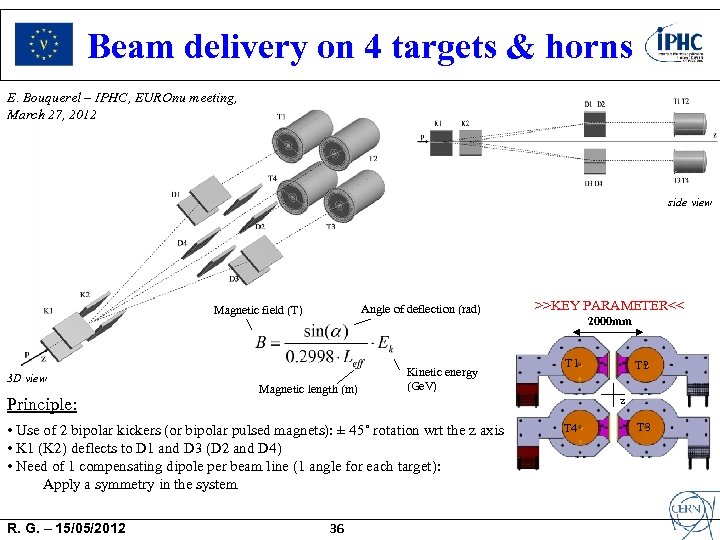 Beam delivery on 4 targets & horns E. Bouquerel – IPHC, EUROnu meeting, March 27, 2012 side view Angle of deflection (rad) Magnetic field (T) 3 D view Principle: Magnetic length (m) Kinetic energy (Ge. V) • Use of 2 bipolar kickers (or bipolar pulsed magnets): ± 45˚ rotation wrt the z axis • K 1 (K 2) deflects to D 1 and D 3 (D 2 and D 4) • Need of 1 compensating dipole per beam line (1 angle for each target): Apply a symmetry in the system R. G. – 15/05/2012 36 >>KEY PARAMETER<< 2000 mm T 1 T 2 z T 4 T 3
 Summary
 Technology (1/2) Presently, the HP-SPL R&D: • progresses at a good pace, leading to the high power test of a short 4 cavities cryomodule in 2014. • allows testing the validity of new concepts that should result in significant savings (RF couplers, SS He tanks, Cryomodule design…) • can potentially be used in multiple projects at CERN as well as outside (ESS, MYRRHA) and benefits from external support (ESS and EU programmes) • is a means for CERN to embed inside the network of labs involved in superconducting RF technology (CEA, IN 2 P 3, DESY, JLAB, FNAL, ANL…) and re-establish in-house competence in that field at the state-of-the-art level • drives infrastructural upgrades (e. g. electro-polishing facility, clean room, high power RF at 704 MHz…) which will be beneficial for other development (LHC main RF, Crab cavities, HIE IDOLDE…) R. G. – 15/05/2012 38
 Technology (2/2) Important future R&D subjects • HOM damper for beam stability at high current • Cavities in view of reaching the expected performance/simplifying fabrication/evaluating alternative solutions (Nb on Cu) • Cryomodule towards a full size prototype • RF amplifiers for reducing cost • Power supply for high power amplifier for reducing cost R. G. – 15/05/2012 39
 Accelerator design • The SPL accelerator design is «mature» and stable • In the context of the LAGUNA-LBNO: – The LP-SPL design will be adapted to the requirements of the HP-PS – The HP-SPL design will be briefly revisited and completed with the design of the accumulation ring • Other applications may require resuming/refining accelerator design: – e+/e- acceleration in the ERL of the Linac-Ring option of LHe. C – LEP-3 – LP-SPL remains a back-up option for the LHC injector complex… R. G. – 15/05/2012 40