


 Скачать презентацию Neurostimulation for Pain Neurosurgical Considerations Joshua M Rosenow
8facefb7bbf3acd2964caa630bc68933.ppt
- Количество слайдов: 26
 Neurostimulation for Pain: Neurosurgical Considerations Joshua M. Rosenow, MD, FACS Director, Functional Neurosurgery Associate Professor, Department of Neurosurgery Northwestern Memorial Hospital Northwestern University Department of Neurosurgery
 SCS: Patient Selection Ø Pain syndrome amenable to stimulation § Radicular preferable to axial § Neuropathic preferable to nociceptive Ø Failed reasonable medical management § Several pharmacologic classes § Dose titration until adverse side effects or lack of response noted Ø Surgical disease ruled out § Reoperation vs. stim? § Not surgical candidate? Ø Pain psychological evaluation *North, et al. Stereotact Funct Neurosurg 1994; 62: 267 -272. Northwestern University Department of Neurosurgery
 Patient Factors Ø Set appropriate expectations!!!! § Takes time, but will be worth the investment Ø Prepare patients for the procedure Ø Involve them in the process § i. e. IPG placement Northwestern University Department of Neurosurgery
 Surgical Contraindications Ø Thecal sac compression/significant spinal stenosis Ø Significant spinal deformity Ø Severe emaciation Ø Significantly low WBC, plt Ø Coagulopathy Ø Ongoing infection Ø Inability to assess patient response to trial Ø Psychological contraindications Ø Patient compliance issues Ø Medication abuse issues Ø Unsuccessful trial Northwestern University Department of Neurosurgery
 General Principles Ø Adequate length of trial Ø Choose appropriate hardware Ø Simulate everyday life during trial, within limits Ø Confirm location and ensure stability of electrode Ø Prevent infection Ø Prepare for permanent implant Ø Permanent system should be stable, flexible and convenient Ø Prepare for revisions Northwestern University Department of Neurosurgery
 MAC vs. GETA Ø Airway/body habitus Ø Comorbidities Ø Procedure to be performed/region of operation Ø Anticipated intraoperative difficulties Ø Need for intraoperative verification of coverage Ø Patient preference Ø Patient ability/willingness to cooperate Ø If GETA - consider neuromonitoring for protection and confirmation Northwestern University Department of Neurosurgery
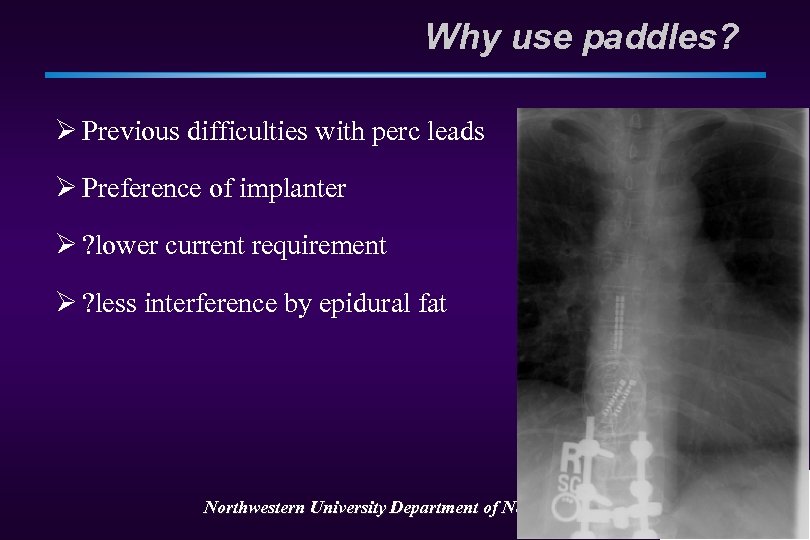 Why use paddles? Ø Previous difficulties with perc leads Ø Preference of implanter Ø ? lower current requirement Ø ? less interference by epidural fat Northwestern University Department of Neurosurgery
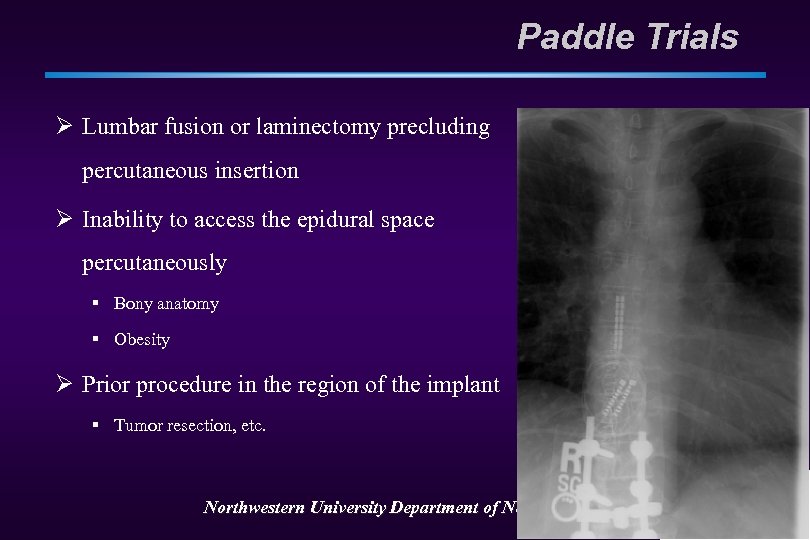 Paddle Trials Ø Lumbar fusion or laminectomy precluding percutaneous insertion Ø Inability to access the epidural space percutaneously § Bony anatomy § Obesity Ø Prior procedure in the region of the implant § Tumor resection, etc. Northwestern University Department of Neurosurgery
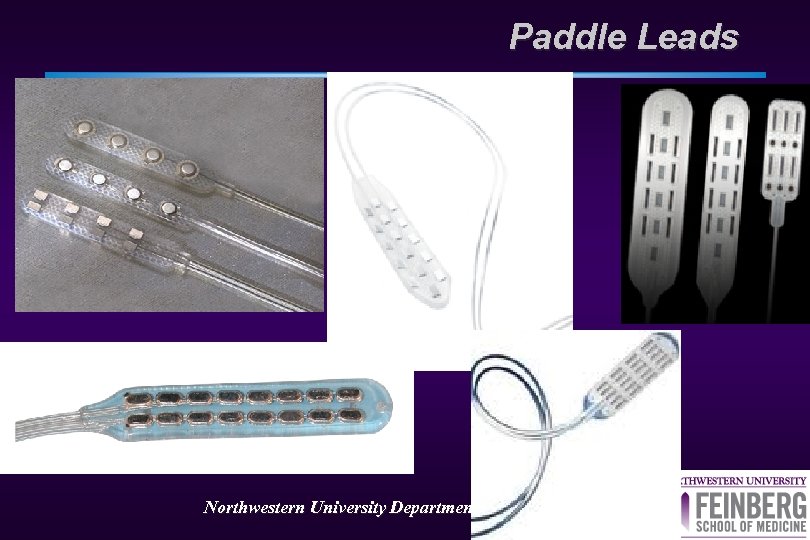 Paddle Leads Northwestern University Department of Neurosurgery
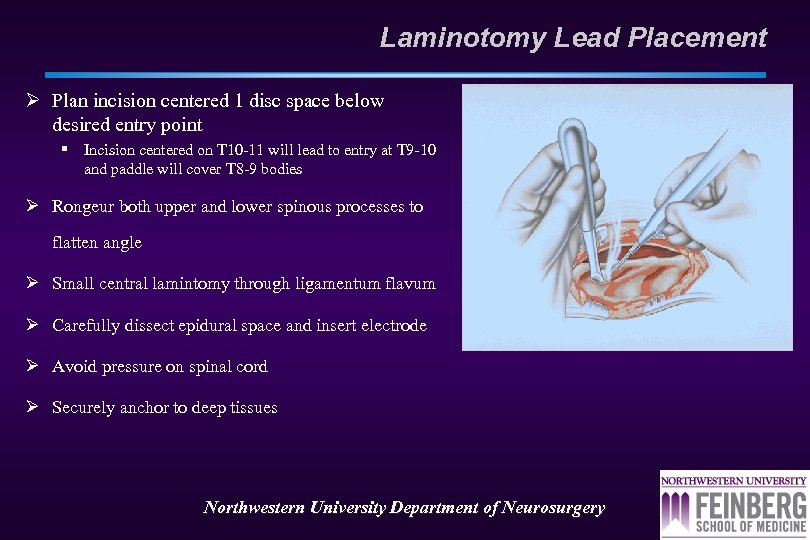 Laminotomy Lead Placement Ø Plan incision centered 1 disc space below desired entry point § Incision centered on T 10 -11 will lead to entry at T 9 -10 and paddle will cover T 8 -9 bodies Ø Rongeur both upper and lower spinous processes to flatten angle Ø Small central lamintomy through ligamentum flavum Ø Carefully dissect epidural space and insert electrode Ø Avoid pressure on spinal cord Ø Securely anchor to deep tissues Northwestern University Department of Neurosurgery
 Paddle issues Ø Where does the paddle go? Ø Assessing canal adequacy for paddle Ø Clearing the epidural space Ø The paddle won’t go straight Northwestern University Department of Neurosurgery
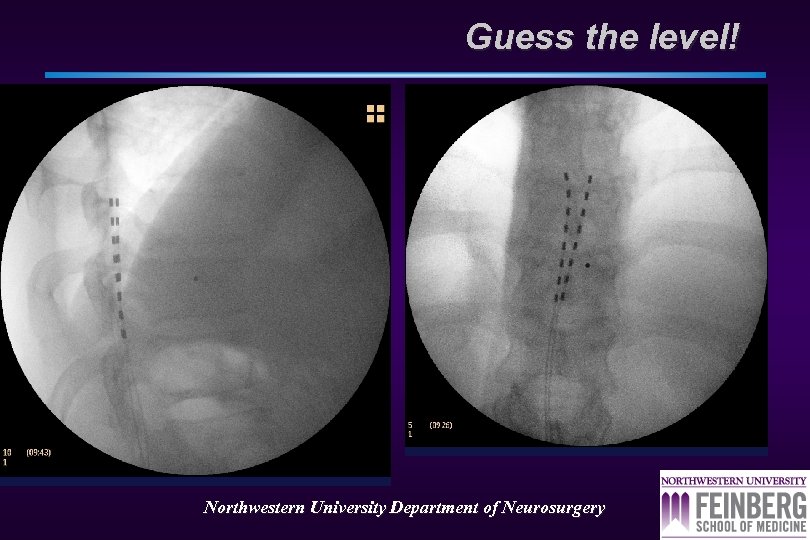 Guess the level! Northwestern University Department of Neurosurgery
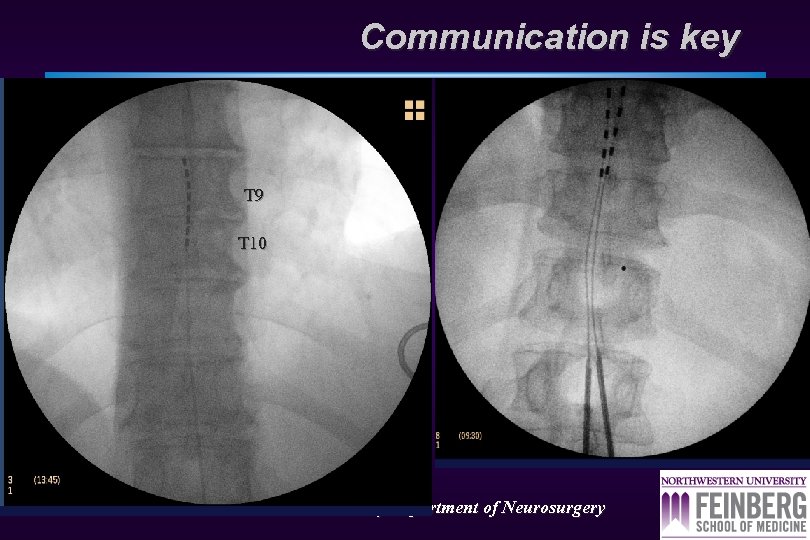 Communication is key T 9 T 10 Northwestern University Department of Neurosurgery
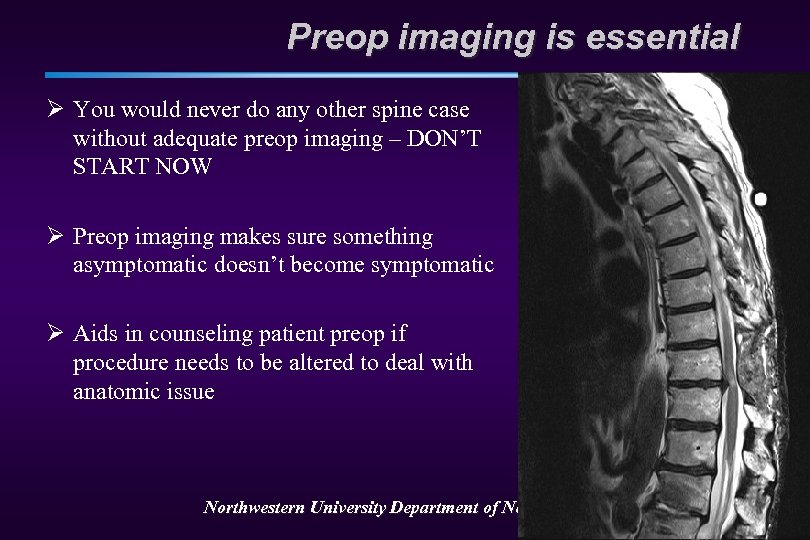 Preop imaging is essential Ø You would never do any other spine case without adequate preop imaging – DON’T START NOW Ø Preop imaging makes sure something asymptomatic doesn’t become symptomatic Ø Aids in counseling patient preop if procedure needs to be altered to deal with anatomic issue Northwestern University Department of Neurosurgery
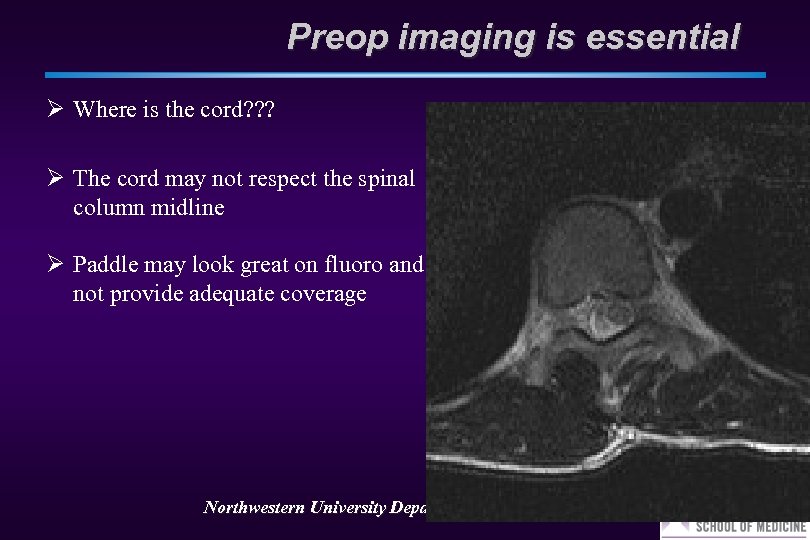 Preop imaging is essential Ø Where is the cord? ? ? Ø The cord may not respect the spinal column midline Ø Paddle may look great on fluoro and not provide adequate coverage Northwestern University Department of Neurosurgery
 Paddle issues in the OR Ø Dissecting epidural space § Careful § You’re a surgeon – use surgical tools No – paddle lead, passing device Yes – dural separator, narrow tip malleable brain ribbon Ø Anywhere but straight § Straight paddle in curved space § Epidural adhesion § Unilateral extension vs. “reach around” laminotomy Northwestern University Department of Neurosurgery
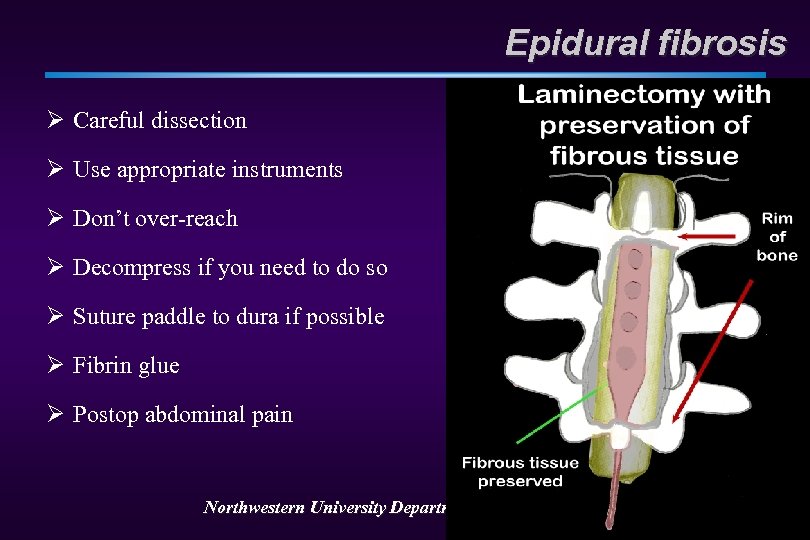 Epidural fibrosis Ø Careful dissection Ø Use appropriate instruments Ø Don’t over-reach Ø Decompress if you need to do so Ø Suture paddle to dura if possible Ø Fibrin glue Ø Postop abdominal pain Northwestern University Department of Neurosurgery
 Complication avoidance Ø Don’t be overzealous Ø Don’t push a bad situation § If it won’t go, it won’t go… Ø Caution when dissecting laterally – epidural veins Ø Poor coverage despite radiographic adequacy § check trial fluoros § make sure c-arm aligned in both planes Northwestern University Department of Neurosurgery
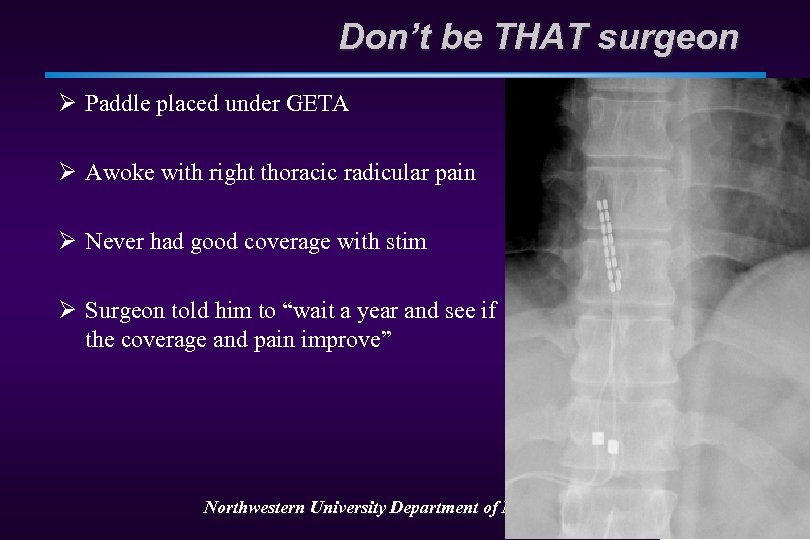 Don’t be THAT surgeon Ø Paddle placed under GETA Ø Awoke with right thoracic radicular pain Ø Never had good coverage with stim Ø Surgeon told him to “wait a year and see if the coverage and pain improve” Northwestern University Department of Neurosurgery
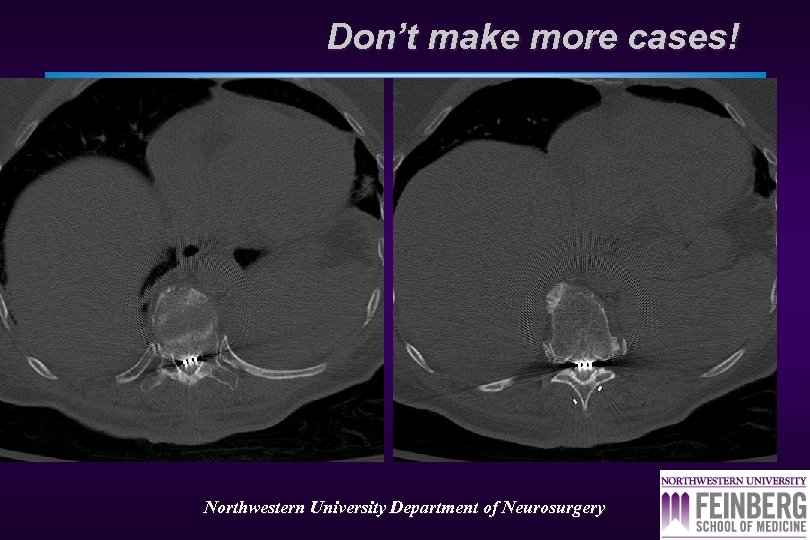 Don’t make more cases! Northwestern University Department of Neurosurgery
 To Extend or Not to Extend Ø PRO § § Adds slack to system May make revision less invasive May be needed to adapt electrodes to IPG Needed for “permanent trial” Ø CON § § Another electrical connection Another wire that may break Connector adds bulk and may not be suitable for some locations Direct connection to IPG may reduce slack in system and add tension to electrode Ø In either case, there should be a relaxing loop of electrode in the electrode incision site Northwestern University Department of Neurosurgery
 IPG Considerations Ø Location location § § § Patient comfort Cosmesis Ease of remote interface Ease of recharger interface (if rechargeable) Ease of implant Ease of revision Ø Rechargeable vs. Primary cell Northwestern University Department of Neurosurgery
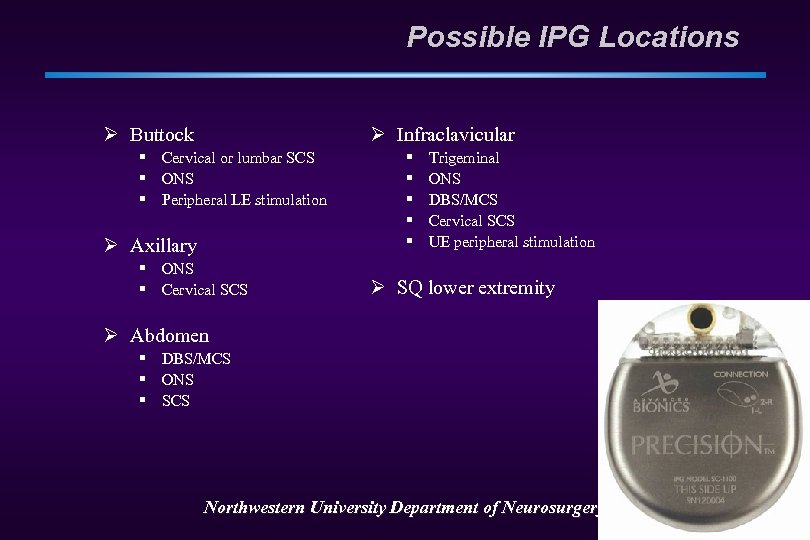 Possible IPG Locations Ø Buttock Ø Infraclavicular § Cervical or lumbar SCS § ONS § Peripheral LE stimulation Ø Axillary § ONS § Cervical SCS § § § Trigeminal ONS DBS/MCS Cervical SCS UE peripheral stimulation Ø SQ lower extremity Ø Abdomen § DBS/MCS § ONS § SCS Northwestern University Department of Neurosurgery
 Conclusions Ø Rational treatment plan improves outcomes Ø Good patient selection important Ø Technique is key, as always Ø Goal: not “do implants” but TREAT PAIN Northwestern University Department of Neurosurgery
 Thank you for coming! E-mail: jrosenow@nmff. org Phone: 312 -695 -0495 Northwestern University Department of Neurosurgery
 Northwestern University Department of Neurosurgery