


 Скачать презентацию Neurosciences Working Group Medical Education Retreat Tarvez Tucker
a67c8685b04604e81b497a0b6bd5fd54.ppt
- Количество слайдов: 14
 Neurosciences Working Group Medical Education Retreat Tarvez Tucker, M. D. February 27
 Commitee Dept. of Neurosciences David M. Katz, Ph. D, (Committee Chair) Department of Neurology Dennis Landis, MD Chair of Neurology Michael Devereaux, D Robert Ruff, MD, Ph. D Tom Chelimsky, MD Tarvez Tucker, MD Joseph La. Manna, Ph. D Dept. Psychiatry Charles Schulz, MD, Chair of Psychiatry David Agle, MD Robert Ronis, MD Dept. Neurosurgery Robert Ratcheson, MD, Chair of Neurosurgery Alan Cohen, MD Dept. Physiology & Biophysics: Stephen Jones, Ph. D
 Working Group Process Bring together representatives of each relevant constituency ª Begin with end-point learning objectives for all third-year students ª Focus on content, not process ª
 What do we want to do better than what we’re doing now • Improve integration of basic and clinical sciences • Improve appreciation of the role of mind/body interactions in health and disease • Begin with understanding normal range of function/behavior
 What do we want to do better than what we’re doing now • Early introduction of clinical skills and perspective, clinical correlates to basic science teaching • Begin with integrative/macro viewpoint • Integrate professionalism and biomedical ethics early • Integrate genetics, epidemiology and informatics (critical thinking and evaluation skills) early
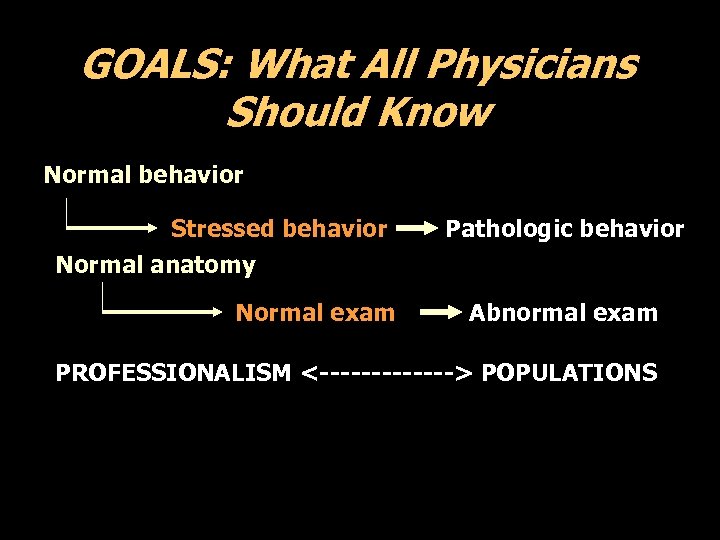 GOALS: What All Physicians Should Know Normal behavior Stressed behavior Pathologic behavior Normal anatomy Normal exam Abnormal exam PROFESSIONALISM <-------> POPULATIONS
 TABLE OF DEPENDENCIES NO PRE-REQUISITES • Building clinical skills • Understanding normal behavior • Emulation/Modeling • Expectations PRE-REQUISITES • Cell/Molecular Biology before Neurogenetics • Basic genetics and Epidemiology before Populations
 PHASE I: ethics & behavior • Listening to patient’s description of pain • Hearing how pain affects daily function and impacts life and family • Understanding ethics of pain control – Importance – Addiction – Confidentiality – Limits DIABETIC PERIPHERAL NEUROPATHY
 PHASE II: physiology & pharmocology • Normal functional neuroanatomy • Neuropharmocology • Synaptic physiology and neurotransmitters • Autonomic and behavioral response to stress DIABETIC PERIPHERAL NEUROPATHY
 PHASE III: diagnosis & management • Understanding the disease process • Perspective on the natural history of a disease DIABETIC • Differential diagnosis PERIPHERAL • Management plan NEUROPATHY • Proper use of tests
 Will the Model Neuroscience Curriculum Fulfill Goals of the Millenium Curriculum? • Can students learn “longitudinal” topics such as PAIN in a setting that crosses traditional disciplinary boundaries and encourages student-initiated learning? • Have we successfully interlaced basic science teaching with clinical correlates?
 Will the Model Neuroscience Curriculum Fulfill Goals of the Millenium Curriculum? • Have we introduced clinical relevance in the very first week of medical school; teaching human behavior and professional ethics by clinicians comfortable with these topics to students from a wide variety of backgrounds?
 Will the Model Neuroscience Curriculum Fulfill Goals of the Millenium Curriculum? • Have we successfully prepared our Physicians of the Future to create and expand upon their own pathway for learning throughout their professional careers? (including Internet and long distance learning technologies)
 Will the Model Neuroscience Curriculum Fulfill Goals of the Millenium Curriculum? • Lastly, have we a “template” model curriculum in Neuroscience that other medical and surgical working groups can adapt to create their own plan for the year 2000 and beyond?