


 Скачать презентацию Neuroscience Program s Seminar Series HUMAN LANGUAGE TECHNOLOGY From
ad80c62e9ecbddd0ccb73286c5a3b46d.ppt
- Количество слайдов: 40
 Neuroscience Program's Seminar Series HUMAN LANGUAGE TECHNOLOGY: From Bits to Blogs Joseph Picone, Ph. D Professor and Chair Department of Electrical and Computer Engineering Temple University URL:
 Abstract • What makes machine understanding of human language so difficult? § “In any natural history of the human species, language would stand out as the preeminent trait. ” § “For you and I belong to a species with a remarkable trait: we can shape events in each other’s brains with exquisite precision. ” S. Pinker, The Language Instinct: How the Mind Creates Language, 1994 • In this presentation, we will: § Discuss the complexity of the language problem in terms of three key engineering approaches: statistics, signal processing and machine learning. § Introduce the basic ways in which we process language by computer. § Discuss some important applications that continue to drive the field (commercial and defense/homeland security). Neuro. Sci: Slide 1
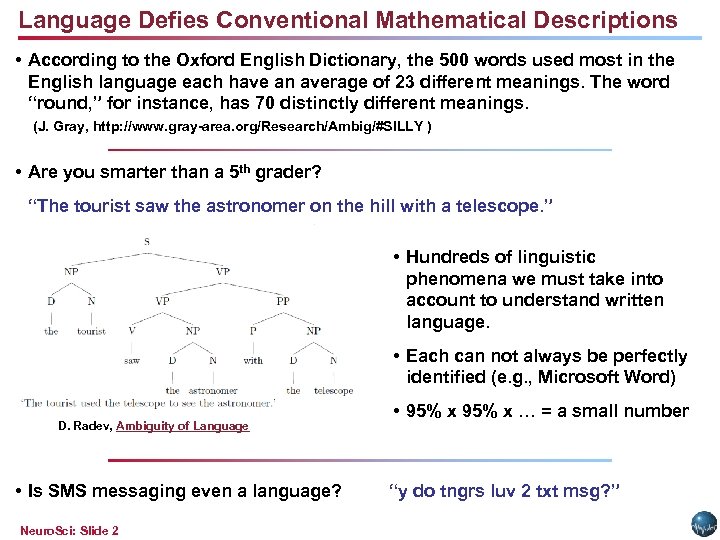 Language Defies Conventional Mathematical Descriptions • According to the Oxford English Dictionary, the 500 words used most in the English language each have an average of 23 different meanings. The word “round, ” for instance, has 70 distinctly different meanings. (J. Gray, http: //www. gray-area. org/Research/Ambig/#SILLY ) • Are you smarter than a 5 th grader? “The tourist saw the astronomer on the hill with a telescope. ” • Hundreds of linguistic phenomena we must take into account to understand written language. • Each can not always be perfectly identified (e. g. , Microsoft Word) D. Radev, Ambiguity of Language • Is SMS messaging even a language? Neuro. Sci: Slide 2 • 95% x … = a small number “y do tngrs luv 2 txt msg? ”
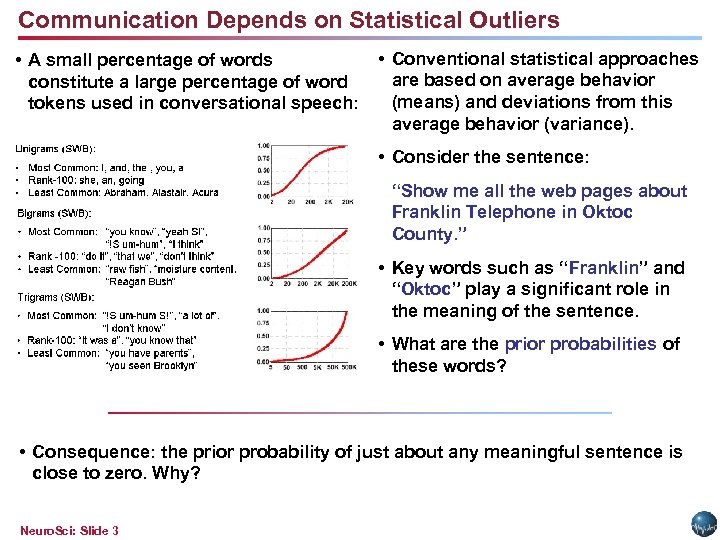 Communication Depends on Statistical Outliers • A small percentage of words constitute a large percentage of word tokens used in conversational speech: • Conventional statistical approaches are based on average behavior (means) and deviations from this average behavior (variance). • Consider the sentence: “Show me all the web pages about Franklin Telephone in Oktoc County. ” • Key words such as “Franklin” and “Oktoc” play a significant role in the meaning of the sentence. • What are the prior probabilities of these words? • Consequence: the prior probability of just about any meaningful sentence is close to zero. Why? Neuro. Sci: Slide 3
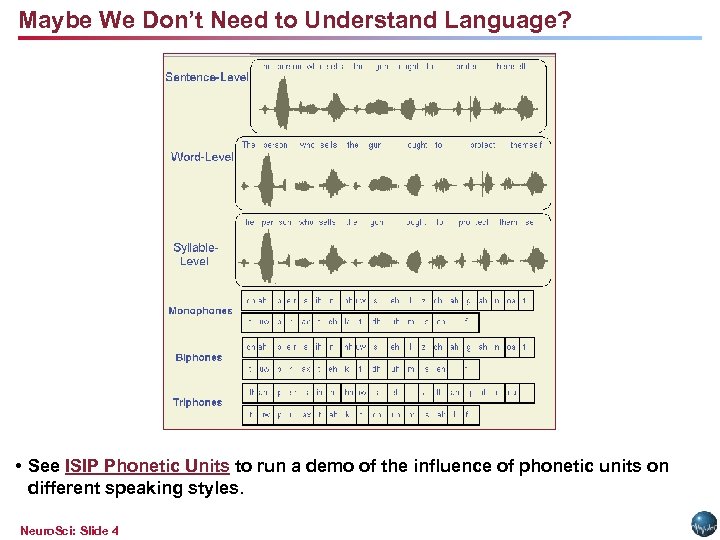 Maybe We Don’t Need to Understand Language? • See ISIP Phonetic Units to run a demo of the influence of phonetic units on different speaking styles. Neuro. Sci: Slide 4
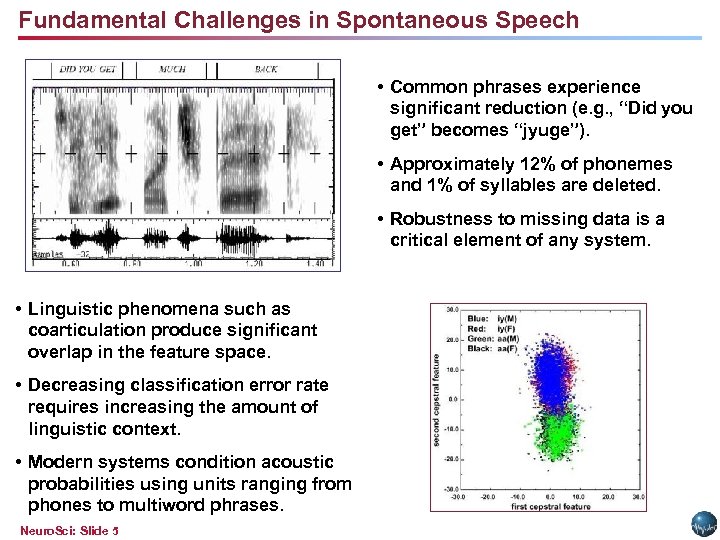 Fundamental Challenges in Spontaneous Speech • Common phrases experience significant reduction (e. g. , “Did you get” becomes “jyuge”). • Approximately 12% of phonemes and 1% of syllables are deleted. • Robustness to missing data is a critical element of any system. • Linguistic phenomena such as coarticulation produce significant overlap in the feature space. • Decreasing classification error rate requires increasing the amount of linguistic context. • Modern systems condition acoustic probabilities using units ranging from phones to multiword phrases. Neuro. Sci: Slide 5
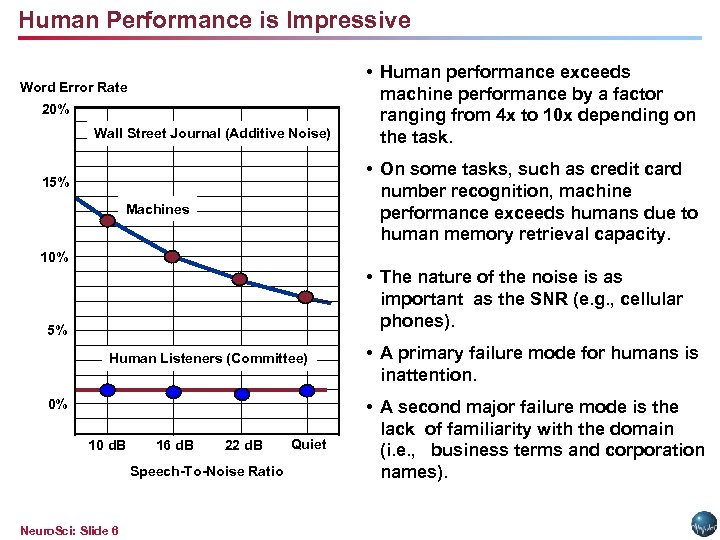 Human Performance is Impressive Word Error Rate 20% Wall Street Journal (Additive Noise) • Human performance exceeds machine performance by a factor ranging from 4 x to 10 x depending on the task. • On some tasks, such as credit card number recognition, machine performance exceeds humans due to human memory retrieval capacity. 15% Machines 10% • The nature of the noise is as important as the SNR (e. g. , cellular phones). 5% Human Listeners (Committee) 0% 10 d. B 16 d. B 22 d. B Speech-To-Noise Ratio Neuro. Sci: Slide 6 Quiet • A primary failure mode for humans is inattention. • A second major failure mode is the lack of familiarity with the domain (i. e. , business terms and corporation names).
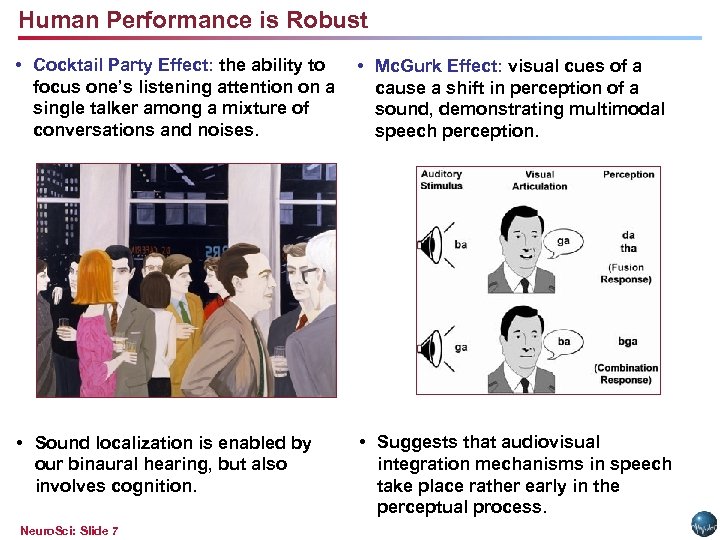 Human Performance is Robust • Cocktail Party Effect: the ability to focus one’s listening attention on a single talker among a mixture of conversations and noises. • Mc. Gurk Effect: visual cues of a cause a shift in perception of a sound, demonstrating multimodal speech perception. • Sound localization is enabled by our binaural hearing, but also involves cognition. • Suggests that audiovisual integration mechanisms in speech take place rather early in the perceptual process. Neuro. Sci: Slide 7
 Human Language Technology (HLT) • Audio Processing: § Speech Coding/Compression (mpeg) § Text to Speech Synthesis (voice response systems) • Pattern Recognition / Machine Learning: § Language Identification (defense) § Speaker Identification (biometrics for security) § Speech Recognition (automated operator services) • Natural Language Processing (NLP): § Entity/Content Extraction (ask. com, cuil. com) § Summarization and Gisting (CNN, defense) § Machine Translation (Google search) • Integrated Technologies: § Real-time Speech to Speech Translation (videoconferencing) § Multimodal Speech Recognition (automotive) § Human Computer Interfaces (tablet computing) • All technologies share a common technology base: machine learning. Neuro. Sci: Slide 8
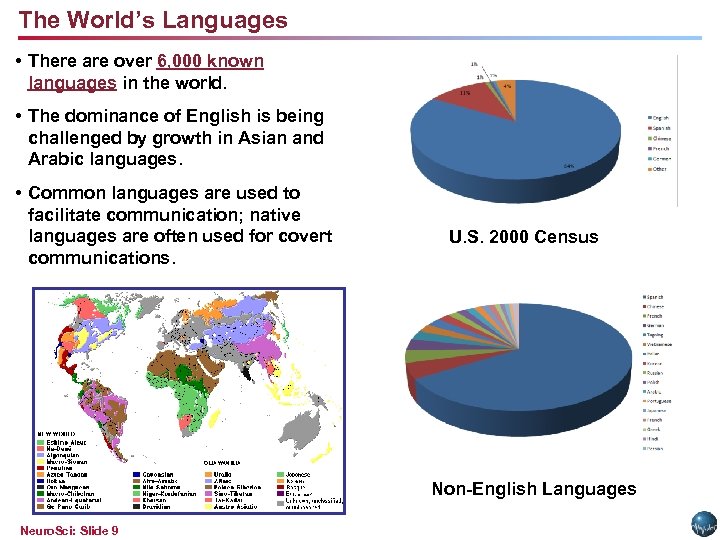 The World’s Languages • There are over 6, 000 known languages in the world. • The dominance of English is being challenged by growth in Asian and Arabic languages. • Common languages are used to facilitate communication; native languages are often used for covert communications. U. S. 2000 Census Non-English Languages Neuro. Sci: Slide 9
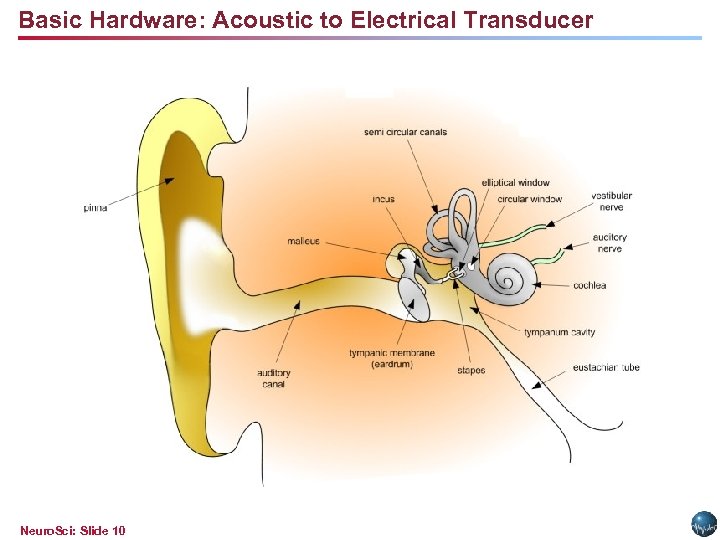 Basic Hardware: Acoustic to Electrical Transducer Neuro. Sci: Slide 10
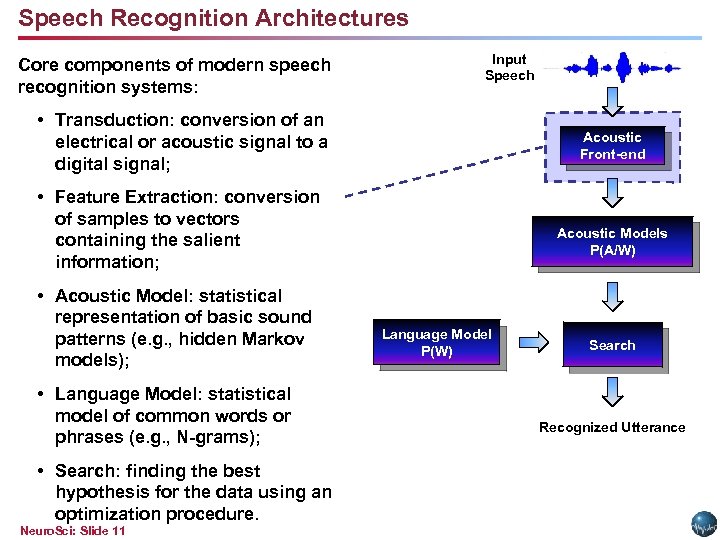 Speech Recognition Architectures Core components of modern speech recognition systems: Input Speech • Transduction: conversion of an electrical or acoustic signal to a digital signal; Acoustic Front-end • Feature Extraction: conversion of samples to vectors containing the salient information; • Acoustic Model: statistical representation of basic sound patterns (e. g. , hidden Markov models); • Language Model: statistical model of common words or phrases (e. g. , N-grams); • Search: finding the best hypothesis for the data using an optimization procedure. Neuro. Sci: Slide 11 Acoustic Models P(A/W) Language Model P(W) Search Recognized Utterance
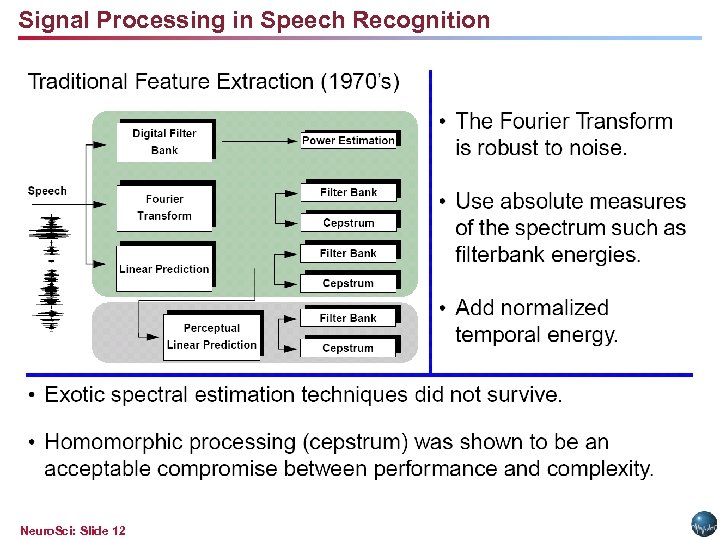 Signal Processing in Speech Recognition Neuro. Sci: Slide 12
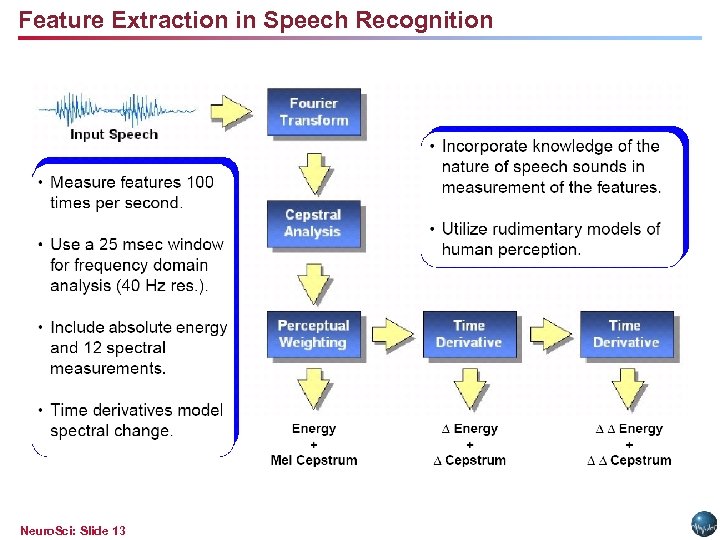 Feature Extraction in Speech Recognition Neuro. Sci: Slide 13
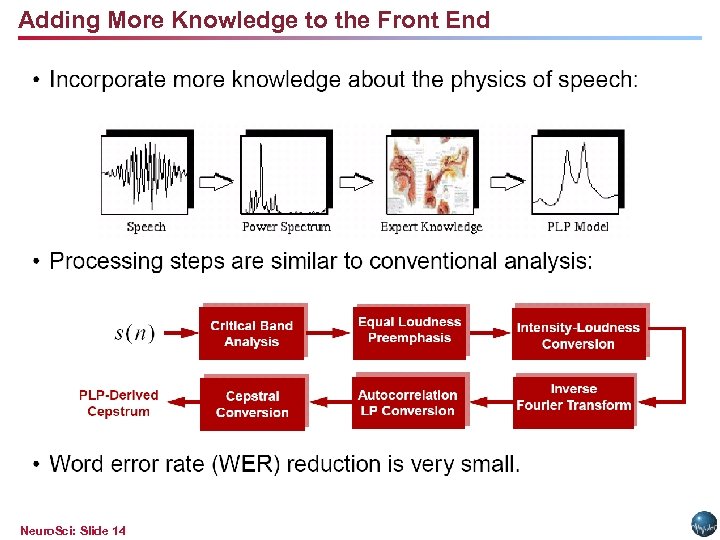 Adding More Knowledge to the Front End Neuro. Sci: Slide 14
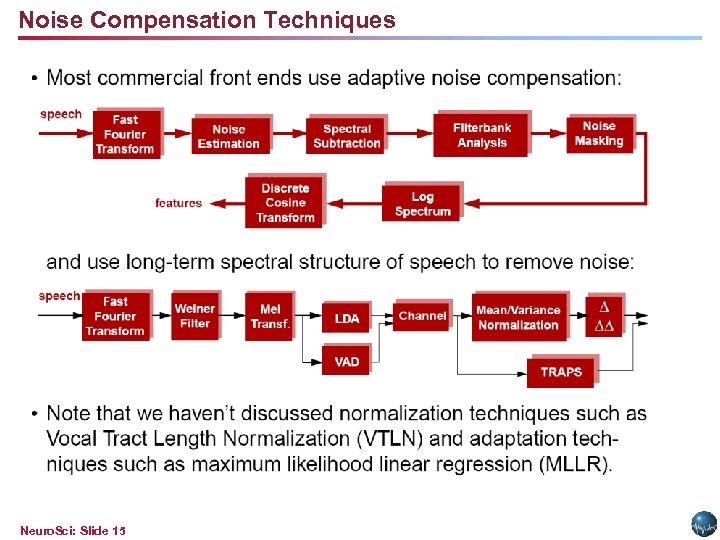 Noise Compensation Techniques Neuro. Sci: Slide 15
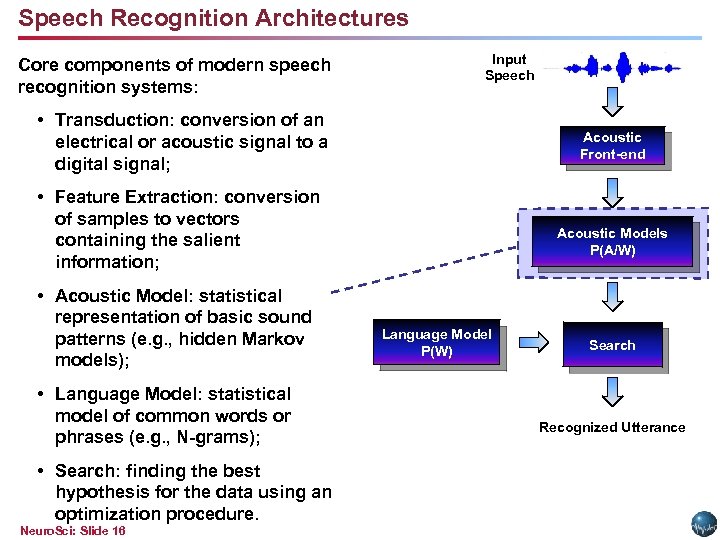 Speech Recognition Architectures Core components of modern speech recognition systems: Input Speech • Transduction: conversion of an electrical or acoustic signal to a digital signal; Acoustic Front-end • Feature Extraction: conversion of samples to vectors containing the salient information; • Acoustic Model: statistical representation of basic sound patterns (e. g. , hidden Markov models); • Language Model: statistical model of common words or phrases (e. g. , N-grams); • Search: finding the best hypothesis for the data using an optimization procedure. Neuro. Sci: Slide 16 Acoustic Models P(A/W) Language Model P(W) Search Recognized Utterance
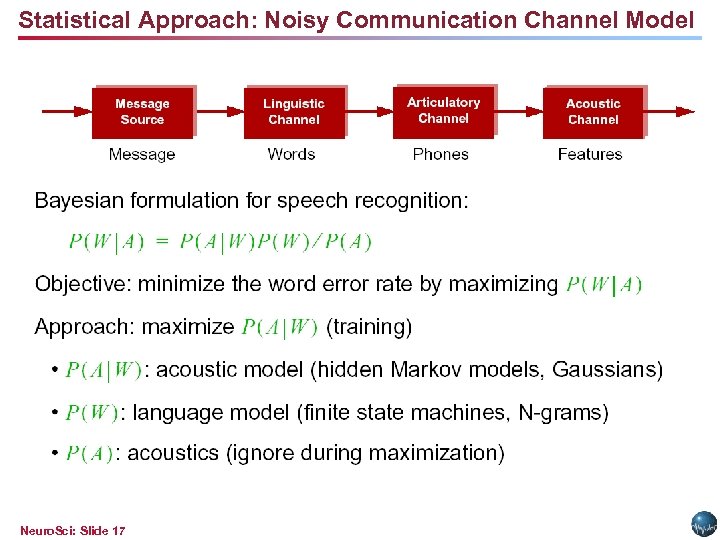 Statistical Approach: Noisy Communication Channel Model Neuro. Sci: Slide 17
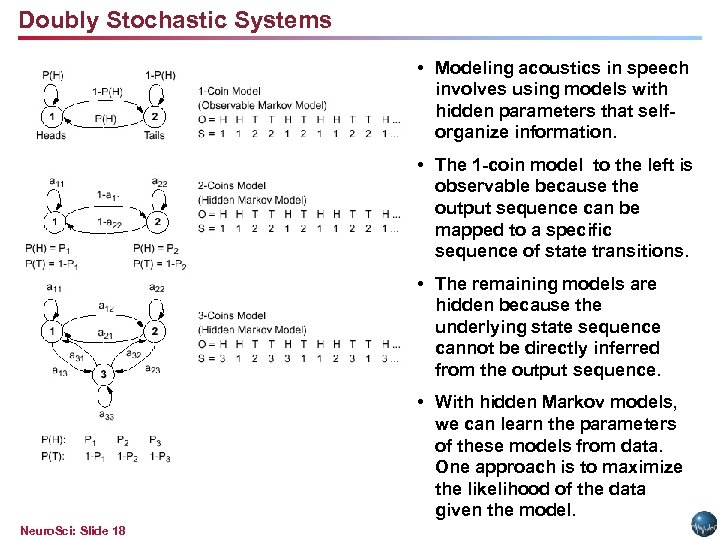 Doubly Stochastic Systems • Modeling acoustics in speech involves using models with hidden parameters that selforganize information. • The 1 -coin model to the left is observable because the output sequence can be mapped to a specific sequence of state transitions. • The remaining models are hidden because the underlying state sequence cannot be directly inferred from the output sequence. • With hidden Markov models, we can learn the parameters of these models from data. One approach is to maximize the likelihood of the data given the model. Neuro. Sci: Slide 18
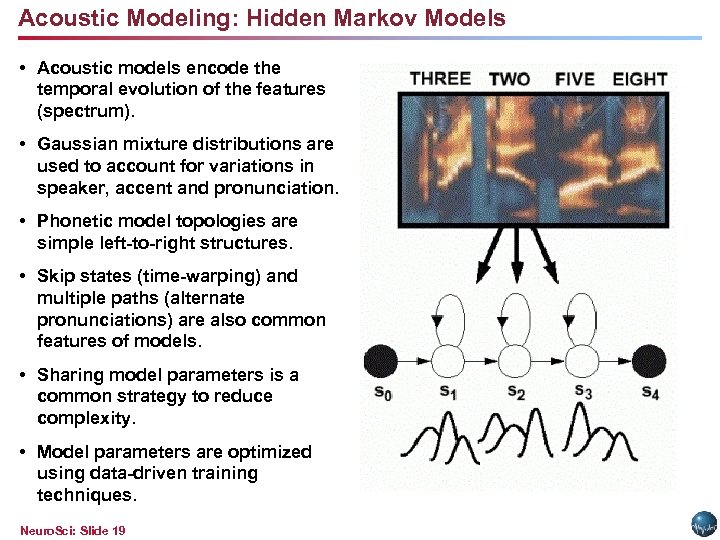 Acoustic Modeling: Hidden Markov Models • Acoustic models encode the temporal evolution of the features (spectrum). • Gaussian mixture distributions are used to account for variations in speaker, accent and pronunciation. • Phonetic model topologies are simple left-to-right structures. • Skip states (time-warping) and multiple paths (alternate pronunciations) are also common features of models. • Sharing model parameters is a common strategy to reduce complexity. • Model parameters are optimized using data-driven training techniques. Neuro. Sci: Slide 19
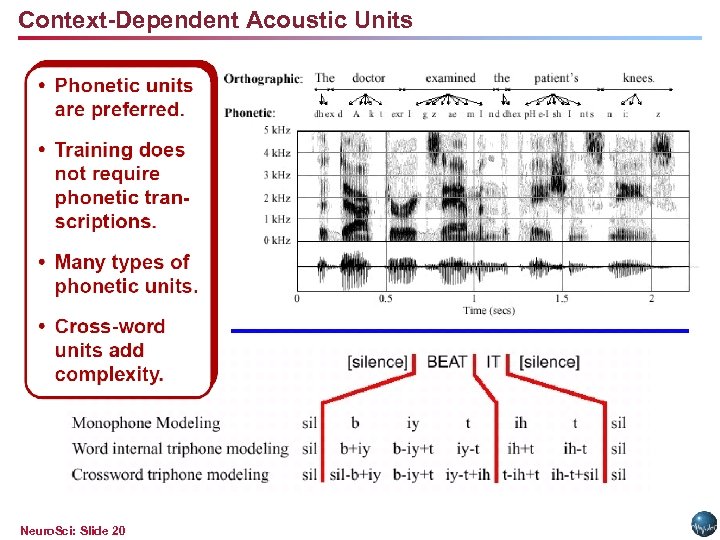 Context-Dependent Acoustic Units Neuro. Sci: Slide 20
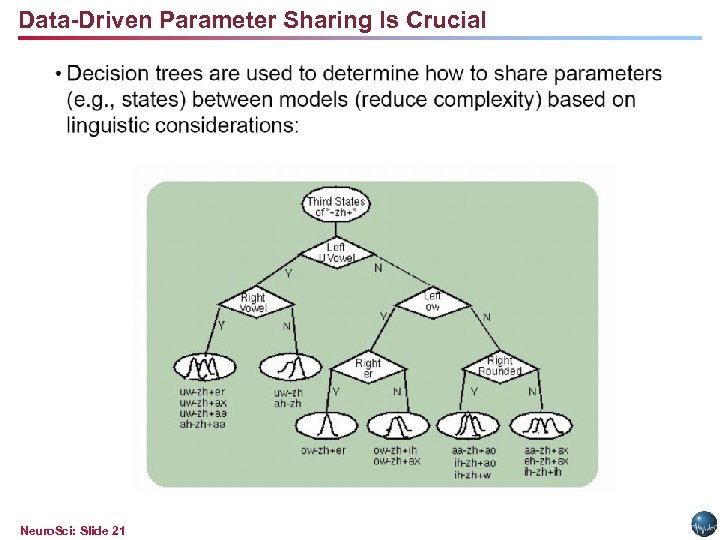 Data-Driven Parameter Sharing Is Crucial Neuro. Sci: Slide 21
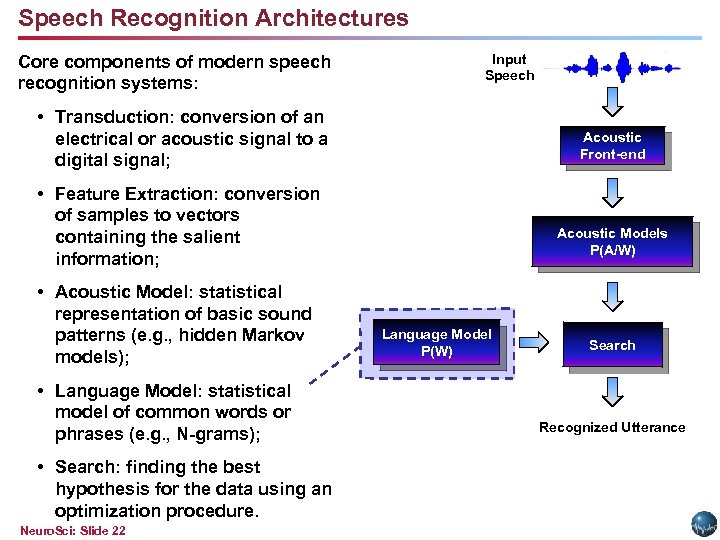 Speech Recognition Architectures Core components of modern speech recognition systems: Input Speech • Transduction: conversion of an electrical or acoustic signal to a digital signal; Acoustic Front-end • Feature Extraction: conversion of samples to vectors containing the salient information; • Acoustic Model: statistical representation of basic sound patterns (e. g. , hidden Markov models); • Language Model: statistical model of common words or phrases (e. g. , N-grams); • Search: finding the best hypothesis for the data using an optimization procedure. Neuro. Sci: Slide 22 Acoustic Models P(A/W) Language Model P(W) Search Recognized Utterance
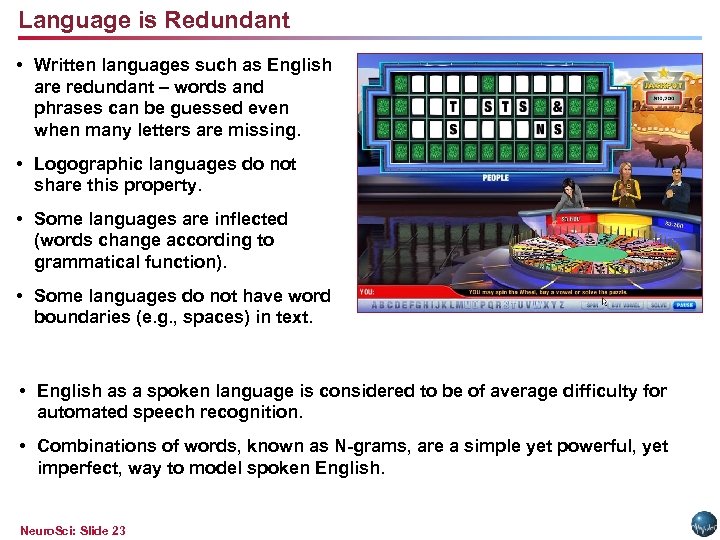 Language is Redundant • Written languages such as English are redundant – words and phrases can be guessed even when many letters are missing. • Logographic languages do not share this property. • Some languages are inflected (words change according to grammatical function). • Some languages do not have word boundaries (e. g. , spaces) in text. • English as a spoken language is considered to be of average difficulty for automated speech recognition. • Combinations of words, known as N-grams, are a simple yet powerful, yet imperfect, way to model spoken English. Neuro. Sci: Slide 23
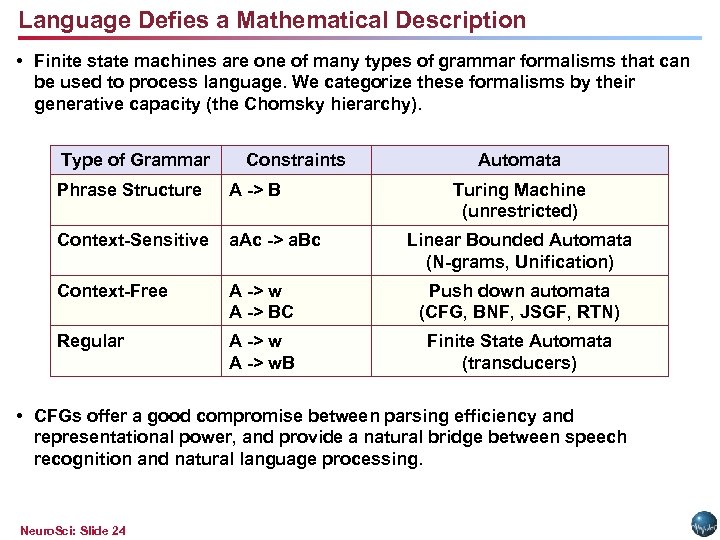 Language Defies a Mathematical Description • Finite state machines are one of many types of grammar formalisms that can be used to process language. We categorize these formalisms by their generative capacity (the Chomsky hierarchy). Type of Grammar Constraints Automata Phrase Structure A -> B Turing Machine (unrestricted) Context-Sensitive a. Ac -> a. Bc Context-Free A -> w A -> BC Push down automata (CFG, BNF, JSGF, RTN) Regular A -> w. B Finite State Automata (transducers) Linear Bounded Automata (N-grams, Unification) • CFGs offer a good compromise between parsing efficiency and representational power, and provide a natural bridge between speech recognition and natural language processing. Neuro. Sci: Slide 24
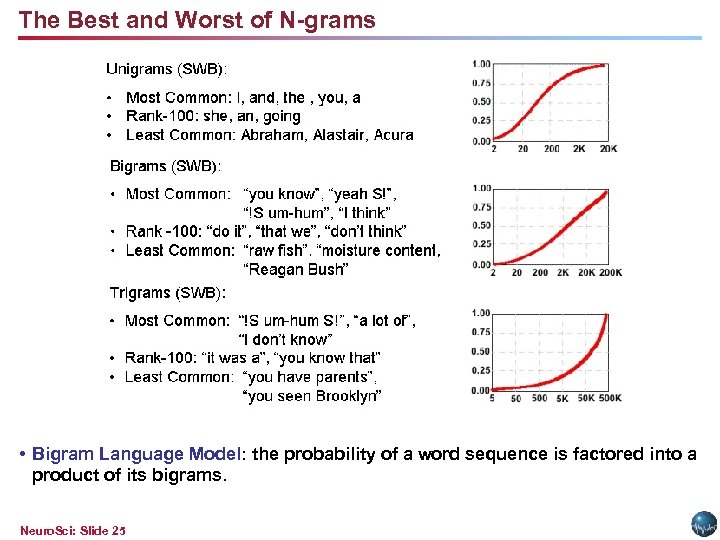 The Best and Worst of N-grams • Bigram Language Model: the probability of a word sequence is factored into a product of its bigrams. Neuro. Sci: Slide 25
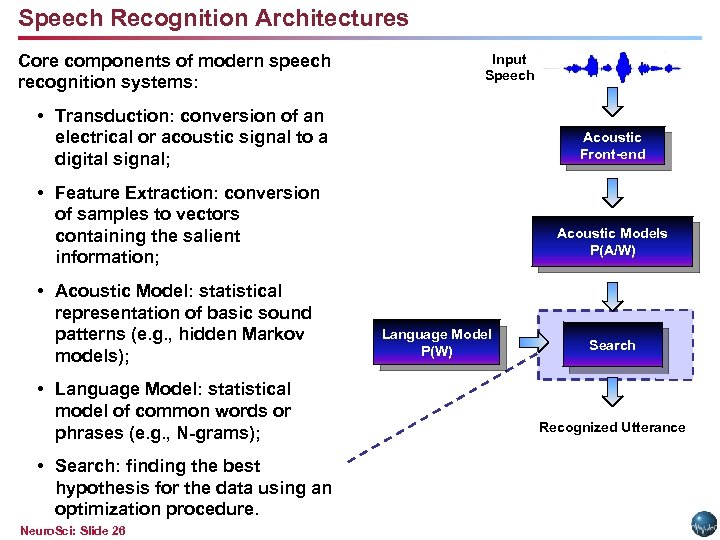 Speech Recognition Architectures Core components of modern speech recognition systems: Input Speech • Transduction: conversion of an electrical or acoustic signal to a digital signal; Acoustic Front-end • Feature Extraction: conversion of samples to vectors containing the salient information; • Acoustic Model: statistical representation of basic sound patterns (e. g. , hidden Markov models); • Language Model: statistical model of common words or phrases (e. g. , N-grams); • Search: finding the best hypothesis for the data using an optimization procedure. Neuro. Sci: Slide 26 Acoustic Models P(A/W) Language Model P(W) Search Recognized Utterance
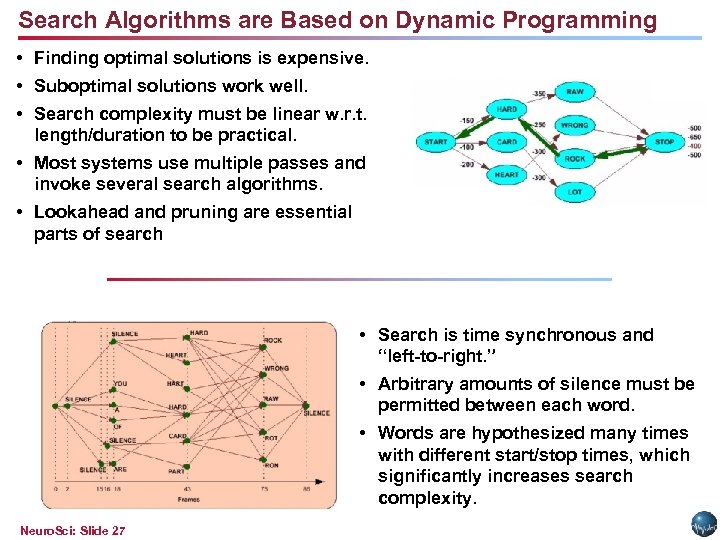 Search Algorithms are Based on Dynamic Programming • Finding optimal solutions is expensive. • Suboptimal solutions work well. • Search complexity must be linear w. r. t. length/duration to be practical. • Most systems use multiple passes and invoke several search algorithms. • Lookahead and pruning are essential parts of search • Search is time synchronous and “left-to-right. ” • Arbitrary amounts of silence must be permitted between each word. • Words are hypothesized many times with different start/stop times, which significantly increases search complexity. Neuro. Sci: Slide 27
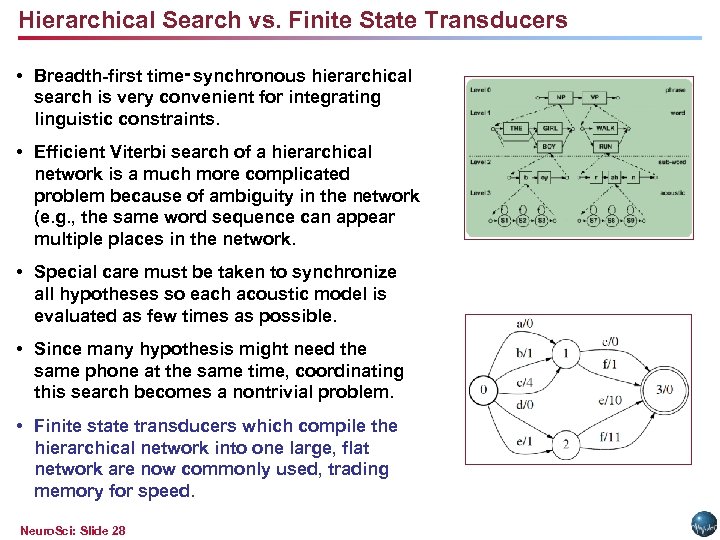 Hierarchical Search vs. Finite State Transducers • Breadth-first time‑synchronous hierarchical search is very convenient for integrating linguistic constraints. • Efficient Viterbi search of a hierarchical network is a much more complicated problem because of ambiguity in the network (e. g. , the same word sequence can appear multiple places in the network. • Special care must be taken to synchronize all hypotheses so each acoustic model is evaluated as few times as possible. • Since many hypothesis might need the same phone at the same time, coordinating this search becomes a nontrivial problem. • Finite state transducers which compile the hierarchical network into one large, flat network are now commonly used, trading memory for speed. Neuro. Sci: Slide 28
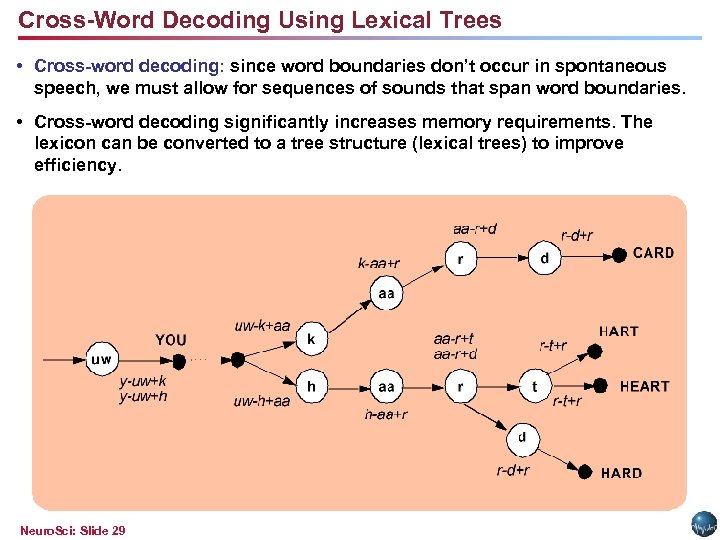 Cross-Word Decoding Using Lexical Trees • Cross-word decoding: since word boundaries don’t occur in spontaneous speech, we must allow for sequences of sounds that span word boundaries. • Cross-word decoding significantly increases memory requirements. The lexicon can be converted to a tree structure (lexical trees) to improve efficiency. Neuro. Sci: Slide 29
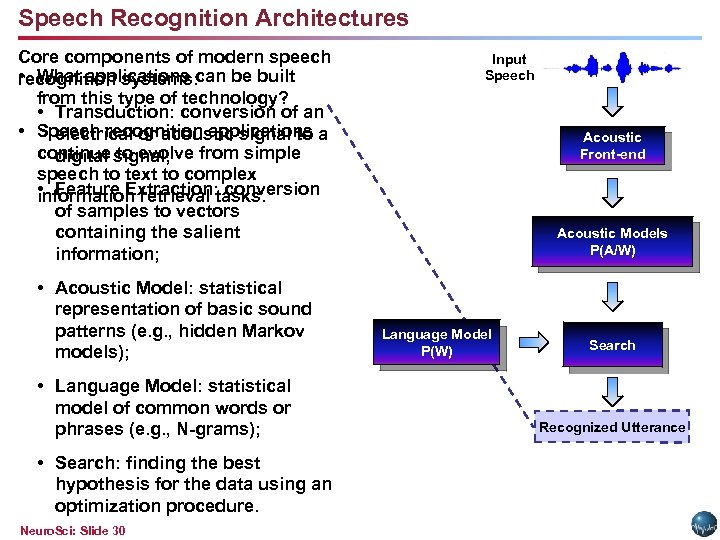 Speech Recognition Architectures Core components of modern speech • What applications can be built recognition systems: from this type of technology? • Transduction: conversion of an • Speech recognition applications a electrical or acoustic signal to continue signal; digital to evolve from simple speech to text to complex • Feature Extraction: tasks. information retrieval conversion of samples to vectors containing the salient information; • Acoustic Model: statistical representation of basic sound patterns (e. g. , hidden Markov models); • Language Model: statistical model of common words or phrases (e. g. , N-grams); • Search: finding the best hypothesis for the data using an optimization procedure. Neuro. Sci: Slide 30 Input Speech Acoustic Front-end Acoustic Models P(A/W) Language Model P(W) Search Recognized Utterance
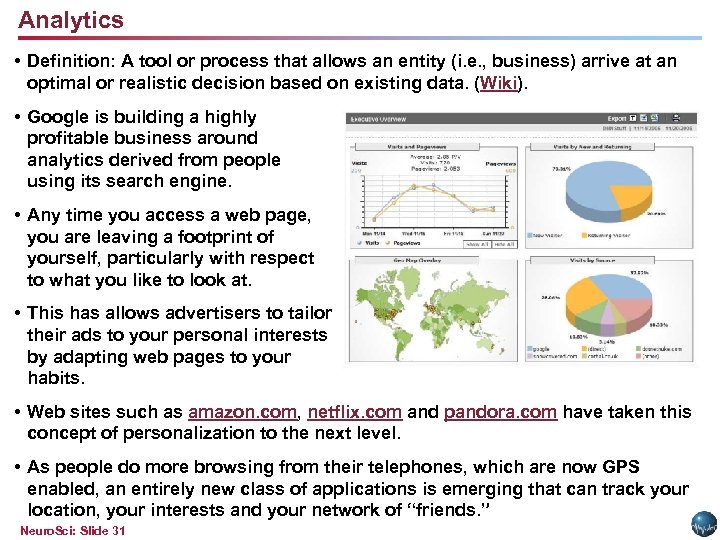 Analytics • Definition: A tool or process that allows an entity (i. e. , business) arrive at an optimal or realistic decision based on existing data. (Wiki). • Google is building a highly profitable business around analytics derived from people using its search engine. • Any time you access a web page, you are leaving a footprint of yourself, particularly with respect to what you like to look at. • This has allows advertisers to tailor their ads to your personal interests by adapting web pages to your habits. • Web sites such as amazon. com, netflix. com and pandora. com have taken this concept of personalization to the next level. • As people do more browsing from their telephones, which are now GPS enabled, an entirely new class of applications is emerging that can track your location, your interests and your network of “friends. ” Neuro. Sci: Slide 31
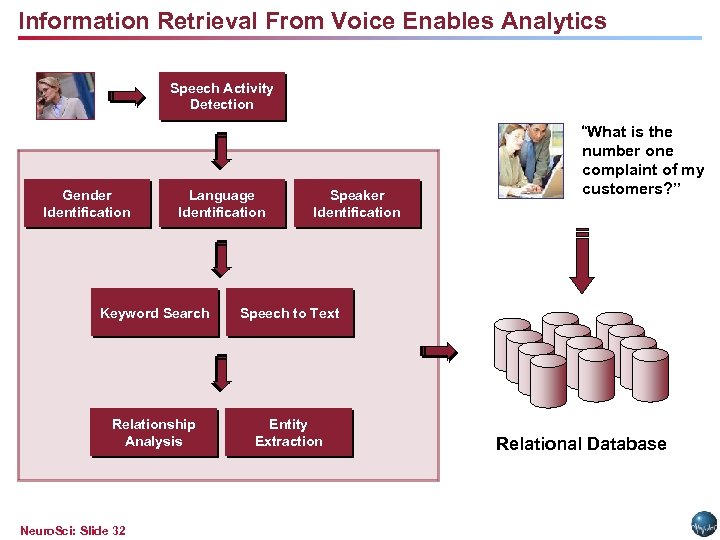 Information Retrieval From Voice Enables Analytics Speech Activity Detection Gender Identification Language Identification Speaker Identification Keyword Search Speech to Text Relationship Analysis Entity Extraction “What is the number one complaint of my customers? ” Neuro. Sci: Slide 32 Relational Database
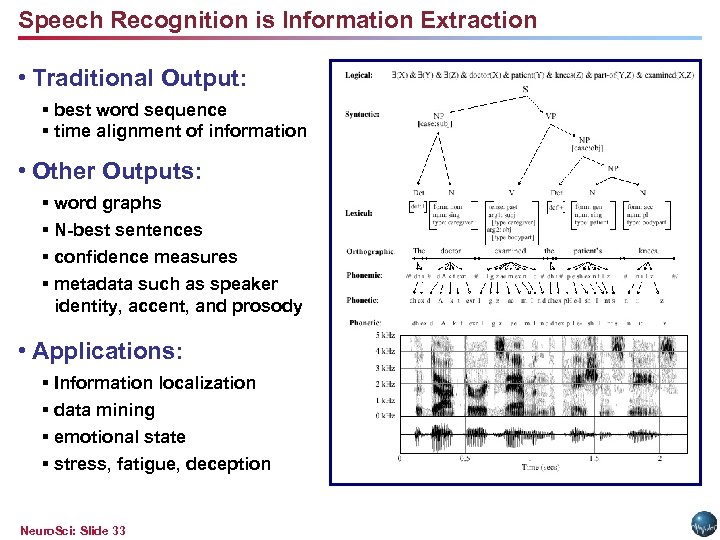 Speech Recognition is Information Extraction • Traditional Output: § best word sequence § time alignment of information • Other Outputs: § word graphs § N-best sentences § confidence measures § metadata such as speaker identity, accent, and prosody • Applications: § Information localization § data mining § emotional state § stress, fatigue, deception Neuro. Sci: Slide 33
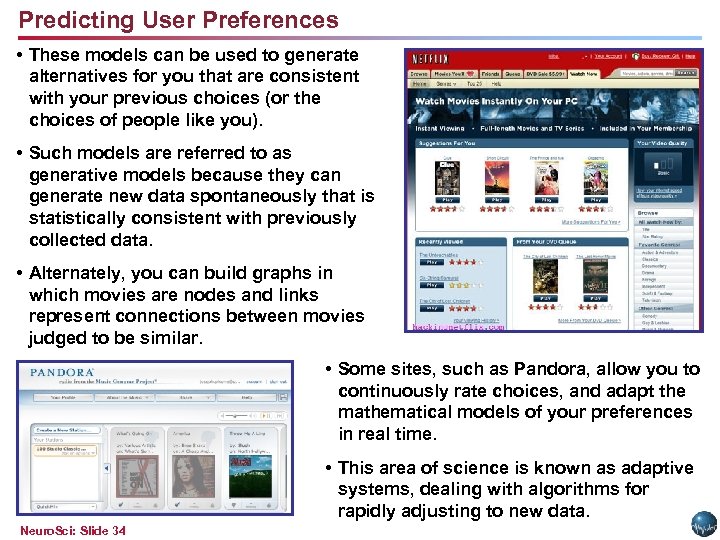 Predicting User Preferences • These models can be used to generate alternatives for you that are consistent with your previous choices (or the choices of people like you). • Such models are referred to as generative models because they can generate new data spontaneously that is statistically consistent with previously collected data. • Alternately, you can build graphs in which movies are nodes and links represent connections between movies judged to be similar. • Some sites, such as Pandora, allow you to continuously rate choices, and adapt the mathematical models of your preferences in real time. • This area of science is known as adaptive systems, dealing with algorithms for rapidly adjusting to new data. Neuro. Sci: Slide 34
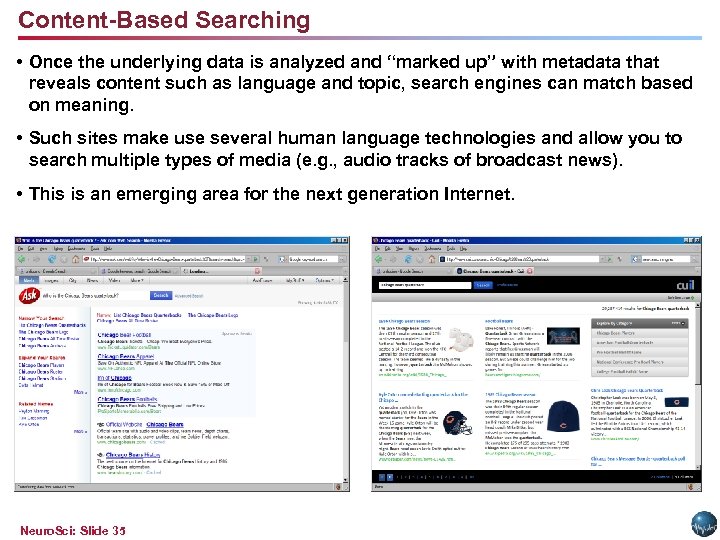 Content-Based Searching • Once the underlying data is analyzed and “marked up” with metadata that reveals content such as language and topic, search engines can match based on meaning. • Such sites make use several human language technologies and allow you to search multiple types of media (e. g. , audio tracks of broadcast news). • This is an emerging area for the next generation Internet. Neuro. Sci: Slide 35
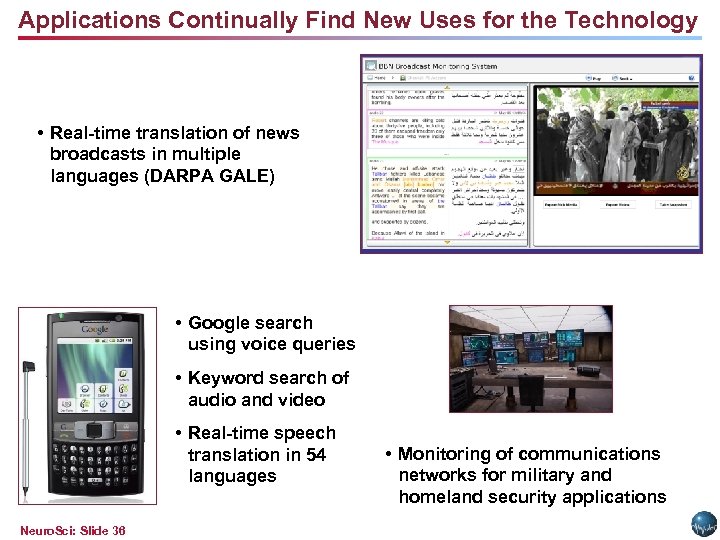 Applications Continually Find New Uses for the Technology • Real-time translation of news broadcasts in multiple languages (DARPA GALE) • Google search using voice queries • Keyword search of audio and video • Real-time speech translation in 54 languages Neuro. Sci: Slide 36 • Monitoring of communications networks for military and homeland security applications
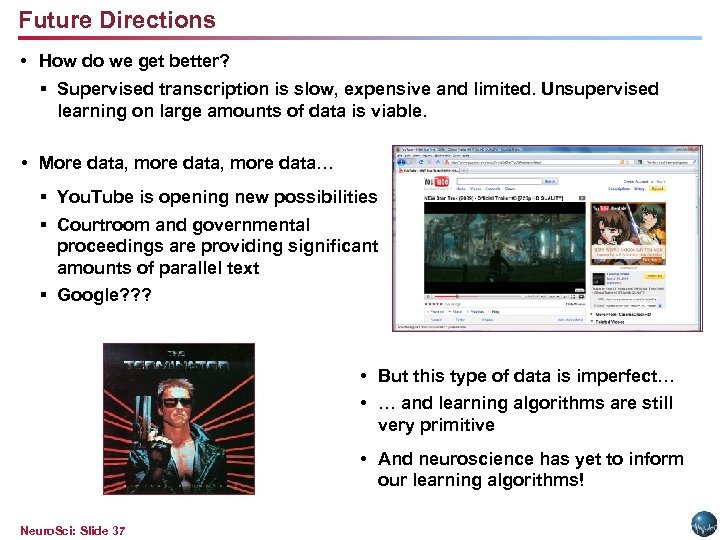 Future Directions • How do we get better? § Supervised transcription is slow, expensive and limited. Unsupervised learning on large amounts of data is viable. • More data, more data… § You. Tube is opening new possibilities § Courtroom and governmental proceedings are providing significant amounts of parallel text § Google? ? ? • But this type of data is imperfect… • … and learning algorithms are still very primitive • And neuroscience has yet to inform our learning algorithms! Neuro. Sci: Slide 37
 Brief Bibliography of Related Research • S. Pinker, The Language Instinct: How the Mind Creates Language, William Morrow and Company, New York, USA, 1994. • F. Juang and L. R. Rabiner, “Automatic Speech Recognition - A Brief History of the Technology, ” Elsevier Encyclopedia of Language and Linguistics, 2 nd Edition, 2005. • M. Benzeghiba, et al. , “Automatic Speech Recognition and Speech Variability, A Review, ” Speech Communication, vol. 49, no. 10 -11, pp. 763– 786, October 2007. • B. J. Kroger, et al. , “Towards a Neurocomputational Model of Speech Production and Perception, ” Speech Communication, vol. 51, no. 9, pp. 793809, September 2009. • B. Lee, “The Biological Foundations of Language”, available at http: //www. duke. edu/~pk 10/language/neuro. htm (a review paper). • M. Gladwell, Blink: The Power of Thinking Without Thinking, Little, Brown and Company, New York, USA, 2005. Neuro. Sci: Slide 38
 Biography Joseph Picone received his Ph. D. in Electrical Engineering in 1983 from the Illinois Institute of Technology. He is currently Professor and Chair of the Department of Electrical and Computer Engineering at Temple University. He recently completed a three-year sabbatical at the Department of Defense where he directed human language technology research and development. His primary research interests are currently machine learning approaches to acoustic modeling in speech recognition. For over 25 years he has conducted research on many aspects of digital speech and signal processing. He has also been a long-term advocate of open source technology, delivering one of the first state-of-the-art open source speech recognition systems, and maintaining one of the more comprehensive web sites related to signal processing. His research group is known for producing many innovative educational materials that have increased access to the field. Dr. Picone has previously been employed by Texas Instruments and AT&T Bell Laboratories, including a two-year assignment in Japan establishing Texas Instruments’ first international research center. He is a Senior Member of the IEEE, holds several patents in this area, and has been active in several professional societies related to human language technology. Neuro. Sci: Slide 39