


 Скачать презентацию Neurology APTT PT INR The Tests We
64a46d12f6e913f7d73b6e1042549b11.ppt
- Количество слайдов: 20
 Neurology APTT, PT, INR
 The Tests We All Must Pass • Chronological Order of the Presentation – – – – Introduction APTT & PTT PT & INR Nursing Interventions Differences Current Research Summary Questions
 The Cold Hard Facts • We all die, but first we must live • We control our bodies via a large neurological system • Depriving this neurological system of blood flow = death • Thromboli can impede blood flow • Therefore thromboli = death
 The Selfish Gene • We all want to live • Keeping blood flowing to neurological system prolongs life • Thromboli impedes blood flow • Antithrombolitic therapy prevents thromboli formation • Therefore antithrombolitic therapy prolongs life
 Too Much of a Good Thing. . . • Too much antithrombolitic therapy = prolonged bleeding • Prolonged bleeding decreases blood flow to neurological system • Decreased blood flow to neurological system can cause death • Therefore too much antithrombolitic therapy can cause death
 How to Walk the Line • Develop tests to measure clotting factor • APTT & PTT • PT & INR
 APTT & PTT • APTT – Activated Partial Thromboplastin Time • PTT - Partial Thromboplastin Time • Use intrinsic factors to initiate coagulation pathways • Coagulation is timed and compared to a standard • Test used to diagnosis and monitor • 70 seconds…
 PT & INR • PT – Prothrombolin time • INR – International Normalization Ratio • Firm fibrin clot formation initiated by tissue thromboplastin (factor III) and calcium • Timed test
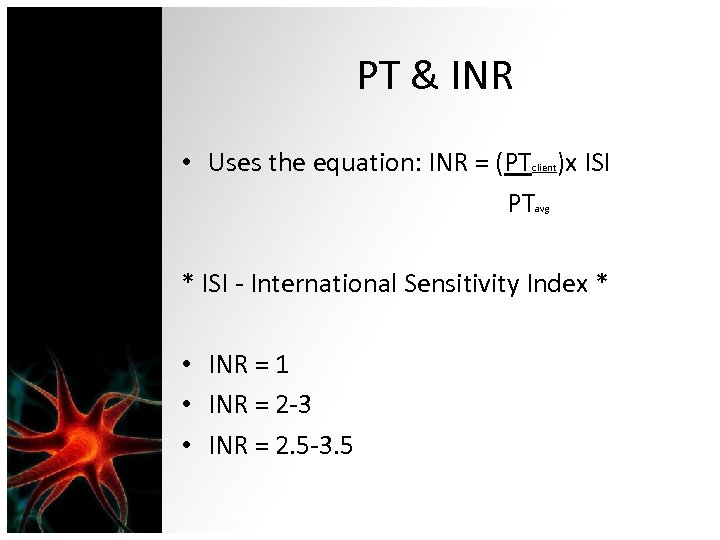 PT & INR • Uses the equation: INR = (PT )x ISI PT client avg * ISI - International Sensitivity Index * • INR = 1 • INR = 2 -3 • INR = 2. 5 -3. 5
 Nursing Interventions • Both are blood tests = similar interventions • Require interventions at all stages of the test: – Pre-test – Intra-test – Post-test
 Pre-Test • Education • Client Health History – Bleeding disorders – Surgeries, lab tests, diagnostic tests • Current and recent medications – Anticoagulants, acetylsalicylic acid, herbs, nutritional suppliments, and nutraceuticals
 Intra-Test • • Follow directions Breath normally Avoid unnecessary movement Identify client Label vials accordingly Fill tube completely Have sample analyzed within 4 hours
 Post-Test • Observe venipuncture site • Provide instructions regarding excessive bleeding and bruising • Educate regarding prolonged APTT or high INR • Reinforce health care provider information or instructions • Notify client’s health care provider if INR < 2 or APTT < 53 seconds
 Where are the Differences • INR internationally recognized and understood • APTT uses kaolin, celite or elegia acid to speed up reaction time, therefore increasing the speed of the test • APTT not recommended for prophylactic lowdose heparin therapy • INR affected by more drugs • INR may be performed on samples older than 4 hours* * A topic of current research
 Current Research • Certified Diagnostic Plasmas for INR • Are 2. 0 -3. 0 INR values optimal? • Obtaining INR and APTT values using different analyzers • INR self testing by clients
 Summary • APTT value < 70 seconds • INR value 2. 0 -3. 0 • APTT and INR instrumental in anticoagulation therapies, should be monitored closely to ensure adequate dosing
 References • • Cha, C. H. , Park, C. J. , Kim, D. H. , Kim, M. J. , Cho, Y. U. , Jang, S. & Chi, H. S. (2010) Direct international normalized ratio determination using multicalibrators is more responsive than the conventional method for measuring prothrombin time. International Journal of Laboratory Hematology, 32(4), pp. 392– 397. doi: 10. 1111/j. 1751 -553 X. 2009. 01195. x Christensen, T. D. , Jensen, C. , Larsen T. B. , Maegaard, M. , Christiansen, K. & Sørensen, B. (2010) International normalized ratio (INR), coagulation factor activities and calibrated automated thrombin generation -- Influence of 24 h storage at ambient temperature. International Journal of Laboratory Hematology, 32(2), pp. 206 -214. doi: 10. 1111/j. 1751 -553 X. 2009. 01170. x Peng, L. , Yan, C. , Wu, X. & Nie, L. (2009) Comparability of the results of PT–INR with local MNPT and APTTR with MNAPTT on different coagulation analyzers in China. International Journal of Laboratory Hematology, 31(3), pp. 352 -358. doi: 10. 1111/j. 1751 -553 X. 2008. 01071. x Plesch, W. & van den Besselaar, A. M. H. P. (2009) Validation of the international normalized ratio (INR) in a new point-of-care system designed for home monitoring of oral anticoagulation therapy. International Journal of Laboratory Hematology, 31(1), pp. 20 -25. doi: 10. 1111/j. 1751553 X. 2007. 00998. x
 References • You, J. H. S. , Chan, F. W. H. , Wong, R. S. M. & Cheng, G. (2005) Is INR between 2. 0 and 3. 0 the optimal level for Chinese patients on warfarin therapy for moderate-intensity anticoagulation? British Journal of Clinical Pharmacology, 59(5), pp. 582 -587. doi: 10. 1111/j. 1365 -2125. 2005. 02361. x
 Questions? • A wise person once observed: “Nurses are like the blood of the health care system. . . without them it would die. ”