


 Скачать презентацию Neuroinformatics for Telemedicine and Medical Services Allen D
7db1b720e13c34460d6fa39f46091ed2.ppt
- Количество слайдов: 42
 Neuroinformatics for Telemedicine and Medical Services Allen D. Malony Department of Computer and Information Science Don Tucker Electrical Geodesics, Inc. Neuroinformatics Center University of Oregon
 Neuro. Informatics Center (NIC) at UO r Computational science applied to human neuroscience ¦ ¦ ¦ r Integration of neuroimaging methods and technology ¦ ¦ ¦ r Tools to help understand dynamic brain function Tools to help diagnosis brain-related disorders HPC simulation, complex data analysis, medical services Coupled measures and evaluation (EEG/ERP, MR) Advanced statistical signal analysis (PCA, ICA) Advanced image analysis (segmentation, anatomy) Computational head modeling (electromagnetics, FDM) Source localization modeling (dipole, linear inverse) Internet-based capabilities for brain analysis services, data archiving, and data mining
 NIC Organization r r r Allen D. Malony, Director Don M. Tucker, Associate Director Sergei Turovets, Computational Physicist Bob Frank, Senior Data Analyst Kai Li, Computer Scientist Chris Hoge, Computational Software Engineer Matt Sottile, Computer Scientist, CIS Department Dejing Dou, Computer Scientist, CIS Department Gwen Frishkoff, Neuro Scientist, Wisconsin Medical C. Brad Davidson, Systems administrator Adnan Salman, Ph. D. student, Computer Science Jason Sydes, Ph. D. student, Computer Science
 NIC Scientists/Students and Projects r Sergei Turovets, Ph. D. , Physics r Kai Li, Ph. D. , Computer Science r Bob Frank, M. S. , Mathematics r Chris Hoge, M. S. , Computer Science r Matt Sottile, Ph. D. , Computer Science r Dejing Dou, Ph. D. , Computer Science r Gwen Frishkoff, Ph. D. , Psychology, Wisconsin Medical College r Adnan Salman, Ph. D. student, Computer Science r Jason Sydes, M. S. student, Computer Science Physics-based computational models of human head tissues for developing electrical and optical probes of brain activity Tissue segmentation of neurological images, cortical surface extraction of the individual brain, and brain visualization Statistical analysis of neurophysiological recordings to separate brain from non-brain signals in scalp and source space Computational software development, high-performance signal analysis tools, application server environments, EEG and MRI databases, neuroinformatics workflow EEG data modeling methods for detecting spike and seizure Data mining and ontologies Automated component separation, ERP pattern classification, and neuro electromagnetic ontologies Optimization solutions for finding human head tissues conductivity EEG and MRI database development
 Neuroinformatic Challenges r Dense-array ¦ Artifact EEG signal analysis and decomposition cleaning and component analysis r Automatic brain image segmentation ¦ Brain tissue identification ¦ Cortex extraction r Computational head modeling ¦ Tissue conductivity estimation ¦ Source localization r Statistical analysis to detect brain states ¦ Discriminant analysis ¦ Pattern recognition r Electromagnetic databases and ontologies r HPC, data management, workflow, services delivery
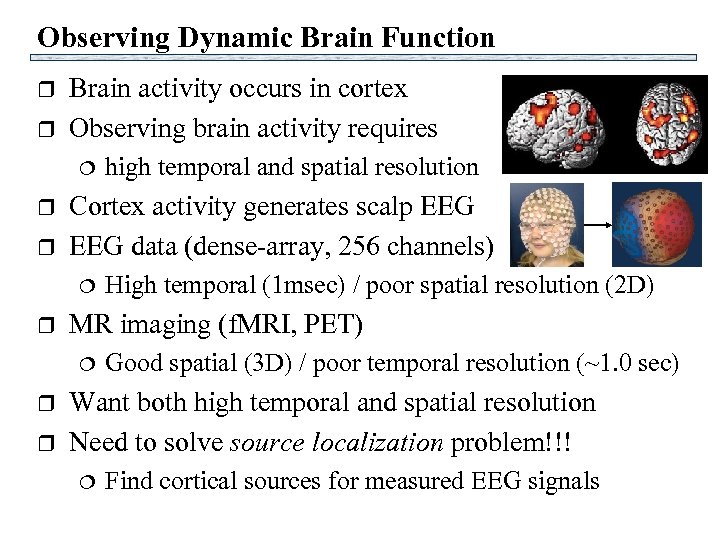 Observing Dynamic Brain Function r r Brain activity occurs in cortex Observing brain activity requires ¦ r r Cortex activity generates scalp EEG data (dense-array, 256 channels) ¦ r r High temporal (1 msec) / poor spatial resolution (2 D) MR imaging (f. MRI, PET) ¦ r high temporal and spatial resolution Good spatial (3 D) / poor temporal resolution (~1. 0 sec) Want both high temporal and spatial resolution Need to solve source localization problem!!! ¦ Find cortical sources for measured EEG signals
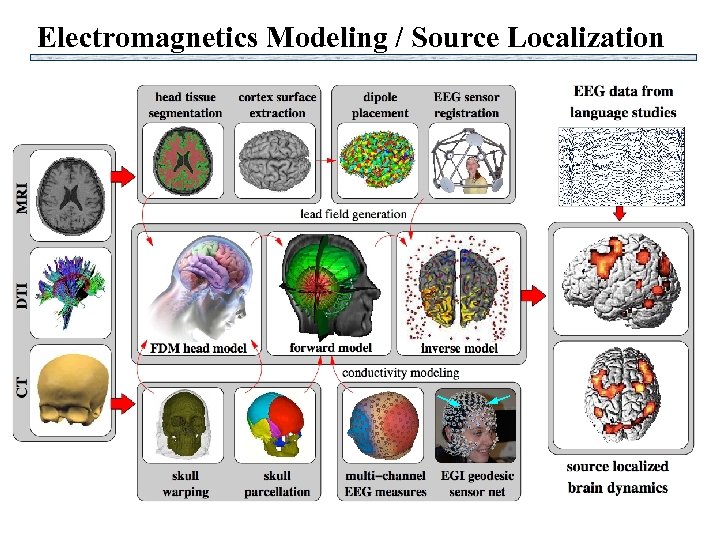 Electromagnetics Modeling / Source Localization
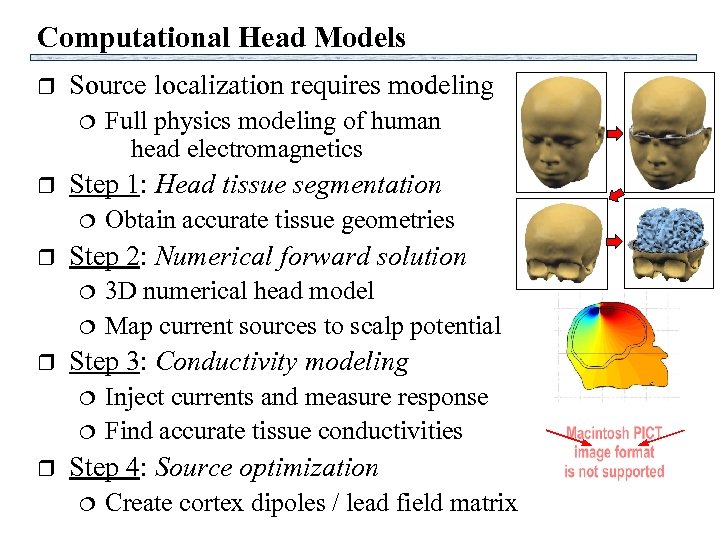 Computational Head Models r Source localization requires modeling ¦ r Step 1: Head tissue segmentation ¦ r ¦ 3 D numerical head model Map current sources to scalp potential Step 3: Conductivity modeling ¦ ¦ r Obtain accurate tissue geometries Step 2: Numerical forward solution ¦ r Full physics modeling of human head electromagnetics Inject currents and measure response Find accurate tissue conductivities Step 4: Source optimization ¦ Create cortex dipoles / lead field matrix
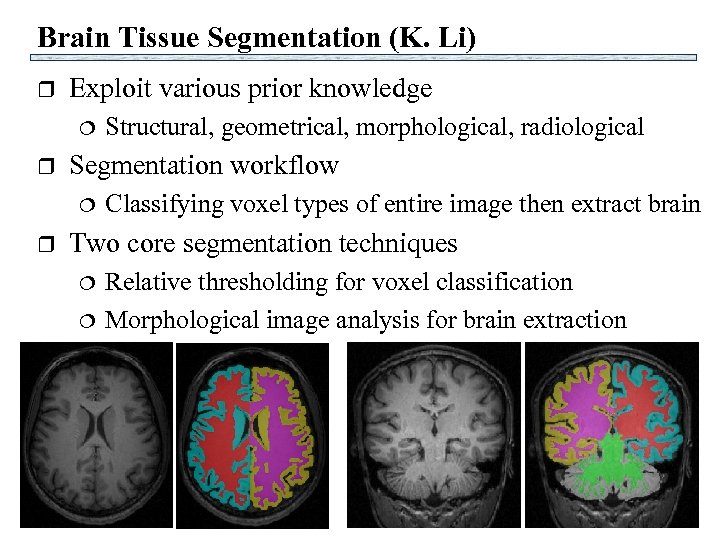 Brain Tissue Segmentation (K. Li) r Exploit various prior knowledge ¦ r Segmentation workflow ¦ r Structural, geometrical, morphological, radiological Classifying voxel types of entire image then extract brain Two core segmentation techniques ¦ ¦ Relative thresholding for voxel classification Morphological image analysis for brain extraction
 Cortical Surface Reconstruction r r Performed after brain tissue segmentation Use the marching cube isosurface algorithm Guarantee topology correctness Application to surface tessellation and dipole creation
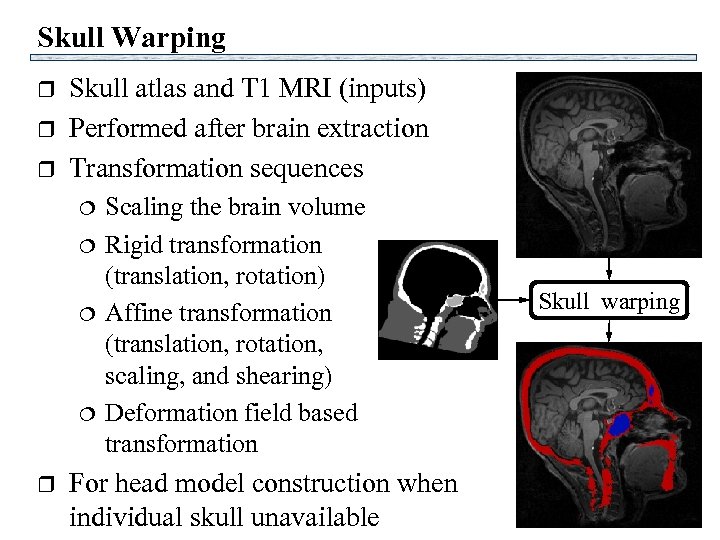 Skull Warping r r r Skull atlas and T 1 MRI (inputs) Performed after brain extraction Transformation sequences ¦ ¦ r Scaling the brain volume Rigid transformation (translation, rotation) Affine transformation (translation, rotation, scaling, and shearing) Deformation field based transformation For head model construction when individual skull unavailable Skull warping
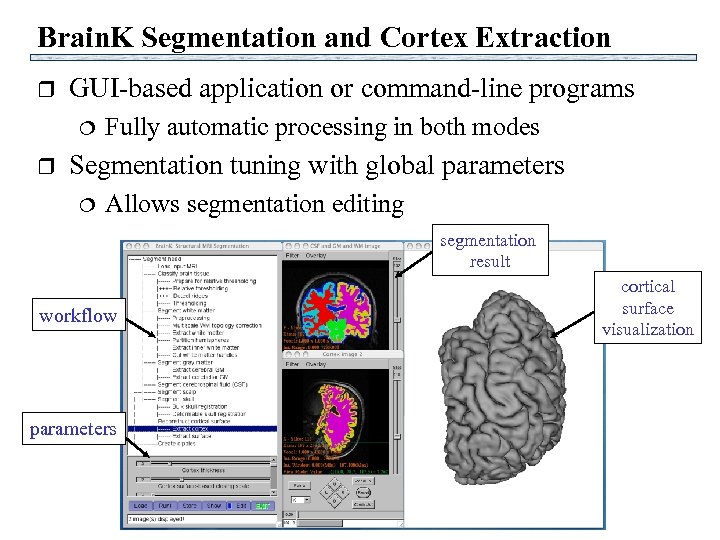 Brain. K Segmentation and Cortex Extraction r GUI-based application or command-line programs ¦ r Fully automatic processing in both modes Segmentation tuning with global parameters ¦ Allows segmentation editing segmentation result workflow parameters cortical surface visualization
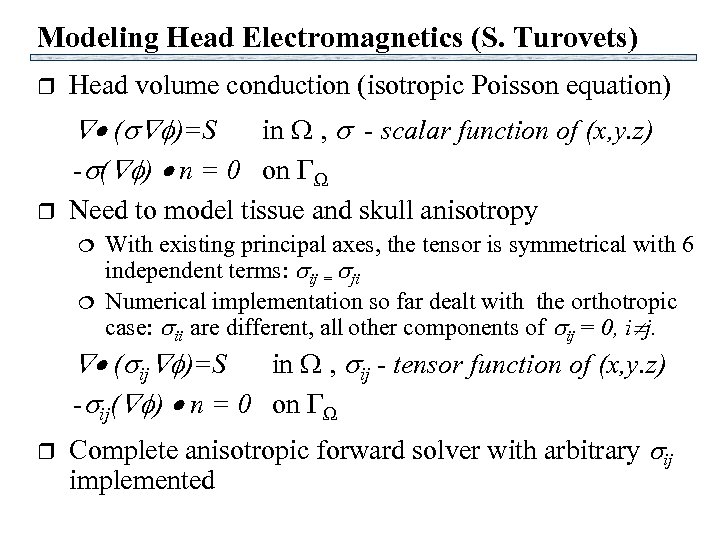 Modeling Head Electromagnetics (S. Turovets) r Head volume conduction (isotropic Poisson equation) ( )=S in , - scalar function of (x, y. z) - ( ) n = 0 on r Need to model tissue and skull anisotropy ¦ ¦ With existing principal axes, the tensor is symmetrical with 6 independent terms: ij = ji Numerical implementation so far dealt with the orthotropic case: ii are different, all other components of ij = 0, i j. ( ij )=S in , ij - tensor function of (x, y. z) - ij( ) n = 0 on r Complete anisotropic forward solver with arbitrary ij implemented
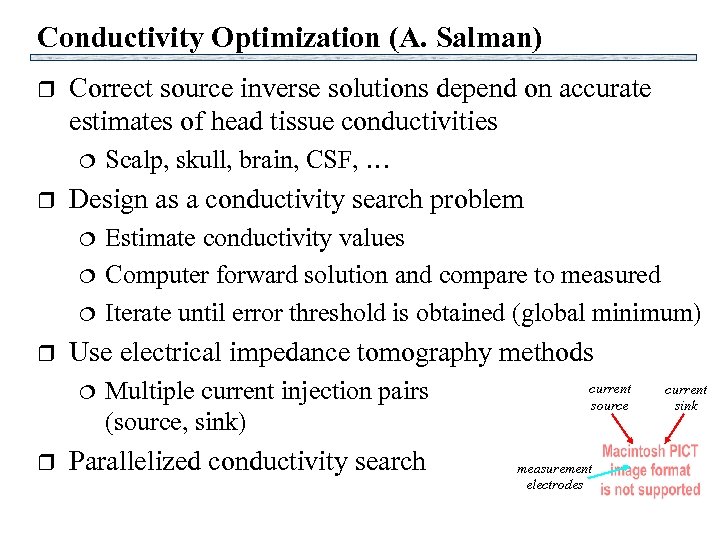 Conductivity Optimization (A. Salman) r Correct source inverse solutions depend on accurate estimates of head tissue conductivities ¦ r Design as a conductivity search problem ¦ ¦ ¦ r Estimate conductivity values Computer forward solution and compare to measured Iterate until error threshold is obtained (global minimum) Use electrical impedance tomography methods ¦ r Scalp, skull, brain, CSF, … Multiple current injection pairs (source, sink) Parallelized conductivity search current source measurement electrodes current sink
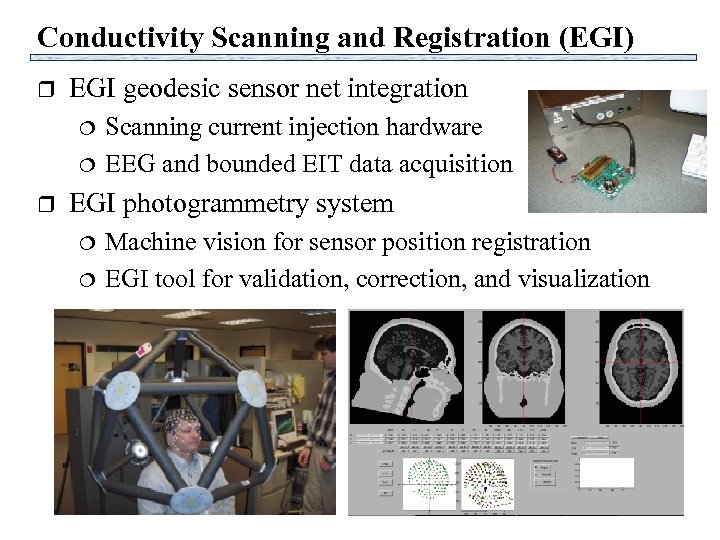 Conductivity Scanning and Registration (EGI) r EGI geodesic sensor net integration ¦ ¦ r Scanning current injection hardware EEG and bounded EIT data acquisition EGI photogrammetry system ¦ ¦ Machine vision for sensor position registration EGI tool for validation, correction, and visualization
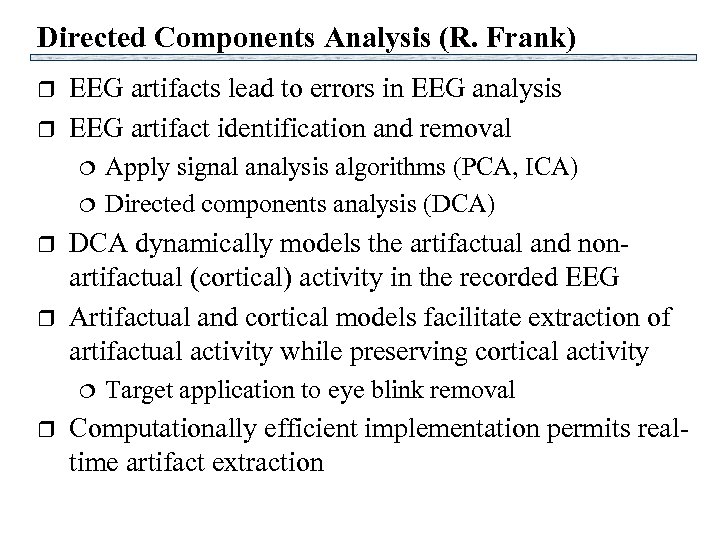 Directed Components Analysis (R. Frank) r r EEG artifacts lead to errors in EEG analysis EEG artifact identification and removal ¦ ¦ r r DCA dynamically models the artifactual and nonartifactual (cortical) activity in the recorded EEG Artifactual and cortical models facilitate extraction of artifactual activity while preserving cortical activity ¦ r Apply signal analysis algorithms (PCA, ICA) Directed components analysis (DCA) Target application to eye blink removal Computationally efficient implementation permits realtime artifact extraction
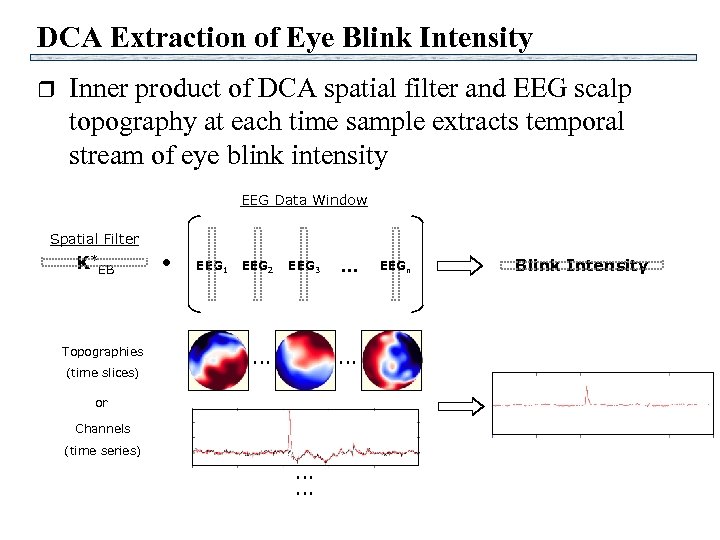 DCA Extraction of Eye Blink Intensity r Inner product of DCA spatial filter and EEG scalp topography at each time sample extracts temporal stream of eye blink intensity EEG Data Window Spatial Filter K*EB Topographies (time slices) EEG 1 EEG 2 EEG 3 … … or Channels (time series) … … … EEGn Blink Intensity
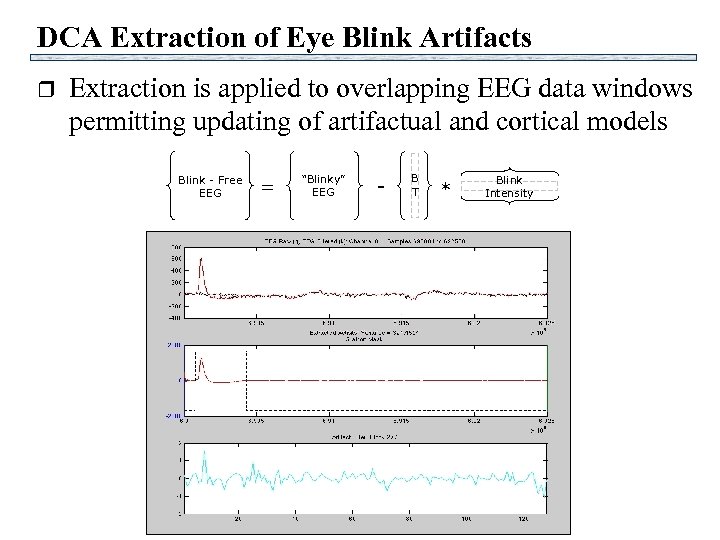 DCA Extraction of Eye Blink Artifacts r Extraction is applied to overlapping EEG data windows permitting updating of artifactual and cortical models Blink - Free EEG = “Blinky” EEG - B T * Blink Intensity
 Neural Electro. Magnetic Ontologies (NEMO) r r r How can EEG data be compared across laboratories? Need a system for representation, storage, mining, and dissemination of electromagnetic information Need standardization of methods for measure generation and classification of information ¦ ¦ r NEMO will address issue by providing ¦ ¦ ¦ r Identification and labeling of components Patterns of interest Spatial and temporal ontology database Use for data representation, mining, and meta-analysis Components in average EEG and MEG (ERPs) D. Dou, G. Frishkoff, R. Frank
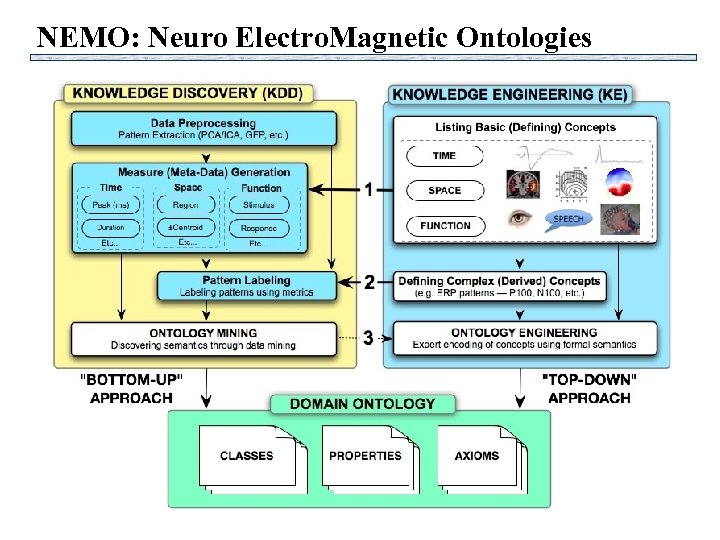 NEMO: Neuro Electro. Magnetic Ontologies
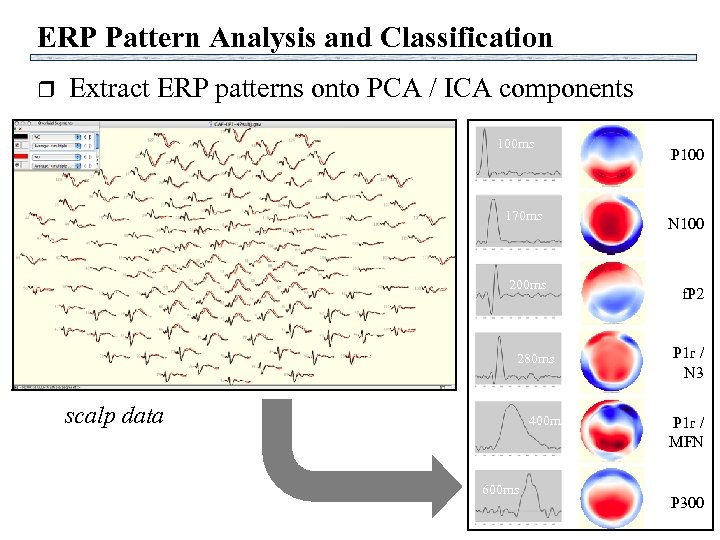 ERP Pattern Analysis and Classification r Extract ERP patterns onto PCA / ICA components 100 ms 170 ms 200 ms 280 ms scalp data 400 ms 600 ms P 100 N 100 f. P 2 P 1 r / N 3 P 1 r / MFN P 300
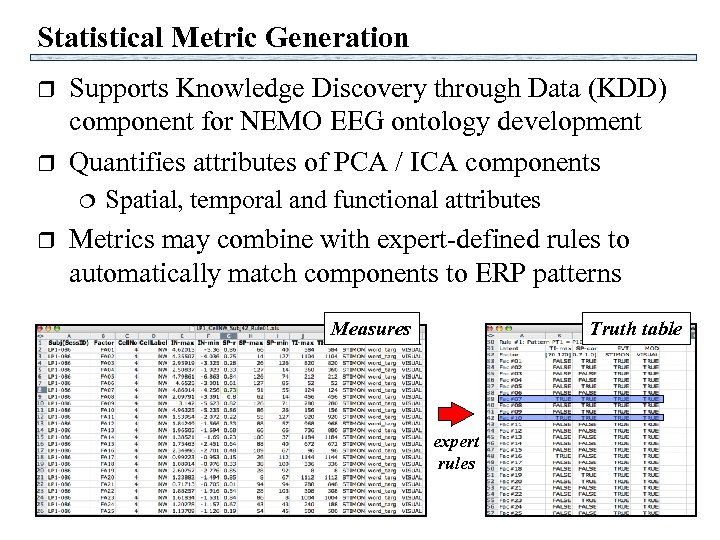 Statistical Metric Generation r r Supports Knowledge Discovery through Data (KDD) component for NEMO EEG ontology development Quantifies attributes of PCA / ICA components ¦ r Spatial, temporal and functional attributes Metrics may combine with expert-defined rules to automatically match components to ERP patterns Measures Truth table expert rules
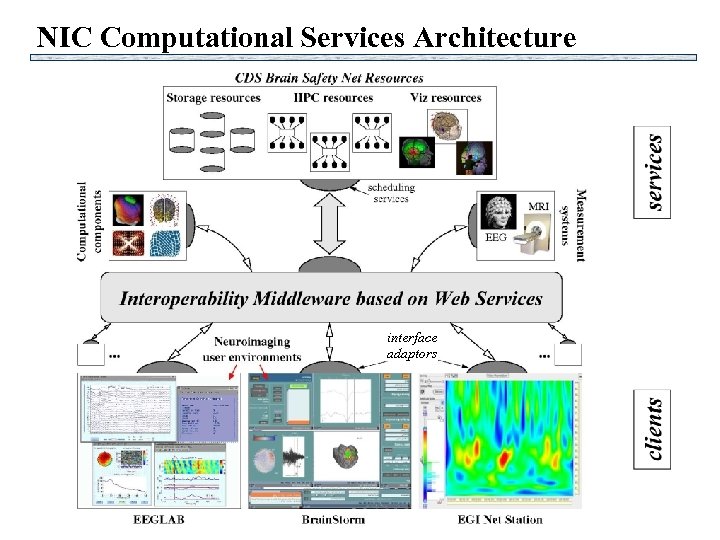
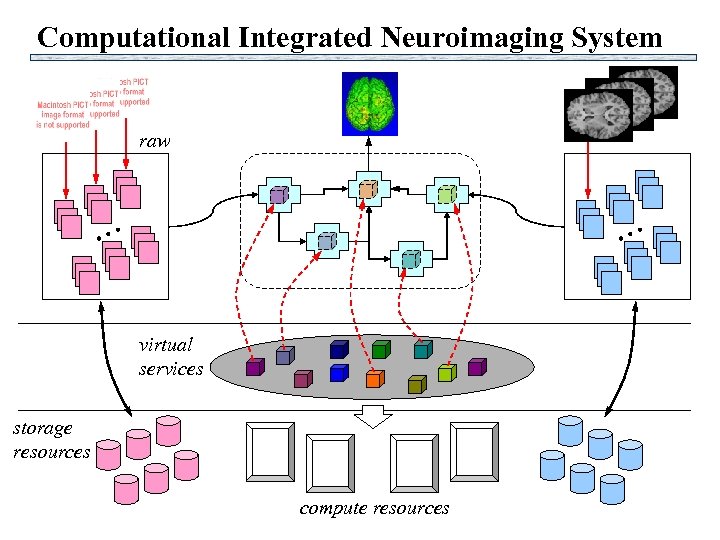 Computational Integrated Neuroimaging System raw … … virtual services storage resources compute resources
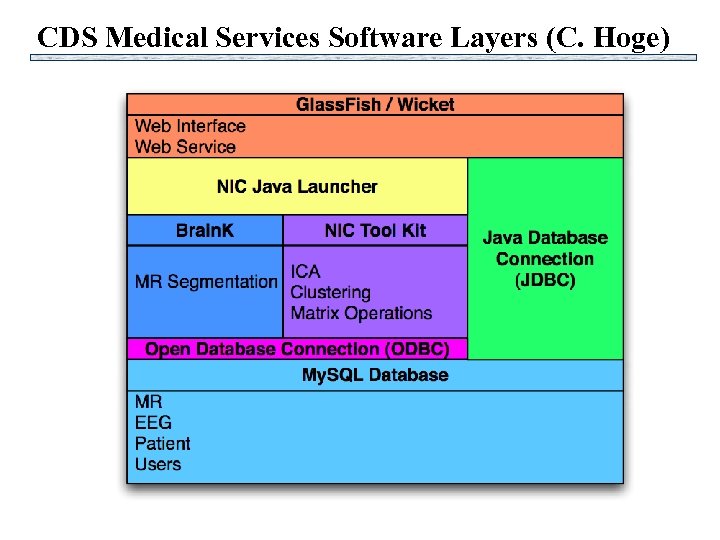 CDS Medical Services Software Layers (C. Hoge)
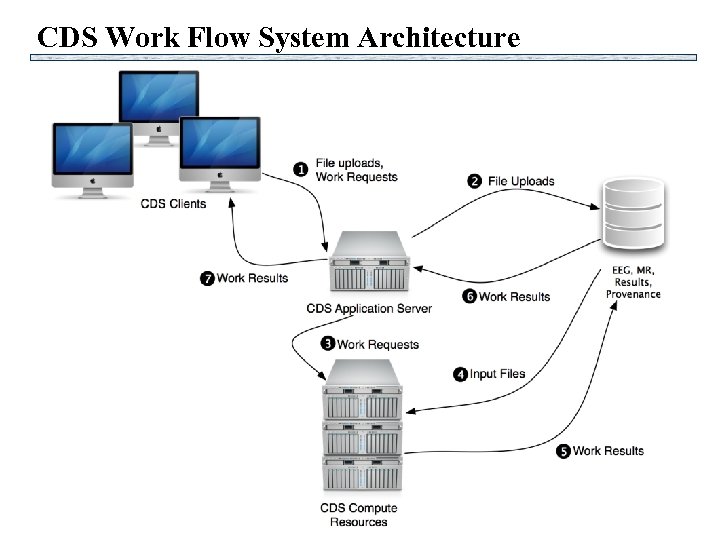 CDS Work Flow System Architecture
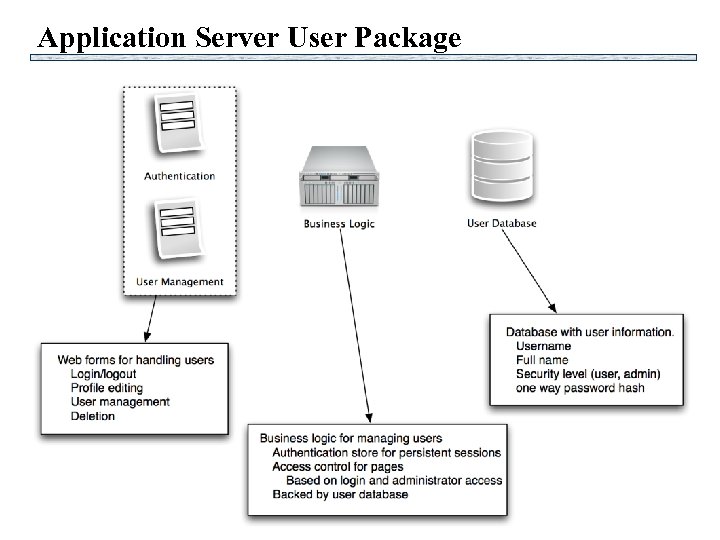 Application Server User Package
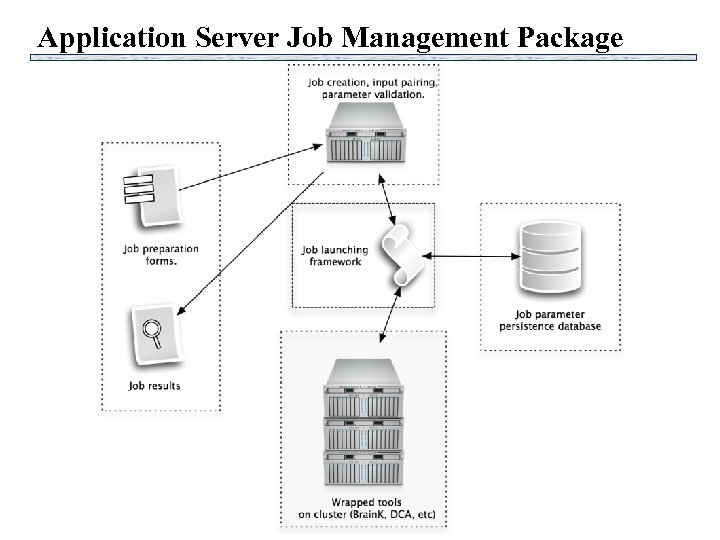 Application Server Job Management Package
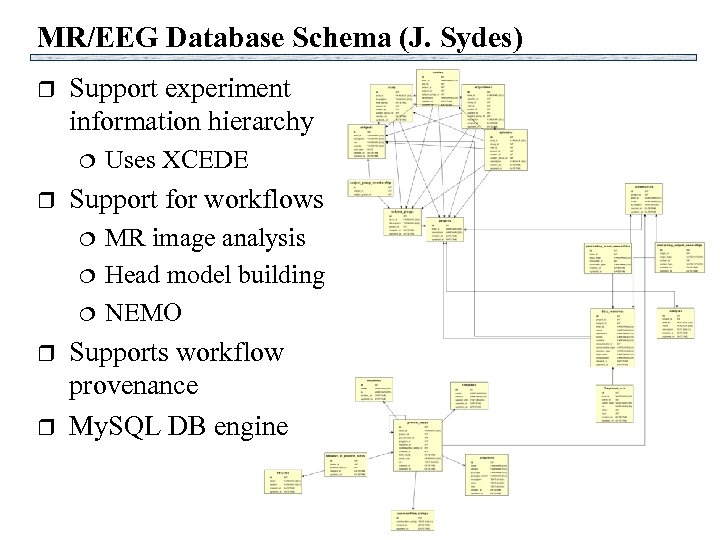 MR/EEG Database Schema (J. Sydes) r Support experiment information hierarchy ¦ r Support for workflows ¦ ¦ ¦ r r Uses XCEDE MR image analysis Head model building NEMO Supports workflow provenance My. SQL DB engine
 Companion Slides
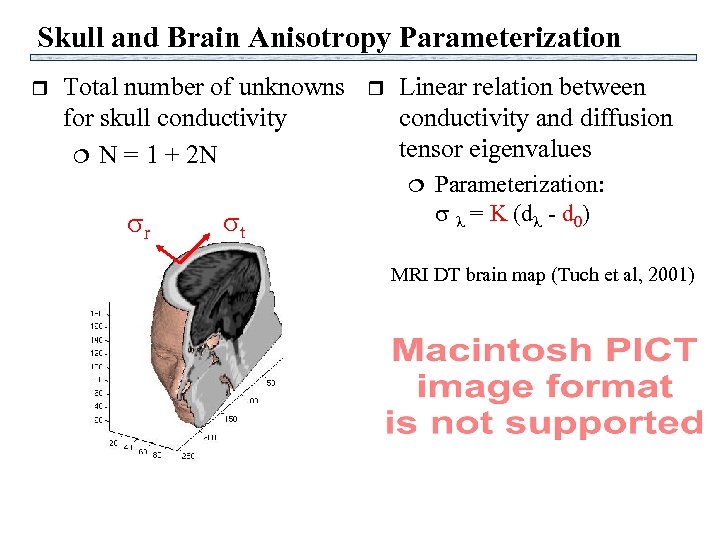 Skull and Brain Anisotropy Parameterization r Total number of unknowns for skull conductivity ¦ N = 1 + 2 N r Linear relation between conductivity and diffusion tensor eigenvalues ¦ r t Parameterization: = K (d - d 0) MRI DT brain map (Tuch et al, 2001)
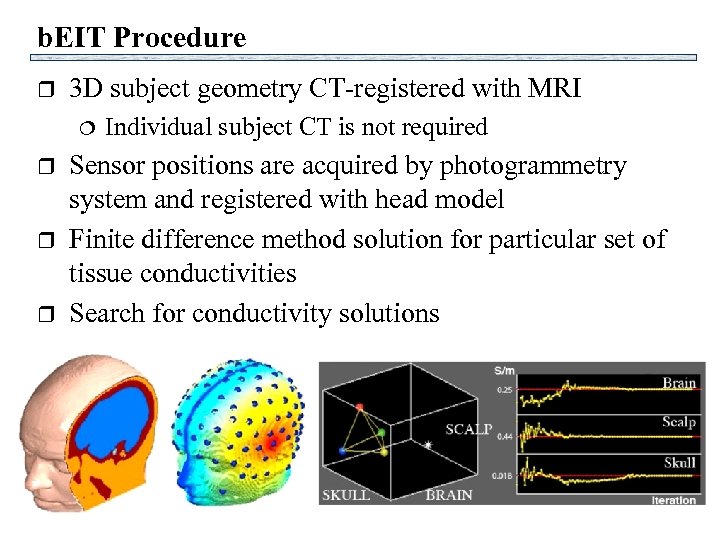 b. EIT Procedure r 3 D subject geometry CT-registered with MRI ¦ r r r Individual subject CT is not required Sensor positions are acquired by photogrammetry system and registered with head model Finite difference method solution for particular set of tissue conductivities Search for conductivity solutions
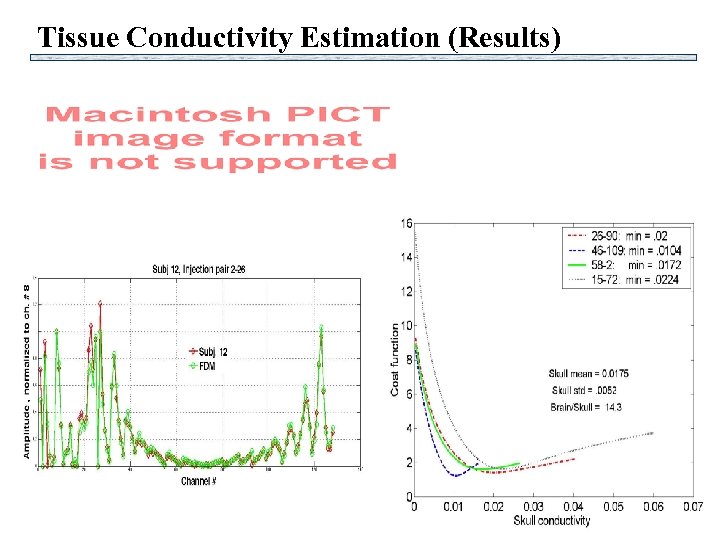 Tissue Conductivity Estimation (Results)
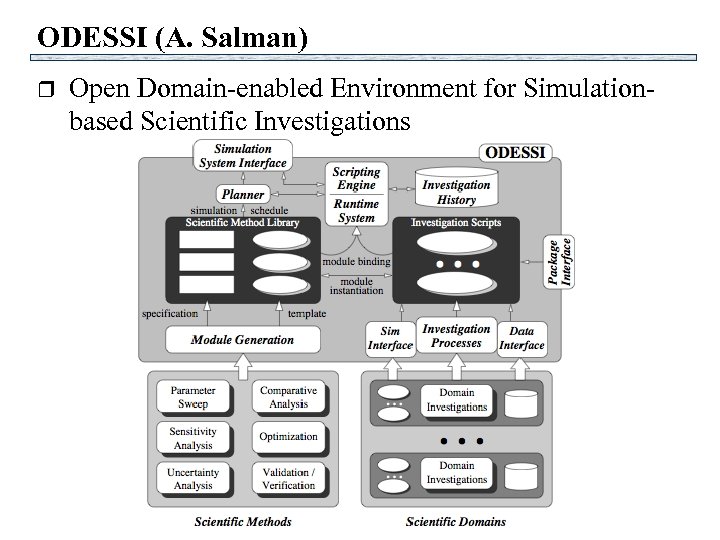 ODESSI (A. Salman) r Open Domain-enabled Environment for Simulationbased Scientific Investigations
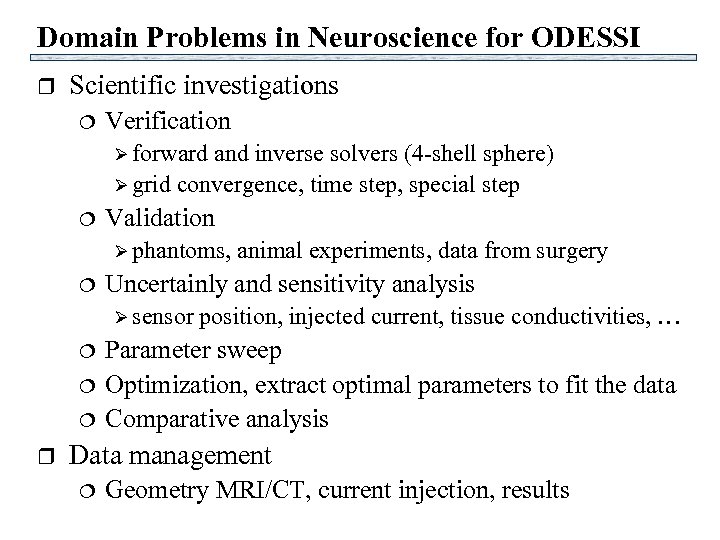 Domain Problems in Neuroscience for ODESSI r Scientific investigations ¦ Verification Ø forward and inverse solvers (4 -shell sphere) Ø grid convergence, time step, special step ¦ Validation Ø phantoms, ¦ Uncertainly and sensitivity analysis Ø sensor ¦ ¦ ¦ r animal experiments, data from surgery position, injected current, tissue conductivities, … Parameter sweep Optimization, extract optimal parameters to fit the data Comparative analysis Data management ¦ Geometry MRI/CT, current injection, results
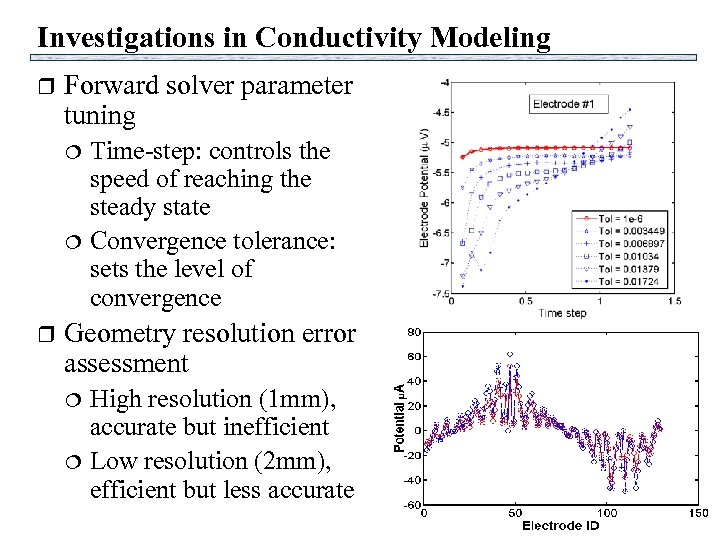 Investigations in Conductivity Modeling r Forward solver parameter tuning Time-step: controls the speed of reaching the steady state ¦ Convergence tolerance: sets the level of convergence ¦ r Geometry resolution error assessment High resolution (1 mm), accurate but inefficient ¦ Low resolution (2 mm), efficient but less accurate ¦
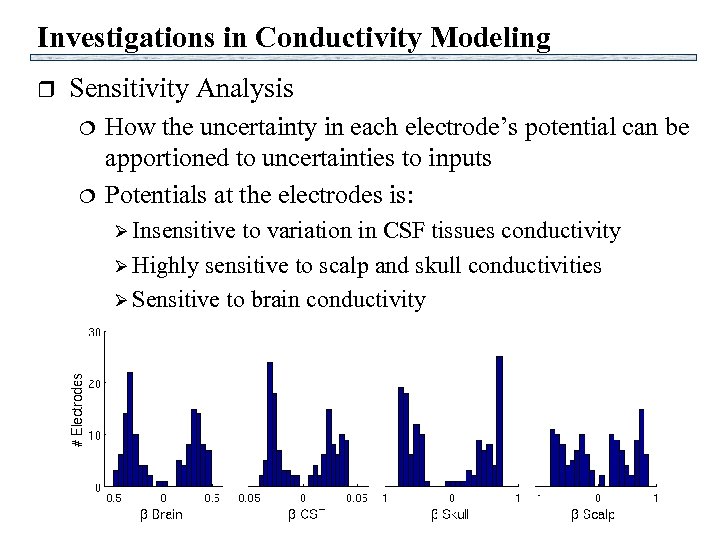 Investigations in Conductivity Modeling r Sensitivity Analysis ¦ ¦ How the uncertainty in each electrode’s potential can be apportioned to uncertainties to inputs Potentials at the electrodes is: Ø Insensitive to variation in CSF tissues conductivity Ø Highly sensitive to scalp and skull conductivities Ø Sensitive to brain conductivity
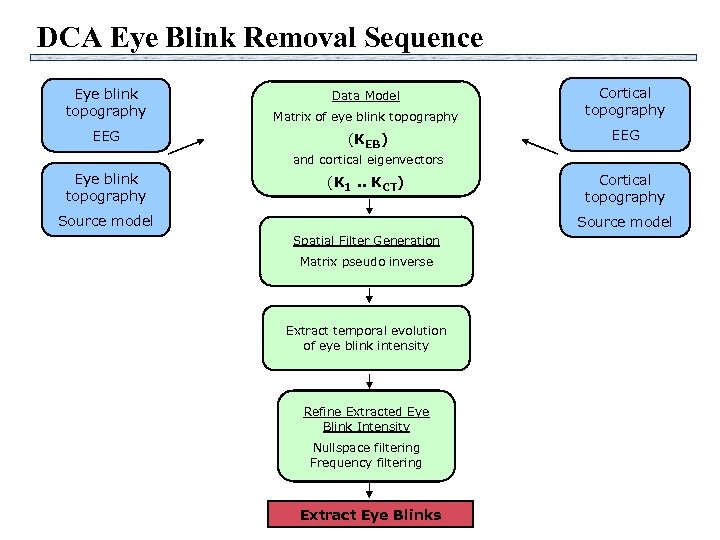 DCA Eye Blink Removal Sequence Eye blink topography Matrix of eye blink topography EEG (KEB) Data Model Cortical topography EEG and cortical eigenvectors Eye blink topography (K 1. . KCT) Source model Cortical topography Source model Spatial Filter Generation Matrix pseudo inverse Extract temporal evolution of eye blink intensity Refine Extracted Eye Blink Intensity Nullspace filtering Frequency filtering Extract Eye Blinks
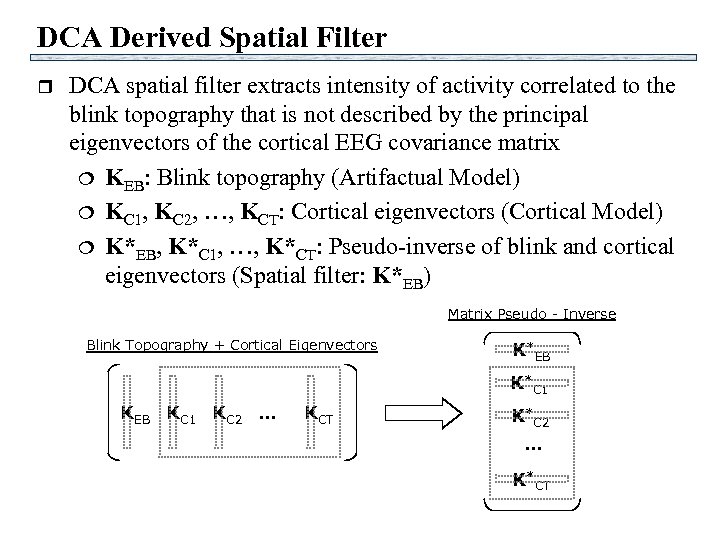 DCA Derived Spatial Filter r DCA spatial filter extracts intensity of activity correlated to the blink topography that is not described by the principal eigenvectors of the cortical EEG covariance matrix ¦ KEB: Blink topography (Artifactual Model) ¦ KC 1, KC 2, …, KCT: Cortical eigenvectors (Cortical Model) ¦ K*EB, K*C 1, …, K*CT: Pseudo-inverse of blink and cortical eigenvectors (Spatial filter: K*EB) Matrix Pseudo - Inverse Blink Topography + Cortical Eigenvectors K*EB K*C 1 KEB KC 1 KC 2 … KCT K*C 2 … K*CT
 NIC Computational Services Architecture interface adaptors
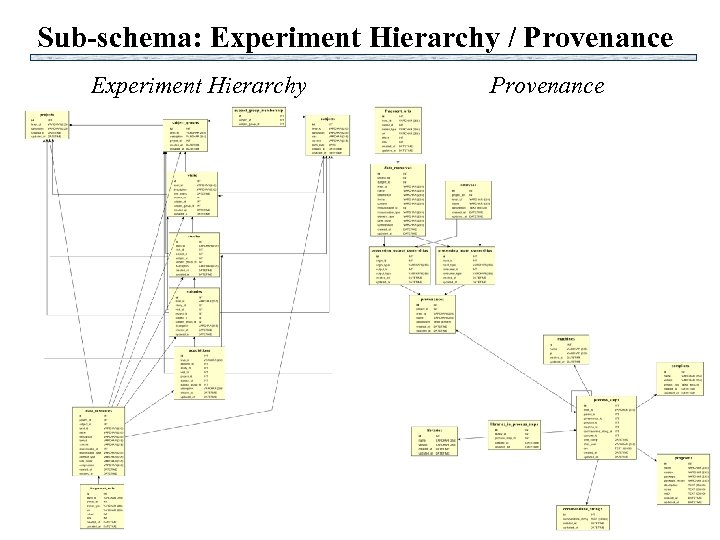 Sub-schema: Experiment Hierarchy / Provenance Experiment Hierarchy Provenance
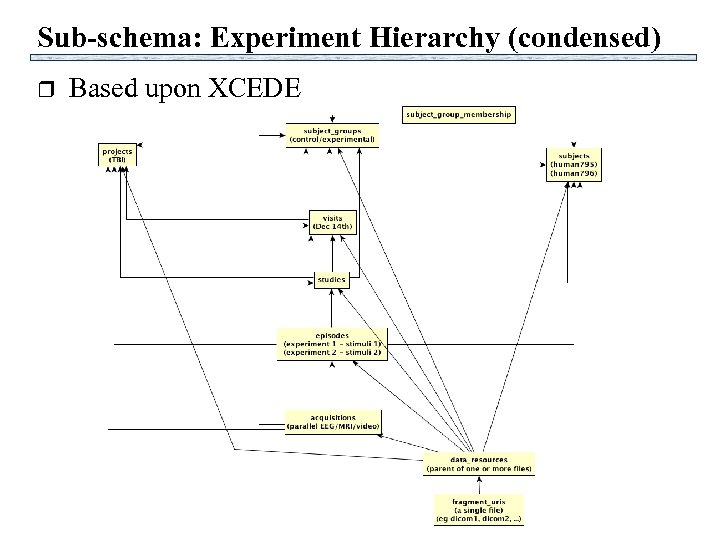 Sub-schema: Experiment Hierarchy (condensed) r Based upon XCEDE
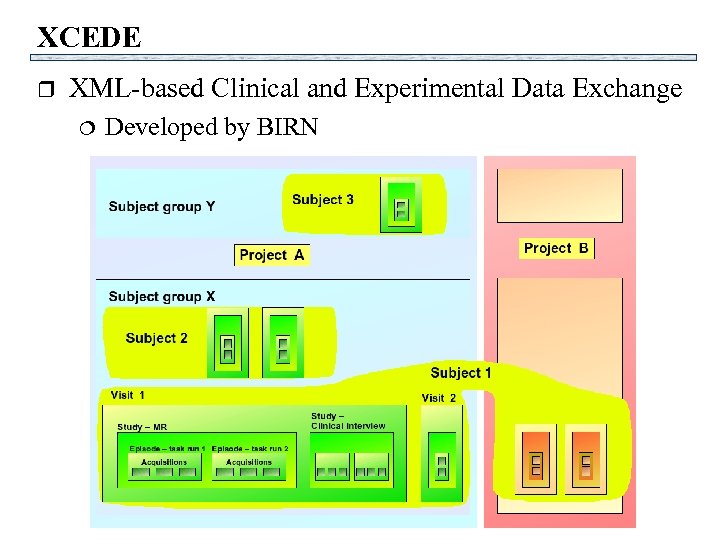 XCEDE r XML-based Clinical and Experimental Data Exchange ¦ Developed by BIRN