


 Скачать презентацию Neur On Modeling Ontology for Neurosurgery K S
df013bdafc25c0d17cdf84c627a0ba24.ppt
- Количество слайдов: 24
 Neur. On: Modeling Ontology for Neurosurgery K. S. Raghavan & C. Sajana Indian Statistical Institute Bangalore
 Information & Healthcare • Health care is a knowledge intensive activity; Available knowledge is a fluid mix of: – Scholarly documents – New experiences – Contextual information – Expert insights collectively providing a framework for decisionmaking
 Information & Healthcare • Patient records as an important source of valuable information – Much of this valuable information may not even appear in published sources or become a part of standard texts until years later • Quality of health care vis-à-vis access to patient records with defined similarities to the problem on hand
 Decision-making is… something which concerns all of us, both as makers of the choice and as sufferers of the consequences. -D. Lindley K. S. Raghavan, Indian Statistical Institute, Bangalore, India
 Background The work reported here is set in a large hospital (and is in progress) – Present system & its limitations • WINISIS database with hyperlinks to related files (Such as X-rays, CT Scans, Pathology reports, etc) – Data on a large number of parameters – The range of relations between concepts in a complex domain such as health care – Search technologies in thesauri – based IR systems
 The Present Study • Hypotheses – Ontologies can help build more effective information support systems in healthcare. – Ontologies can support the need of the healthcare and delivery process to transmit, re-use and share patient data • Why Ontology? – Ontologies are effective in representing domain knowledge – Possible to include ‘IF – THEN’ rules to support inferencing
 Ontology? • Gruber’s Definition: “Explicit Specification of a Conceptualization” • Studer’s extension: “ a formal, explicit specification of a shared conceptualization” • For practical purposes and applications a domain ontology could be perceived as: – The complete set of domain concepts and their interrelationships
 Ontology? • A semantic network of concepts grouped into classes and subclasses and linked by means of a well defined set of relations. Ontologies also have a set of rules that support inferencing
 The Project • About 1500 patient records of the Neurosurgery unit of a large hospital – The neurological disorder • disease name (Final Diagnosis) – specific treatment – symptoms – associated illnesses – Patient Data; name, ID number, doctor’s name, disease index number, gender, age range, consciousness level, visual acuity details , etc
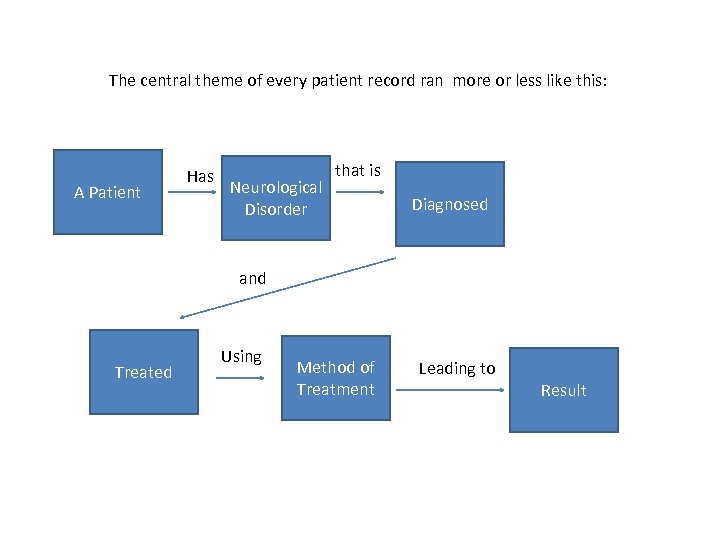 The central theme of every patient record ran more or less like this: A Patient Has Neurological Disorder that is Diagnosed and Treated Using Method of Treatment Leading to Result
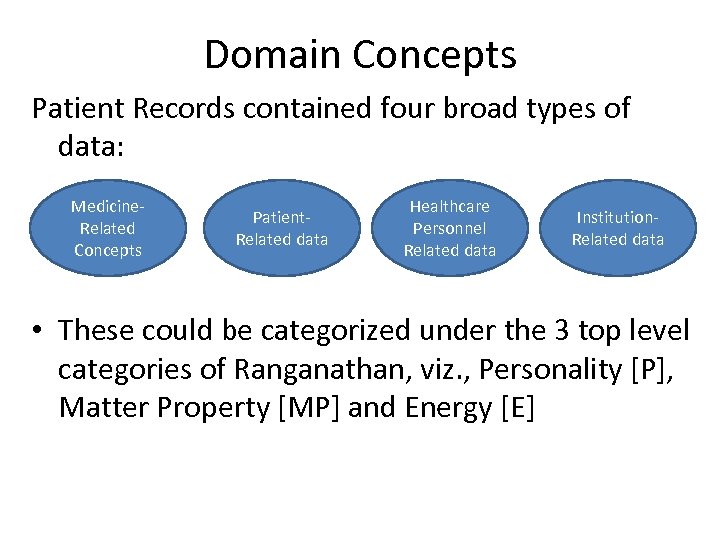 Domain Concepts Patient Records contained four broad types of data: Medicine. Related Concepts Patient. Related data Healthcare Personnel Related data Institution. Related data • These could be categorized under the 3 top level categories of Ranganathan, viz. , Personality [P], Matter Property [MP] and Energy [E]
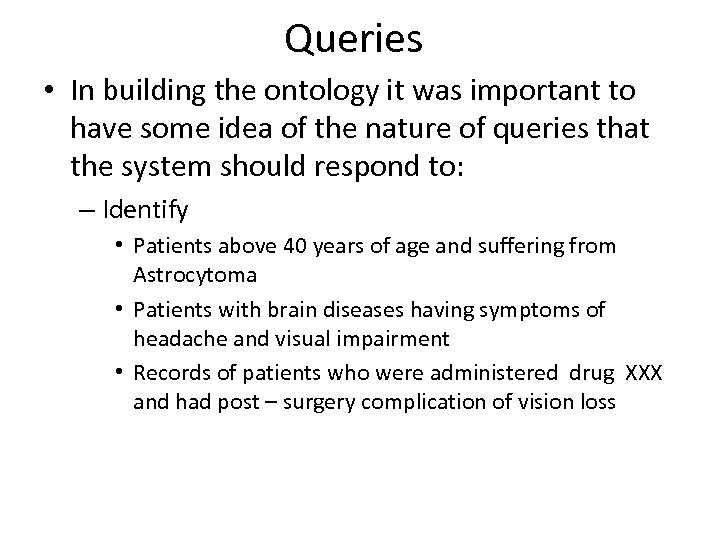 Queries • In building the ontology it was important to have some idea of the nature of queries that the system should respond to: – Identify • Patients above 40 years of age and suffering from Astrocytoma • Patients with brain diseases having symptoms of headache and visual impairment • Records of patients who were administered drug XXX and had post – surgery complication of vision loss
 Queries • While a clear picture will emerge only after the system is implemented; – A small query library was built to serve as the basis for defining classes and sub-classes
 The Ontology • No one perfect way of building an ontology – Definition of classes, properties, etc. • decisions regarding how detailed the classes and / or relations should be is largely based on the purpose and ease of maintenance – ’female patients’ could be seen as a subclass of ‘patients’; it could also be handled as: Patient HAS GENDER and by fdefining acceptable values for gender
 The Ontology • The decision-support system proposed here is conceived to have at least two major components when completed: – The ontology as part of the search interface; and – A database of patient records linked to related records in other databases, e. g. of images (scans, X-rays, etc)
 Populating the Ontology • Phase 1 – Medicine-related concepts - neurological disorders including associated symptoms and characteristics and their treatment – – patient data. Other sub-domain concepts will be added later • Complex nature of relations
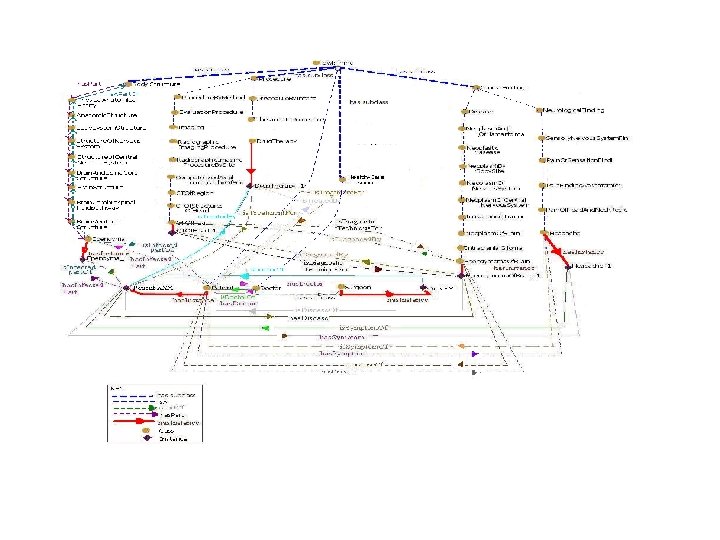
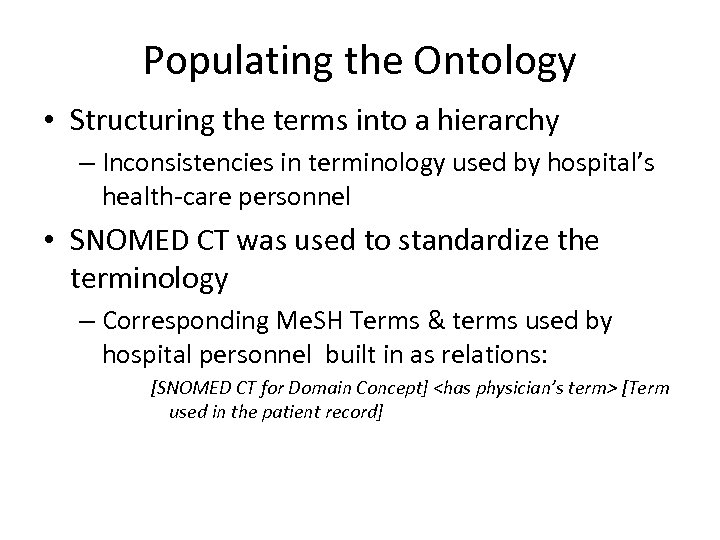 Populating the Ontology • Structuring the terms into a hierarchy – Inconsistencies in terminology used by hospital’s health-care personnel • SNOMED CT was used to standardize the terminology – Corresponding Me. SH Terms & terms used by hospital personnel built in as relations: [SNOMED CT for Domain Concept]
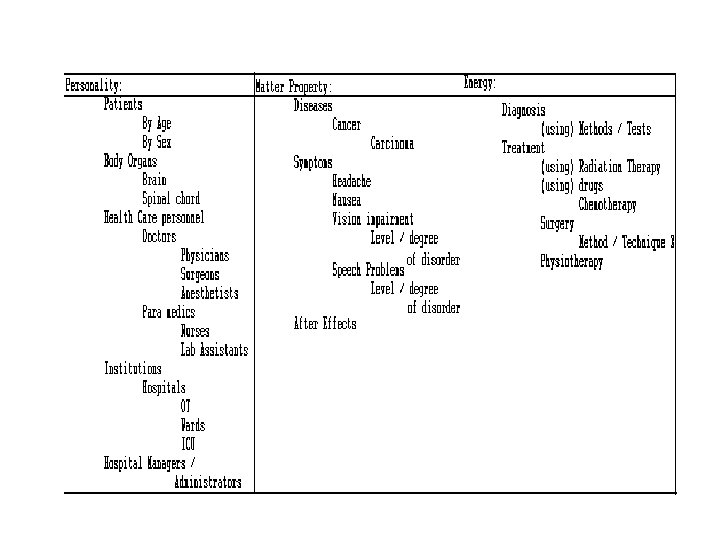
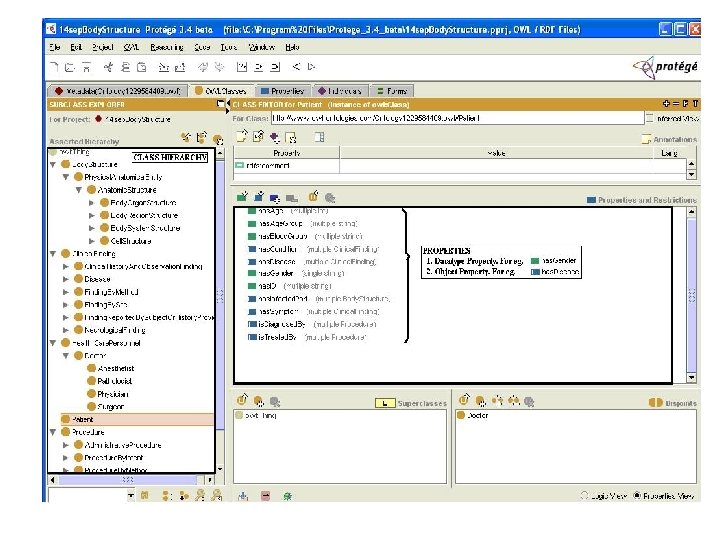
 Populating the Ontology • Properties – Object – Data type • A general idea of the class hierarchy and properties (see Figure)
 Future work • To be implemented in the hospital – Only a limited number of patient records used – Tested with a few sample queries • To include concepts related to healthcare institutions and personnel • To link relevant manuals, reference sources, text books and papers with a view to widen the knowledge base available to the users of the decision support system
 Future work • To build rules for inferencing that allow – reasonable and intelligent guess of the probable cause or condition of a patient based on values of certain clinical parameters – decision regarding the possible course of action – defining parameters that could generate an alert message
 Future work • The complexity of medical terminology; – Non-availability of exact equivalents for some of the terms used (in patient records) in the standard medical terminologies (like Me. SH and SNOMED CT) – Ethical issues • Can we define principles for decisions regarding ‘classes’ ‘subclasses’ ‘properties’ and ‘relation types’ for ontology?