


 Скачать презентацию Networking The Network is the Computer
88f0be266d02fef413a9e072c930199c.ppt
- Количество слайдов: 51
 Networking
 The Network is the Computer • Client-Server computing • Peer-to-Peer • The Web • Today’s networking is wonderful, but w How is it done?
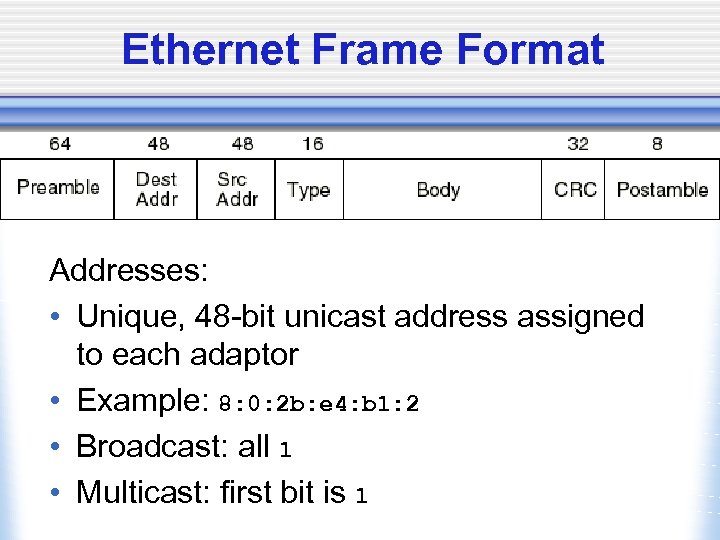 Ethernet Frame Format Addresses: • Unique, 48 -bit unicast address assigned to each adaptor • Example: 8: 0: 2 b: e 4: b 1: 2 • Broadcast: all 1 • Multicast: first bit is 1
 Layering • Use abstractions to hide complexity • Abstraction naturally leads to layering Application Programs Process-to-process Host-to-Host Connectivity Hardware Protocol Stack
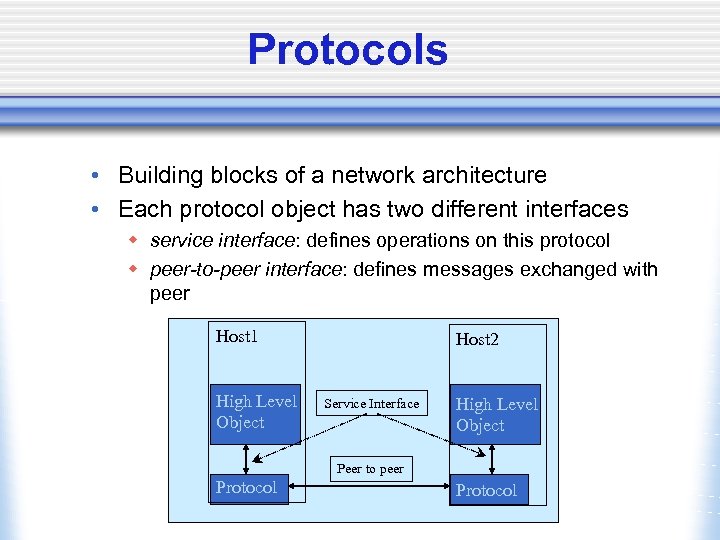 Protocols • Building blocks of a network architecture • Each protocol object has two different interfaces w service interface: defines operations on this protocol w peer-to-peer interface: defines messages exchanged with peer Host 1 High Level Object Host 2 Service Interface High Level Object Peer to peer Protocol
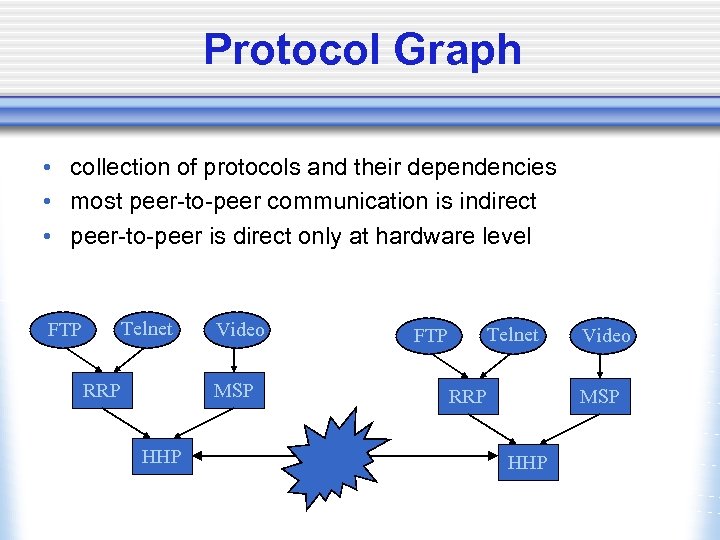 Protocol Graph • collection of protocols and their dependencies • most peer-to-peer communication is indirect • peer-to-peer is direct only at hardware level Telnet FTP RRP Video MSP HHP
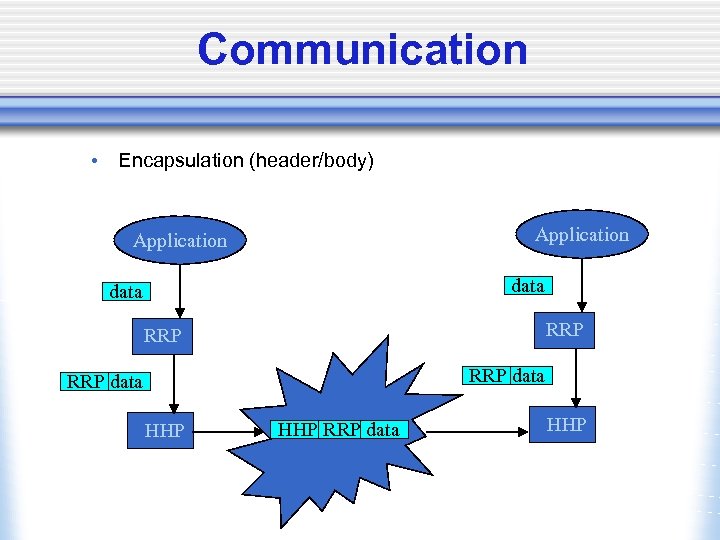 Communication • Encapsulation (header/body) Application data RRP RRP data HHP
 Standard Architectures • Open Systems Interconnect (OSI) Architecture w International Standards Organization (ISO) w International Telecommunications Union (ITU); formerly CCITT w “X dot” series: X. 25, X. 400, X. 500 w Reference Model
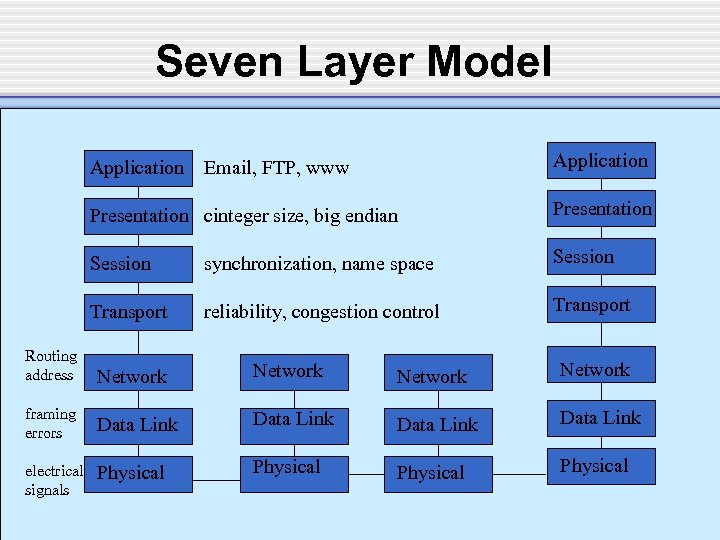 Seven Layer Model Application Email, FTP, www Application Presentation cinteger size, big endian Presentation Session synchronization, name space Session Transport reliability, congestion control Transport Routing address Network framing errors Data Link Physical electrical signals
 Internetworking
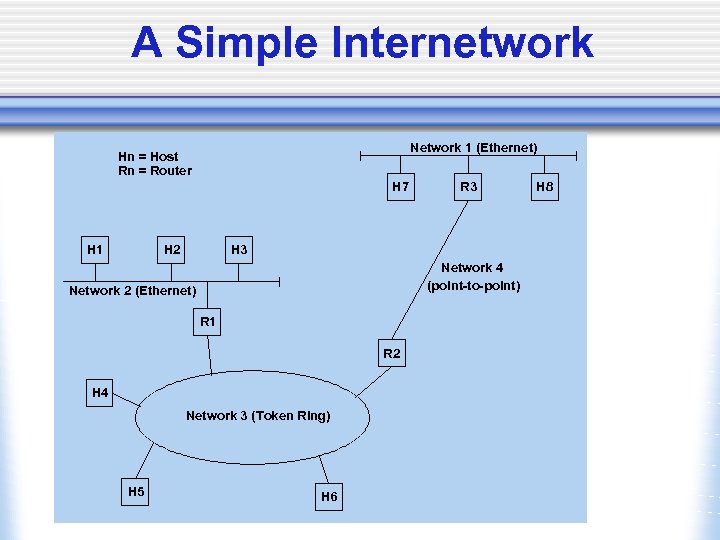 A Simple Internetwork Network 1 (Ethernet) Hn = Host Rn = Router H 7 H 1 H 2 H 3 Network 4 (point-to-point) Network 2 (Ethernet) R 1 R 2 H 4 Network 3 (Token Ring) H 5 R 3 H 6 H 8
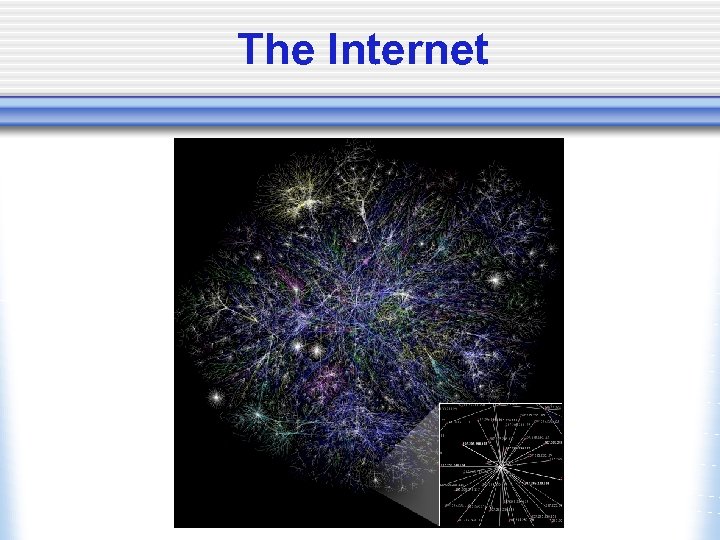 The Internet
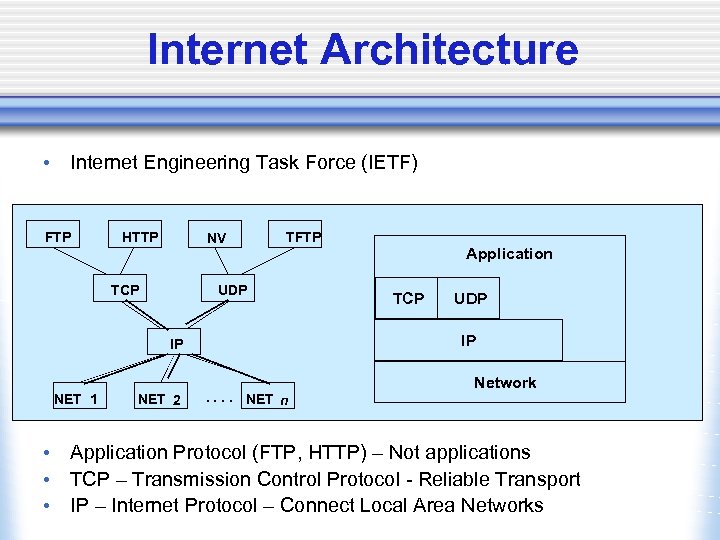 Internet Architecture • Internet Engineering Task Force (IETF) FTP HTTP NV TCP TFTP UDP NET 2 TCP UDP IP IP NET 1 Application . . NET n Network • Application Protocol (FTP, HTTP) – Not applications • TCP – Transmission Control Protocol - Reliable Transport • IP – Internet Protocol – Connect Local Area Networks
 Internet Protocol (IP)
 IP Service Model • Global Addressing Scheme w IP Addresses • Packet Delivery Model w Connectionless (datagram-based) w Best-effort delivery (unreliable service) § packets are often lost § packets are often delivered out of order § duplicate copies of a packet are often delivered § packets can be delayed for a long time
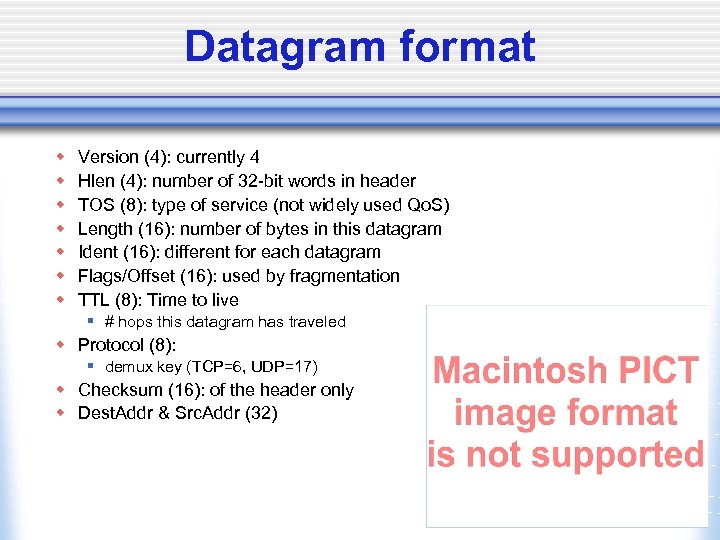 Datagram format w w w w Version (4): currently 4 Hlen (4): number of 32 -bit words in header TOS (8): type of service (not widely used Qo. S) Length (16): number of bytes in this datagram Ident (16): different for each datagram Flags/Offset (16): used by fragmentation TTL (8): Time to live § # hops this datagram has traveled w Protocol (8): § demux key (TCP=6, UDP=17) w Checksum (16): of the header only w Dest. Addr & Src. Addr (32)
 Datagram Forwarding Strategy every datagram contains destination's address if directly connected to destination network, then forward to host if not directly connected to destination network, then forward to some router each host has a default router each router maintains a forwarding table maps network number into next hop
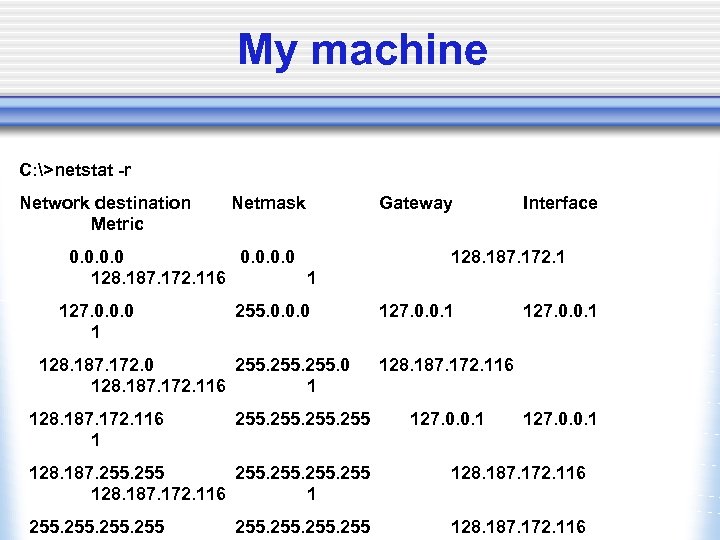 My machine C: >netstat -r Network destination Metric Netmask 0. 0 128. 187. 172. 116 1 127. 0. 0. 0 1 255. 0. 0. 0 128. 187. 172. 0 255. 0 128. 187. 172. 116 1 255 Gateway Interface 128. 187. 172. 1 127. 0. 0. 1 128. 187. 172. 116 127. 0. 0. 1 128. 187. 255 255 128. 187. 172. 116 1 128. 187. 172. 116 255
 Reliable Byte-Stream (TCP)
 Overview • Byte-stream w w sending process writes some number of bytes TCP breaks into segments and sends via IP receiving process reads some number of bytes Full duplex • Connection-oriented (Reliable) w Every segment is numbered & acknowledged • Flow control: w keep sender from overrunning receiver • Congestion control: w keep sender from overrunning network
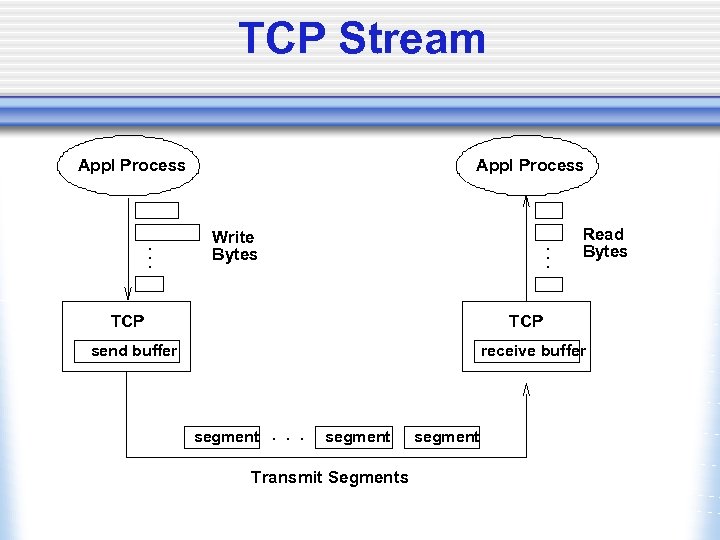 TCP Stream Appl Process . . . Write Bytes TCP Read Bytes TCP send buffer receive buffer segment. . . segment Transmit Segments segment
 Issues • Potentially long delay in network w need to be prepared for arrival of very old packets w (limit 60 seconds) • Potentially different capacity at destination w need to accommodate different amounts of buffering w (end hosts may have hundreds of applications) • Potentially different network capacity w need to be prepared for network congestion
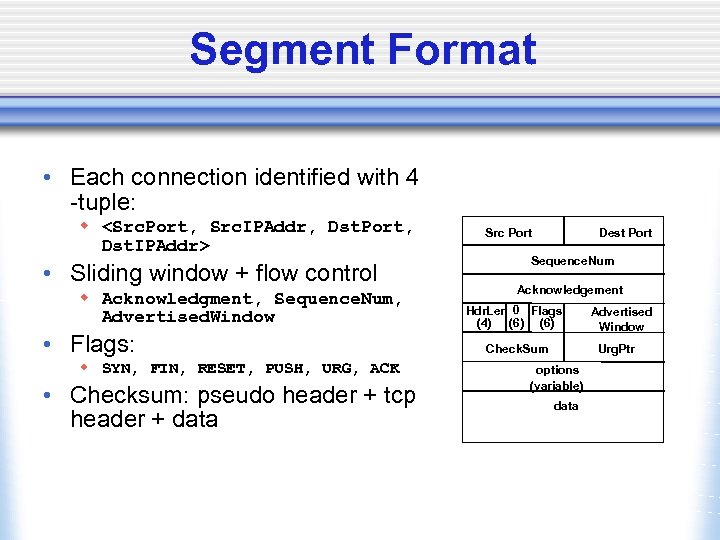 Segment Format • Each connection identified with 4 -tuple: w
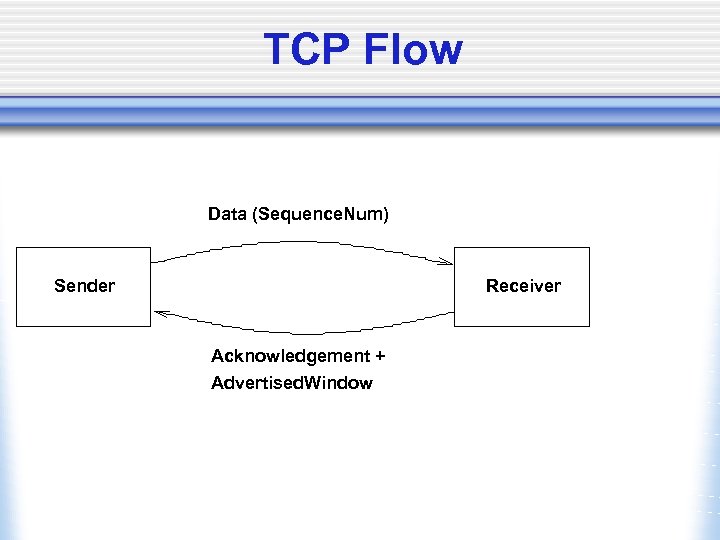 TCP Flow Data (Sequence. Num) Sender Receiver Acknowledgement + Advertised. Window
 DNS (Domain Name Service)
 DNS • People don’t remember 32 -bit numbers very well • Instead of using IP addresses, map the IP address to a name w People remember names better • Translation of names to IP addresses is done by name servers w Originally done by files on each host
 DNS • Basically, it is a distributed database w Distributed administration w Distributed load w Distributed security problems • Robustness and performance through w Replication w Caching
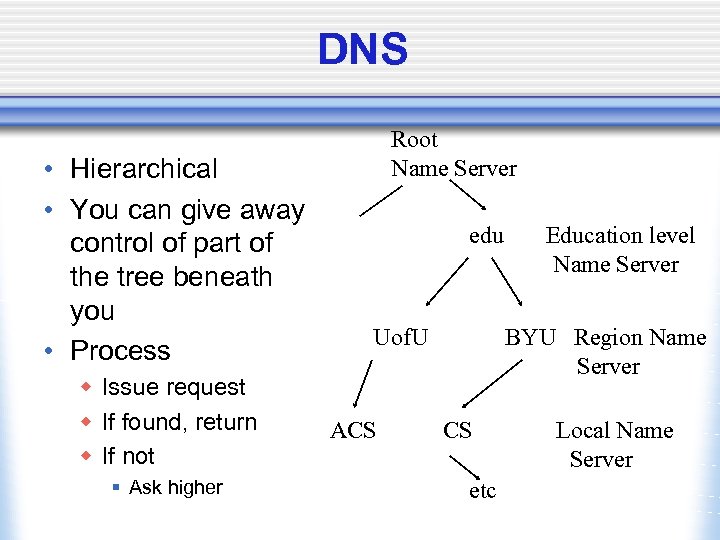 DNS • Hierarchical • You can give away control of part of the tree beneath you • Process w Issue request w If found, return w If not § Ask higher Root Name Server edu Uof. U ACS Education level Name Server BYU Region Name Server CS etc Local Name Server
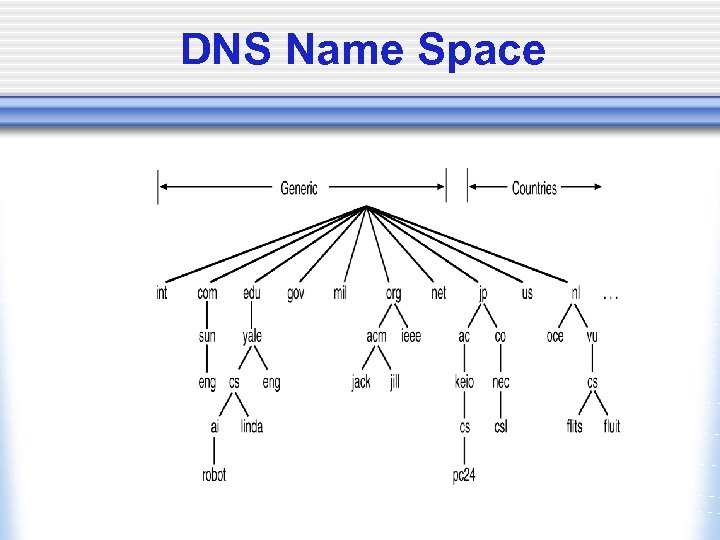 DNS Name Space
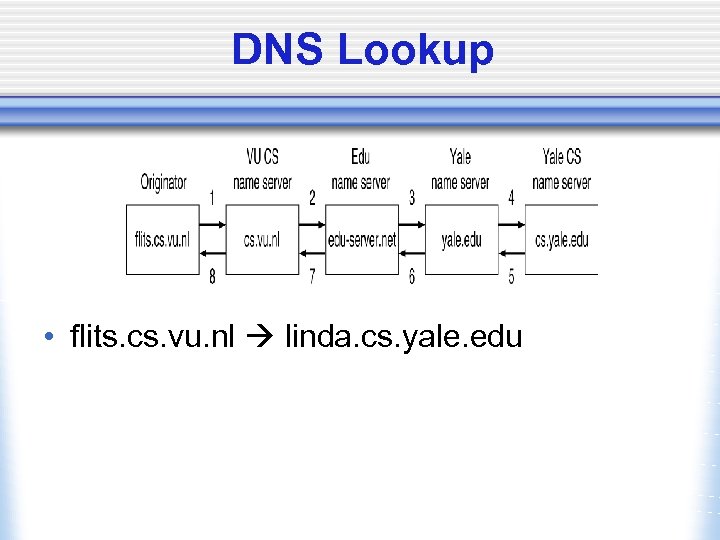 DNS Lookup • flits. cs. vu. nl linda. cs. yale. edu
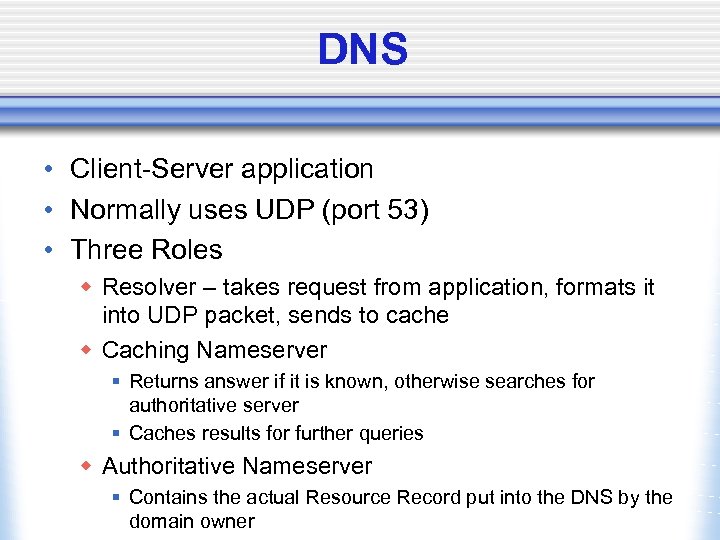 DNS • Client-Server application • Normally uses UDP (port 53) • Three Roles w Resolver – takes request from application, formats it into UDP packet, sends to cache w Caching Nameserver § Returns answer if it is known, otherwise searches for authoritative server § Caches results for further queries w Authoritative Nameserver § Contains the actual Resource Record put into the DNS by the domain owner
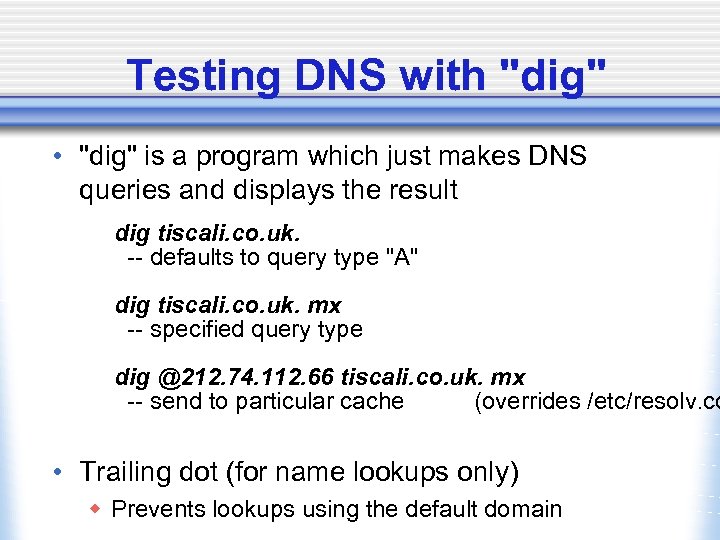 Testing DNS with "dig" • "dig" is a program which just makes DNS queries and displays the result dig tiscali. co. uk. -- defaults to query type "A" dig tiscali. co. uk. mx -- specified query type dig @212. 74. 112. 66 tiscali. co. uk. mx -- send to particular cache (overrides /etc/resolv. co • Trailing dot (for name lookups only) w Prevents lookups using the default domain
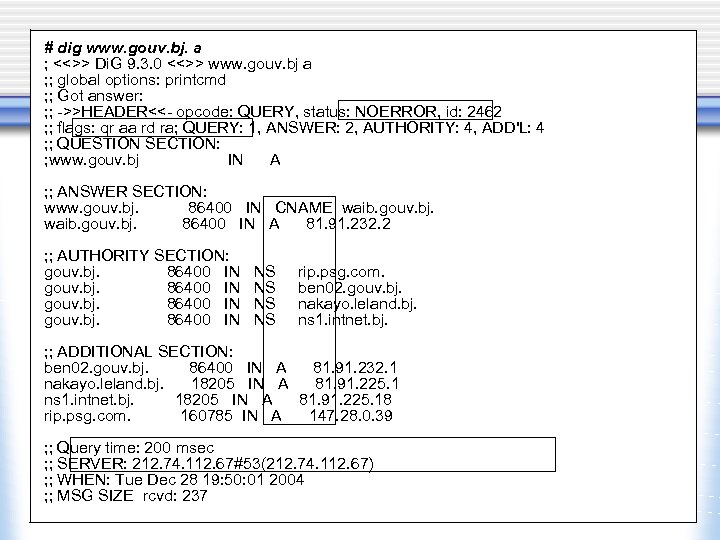 # dig www. gouv. bj. a ; <<>> Di. G 9. 3. 0 <<>> www. gouv. bj a ; ; global options: printcmd ; ; Got answer: ; ; ->>HEADER<<- opcode: QUERY, status: NOERROR, id: 2462 ; ; flags: qr aa rd ra; QUERY: 1, ANSWER: 2, AUTHORITY: 4, ADD'L: 4 ; ; QUESTION SECTION: ; www. gouv. bj IN A ; ; ANSWER SECTION: www. gouv. bj. 86400 IN CNAME waib. gouv. bj. 86400 IN A 81. 91. 232. 2 ; ; AUTHORITY SECTION: gouv. bj. 86400 IN NS NS rip. psg. com. ben 02. gouv. bj. nakayo. leland. bj. ns 1. intnet. bj. ; ; ADDITIONAL SECTION: ben 02. gouv. bj. 86400 IN A 81. 91. 232. 1 nakayo. leland. bj. 18205 IN A 81. 91. 225. 1 ns 1. intnet. bj. 18205 IN A 81. 91. 225. 18 rip. psg. com. 160785 IN A 147. 28. 0. 39 ; ; Query time: 200 msec ; ; SERVER: 212. 74. 112. 67#53(212. 74. 112. 67) ; ; WHEN: Tue Dec 28 19: 50: 01 2004 ; ; MSG SIZE rcvd: 237
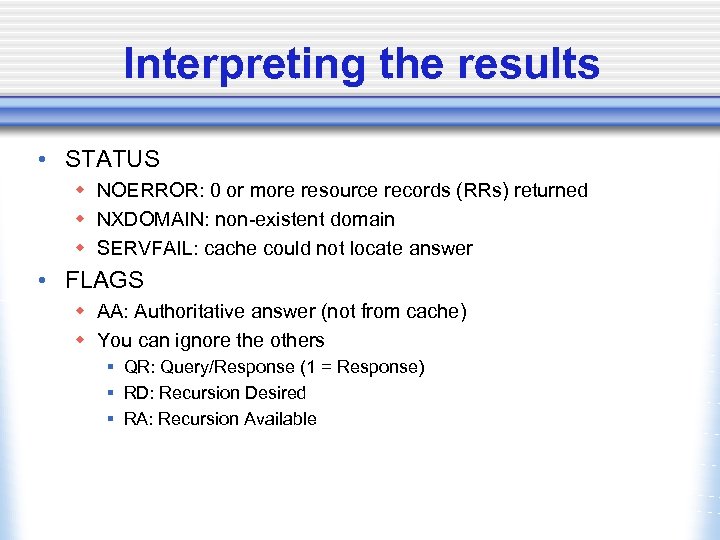 Interpreting the results • STATUS w NOERROR: 0 or more resource records (RRs) returned w NXDOMAIN: non-existent domain w SERVFAIL: cache could not locate answer • FLAGS w AA: Authoritative answer (not from cache) w You can ignore the others § QR: Query/Response (1 = Response) § RD: Recursion Desired § RA: Recursion Available
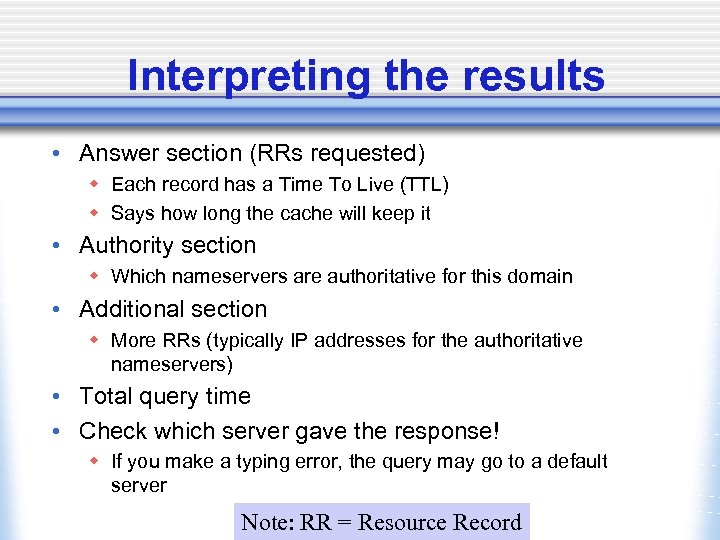 Interpreting the results • Answer section (RRs requested) w Each record has a Time To Live (TTL) w Says how long the cache will keep it • Authority section w Which nameservers are authoritative for this domain • Additional section w More RRs (typically IP addresses for the authoritative nameservers) • Total query time • Check which server gave the response! w If you make a typing error, the query may go to a default server Note: RR = Resource Record
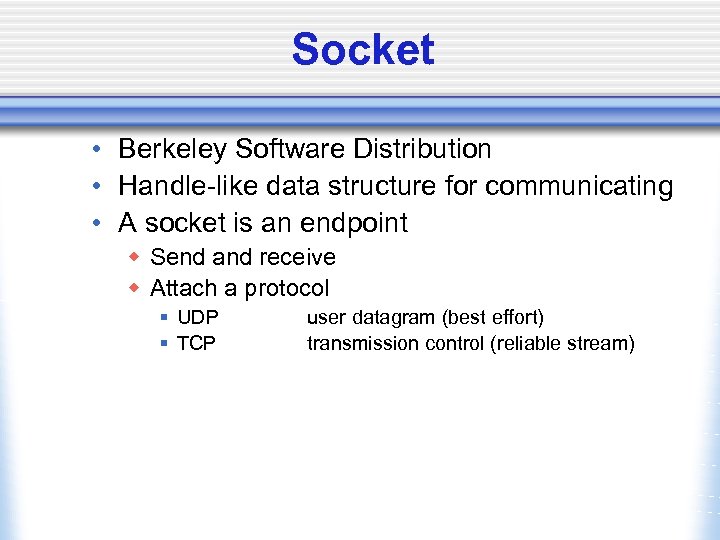 Socket • Berkeley Software Distribution • Handle-like data structure for communicating • A socket is an endpoint w Send and receive w Attach a protocol § UDP § TCP user datagram (best effort) transmission control (reliable stream)
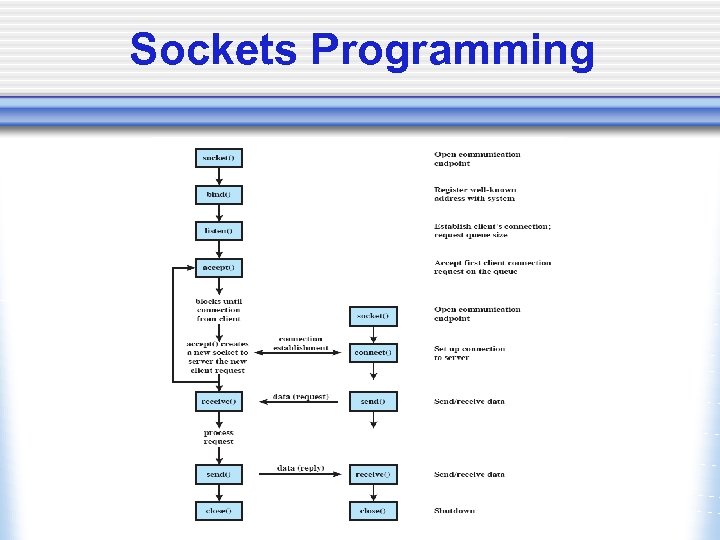 Sockets Programming
![Sockets • Sockaddr w struct sockaddr { u_short char sa_family; sa_data[14]; }; w designed](https://present5.com/presentation/88f0be266d02fef413a9e072c930199c/image-39.jpg "Sockets • Sockaddr w struct sockaddr { u_short char sa_family; sa_data[14]; }; w designed") Sockets • Sockaddr w struct sockaddr { u_short char sa_family; sa_data[14]; }; w designed to work with all protocols § sockaddr_in is used with TCP/IP • Sockaddr_in w struct sockaddr_in { short u_short struct inaddr char sin_family; sin_port; sin_addr; sin_zero[8]; };
Sockets • Sockaddr w struct sockaddr { u_short char sa_family; sa_data[14]; }; w designed to work with all protocols § sockaddr_in is used with TCP/IP • Sockaddr_in w struct sockaddr_in { short u_short struct inaddr char sin_family; sin_port; sin_addr; sin_zero[8]; };
 A situation • Client can determine IP address of server w But how can it know the socket id? § Socket is a handle – different number on each machine § Name server can’t deal with all the handles • BSD provides a way to map a socket to a port that exists in the network name space. w Bind w A Port is an address § Many are well known
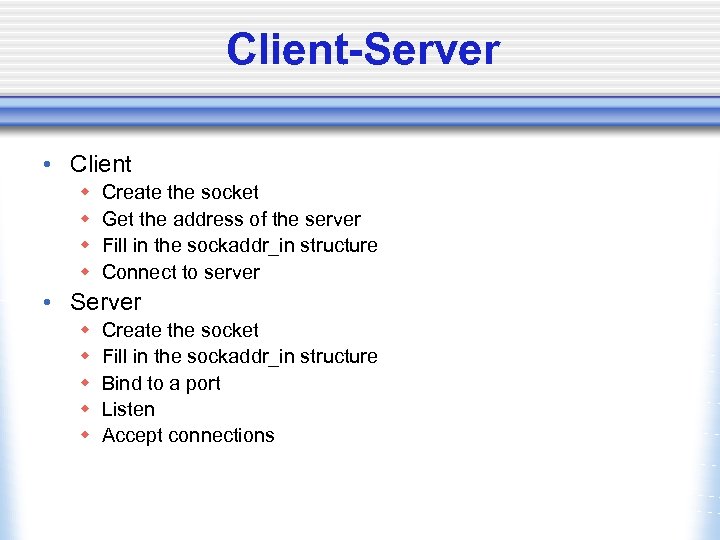 Client-Server • Client w w Create the socket Get the address of the server Fill in the sockaddr_in structure Connect to server • Server w w w Create the socket Fill in the sockaddr_in structure Bind to a port Listen Accept connections
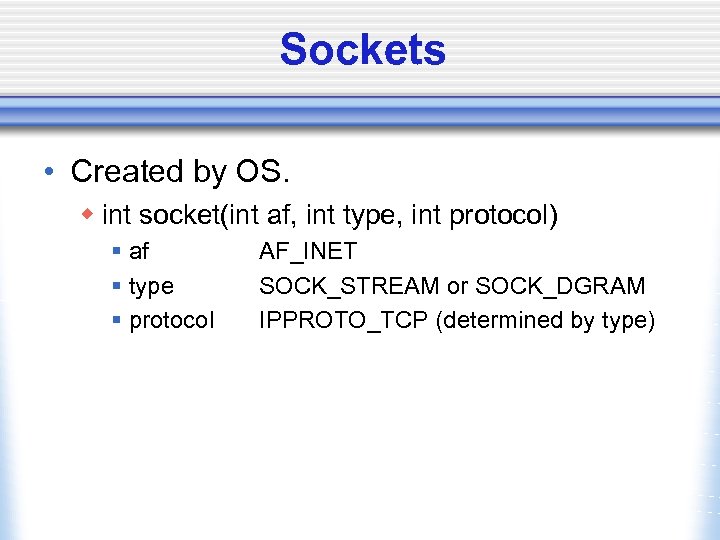 Sockets • Created by OS. w int socket(int af, int type, int protocol) § af § type § protocol AF_INET SOCK_STREAM or SOCK_DGRAM IPPROTO_TCP (determined by type)
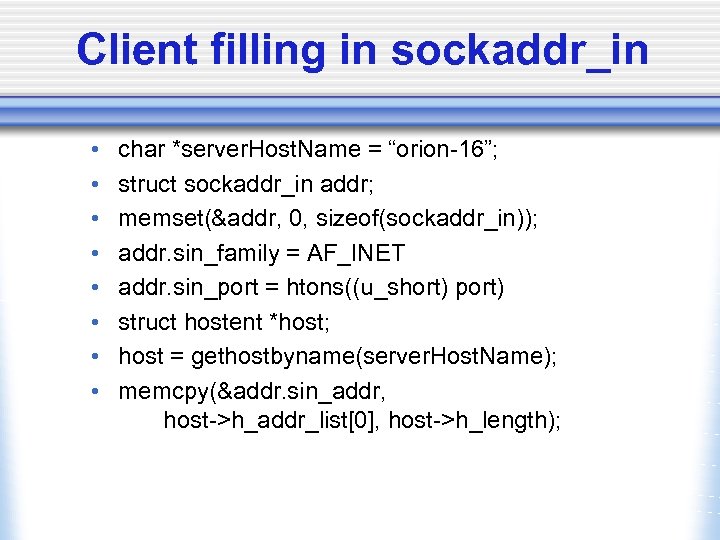 Client filling in sockaddr_in • • char *server. Host. Name = “orion-16”; struct sockaddr_in addr; memset(&addr, 0, sizeof(sockaddr_in)); addr. sin_family = AF_INET addr. sin_port = htons((u_short) port) struct hostent *host; host = gethostbyname(server. Host. Name); memcpy(&addr. sin_addr, host->h_addr_list[0], host->h_length);
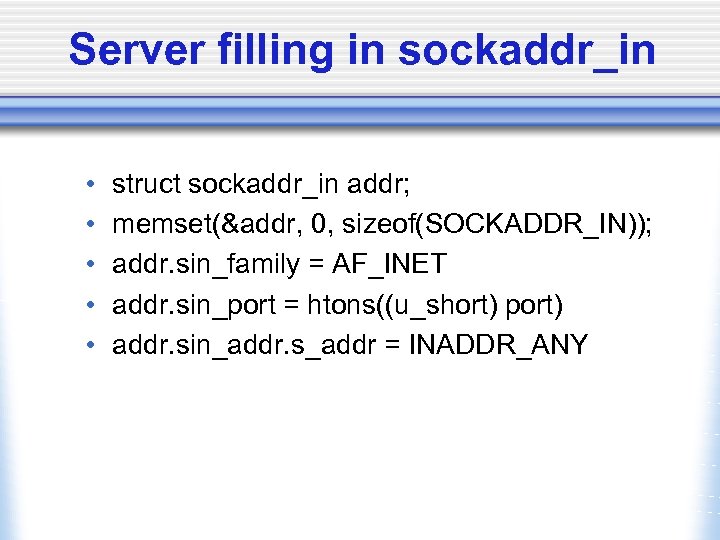 Server filling in sockaddr_in • • • struct sockaddr_in addr; memset(&addr, 0, sizeof(SOCKADDR_IN)); addr. sin_family = AF_INET addr. sin_port = htons((u_short) port) addr. sin_addr. s_addr = INADDR_ANY
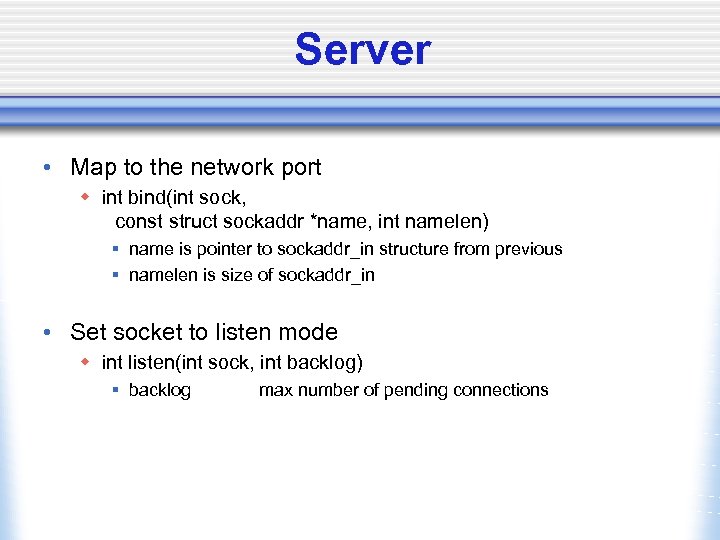 Server • Map to the network port w int bind(int sock, const struct sockaddr *name, int namelen) § name is pointer to sockaddr_in structure from previous § namelen is size of sockaddr_in • Set socket to listen mode w int listen(int sock, int backlog) § backlog max number of pending connections
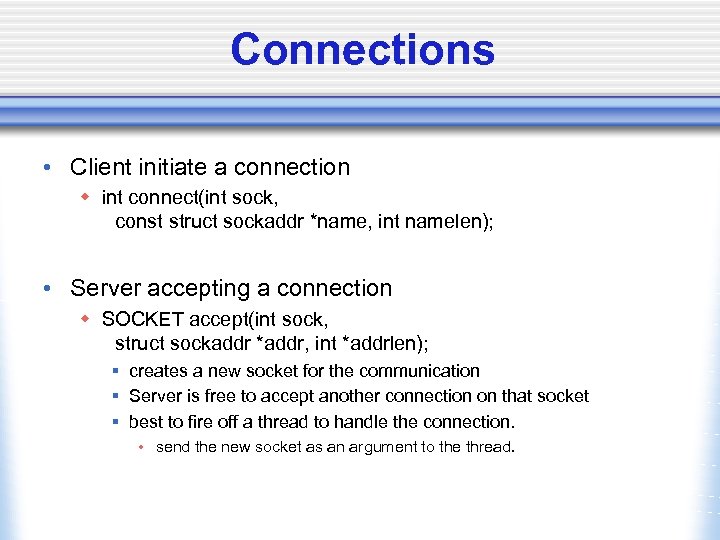 Connections • Client initiate a connection w int connect(int sock, const struct sockaddr *name, int namelen); • Server accepting a connection w SOCKET accept(int sock, struct sockaddr *addr, int *addrlen); § creates a new socket for the communication § Server is free to accept another connection on that socket § best to fire off a thread to handle the connection. • send the new socket as an argument to the thread.
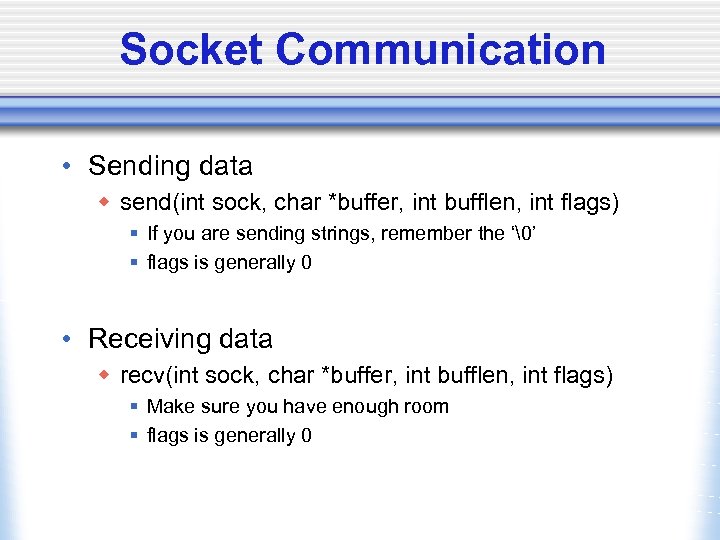 Socket Communication • Sending data w send(int sock, char *buffer, int bufflen, int flags) § If you are sending strings, remember the ‘’ § flags is generally 0 • Receiving data w recv(int sock, char *buffer, int bufflen, int flags) § Make sure you have enough room § flags is generally 0
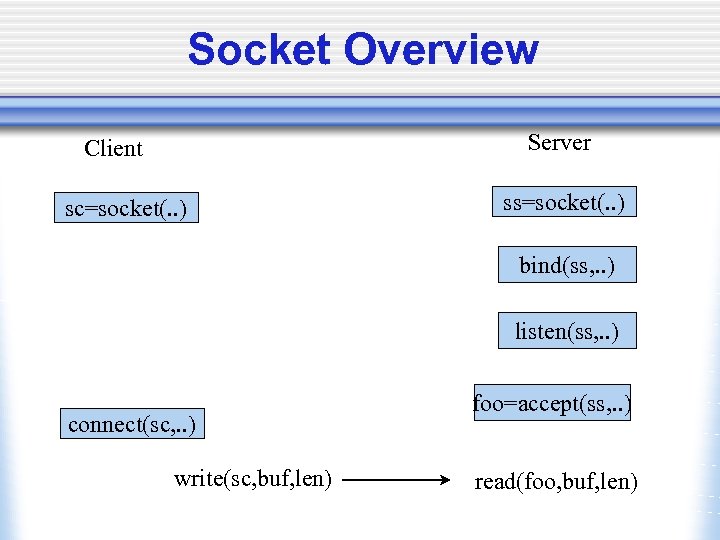 Socket Overview Server Client sc=socket(. . ) ss=socket(. . ) bind(ss, . . ) listen(ss, . . ) connect(sc, . . ) write(sc, buf, len) foo=accept(ss, . . ) read(foo, buf, len)
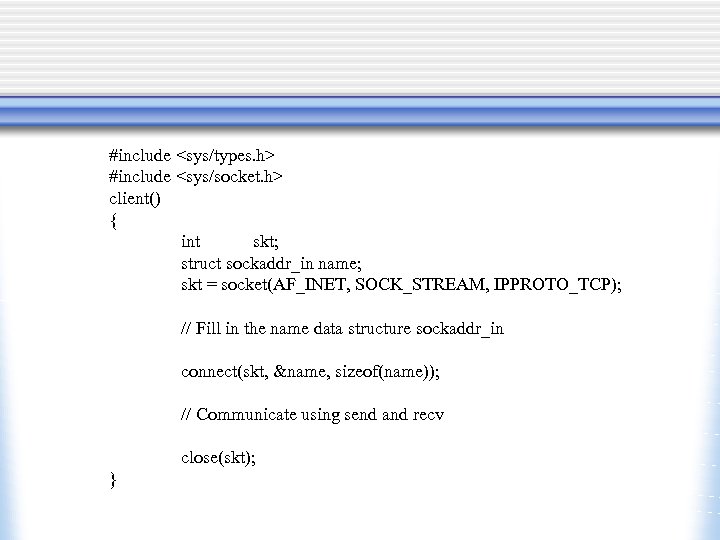 #include
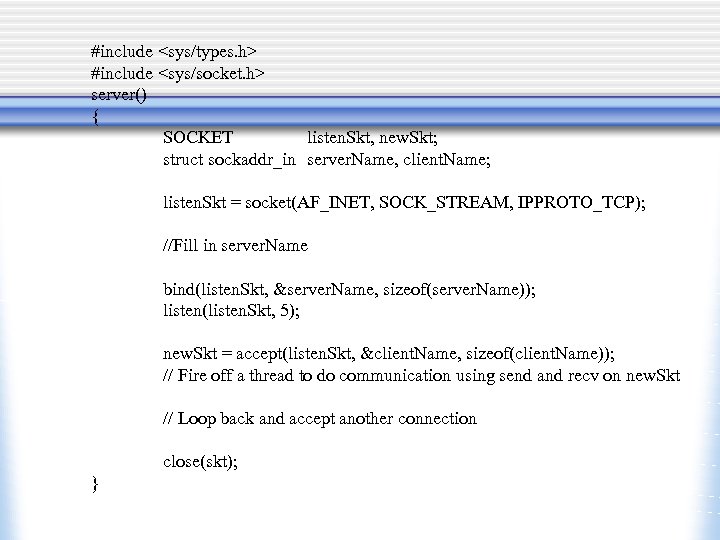 #include
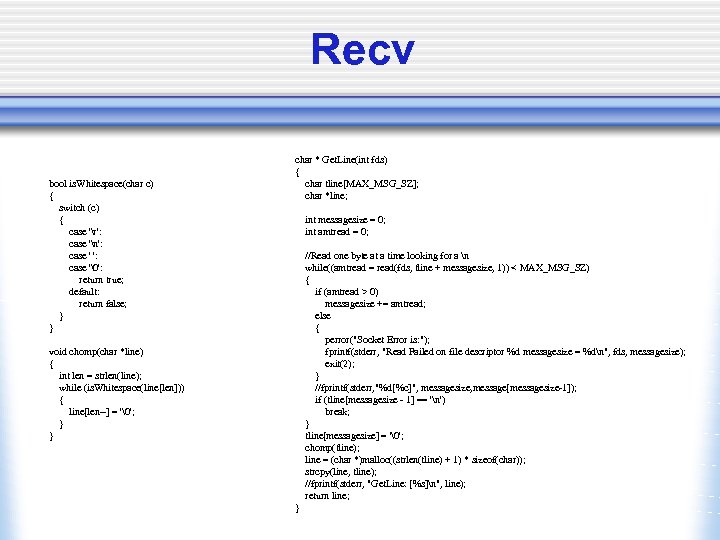 Recv bool is. Whitespace(char c) { switch (c) { case 'r': case 'n': case '': return true; default: return false; } } char * Get. Line(int fds) { char tline[MAX_MSG_SZ]; char *line; int messagesize = 0; int amtread = 0; //Read one byte at a time looking for a n while((amtread = read(fds, tline + messagesize, 1)) < MAX_MSG_SZ) { if (amtread > 0) messagesize += amtread; else { perror("Socket Error is: "); fprintf(stderr, "Read Failed on file descriptor %d messagesize = %dn", fds, messagesize); exit(2); } //fprintf(stderr, "%d[%c]", messagesize, message[messagesize-1]); if (tline[messagesize - 1] == 'n') break; } tline[messagesize] = ''; chomp(tline); line = (char *)malloc((strlen(tline) + 1) * sizeof(char)); strcpy(line, tline); //fprintf(stderr, "Get. Line: [%s]n", line); return line; void chomp(char *line) { int len = strlen(line); while (is. Whitespace(line[len])) { line[len--] = ''; } } }