


 Скачать презентацию Networked Games Coloring Consensus and Voting Prof Michael
b38a6d751cb29d56783dc77fbc776b5f.ppt
- Количество слайдов: 18
 Networked Games: Coloring, Consensus and Voting Prof. Michael Kearns Networked Life NETS 112 Fall 2015
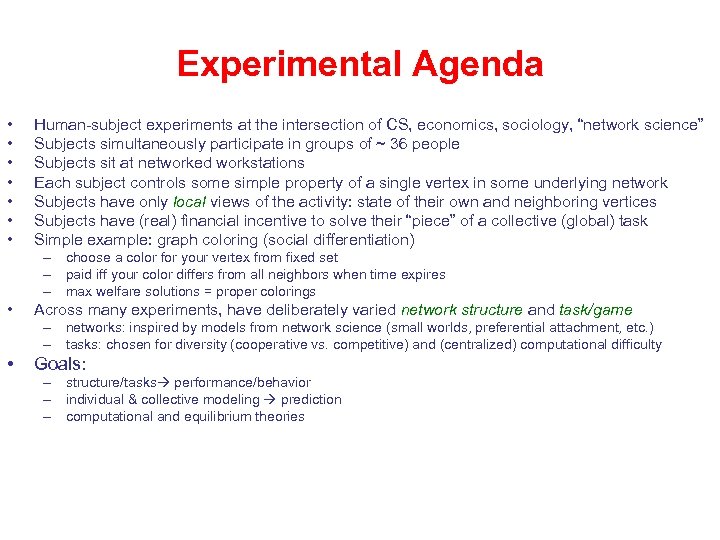 Experimental Agenda • • Human-subject experiments at the intersection of CS, economics, sociology, “network science” Subjects simultaneously participate in groups of ~ 36 people Subjects sit at networked workstations Each subject controls some simple property of a single vertex in some underlying network Subjects have only local views of the activity: state of their own and neighboring vertices Subjects have (real) financial incentive to solve their “piece” of a collective (global) task Simple example: graph coloring (social differentiation) – choose a color for your vertex from fixed set – paid iff your color differs from all neighbors when time expires – max welfare solutions = proper colorings • Across many experiments, have deliberately varied network structure and task/game – networks: inspired by models from network science (small worlds, preferential attachment, etc. ) – tasks: chosen for diversity (cooperative vs. competitive) and (centralized) computational difficulty • Goals: – structure/tasks performance/behavior – individual & collective modeling prediction – computational and equilibrium theories
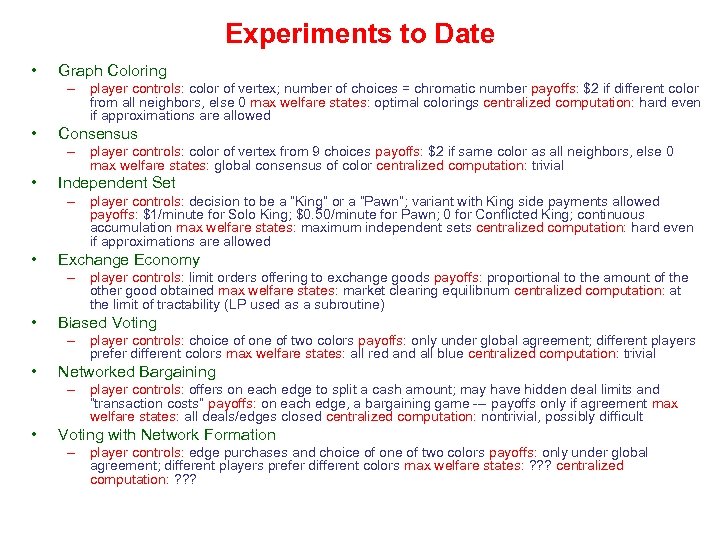 Experiments to Date • Graph Coloring – player controls: color of vertex; number of choices = chromatic number payoffs: $2 if different color from all neighbors, else 0 max welfare states: optimal colorings centralized computation: hard even if approximations are allowed • Consensus – player controls: color of vertex from 9 choices payoffs: $2 if same color as all neighbors, else 0 max welfare states: global consensus of color centralized computation: trivial • Independent Set – player controls: decision to be a “King” or a “Pawn”; variant with King side payments allowed payoffs: $1/minute for Solo King; $0. 50/minute for Pawn; 0 for Conflicted King; continuous accumulation max welfare states: maximum independent sets centralized computation: hard even if approximations are allowed • Exchange Economy – player controls: limit orders offering to exchange goods payoffs: proportional to the amount of the other good obtained max welfare states: market clearing equilibrium centralized computation: at the limit of tractability (LP used as a subroutine) • Biased Voting – player controls: choice of one of two colors payoffs: only under global agreement; different players prefer different colors max welfare states: all red and all blue centralized computation: trivial • Networked Bargaining – player controls: offers on each edge to split a cash amount; may have hidden deal limits and “transaction costs” payoffs: on each edge, a bargaining game --- payoffs only if agreement max welfare states: all deals/edges closed centralized computation: nontrivial, possibly difficult • Voting with Network Formation – player controls: edge purchases and choice of one of two colors payoffs: only under global agreement; different players prefer different colors max welfare states: ? ? ? centralized computation: ? ? ?
 Coloring and Consensus
![“first neighborhood” view [demo]](https://present5.com/presentation/b38a6d751cb29d56783dc77fbc776b5f/image-5.jpg "“first neighborhood” view [demo]") “first neighborhood” view [demo]
“first neighborhood” view [demo]
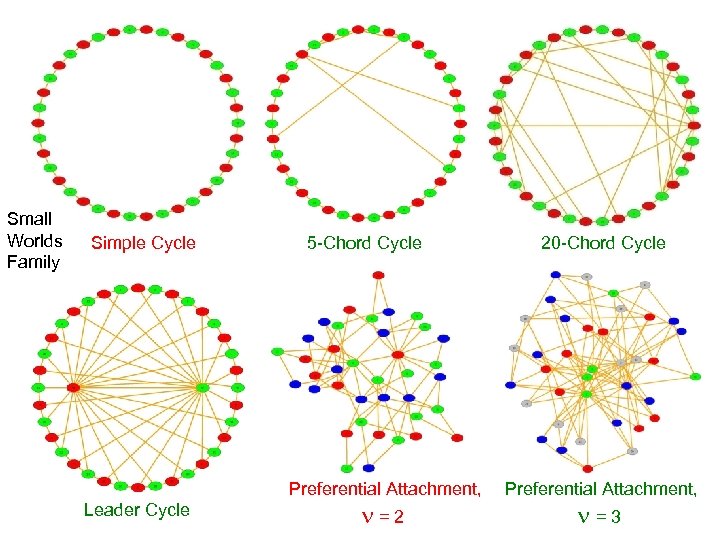 Small Worlds Family Simple Cycle 5 -Chord Cycle Preferential Attachment, Leader Cycle n=2 20 -Chord Cycle Preferential Attachment, n=3
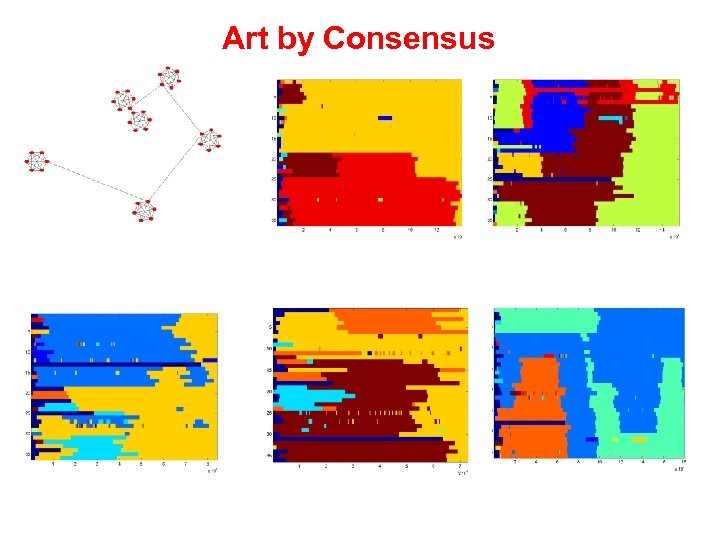 Art by Consensus
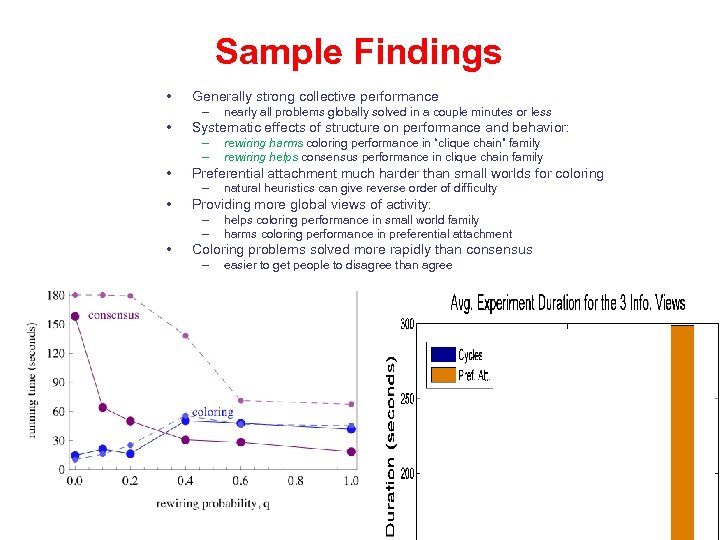 Sample Findings • Generally strong collective performance – • Systematic effects of structure on performance and behavior: – – • natural heuristics can give reverse order of difficulty Providing more global views of activity: – – • rewiring harms coloring performance in “clique chain” family rewiring helps consensus performance in clique chain family Preferential attachment much harder than small worlds for coloring – • nearly all problems globally solved in a couple minutes or less helps coloring performance in small world family harms coloring performance in preferential attachment Coloring problems solved more rapidly than consensus – easier to get people to disagree than agree
 Biased Voting in Networks
 Biased Voting in Networks • Cosmetically similar to consensus, with a crucial strategic difference • Deliberately introduce a tension between: – individual preferences – desire for collective unity • Only two color choices; challenge comes from competing incentives • If everyone converges to same color, everyone gets some payoff • But different players have different preferences – each player has payoffs for their preferred and non-preferred color – e. g. $1. 50 red/$0. 50 blue vs. $0. 50 red/$1. 50 blue – can have symmetric and asymmetric payoffs • High-level experimental design: – choice of network structures – arrangement of types (red/blue prefs) & strengths of incentives – most interesting to coordinate network structure and types
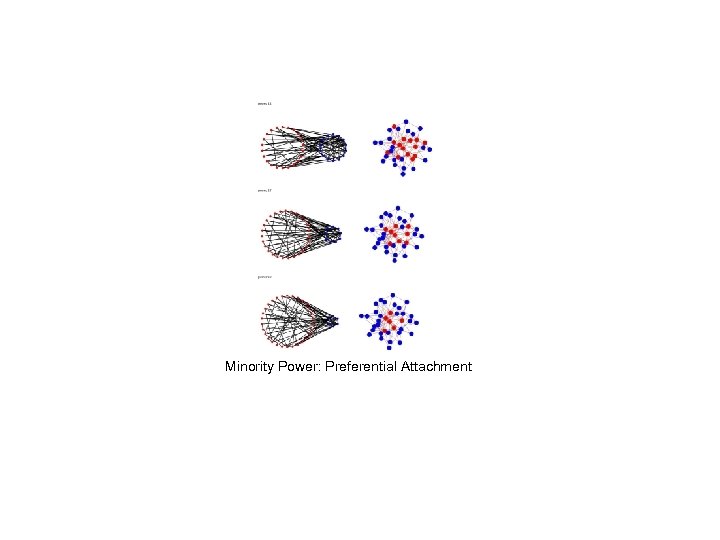 Minority Power: Preferential Attachment
 Summary of Findings • 55/81 experiments reached global consensus in 1 minute allowed – mean of successful ~ 44 s • Effects of network structure: – – – Cohesion harder than Minority Power: 31/54 Cohesion, 24/27 Minority Power all 24 successful Minority Powers converge to minority preference! Cohesion P. A. (20/27) easier than Cohesion E-R overall, P. A. easier than E-R (contrast w/coloring) within Cohesion, increased inter-group communication helps • some notable exceptions… • Effects of incentives: – asymmetric beats weak symmetric beats strong symmetric – the value of “extremists”
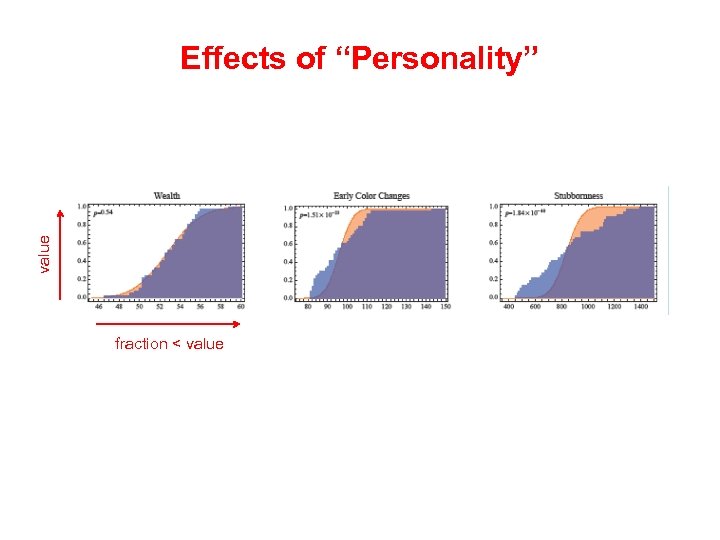 value Effects of “Personality” fraction < value
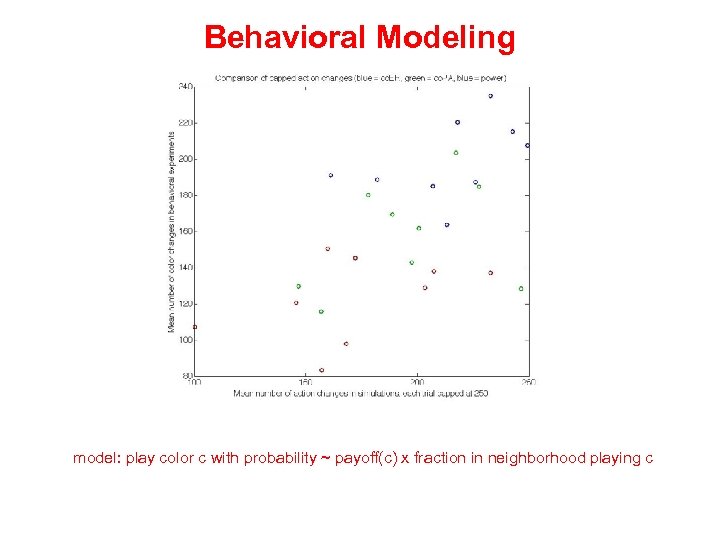 Behavioral Modeling model: play color c with probability ~ payoff(c) x fraction in neighborhood playing c
 Lessons Learned, 2005 -2011 • At least for n=36, human subjects remarkably good – diverse set of collective tasks – diverse set of network topologies – efficiency ~ 90% across all tasks/topologies • Network structure matters; interaction with task – contrast with emphasis on topology alone • Importance of subject variability and style/personality • Most recently: endogenized creation of the network – network formation games – challenging computationally (best response) and analytically
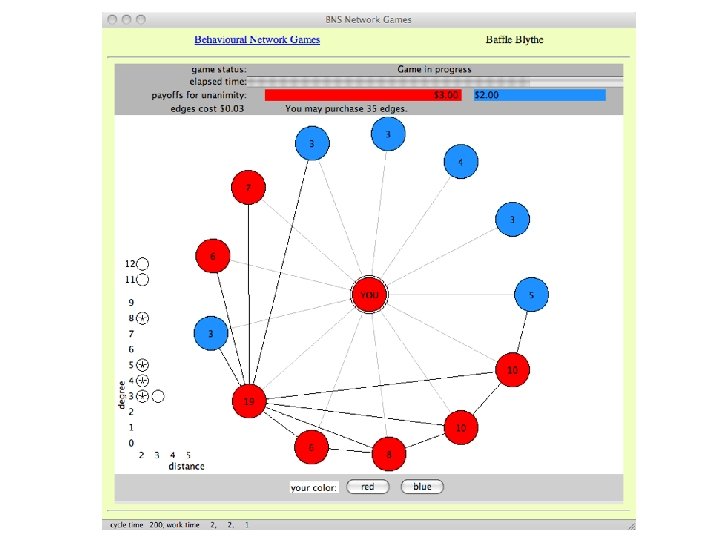
 Edge Purchases: Strategic Tensions • • • Buy edges or not? For information or influence? Early in the game or late? To high degree or low degree players? Nearby or far away?
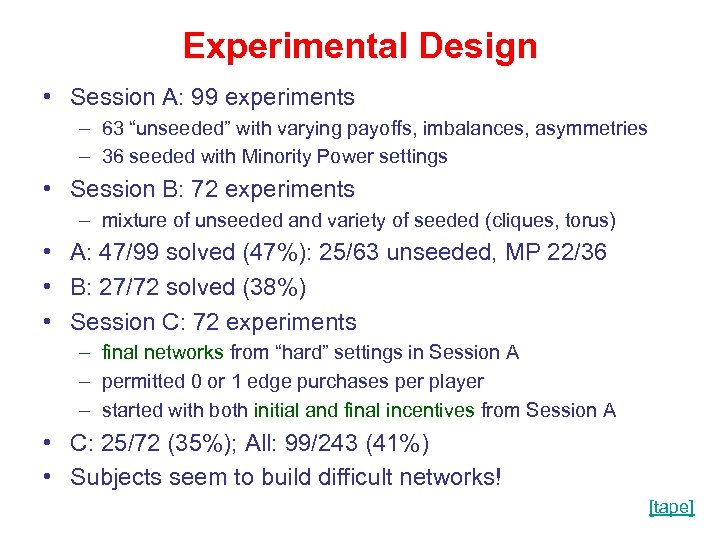 Experimental Design • Session A: 99 experiments – 63 “unseeded” with varying payoffs, imbalances, asymmetries – 36 seeded with Minority Power settings • Session B: 72 experiments – mixture of unseeded and variety of seeded (cliques, torus) • A: 47/99 solved (47%): 25/63 unseeded, MP 22/36 • B: 27/72 solved (38%) • Session C: 72 experiments – final networks from “hard” settings in Session A – permitted 0 or 1 edge purchases per player – started with both initial and final incentives from Session A • C: 25/72 (35%); All: 99/243 (41%) • Subjects seem to build difficult networks! [tape]