


 Скачать презентацию Network Security Research Using High Performance Simulation David
331c9dbf73a152a0484fbcd34a918155.ppt
- Количество слайдов: 19
 Network Security Research Using High Performance Simulation David M. Nicol Assoc. Director R&D, ISTS Professor of Computer Science, Dartmouth
 My First Car 1967 VW Microbus Mine was yellow, with spots of black primer Car repair, Control Data Corporation style SOS 7, 6 March 2003
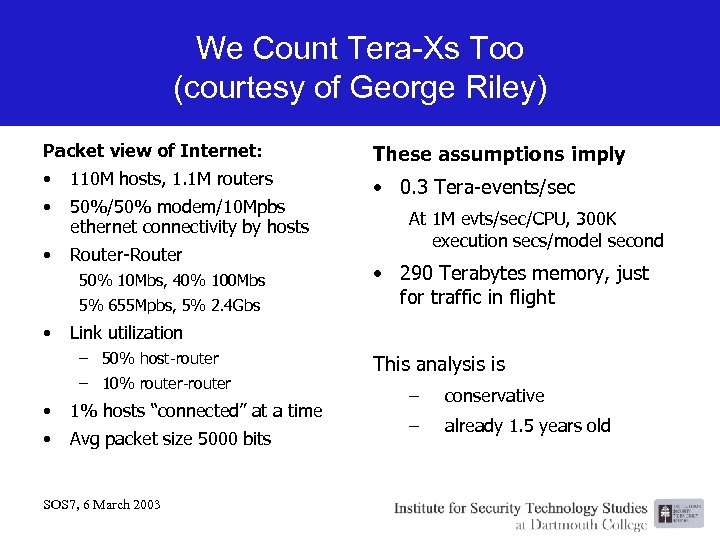 We Count Tera-Xs Too (courtesy of George Riley) Packet view of Internet: These assumptions imply • 110 M hosts, 1. 1 M routers • 50%/50% modem/10 Mpbs ethernet connectivity by hosts • 0. 3 Tera-events/sec • Router-Router 50% 10 Mbs, 40% 100 Mbs 5% 655 Mpbs, 5% 2. 4 Gbs • At 1 M evts/sec/CPU, 300 K execution secs/model second • 290 Terabytes memory, just for traffic in flight Link utilization – 50% host-router – 10% router-router • 1% hosts “connected” at a time • Avg packet size 5000 bits SOS 7, 6 March 2003 This analysis is – conservative – already 1. 5 years old
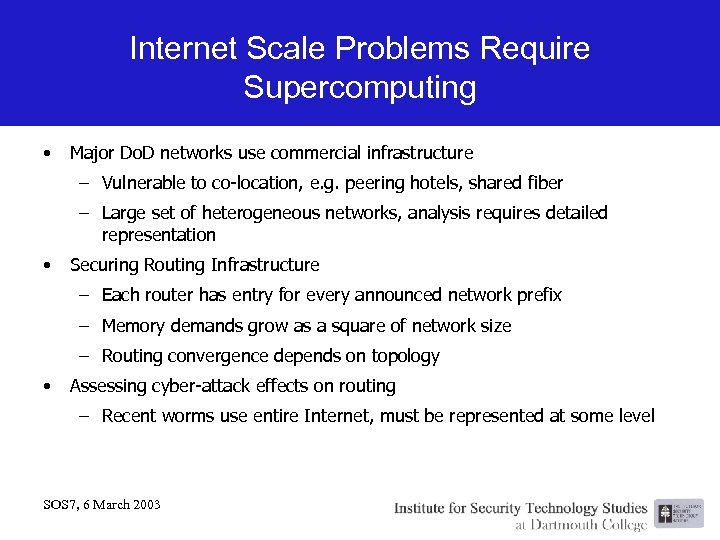 Internet Scale Problems Require Supercomputing • Major Do. D networks use commercial infrastructure – Vulnerable to co-location, e. g. peering hotels, shared fiber – Large set of heterogeneous networks, analysis requires detailed representation • Securing Routing Infrastructure – Each router has entry for every announced network prefix – Memory demands grow as a square of network size – Routing convergence depends on topology • Assessing cyber-attack effects on routing – Recent worms use entire Internet, must be represented at some level SOS 7, 6 March 2003
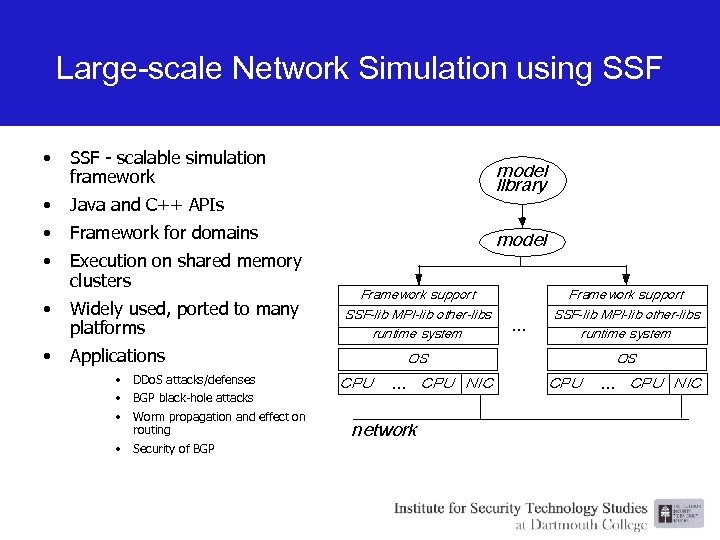 Large-scale Network Simulation using SSF • SSF - scalable simulation framework • Java and C++ APIs • Framework for domains • Execution on shared memory clusters • Widely used, ported to many platforms • Applications • DDo. S attacks/defenses • BGP black-hole attacks • Worm propagation and effect on routing • Security of BGP
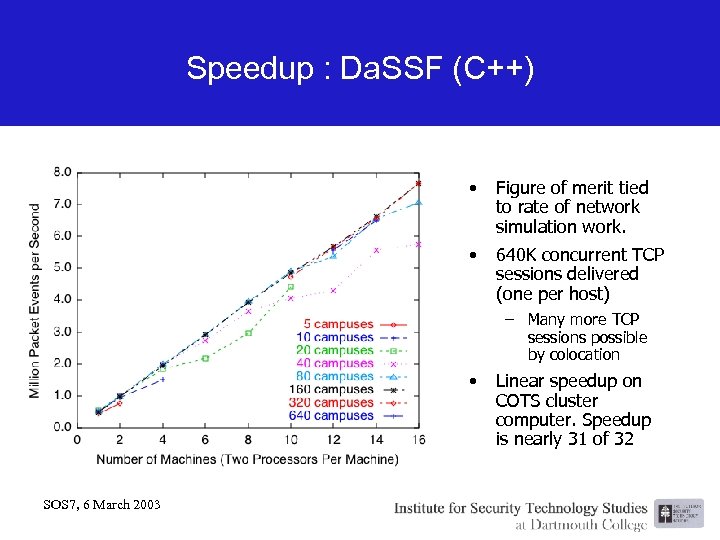 Speedup : Da. SSF (C++) • Figure of merit tied to rate of network simulation work. • 640 K concurrent TCP sessions delivered (one per host) – Many more TCP sessions possible by colocation • SOS 7, 6 March 2003 Linear speedup on COTS cluster computer. Speedup is nearly 31 of 32
 BGP Primer • Internet is a confederation of “Autonomous Systems” (each AS originates various prefixes of Internet addressing space) • Traffic flow between them is dynamically maintained : Boundary Gateway Protocol is the glue • Every BGP router is supposed to know how to get to every advertised prefix • A BGP router bases the routes it advertises on the routes its peers advertise – A Session reset is the re-establishment of a relationship between two peers---happens following a router reboot, or reestablishment of a TCP session between them • Global information propagation – Any AS being “difficult to get to” will cause a great deal of BGP update traffic. SOS 7, 6 March 2003
 Efficient Securing of BGP Path Advertisements Problem : Efficient authentication of BGP path in advertisement 202. 128. 0. 0/14 703 17 34 – Without authentication, AS path can be spoofed • By an intruder masquerading as a peer • Prefix origination can be spoofed • Various attacks : block hole, sniffing, economic, Do. S A solution is to apply authentication at every hop in the path 202. 128. 0. 0/14 703 17 34 s(h(703 17)) s(h(17 34)) s(h(202. 128. 0. 0/14 34)) Source/destination must be signed to defeat “cut and paste” attack – A rogue peer R observes announcement A ->B, copies it and sends to D Multiple signatures every announcement SOS 7, 6 March 2003
 S-BGP : Cost analysis • Crypto costs (RSA, 1024 -bit modulus, SHA-1 hash) – Signature: approx. 512 modular exponentiations and 1024 squaring – Verification : 2 large exponentiations and small (17) squarings – Hash : linear in the length of the hashed data • Outbound crypto operation costs – Separate hash & signature for every peer • Inbound crypto operation costs – hash and verification of each hop High connectivity and long paths make this very costly SOS 7, 6 March 2003
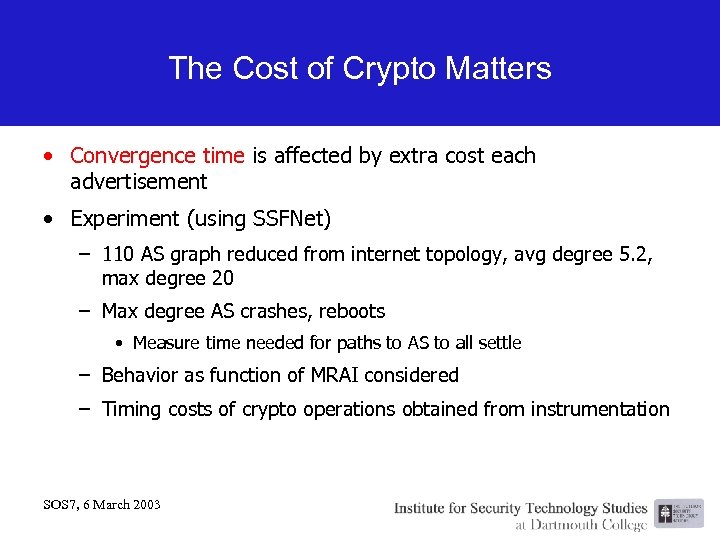 The Cost of Crypto Matters • Convergence time is affected by extra cost each advertisement • Experiment (using SSFNet) – 110 AS graph reduced from internet topology, avg degree 5. 2, max degree 20 – Max degree AS crashes, reboots • Measure time needed for paths to AS to all settle – Behavior as function of MRAI considered – Timing costs of crypto operations obtained from instrumentation SOS 7, 6 March 2003
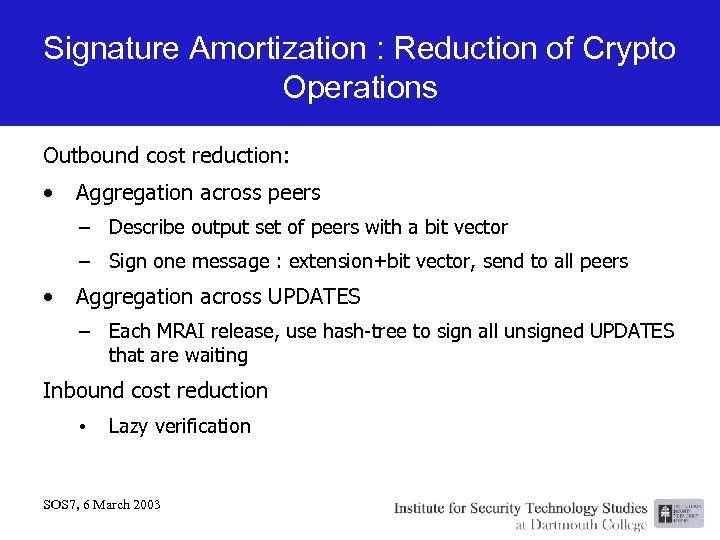 Signature Amortization : Reduction of Crypto Operations Outbound cost reduction: • Aggregation across peers – Describe output set of peers with a bit vector – Sign one message : extension+bit vector, send to all peers • Aggregation across UPDATES – Each MRAI release, use hash-tree to sign all unsigned UPDATES that are waiting Inbound cost reduction • Lazy verification SOS 7, 6 March 2003
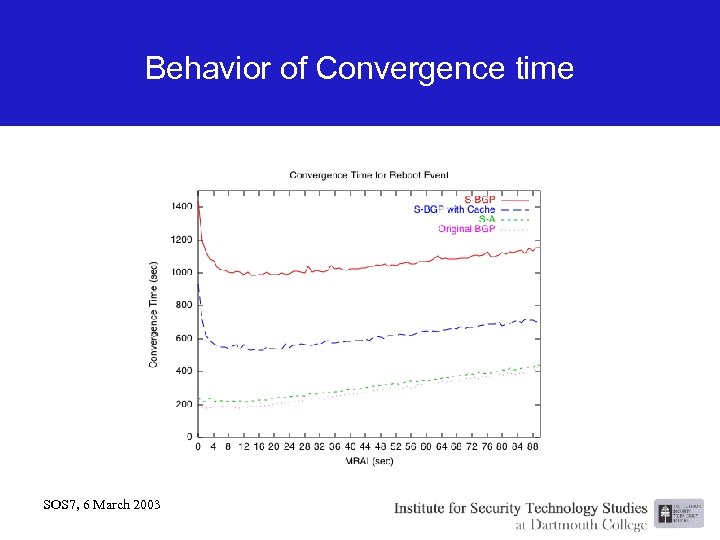 Behavior of Convergence time SOS 7, 6 March 2003
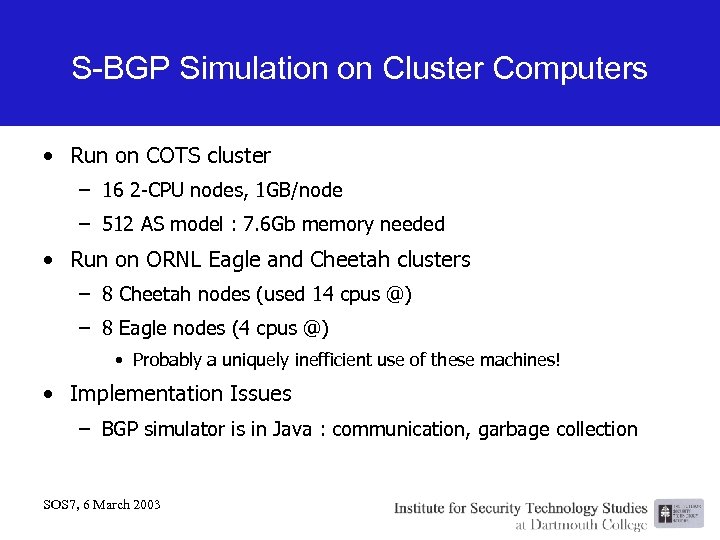 S-BGP Simulation on Cluster Computers • Run on COTS cluster – 16 2 -CPU nodes, 1 GB/node – 512 AS model : 7. 6 Gb memory needed • Run on ORNL Eagle and Cheetah clusters – 8 Cheetah nodes (used 14 cpus @) – 8 Eagle nodes (4 cpus @) • Probably a uniquely inefficient use of these machines! • Implementation Issues – BGP simulator is in Java : communication, garbage collection SOS 7, 6 March 2003
 Interaction of Worms and Routing Infrastructure
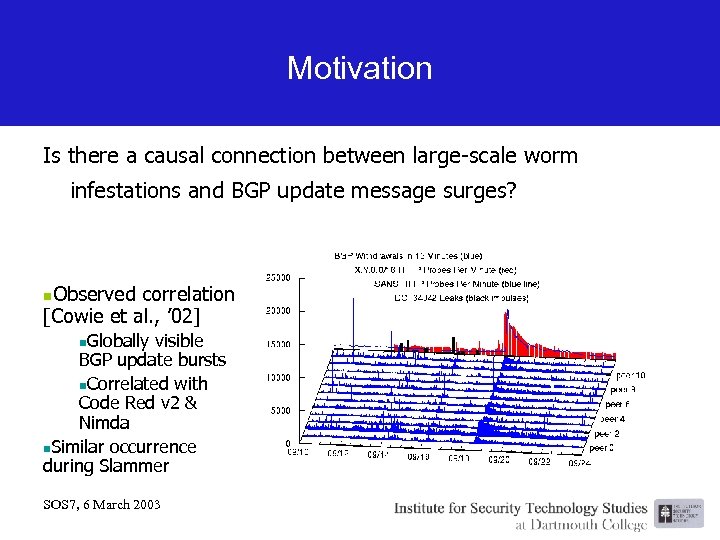 Motivation Is there a causal connection between large-scale worm infestations and BGP update message surges? Observed correlation [Cowie et al. , ’ 02] n Globally visible BGP update bursts n. Correlated with Code Red v 2 & Nimda n. Similar occurrence during Slammer n SOS 7, 6 March 2003
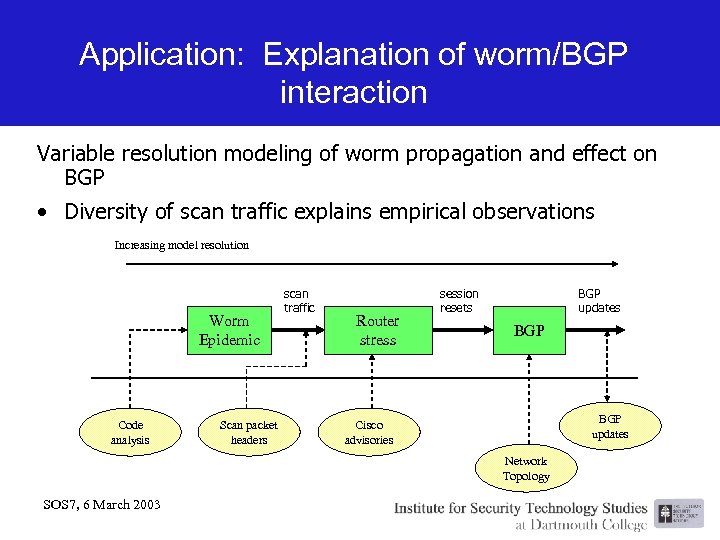 Application: Explanation of worm/BGP interaction Variable resolution modeling of worm propagation and effect on BGP • Diversity of scan traffic explains empirical observations Increasing model resolution Worm Epidemic Code analysis Scan packet headers scan traffic Router stress session resets BGP updates Cisco advisories Network Topology SOS 7, 6 March 2003
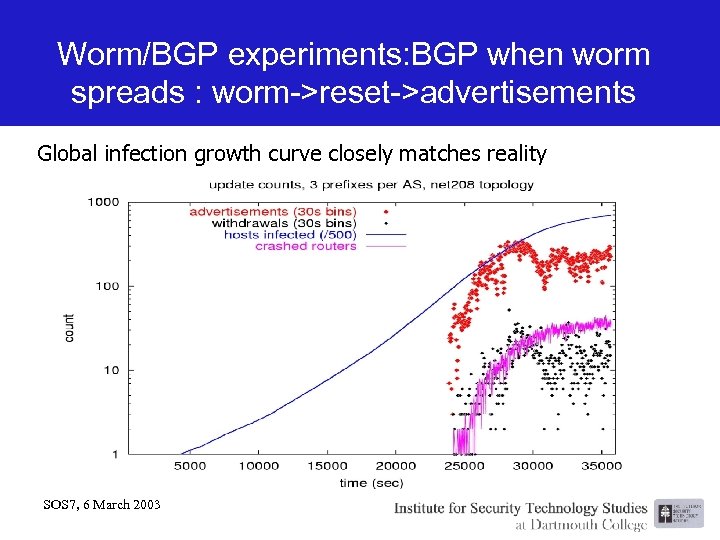 Worm/BGP experiments: BGP when worm spreads : worm->reset->advertisements Global infection growth curve closely matches reality SOS 7, 6 March 2003
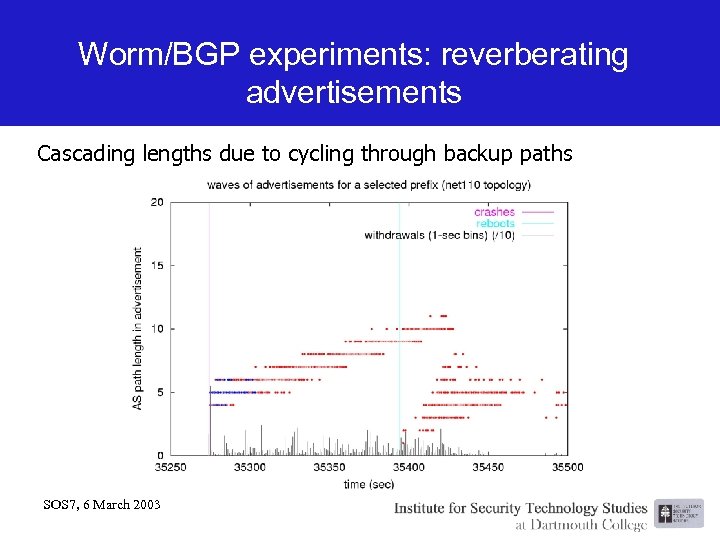 Worm/BGP experiments: reverberating advertisements Cascading lengths due to cycling through backup paths SOS 7, 6 March 2003
 High Performance Simulation : Summary • We have a mature toolset designed to study large-scale systems. – Designed to scale up with problem size and execution engine – Proven on large-scale problems and large-scale machines – Used on a number of networking studies • DDo. S attack analysis • Worm propagation / BGP • BGP convergence • BGP black hole attacks SOS 7, 6 March 2003