


 Скачать презентацию Network Security Lecture 4 Modes of Operation http
0215ff434b81b94e8f0d4df062aa9f2e.ppt
- Количество слайдов: 32
 Network Security Lecture 4 Modes of Operation http: //web. uettaxila. edu. pk/CMS/coe. CCNbs. Sp 09/index. asp Waleed Ejaz waleed. ejaz@uettaxila. edu. pk
 Overview 1. 2. 3. 4. Modes of Operation: ECB, CBC, OFB, CTR Privacy + Integrity DES Attacks 3 DES and its design Ref: Chapter 4 of textbook.
 Modes of Operation 1. 2. 3. 4. 5. Electronic Code Book (ECB) Cipher Block Chaining (CBC) Cipher Feedback Mode (CFB) Output Feedback Mode (OFB) Counter Mode (CTR)
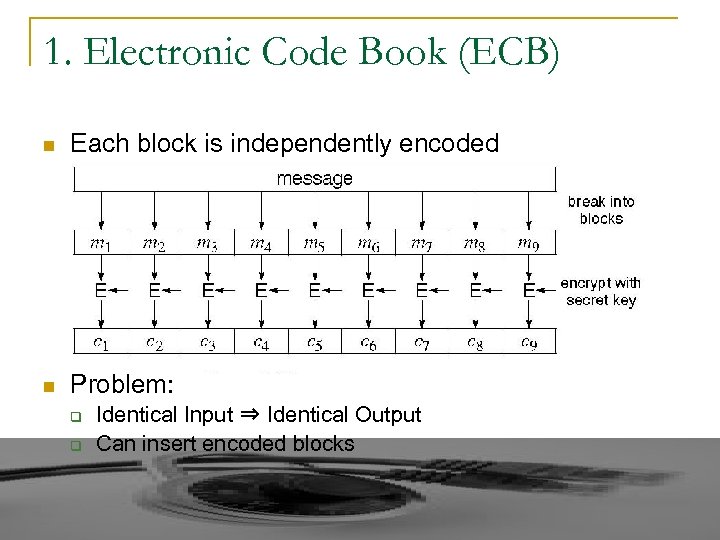 1. Electronic Code Book (ECB) n Each block is independently encoded n Problem: q q Identical Input ⇒ Identical Output Can insert encoded blocks
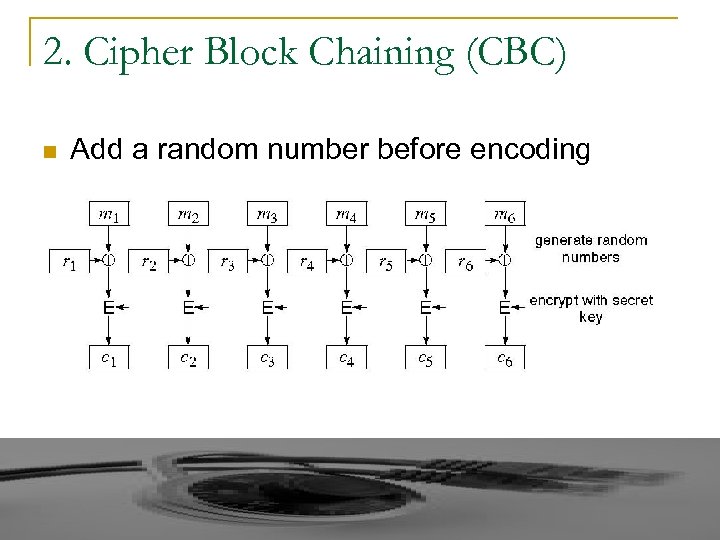 2. Cipher Block Chaining (CBC) n Add a random number before encoding
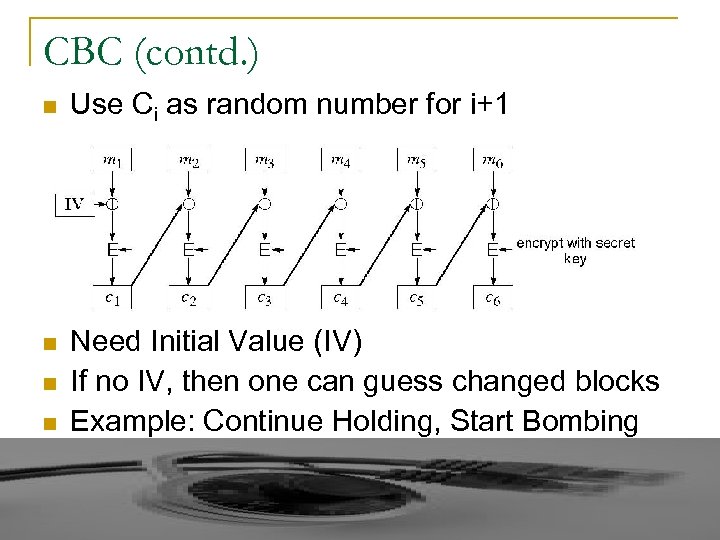 CBC (contd. ) n Use Ci as random number for i+1 n Need Initial Value (IV) If no IV, then one can guess changed blocks Example: Continue Holding, Start Bombing n n
 CBC (contd. ) n Attack 1: Change selected bits in encrypted message q n Garbled text not detected by computers Attack 2: Attacker knows plain text and cipher text. Can change plain text. q 32 -bit CRC may not detect. 64 -bit CRC may be better.
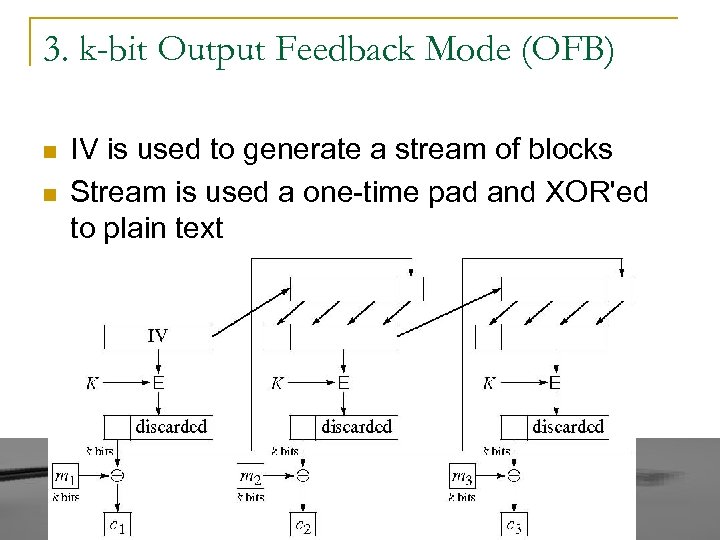 3. k-bit Output Feedback Mode (OFB) n n IV is used to generate a stream of blocks Stream is used a one-time pad and XOR'ed to plain text
 OFB (contd. ) n Advantages: q q n n Stream can be generated in advance 1 -bit error in transmission affects only one bit of plain text Message can be any size All messages are immediately transmitted Disadvantage: Plain text can be trivially modified Only left-most k-bits of the block can be used
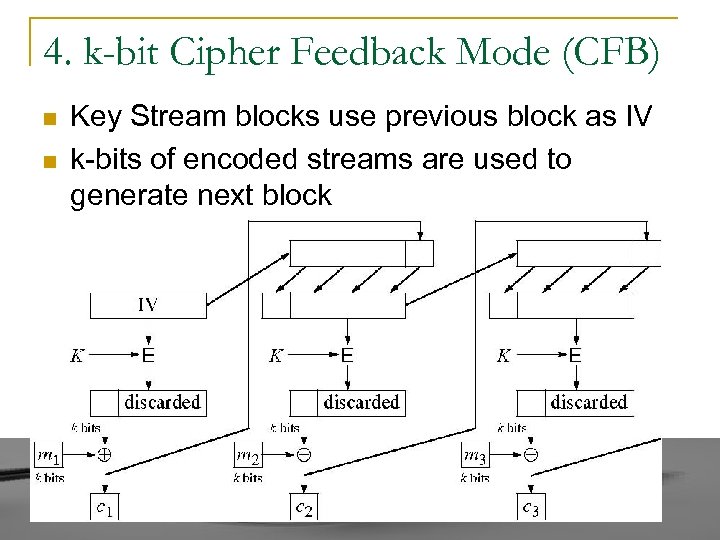 4. k-bit Cipher Feedback Mode (CFB) n n Key Stream blocks use previous block as IV k-bits of encoded streams are used to generate next block
 CFB (contd. ) n n Stream cannot be generated in advance. In practice, k=8 bit or 64 bit If a byte is added or deleted, that byte and next 8 bytes will be affected No block rearranging effect
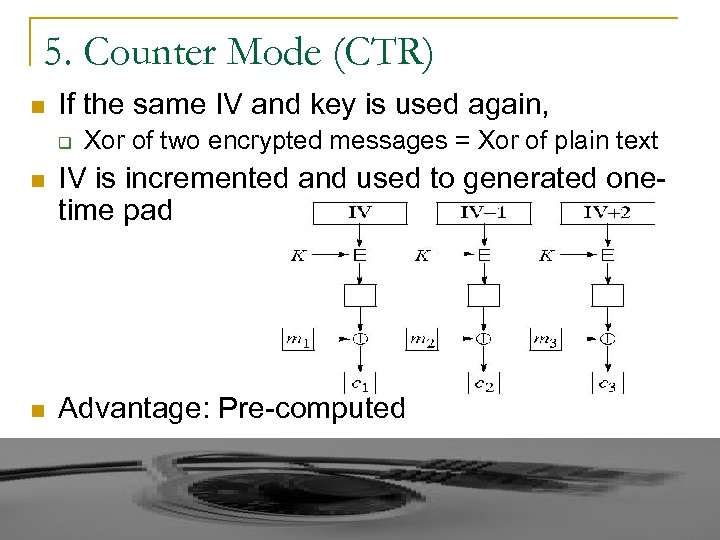 5. Counter Mode (CTR) n If the same IV and key is used again, q Xor of two encrypted messages = Xor of plain text n IV is incremented and used to generated onetime pad n Advantage: Pre-computed
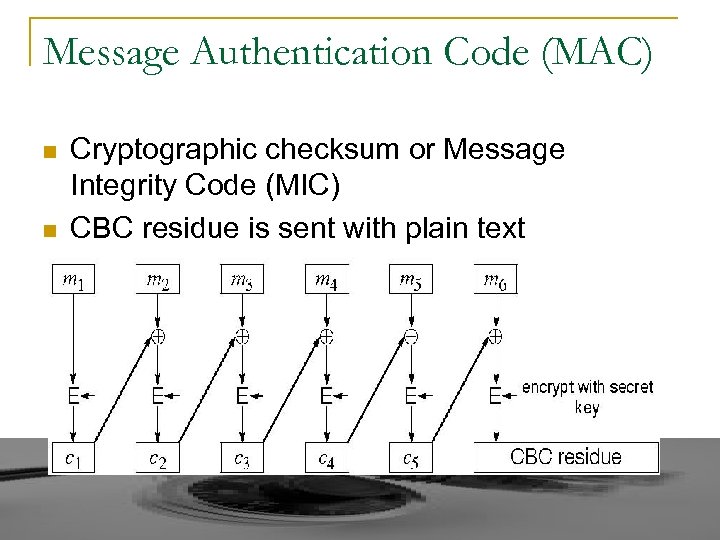 Message Authentication Code (MAC) n n Cryptographic checksum or Message Integrity Code (MIC) CBC residue is sent with plain text
 Weak and Semi Weak Keys n n Recall that 56 -bit DES key is divided in two halves and permuted to produce C 0 and D 0 Keys are weak if C 0 and D 0 (after permutation) result in: q q q n All 0's All 1's Alternating 10 or 01 Four possibilities for each half ⇒ 16 weak keys
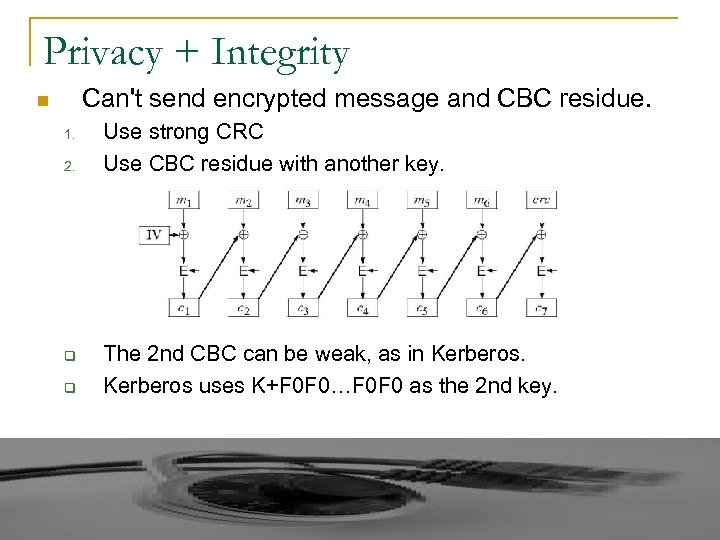 Privacy + Integrity Can't send encrypted message and CBC residue. n 1. 2. q q Use strong CRC Use CBC residue with another key. The 2 nd CBC can be weak, as in Kerberos uses K+F 0 F 0…F 0 F 0 as the 2 nd key.
 Privacy + Integrity (contd. ) 3. Use hash with another key. Faster than encryption. 4. Use Offset Code Book (OCB), http: //www. cs. ucdavis. edu/~rogaway/papers/draft krovetz-ocb-00. txt
 MISTY 1 n n n n Block cipher with 128 bit keys With 4 to 8 rounds. Each round consists of 3 subrounds. Secure against linear and differential cryptanalysis Named after the inventors: Matsui Mitsuru, Ichikawa Tetsuya, Sorimachi Toru, Tokita Toshio, and Yamagishi Atsuhiro A. k. a. Mitsubishi Improved Security Technology Recommended for Japanese government use. Patented Described in RFC 2994 Ref: http: //en. wikipedia. org/wiki/MISTY 1
 KASUMI n n n Selected by 3 GPP 64 -bit block cipher with 128 bit key A variant of MISTY 1 Needs limited computing power Works in real time (voice) KASUMI with counter mode and output feedback modes. This algorithm is known as f 8.
 GSM Encryption n Three stream ciphers: A 5/1, A 5/2, A 5/3 Description of A 5/1 and A 5/2 were never released to public but were reverse engineered and broken A 5/3 is based KASUMI
 DES Attacks n n n 1997 RSA Lab set a prize of $10 k Curtin and Dolske used combined power of Internet computers to find the key using a brute force method. 1998 Electronic Frontier Foundation (EFF) showed that a $250 k machine could find any DES key in max 1 week. Avg 3 days. 2001 EFF combined the cracker with Internet to crack DES in 1 day. Differential Cryptanalysis and Linear cryptanalysis can be used to crack DES NIST recommended 3 DES
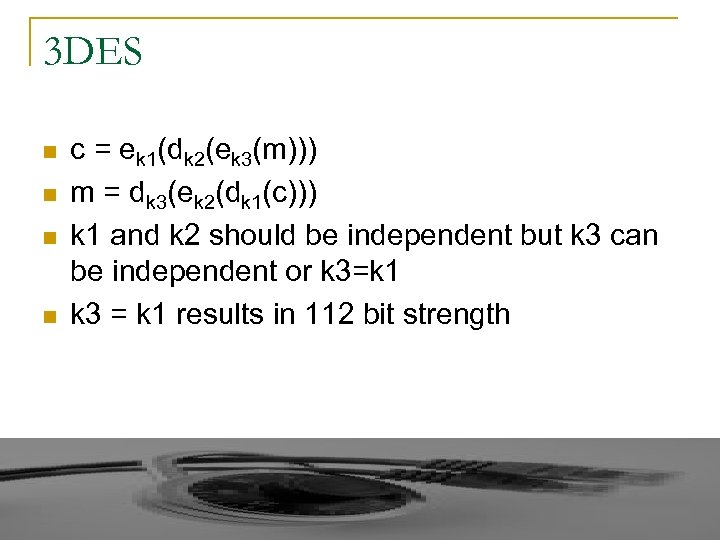 3 DES n n c = ek 1(dk 2(ek 3(m))) m = dk 3(ek 2(dk 1(c))) k 1 and k 2 should be independent but k 3 can be independent or k 3=k 1 k 3 = k 1 results in 112 bit strength
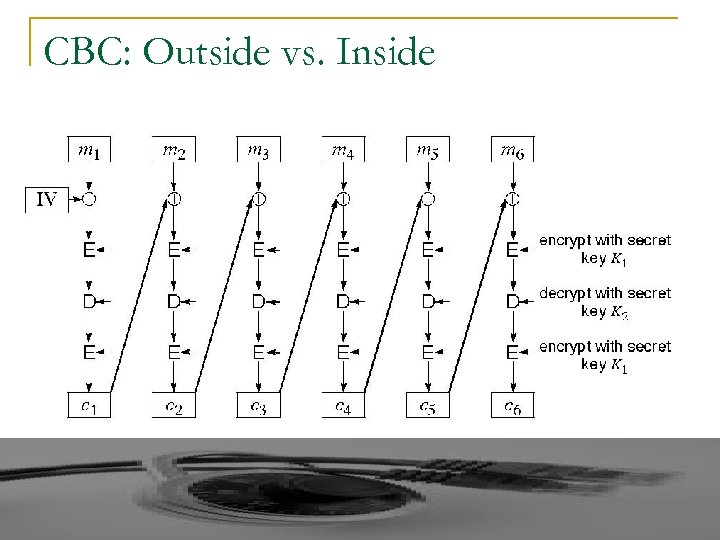 CBC: Outside vs. Inside
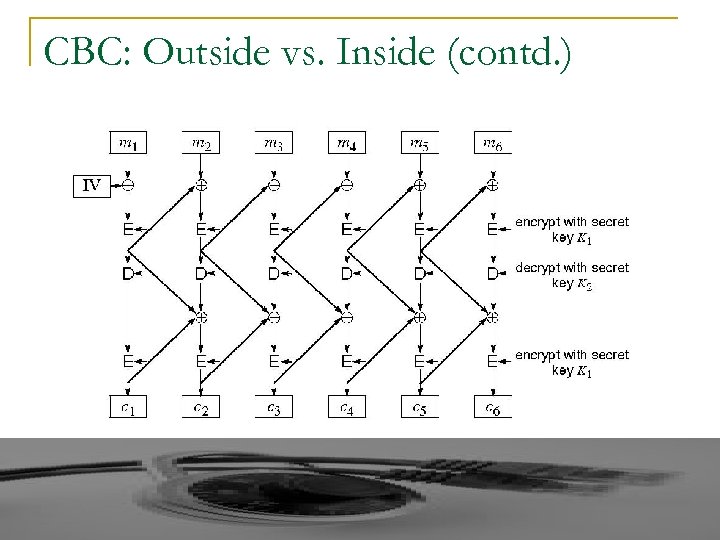 CBC: Outside vs. Inside (contd. )
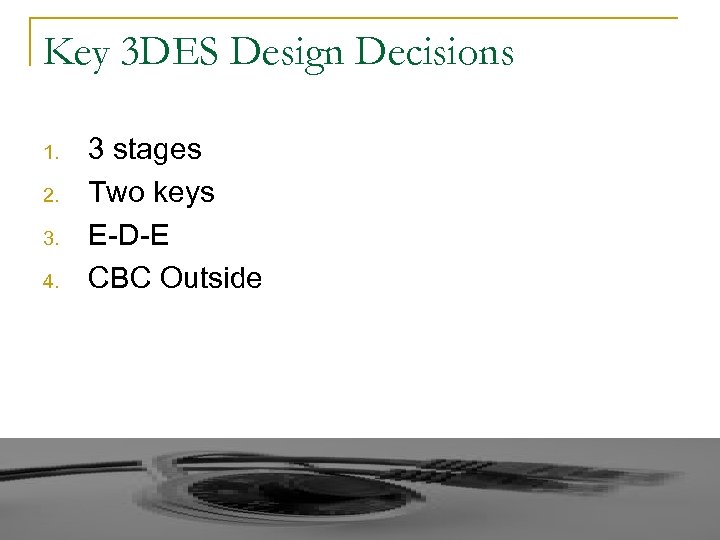 Key 3 DES Design Decisions 1. 2. 3. 4. 3 stages Two keys E-D-E CBC Outside
 1. Why not 2 DES? n n n ek 1(ek 2(m)) 2 DES is only twice as secure as DES (57 -bit key) Suppose you know (m 1, c 1), (m 2, c 2), . . . c 1=ek 1(ek 2(m 1)) dk 1(c 1)=ek 2(m 1) k 1 and k 2 can be found by preparing two 2^56 entry tables Table 1 contains all possible encryptions of m 1. Table 2 contains all possible decryptions of c 1. Sort both tables. Find matching entries ⇒ potential (k 1, k 2) pairs Try these pairs on (m 2, c 2), . . .
 2. Why only Two Keys? n n n k 3=k 1 is as secure as k 3=k 1 Given (m, c) pairs, it is easy to find 3 keys such that ek 1(dk 2(ek 3(m)))=r But finding the keys when k 3=k 1 is difficult.
 3. Why E-D-E and not E-E-E? n n E and D are both equally strong encryptions. With k 1=k 2, EDE = E ⇒ a 3 DES system can talk to DES by setting k 1=k 2
 Why CBC outside? Bit Flipping: 1. q CBC Outside: One bit flip in the cipher text causes that block of plain text and next block garbled ⇒ Self-Synchronizing q CBC Inside: One bit flip in the cipher text causes more blocks to be garbled. 2. Pipelining: q More pipelining possible in CBC inside implementation. 3. Flexibility of Change: q CBC outside: Can easily replace CBC with other feedback modes (ECB, CFB, …. )
 Summary 1. 2. 3. 4. To encrypt long messages, we need to use different modes of operation Five modes of operation: ECB, CBC, OFG, CFB, CTR Privacy + Integrity: Use CRC or CBC residue 3 DES uses two keys and E-D-E sequence and CBC on the outside.
 References 1. 2. 3. 4. C. Kaufman, R. Perlman, and M. Speciner, “Network Security: Private Communication in a Public World, ” 2 nd Ed, Prentice Hall, 2002, ISBN: 0130460192 William Stallings, “Cryptography and Network Security, ” 4 th Ed, Prentice-Hall, 2006, ISBN: 013187316 W. Dent and C. J. Mitchell, “User’s Guide to Cryptography and Standards, ” Artech House, 2005, ISBN: 1580535305 N. Ferguson and B. Schneier, “Practical Cryptography, ” Wiley, 2003, ISBN: 047122894 X
 Assignment 2 n n n Read chapter 4 of the textbook Submit answer to Exercise 4. 4: What is a practical method of finding a triple of keys that maps a given plain text to a given cipher text using EDE? Hint: 1. You have only one (m, c) pair 2. Worst case is to have 3 nested loops for trying all k 1, k 2, k 3 ⇒ 264 × 264 = 2192 steps but requires storing only 1 intermediate result. 3. How can you reduce the number of steps using more storage for intermediate results.
 Questions!