


 Скачать презентацию Network Security Dr Syed Ismail Shah syedismailshah gmail com
4c3a0d3ce482e4d12c2e008ac8a8dd45.ppt
- Количество слайдов: 33
 Network Security Dr. Syed Ismail Shah syedismailshah@gmail. com 1
 Chapter 10 – Key Management; Other Public Key Cryptosystems No Singhalese, whether man or woman, would venture out of the house without a bunch of keys in his hand, for without such a talisman he would fear that some devil might take advantage of his weak state to slip into his body. —The Golden Bough, Sir James George Frazer 2
 Elliptic Curve Cryptography • Majority of public-key crypto (RSA, D-H) use either integer or polynomial arithmetic with very large numbers/polynomials • Imposes a significant load in storing and processing keys and messages • An alternative is to use elliptic curves • Offers same security with smaller bit sizes 3
 Elliptic Curve Groups over Real Numbers • An elliptic curve over real numbers may be defined as the set of points (x, y) which satisfy an elliptic curve equation of the form: y 2 = x 3 + ax + b, where x, y, a and b are real numbers. • Each choice of the numbers a and b yields a different elliptic curve. • For example, a = -4 and b =0. 67 gives the elliptic curve with equation y 2 = x 3 - 4 x + 0. 67; the graph of this curve is shown on the next slide. 4
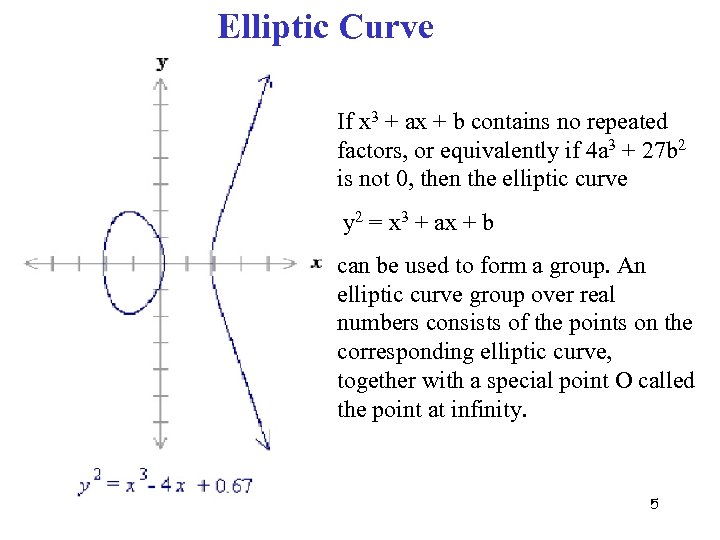 Elliptic Curve If x 3 + ax + b contains no repeated factors, or equivalently if 4 a 3 + 27 b 2 is not 0, then the elliptic curve y 2 = x 3 + ax + b can be used to form a group. An elliptic curve group over real numbers consists of the points on the corresponding elliptic curve, together with a special point O called the point at infinity. 5
 Adding distinct points P and Q P + Q = R is the additive property defined geometrically. Suppose that P and Q are two distinct points on an elliptic curve, and the P is not -Q. To add the points P and Q, a line is drawn through the two points. This line will intersect the elliptic curve in exactly one more point, call -R. The point -R is reflected in the x-axis to the point R. The law for addition in an elliptic curve group is P + Q = R. 6
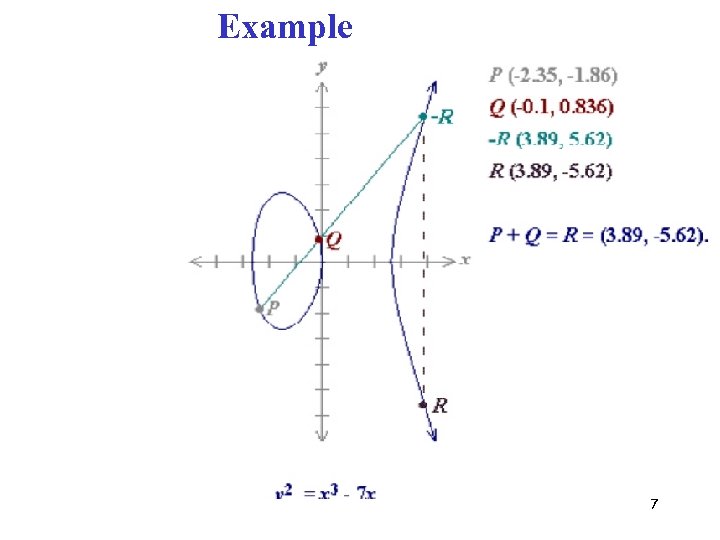 Example 7
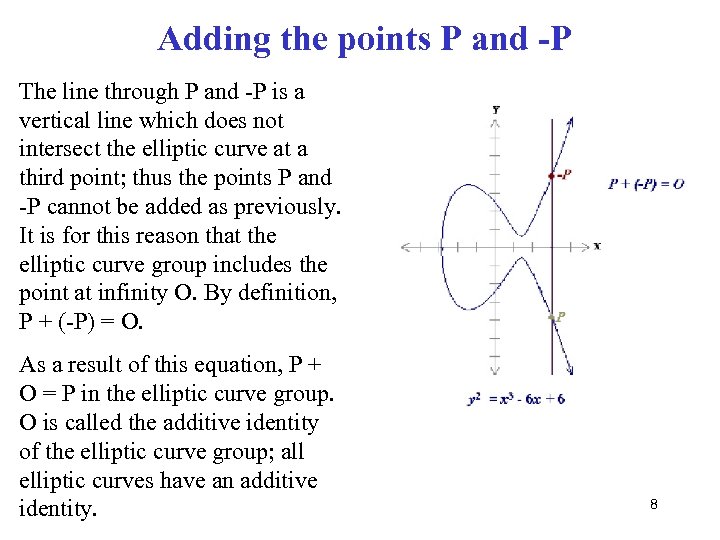 Adding the points P and -P The line through P and -P is a vertical line which does not intersect the elliptic curve at a third point; thus the points P and -P cannot be added as previously. It is for this reason that the elliptic curve group includes the point at infinity O. By definition, P + (-P) = O. As a result of this equation, P + O = P in the elliptic curve group. O is called the additive identity of the elliptic curve group; all elliptic curves have an additive identity. 8
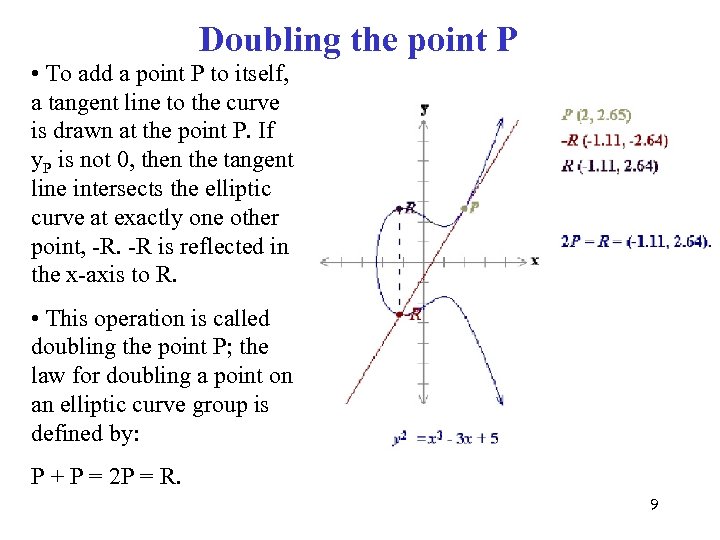 Doubling the point P • To add a point P to itself, a tangent line to the curve is drawn at the point P. If y. P is not 0, then the tangent line intersects the elliptic curve at exactly one other point, -R. -R is reflected in the x-axis to R. • This operation is called doubling the point P; the law for doubling a point on an elliptic curve group is defined by: P + P = 2 P = R. 9
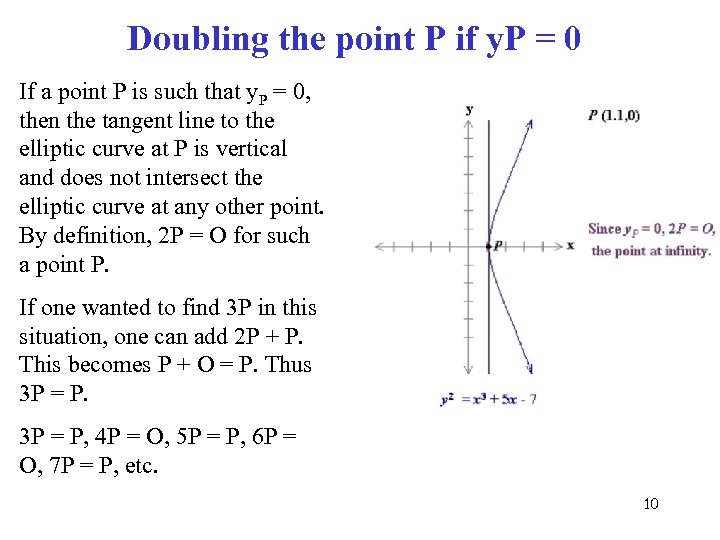 Doubling the point P if y. P = 0 If a point P is such that y. P = 0, then the tangent line to the elliptic curve at P is vertical and does not intersect the elliptic curve at any other point. By definition, 2 P = O for such a point P. If one wanted to find 3 P in this situation, one can add 2 P + P. This becomes P + O = P. Thus 3 P = P, 4 P = O, 5 P = P, 6 P = O, 7 P = P, etc. 10
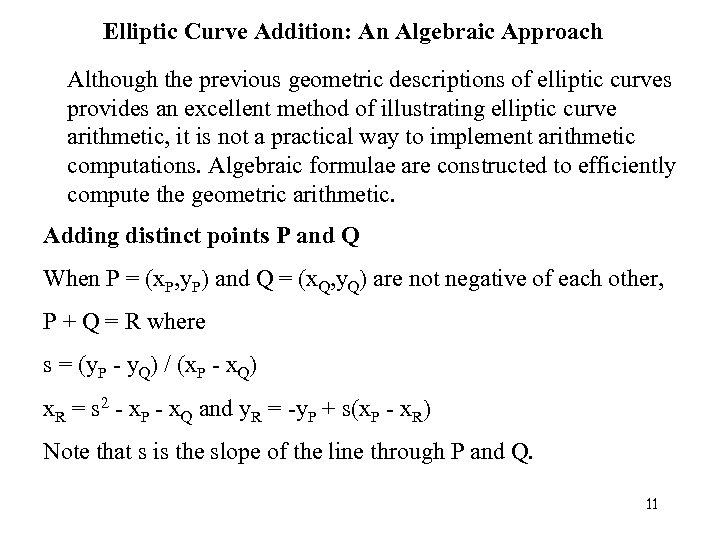 Elliptic Curve Addition: An Algebraic Approach Although the previous geometric descriptions of elliptic curves provides an excellent method of illustrating elliptic curve arithmetic, it is not a practical way to implement arithmetic computations. Algebraic formulae are constructed to efficiently compute the geometric arithmetic. Adding distinct points P and Q When P = (x. P, y. P) and Q = (x. Q, y. Q) are not negative of each other, P + Q = R where s = (y. P - y. Q) / (x. P - x. Q) x. R = s 2 - x. P - x. Q and y. R = -y. P + s(x. P - x. R) Note that s is the slope of the line through P and Q. 11
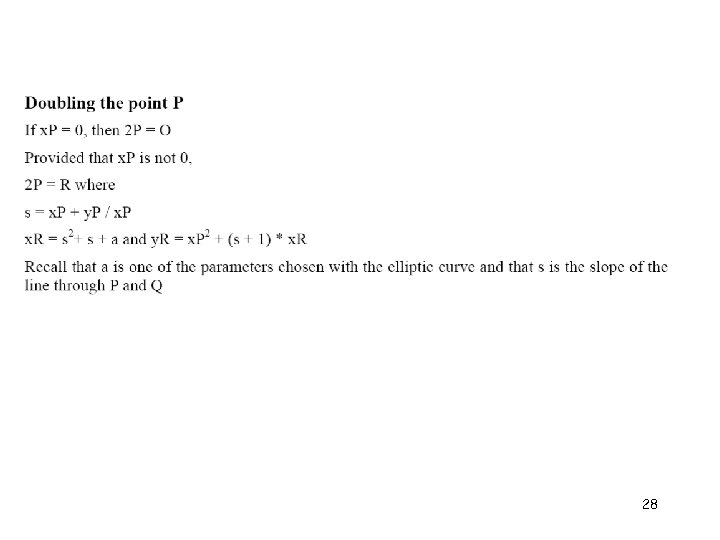
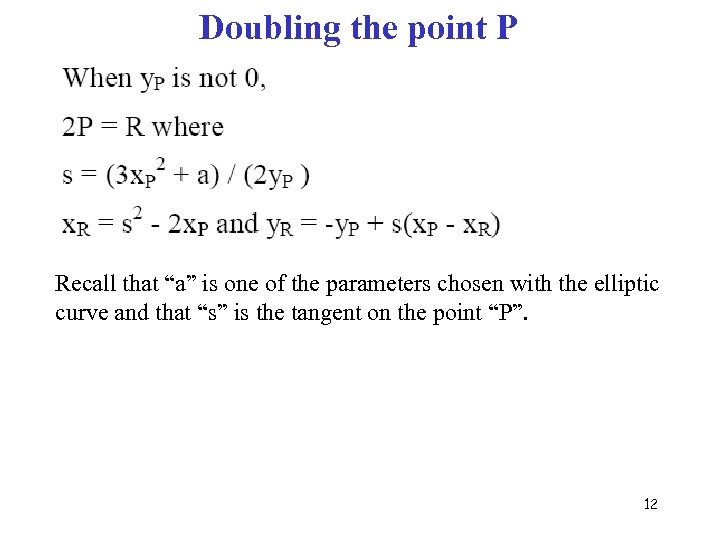 Doubling the point P Recall that “a” is one of the parameters chosen with the elliptic curve and that “s” is the tangent on the point “P”. 12
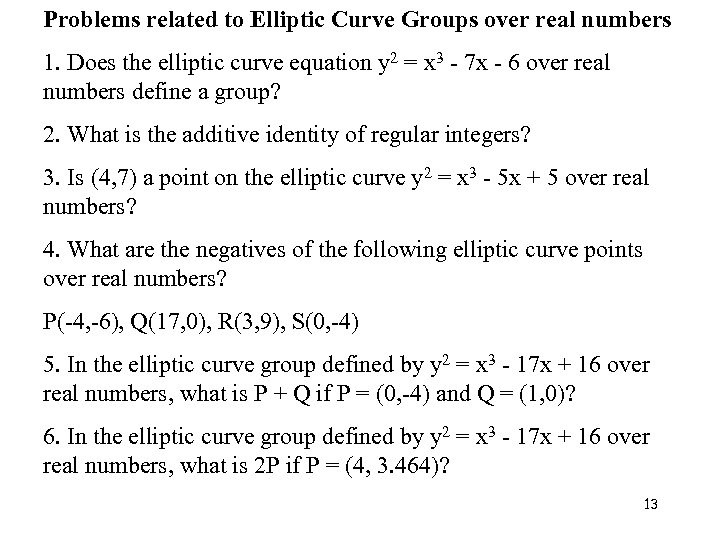 Problems related to Elliptic Curve Groups over real numbers 1. Does the elliptic curve equation y 2 = x 3 - 7 x - 6 over real numbers define a group? 2. What is the additive identity of regular integers? 3. Is (4, 7) a point on the elliptic curve y 2 = x 3 - 5 x + 5 over real numbers? 4. What are the negatives of the following elliptic curve points over real numbers? P(-4, -6), Q(17, 0), R(3, 9), S(0, -4) 5. In the elliptic curve group defined by y 2 = x 3 - 17 x + 16 over real numbers, what is P + Q if P = (0, -4) and Q = (1, 0)? 6. In the elliptic curve group defined by y 2 = x 3 - 17 x + 16 over real numbers, what is 2 P if P = (4, 3. 464)? 13
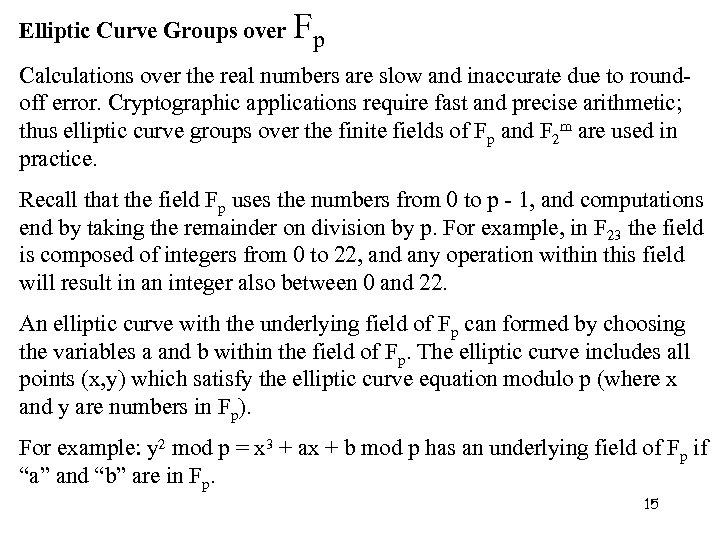 Elliptic Curve Groups over Fp Calculations over the real numbers are slow and inaccurate due to roundoff error. Cryptographic applications require fast and precise arithmetic; thus elliptic curve groups over the finite fields of Fp and F 2 m are used in practice. Recall that the field Fp uses the numbers from 0 to p - 1, and computations end by taking the remainder on division by p. For example, in F 23 the field is composed of integers from 0 to 22, and any operation within this field will result in an integer also between 0 and 22. An elliptic curve with the underlying field of Fp can formed by choosing the variables a and b within the field of Fp. The elliptic curve includes all points (x, y) which satisfy the elliptic curve equation modulo p (where x and y are numbers in Fp). For example: y 2 mod p = x 3 + ax + b mod p has an underlying field of Fp if “a” and “b” are in Fp. 15
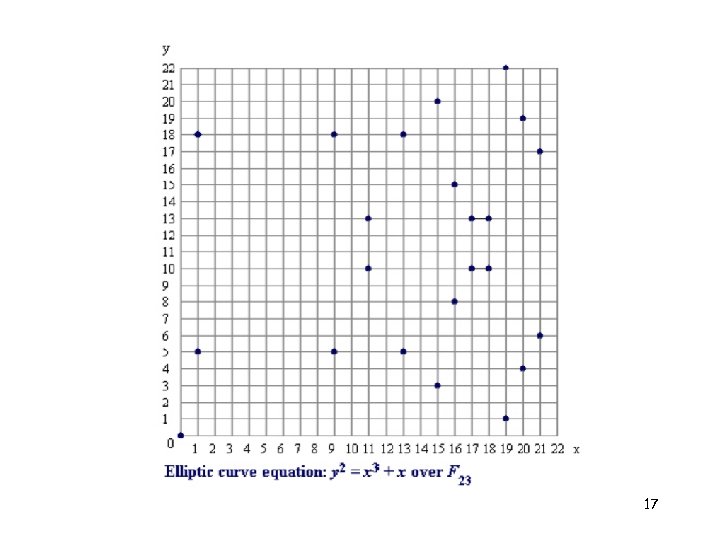
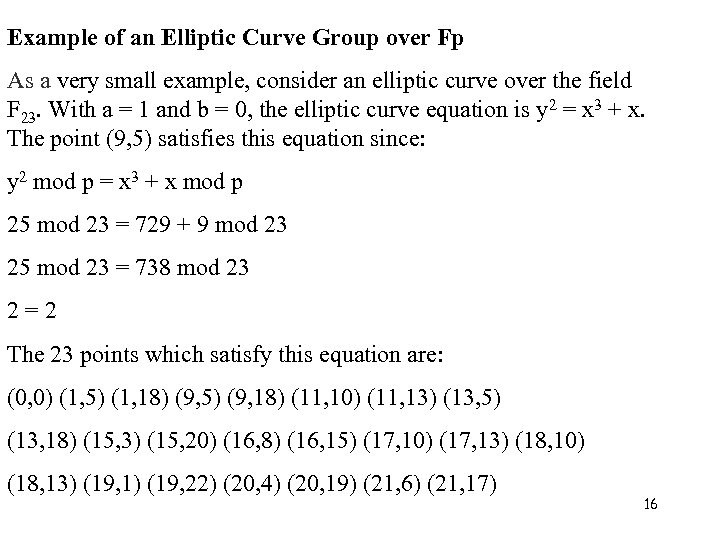 Example of an Elliptic Curve Group over Fp As a very small example, consider an elliptic curve over the field F 23. With a = 1 and b = 0, the elliptic curve equation is y 2 = x 3 + x. The point (9, 5) satisfies this equation since: y 2 mod p = x 3 + x mod p 25 mod 23 = 729 + 9 mod 23 25 mod 23 = 738 mod 23 2=2 The 23 points which satisfy this equation are: (0, 0) (1, 5) (1, 18) (9, 5) (9, 18) (11, 10) (11, 13) (13, 5) (13, 18) (15, 3) (15, 20) (16, 8) (16, 15) (17, 10) (17, 13) (18, 10) (18, 13) (19, 1) (19, 22) (20, 4) (20, 19) (21, 6) (21, 17) 16
 17
17
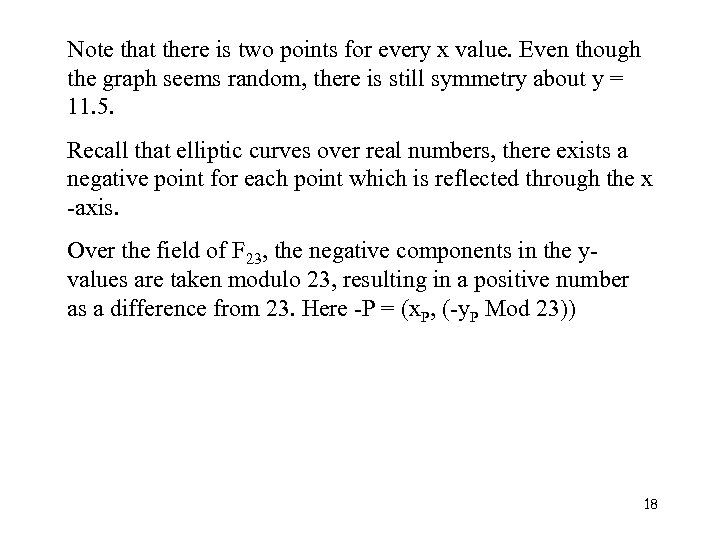 Note that there is two points for every x value. Even though the graph seems random, there is still symmetry about y = 11. 5. Recall that elliptic curves over real numbers, there exists a negative point for each point which is reflected through the x -axis. Over the field of F 23, the negative components in the yvalues are taken modulo 23, resulting in a positive number as a difference from 23. Here -P = (x. P, (-y. P Mod 23)) 18
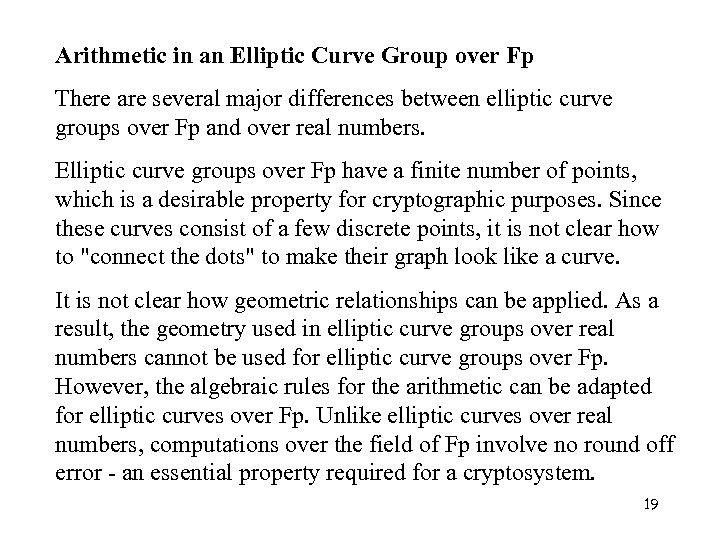 Arithmetic in an Elliptic Curve Group over Fp There are several major differences between elliptic curve groups over Fp and over real numbers. Elliptic curve groups over Fp have a finite number of points, which is a desirable property for cryptographic purposes. Since these curves consist of a few discrete points, it is not clear how to "connect the dots" to make their graph look like a curve. It is not clear how geometric relationships can be applied. As a result, the geometry used in elliptic curve groups over real numbers cannot be used for elliptic curve groups over Fp. However, the algebraic rules for the arithmetic can be adapted for elliptic curves over Fp. Unlike elliptic curves over real numbers, computations over the field of Fp involve no round off error - an essential property required for a cryptosystem. 19
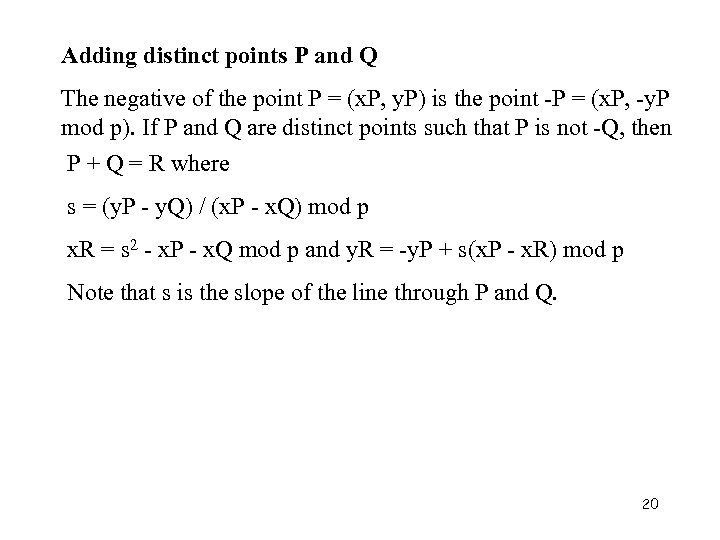 Adding distinct points P and Q The negative of the point P = (x. P, y. P) is the point -P = (x. P, -y. P mod p). If P and Q are distinct points such that P is not -Q, then P + Q = R where s = (y. P - y. Q) / (x. P - x. Q) mod p x. R = s 2 - x. P - x. Q mod p and y. R = -y. P + s(x. P - x. R) mod p Note that s is the slope of the line through P and Q. 20
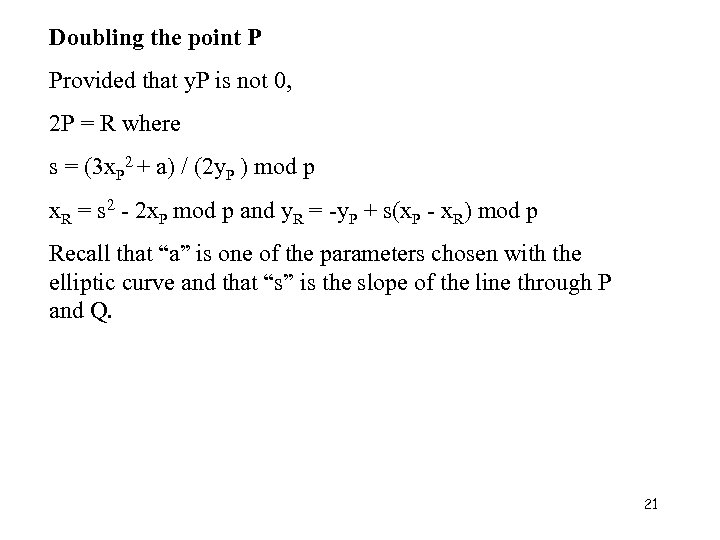 Doubling the point P Provided that y. P is not 0, 2 P = R where s = (3 x. P 2 + a) / (2 y. P ) mod p x. R = s 2 - 2 x. P mod p and y. R = -y. P + s(x. P - x. R) mod p Recall that “a” is one of the parameters chosen with the elliptic curve and that “s” is the slope of the line through P and Q. 21
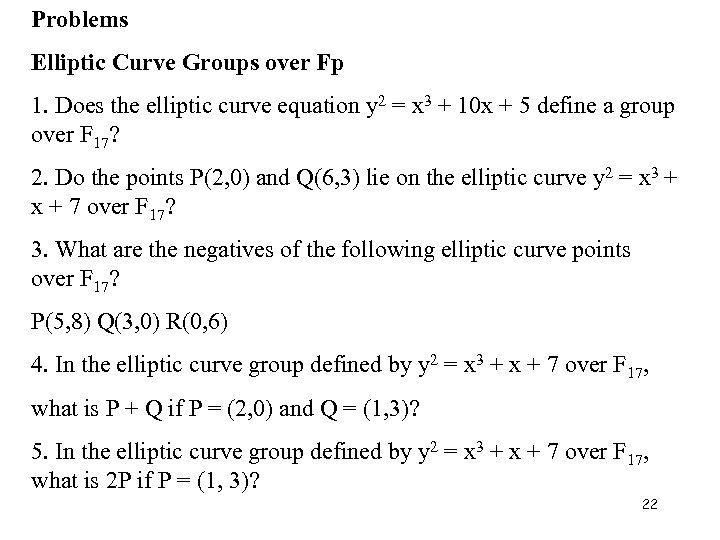 Problems Elliptic Curve Groups over Fp 1. Does the elliptic curve equation y 2 = x 3 + 10 x + 5 define a group over F 17? 2. Do the points P(2, 0) and Q(6, 3) lie on the elliptic curve y 2 = x 3 + x + 7 over F 17? 3. What are the negatives of the following elliptic curve points over F 17? P(5, 8) Q(3, 0) R(0, 6) 4. In the elliptic curve group defined by y 2 = x 3 + x + 7 over F 17, what is P + Q if P = (2, 0) and Q = (1, 3)? 5. In the elliptic curve group defined by y 2 = x 3 + x + 7 over F 17, what is 2 P if P = (1, 3)? 22
 23
23
 24
24
 25
25
 26
26
 27
27
 28
28
 29
29
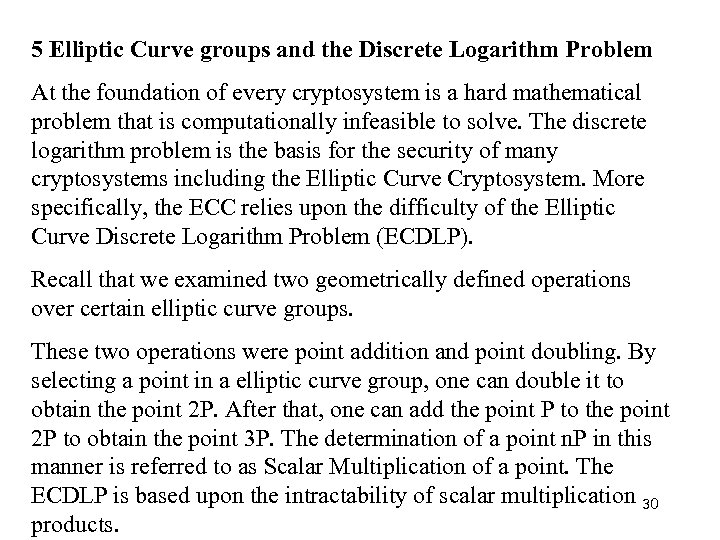 5 Elliptic Curve groups and the Discrete Logarithm Problem At the foundation of every cryptosystem is a hard mathematical problem that is computationally infeasible to solve. The discrete logarithm problem is the basis for the security of many cryptosystems including the Elliptic Curve Cryptosystem. More specifically, the ECC relies upon the difficulty of the Elliptic Curve Discrete Logarithm Problem (ECDLP). Recall that we examined two geometrically defined operations over certain elliptic curve groups. These two operations were point addition and point doubling. By selecting a point in a elliptic curve group, one can double it to obtain the point 2 P. After that, one can add the point P to the point 2 P to obtain the point 3 P. The determination of a point n. P in this manner is referred to as Scalar Multiplication of a point. The ECDLP is based upon the intractability of scalar multiplication 30 products.
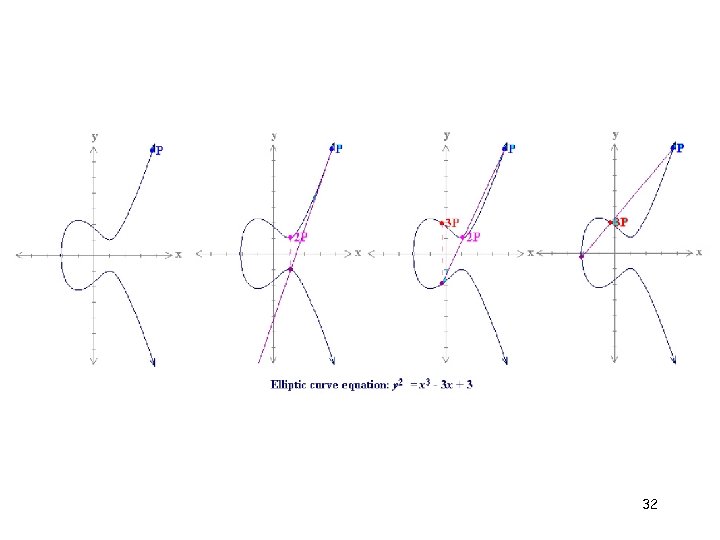
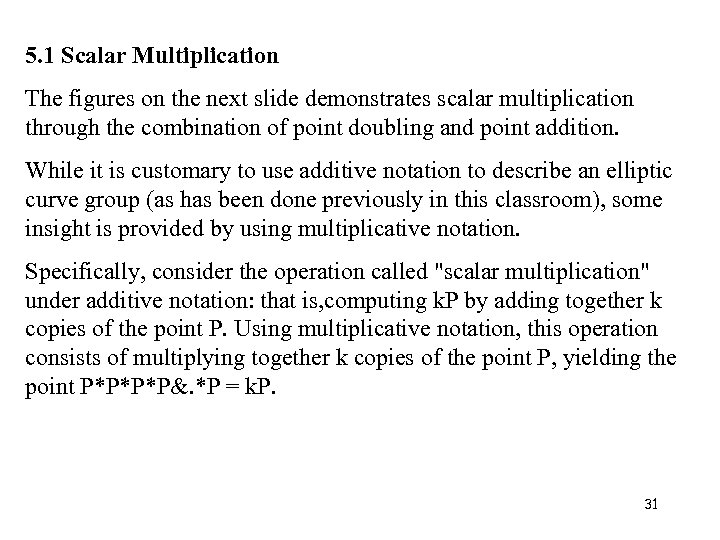 5. 1 Scalar Multiplication The figures on the next slide demonstrates scalar multiplication through the combination of point doubling and point addition. While it is customary to use additive notation to describe an elliptic curve group (as has been done previously in this classroom), some insight is provided by using multiplicative notation. Specifically, consider the operation called "scalar multiplication" under additive notation: that is, computing k. P by adding together k copies of the point P. Using multiplicative notation, this operation consists of multiplying together k copies of the point P, yielding the point P*P*P*P&. *P = k. P. 31
 32
32
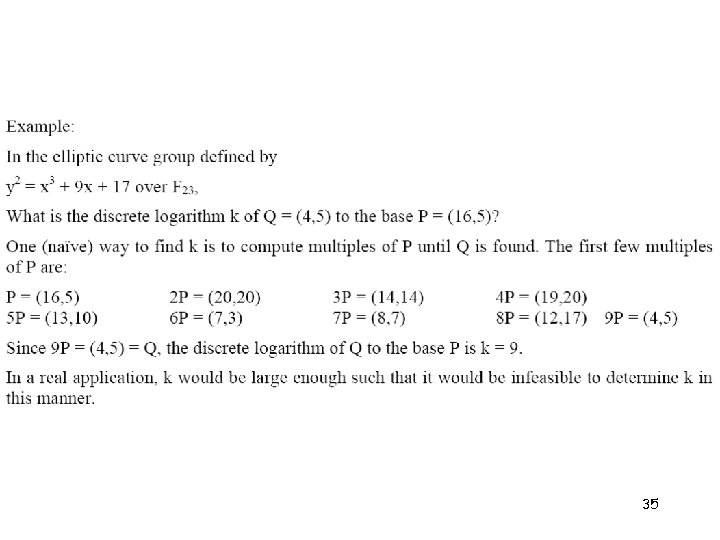
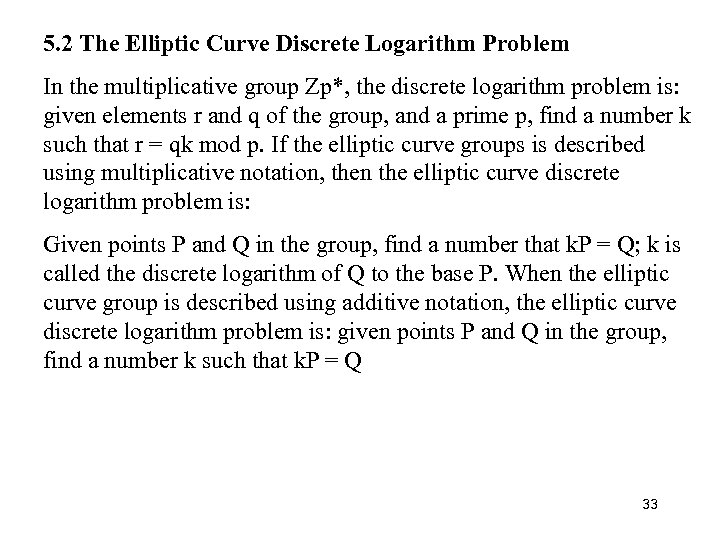 5. 2 The Elliptic Curve Discrete Logarithm Problem In the multiplicative group Zp*, the discrete logarithm problem is: given elements r and q of the group, and a prime p, find a number k such that r = qk mod p. If the elliptic curve groups is described using multiplicative notation, then the elliptic curve discrete logarithm problem is: Given points P and Q in the group, find a number that k. P = Q; k is called the discrete logarithm of Q to the base P. When the elliptic curve group is described using additive notation, the elliptic curve discrete logarithm problem is: given points P and Q in the group, find a number k such that k. P = Q 33
 35
35