


 Скачать презентацию Network Science and Engineering Call for a Research
8389e365494b7ac6df2bc93c2d95de02.ppt
- Количество слайдов: 37
 Network Science and Engineering: Call for a Research Agenda Jeannette M. Wing Assistant Director Computer and Information Science and Engineering Directorate National Science Foundation and President’s Professor of Computer Science Carnegie Mellon University Network Science and Engineering Stanford University, Palo Alto, CA May 21, 2008 Jeannette M. Wing
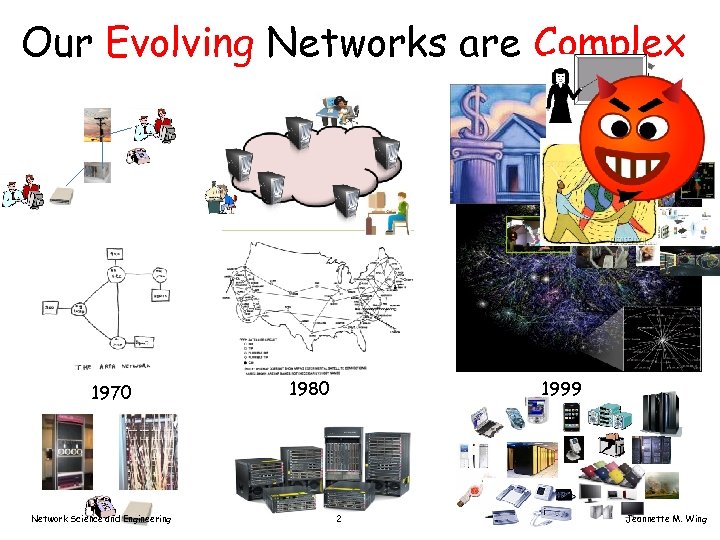 Our Evolving Networks are Complex 1970 Network Science and Engineering 1980 1999 2 Jeannette M. Wing
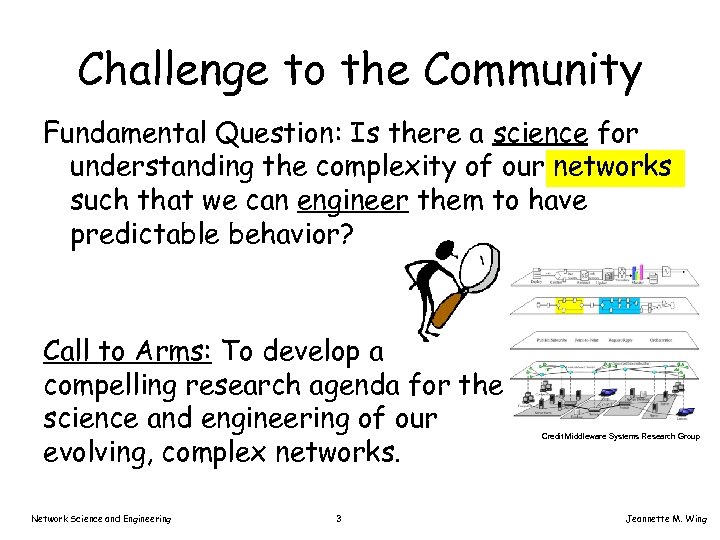 Challenge to the Community Fundamental Question: Is there a science for understanding the complexity of our networks such that we can engineer them to have predictable behavior? Call to Arms: To develop a compelling research agenda for the science and engineering of our evolving, complex networks. Network Science and Engineering 3 Credit Middleware Systems Research Group Jeannette M. Wing
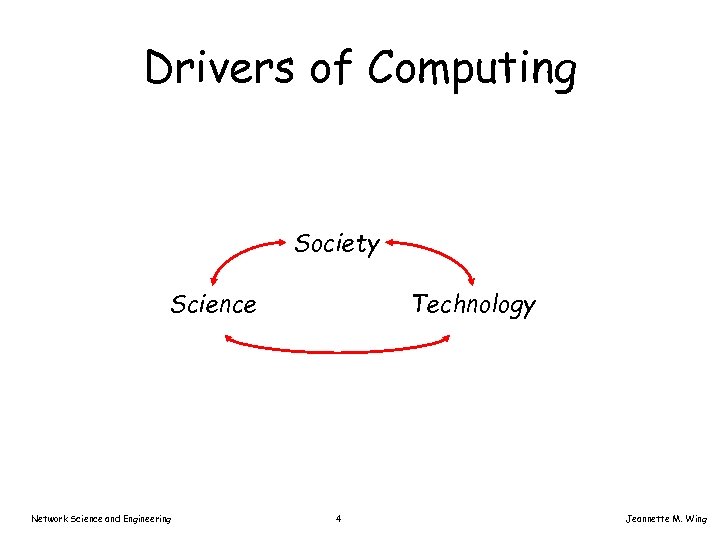 Drivers of Computing Society Science Network Science and Engineering Technology 4 Jeannette M. Wing
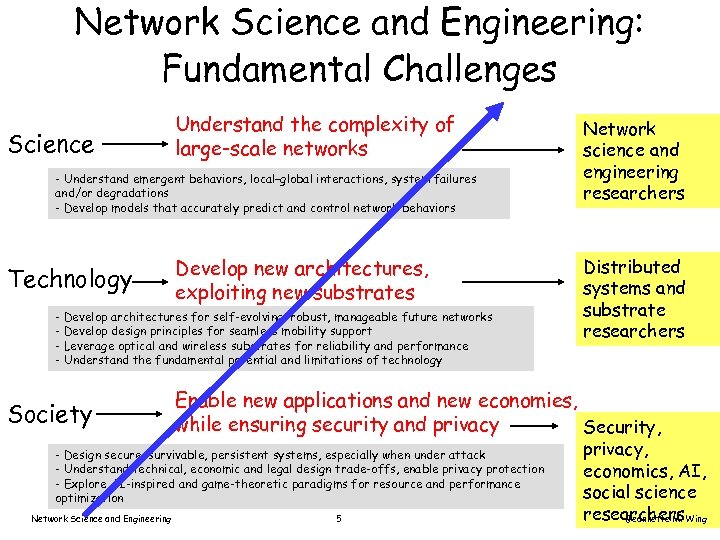 Network Science and Engineering: Fundamental Challenges Science Understand the complexity of large-scale networks - Understand emergent behaviors, local–global interactions, system failures and/or degradations - Develop models that accurately predict and control network behaviors Technology Develop new architectures, exploiting new substrates - Develop architectures for self-evolving, robust, manageable future networks - Develop design principles for seamless mobility support - Leverage optical and wireless substrates for reliability and performance - Understand the fundamental potential and limitations of technology Society Distributed systems and substrate researchers Enable new applications and new economies, while ensuring security and privacy Security, - Design secure, survivable, persistent systems, especially when under attack - Understand technical, economic and legal design trade-offs, enable privacy protection - Explore AI-inspired and game-theoretic paradigms for resource and performance optimization Network Science and Engineering Network science and engineering researchers 5 privacy, economics, AI, social science researchers. Wing Jeannette M.
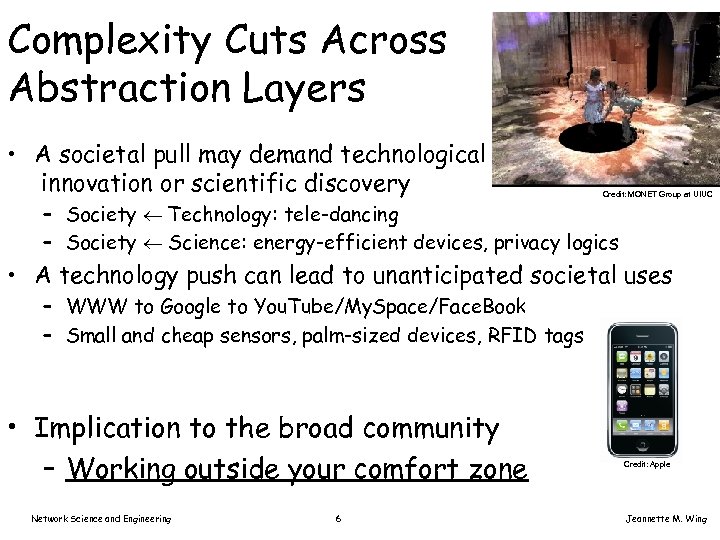 Complexity Cuts Across Abstraction Layers • A societal pull may demand technological innovation or scientific discovery Credit: MONET Group at UIUC – Society Technology: tele-dancing – Society Science: energy-efficient devices, privacy logics • A technology push can lead to unanticipated societal uses – WWW to Google to You. Tube/My. Space/Face. Book – Small and cheap sensors, palm-sized devices, RFID tags • Implication to the broad community – Working outside your comfort zone Network Science and Engineering 6 Credit: Apple Jeannette M. Wing
 A Fundamental Question Is there a science for understanding the complexity of our networks such that we can engineer them to have predictable behavior? Network Science and Engineering 7 Jeannette M. Wing
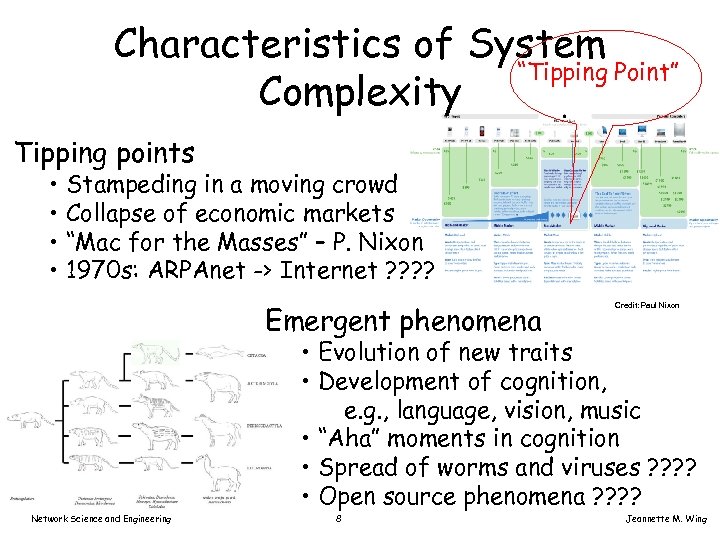 Characteristics of System “Tipping Point” Complexity Tipping points • Stampeding in a moving crowd • Collapse of economic markets • “Mac for the Masses” – P. Nixon • 1970 s: ARPAnet -> Internet ? ? Emergent phenomena Credit: Paul Nixon • Evolution of new traits • Development of cognition, e. g. , language, vision, music • “Aha” moments in cognition • Spread of worms and viruses ? ? • Open source phenomena ? ? Network Science and Engineering 8 Jeannette M. Wing
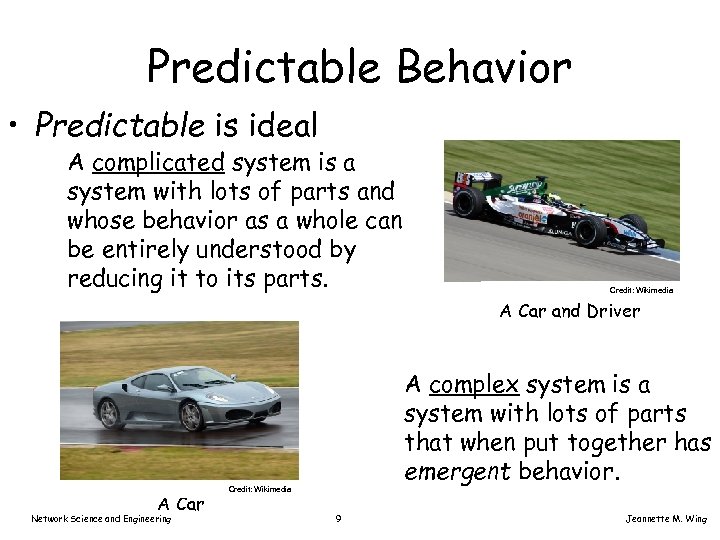 Predictable Behavior • Predictable is ideal A complicated system is a system with lots of parts and whose behavior as a whole can be entirely understood by reducing it to its parts. Credit: Wikimedia A Car and Driver A Car Network Science and Engineering A complex system is a system with lots of parts that when put together has emergent behavior. Credit: Wikimedia 9 Jeannette M. Wing
 Towards Predictable Behavior • Behavior – Performance • Usual: time and space, e. g. , bandwidth, latency, storage • New: power, … – Correctness • Usual: safety and liveness • New: resilience (to failure and attack), responsive – -ables • Adaptable, evolvable, measurable, … – Quantifiable and qualitative measures • Most importantly, our understanding of behavior must reflect the dynamic, evolving nature of our networks Network Science and Engineering 10 Jeannette M. Wing
 Sources of Network Complexity • Inherent – People: unpredictable at best, malicious at worst – Mother Nature: unpredictable, unforgiving, and disruptive • Scale, in terms of – numbers of, sizes of, types of elements (e. g. , users, nodes, connectors), and recursively, … of networks – distance and time, also at different scales • Design – – Mismatched interfaces, non-interoperability Unanticipated uses and users Violation of assumptions as environment or requirements change Lack of requirements Network Science and Engineering 11 Jeannette M. Wing
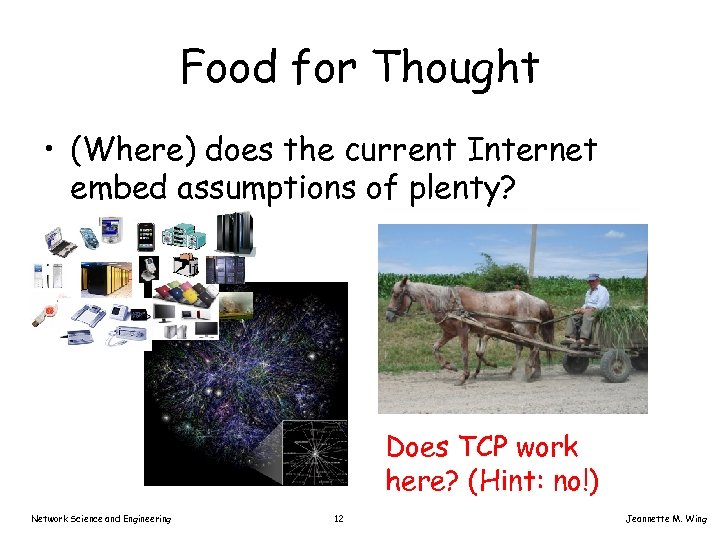 Food for Thought • (Where) does the current Internet embed assumptions of plenty? Does TCP work here? (Hint: no!) Network Science and Engineering 12 Jeannette M. Wing
 Network Models • Poisson, heavy-tail, self-similar, chaotic, fractal, butterfly effect, state machines, game theoretic, disease/viral, … – We know some are wrong or too crude – We are trying others – None consider all “usual” performance and/or correctness properties at once, let alone new ones – Composable models, e. g. , per property, would be nice • Maybe our networks are really different from anything anyone has ever seen (in nature) or built (by human) before – Implication: A BRAND NEW THEORY is needed! Network Science and Engineering 13 Jeannette M. Wing
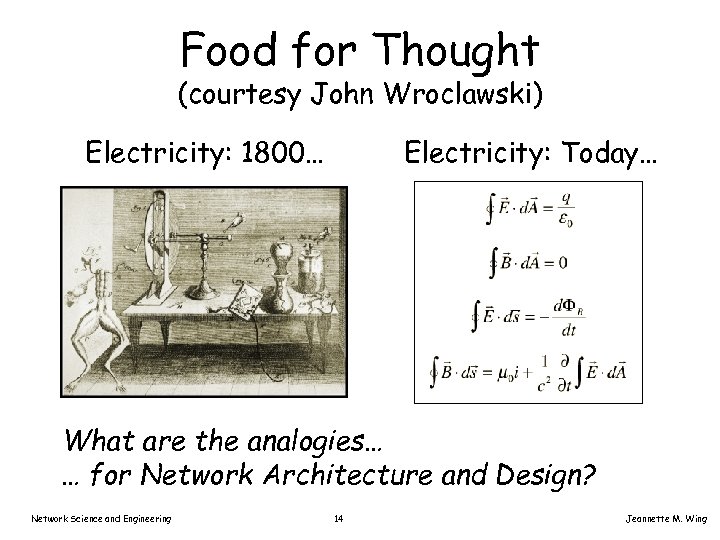 Food for Thought (courtesy John Wroclawski) Electricity: 1800… Electricity: Today… What are the analogies… … for Network Architecture and Design? Network Science and Engineering 14 Jeannette M. Wing
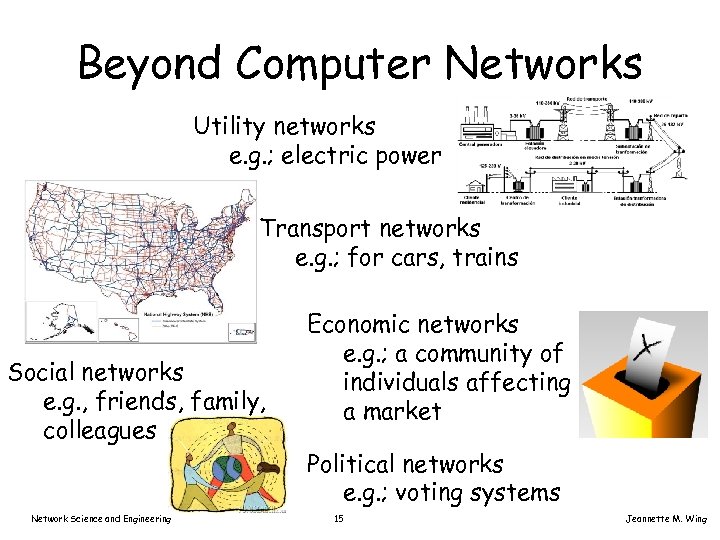 Beyond Computer Networks Utility networks e. g. ; electric power Transport networks e. g. ; for cars, trains Social networks e. g. , friends, family, colleagues Economic networks e. g. ; a community of individuals affecting a market Political networks e. g. ; voting systems Network Science and Engineering 15 Jeannette M. Wing
 Understanding Complexity • Is there a complexity theory for analyzing networks analogous to the complexity theory we have for analyzing algorithms? • If we consider The Internet as a computer, what can be computed by such a machine? – What is computable? [From J. M. Wing, “Five Deep Questions in Computing, ” CACM January 2008] • Let’s call such computer a Network Machine, then much as we have a Universal Turing Machine, what is the equivalent of a Universal Network Machine? – Challenge to us: Could we build one? Network Science and Engineering 16 Jeannette M. Wing
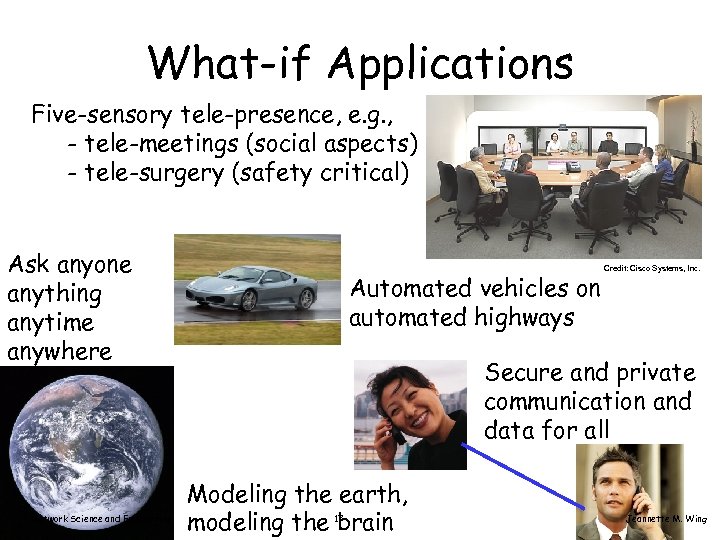 What-if Applications Five-sensory tele-presence, e. g. , - tele-meetings (social aspects) - tele-surgery (safety critical) Ask anyone anything anytime anywhere Network Science and Engineering Automated vehicles on automated highways Credit: Cisco Systems, Inc. Secure and private communication and data for all Modeling the earth, modeling the brain 17 Jeannette M. Wing
 From Agenda to Experiments to Infrastructure • Research agenda – Identifies fundamental questions to answer • aka the “science story” – Drives a set of experiments to conduct • to validate theories and models • Experiments – Drives what infrastructure and facilities are needed • Infrastructure could range from – Existing Internet, existing testbeds, federation of testbeds, something brand new (from small to large), federation of all of the above, to federation with international efforts Network Science and Engineering 18 Jeannette M. Wing
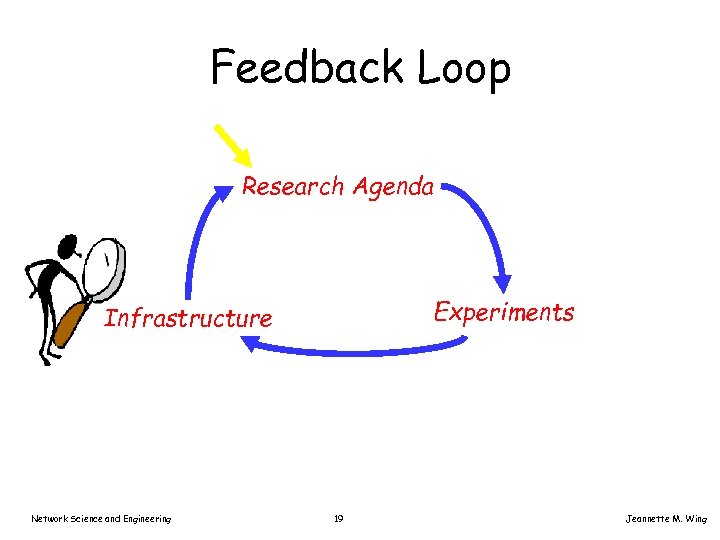 Feedback Loop Research Agenda Experiments Infrastructure Network Science and Engineering 19 Jeannette M. Wing
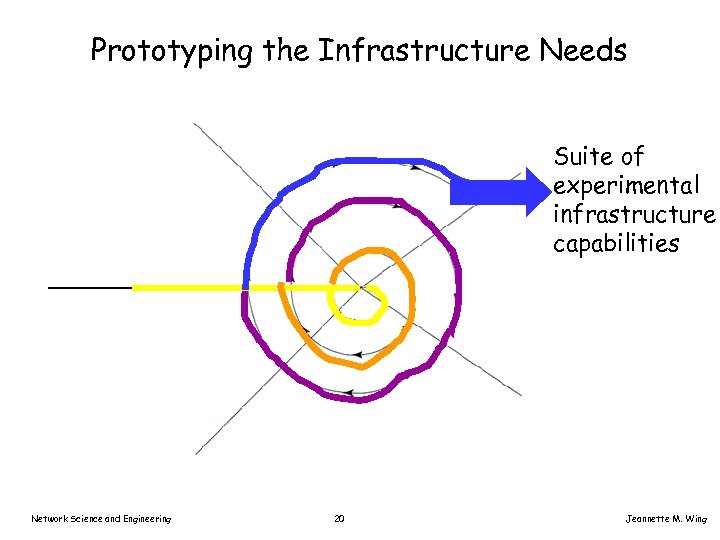 Prototyping the Infrastructure Needs Suite of experimental infrastructure capabilities Network Science and Engineering 20 Jeannette M. Wing
 Core Concepts • • Programmability Virtualization Slice-based experimentation Federation Network Science and Engineering 21 Jeannette M. Wing
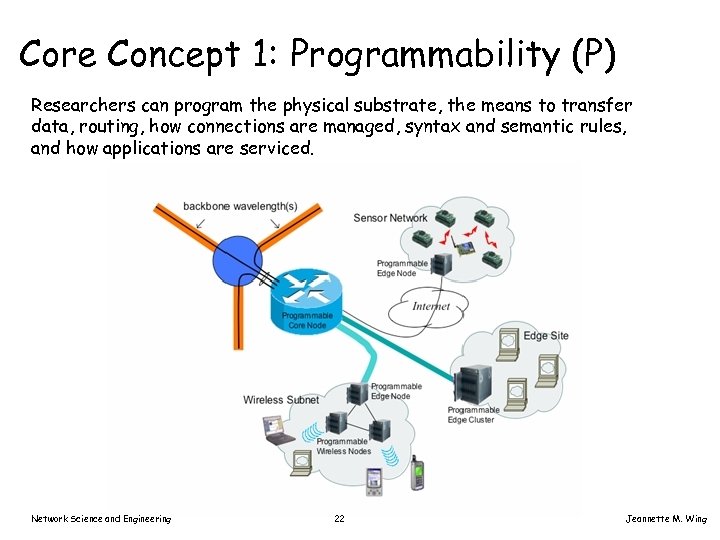 Core Concept 1: Programmability (P) Researchers can program the physical substrate, the means to transfer data, routing, how connections are managed, syntax and semantic rules, and how applications are serviced. Network Science and Engineering 22 Jeannette M. Wing
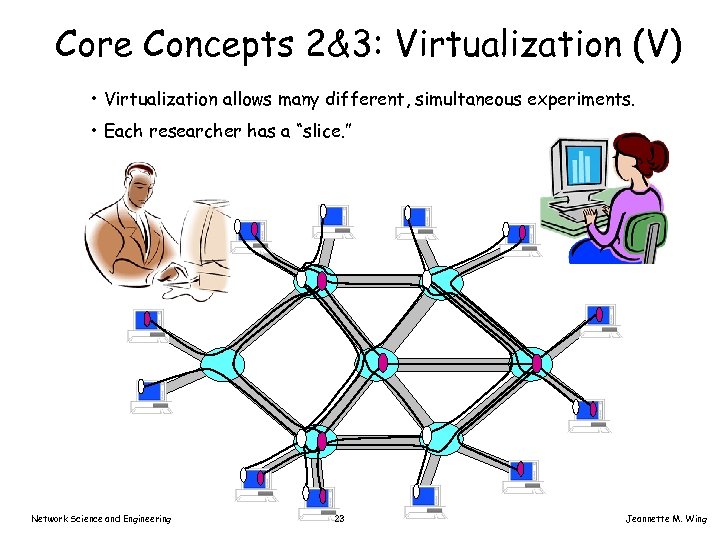 Core Concepts 2&3: Virtualization (V) • Virtualization allows many different, simultaneous experiments. • Each researcher has a “slice. ” Network Science and Engineering 23 Jeannette M. Wing
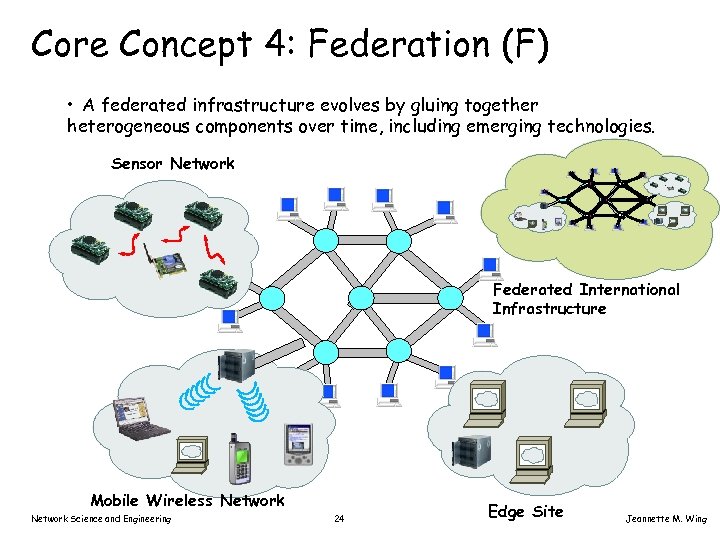 Core Concept 4: Federation (F) • A federated infrastructure evolves by gluing together heterogeneous components over time, including emerging technologies. Sensor Network Federated International Infrastructure Mobile Wireless Network Science and Engineering 24 Edge Site Jeannette M. Wing
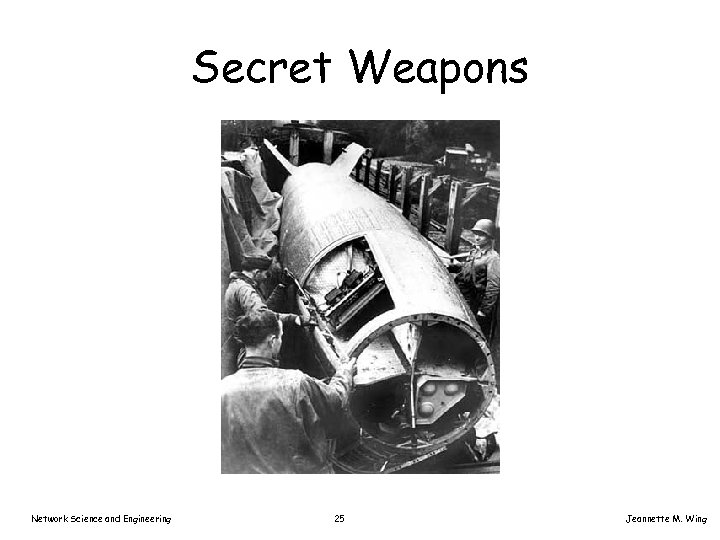 Secret Weapons Network Science and Engineering 25 Jeannette M. Wing
 Exploiting Computing’s Uniqueness • Software is our technical advantage – Plus: We can do anything in software – Minus: We can do anything in software • Unlike other sciences, prototyping is our process advantage – Feasibility – sanity check – Possibility – spark imagination • Implications of our uniqueness – Power of software implies the nature of our infrastructure is different – Power of prototyping implies the nature of our infrastructure building process is different • We are breaking new ground at the NSF! Network Science and Engineering 26 Jeannette M. Wing
 People • Net. SE Council: Ellen Zegura, chair • GENI Project Office: Chip Elliott and BBN • CCC: Ed Lazowska, Sue Graham, … • NSF team Network Science and Engineering 27 Jeannette M. Wing
 Synthesizing Discussion: Net. SE Council Mission (work in progress): The primary mission of the Network Science and Engineering (Net. SE) Council is to articulate a compelling research agenda for Network Science and Engineering, including inter-related theoretical, experimental and societal aspects. • • • • • Ellen Zegura, chair Tom Anderson, Washington Hari Balakrishnan, MIT Joe Berthold, Ciena Charlie Catlett, Argonne Mike Dahlin, UT Austin Chip Elliot – GPO (ex-officio) Joan Feigenbaum, Yale Stephanie Forrest, UNM Roscoe Giles, Boston Univ Network Science and Engineering 28 Jim Hendler, RPI Michael Kearns, UPenn Ed Lazowska, Washington Peter Lee, CMU Helen Nissenbaum, NYU Larry Peterson, Princeton Jennifer Rexford, Princeton Stefan Savage, UCSD Scott Shenker, ICSI/Berkeley Al Spector, Google Jeannette M. Wing
 Existing Input • Clark et al. planning document for Global Environment for Network Innovations • Shenker et al. “I Dream of GENI” document • Kearns and Forrest ISAT study • Feigenbaum, Mitzenmacher, and others on Theory of Networked Computation • Hendler and others in Web Science • Ruzena Bajcsy, Fran Berman, and others on CS-plus. Social Sciences • NSF/OECD Workshop “Social and Economic Factors Shaping the Future of the Internet” • Current NSF “networking” programs – FIND, SING, NGNI Network Science and Engineering 29 Jeannette M. Wing
 3 Focused Workshops • Summer and Fall • Focused at the “edges” 1. Science of Network Design – Co-chairs: John Doyle, Cal. Tech; John Wroclawski, ISI 2. Network Economics – Co-chairs: Mike Kearns, UPenn; Colin Camerer, Cal. Tech 3. Network Design and Societal Values – Co-chairs: Helen Nissenbaum, NYU; David Clark, MIT Network Science and Engineering 30 Jeannette M. Wing
 CCC Charge to Net. SE Council 1. Develop a compelling research agenda 2. Identify a set of experiments to carry out the agenda, e. g. , to test out new theories/models of network complexity 3. Identify suite of experimental infrastructure needed to carry out the experiments 4. Work with the GENI Project Office in prototyping activity for experimental infrastructure. Network Science and Engineering 31 Jeannette M. Wing
 GPO Activities • GENI Project Office: Chip Elliot and team at BBN – Hard work in short period of time • Organizing and challenging the community to push the frontiers of experimental infrastructure • Engineering Conferences, Infrastructure Prototyping Competition (underway) • Working with industry and international partners • Establishment of working groups • Working Groups: Architects and designers of the experimental infrastructure • Community participation in working groups is welcome and encouraged! Network Science and Engineering 32 Jeannette M. Wing
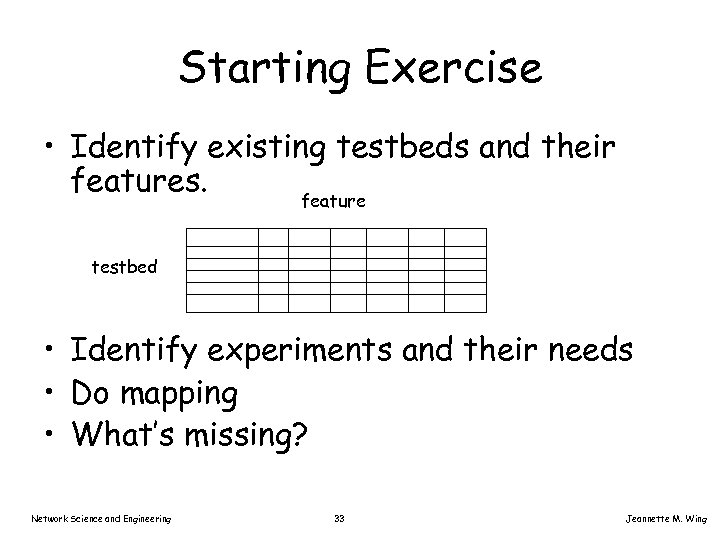 Starting Exercise • Identify existing testbeds and their features. feature testbed • Identify experiments and their needs • Do mapping • What’s missing? Network Science and Engineering 33 Jeannette M. Wing
 Breaking New Ground Together • Unexplored territory in network science and engineering – Broad scope for research agenda – New relationships among theoreticians, experimentalists, and systems and applications builders – New relationships with social science, law, economics, medicine, etc. • Big Science is new for Computer Science – Science at scale, experimental settings at scale, real users at scale, user opt-in at scale – Scientists, engineers, technicians, managers, and funding agencies must work together Network Science and Engineering 34 Jeannette M. Wing
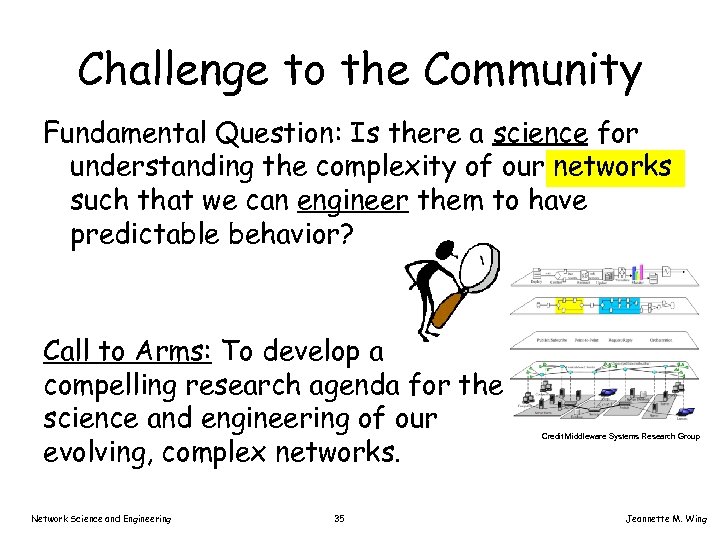 Challenge to the Community Fundamental Question: Is there a science for understanding the complexity of our networks such that we can engineer them to have predictable behavior? Call to Arms: To develop a compelling research agenda for the science and engineering of our evolving, complex networks. Network Science and Engineering 35 Credit Middleware Systems Research Group Jeannette M. Wing
 Thank you! Network Science and Engineering Jeannette M. Wing
 Credits • Copyrighted material used under Fair Use. If you are the copyright holder and believe your material has been used unfairly, or if you have any suggestions, feedback, or support, please contact: jsoleil@nsf. gov • Except where otherwise indicated, permission is granted to copy, distribute, and/or modify all images in this document under the terms of the GNU Free Documentation license, Version 1. 2 or any later version published by the Free Software Foundation; with no Invariant Sections, no Front-Cover Texts, and no Back-Cover Texts. A copy of the license is included in the section entitled “GNU Free Documentation license” (http: //commons. wikimedia. org/wiki/Commons: GNU_Free_Documentation_License) Network Science and Engineering 37 Jeannette M. Wing