


 Скачать презентацию Network Protocol Software Design and Implementation An Industrial
5f7eec237d93749ba20b45c5905d62c1.ppt
- Количество слайдов: 34
 Network Protocol Software: Design and Implementation An Industrial Perspective Edward Qian 12/02/2002
 Overview: Network Protocols MPLS with RSVP-TE Practical Considerations on Protocol Software Implementation The requirements for protocol software The design for protocol software The implementation for protocol software The verification for protocol software Edward Qian 12/02/2002 Discussions 2
 Overview Ø Network Protocols: the communication language that network devices talk to each other at a specific layer q One example: Even since the Internet was developed, two camps of religious debates over “datagram” vs. “virtual circuit” § Connectionless IP carries a transmission connection (TCP) § Connected-oriented ATM or MPLS needs its connectionless routing to guide the way in setting up a connection. § Industry actually accepted both. q Edward Qian 12/02/2002 No matter which way network devices communicate, they communicate with protocols. Ø We take MPLS technology and its protocols as the example for this lecture 3
 Overview Ø Typically a router would be equipped with most of these protocol stacks in it. RSVPTE Edward Qian 12/02/2002 4
 Overview Ø Almost all network protocols are implemented as software (stacks) Ø Software design and implementation of network protocols play a crucial roles in developing network systems/devices § The early buggy implementation of OSI protocol stacks burned its users, so it stuck even though it’s got later improvement § Relatively compare with the TCP/IP as part of free Berkeley UNIX, it gained user acceptance quickly, got better improvement, then wider user acceptance Edward Qian 12/02/2002 5
 Overview: Network Protocols F MPLS with RSVP-TE Practical Considerations on Protocol Software Implementation The requirements for protocol software The design for protocol software The implementation for protocol software The verification for protocol software Edward Qian 12/02/2002 Discussions 6
 MPLS with RSVP-TE Ø What is MPLS? § Multi-protocol Label Switching – a network technology defined within IETF body § IP-based routing but connect-oriented label-based switching of packet. § MPLS borrows concepts from other networking protocols such as ATM and IP – which makes it well suited for a lot of today’s networks need. Ø Why uses MPLS? Edward Qian 12/02/2002 § ATM to IP core network evolution (one common MPLS core for multi-service accesses) § Next-Gen Convergence Network (voice, video and data) § Stringent SLA delivery in an IP network (Qo. S offering with Diff. Serv) Control of: end-to-end delay, jitter, packet loss, packet order, etc. § Traffic engineering with path protection and fast re-route to 7
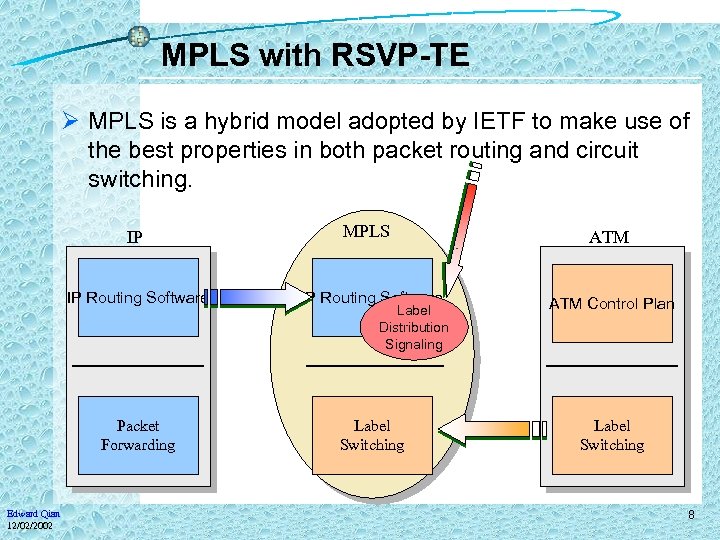 MPLS with RSVP-TE Ø MPLS is a hybrid model adopted by IETF to make use of the best properties in both packet routing and circuit switching. IP MPLS ATM IP Routing Software ATM Control Plan Packet Forwarding Edward Qian 12/02/2002 IP Routing Software Label Switching Label Distribution Signaling 8
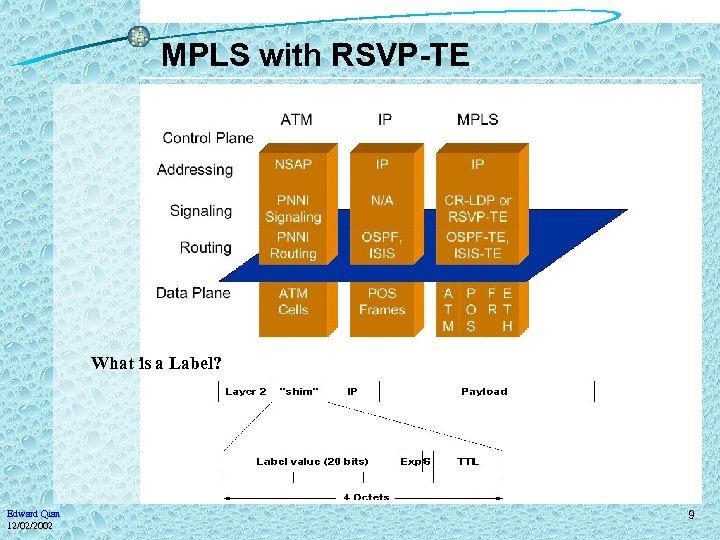 MPLS with RSVP-TE What is a Label? Edward Qian 12/02/2002 9
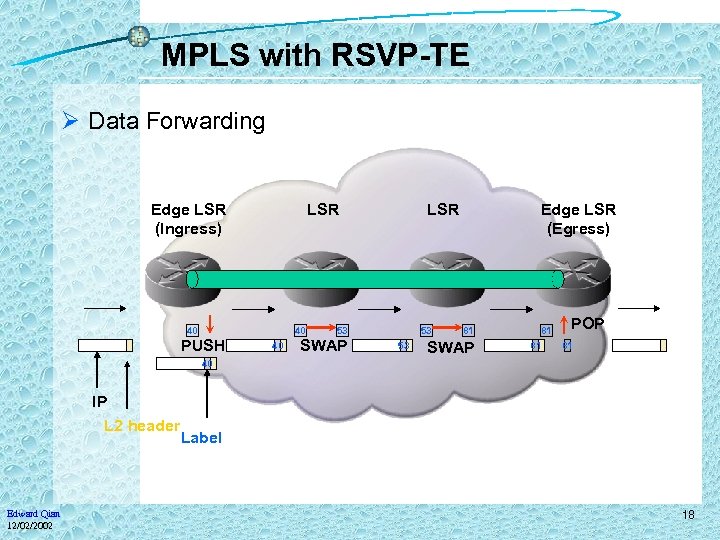
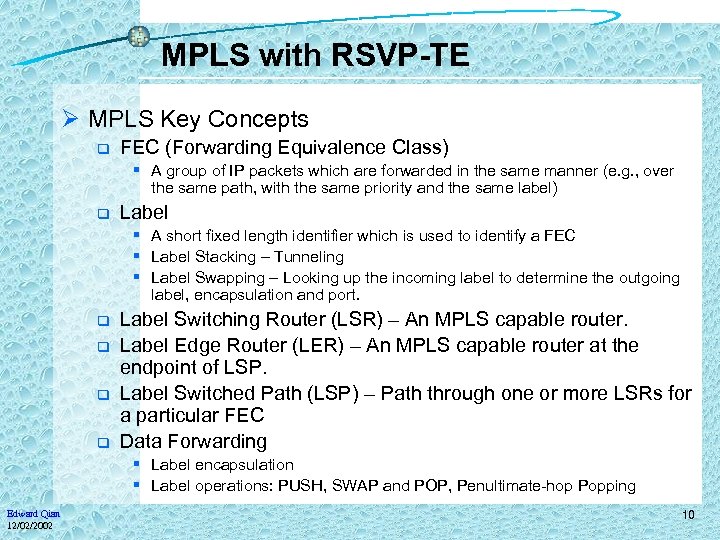 MPLS with RSVP-TE Ø MPLS Key Concepts q FEC (Forwarding Equivalence Class) § A group of IP packets which are forwarded in the same manner (e. g. , over the same path, with the same priority and the same label) q Label § A short fixed length identifier which is used to identify a FEC § Label Stacking – Tunneling § Label Swapping – Looking up the incoming label to determine the outgoing label, encapsulation and port. q q Label Switching Router (LSR) – An MPLS capable router. Label Edge Router (LER) – An MPLS capable router at the endpoint of LSP. Label Switched Path (LSP) – Path through one or more LSRs for a particular FEC Data Forwarding § Label encapsulation § Label operations: PUSH, SWAP and POP, Penultimate-hop Popping Edward Qian 12/02/2002 10
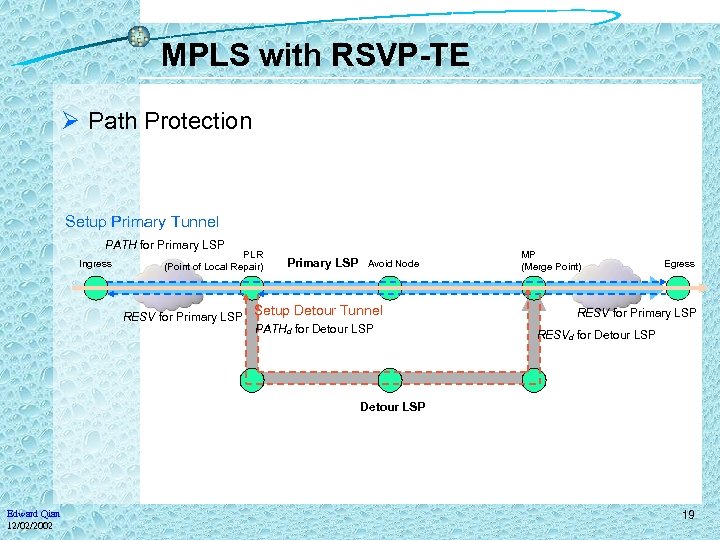
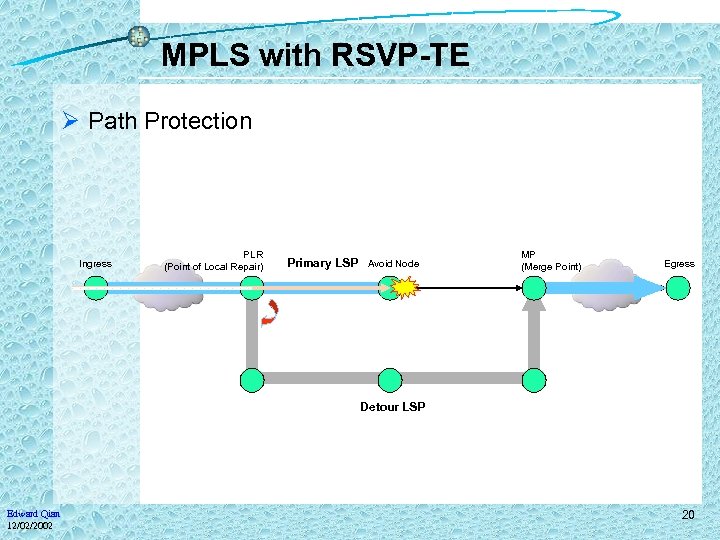
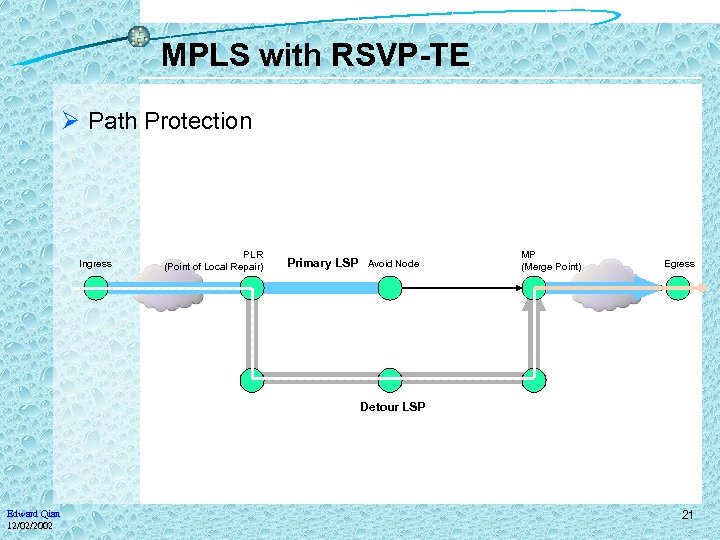
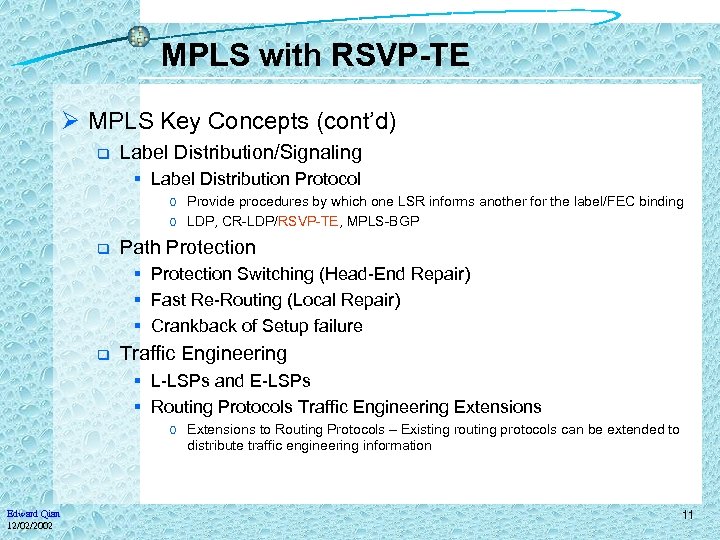 MPLS with RSVP-TE Ø MPLS Key Concepts (cont’d) q Label Distribution/Signaling § Label Distribution Protocol o Provide procedures by which one LSR informs another for the label/FEC binding o LDP, CR-LDP/RSVP-TE, MPLS-BGP q Path Protection § Protection Switching (Head-End Repair) § Fast Re-Routing (Local Repair) § Crankback of Setup failure q Traffic Engineering § L-LSPs and E-LSPs § Routing Protocols Traffic Engineering Extensions o Extensions to Routing Protocols – Existing routing protocols can be extended to distribute traffic engineering information Edward Qian 12/02/2002 11
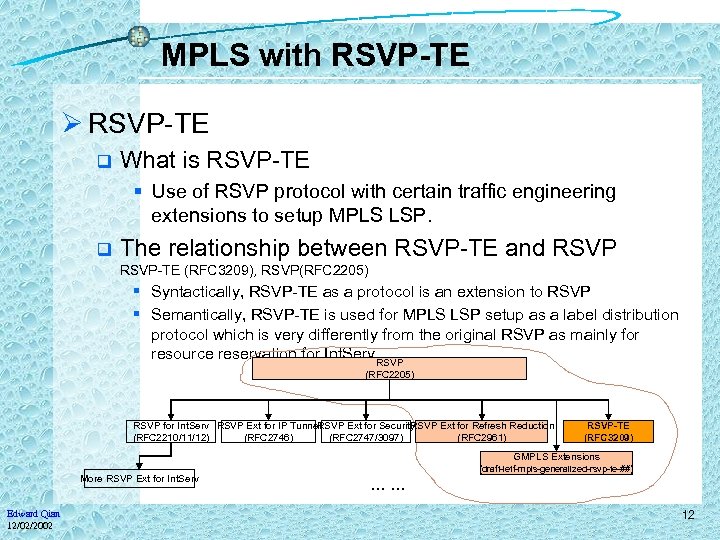 MPLS with RSVP-TE Ø RSVP-TE q What is RSVP-TE § Use of RSVP protocol with certain traffic engineering extensions to setup MPLS LSP. q The relationship between RSVP-TE and RSVP-TE (RFC 3209), RSVP(RFC 2205) § Syntactically, RSVP-TE as a protocol is an extension to RSVP § Semantically, RSVP-TE is used for MPLS LSP setup as a label distribution protocol which is very differently from the original RSVP as mainly for resource reservation for Int. Serv. RSVP (RFC 2205) RSVP for Int. Serv RSVP Ext for IP Tunnel RSVP Ext for Security RSVP Ext for Refresh Reduction (RFC 2210/11/12) (RFC 2746) (RFC 2747/3097) (RFC 2961) More RSVP Ext for Int. Serv Edward Qian 12/02/2002 RSVP-TE (RFC 3209) GMPLS Extensions (draft-ietf-mpls-generalized-rsvp-te-##) …… 12
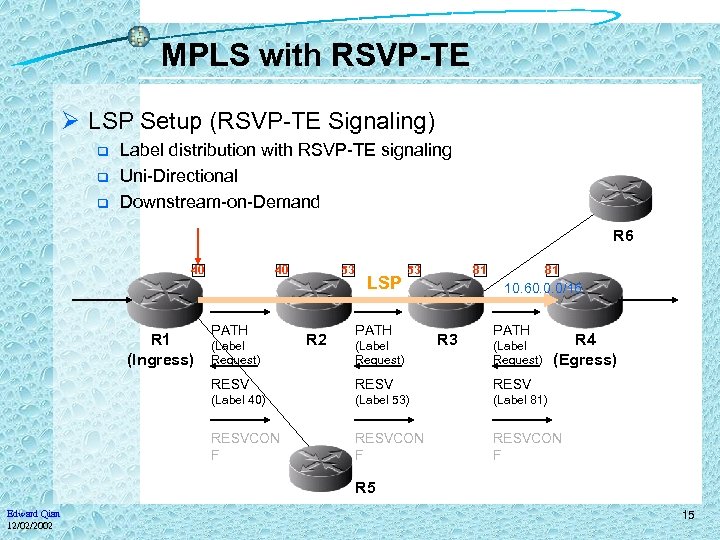
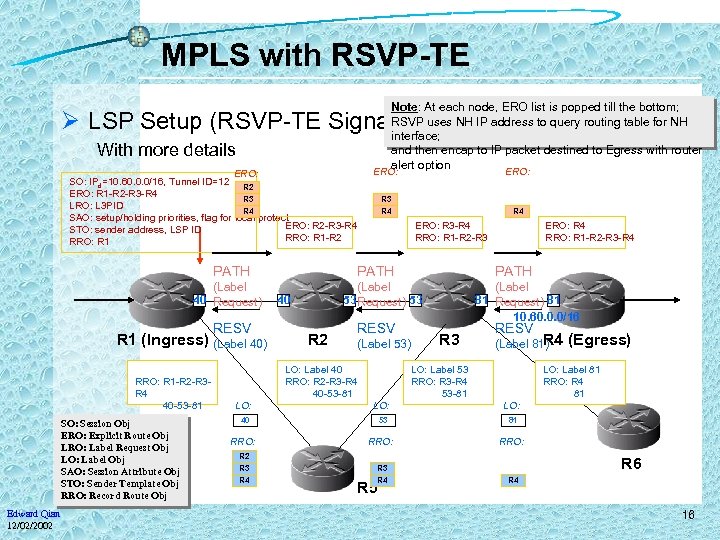
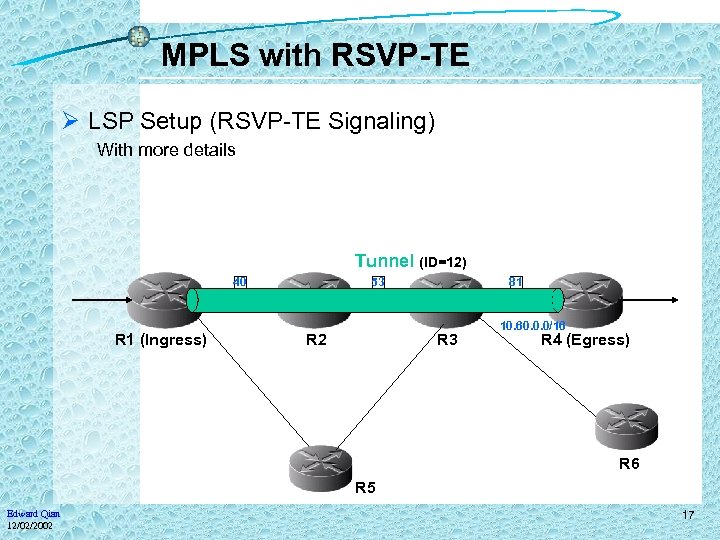
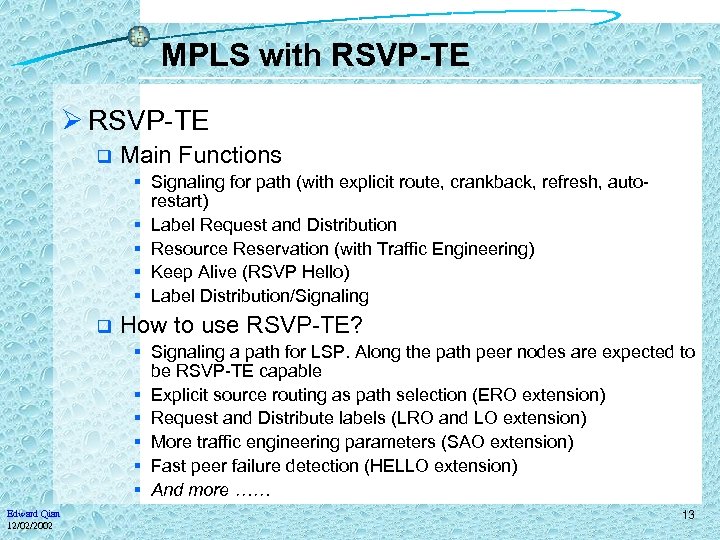 MPLS with RSVP-TE Ø RSVP-TE q Main Functions § Signaling for path (with explicit route, crankback, refresh, autorestart) § Label Request and Distribution § Resource Reservation (with Traffic Engineering) § Keep Alive (RSVP Hello) § Label Distribution/Signaling q How to use RSVP-TE? § Signaling a path for LSP. Along the path peer nodes are expected to be RSVP-TE capable § Explicit source routing as path selection (ERO extension) § Request and Distribute labels (LRO and LO extension) § More traffic engineering parameters (SAO extension) § Fast peer failure detection (HELLO extension) § And more …… Edward Qian 12/02/2002 13
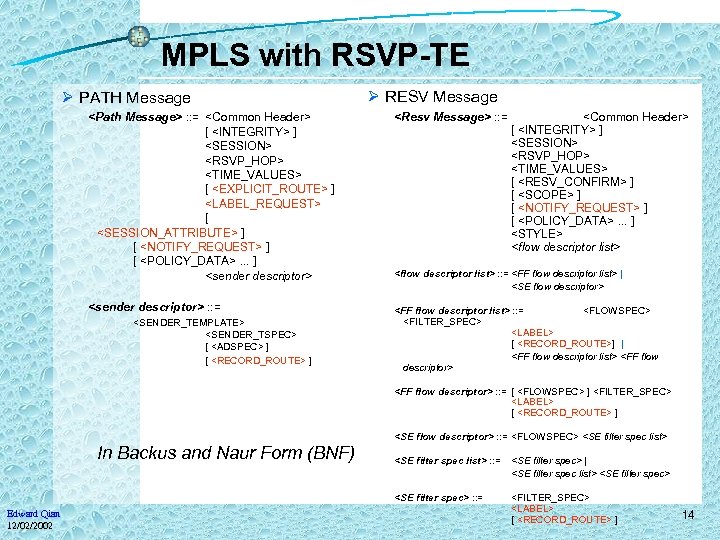 MPLS with RSVP-TE Ø PATH Message Ø RESV Message