


 Скачать презентацию Network Monitoring Sukiswo sukiswok yahoo com Manajemen Jaringan Sukiswo
c00b097c1e9147a5d189f0f92ceff6ec.ppt
- Количество слайдов: 29
 Network Monitoring Sukiswo sukiswok@yahoo. com Manajemen Jaringan, Sukiswo ST, MT 1
 Table of Contents 4 Introduction 4 Monitored Types of Information 4 Network Monitoring Configurations 4 Network Monitoring Methods 4 Performance Monitoring – Performance Indicators – Performance Monitoring Functions 4 Fault Monitoring – Problems of Fault Monitoring – Fault Monitoring Functions 4 Accounting Monitoring Manajemen Jaringan, Sukiswo ST, MT 2
 Introduction 4 Network monitoring is concerned with observing and analyzing the status and behavior of the end systems, intermediate systems, and subnetworks that make up the network to be managed Manajemen Jaringan, Sukiswo ST, MT 3
 Introduction 4 Issues in network monitoring – what to monitor? • define what is to be monitored – how to monitor? • how to obtain information from managed resources – what to do with the monitored information? • how the monitored information is used in various management functional areas Manajemen Jaringan, Sukiswo ST, MT 4
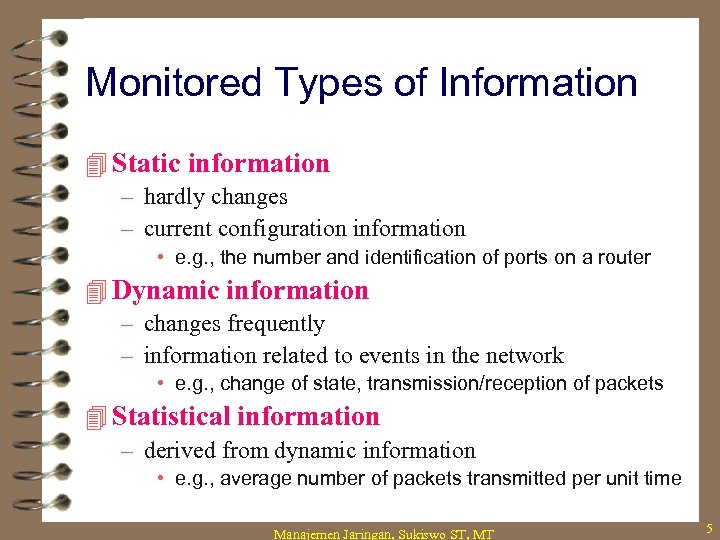 Monitored Types of Information 4 Static information – hardly changes – current configuration information • e. g. , the number and identification of ports on a router 4 Dynamic information – changes frequently – information related to events in the network • e. g. , change of state, transmission/reception of packets 4 Statistical information – derived from dynamic information • e. g. , average number of packets transmitted per unit time Manajemen Jaringan, Sukiswo ST, MT 5
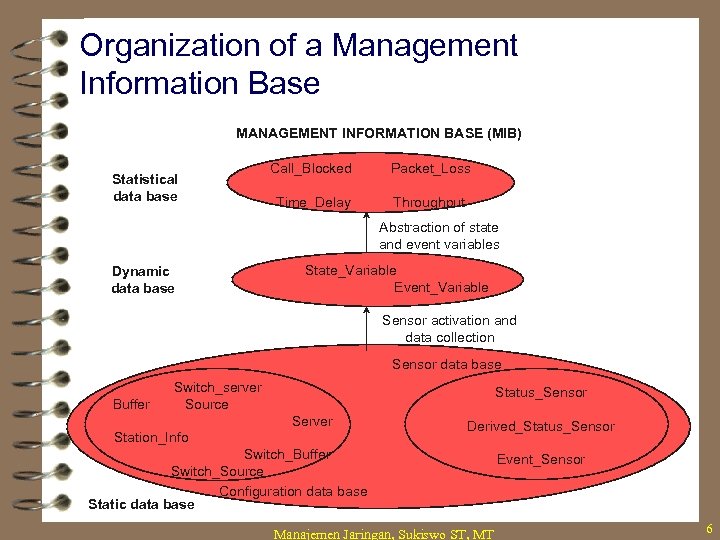 Organization of a Management Information Base MANAGEMENT INFORMATION BASE (MIB) Statistical data base Call_Blocked Packet_Loss Time_Delay Throughput Abstraction of state and event variables Dynamic data base State_Variable Event_Variable Sensor activation and data collection Sensor data base Buffer Switch_server Source Status_Sensor Server Station_Info Derived_Status_Sensor Switch_Buffer Switch_Source Configuration data base Static data base Manajemen Jaringan, Sukiswo ST, MT Event_Sensor 6
 Monitoring System Components 4 monitoring application – includes the functions of monitoring that are visible to the user • e. g. , performance, fault, accounting 4 manager function – performs the basic monitoring function of retrieving information Manajemen Jaringan, Sukiswo ST, MT 7
 Monitoring System Components 4 agent function – gathers and records management information for one or more network elements and delivers the information to the monitor 4 managed objects – mgmt information that represents resources and their activities 4 monitoring agent – generates summaries and statistical analysis of mgmt information Manajemen Jaringan, Sukiswo ST, MT 8
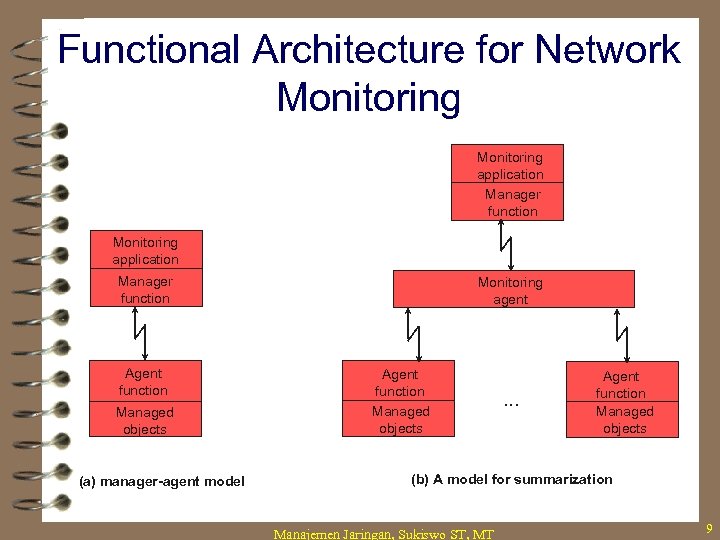 Functional Architecture for Network Monitoring application Manager function Agent function Managed objects (a) manager-agent model Monitoring agent Agent function Managed objects . . . Agent function Managed objects (b) A model for summarization Manajemen Jaringan, Sukiswo ST, MT 9
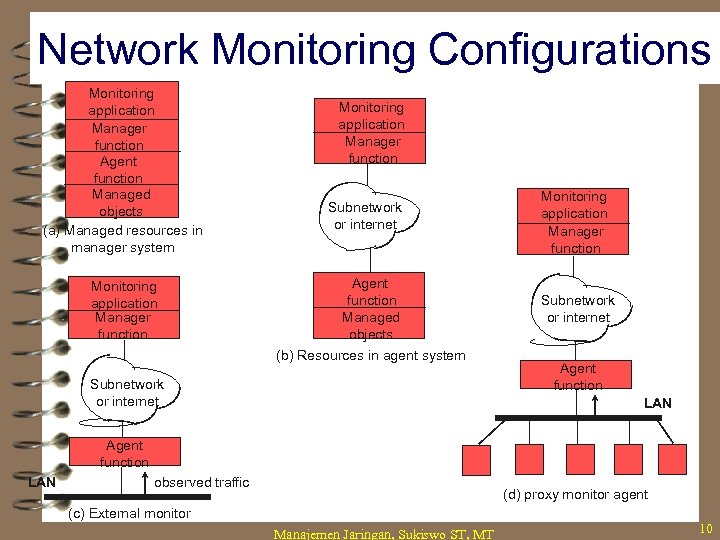 Network Monitoring Configurations Monitoring application Manager function Agent function Managed objects (a) Managed resources in manager system Monitoring application Manager function Subnetwork or internet Agent function Managed objects (b) Resources in agent system Subnetwork or internet Monitoring application Manager function Subnetwork or internet Agent function LAN observed traffic (d) proxy monitor agent (c) External monitor Manajemen Jaringan, Sukiswo ST, MT 10
 Network Monitoring Methods 4 Polling – a request-response interaction between a manager and agent – a manager sends request to an agent which processes the request and responds with information from its MIB – a manager may use polling to • learn about the configuration it is managing • obtain periodically an update of conditions • investigate an area in detail after being altered to a problem Manajemen Jaringan, Sukiswo ST, MT 11
 Network Monitoring Methods 4 Event Reporting – information flow is initiated from the agent to manager – an agent may generate report periodically to give the manager its current status or whenever a significant event (e. g. , change of a state) or an unusual event (e. g. , fault) occurs – good for detecting problems as soon as they occur Manajemen Jaringan, Sukiswo ST, MT 12
 Performance Monitoring 4 Measuring the performance of the network (or performance monitoring) is absolutely required in NM – to detect & fix problems that cause performance degradation – to better plan network upgrades Manajemen Jaringan, Sukiswo ST, MT 13
 Performance Monitoring 4 Problems in selecting and using appropriate indicators (or metrics) – too many indicators in use – the meaning of most indicators are not yet clearly understood – some indicators are supported by some manufacturers only – frequently, the indicators are accurately measured but incorrectly interpreted by human or mgmt application – the calculation of indicators takes too much time Manajemen Jaringan, Sukiswo ST, MT 14
 Network Performance Indicators 4 Service-oriented – Availability: the percentage of time that a network system, a component, or an application is available for a user – Response Time: how long it takes for a response to appear at a user’s terminal after a user action calls for it – Accuracy: the percentage of time that no errors in the transmission and delivery of information Manajemen Jaringan, Sukiswo ST, MT 15
 Network Performance Indicators 4 Efficiency-oriented – Throughput: the rate at which applicationoriented events (e. g. , file transfers) occur – Utilization: the percentage of theoretical capacity of a resource (e. g. , transmission line, switch, CPU) that is being used Manajemen Jaringan, Sukiswo ST, MT 16
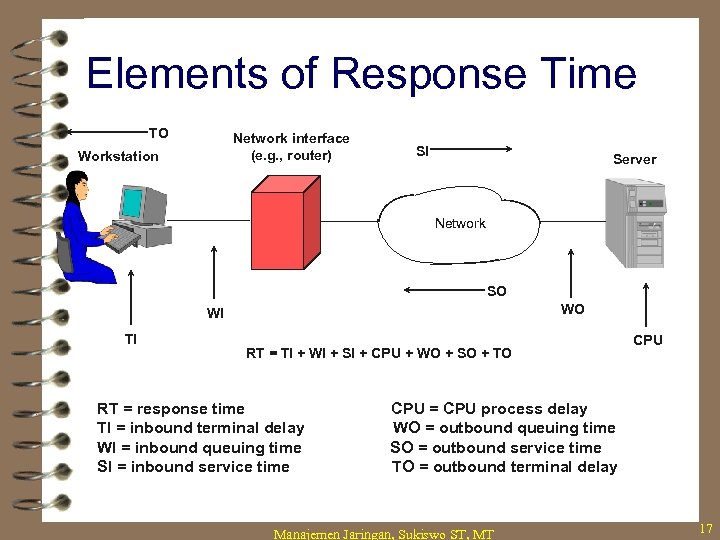 Elements of Response Time TO Network interface (e. g. , router) Workstation SI Server Network SO WO WI TI RT = TI + WI + SI + CPU + WO + SO + TO RT = response time TI = inbound terminal delay WI = inbound queuing time SI = inbound service time CPU = CPU process delay WO = outbound queuing time SO = outbound service time TO = outbound terminal delay Manajemen Jaringan, Sukiswo ST, MT 17
 Performance Monitoring Functions 4 Performance Measurement – the actual gathering of statistics about network traffic & timing – typically performed by agents within network devices – e. g. , amount of data in and out of a node, number of connections, traffic per connection Manajemen Jaringan, Sukiswo ST, MT 18
 Performance Monitoring Functions 4 Performance Analysis – analyzing the gathered data and presenting it – e. g. , total, average, min, max, histogram 4 Synthetic Traffic Generation – generating artificial traffic load – permits the network to be observed under a controlled load Manajemen Jaringan, Sukiswo ST, MT 19
 Typical Performance-Related Questions 4 Performance measurements can be used to answer a number of questions – Why is the response so slow? (a very loaded question!) – Why is the retransmission rate so high? – Is traffic evenly distributed among network users or are there source-destination pairs with unusually heavy traffic? – What is the percentage of each type of packet? Manajemen Jaringan, Sukiswo ST, MT 20
 Typical Performance-Related Questions – What is the channel utilization and throughput? – What is the effect of traffic load on utilization, throughput & time delays? – When does traffic load start to degrade system performance? – What is the maximum capacity of the channel under normal operating conditions? How many active users are necessary to reach this maximum? Manajemen Jaringan, Sukiswo ST, MT 21
 Fault Monitoring 4 To detect faults as quickly as possible after they occur and to identify the cause of the fault so that correctional action may be taken 4 Problems of Fault Monitoring – Fault Detection Problems • Unobservable faults: e. g. , deadlock, device not monitorable • Partially observable faults: insufficient to pinpoint the problem • Uncertainty in observation: not clear what the problem is Manajemen Jaringan, Sukiswo ST, MT 22
 Fault Monitoring – Fault Isolation Problems • Multiple potential causes • Too many related observations • Interference between diagnosis and local recovery procedures • Absence of automated testing tools Manajemen Jaringan, Sukiswo ST, MT 23
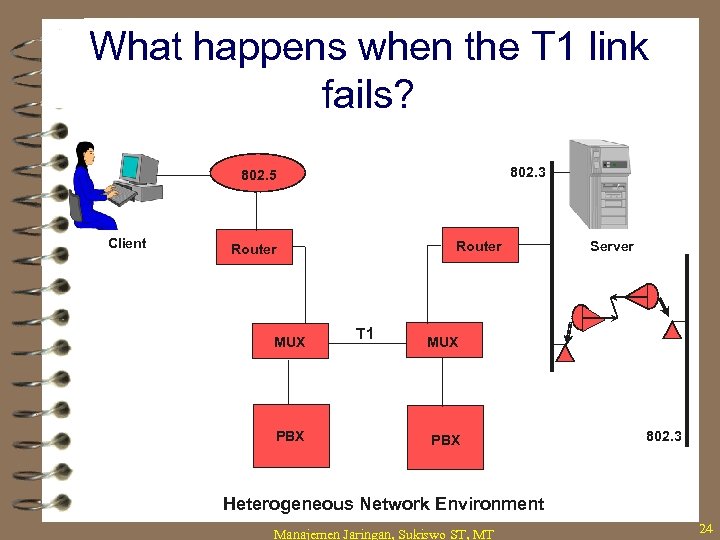 What happens when the T 1 link fails? 802. 3 802. 5 Client Router MUX PBX T 1 Server MUX PBX 802. 3 Heterogeneous Network Environment Manajemen Jaringan, Sukiswo ST, MT 24
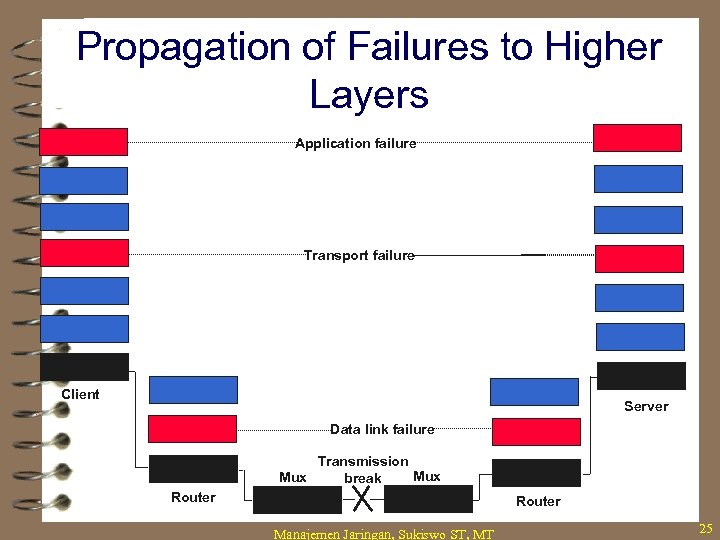 Propagation of Failures to Higher Layers Application failure Transport failure Client Server Data link failure Transmission Mux break Router Manajemen Jaringan, Sukiswo ST, MT 25
 Fault Monitoring Functions 4 Logging – record important events and errors – logs should be accessible by managers (e. g. , via polling) 4 Event Reporting – sending events, errors to managers – sending alarms to manager to warn possible problems Manajemen Jaringan, Sukiswo ST, MT 26
 Fault Monitoring Functions 4 Diagnostic Functions – connectivity test (e. g. , traceroute) – response-time test – liveness test (e. g. , ping) – protocol integrity test – loopback test Manajemen Jaringan, Sukiswo ST, MT 27
 Accounting Monitoring 4 Keeping track of users’ usage of network resources – communication facilities – computer hardware – software and systems – services 4 Usage may need to be broken down by account, by project, or by individual user for appropriate accounting purposes Manajemen Jaringan, Sukiswo ST, MT 28
 Summary 4 Network monitoring is the most basic aspect of NM 4 The purpose of network monitoring is to gather information about the status and behavior of network elements 4 Information to be gathered include – static, dynamic and statistical information 4 Monitoring methods - polling & event reporting 4 Monitoring functions – performance monitoring – fault monitoring – accounting monitoring 4 READ Chapter 2 of Textbook Manajemen Jaringan, Sukiswo ST, MT 29