 Скачать презентацию Network Information System Advisory Committee NISAC n Membership
c840a67ab60b99e120d4bbcb00c24be8.ppt
- Количество слайдов: 20



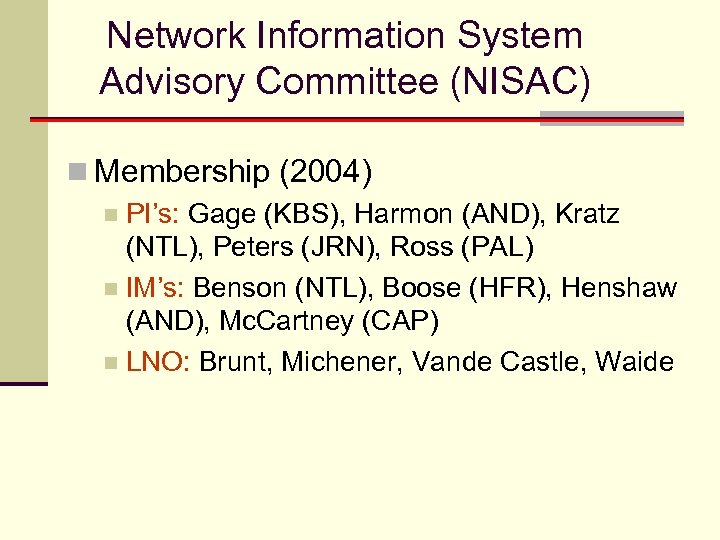
Network Information System Advisory Committee (NISAC) n Membership (2004) n PI’s: Gage (KBS), Harmon (AND), Kratz (NTL), Peters (JRN), Ross (PAL) n IM’s: Benson (NTL), Boose (HFR), Henshaw (AND), Mc. Cartney (CAP) n LNO: Brunt, Michener, Vande Castle, Waide
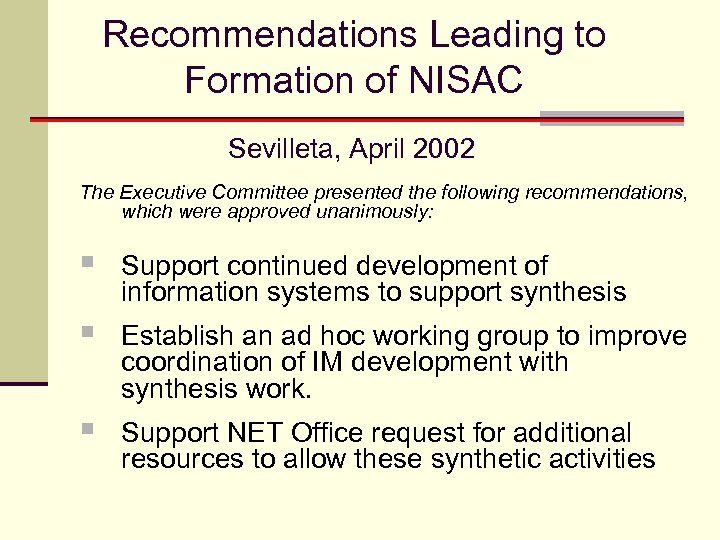
Recommendations Leading to Formation of NISAC Sevilleta, April 2002 The Executive Committee presented the following recommendations, which were approved unanimously: § Support continued development of information systems to support synthesis § Establish an ad hoc working group to improve coordination of IM development with synthesis work. § Support NET Office request for additional resources to allow these synthetic activities
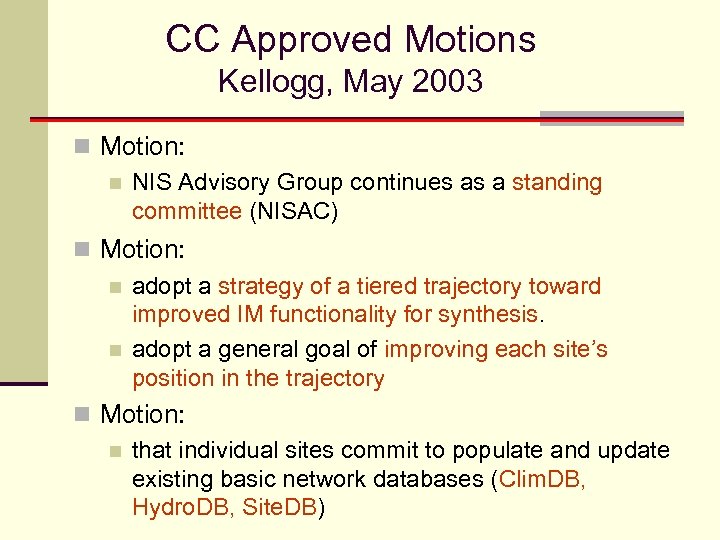
CC Approved Motions Kellogg, May 2003 n Motion: n NIS Advisory Group continues as a standing committee (NISAC) n Motion: n adopt a strategy of a tiered trajectory toward improved IM functionality for synthesis. n adopt a general goal of improving each site’s position in the trajectory n Motion: n that individual sites commit to populate and update existing basic network databases (Clim. DB, Hydro. DB, Site. DB)
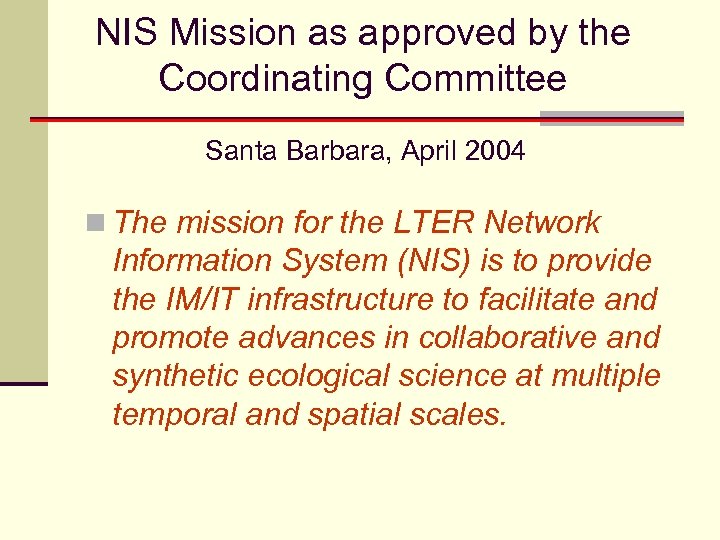
NIS Mission as approved by the Coordinating Committee Santa Barbara, April 2004 n The mission for the LTER Network Information System (NIS) is to provide the IM/IT infrastructure to facilitate and promote advances in collaborative and synthetic ecological science at multiple temporal and spatial scales.
NIS Mission (continued) n This system includes cyberinfrastructure (hardware, software); expertise, standards, and protocols; and the information resulting from research activities across the network of LTER sites and their partners. n The NIS primarily serves the LTER scientific community and collaborators but also provides a portal to LTER data products for the broader scientific community, natural resource managers, policymakers, and the general public.
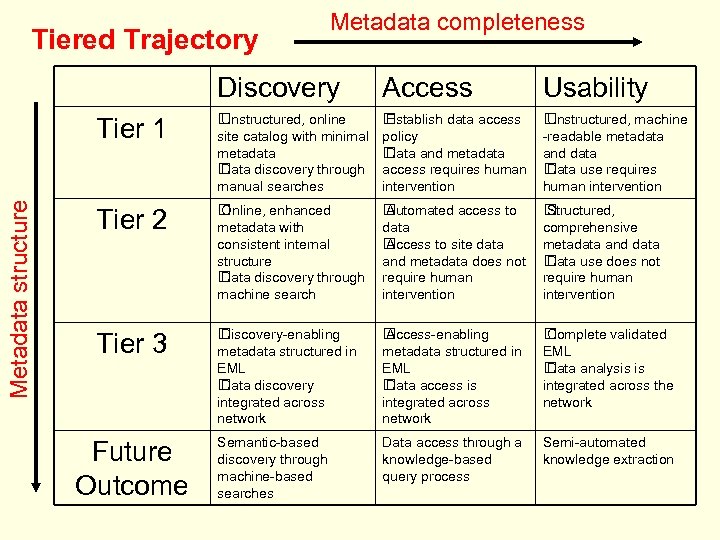
Tiered Trajectory Metadata completeness Access Usability Tier 1 Metadata structure Discovery Unstructured, online site catalog with minimal metadata Data discovery through manual searches Establish data access policy Data and metadata access requires human intervention Unstructured, machine -readable metadata and data Data use requires human intervention Tier 2 Online, enhanced metadata with consistent internal structure Data discovery through machine search Automated access to data Access to site data and metadata does not require human intervention Structured, comprehensive metadata and data Data use does not require human intervention Tier 3 Discovery-enabling metadata structured in EML Data discovery integrated across network Access-enabling metadata structured in EML Data access is integrated across network Complete validated EML Data analysis is integrated across the network Semantic-based discovery through machine-based searches Data access through a knowledge-based query process Semi-automated knowledge extraction Future Outcome
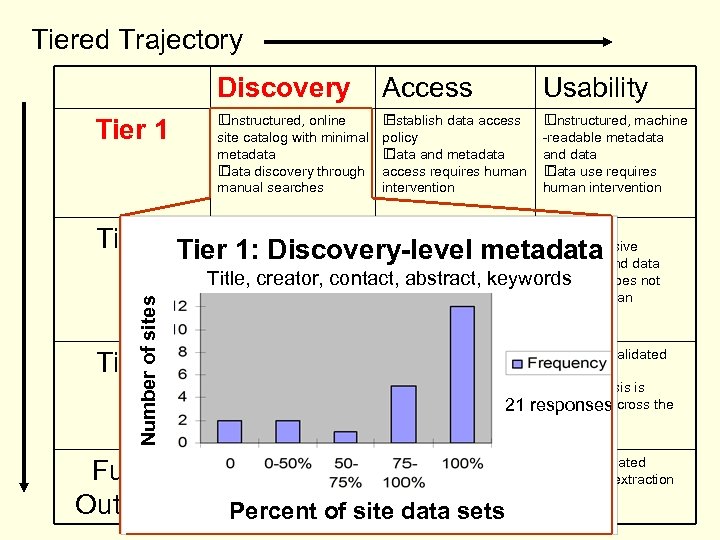
Tiered Trajectory Discovery Tier 1 Access Usability Unstructured, online site catalog with minimal metadata Data discovery through manual searches Establish data access policy Data and metadata access requires human intervention Unstructured, machine -readable metadata and data Data use requires human intervention Online, enhanced Automated access to Structured, metadata with data comprehensive consistent internal Access to site data metadata and data Title, creator, contact, abstract, keywords use does not structure and metadata does not Data discovery through require human machine search intervention Number of sites Tier 2 Tier 1: Discovery-level metadata Tier 3 Future Outcome Discovery-enabling metadata structured in EML Data discovery integrated across network Access-enabling metadata structured in EML Data access is 21 integrated across network Complete validated EML Data analysis is integrated across the responses network Semantic-based discovery through machine-based searches Data access through a knowledge-based query process Semi-automated knowledge extraction Percent of site data sets
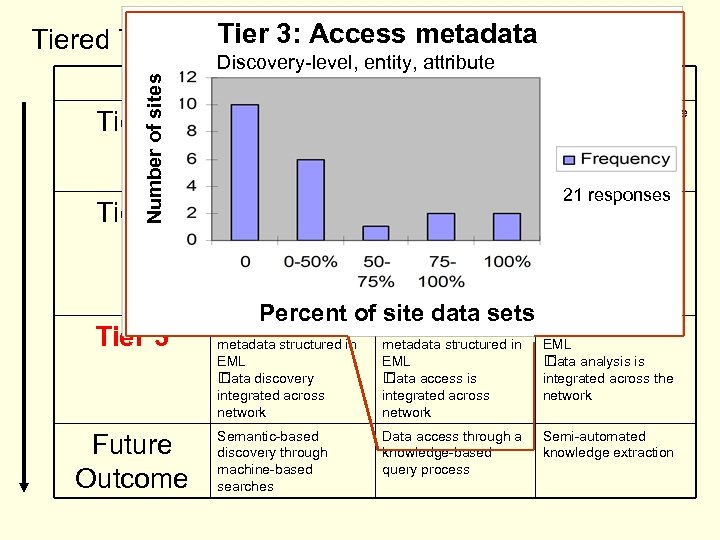
Tiered Trajectory 3: Access metadata Discovery-level, entity, attribute Access Usability Tier 1 Unstructured, online site catalog with minimal metadata Data discovery through manual searches Establish data access policy Data and metadata access requires human intervention Unstructured, machine -readable metadata and data Data use requires human intervention Tier 2 Online, enhanced metadata with consistent internal structure Data discovery through machine search Automated access to data Access to site data and metadata does not require human intervention Tier 3 Discovery-enabling metadata structured in EML Data discovery integrated across network Number of sites Discovery Future Outcome Percent of data sets site Access-enabling Semantic-based discovery through machine-based searches metadata structured in EML Data access is integrated across network Data access through a knowledge-based query process 21 responses Structured, comprehensive metadata and data Data use does not require human intervention Complete validated EML Data analysis is integrated across the network Semi-automated knowledge extraction
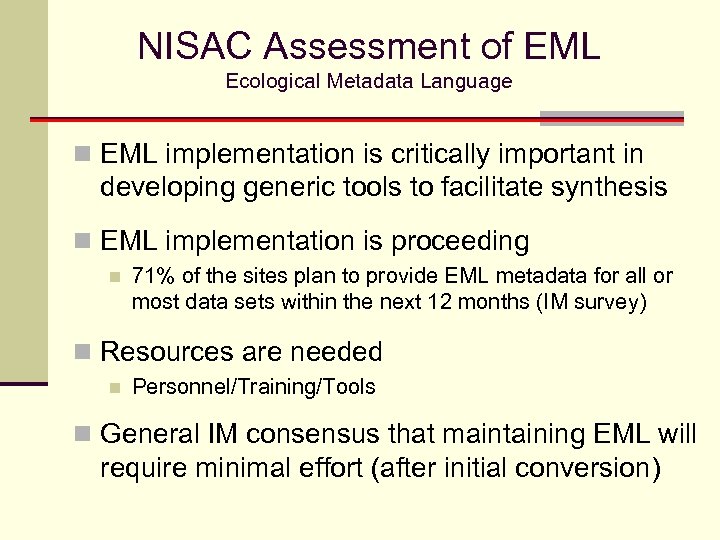
NISAC Assessment of EML Ecological Metadata Language n EML implementation is critically important in developing generic tools to facilitate synthesis n EML implementation is proceeding n 71% of the sites plan to provide EML metadata for all or most data sets within the next 12 months (IM survey) n Resources are needed n Personnel/Training/Tools n General IM consensus that maintaining EML will require minimal effort (after initial conversion)
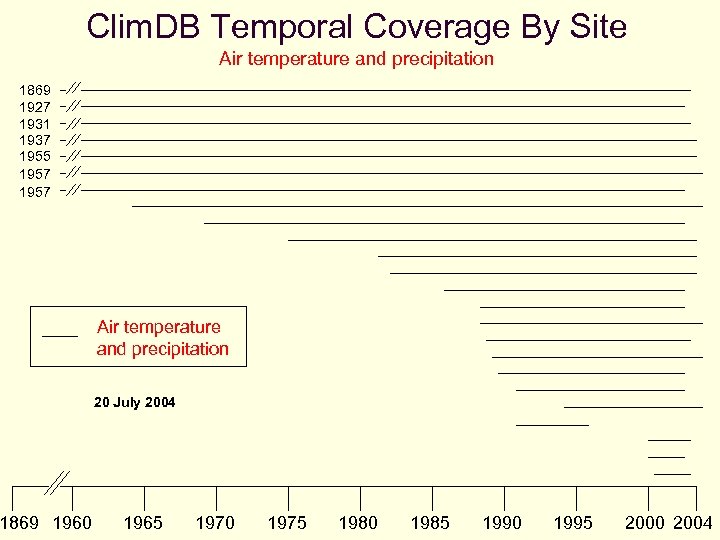
Clim. DB Temporal Coverage By Site Air temperature and precipitation 1869 1927 1931 1937 1955 1957 1869 1960 Air temperature and precipitation 20 July 2004 1965 1970 1975 1980 1985 1990 1995 2000 2004
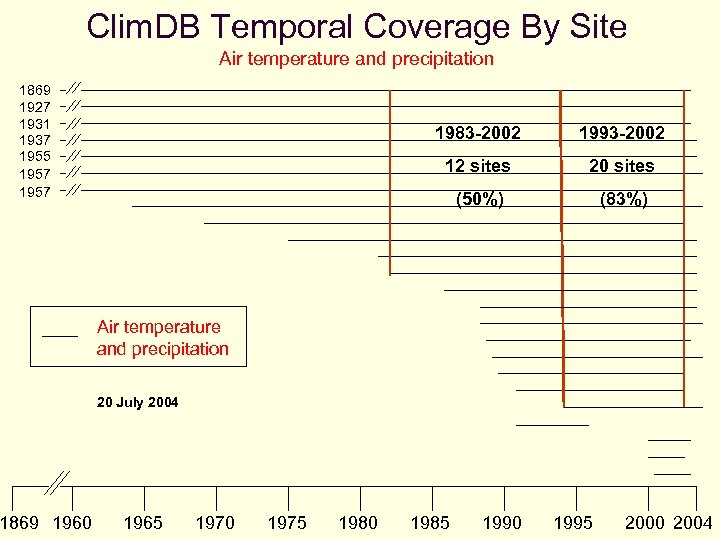
Clim. DB Temporal Coverage By Site Air temperature and precipitation 1869 1927 1931 1937 1955 1957 1869 1960 1983 -2002 1993 -2002 12 sites 20 sites (50%) (83%) Air temperature and precipitation 20 July 2004 1965 1970 1975 1980 1985 1990 1995 2000 2004
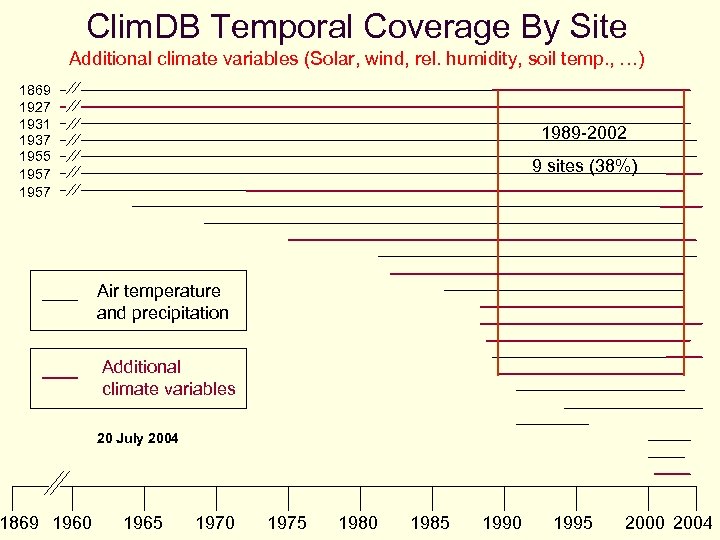
Clim. DB Temporal Coverage By Site Additional climate variables (Solar, wind, rel. humidity, soil temp. , …) 1869 1927 1931 1937 1955 1957 1869 1960 1989 -2002 9 sites (38%) Air temperature and precipitation Additional climate variables 20 July 2004 1965 1970 1975 1980 1985 1990 1995 2000 2004
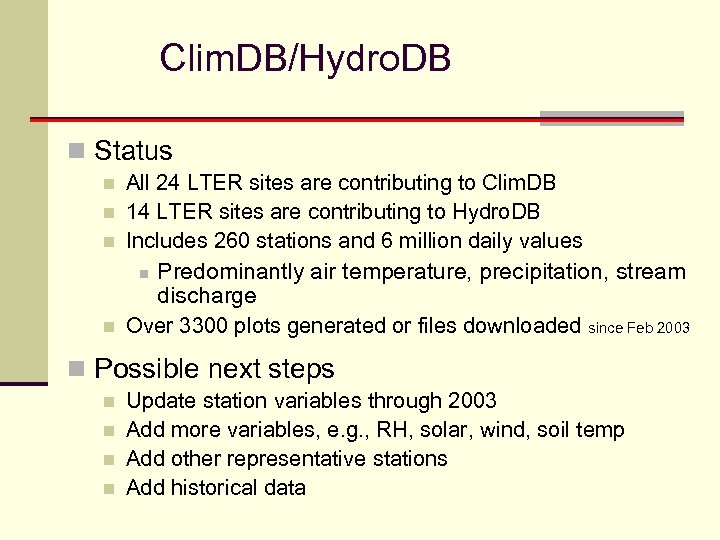
Clim. DB/Hydro. DB n Status n n All 24 LTER sites are contributing to Clim. DB 14 LTER sites are contributing to Hydro. DB Includes 260 stations and 6 million daily values n Predominantly air temperature, precipitation, stream discharge Over 3300 plots generated or files downloaded since Feb 2003 n Possible next steps n n Update station variables through 2003 Add more variables, e. g. , RH, solar, wind, soil temp Add other representative stations Add historical data
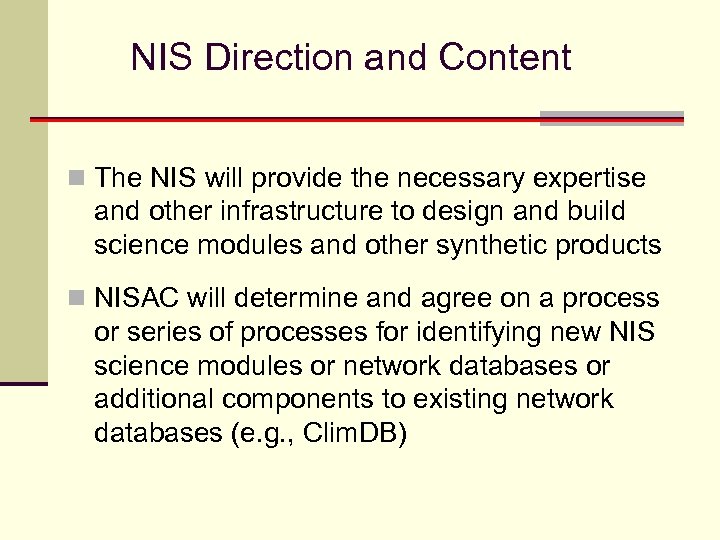
NIS Direction and Content n The NIS will provide the necessary expertise and other infrastructure to design and build science modules and other synthetic products n NISAC will determine and agree on a process or series of processes for identifying new NIS science modules or network databases or additional components to existing network databases (e. g. , Clim. DB)
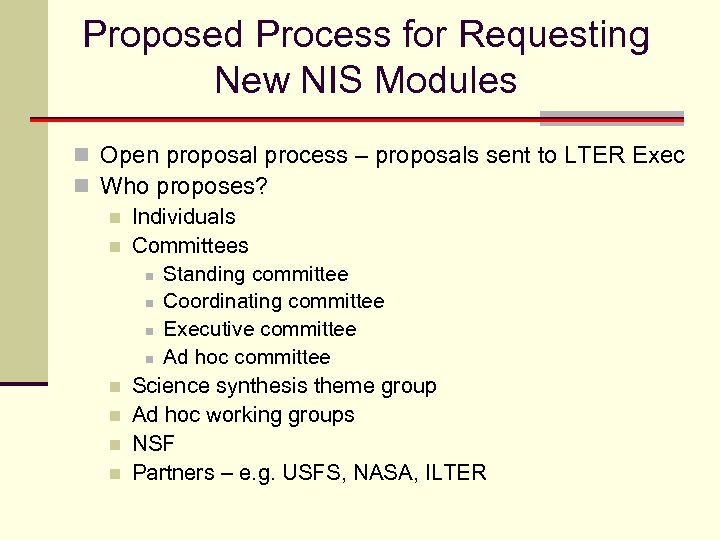
Proposed Process for Requesting New NIS Modules n Open proposal process – proposals sent to LTER Exec n Who proposes? n Individuals n Committees n Standing committee n Coordinating committee n Executive committee n Ad hoc committee n Science synthesis theme group n Ad hoc working groups n NSF n Partners – e. g. USFS, NASA, ILTER
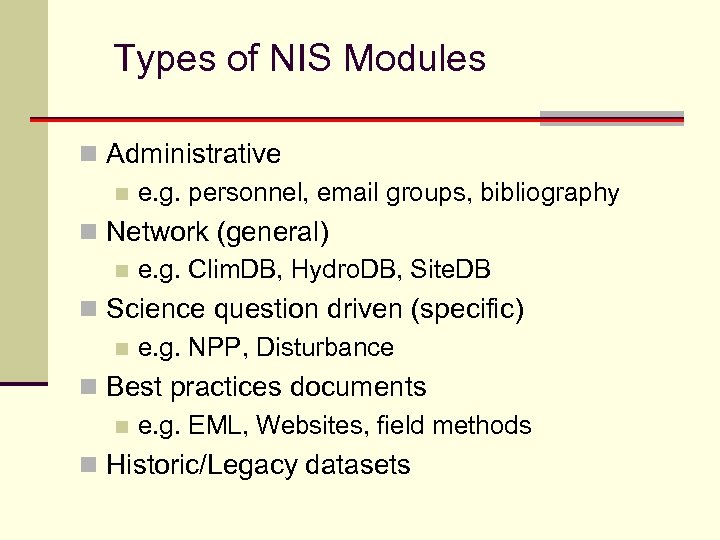
Types of NIS Modules n Administrative n e. g. personnel, email groups, bibliography n Network (general) n e. g. Clim. DB, Hydro. DB, Site. DB n Science question driven (specific) n e. g. NPP, Disturbance n Best practices documents n e. g. EML, Websites, field methods n Historic/Legacy datasets
Module Considerations n Network resources required n Open-ended updates vs completed datasets n Software development n Personnel n Fraction of sites participating n General vs specific question n Raw data vs derived data
Strategies for NIS Development n Improve the overall effectiveness of site information systems n Enhance discovery and access of information across sites n Enhance synthesis and integration of information across sites n Leverage partnerships with other organizations to develop critical tools n Promote interaction among CI developers, scientists, and information managers
IM Committee Input to Work Plans n Network-wide data catalog and query interface n EML implementation n Site IM evaluation criteria n n Assess progress within the tiered trajectory Establish minimum site IM personnel resources n Best practices documents n Web site development, EML implementation n Tool development n n n Identify and prioritize critical tools, e. g. , EML editors, query tools, data stream/sensor network management, web development Identify LNO resources for development/maintenance Partner with Cyberinfrastructure (CI) developers
Current Technology Issues n Cyberinfrastructure and technology challenges: Spatial technologies, wireless networks, sensor technologies, real-time data processing, collaboration technologies, etc. n How can these support LTER science? n Convene LTER Technology Committee n Partner with supercomputer centers, i. e. , SDSC or NCSA
Скачать презентацию Network Information System Advisory Committee NISAC n Membership
c840a67ab60b99e120d4bbcb00c24be8.ppt