


 Скачать презентацию Network Fundamentals Intro to Network Structure and Protocol
bd215d3151f0278edf47d79900e27445.ppt
- Количество слайдов: 56
 Network Fundamentals: Intro to Network Structure and Protocol LAN, WAN, TCP/IP ﺍﻻﻟﻜﺘﺮﻭﻧﻲ ﻧﻈﺎﻡ ﺍﻟﻤﺤﺎﺿﺮﺍﺕ
 q Outline • Understanding Networking. • Understanding Transmission Medium (Network Cables) • Understanding Network Hardware • WAN and LAN • Understanding Network Protocols ﺍﻻﻟﻜﺘﺮﻭﻧﻲ ﻧﻈﺎﻡ ﺍﻟﻤﺤﺎﺿﺮﺍﺕ
 Understanding Networking ﺍﻻﻟﻜﺘﺮﻭﻧﻲ ﻧﻈﺎﻡ ﺍﻟﻤﺤﺎﺿﺮﺍﺕ
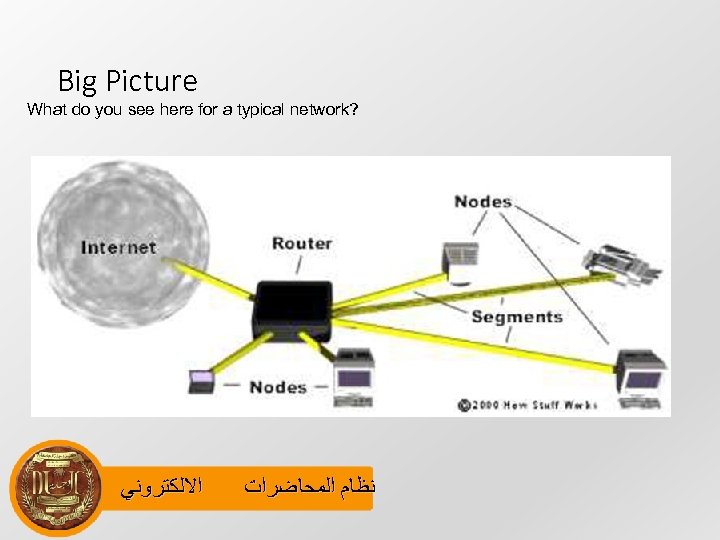 Big Picture What do you see here for a typical network? ﺍﻻﻟﻜﺘﺮﻭﻧﻲ ﻧﻈﺎﻡ ﺍﻟﻤﺤﺎﺿﺮﺍﺕ
 q Key Network Terminology Explained (1) • Networks needs to interconnect at a distance by a form of point to point or point to multiple point connected media • Networks that are interconnected have proven to be low cost, reliable, and efficient means of communicating at a distance ﺍﻻﻟﻜﺘﺮﻭﻧﻲ ﻧﻈﺎﻡ ﺍﻟﻤﺤﺎﺿﺮﺍﺕ
 q Network architecture • Node: anything connected to the network, usually a computer, but it could be a printer or a scanner • Segment: any portion of a network that is separated by a switch, bridge or a router from another part of a network. • Backbone: the main cabling of a network that all of the segment connect to. Usually, the backbone is capable of carrying more information than the individual segments. • Topology: The way each node is physically connected to the network ﺍﻻﻟﻜﺘﺮﻭﻧﻲ ﻧﻈﺎﻡ ﺍﻟﻤﺤﺎﺿﺮﺍﺕ
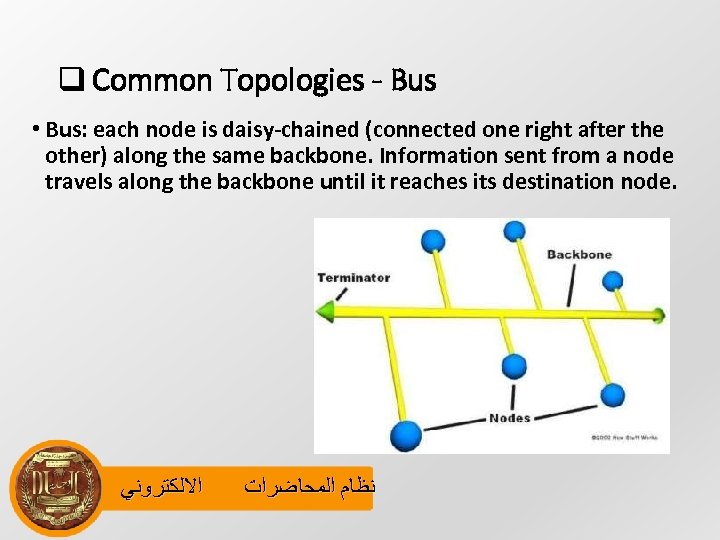 q Common Topologies - Bus • Bus: each node is daisy-chained (connected one right after the other) along the same backbone. Information sent from a node travels along the backbone until it reaches its destination node. ﺍﻻﻟﻜﺘﺮﻭﻧﻲ ﻧﻈﺎﻡ ﺍﻟﻤﺤﺎﺿﺮﺍﺕ
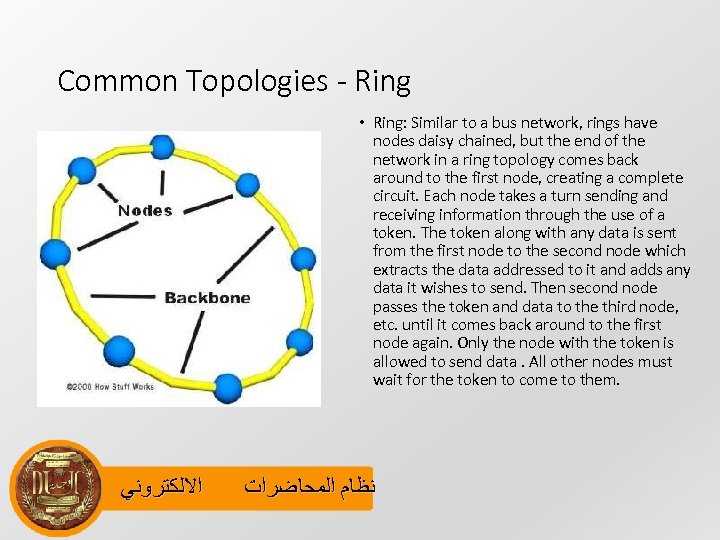 Common Topologies - Ring • Ring: Similar to a bus network, rings have nodes daisy chained, but the end of the network in a ring topology comes back around to the first node, creating a complete circuit. Each node takes a turn sending and receiving information through the use of a token. The token along with any data is sent from the first node to the second node which extracts the data addressed to it and adds any data it wishes to send. Then second node passes the token and data to the third node, etc. until it comes back around to the first node again. Only the node with the token is allowed to send data. All other nodes must wait for the token to come to them. ﺍﻻﻟﻜﺘﺮﻭﻧﻲ ﻧﻈﺎﻡ ﺍﻟﻤﺤﺎﺿﺮﺍﺕ
 Common Topologies - Star • In a star network, each node is connected to a central device called a hub. The hub takes a signal that comes from any node and passes it along to all the other nodes in the network. • A hub does not perform any type of filtering or routing of the data. • A hub is a junction that joins all the different nodes together. ﺍﻻﻟﻜﺘﺮﻭﻧﻲ ﻧﻈﺎﻡ ﺍﻟﻤﺤﺎﺿﺮﺍﺕ
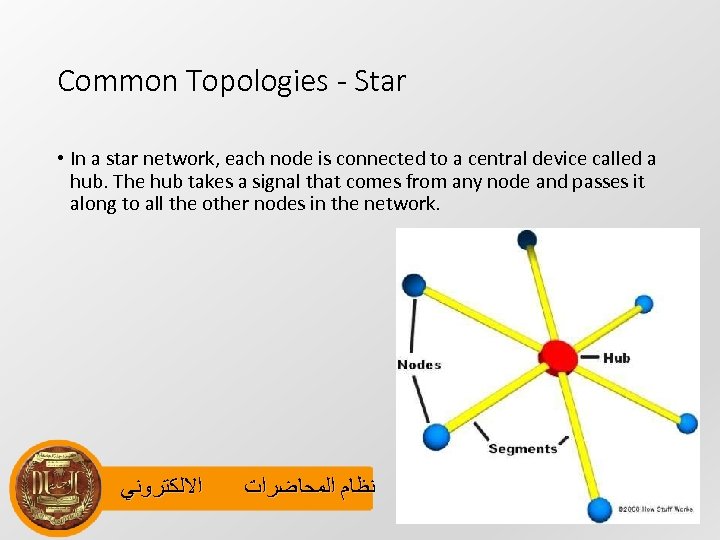 Common Topologies - Star • In a star network, each node is connected to a central device called a hub. The hub takes a signal that comes from any node and passes it along to all the other nodes in the network. ﺍﻻﻟﻜﺘﺮﻭﻧﻲ ﻧﻈﺎﻡ ﺍﻟﻤﺤﺎﺿﺮﺍﺕ
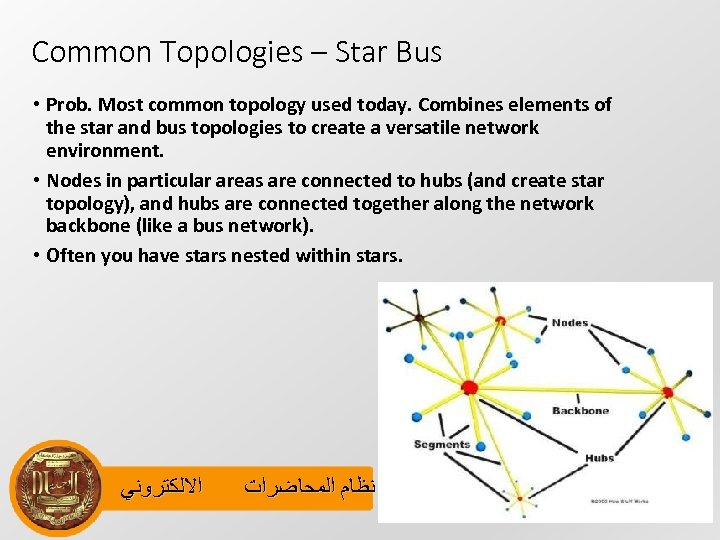 Common Topologies – Star Bus • Prob. Most common topology used today. Combines elements of the star and bus topologies to create a versatile network environment. • Nodes in particular areas are connected to hubs (and create star topology), and hubs are connected together along the network backbone (like a bus network). • Often you have stars nested within stars. ﺍﻻﻟﻜﺘﺮﻭﻧﻲ ﻧﻈﺎﻡ ﺍﻟﻤﺤﺎﺿﺮﺍﺕ
 q Types of Data Transmission • Simplex: information flows in only one direction • Half-duplex: information flows in two directions, but only in one direction at a time. • Full-duplex: information flows in two directions at the same time ﺍﻻﻟﻜﺘﺮﻭﻧﻲ ﻧﻈﺎﻡ ﺍﻟﻤﺤﺎﺿﺮﺍﺕ
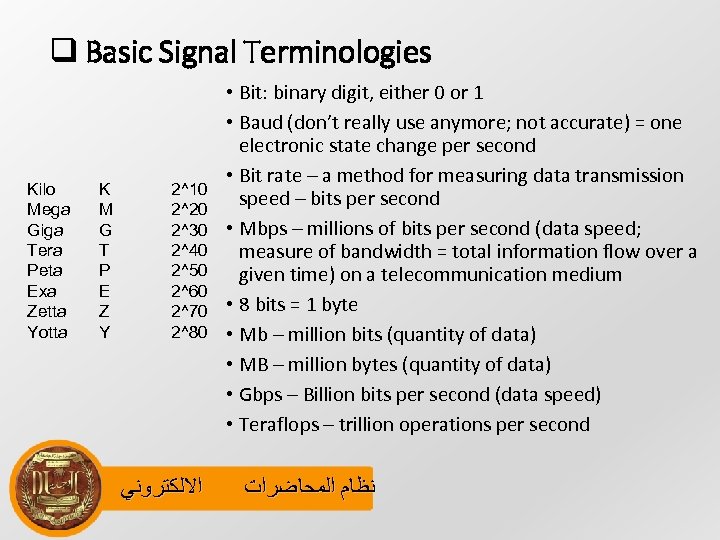 q Basic Signal Terminologies Kilo Mega Giga Tera Peta Exa Zetta Yotta K M G T P E Z Y 2^10 2^20 2^30 2^40 2^50 2^60 2^70 2^80 ﺍﻻﻟﻜﺘﺮﻭﻧﻲ • Bit: binary digit, either 0 or 1 • Baud (don’t really use anymore; not accurate) = one electronic state change per second • Bit rate – a method for measuring data transmission speed – bits per second • Mbps – millions of bits per second (data speed; measure of bandwidth = total information flow over a given time) on a telecommunication medium • 8 bits = 1 byte • Mb – million bits (quantity of data) • MB – million bytes (quantity of data) • Gbps – Billion bits per second (data speed) • Teraflops – trillion operations per second ﻧﻈﺎﻡ ﺍﻟﻤﺤﺎﺿﺮﺍﺕ
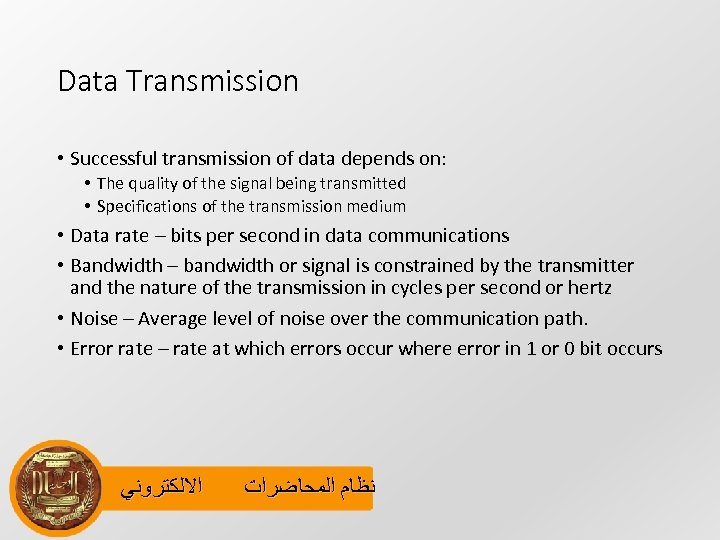 Data Transmission • Successful transmission of data depends on: • The quality of the signal being transmitted • Specifications of the transmission medium • Data rate – bits per second in data communications • Bandwidth – bandwidth or signal is constrained by the transmitter and the nature of the transmission in cycles per second or hertz • Noise – Average level of noise over the communication path. • Error rate – rate at which errors occur where error in 1 or 0 bit occurs ﺍﻻﻟﻜﺘﺮﻭﻧﻲ ﻧﻈﺎﻡ ﺍﻟﻤﺤﺎﺿﺮﺍﺕ
 Understanding Transmission Medium ﺍﻻﻟﻜﺘﺮﻭﻧﻲ ﻧﻈﺎﻡ ﺍﻟﻤﺤﺎﺿﺮﺍﺕ
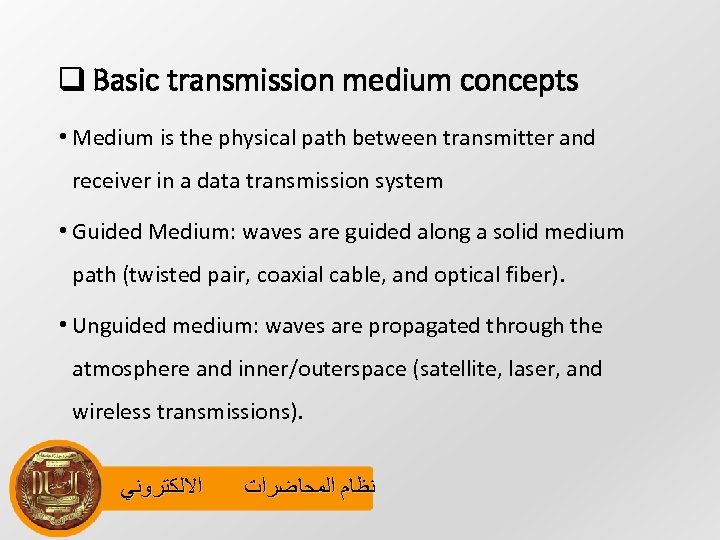 q Basic transmission medium concepts • Medium is the physical path between transmitter and receiver in a data transmission system • Guided Medium: waves are guided along a solid medium path (twisted pair, coaxial cable, and optical fiber). • Unguided medium: waves are propagated through the atmosphere and inner/outerspace (satellite, laser, and wireless transmissions). ﺍﻻﻟﻜﺘﺮﻭﻧﻲ ﻧﻈﺎﻡ ﺍﻟﻤﺤﺎﺿﺮﺍﺕ
 q Medium examples by type • Conductive: twisted pairs and coaxial cables • Electromagnetic: microwave • Light: lasers and optical fibers (need clear line of sight) • Wireless – inner/outerspace; satellite (omnidirectional security issues) ﺍﻻﻟﻜﺘﺮﻭﻧﻲ ﻧﻈﺎﻡ ﺍﻟﻤﺤﺎﺿﺮﺍﺕ
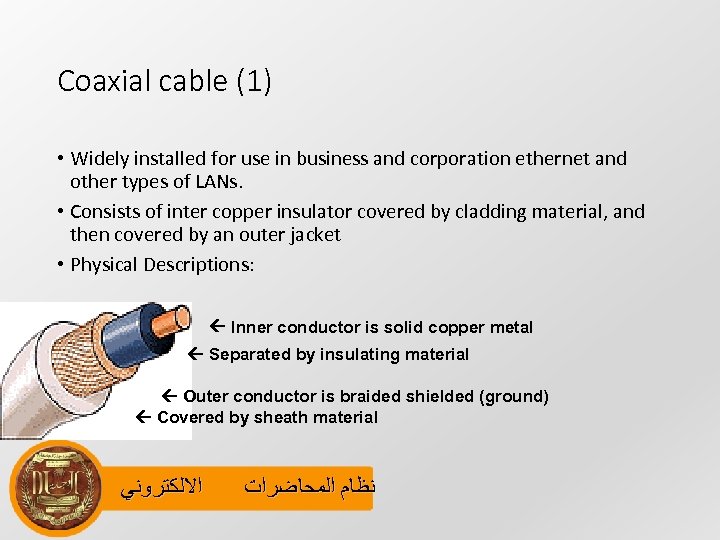 Coaxial cable (1) • Widely installed for use in business and corporation ethernet and other types of LANs. • Consists of inter copper insulator covered by cladding material, and then covered by an outer jacket • Physical Descriptions: Inner conductor is solid copper metal Separated by insulating material Outer conductor is braided shielded (ground) Covered by sheath material ﺍﻻﻟﻜﺘﺮﻭﻧﻲ ﻧﻈﺎﻡ ﺍﻟﻤﺤﺎﺿﺮﺍﺕ
 q Coaxial cable (2) • Applications: • TV distribution (cable tv); long distance telephone transmission; short run computer system links • Local area networks • Transmission characteristics: • Can transmit analog and digital signals • Usable spectrum for analog signaling is about 400 Mhz • Amplifier needed for analog signals for less than 1 Km and less distance for higher frequency • Repeater needed for digital signals every 1 Km or less distance for higher data rates • Operation of 100’s Mb/s over 1 Km. ﺍﻻﻟﻜﺘﺮﻭﻧﻲ ﻧﻈﺎﻡ ﺍﻟﻤﺤﺎﺿﺮﺍﺕ
 q Twisted Pair Cables • Physical description: • Each wire with copper conductor • Separately insulated wires • Twisted together to reduce cross talk • Often bundled into cables of two or four twisted pairs • If enclosed in a sheath then is shielded twisted pair (STP) otherwise often for home usage unshielded twisted pair (UTP). Must be shield from voltage lines • Application: • Common in building for digital signaling used at speed of 10’s Mb/s (CAT 3) and 100 Mb/s (CAT 5) over 100 s meters. • Common for telephone interconnection at home and office buildings • Less expensive medium; limited in distance, bandwidth, and data rate. ﺍﻻﻟﻜﺘﺮﻭﻧﻲ ﻧﻈﺎﻡ ﺍﻟﻤﺤﺎﺿﺮﺍﺕ
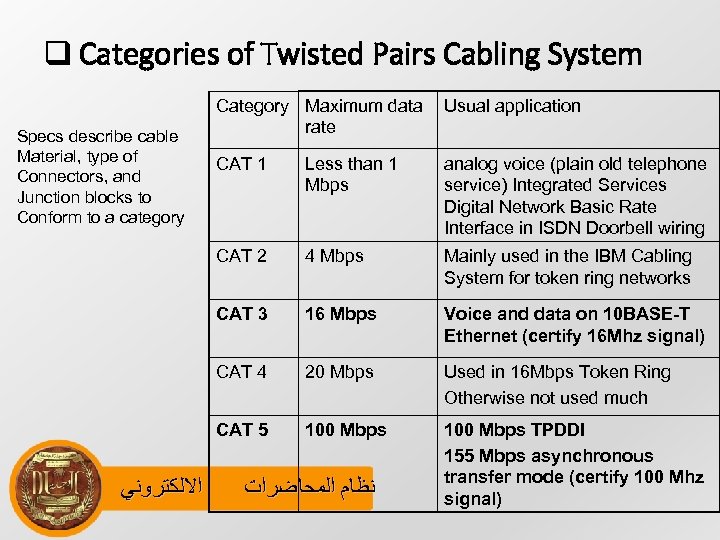 q Categories of Twisted Pairs Cabling System CAT 1 Less than 1 Mbps analog voice (plain old telephone service) Integrated Services Digital Network Basic Rate Interface in ISDN Doorbell wiring 4 Mbps Mainly used in the IBM Cabling System for token ring networks CAT 3 16 Mbps Voice and data on 10 BASE-T Ethernet (certify 16 Mhz signal) CAT 4 20 Mbps Used in 16 Mbps Token Ring Otherwise not used much CAT 5 ﺍﻻﻟﻜﺘﺮﻭﻧﻲ Usual application CAT 2 Specs describe cable Material, type of Connectors, and Junction blocks to Conform to a category Category Maximum data rate 100 Mbps TPDDI 155 Mbps asynchronous transfer mode (certify 100 Mhz signal) ﻧﻈﺎﻡ ﺍﻟﻤﺤﺎﺿﺮﺍﺕ
 q Optical Fibers (1) • Physical Description: • • Glass or plastic core of optical fiber = 2 to 125 µm Cladding is an insulating material Jacket is a protective cover Laser or light emitting diode provides transmission light source • Applications: Long distance telecommunication Greater capacity; 2 Gb/s over 10’s of Km Smaller size and lighter weight Lower attenuation (reduction in strength of signal) Electromagnetic isolation – not effected by external electromagnetic environment. Aka more privacy • Greater repeater spacing – fewer repeaters, reduces line regeneration cost • • • ﺍﻻﻟﻜﺘﺮﻭﻧﻲ ﻧﻈﺎﻡ ﺍﻟﻤﺤﺎﺿﺮﺍﺕ
 q Optical Fibers (2) • multimode fiber is optical fiber that is designed to carry multiple light rays or modes concurrently, each at a slightly different reflection angle within the optical fiber core. • For longer distances, single mode fiber (sometimes called monomode) fiber is used. In single mode fiber a single ray or mode of light act as a carrier ﺍﻻﻟﻜﺘﺮﻭﻧﻲ ﻧﻈﺎﻡ ﺍﻟﻤﺤﺎﺿﺮﺍﺕ
 q Wireless Transmission (1) • Frequency range (line of sight): • 26 GHz to 40 GHz: for microwave with highly directional beam as possible • 30 MHz to 1 GHz: for omnidirectional applications • 300 MHz to 20000 GHz: for infrared spectrum; used for point to point and multiple point application (line of sight) • Physical applications: • Terrestrial microwave – long haul telecommunication service (alternative to coaxial or optical fiber) • Few amplifier and repeaters • Propagation via towers located without blockage from trees, etc (towers less than 60 miles apart) ﺍﻻﻟﻜﺘﺮﻭﻧﻲ ﻧﻈﺎﻡ ﺍﻟﻤﺤﺎﺿﺮﺍﺕ
 Wireless Transmission (2) • Satellite is a microwave relay station • Geostationary orbit (22, 000 miles) and low orbit (12000 miles) • Satellite ground stations are aligned to the space satellite, establishes a link, broadcast at a specified frequency. Ground station normally operate at a number of frequencies – full duplex • Satellite space antenna is aligned to the ground station establishes a link and transmits at the specified frequency. Satellite are capable of transmitting at multiple frequencies simultaneously, full duplex. • To avoid satellites from interfering with each other, a 4 degree separation is required for 4/6 GHz band 3 degree for 12/14 GHz band. Limited to 90 satellites. • Disadvantages: not satellite repair capability; greater delay and attenuation problems. ﺍﻻﻟﻜﺘﺮﻭﻧﻲ ﻧﻈﺎﻡ ﺍﻟﻤﺤﺎﺿﺮﺍﺕ
 q Wireless LAN • Wireless LAN (CSMA/CD) • Hiper. LAN (European standard; allow communication at up to 20 Mbps in 5 GHz range of the radio frquency (RF) spectrum. • Hiper. LAN/2 operate at about 54 Mbps in the same RF band. ﺍﻻﻟﻜﺘﺮﻭﻧﻲ ﻧﻈﺎﻡ ﺍﻟﻤﺤﺎﺿﺮﺍﺕ
 Network Hardware ﻧﻈﺎﻡ ﺍﻟﻤﺤﺎﺿﺮﺍﺕ ﺍﻻﻟﻜﺘﺮﻭﻧﻲ
 Hubs • A hub is the place where data converges from one or more directions and is forwarded out in one or more directions. • Seen in local area networks ﺍﻻﻟﻜﺘﺮﻭﻧﻲ ﻧﻈﺎﻡ ﺍﻟﻤﺤﺎﺿﺮﺍﺕ
 Gateways • A gateway is a network point that acts as an entrance to another network. On the internet, in terms of routing, the network consists of gateway nodes and host nodes. • Host nodes are computer of network users and the computers that serve contents (such as Web pages). • Gateway nodes are computers that control traffic within your company’s network or at your local internet service provider (ISP) ﺍﻻﻟﻜﺘﺮﻭﻧﻲ ﻧﻈﺎﻡ ﺍﻟﻤﺤﺎﺿﺮﺍﺕ
 Routers • A router is a device or a software in a computer that determines the next network point to which a packet should be forwarded toward its destination. • Allow different networks to communicate with each other • A router creates and maintain a table of the available routes and their conditions and uses this information along with distance and cost algorithms to determine the best route for a given packet. • A packet will travel through a number of network points with routers before arriving at its destination. ﺍﻻﻟﻜﺘﺮﻭﻧﻲ ﻧﻈﺎﻡ ﺍﻟﻤﺤﺎﺿﺮﺍﺕ
 Bridge • a bridge is a product that connects a local area network (LAN) to another local area network that uses the same protocol (for example, Ethernet or token ring). • A bridge examines each message on a LAN, "passing" those known to be within the same LAN, and forwarding those known to be on the other interconnected LAN (or LANs). ﺍﻻﻟﻜﺘﺮﻭﻧﻲ ﻧﻈﺎﻡ ﺍﻟﻤﺤﺎﺿﺮﺍﺕ
 What is the difference between? • Bridge: device to interconnect two LANs that use the SAME logical link control protocol but may use different medium access control protocols. • Router: device to interconnect SIMILAR networks, e. g. similar protocols and workstations and servers • Gateway: device to interconnect DISSIMILAR protocols and servers, and Macintosh and IBM LANs and equipment ﺍﻻﻟﻜﺘﺮﻭﻧﻲ ﻧﻈﺎﻡ ﺍﻟﻤﺤﺎﺿﺮﺍﺕ
 Switches • Allow different nodes of a network to communicate directly with each other. • Allow several users to send information over a network at the same time without slowing each other down. ﺍﻻﻟﻜﺘﺮﻭﻧﻲ ﻧﻈﺎﻡ ﺍﻟﻤﺤﺎﺿﺮﺍﺕ
 WANs and LANs ﻧﻈﺎﻡ ﺍﻟﻤﺤﺎﺿﺮﺍﺕ ﺍﻻﻟﻜﺘﺮﻭﻧﻲ
 Major Categories of Networks • Local Area Networks (LAN) • A network of computers that are in the same general physical location, within a building or a campus. • Metropolitan Area Networks (MAN) • Wide Area Networks (WAN) Issues of size and breadth. ﺍﻻﻟﻜﺘﺮﻭﻧﻲ ﻧﻈﺎﻡ ﺍﻟﻤﺤﺎﺿﺮﺍﺕ
 Data Communications Through WANs (1) • WANs were developed to communicate over a large geographical area (e. g. lab-tolab; city-to-city; east coast-to-west coast; North America-to-South America etc) • WANs require the crossing of public right of ways (under control and regulations of the interstate commerce and institute of telephone and data communications established by the gov’t and international treaties). • WANs around the world relies on the infrastructure established by the telephone companies (“common carrier”) or public switched telephone network (PSTN). • WANs consists of a number of interconnected switching nodes (today = computers). Transmission signals are routed across the network automatically by software control to the specified destination. The purpose of these nodes are to route messages through switching facilities to move data from node to its destination. ﺍﻻﻟﻜﺘﺮﻭﻧﻲ ﻧﻈﺎﻡ ﺍﻟﻤﺤﺎﺿﺮﺍﺕ
 Data Communications Through WANs (2) • WANs originally implemented circuit switching and packet switching technologies. Recently, frame relay and asynchronous transfer mode (ATM) networks have been implemented to achieve higher operating and processing speeds for the message. • WAN transmission speeds are _______ • Interconnected devices, I. e. LANs or Personal Computers (PC) or Workstation or Servers can be (usually are) privately owned by companies. ﺍﻻﻟﻜﺘﺮﻭﻧﻲ ﻧﻈﺎﻡ ﺍﻟﻤﺤﺎﺿﺮﺍﺕ
 Circuit Switching Technologies • Circuit switching is a dedicated communications path established between two stations or multiple end points through nodes of the WAN • Transmission path is a connected sequence of physical link between nodes. • On each link, a logical channel is dedicated to the connection. Data generated by the source station are transmitted along dedicated path as rapidly as possible. • At each node, incoming data are routed or switched to the appropriate outgoing channel without excessive delay. However, if data processing is required, some delay is experienced. • Example of circuit switching above is the telephone networks. ﺍﻻﻟﻜﺘﺮﻭﻧﻲ ﻧﻈﺎﻡ ﺍﻟﻤﺤﺎﺿﺮﺍﺕ
 Packet Switching Technologies • It is not necessary (as in circuit switching) to dedicate transmission capacity along a path through the WAN rather data are sent out in a sequence of small chucks, called packets. • Each packet, consisting of several bits is passed through the network from node to node along some path leading from the source to the destination • At each node along the path, the entire packet is received, stored briefly, and then transmitted to the next node. • At destination all individual packets are assembled together to form the complete text and message from the source. Each packet is identified as to its place in the overall text for reassembly. • Packet switching networks are commonly used for terminal-to-computer and computer-to-computer communications. • If packet errors occur, the packet is retransmitted. ﺍﻻﻟﻜﺘﺮﻭﻧﻲ ﻧﻈﺎﻡ ﺍﻟﻤﺤﺎﺿﺮﺍﺕ
 Local Area Network 1. 2. Ethernet Token Ring • Small interconnected of personal computers or workstations and printers within a building or small area up to 10 Kms. • Small group of workers that share common application programs and communication needs. • LANs are capable of very high transmission rates (100 s Mb/s to G b/s). • LAN equipment usually owned by organization. Medium may be owned or leased from telephone company provider or common carrier. • PC or Workstation interconnected to medium (twisted pair; fiber optics; etc) through concentrators to servers. LAN is interconnected with other networks via switches and router/gateways. • Advanced LANs using circuit switching are available. ATM LANs, fibre channel baseband, and broadband LANs are being used. Etc. ﺍﻻﻟﻜﺘﺮﻭﻧﻲ ﻧﻈﺎﻡ ﺍﻟﻤﺤﺎﺿﺮﺍﺕ
 What is ethernet? • A group of standards for defining a local area network that includes standards in cabling and the structure of the data sent over those cables as well as the hardware that connects those cables. • Independent of the network architecture • Flavors of ethernet • IEEE 802. 3 Ethernet Specification • Great detail specifying cable types, data formats, and procedures for transferring that data through those cables • IEEE 802. 5 Token Ring Specification ﺍﻻﻟﻜﺘﺮﻭﻧﻲ ﻧﻈﺎﻡ ﺍﻟﻤﺤﺎﺿﺮﺍﺕ
 Network Interface Card (NIC) • Every computer and most devices (e. g. a network printer) is connected to network through an NIC. In most desktop computers, this is an Ethernet card (10 or 100 Mbps) that is plugged into a slot on the computer motherboard. ﺍﻻﻟﻜﺘﺮﻭﻧﻲ ﻧﻈﺎﻡ ﺍﻟﻤﺤﺎﺿﺮﺍﺕ
 How does Ethernet work? • Using MAC addresses to distinguish between machines, Ethernet transmits frames of data across baseband cables using CSMA/CD (IEEE 802. 3) ﺍﻻﻟﻜﺘﺮﻭﻧﻲ ﻧﻈﺎﻡ ﺍﻟﻤﺤﺎﺿﺮﺍﺕ
 What is a MAC Address? • Media Access Control (MAC) Address – are the physical address of any device, e. g. a NIC in a computer on the network. The MAC address has two parts of 6 bytes long. The first 3 bytes specify the company that made the NIC and the second 3 bytes are the serial number of the NIC. ﺍﻻﻟﻜﺘﺮﻭﻧﻲ ﻧﻈﺎﻡ ﺍﻟﻤﺤﺎﺿﺮﺍﺕ
 What is a Token Ring? • All computers are connected in a ring or star topology and a binary digit or token passing scheme is used in order to prevent the collision of data between two computers that want to send messages at the same time. ﺍﻻﻟﻜﺘﺮﻭﻧﻲ ﻧﻈﺎﻡ ﺍﻟﻤﺤﺎﺿﺮﺍﺕ
 How do Token Rings work? 1. Empty information frames are continuously circulated on the ring. 2. When a computer has a message to send, it inserts a token in an empty frame (this may consist of simply changing a 0 to a 1 in the token bit part of the frame) and inserts a message and a destination identifier in the frame. 3. The frame is then examined by each successive workstation. If the workstation sees that it is the destination for the message, it copies the message from the frame and changes the token back to 0. 4. When the frame gets back to the originator, it sees that the token has been changed to 0 and that the message has been copied and received. It removes the message from the frame. 5. The frame continues to circulate as an "empty" frame, ready to be taken by a workstation when it has a message to send. ﺍﻻﻟﻜﺘﺮﻭﻧﻲ ﻧﻈﺎﻡ ﺍﻟﻤﺤﺎﺿﺮﺍﺕ
 Understanding Network Protocols ﺍﻻﻟﻜﺘﺮﻭﻧﻲ ﻧﻈﺎﻡ ﺍﻟﻤﺤﺎﺿﺮﺍﺕ
 Protocols of Computer Communications and Networks • Protocol are used for communication between computers in different computer networks. Protocol achieves: • • What is communicated between computers? How it is communicated? When it is communicated? What conformance (bit sequence) between computers? • Key elements of a protocol are: • SYNTAC: Data format and signal levels • SEMANTICS: Control information for coordination and error handling • TIMING: Synchronization, speed matching, and sequencing • Examples of protocols: • WAN Protocol: TCP/IP • LAN Protocol: Media Access Control; Contention; Token Passing ﺍﻻﻟﻜﺘﺮﻭﻧﻲ ﻧﻈﺎﻡ ﺍﻟﻤﺤﺎﺿﺮﺍﺕ
 Protocol Architecture • Architecture provides high degree of cooperation between two computers. • Example: • INSERT DIAGRAM of file transfer ﺍﻻﻟﻜﺘﺮﻭﻧﻲ ﻧﻈﺎﻡ ﺍﻟﻤﺤﺎﺿﺮﺍﺕ
 ISO/OSI Reference Model (1) • Open Systems Interconnection • No one really uses this in the real world. • A reference model so others can develop detailed interfaces. • Value: The reference model defines 7 layers of functions that take place at each end of communication and with each layer adding its own set of special related functions. • Flow of data through each layer at one ﺍﻻﻟﻜﺘﺮﻭﻧﻲ ﻧﻈﺎﻡ ﺍﻟﻤﺤﺎﺿﺮﺍﺕ
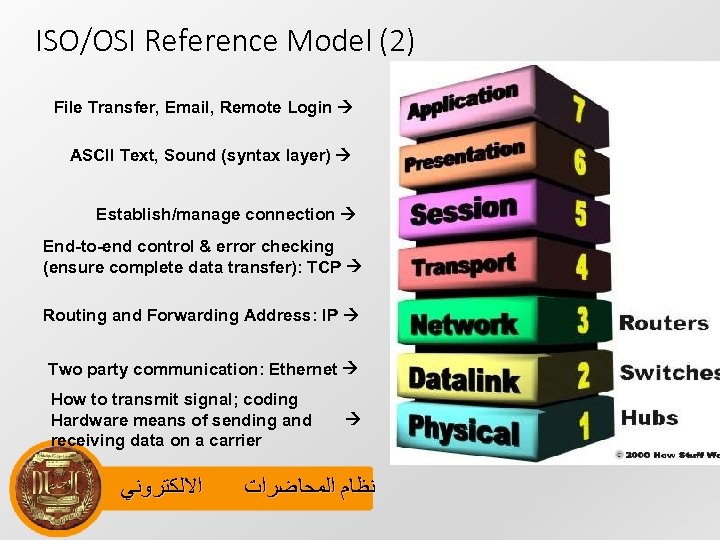 ISO/OSI Reference Model (2) File Transfer, Email, Remote Login ASCII Text, Sound (syntax layer) Establish/manage connection End-to-end control & error checking (ensure complete data transfer): TCP Routing and Forwarding Address: IP Two party communication: Ethernet How to transmit signal; coding Hardware means of sending and receiving data on a carrier ﺍﻻﻟﻜﺘﺮﻭﻧﻲ ﻧﻈﺎﻡ ﺍﻟﻤﺤﺎﺿﺮﺍﺕ
 What is TCP/IP? • Transmission Control Protocol (TCP) – uses a set of rules to exchange messages with other Internet points at the information packet level • Internet Protocol (IP) – uses a set of rules to send and receive messages at the Internet address level • Is the predominate network protocol in use today (Other includes OSI Model) for interoperable architecture and the internet. • TCP/IP is a result of protocol research and development conducted on experimental packet switched network by ARPANET funded by the defense advanced research projects agency (DARPA). TCP/IP used as internet standards by the internet architecture board (IAB). ﺍﻻﻟﻜﺘﺮﻭﻧﻲ ﻧﻈﺎﻡ ﺍﻟﻤﺤﺎﺿﺮﺍﺕ
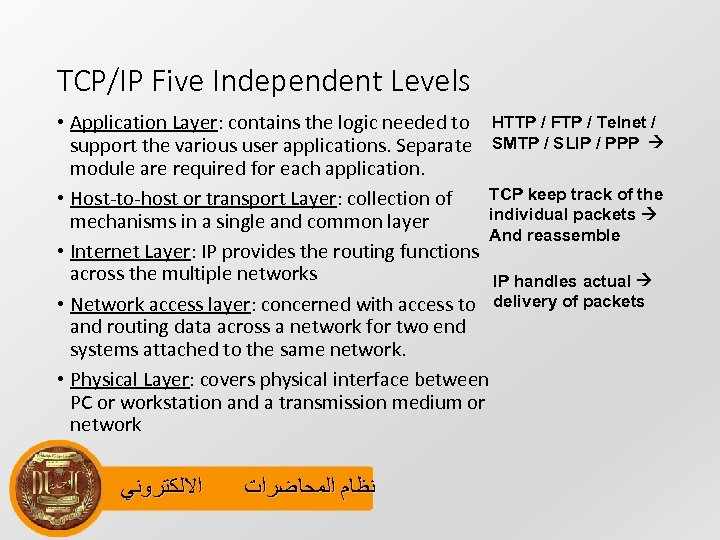 TCP/IP Five Independent Levels • Application Layer: contains the logic needed to HTTP / FTP / Telnet / support the various user applications. Separate SMTP / SLIP / PPP module are required for each application. TCP keep track of the • Host-to-host or transport Layer: collection of individual packets mechanisms in a single and common layer And reassemble • Internet Layer: IP provides the routing functions across the multiple networks IP handles actual • Network access layer: concerned with access to delivery of packets and routing data across a network for two end systems attached to the same network. • Physical Layer: covers physical interface between PC or workstation and a transmission medium or network ﺍﻻﻟﻜﺘﺮﻭﻧﻲ ﻧﻈﺎﻡ ﺍﻟﻤﺤﺎﺿﺮﺍﺕ
 TCP (example) • Web Server: serves HTML pages • TCP layer in the server divides the file into one or more packets, numbers the packet, then forward packets individually to IP. • Note: each packet has the same destination IP address, it may get routed differently through the network. • TCP (on the client) reassembles the individual packets and waits until they have arrived to forward them as a single file. • Connection-oriented protocol ﺍﻻﻟﻜﺘﺮﻭﻧﻲ ﻧﻈﺎﻡ ﺍﻟﻤﺤﺎﺿﺮﺍﺕ
 IP • Connectionless protocol (I. e. no established connection between the end points that are communicating. ) • Responsible for delivery the independently treated packet !!!! • TCP responsible for reassembly. ﺍﻻﻟﻜﺘﺮﻭﻧﻲ ﻧﻈﺎﻡ ﺍﻟﻤﺤﺎﺿﺮﺍﺕ
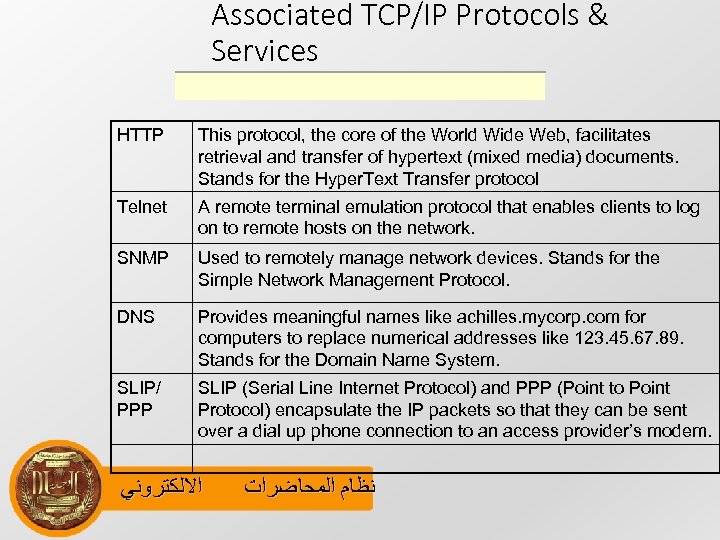 Associated TCP/IP Protocols & Services HTTP This protocol, the core of the World Wide Web, facilitates retrieval and transfer of hypertext (mixed media) documents. Stands for the Hyper. Text Transfer protocol Telnet A remote terminal emulation protocol that enables clients to log on to remote hosts on the network. SNMP Used to remotely manage network devices. Stands for the Simple Network Management Protocol. DNS Provides meaningful names like achilles. mycorp. com for computers to replace numerical addresses like 123. 45. 67. 89. Stands for the Domain Name System. SLIP/ PPP SLIP (Serial Line Internet Protocol) and PPP (Point to Point Protocol) encapsulate the IP packets so that they can be sent over a dial up phone connection to an access provider’s modem. ﺍﻻﻟﻜﺘﺮﻭﻧﻲ ﻧﻈﺎﻡ ﺍﻟﻤﺤﺎﺿﺮﺍﺕ