 Скачать презентацию Network Embedded Systems Technology NEST Extreme Scaling Experiments
e91c393cbf89a1bb5e927ad520db7e5a.ppt
- Количество слайдов: 22




Network Embedded Systems Technology (NEST) Extreme Scaling Experiments Sites Logistics Deployment Al Sciarretta CNS Technologies, Inc. 1
Topics • Sites – OSU – Wright-Patterson AFB (near Dayton, OH) – Eglin AFB (near Fort Walton Beach, FL) • Logistics • Deployment – Packaging – Shipping – Sustainment – Emplacement 2
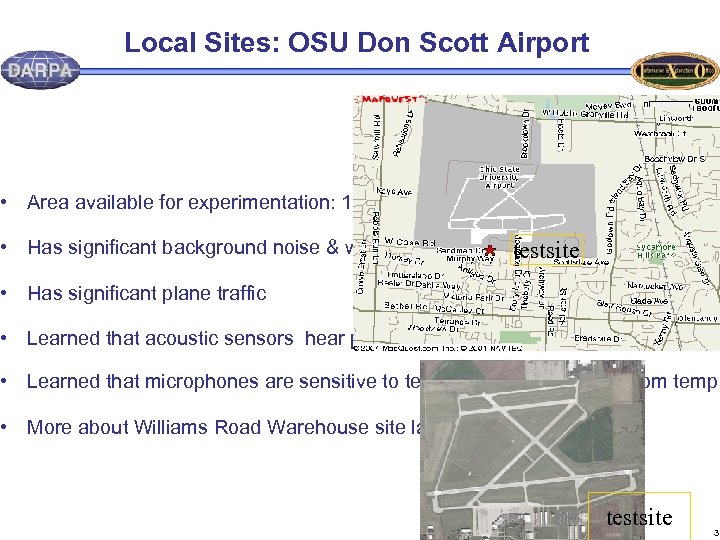
Local Sites: OSU Don Scott Airport • Area available for experimentation: 1 km x. 5 km • Has significant background noise & wind testsite • Has significant plane traffic • Learned that acoustic sensors hear planes well • Learned that microphones are sensitive to temperature too (Tuesday pm temp: • More about Williams Road Warehouse site later in IPT testsite 3
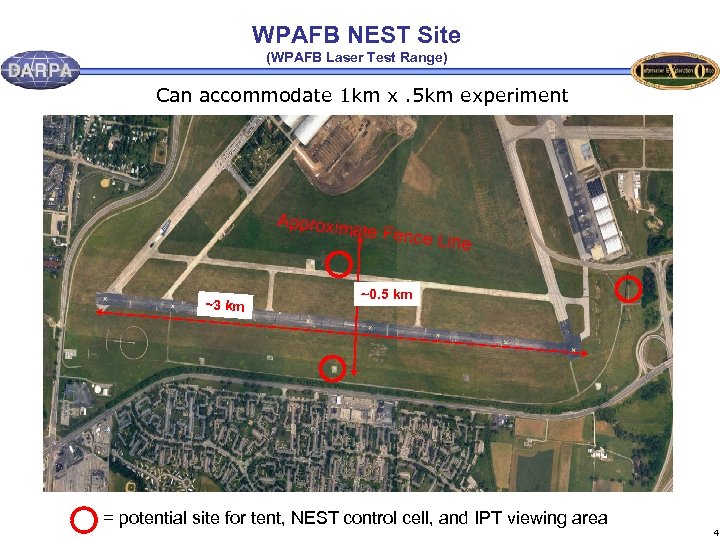
WPAFB NEST Site (WPAFB Laser Test Range) Can accommodate 1 km x. 5 km experiment Approxim ate Fence ~3 km Line ~0. 5 km = potential site for tent, NEST control cell, and IPT viewing area 4
Logistics • Experiment Execution – – – – – • Large monitor for IPT day Two-way radios (4 total) GPS device Set of binoculars Large storage container (with lock) for locking up monitor and other valuable items each night Truck for moving sensors from warehouse to site, distributing sensors, hauling food/water, etc. ATV for testing Soldier with weapon for testing Some flags/cones for marking boundaries of sensor field We may want to film some of the effort, so a video camera may be needed Tent (large – maybe 20’ x 40’) with sides that can fold down during rain and roll up during hot/clear weather – – – – Tent stakes: normal stakes for part of tent near grassy area, special stakes (or something similar) for penetrating hardstand material. Large hammer for stakes Lights for hanging inside tent Large industrial fan for blowing air into tent Tables (6’ in length): at least 5 Folding Chairs: at least 12 during normal work days (maybe more for IPT day) If not set up on hardstand, then may need plywood to place under chairs and tables 5
Logistics (continued) • Power – – Access to electrical power Extension cords/power strips Car battery chargers for charging Tier 2 batteries Generators (at least 2) – as backup (for power access above) or for primary power [NOTE: Size of generator should accommodate laptops, monitor, lights, fan, and car battery chargers • • • Food/Refreshments – – • Fuel for generators Fuel storage container Two large coolers for ice and drinks Two water jugs for ice water Food (lunch? Other? ) Paper plates, paper towels, paper cups, plastic ware, etc. Other – – – Garbage bags First aid kit Portable toilets (extra toilet paper) A heater (with fuel) for October test/experiment period Access to solder equipment for repairing sensors Mowing grass 6
Logistics (continued) • Tier-2 Sensors – – • Warehouse – – • • • Total Weight of 300 Tier-2 batteries Will tier-2 batteries create a storage problem (hazardous material) Tier-2 batteries must be completely sealed to prevent environmental hazards, safety issues, and storage issues Tier-2 batteries have to come fully charged. Need warehouse for storage of sensors and batteries when they are shipped to WPAFB Need a shipping address for the warehouse Test/experiment site is primarily thick grass. Grass should be mowed just before each test/experiment period and NOT mowed once the sensors are set up Should establish procedure for use of on-post/off-post medical facilities for emergency and non-emergency use Since a WPAFB person needs to be with NEST personnel at all times, a schedule should be set up to accommodate working other than normal working hours (e. g. , working from 7: 00 AM to 8: 00 PM) Will need access to high speed internet (e. g. , Bill’s office) for downloading/uploading NEST programs/information Crossbow shipping containers should require no more than two people for lifting/handling 7
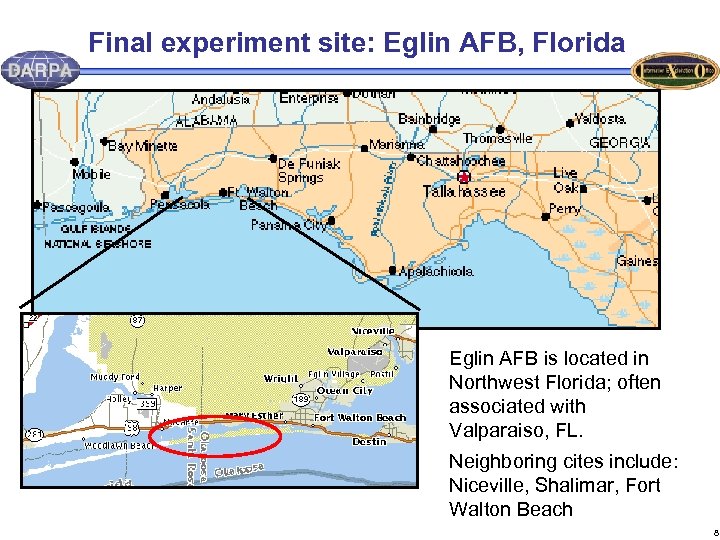
Final experiment site: Eglin AFB, Florida Eglin AFB is located in Northwest Florida; often associated with Valparaiso, FL. Neighboring cites include: Niceville, Shalimar, Fort Walton Beach 8
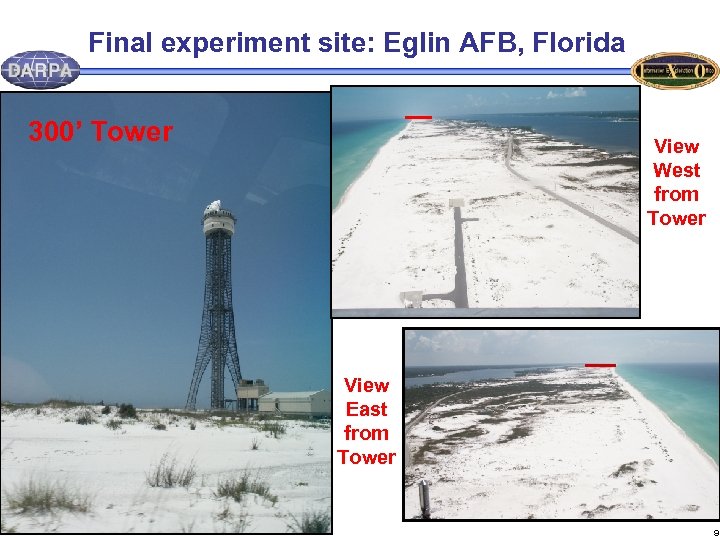
Final experiment site: Eglin AFB, Florida 300’ Tower View West from Tower View East from Tower 9
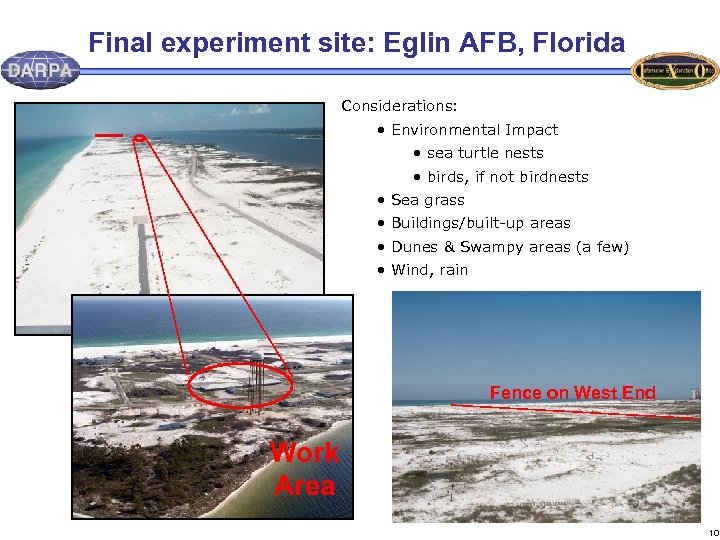
Final experiment site: Eglin AFB, Florida Considerations: • Environmental Impact • sea turtle nests • birds, if not birdnests • Sea grass • Buildings/built-up areas • Dunes & Swampy areas (a few) • Wind, rain Fence on West End Work Area 10
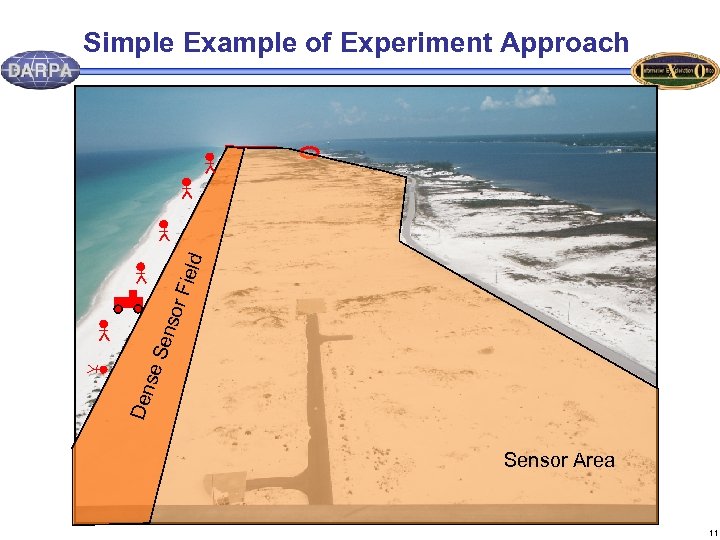
Den se S ens or F ield Simple Example of Experiment Approach Sensor Area 11
Access to Site • Airports –Okaloosa Regional Airport is on State Road 85, on Eglin AFB –Pensacola Airport is on Airport Road in Pensacola, about 60 miles from Eglin AFB • Hotels – Many “off-season” accommodations in Fort Walton Beach and nearby Niceville, Destin, and San Destin (site of next PI meeting) • Fort Walton Beach hotels are within a couple of miles of gate on east end of experiment site 12
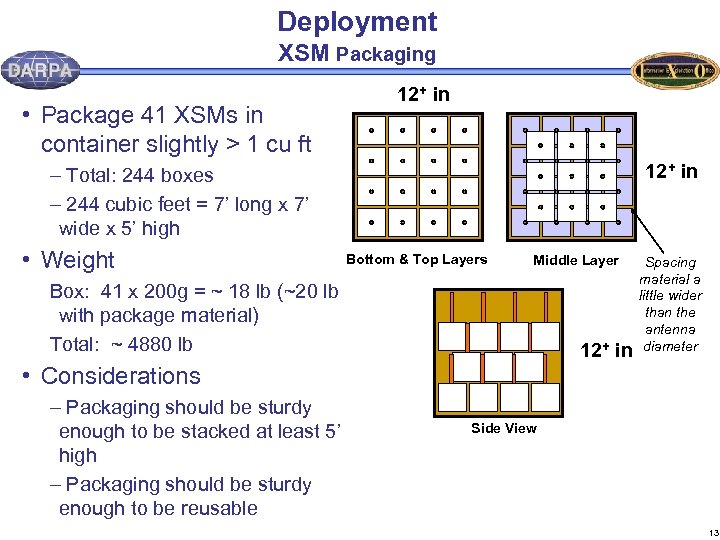
Deployment XSM Packaging • Package 41 XSMs in container slightly > 1 cu ft 12+ in – Total: 244 boxes – 244 cubic feet = 7’ long x 7’ wide x 5’ high • Weight Bottom & Top Layers Middle Layer Box: 41 x 200 g = ~ 18 lb (~20 lb with package material) Total: ~ 4880 lb 12+ in Spacing material a little wider than the antenna diameter • Considerations – Packaging should be sturdy enough to be stacked at least 5’ high – Packaging should be sturdy enough to be reusable Side View 13
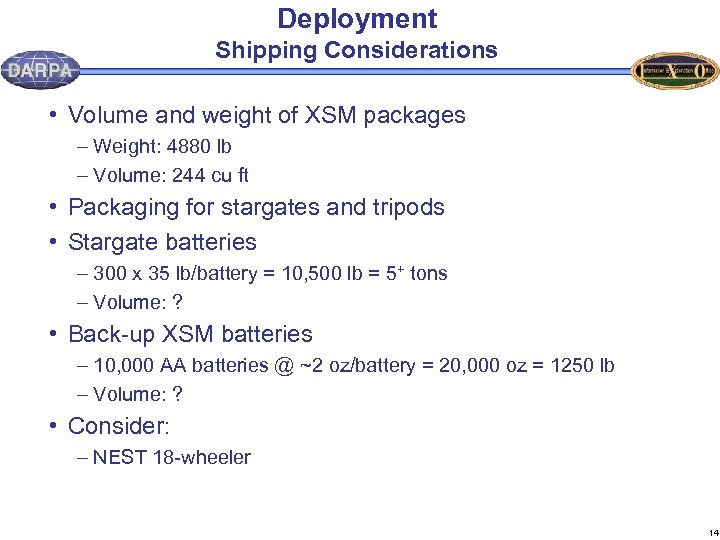
Deployment Shipping Considerations • Volume and weight of XSM packages – Weight: 4880 lb – Volume: 244 cu ft • Packaging for stargates and tripods • Stargate batteries – 300 x 35 lb/battery = 10, 500 lb = 5+ tons – Volume: ? • Back-up XSM batteries – 10, 000 AA batteries @ ~2 oz/battery = 20, 000 oz = 1250 lb – Volume: ? • Consider: – NEST 18 -wheeler 14
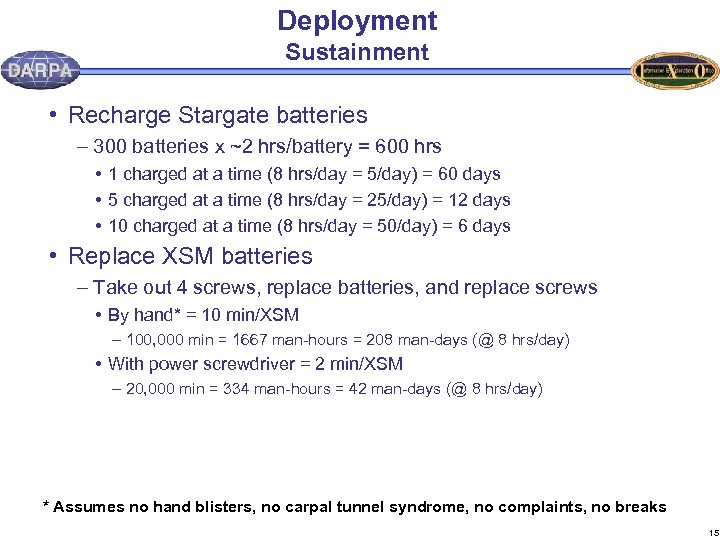
Deployment Sustainment • Recharge Stargate batteries – 300 batteries x ~2 hrs/battery = 600 hrs • 1 charged at a time (8 hrs/day = 5/day) = 60 days • 5 charged at a time (8 hrs/day = 25/day) = 12 days • 10 charged at a time (8 hrs/day = 50/day) = 6 days • Replace XSM batteries – Take out 4 screws, replace batteries, and replace screws • By hand* = 10 min/XSM – 100, 000 min = 1667 man-hours = 208 man-days (@ 8 hrs/day) • With power screwdriver = 2 min/XSM – 20, 000 min = 334 man-hours = 42 man-days (@ 8 hrs/day) * Assumes no hand blisters, no carpal tunnel syndrome, no complaints, no breaks 15
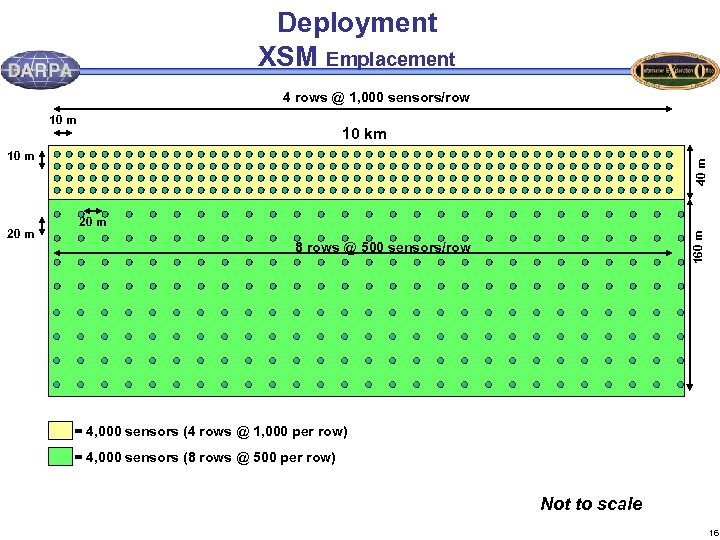
Deployment XSM Emplacement 4 rows @ 1, 000 sensors/row 10 m 10 km 20 m 160 m 20 m 40 m 10 m 8 rows @ 500 sensors/row = 4, 000 sensors (4 rows @ 1, 000 per row) = 4, 000 sensors (8 rows @ 500 per row) Not to scale 16
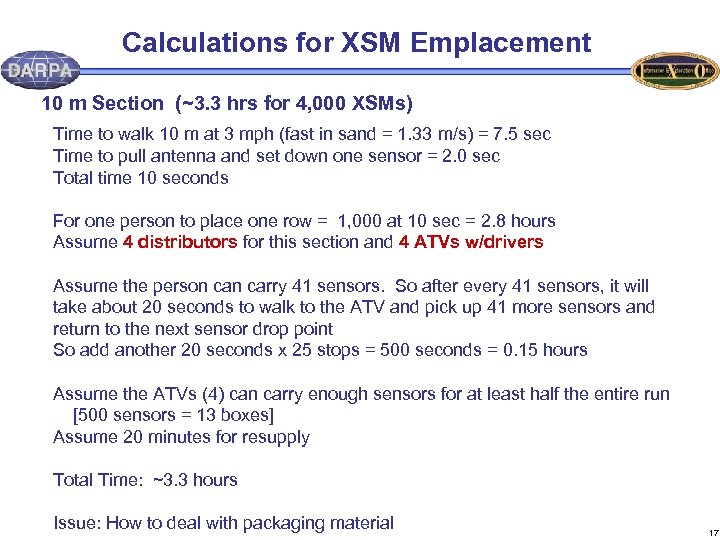
Calculations for XSM Emplacement 10 m Section (~3. 3 hrs for 4, 000 XSMs) Time to walk 10 m at 3 mph (fast in sand = 1. 33 m/s) = 7. 5 sec Time to pull antenna and set down one sensor = 2. 0 sec Total time 10 seconds For one person to place one row = 1, 000 at 10 sec = 2. 8 hours Assume 4 distributors for this section and 4 ATVs w/drivers Assume the person carry 41 sensors. So after every 41 sensors, it will take about 20 seconds to walk to the ATV and pick up 41 more sensors and return to the next sensor drop point So add another 20 seconds x 25 stops = 500 seconds = 0. 15 hours Assume the ATVs (4) can carry enough sensors for at least half the entire run [500 sensors = 13 boxes] Assume 20 minutes for resupply Total Time: ~3. 3 hours Issue: How to deal with packaging material 17
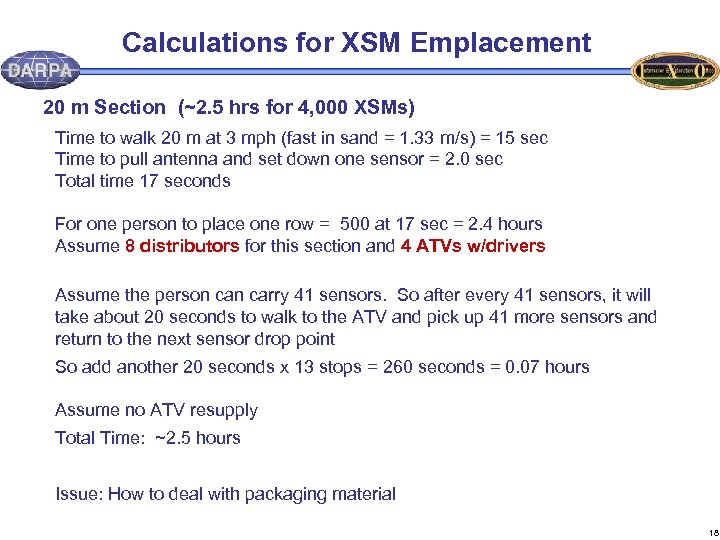
Calculations for XSM Emplacement 20 m Section (~2. 5 hrs for 4, 000 XSMs) Time to walk 20 m at 3 mph (fast in sand = 1. 33 m/s) = 15 sec Time to pull antenna and set down one sensor = 2. 0 sec Total time 17 seconds For one person to place one row = 500 at 17 sec = 2. 4 hours Assume 8 distributors for this section and 4 ATVs w/drivers Assume the person carry 41 sensors. So after every 41 sensors, it will take about 20 seconds to walk to the ATV and pick up 41 more sensors and return to the next sensor drop point So add another 20 seconds x 13 stops = 260 seconds = 0. 07 hours Assume no ATV resupply Total Time: ~2. 5 hours Issue: How to deal with packaging material 18
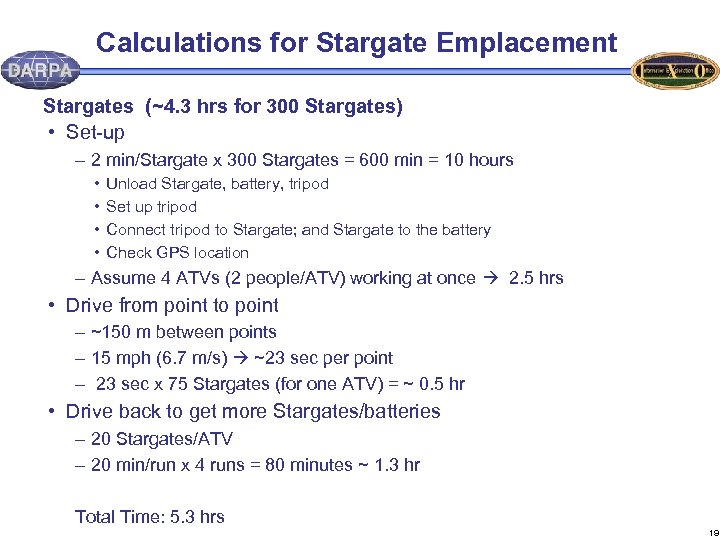
Calculations for Stargate Emplacement Stargates (~4. 3 hrs for 300 Stargates) • Set-up – 2 min/Stargate x 300 Stargates = 600 min = 10 hours • • Unload Stargate, battery, tripod Set up tripod Connect tripod to Stargate; and Stargate to the battery Check GPS location – Assume 4 ATVs (2 people/ATV) working at once 2. 5 hrs • Drive from point to point – ~150 m between points – 15 mph (6. 7 m/s) ~23 sec per point – 23 sec x 75 Stargates (for one ATV) = ~ 0. 5 hr • Drive back to get more Stargates/batteries – 20 Stargates/ATV – 20 min/run x 4 runs = 80 minutes ~ 1. 3 hr Total Time: 5. 3 hrs 19
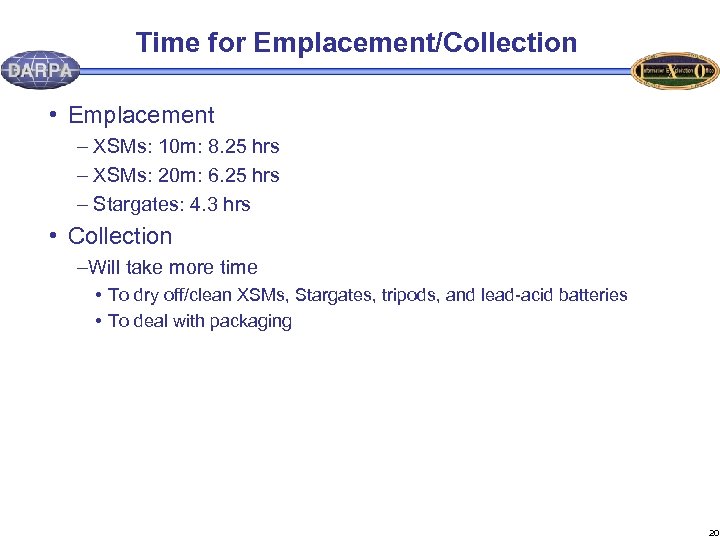
Time for Emplacement/Collection • Emplacement – XSMs: 10 m: 8. 25 hrs – XSMs: 20 m: 6. 25 hrs – Stargates: 4. 3 hrs • Collection –Will take more time • To dry off/clean XSMs, Stargates, tripods, and lead-acid batteries • To deal with packaging 20
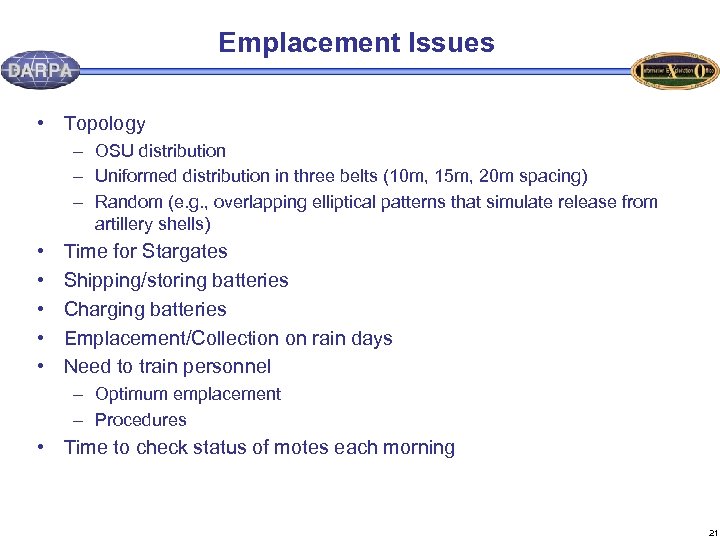
Emplacement Issues • Topology – OSU distribution – Uniformed distribution in three belts (10 m, 15 m, 20 m spacing) – Random (e. g. , overlapping elliptical patterns that simulate release from artillery shells) • • • Time for Stargates Shipping/storing batteries Charging batteries Emplacement/Collection on rain days Need to train personnel – Optimum emplacement – Procedures • Time to check status of motes each morning 21

Experiment/Demonstration Planning and Execution Al Sciarretta CNS Technologies, Inc. 703 -517 -2143 asciarretta@unconventional-inc. com 22
Скачать презентацию Network Embedded Systems Technology NEST Extreme Scaling Experiments
e91c393cbf89a1bb5e927ad520db7e5a.ppt