 Скачать презентацию Network Centric Operations Industry Consortium Approved for Public
462c1d7faf3341837c3aa611539d67d7.ppt
- Количество слайдов: 22



Network Centric Operations Industry Consortium Approved for Public Release Distribution Unlimited NCOIC-Def. Daily-KC 20100917
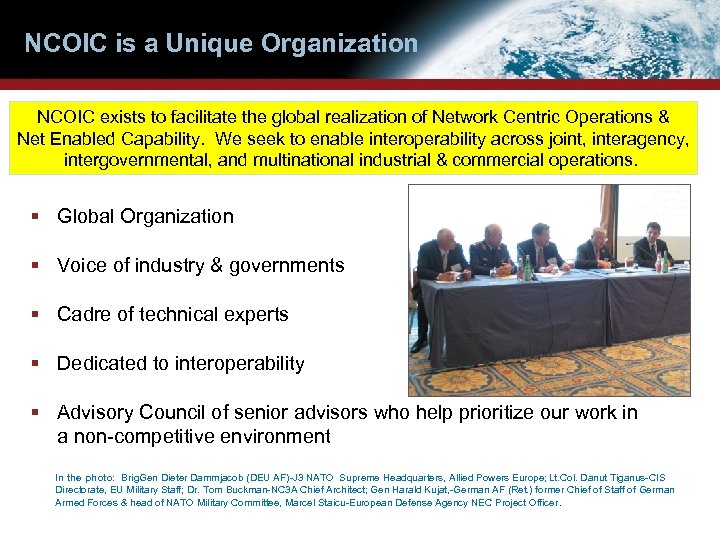
NCOIC is a Unique Organization NCOIC exists to facilitate the global realization of Network Centric Operations & Net Enabled Capability. We seek to enable interoperability across joint, interagency, intergovernmental, and multinational industrial & commercial operations. § Global Organization § Voice of industry & governments § Cadre of technical experts § Dedicated to interoperability § Advisory Council of senior advisors who help prioritize our work in a non-competitive environment In the photo: Brig. Gen Dieter Dammjacob (DEU AF)-J 3 NATO Supreme Headquarters, Allied Powers Europe; Lt. Col. Danut Tiganus-CIS Directorate, EU Military Staff; Dr. Tom Buckman-NC 3 A Chief Architect; Gen Harald Kujat, -German AF (Ret. ) former Chief of Staff of German Armed Forces & head of NATO Military Committee, Marcel Staicu-European Defense Agency NEC Project Officer.
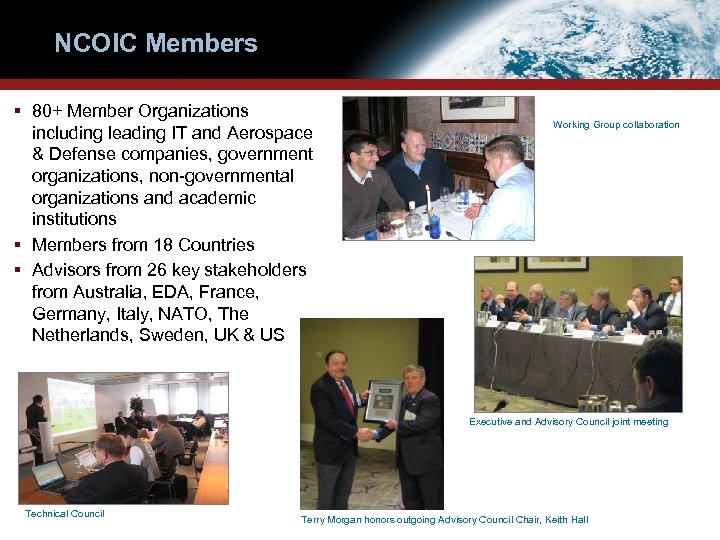
NCOIC Members § 80+ Member Organizations including leading IT and Aerospace & Defense companies, government organizations, non-governmental organizations and academic institutions § Members from 18 Countries § Advisors from 26 key stakeholders from Australia, EDA, France, Germany, Italy, NATO, The Netherlands, Sweden, UK & US Working Group collaboration Executive and Advisory Council joint meeting Technical Council Terry Morgan honors outgoing Advisory Council Chair, Keith Hall
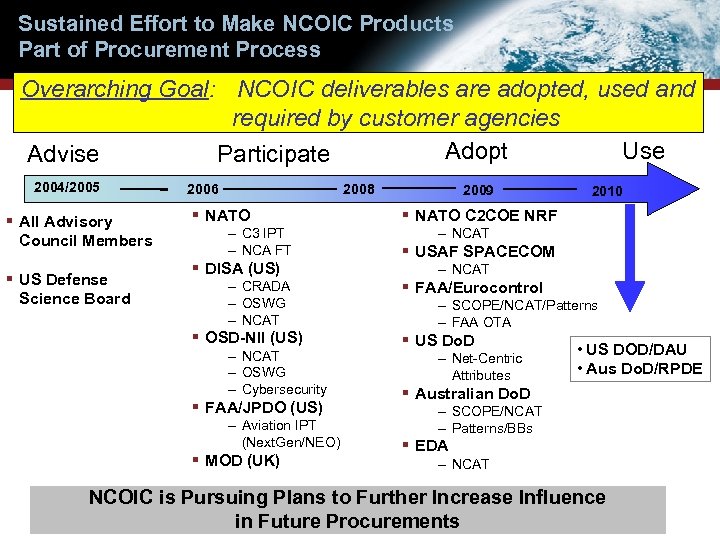
Sustained Effort to Make NCOIC Products Part of Procurement Process Overarching Goal: NCOIC deliverables are adopted, used and required by customer agencies Adopt Use Participate Advise 2004/2005 § All Advisory Council Members § US Defense Science Board 2006 2008 § NATO – C 3 IPT – NCA FT § DISA (US) – CRADA – OSWG – NCAT § OSD-NII (US) – NCAT – OSWG – Cybersecurity § FAA/JPDO (US) – Aviation IPT (Next. Gen/NEO) § MOD (UK) 2009 2010 § NATO C 2 COE NRF – NCAT § USAF SPACECOM – NCAT § FAA/Eurocontrol – SCOPE/NCAT/Patterns – FAA OTA § US Do. D – Net-Centric Attributes • US DOD/DAU • Aus Do. D/RPDE § Australian Do. D – SCOPE/NCAT – Patterns/BBs § EDA – NCAT NCOIC is Pursuing Plans to Further Increase Influence in Future Procurements
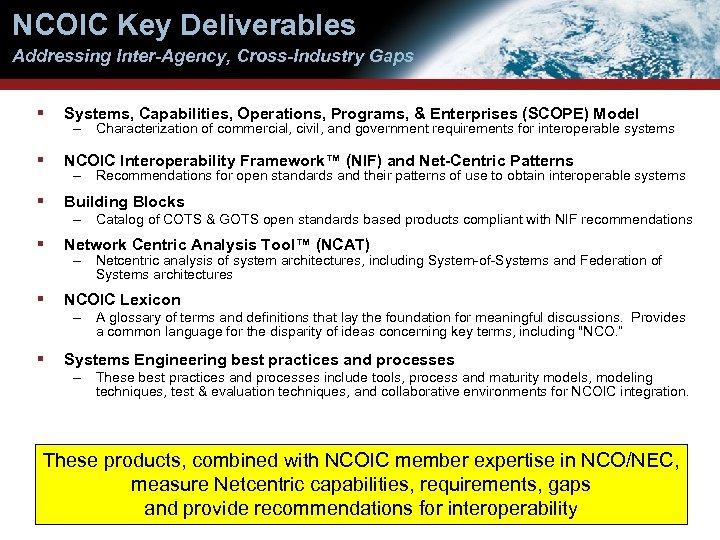
NCOIC Key Deliverables Addressing Inter-Agency, Cross-Industry Gaps § Systems, Capabilities, Operations, Programs, & Enterprises (SCOPE) Model § NCOIC Interoperability Framework™ (NIF) and Net-Centric Patterns § Building Blocks § Network Centric Analysis Tool™ (NCAT) § NCOIC Lexicon § Systems Engineering best practices and processes – Characterization of commercial, civil, and government requirements for interoperable systems – Recommendations for open standards and their patterns of use to obtain interoperable systems – Catalog of COTS & GOTS open standards based products compliant with NIF recommendations – Netcentric analysis of system architectures, including System-of-Systems and Federation of Systems architectures – A glossary of terms and definitions that lay the foundation for meaningful discussions. Provides a common language for the disparity of ideas concerning key terms, including "NCO. “ – These best practices and processes include tools, process and maturity models, modeling techniques, test & evaluation techniques, and collaborative environments for NCOIC integration. These products, combined with NCOIC member expertise in NCO/NEC, measure Netcentric capabilities, requirements, gaps and provide recommendations for interoperability
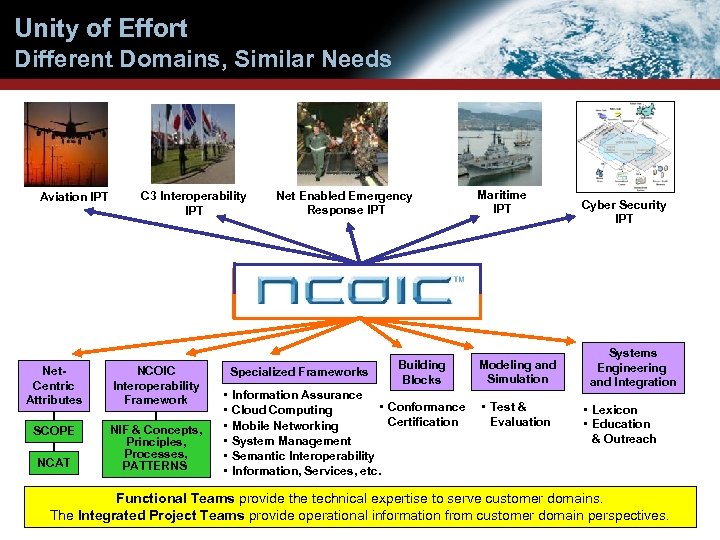
Unity of Effort Different Domains, Similar Needs Aviation IPT C 3 Interoperability IPT Net. Centric Attributes NCOIC Interoperability Framework SCOPE NIF & Concepts, Principles, Processes, PATTERNS NCAT Net Enabled Emergency Response IPT Specialized Frameworks • • • Building Blocks Information Assurance • Conformance Cloud Computing Certification Mobile Networking System Management Semantic Interoperability Information, Services, etc. Maritime IPT Modeling and Simulation • Test & Evaluation Cyber Security IPT Systems Engineering and Integration • Lexicon • Education & Outreach Functional Teams provide the technical expertise to serve customer domains. The Integrated Project Teams provide operational information from customer domain perspectives.
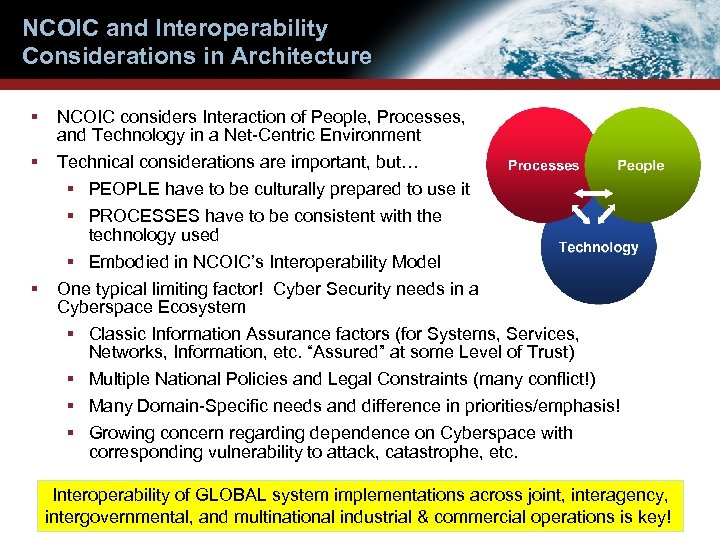
NCOIC and Interoperability Considerations in Architecture § § § NCOIC considers Interaction of People, Processes, and Technology in a Net-Centric Environment Technical considerations are important, but… § PEOPLE have to be culturally prepared to use it § PROCESSES have to be consistent with the technology used § Embodied in NCOIC’s Interoperability Model One typical limiting factor! Cyber Security needs in a Cyberspace Ecosystem § Classic Information Assurance factors (for Systems, Services, Networks, Information, etc. “Assured” at some Level of Trust) § Multiple National Policies and Legal Constraints (many conflict!) § Many Domain-Specific needs and difference in priorities/emphasis! § Growing concern regarding dependence on Cyberspace with corresponding vulnerability to attack, catastrophe, etc. Interoperability of GLOBAL system implementations across joint, interagency, intergovernmental, and multinational industrial & commercial operations is key!
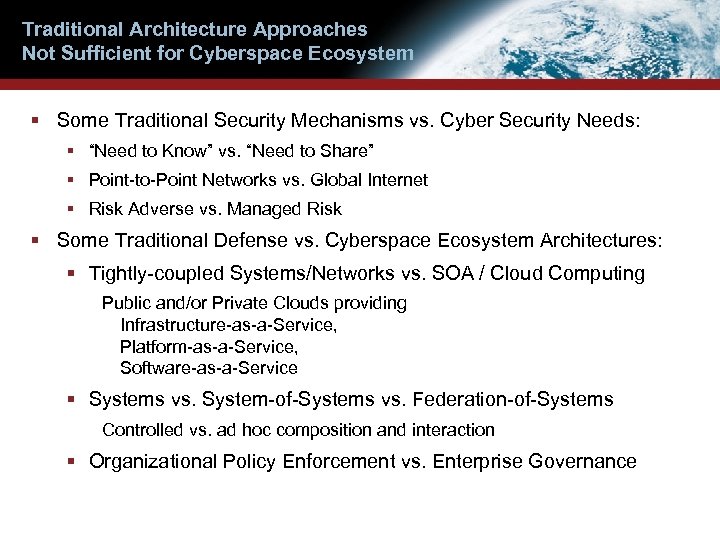
Traditional Architecture Approaches Not Sufficient for Cyberspace Ecosystem § Some Traditional Security Mechanisms vs. Cyber Security Needs: § “Need to Know” vs. “Need to Share” § Point-to-Point Networks vs. Global Internet § Risk Adverse vs. Managed Risk § Some Traditional Defense vs. Cyberspace Ecosystem Architectures: § Tightly-coupled Systems/Networks vs. SOA / Cloud Computing Public and/or Private Clouds providing Infrastructure-as-a-Service, Platform-as-a-Service, Software-as-a-Service § Systems vs. System-of-Systems vs. Federation-of-Systems Controlled vs. ad hoc composition and interaction § Organizational Policy Enforcement vs. Enterprise Governance
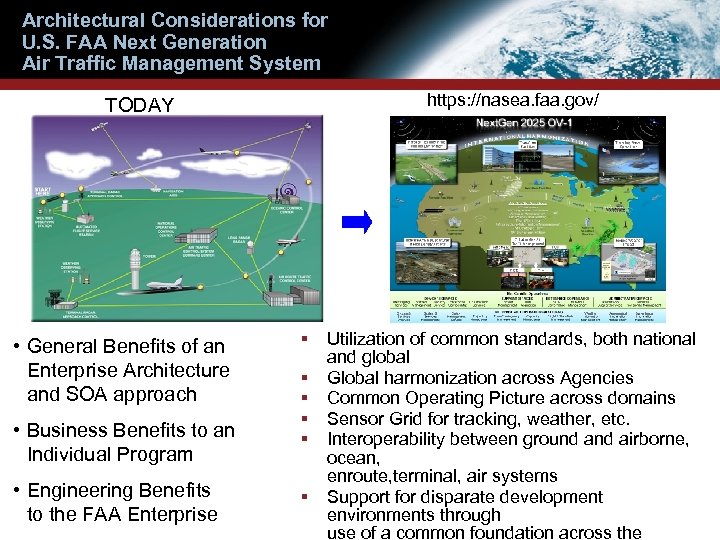
Architectural Considerations for U. S. FAA Next Generation Air Traffic Management System https: //nasea. faa. gov/ TODAY • General Benefits of an Enterprise Architecture and SOA approach • Business Benefits to an Individual Program • Engineering Benefits to the FAA Enterprise § § § Utilization of common standards, both national and global Global harmonization across Agencies Common Operating Picture across domains Sensor Grid for tracking, weather, etc. Interoperability between ground airborne, ocean, enroute, terminal, air systems Support for disparate development environments through use of a common foundation across the
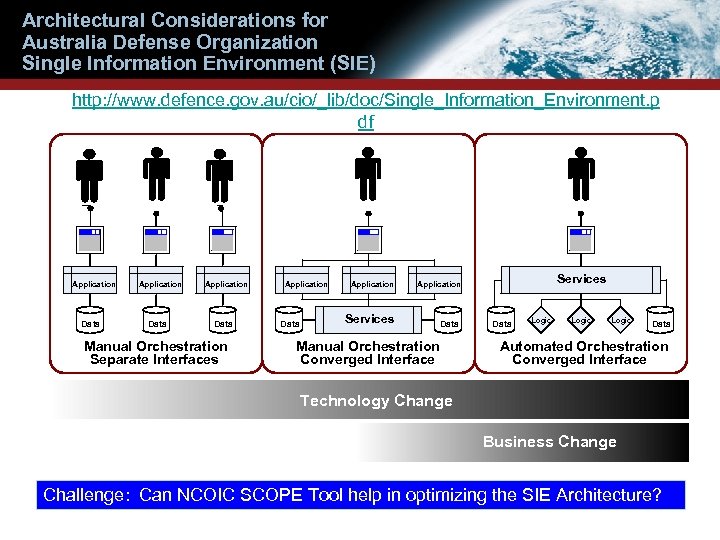
Architectural Considerations for Australia Defense Organization Single Information Environment (SIE) http: //www. defence. gov. au/cio/_lib/doc/Single_Information_Environment. p df Application Data Manual Orchestration Separate Interfaces Application Data Application Services Data Services Application Manual Orchestration Converged Interface Data Logic Data Automated Orchestration Converged Interface Technology Change Business Change Challenge: Can NCOIC SCOPE Tool help in optimizing the SIE Architecture?
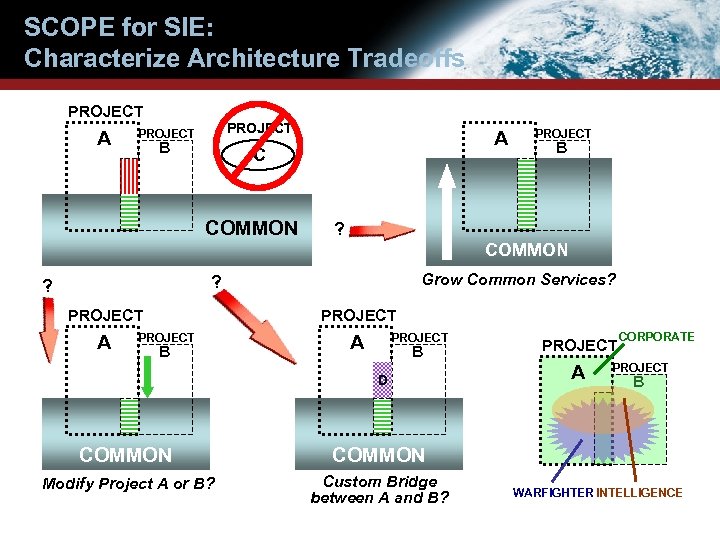
SCOPE for SIE: Characterize Architecture Tradeoffs PROJECT A PROJECT B A C COMMON PROJECT B ? COMMON Grow Common Services? ? ? PROJECT A PROJECT B PROJECT A B D COMMON Custom Bridge between A and B? A CORPORATE PROJECT B COMMON Modify Project A or B? PROJECT WARFIGHTER INTELLIGENCE
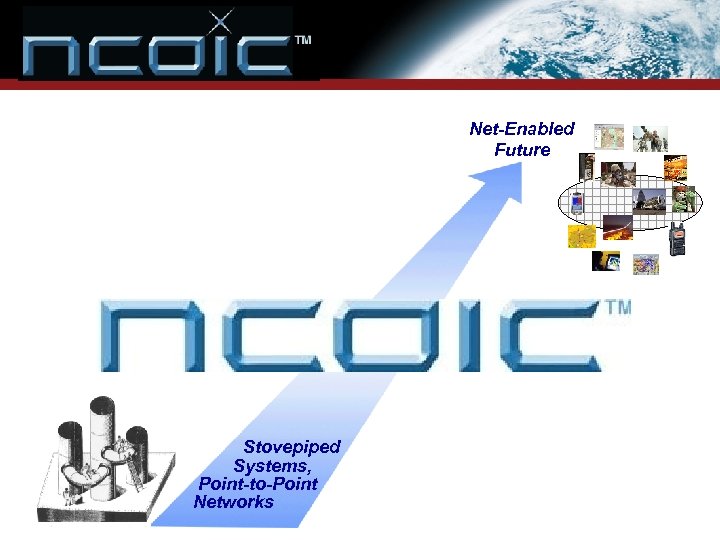
Net-Enabled Future Stovepiped Systems, Point-to-Point Networks

BACK UP
Why NCOIC is Good for Business § Provides direct access to broad global customer base at the highest level, and entrée to others through NCOIC relationships § Provides access to potential partners, suppliers and competitors for NCO business § Illustrates global thought leadership & consensus with international stakeholders on NCO/NEC – No compromise of national or alliance interests § Industry consensus on NCO standards beneath the application layer reduces cost, provides for more efficient design and effective partnering § Certification program will validate interoperability of systems within defined parameters “Like organizations that pioneered the Internet, NCOIC sponsors innovative thought, conducts critical analyses, and demonstrates how a net-centric environment can bring interoperability to a broad range of sectors. In this way, NCOIC helps member companies to find new markets, evaluate their unique needs and explore ways to drive interoperability into those markets. ” Terry Morgan, Cisco.
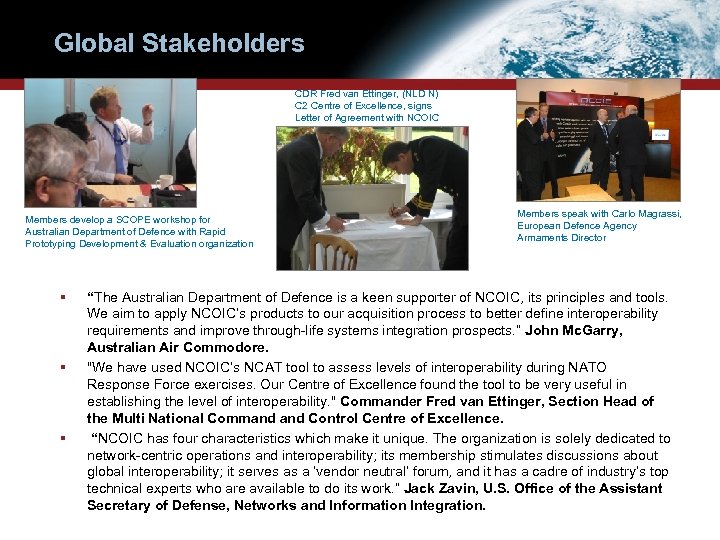
Global Stakeholders CDR Fred van Ettinger, (NLD N) C 2 Centre of Excellence, signs Letter of Agreement with NCOIC Members develop a SCOPE workshop for Australian Department of Defence with Rapid Prototyping Development & Evaluation organization § § § Members speak with Carlo Magrassi, European Defence Agency Armaments Director “The Australian Department of Defence is a keen supporter of NCOIC, its principles and tools. We aim to apply NCOIC’s products to our acquisition process to better define interoperability requirements and improve through-life systems integration prospects. ” John Mc. Garry, Australian Air Commodore. "We have used NCOIC’s NCAT tool to assess levels of interoperability during NATO Response Force exercises. Our Centre of Excellence found the tool to be very useful in establishing the level of interoperability. " Commander Fred van Ettinger, Section Head of the Multi National Command Control Centre of Excellence. “NCOIC has four characteristics which make it unique. The organization is solely dedicated to network-centric operations and interoperability; its membership stimulates discussions about global interoperability; it serves as a ‘vendor neutral’ forum, and it has a cadre of industry’s top technical experts who are available to do its work. ” Jack Zavin, U. S. Office of the Assistant Secretary of Defense, Networks and Information Integration.
Benefits of Membership § § § “From NCOIC members and senior government advisors, we continue to learn how to improve the world we know today. And we are overwhelmed with opportunities to see the way networkcentric operations can shape the future. ” USAF Lt. Gen. (Ret. ) Harry Raduege, Chairman of the Deloitte Center for Cyber Innovation. “Consortium leaders gain insight about the direction of a customer’s vision and the potential network-centric business opportunity, ” he says. “They’re in a better position to see the future, take a hand in shaping it and place their company’s bets on new solutions, more precisely. ” Terry Morgan, Cisco. “People who operate in one market segment adopt a model about how the world works--that can lead to a mental rut. But NCOIC members come from many sectors and have opinions that don’t always agree with your own. Within the context of such a collaborative environment, diverse thinking can be a catalyst for innovation. ” Hans Polzer, Senior Fellow, Lockheed Martin. “Achieving interoperability among systems is huge work and there are national political barriers. When NCOIC members work together as transnational companies these obstacles diminish— even though the companies can only discuss non-sensitive issues— but they can focus on real technical difficulties. NCOIC is then by far the best forum for ongoing conversations about interoperability. Outside this forum, when national customers have more influence, such collaboration would be much more difficult. ” Dr. Claude Roche, EADS Defence & Security and NCOIC Executive Council member. “We are a global society and the next series of potential problems—civil wars, scarce water, food shortages, pandemics, cyber warfare—cannot be resolved by one nation. To avoid catastrophic outcomes our only chance is to cooperate. We have incredible motivation to work together and NCOIC is making significant contributions to the technological foundation that will help nations collaborate. ” Brett Biddington, Cisco Systems’Global Government Solutions Group.
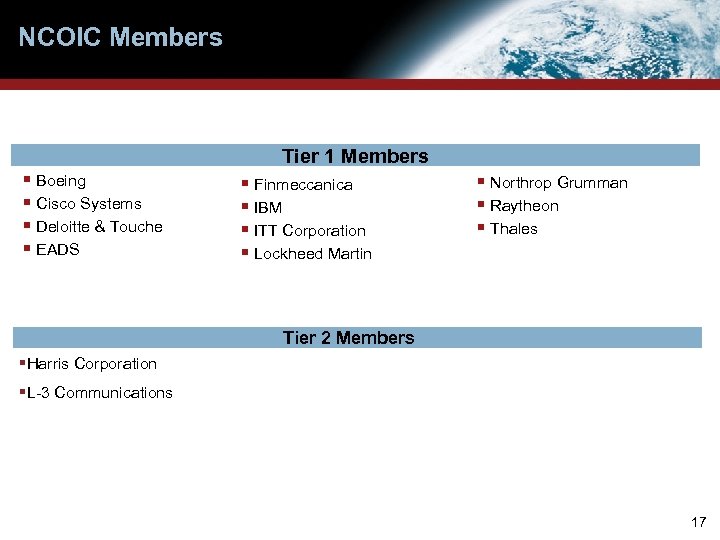
NCOIC Members Tier 1 Members § Boeing § Cisco Systems § Deloitte & Touche § EADS § Finmeccanica § IBM § ITT Corporation § Lockheed Martin § Northrop Grumman § Raytheon § Thales Tier 2 Members §Harris Corporation §L-3 Communications 17
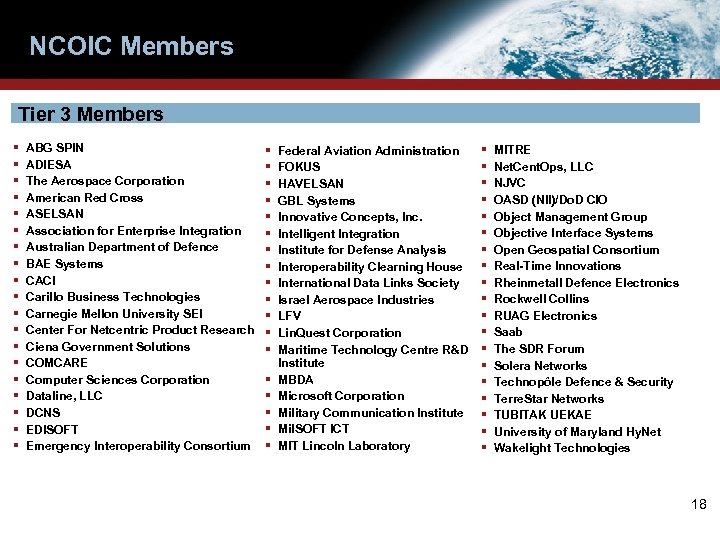
NCOIC Members Tier 3 Members § § § § § ABG SPIN ADIESA The Aerospace Corporation American Red Cross ASELSAN Association for Enterprise Integration Australian Department of Defence BAE Systems CACI Carillo Business Technologies Carnegie Mellon University SEI Center For Netcentric Product Research Ciena Government Solutions COMCARE Computer Sciences Corporation Dataline, LLC DCNS EDISOFT Emergency Interoperability Consortium § § § § § Federal Aviation Administration FOKUS HAVELSAN GBL Systems Innovative Concepts, Inc. Intelligent Integration Institute for Defense Analysis Interoperability Clearning House International Data Links Society Israel Aerospace Industries LFV Lin. Quest Corporation Maritime Technology Centre R&D Institute MBDA Microsoft Corporation Military Communication Institute Mil. SOFT ICT MIT Lincoln Laboratory § § § § § MITRE Net. Cent. Ops, LLC NJVC OASD (NII)/Do. D CIO Object Management Group Objective Interface Systems Open Geospatial Consortium Real-Time Innovations Rheinmetall Defence Electronics Rockwell Collins RUAG Electronics Saab The SDR Forum Solera Networks Technopôle Defence & Security Terre. Star Networks TUBITAK UEKAE University of Maryland Hy. Net Wakelight Technologies 18
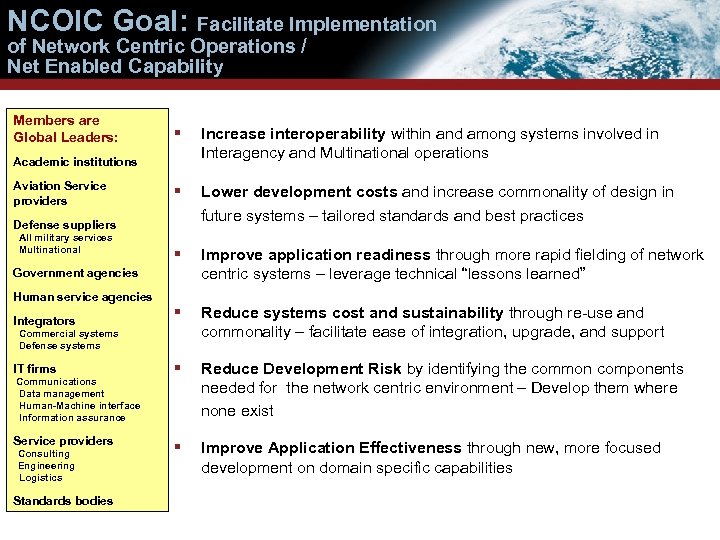
NCOIC Goal: Facilitate Implementation of Network Centric Operations / Net Enabled Capability Members are Global Leaders: § Academic institutions Aviation Service providers Defense suppliers All military services Multinational § Lower development costs and increase commonality of design in future systems – tailored standards and best practices § Improve application readiness through more rapid fielding of network centric systems – leverage technical “lessons learned” § Reduce systems cost and sustainability through re-use and commonality – facilitate ease of integration, upgrade, and support Government agencies Human service agencies Integrators Commercial systems Defense systems IT firms Communications Data management Human-Machine interface Information assurance Service providers Consulting Engineering Logistics Standards bodies Increase interoperability within and among systems involved in Interagency and Multinational operations § Reduce Development Risk by identifying the common components needed for the network centric environment – Develop them where none exist § Improve Application Effectiveness through new, more focused development on domain specific capabilities
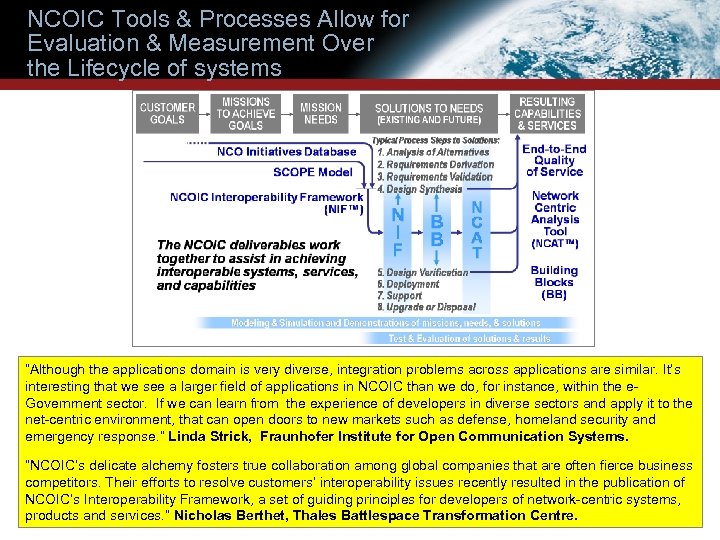
NCOIC Tools & Processes Allow for Evaluation & Measurement Over the Lifecycle of systems “Although the applications domain is very diverse, integration problems across applications are similar. It’s interesting that we see a larger field of applications in NCOIC than we do, for instance, within the e. Government sector. If we can learn from the experience of developers in diverse sectors and apply it to the net-centric environment, that can open doors to new markets such as defense, homeland security and emergency response. ” Linda Strick, Fraunhofer Institute for Open Communication Systems. “NCOIC’s delicate alchemy fosters true collaboration among global companies that are often fierce business competitors. Their efforts to resolve customers’ interoperability issues recently resulted in the publication of NCOIC’s Interoperability Framework, a set of guiding principles for developers of network-centric systems, products and services. ” Nicholas Berthet, Thales Battlespace Transformation Centre.
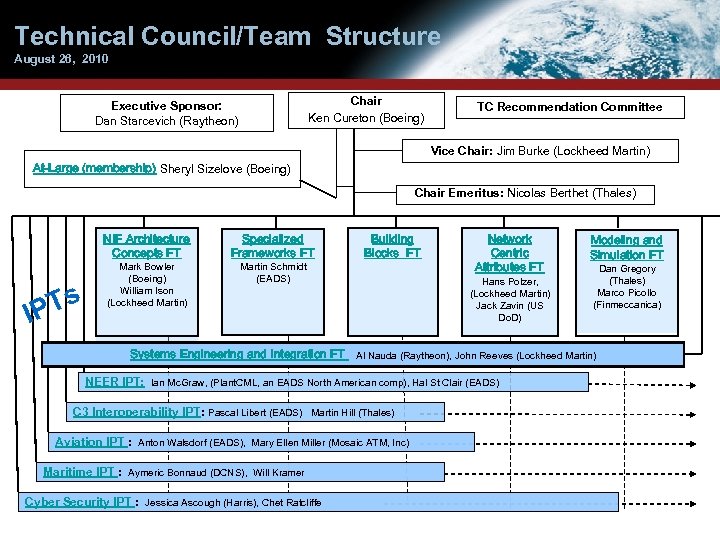
Technical Council/Team Structure August 26, 2010 Chair Ken Cureton (Boeing) Executive Sponsor: Dan Starcevich (Raytheon) TC Recommendation Committee Vice Chair: Jim Burke (Lockheed Martin) At-Large (membership) Sheryl Sizelove (Boeing) Chair Emeritus: Nicolas Berthet (Thales) NIF Architecture Concepts FT Ts IP Specialized Frameworks FT Mark Bowler (Boeing) William Ison (Lockheed Martin) Martin Schmidt (EADS) Building Blocks FT Network Centric Attributes FT Hans Polzer, (Lockheed Martin) Jack Zavin (US Do. D) Modeling and Simulation FT Dan Gregory (Thales) Marco Picollo (Finmeccanica) Systems Engineering and Integration FT Al Nauda (Raytheon), John Reeves (Lockheed Martin) NEER IPT: Ian Mc. Graw, (Plant. CML, an EADS North American comp), Hal St Clair (EADS) C 3 Interoperability IPT: Pascal Libert (EADS) Martin Hill (Thales) Aviation IPT : Anton Walsdorf (EADS), Mary Ellen Miller (Mosaic ATM, Inc) Maritime IPT : Aymeric Bonnaud (DCNS), Will Kramer Cyber Security IPT : Jessica Ascough (Harris), Chet Ratcliffe
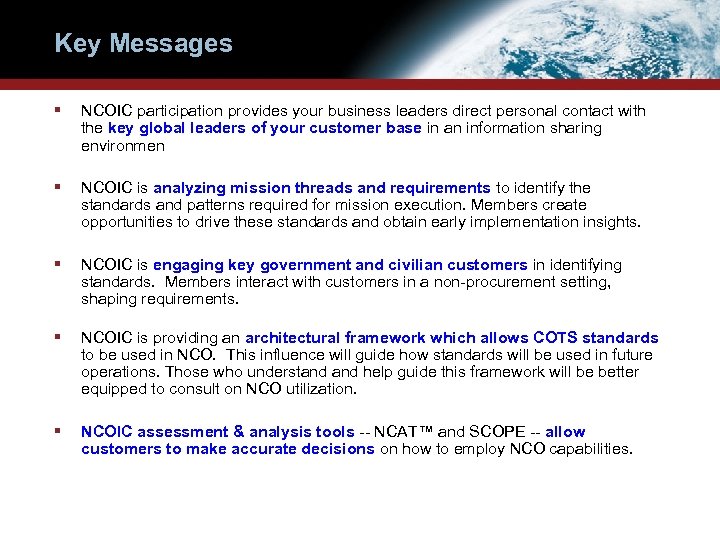
Key Messages § NCOIC participation provides your business leaders direct personal contact with the key global leaders of your customer base in an information sharing environmen § NCOIC is analyzing mission threads and requirements to identify the standards and patterns required for mission execution. Members create opportunities to drive these standards and obtain early implementation insights. § NCOIC is engaging key government and civilian customers in identifying standards. Members interact with customers in a non-procurement setting, shaping requirements. § NCOIC is providing an architectural framework which allows COTS standards to be used in NCO. This influence will guide how standards will be used in future operations. Those who understand help guide this framework will be better equipped to consult on NCO utilization. § NCOIC assessment & analysis tools -- NCAT™ and SCOPE -- allow customers to make accurate decisions on how to employ NCO capabilities.
Скачать презентацию Network Centric Operations Industry Consortium Approved for Public
462c1d7faf3341837c3aa611539d67d7.ppt