 Скачать презентацию Network builder s checklist for rules and regulation Licencing
01ebeb8ec71db3803b1e1a0d06766896.ppt
- Количество слайдов: 22



Network builder’s checklist for rules and regulation Licencing Spectrum Other laws IPR Approvals Standards IOP System planning 28. 10. 2005 Risto Toikkanen EADS Secure Networks
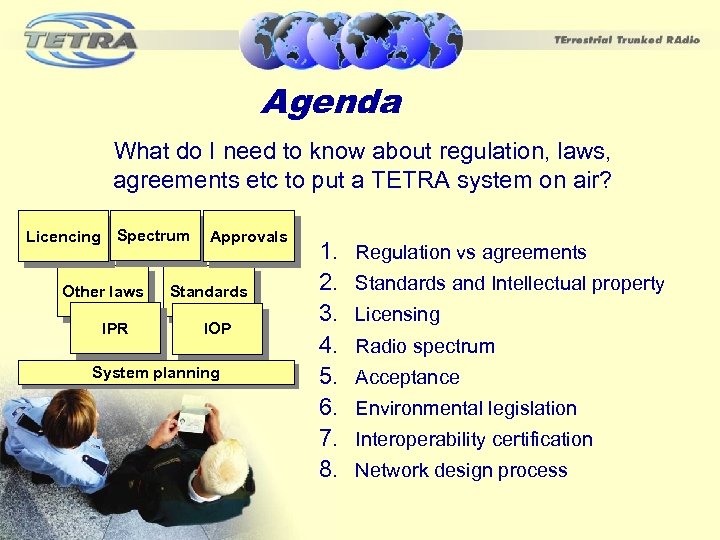
Agenda What do I need to know about regulation, laws, agreements etc to put a TETRA system on air? Licencing Spectrum Other laws IPR Approvals Standards IOP System planning 1. 2. 3. 4. 5. 6. 7. 8. Regulation vs agreements Standards and Intellectual property Licensing Radio spectrum Acceptance Environmental legislation Interoperability certification Network design process
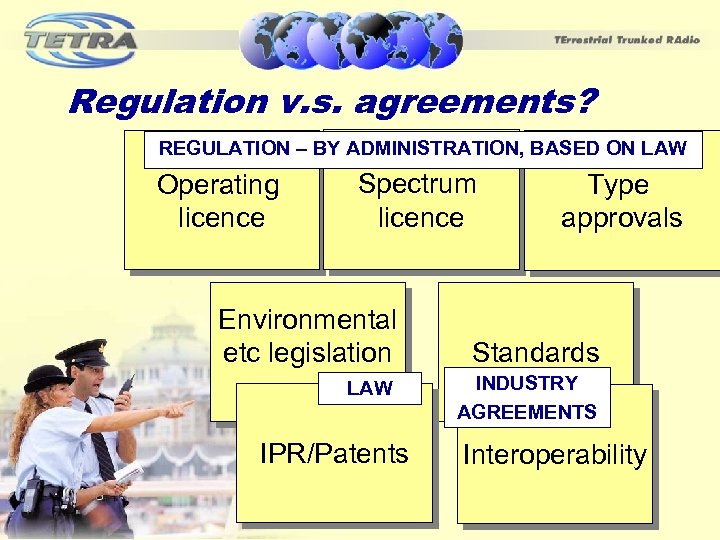
Regulation v. s. agreements? REGULATION – BY ADMINISTRATION, BASED ON LAW Operating licence Spectrum licence Environmental etc legislation LAW IPR/Patents Type approvals Standards INDUSTRY AGREEMENTS Interoperability
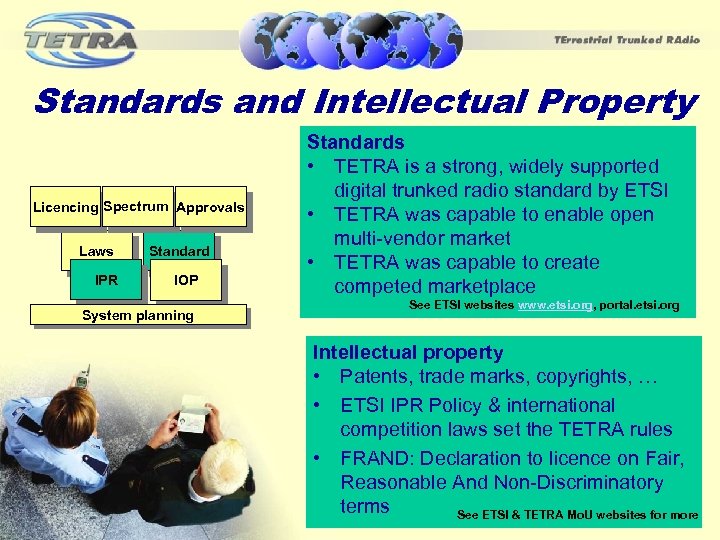
Standards and Intellectual Property Licencing Spectrum Approvals Laws IPR Standard IOP System planning Standards • TETRA is a strong, widely supported digital trunked radio standard by ETSI • TETRA was capable to enable open multi-vendor market • TETRA was capable to create competed marketplace See ETSI websites www. etsi. org, portal. etsi. org Intellectual property • Patents, trade marks, copyrights, … • ETSI IPR Policy & international competition laws set the TETRA rules • FRAND: Declaration to licence on Fair, Reasonable And Non-Discriminatory terms See ETSI & TETRA Mo. U websites for more
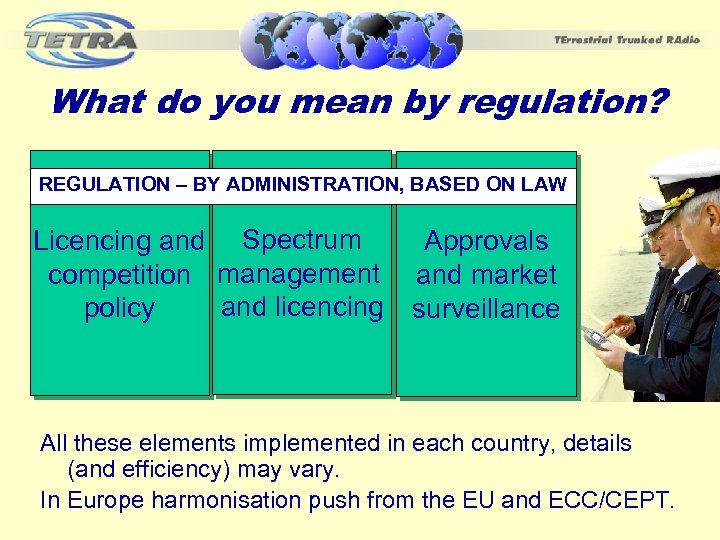
What do you mean by regulation? REGULATION – BY ADMINISTRATION, BASED ON LAW Licencing and Spectrum competition management and licencing policy Approvals and market surveillance All these elements implemented in each country, details (and efficiency) may vary. In Europe harmonisation push from the EU and ECC/CEPT.
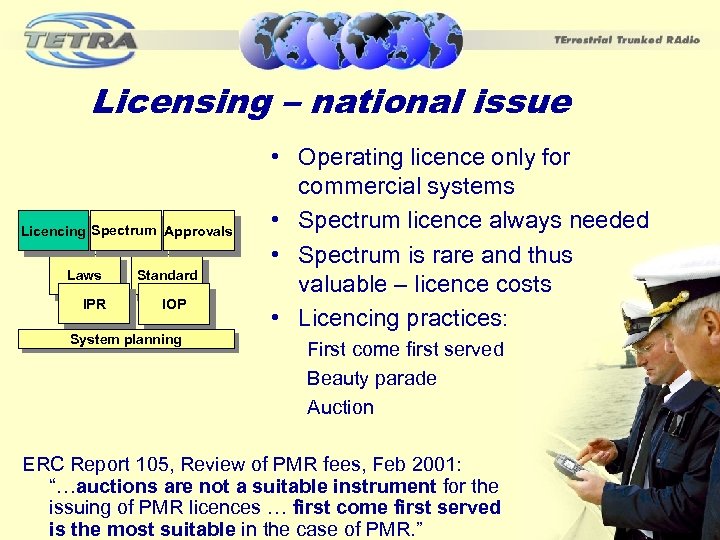
Licensing – national issue Licencing Spectrum Approvals Laws IPR Standard IOP System planning • Operating licence only for commercial systems • Spectrum licence always needed • Spectrum is rare and thus valuable – licence costs • Licencing practices: First come first served Beauty parade Auction ERC Report 105, Review of PMR fees, Feb 2001: “…auctions are not a suitable instrument for the issuing of PMR licences … first come first served is the most suitable in the case of PMR. ”
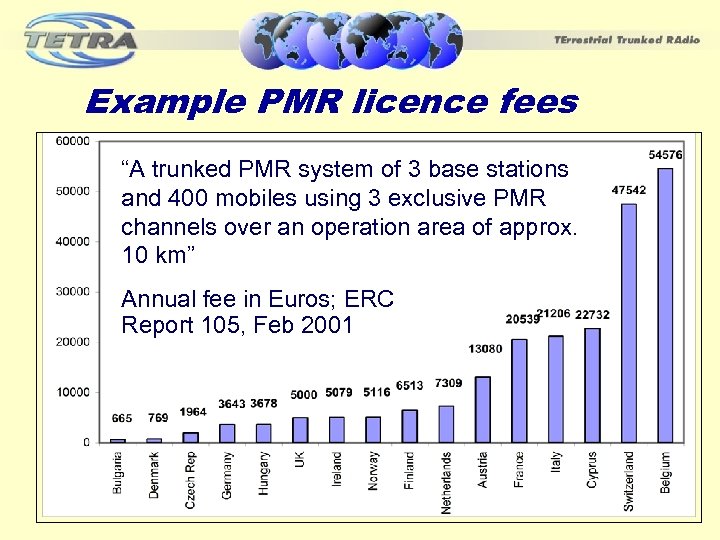
Example PMR licence fees “A trunked PMR system of 3 base stations and 400 mobiles using 3 exclusive PMR channels over an operation area of approx. 10 km” Annual fee in Euros; ERC Report 105, Feb 2001
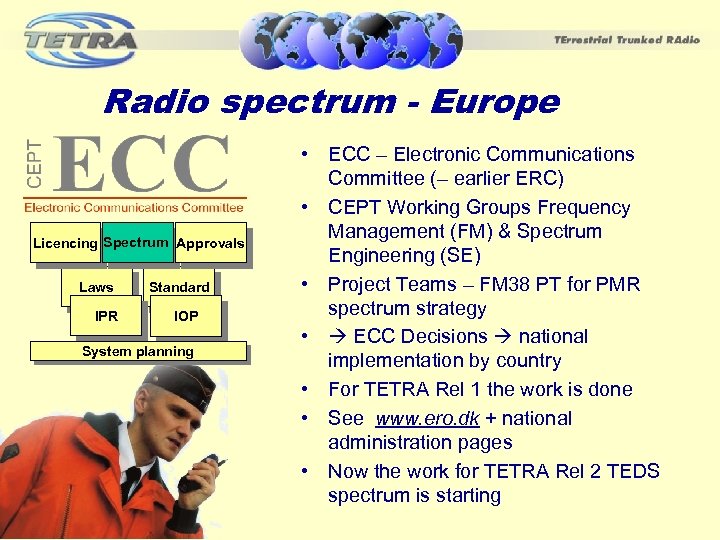
Radio spectrum - Europe Licencing Spectrum Approvals Laws IPR Standard IOP System planning • ECC – Electronic Communications Committee (– earlier ERC) • CEPT Working Groups Frequency Management (FM) & Spectrum Engineering (SE) • Project Teams – FM 38 PT for PMR spectrum strategy • ECC Decisions national implementation by country • For TETRA Rel 1 the work is done • See www. ero. dk + national administration pages • Now the work for TETRA Rel 2 TEDS spectrum is starting
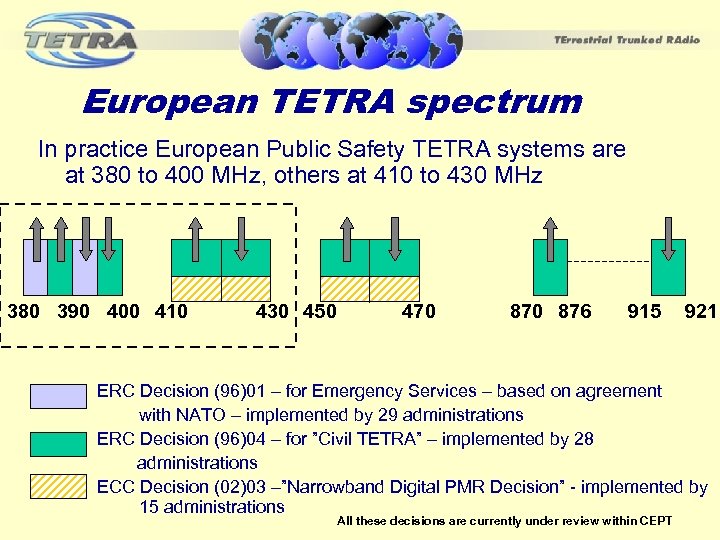
European TETRA spectrum In practice European Public Safety TETRA systems are at 380 to 400 MHz, others at 410 to 430 MHz 380 390 400 410 430 450 470 876 915 921 ERC Decision (96)01 – for Emergency Services – based on agreement with NATO – implemented by 29 administrations ERC Decision (96)04 – for ”Civil TETRA” – implemented by 28 administrations ECC Decision (02)03 –”Narrowband Digital PMR Decision” - implemented by 15 administrations All these decisions are currently under review within CEPT
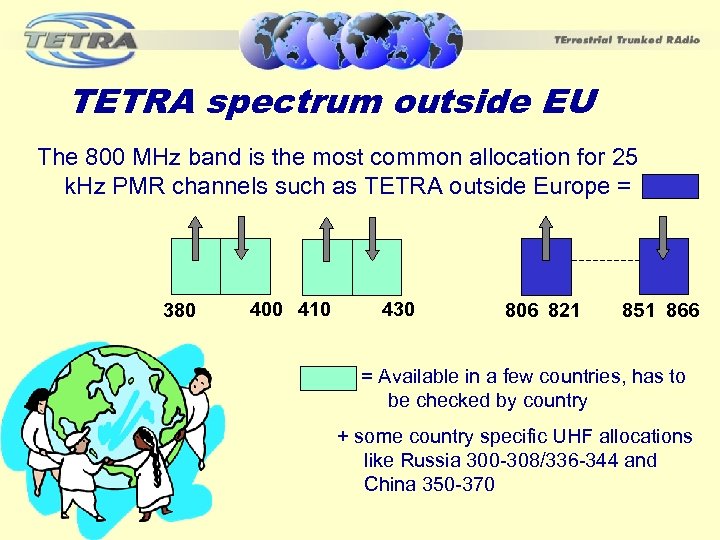
TETRA spectrum outside EU The 800 MHz band is the most common allocation for 25 k. Hz PMR channels such as TETRA outside Europe = 380 400 410 430 806 821 851 866 = Available in a few countries, has to be checked by country + some country specific UHF allocations like Russia 300 -308/336 -344 and China 350 -370
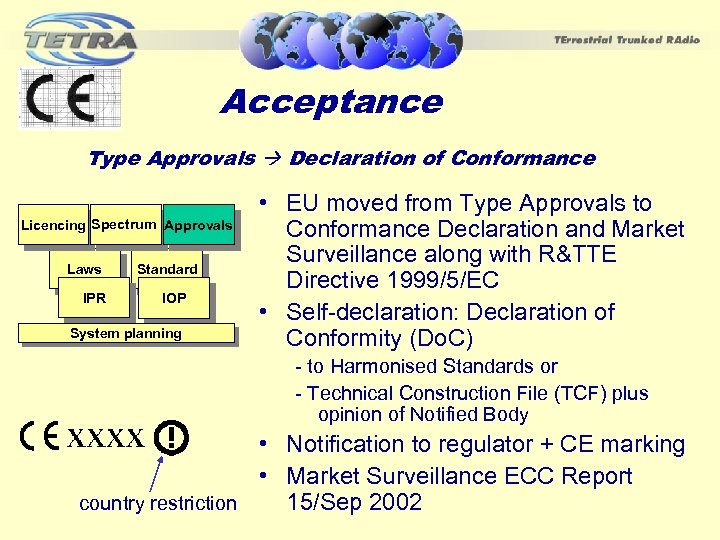
Acceptance Type Approvals Declaration of Conformance Licencing Spectrum Approvals Laws IPR Standard IOP System planning • EU moved from Type Approvals to Conformance Declaration and Market Surveillance along with R&TTE Directive 1999/5/EC • Self-declaration: Declaration of Conformity (Do. C) - to Harmonised Standards or - Technical Construction File (TCF) plus opinion of Notified Body • Notification to regulator + CE marking • Market Surveillance ECC Report 15/Sep 2002 country restriction
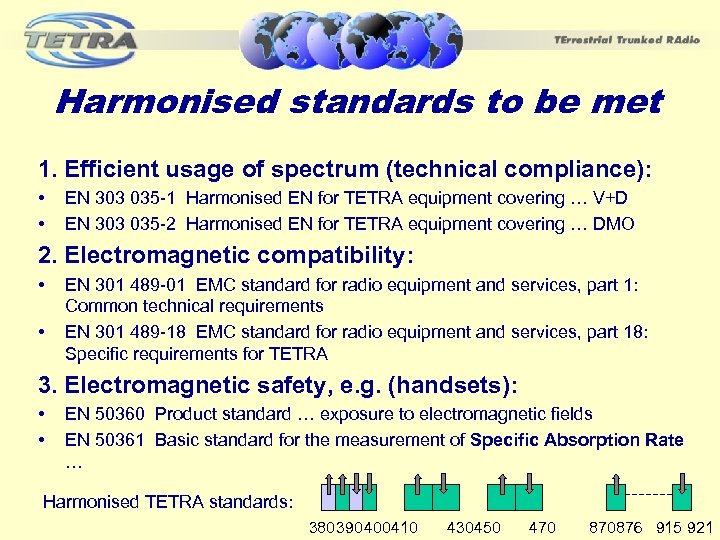
Harmonised standards to be met 1. Efficient usage of spectrum (technical compliance): • • EN 303 035 -1 Harmonised EN for TETRA equipment covering … V+D EN 303 035 -2 Harmonised EN for TETRA equipment covering … DMO 2. Electromagnetic compatibility: • • EN 301 489 -01 EMC standard for radio equipment and services, part 1: Common technical requirements EN 301 489 -18 EMC standard for radio equipment and services, part 18: Specific requirements for TETRA 3. Electromagnetic safety, e. g. (handsets): • • EN 50360 Product standard … exposure to electromagnetic fields EN 50361 Basic standard for the measurement of Specific Absorption Rate … Harmonised TETRA standards: 380 390 400410 430450 470 870876 915 921
Environment: EU ROHS Directive = Reduction Of Harmful Substances • “DIRECTIVE 2002/95/EC OF THE EUROPEAN PARLIAMENT AND OF THE COUNCIL of 27 January 2003 on the restriction of the use of certain hazardous substances in electrical and electronic equipment” • http: //europa. eu. int/eur-lex/pri/en/oj/dat/2003/l_03720030213 en 00190023. pdf • Becomes effective on 1 st July, 2006 • Restricts the selling of the electronic equipment which contain lead, mercury, cadmium, hexavalent chromium, polybrominated biphenyls (PBB) and/or polybrominated diphenyl ether (PBDE) Licencing Spectrum Approvals • requires hardware redesign • Does not affect spare parts for and re-use (re. Laws Standard selling) of products sold before 1 July 2006 IPR IOP • China is defining their own ROHS legislation System planning
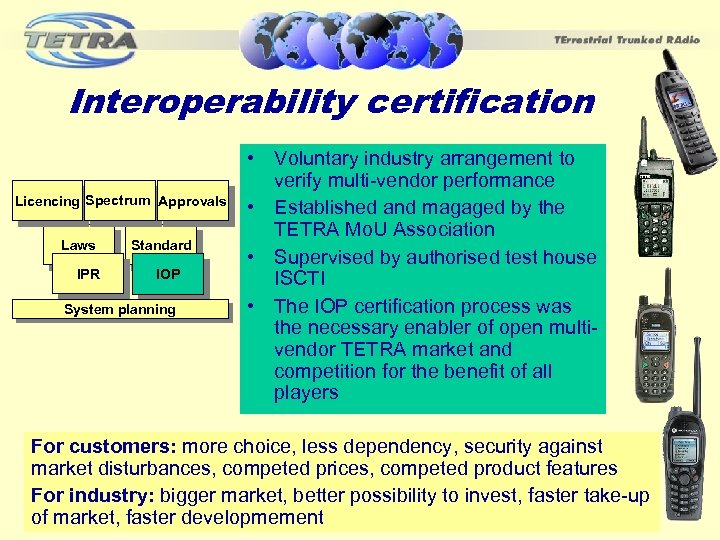
Interoperability certification Licencing Spectrum Approvals Laws IPR Standard IOP System planning • Voluntary industry arrangement to verify multi-vendor performance • Established and magaged by the TETRA Mo. U Association • Supervised by authorised test house ISCTI • The IOP certification process was the necessary enabler of open multivendor TETRA market and competition for the benefit of all players For customers: more choice, less dependency, security against market disturbances, competed prices, competed product features For industry: bigger market, better possibility to invest, faster take-up of market, faster developmement
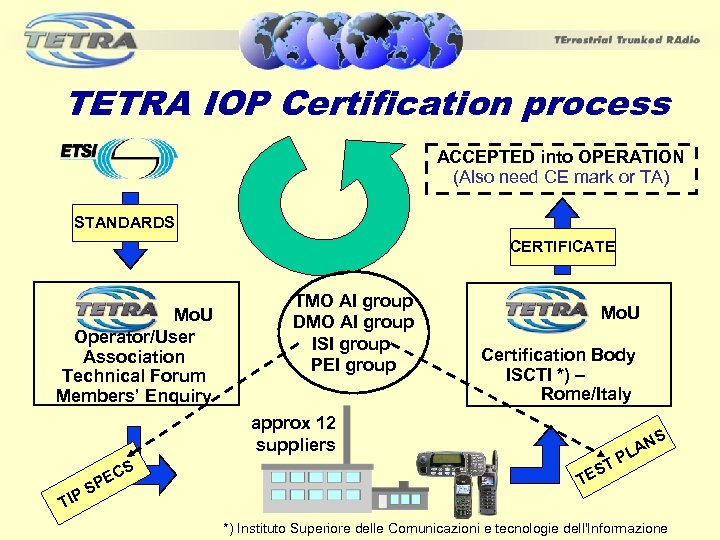
TETRA IOP Certification process ACCEPTED into OPERATION (Also need CE mark or TA) STANDARDS CERTIFICATE Mo. U Operator/User Association Technical Forum Members’ Enquiry TMO AI group DMO AI group ISI group PEI group Mo. U Certification Body ISCTI *) – Rome/Italy approx 12 suppliers S EC P PS S AN L TP ES T TI *) Instituto Superiore delle Comunicazioni e tecnologie dell'Informazione
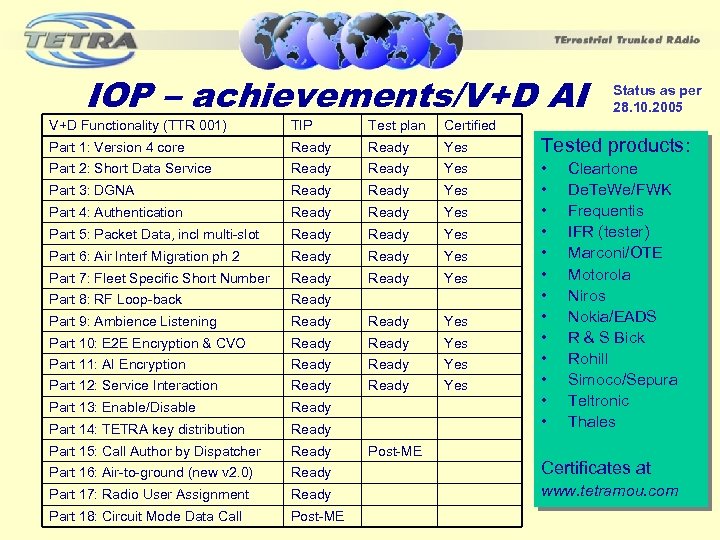
IOP – achievements/V+D AI Status as per 28. 10. 2005 V+D Functionality (TTR 001) TIP Test plan Certified Part 1: Version 4 core Ready Yes Tested products: Part 2: Short Data Service Ready Yes Part 3: DGNA Ready Yes Part 4: Authentication Ready Yes Part 5: Packet Data, incl multi-slot Ready Yes Part 6: Air Interf Migration ph 2 Ready Yes Part 7: Fleet Specific Short Number Ready Yes Part 8: RF Loop-back Ready Part 9: Ambience Listening Ready Yes Part 10: E 2 E Encryption & CVO Ready Yes Part 11: AI Encryption Ready Yes Part 12: Service Interaction Ready Yes Part 13: Enable/Disable Ready Part 14: TETRA key distribution Ready • • • • Part 15: Call Author by Dispatcher Ready Part 16: Air-to-ground (new v 2. 0) Ready Certificates at Part 17: Radio User Assignment Ready www. tetramou. com Part 18: Circuit Mode Data Call Post-ME Cleartone De. Te. We/FWK Frequentis IFR (tester) Marconi/OTE Motorola Niros Nokia/EADS R & S Bick Rohill Simoco/Sepura Teltronic Thales
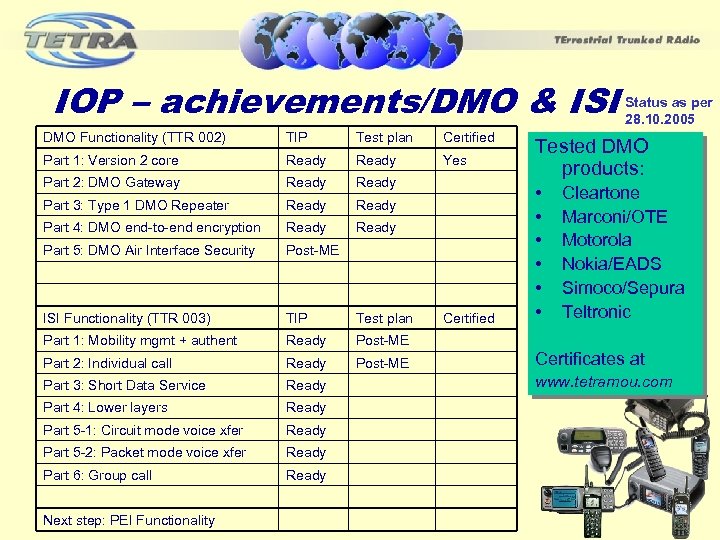
IOP – achievements/DMO & ISI DMO Functionality (TTR 002) TIP Test plan Certified Part 1: Version 2 core Ready Yes Part 2: DMO Gateway Ready Part 3: Type 1 DMO Repeater Ready Part 4: DMO end-to-end encryption Ready Part 5: DMO Air Interface Security Post-ME ISI Functionality (TTR 003) TIP Test plan Part 1: Mobility mgmt + authent Ready Post-ME Part 2: Individual call Ready Post-ME Part 3: Short Data Service Ready Part 4: Lower layers Ready Part 5 -1: Circuit mode voice xfer Ready Part 5 -2: Packet mode voice xfer Ready Part 6: Group call Ready Status as per 28. 10. 2005 Next step: PEI Functionality Certified Tested DMO products: • • • Cleartone Marconi/OTE Motorola Nokia/EADS Simoco/Sepura Teltronic Certificates at www. tetramou. com
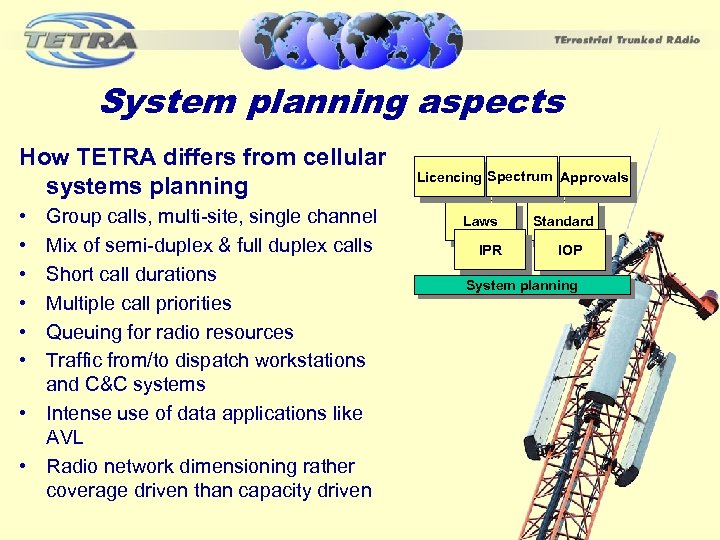
System planning aspects How TETRA differs from cellular systems planning • • • Group calls, multi-site, single channel Mix of semi-duplex & full duplex calls Short call durations Multiple call priorities Queuing for radio resources Traffic from/to dispatch workstations and C&C systems • Intense use of data applications like AVL • Radio network dimensioning rather coverage driven than capacity driven Licencing Spectrum Approvals Laws IPR Standard IOP System planning
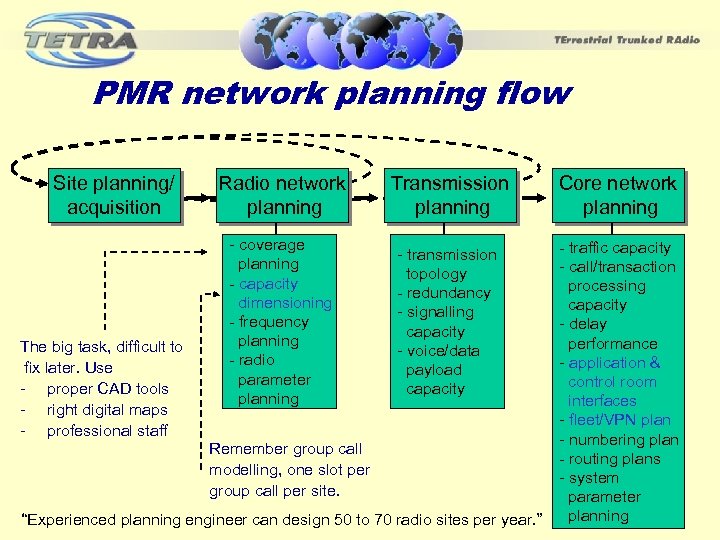
PMR network planning flow Site planning/ acquisition The big task, difficult to fix later. Use - proper CAD tools - right digital maps - professional staff Radio network planning Transmission planning Core network planning - coverage planning - capacity dimensioning - frequency planning - radio parameter planning - transmission topology - redundancy - signalling capacity - voice/data payload capacity - traffic capacity - call/transaction processing capacity - delay performance - application & control room interfaces - fleet/VPN plan - numbering plan - routing plans - system parameter planning Remember group call modelling, one slot per group call per site. “Experienced planning engineer can design 50 to 70 radio sites per year. ”
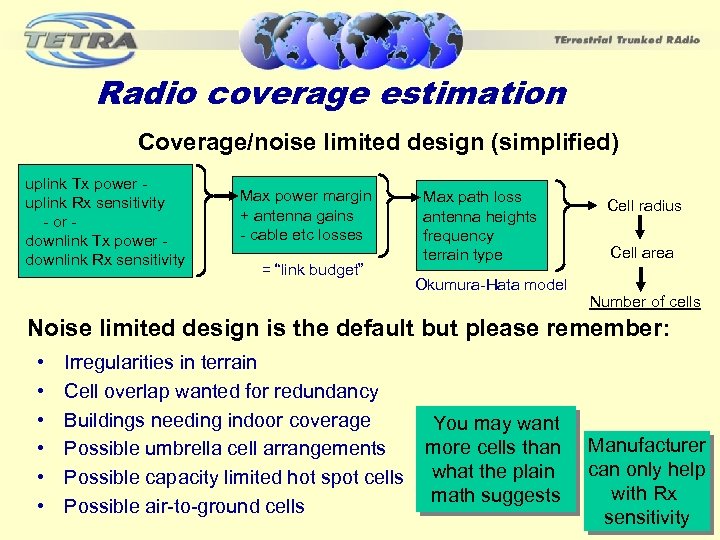
Radio coverage estimation Coverage/noise limited design (simplified) uplink Tx power uplink Rx sensitivity - or downlink Tx power downlink Rx sensitivity Max power margin + antenna gains - cable etc losses = “link budget” Max path loss antenna heights frequency terrain type Okumura-Hata model Cell radius Cell area Number of cells Noise limited design is the default but please remember: • • • Irregularities in terrain Cell overlap wanted for redundancy Buildings needing indoor coverage Possible umbrella cell arrangements Possible capacity limited hot spot cells Possible air-to-ground cells You may want more cells than what the plain math suggests Manufacturer can only help with Rx sensitivity
How do you ensure that. . . you get what you wanted • Permission to switch on: Licence & CE mark • Health & safety: SAR conformance report (part of CE process) • Interoperability: IOP certificate These tell that it meets the baseline. . . but the multi-vendor market lets you choose the product and supplier based on your own evaluation of: • product, features, design, technology. . . • company, field support, resources. . . • price, warranty, payment terms, . . . • salesperson’s friendly smile. . .
Summary • To have a wide and open market one needs - a strong standard - market-oriented regulatory regime - voluntary industry arrangements like IOP • It may mean some extra work, but it gives benefits to all parties • With TETRA is happened already At open market the user can choose.
Скачать презентацию Network builder s checklist for rules and regulation Licencing
01ebeb8ec71db3803b1e1a0d06766896.ppt