


 Скачать презентацию Net-Zero Energy Houses and Offices a vision of
7305591126eb82b81f1fe88989c7dfd6.ppt
- Количество слайдов: 65
 Net-Zero Energy Houses and Offices …a vision of the future? Sustainable Operations 19 Nov 08 Webinar Presentation FPL, Madison, WI by Mel Tyree BA Ph. D LLD FRSC NRS-10
 The Globe & Mail 28 June 2008 The energy content of 1 barrel of oil = the energy content of 8. 6 years of human labor. Think about it. A human lifespan could produce the energy of about 3 barrels of oil in usable work or impact on the world (@ 10 h of work per day). CONCLUSION: human-kind has dominated life on earth thru the unfair advantage of fossil fuels. What is our future when this advantage (fossil fuel) is gone?
 Energy cost of buildings in Canada 30% of Canada’s energy consumption 50% of Canada’s electricity consumption 28% of Canada’s greenhouse gases
 Energy cost of buildings in Canada 30% of Canada’s energy consumption 50% of Canada’s electricity consumption 28% of Canada’s greenhouse gases With declining fossil fuels and rising prices, WHAT MIGHT THE HOUSING FUTURE BE?
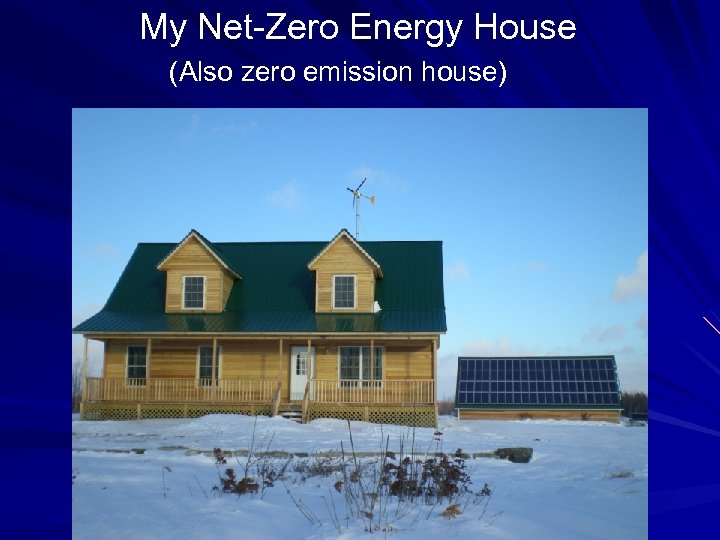 My Net-Zero Energy House (Also zero emission house)
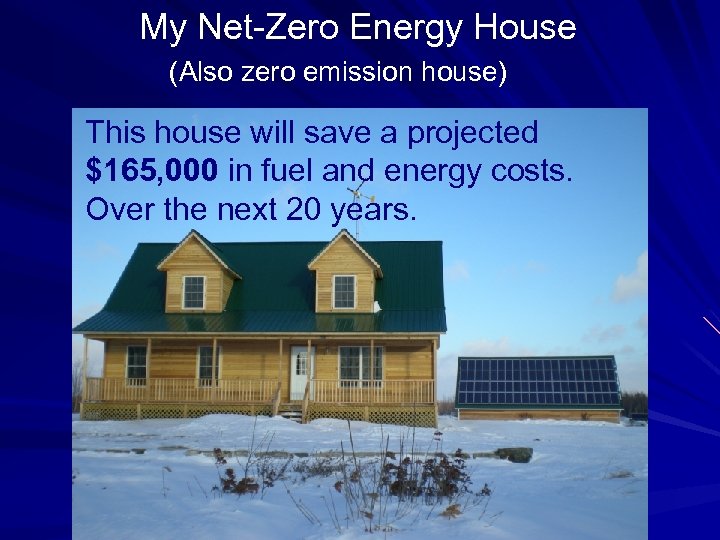 My Net-Zero Energy House (Also zero emission house) This house will save a projected $165, 000 in fuel and energy costs. Over the next 20 years.
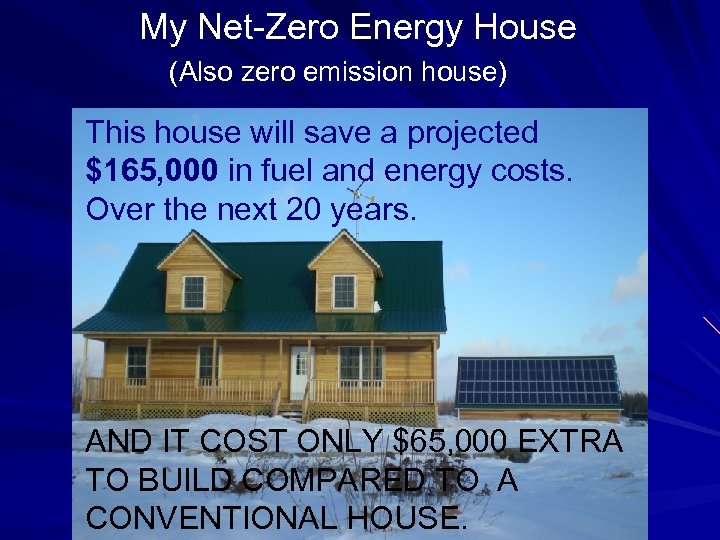 My Net-Zero Energy House (Also zero emission house) This house will save a projected $165, 000 in fuel and energy costs. Over the next 20 years. AND IT COST ONLY $65, 000 EXTRA TO BUILD COMPARED TO A CONVENTIONAL HOUSE.
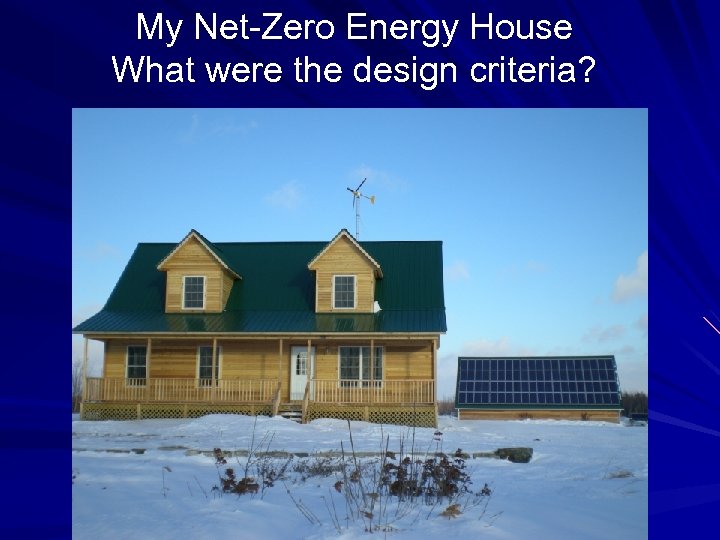 My Net-Zero Energy House What were the design criteria?
 Objectives of my Net-Zero Energy House Sustainable Energy Design (uses no fossil fuels) Generate as much energy ‘on site’ in a year as is used on site in that year. Be energy efficient Be cost-effective Burn NO fuel of any kind on site IF POSSIBLE Use sustainable materials Use materials with low toxicity Cost should be competitive with conventional home over a 20 -year period, i. e. , if you pay more to build it then savings from operating costs to pay for it should break even in the first 20 years.
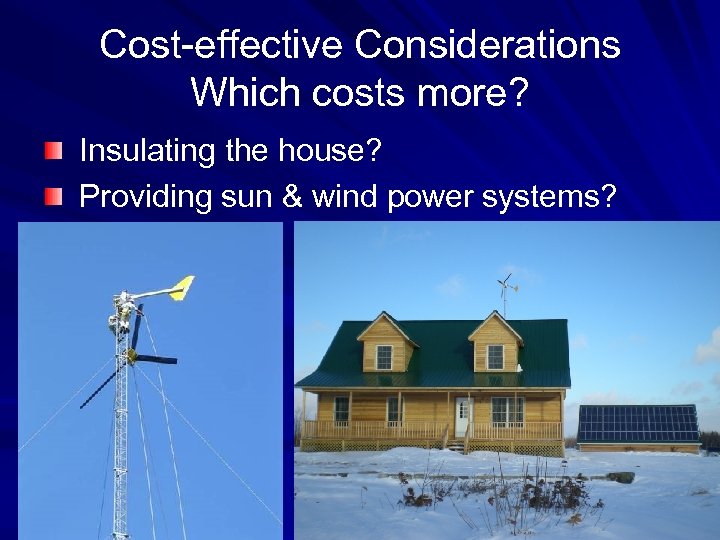 Cost-effective Considerations Which costs more? Insulating the house? Providing sun & wind power systems?
 Cost-effective Considerations Which costs more? Insulating the house? Providing sun & wind power systems? To answer these questions we first need to know how much energy a typical house uses in a year.
 Cost-effective Considerations Which costs more? Insulating the house? Providing sun & wind power systems? To answer these questions we first need to know how much energy a typical house uses in a year. Where does most of my energy go? • To general electrical needs? • To heating?
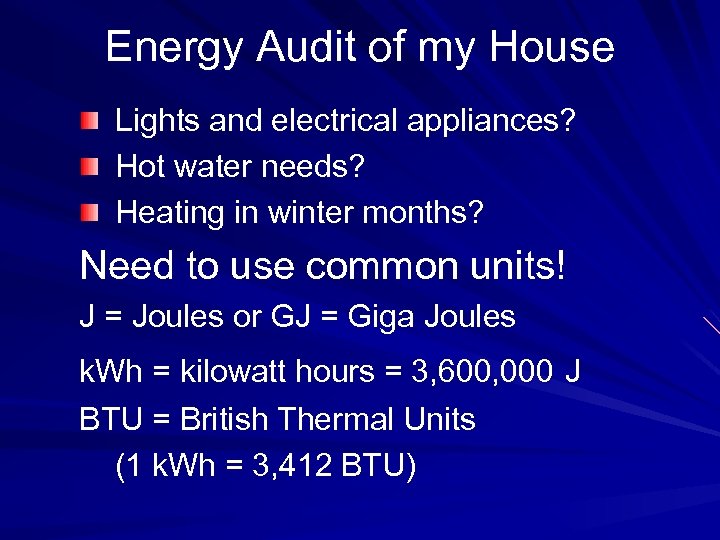 Energy Audit of my House Lights and electrical appliances? Hot water needs? Heating in winter months? Need to use common units! J = Joules or GJ = Giga Joules k. Wh = kilowatt hours = 3, 600, 000 J BTU = British Thermal Units (1 k. Wh = 3, 412 BTU)
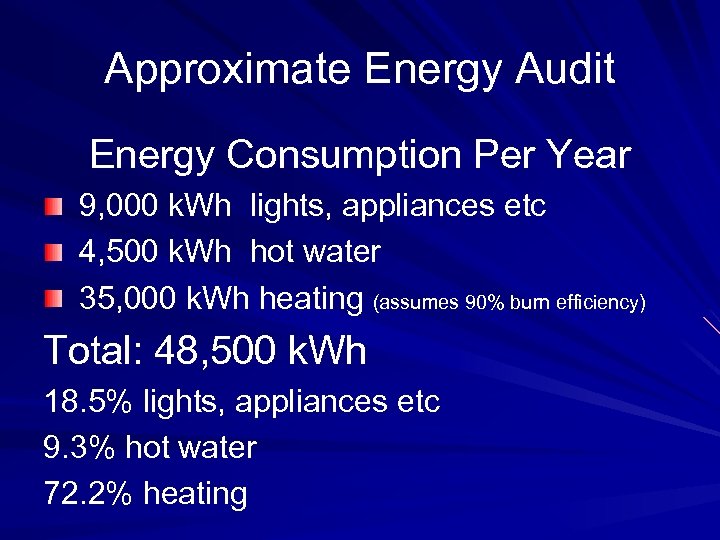 Approximate Energy Audit Energy Consumption Per Year 9, 000 k. Wh lights, appliances etc 4, 500 k. Wh hot water 35, 000 k. Wh heating (assumes 90% burn efficiency) Total: 48, 500 k. Wh 18. 5% lights, appliances etc 9. 3% hot water 72. 2% heating
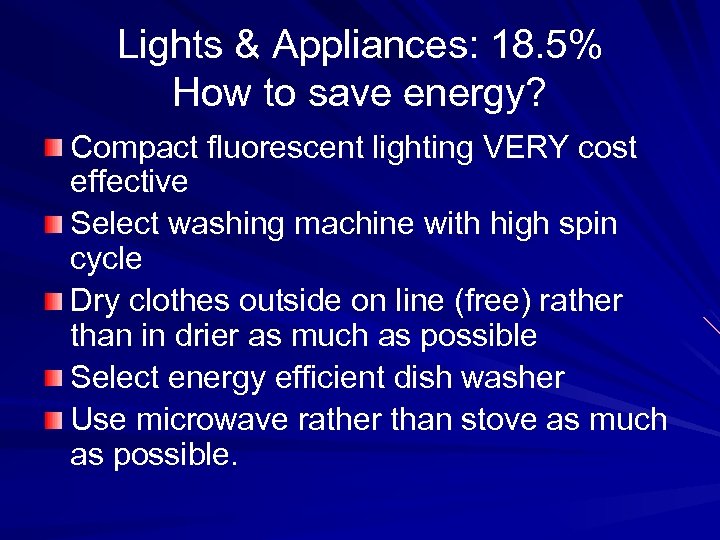 Lights & Appliances: 18. 5% How to save energy? Compact fluorescent lighting VERY cost effective Select washing machine with high spin cycle Dry clothes outside on line (free) rather than in drier as much as possible Select energy efficient dish washer Use microwave rather than stove as much as possible.
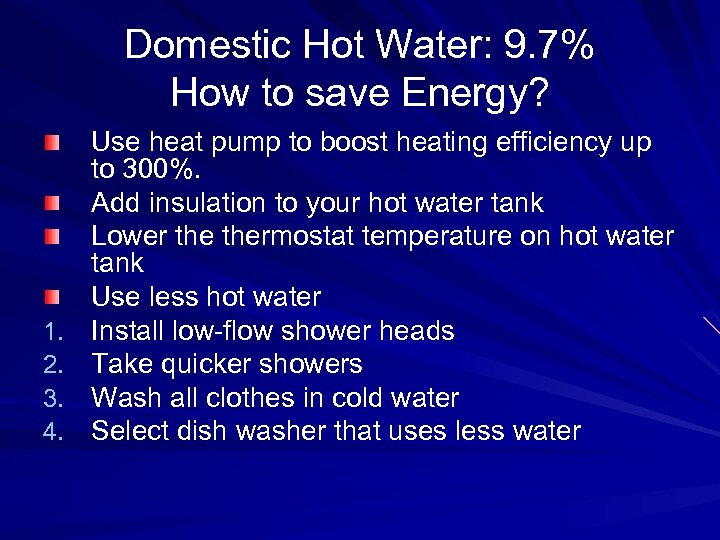 Domestic Hot Water: 9. 7% How to save Energy? 1. 2. 3. 4. Use heat pump to boost heating efficiency up to 300%. Add insulation to your hot water tank Lower thermostat temperature on hot water tank Use less hot water Install low-flow shower heads Take quicker showers Wash all clothes in cold water Select dish washer that uses less water
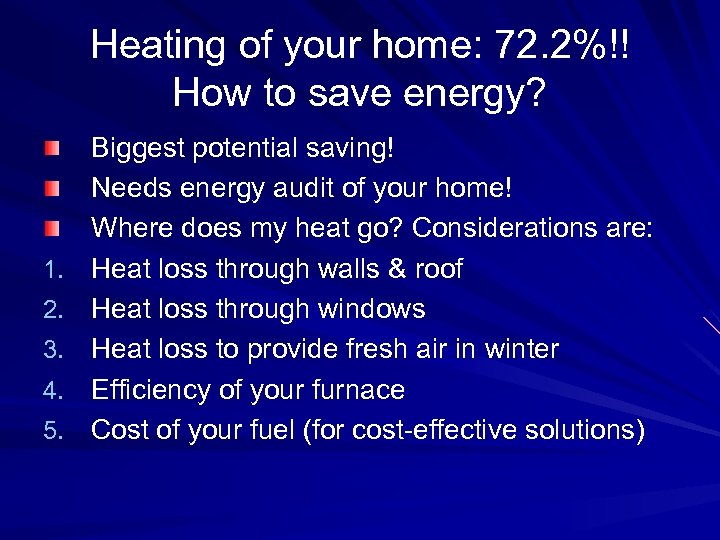 Heating of your home: 72. 2%!! How to save energy? 1. 2. 3. 4. 5. Biggest potential saving! Needs energy audit of your home! Where does my heat go? Considerations are: Heat loss through walls & roof Heat loss through windows Heat loss to provide fresh air in winter Efficiency of your furnace Cost of your fuel (for cost-effective solutions)
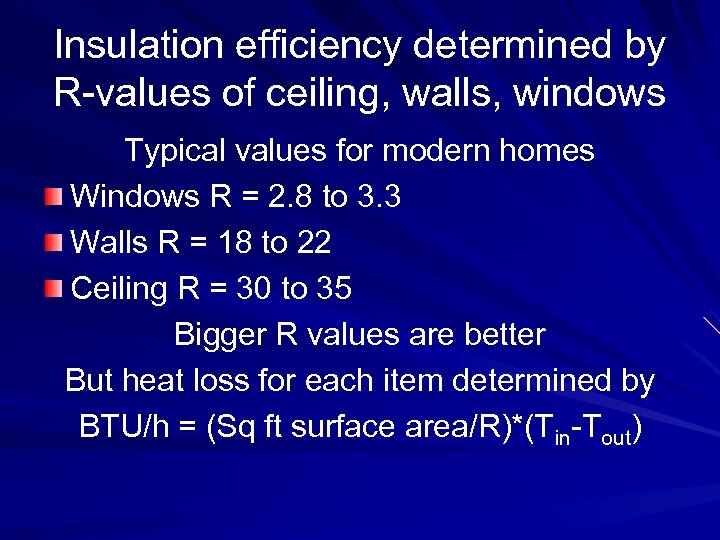 Insulation efficiency determined by R-values of ceiling, walls, windows Typical values for modern homes Windows R = 2. 8 to 3. 3 Walls R = 18 to 22 Ceiling R = 30 to 35 Bigger R values are better But heat loss for each item determined by BTU/h = (Sq ft surface area/R)*(Tin-Tout)
 How I learned to do the calculations! The Passive Solar House by James Kachadorian
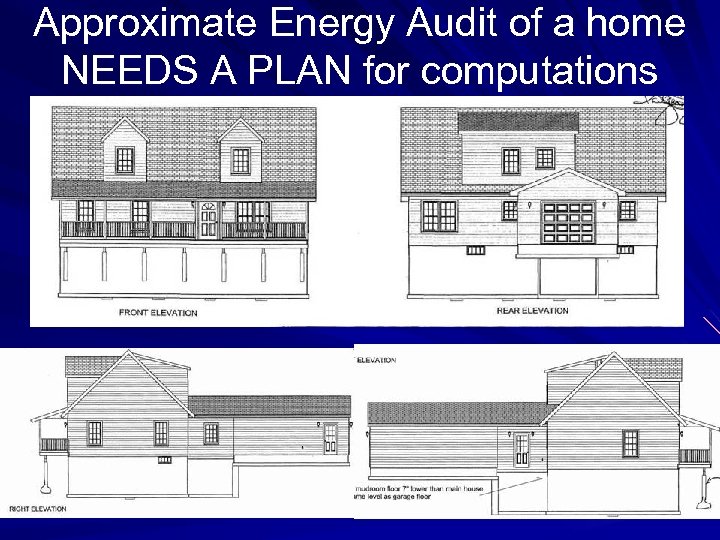 Approximate Energy Audit of a home NEEDS A PLAN for computations
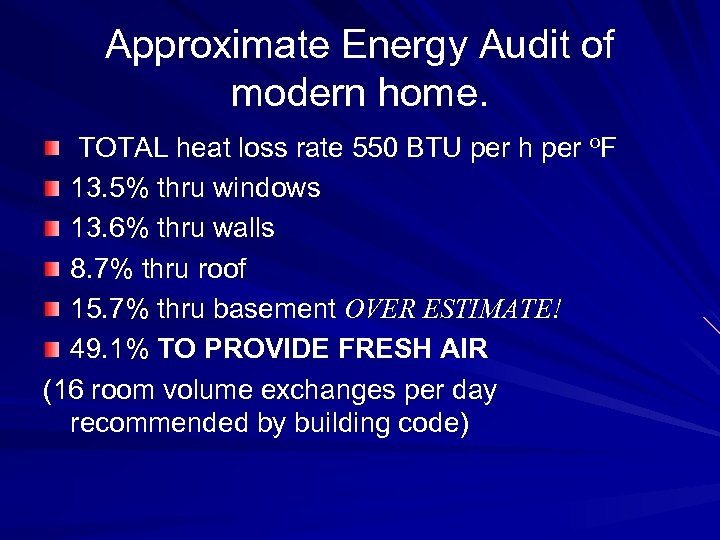 Approximate Energy Audit of modern home. TOTAL heat loss rate 550 BTU per h per o. F 13. 5% thru windows 13. 6% thru walls 8. 7% thru roof 15. 7% thru basement OVER ESTIMATE! 49. 1% TO PROVIDE FRESH AIR (16 room volume exchanges per day recommended by building code)
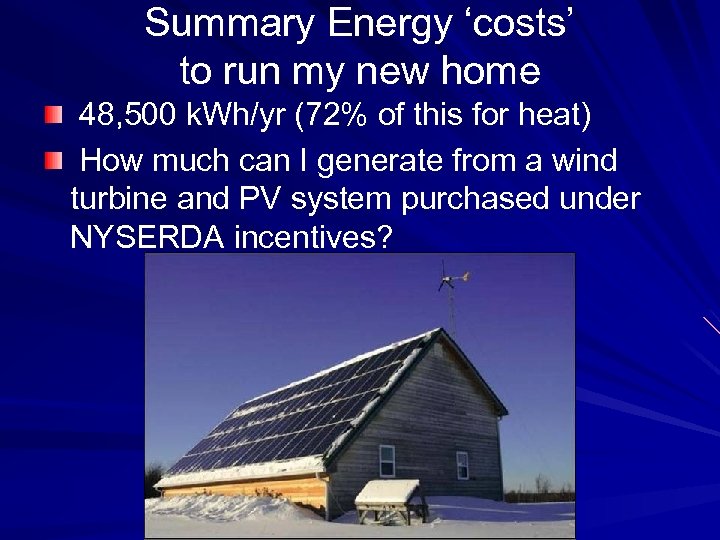 Summary Energy ‘costs’ to run my new home 48, 500 k. Wh/yr (72% of this for heat) How much can I generate from a wind turbine and PV system purchased under NYSERDA incentives?
 www. powernaturally. org 1. 2. 3. 4. Use above web site for info on NY State Cash Incentives from NYSERDA Mr. Sal Graven, NYSERDA, informed me that as of Feb 2008 28 Residential wind turbines have been installed 13 more wind turbines are scheduled under the NYSERDA incentive program 900 Photovoltaic residential systems have been installed My home is the first (and only) in NY State to provide all power needs from the sun and wind under the NYSERDA program.
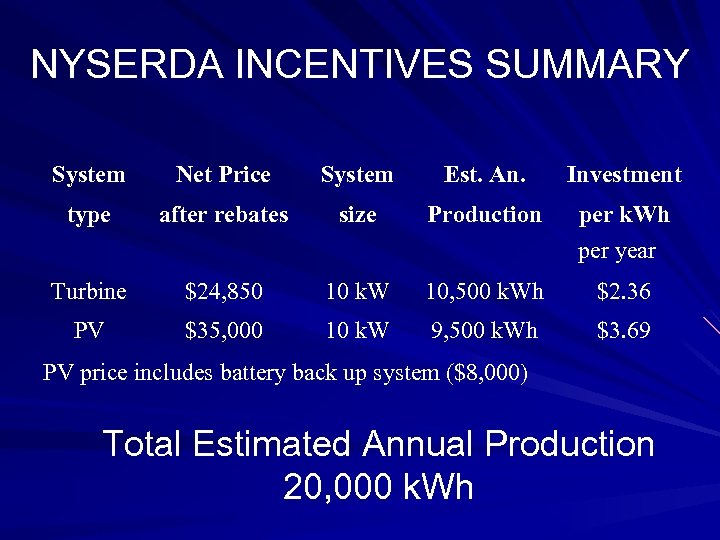 NYSERDA INCENTIVES SUMMARY System Net Price System Est. An. Investment type after rebates size Production per k. Wh per year Turbine $24, 850 10 k. W 10, 500 k. Wh $2. 36 PV $35, 000 10 k. W 9, 500 k. Wh $3. 69 PV price includes battery back up system ($8, 000) Total Estimated Annual Production 20, 000 k. Wh
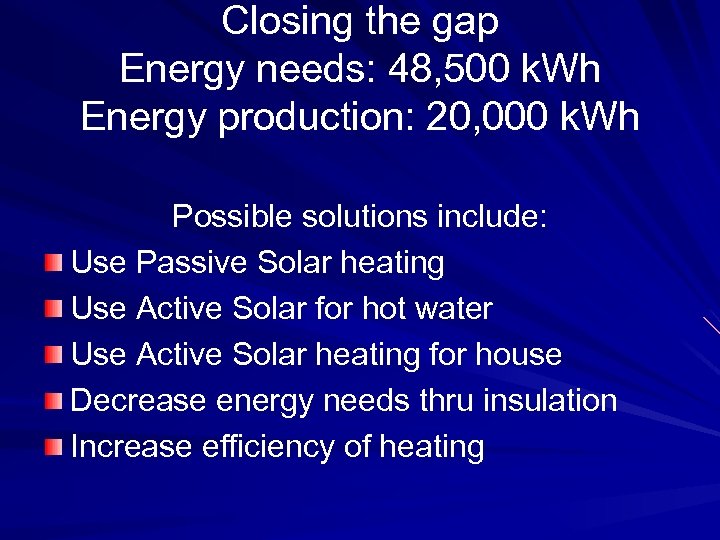 Closing the gap Energy needs: 48, 500 k. Wh Energy production: 20, 000 k. Wh Possible solutions include: Use Passive Solar heating Use Active Solar for hot water Use Active Solar heating for house Decrease energy needs thru insulation Increase efficiency of heating
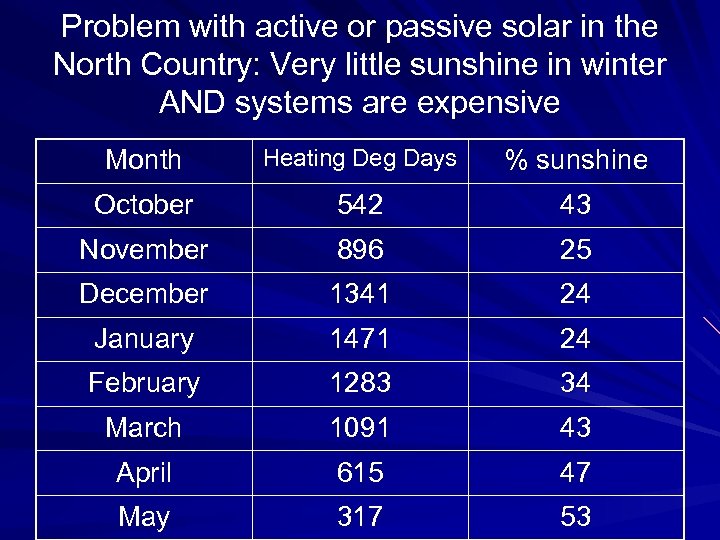 Problem with active or passive solar in the North Country: Very little sunshine in winter AND systems are expensive Month Heating Deg Days % sunshine October 542 43 November 896 25 December 1341 24 January 1471 24 February 1283 34 March 1091 43 April 615 47 May 317 53
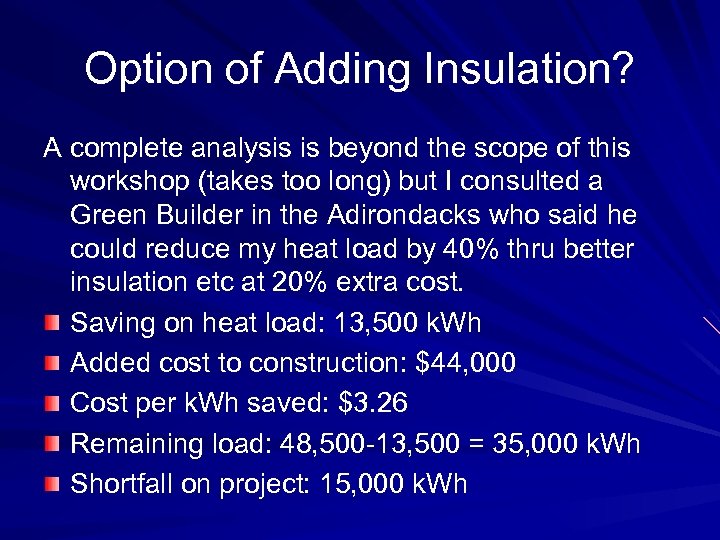 Option of Adding Insulation? A complete analysis is beyond the scope of this workshop (takes too long) but I consulted a Green Builder in the Adirondacks who said he could reduce my heat load by 40% thru better insulation etc at 20% extra cost. Saving on heat load: 13, 500 k. Wh Added cost to construction: $44, 000 Cost per k. Wh saved: $3. 26 Remaining load: 48, 500 -13, 500 = 35, 000 k. Wh Shortfall on project: 15, 000 k. Wh
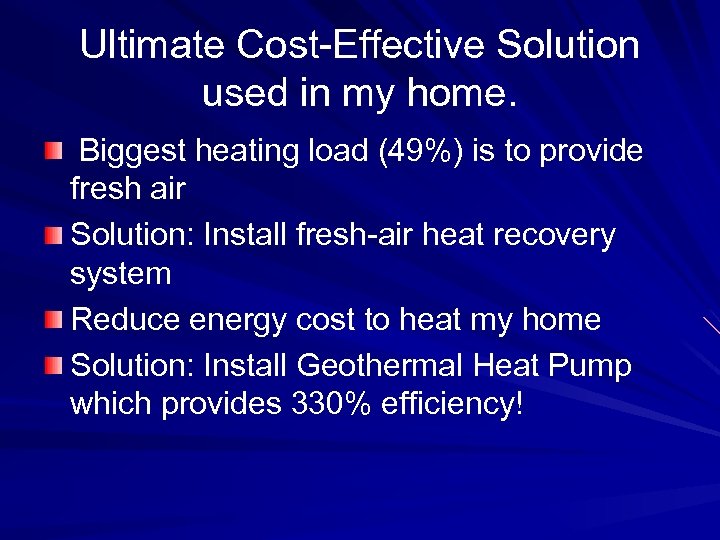 Ultimate Cost-Effective Solution used in my home. Biggest heating load (49%) is to provide fresh air Solution: Install fresh-air heat recovery system Reduce energy cost to heat my home Solution: Install Geothermal Heat Pump which provides 330% efficiency!
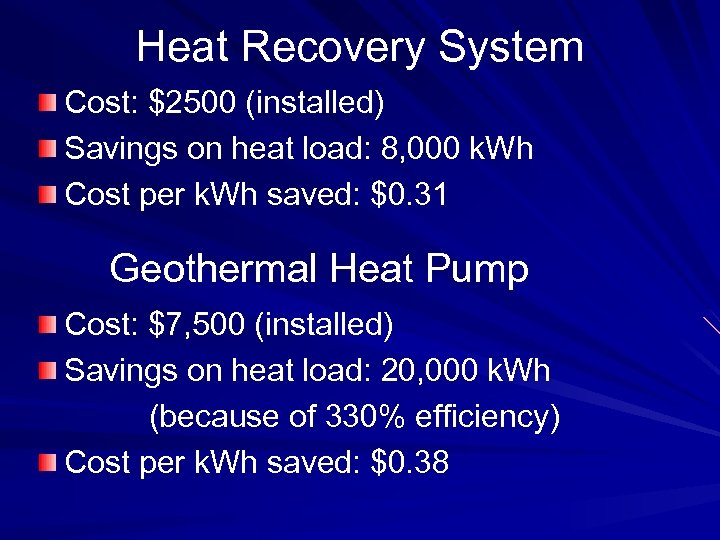 Heat Recovery System Cost: $2500 (installed) Savings on heat load: 8, 000 k. Wh Cost per k. Wh saved: $0. 31 Geothermal Heat Pump Cost: $7, 500 (installed) Savings on heat load: 20, 000 k. Wh (because of 330% efficiency) Cost per k. Wh saved: $0. 38
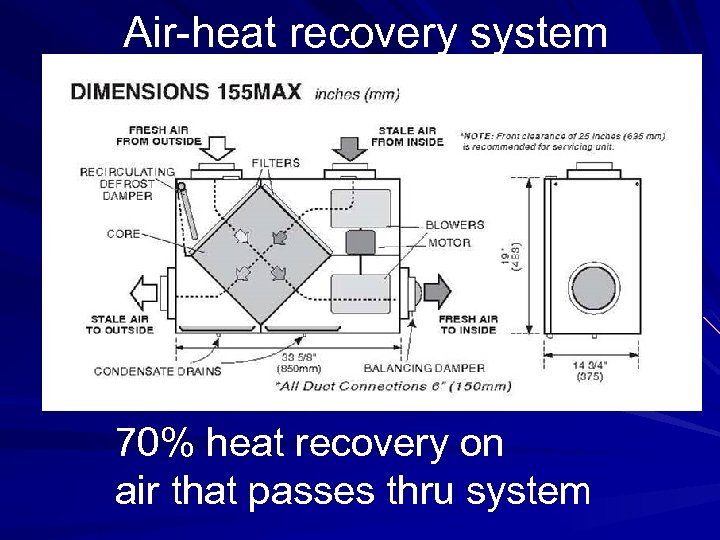 Air-heat recovery system 70% heat recovery on air that passes thru system
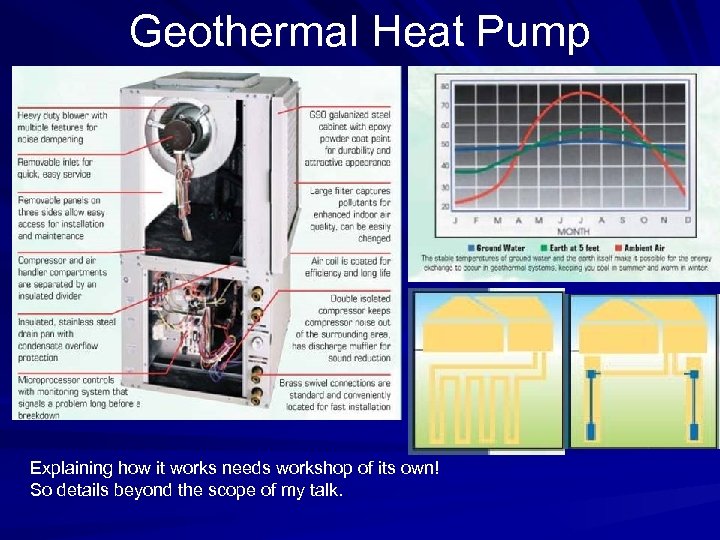 Geothermal Heat Pump Explaining how it works needs workshop of its own! So details beyond the scope of my talk.
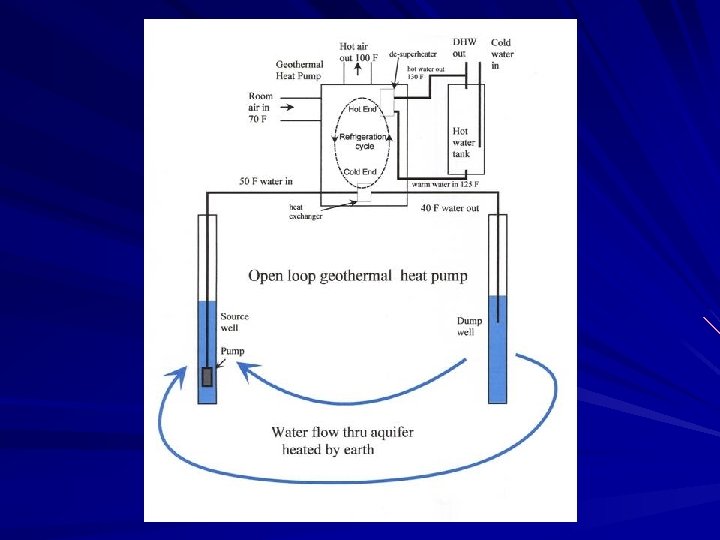
 Types of Geothermal Heat Pumps Open loop: most efficient (400%) but usually more expensive to install Closed loop: less efficient (300%) PLUS the heat pump assists the hot water tank and hence reduces the energy needed to heat hot water with electricity. Explain how it works (it is a very large refrigeration system)
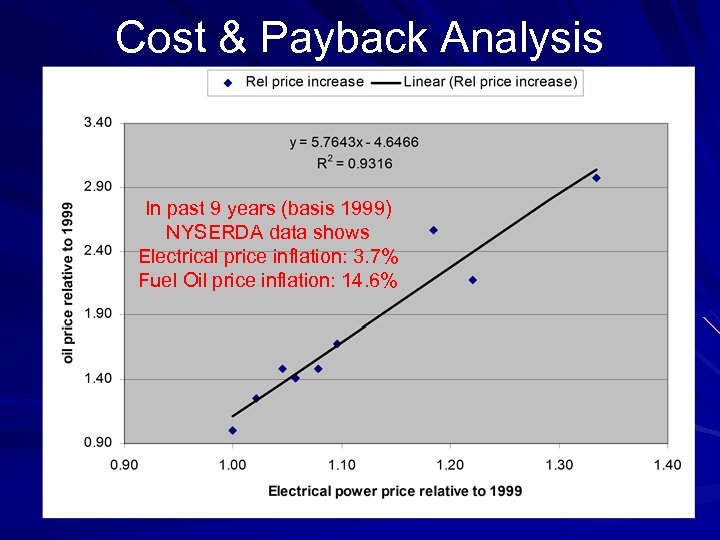 Cost & Payback Analysis In past 9 years (basis 1999) NYSERDA data shows Electrical price inflation: 3. 7% Fuel Oil price inflation: 14. 6%
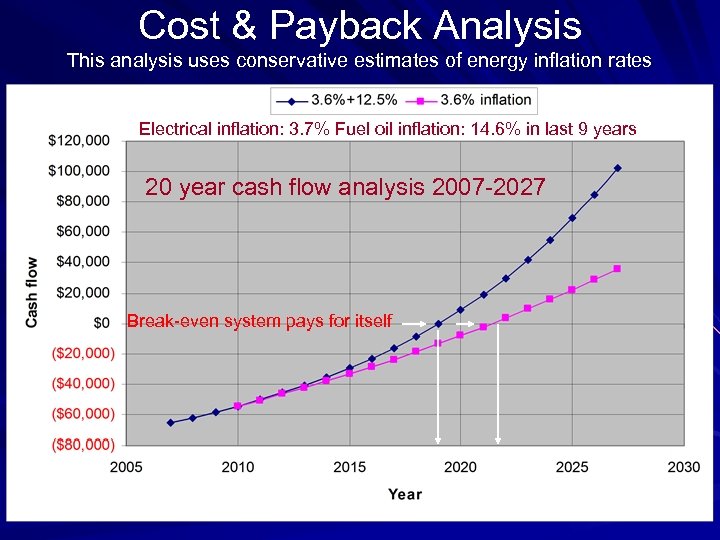 Cost & Payback Analysis This analysis uses conservative estimates of energy inflation rates Electrical inflation: 3. 7% Fuel oil inflation: 14. 6% in last 9 years 20 year cash flow analysis 2007 -2027 Break-even system pays for itself
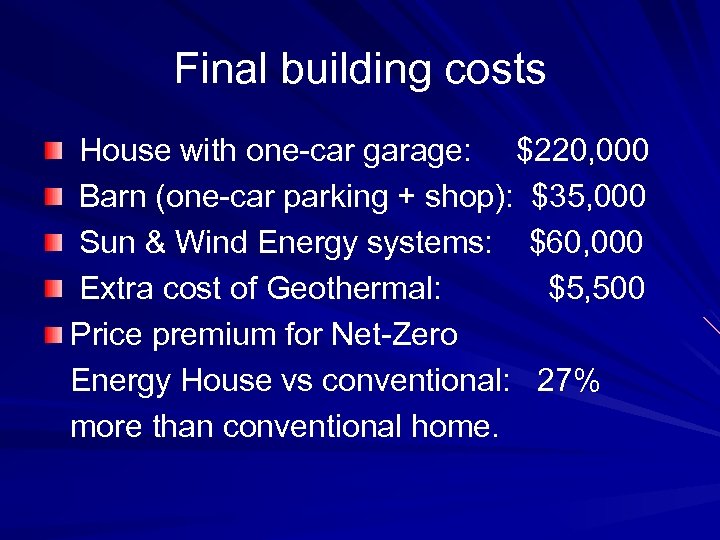 Final building costs House with one-car garage: $220, 000 Barn (one-car parking + shop): $35, 000 Sun & Wind Energy systems: $60, 000 Extra cost of Geothermal: $5, 500 Price premium for Net-Zero Energy House vs conventional: 27% more than conventional home.
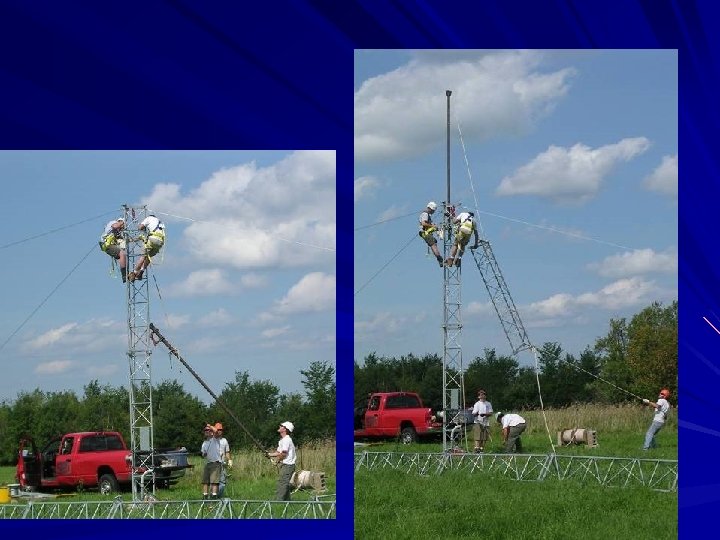
 Construction sequence illustrated by photos and words 1. Built turbine in 2004/05 2. Built barn in 2005 3. Added photovoltaic system in 2006 4. Built house in 2007
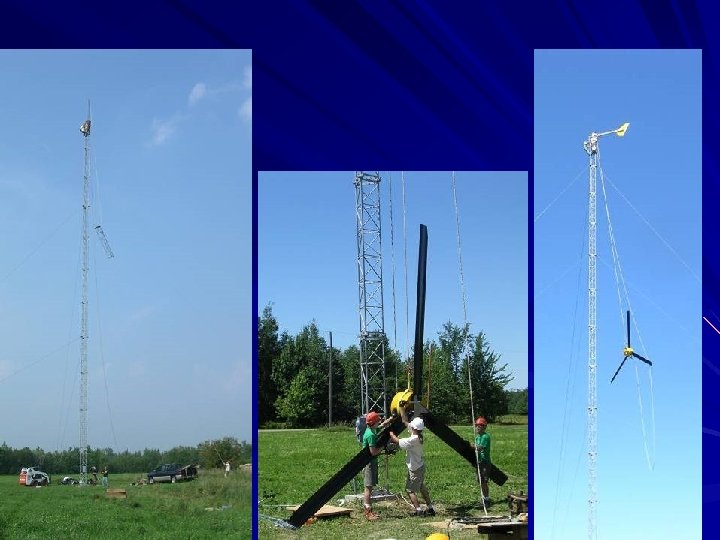
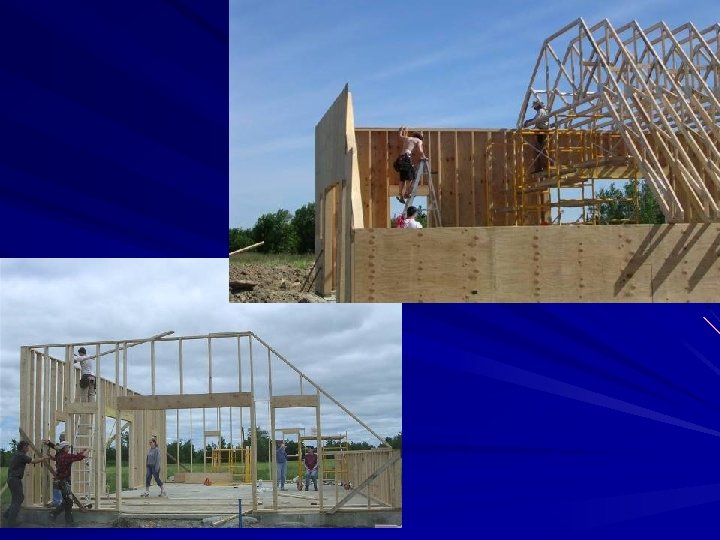
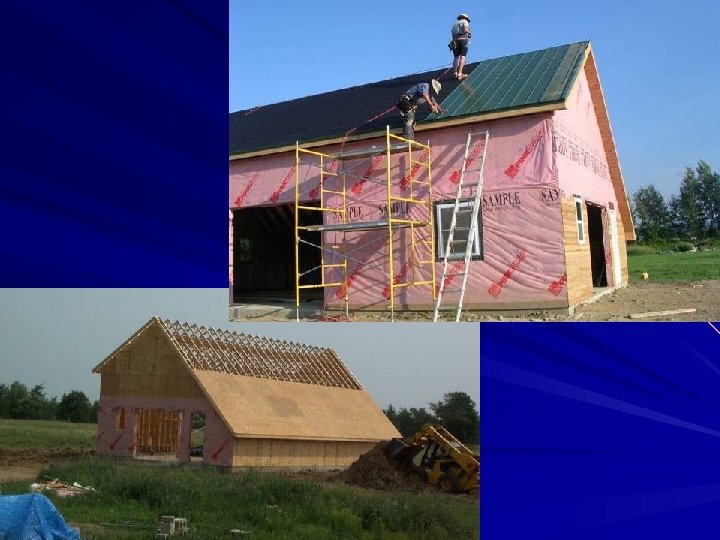
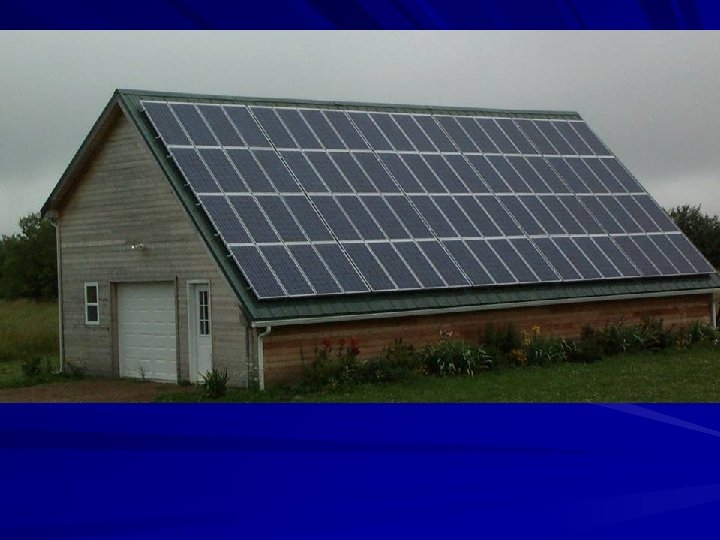
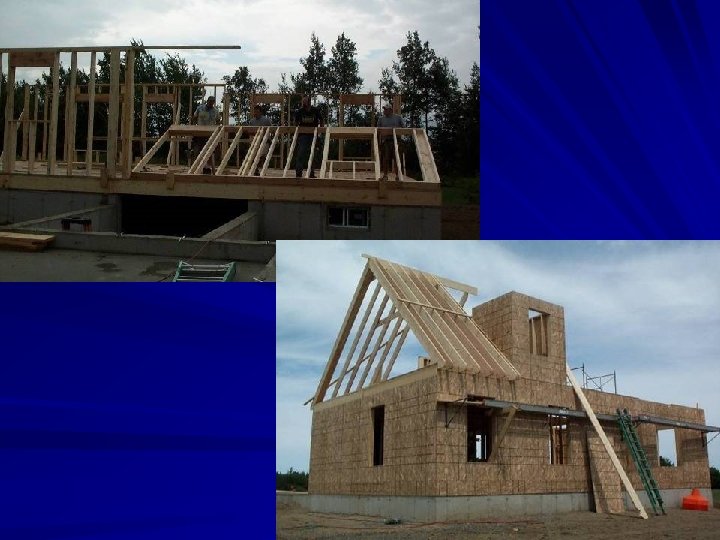
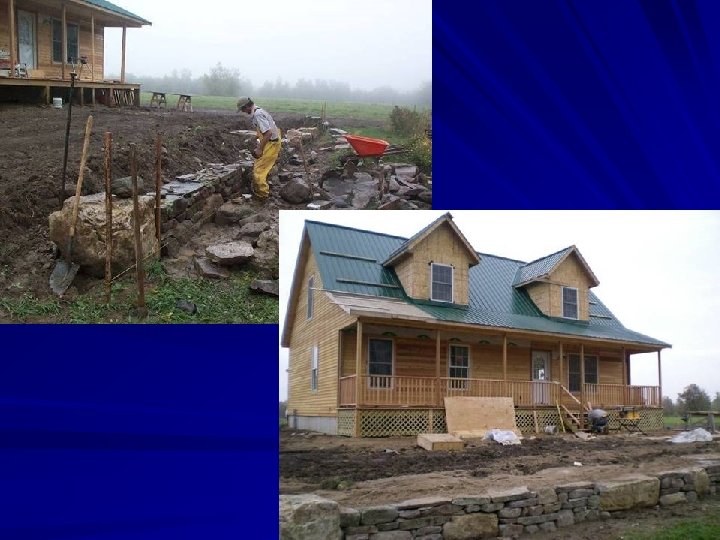
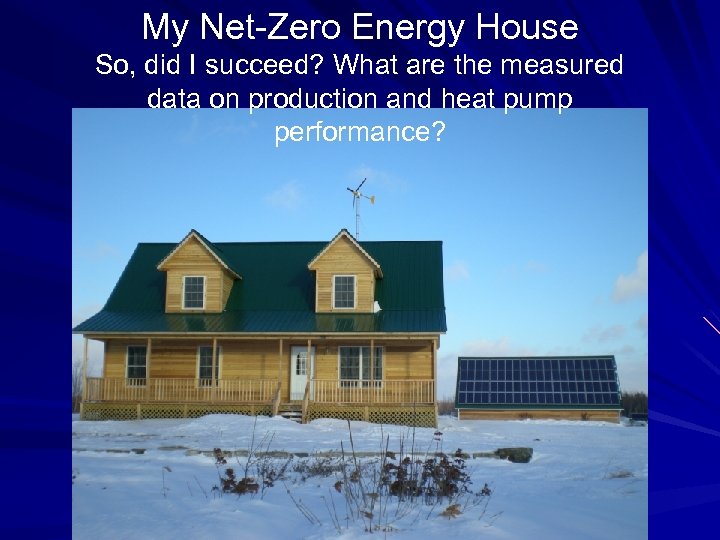 My Net-Zero Energy House So, did I succeed? What are the measured data on production and heat pump performance?
 Production. The solar and wind systems have been grid-tied for > 12 months. Production from 1 Dec 06 to 1 Dec 07: 19, 005 k. Wh GHP = 7500 k. Wh HW = 4500 (will lower this in future) All other = 6000 k. Wh TOTAL = 18, 000 k. Wh

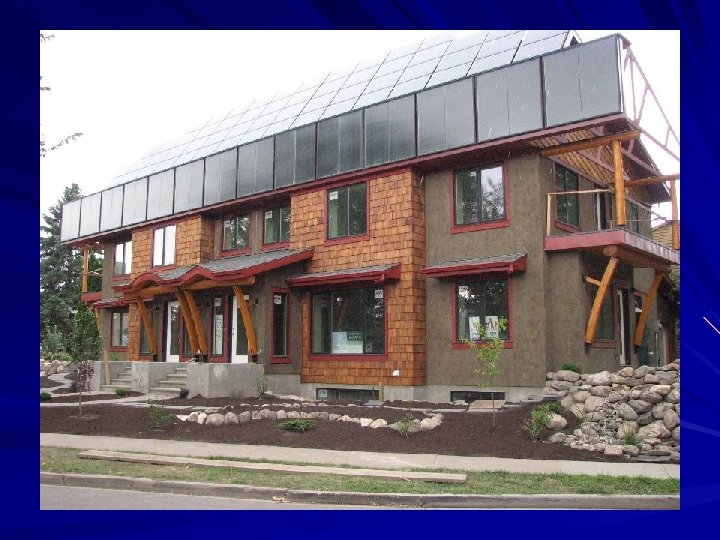
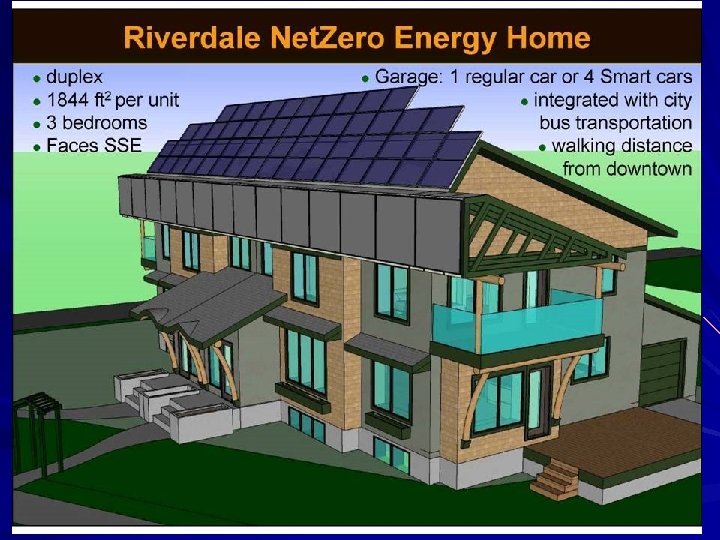
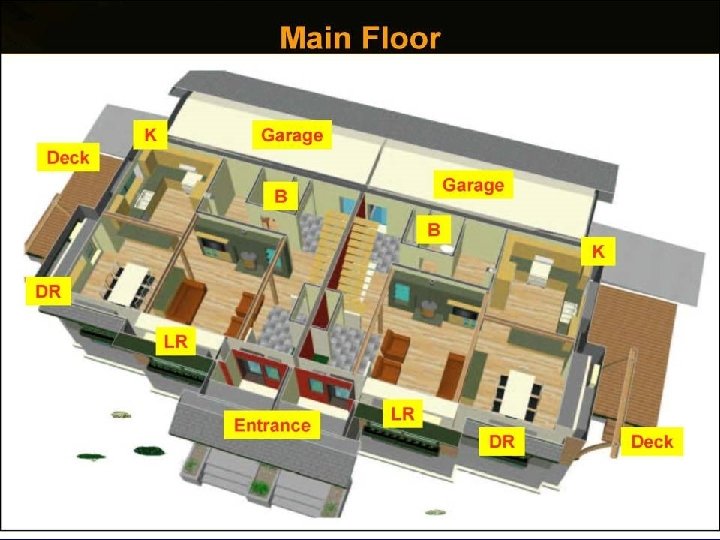
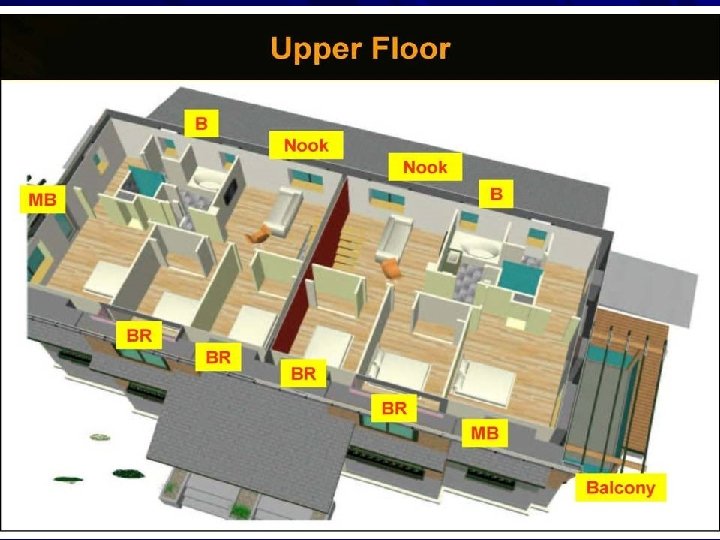
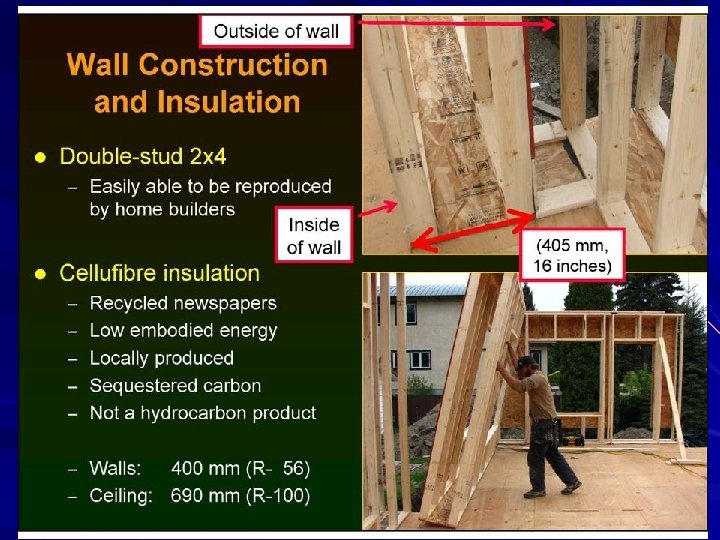
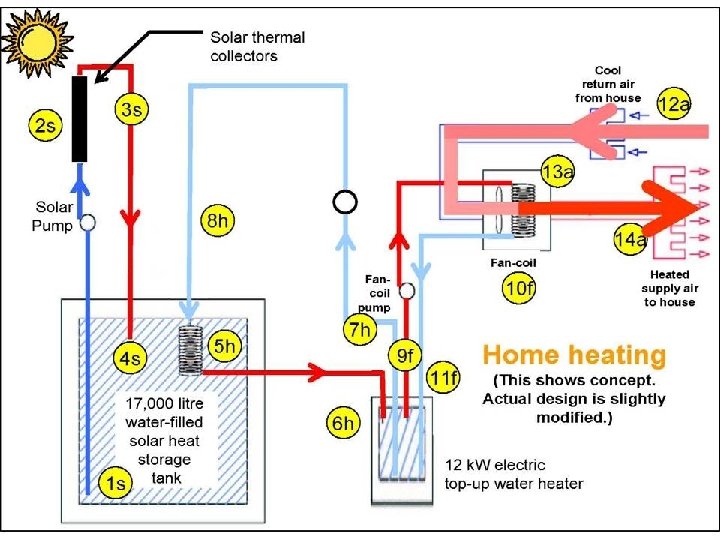
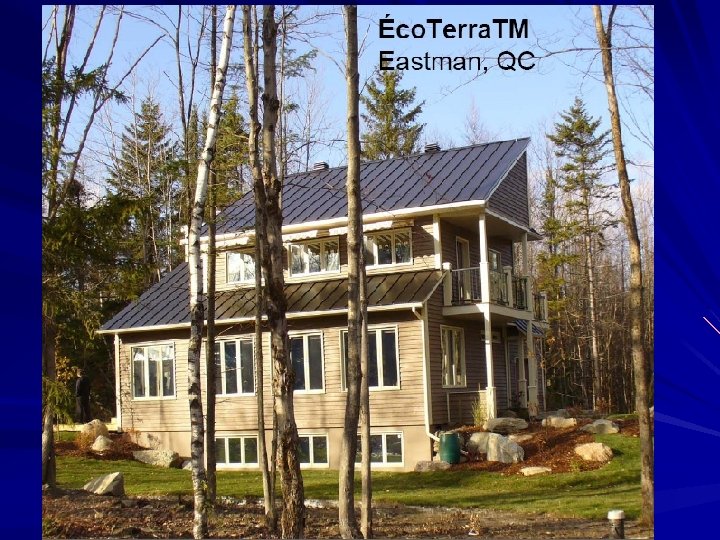
 NZEH IN NZE-CITIES Advantages for the future: Sunlight is free & delivery is free Cost to utilize free sun-energy will eventually be less than cost of fuel Will reduce Canada carbon-footprint Will conserve declining fossil fuels for more vital needs Will reduce size of electrical grid and avoid cost of new power plants (nuclear & conventional)
 NZEH Impact on how cities will look? Street layout for S orientation of all houses Modified look of housing Modified landscaping (e. g. , smaller trees, fewer trees, or mostly deciduous trees? ? ) Use of local materials Use of low toxicity materials Living roofs? Gray-water use? Rain water storage? Unlimited possibilities for a sustainable future!
 Questions & Discussion
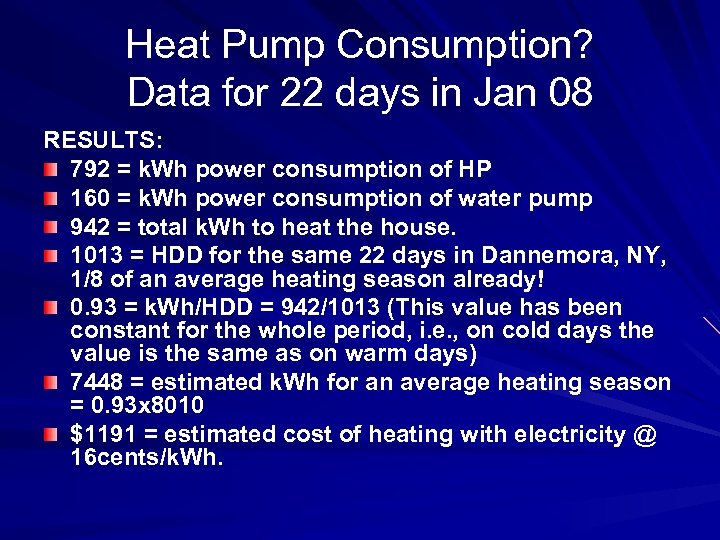 Heat Pump Consumption? Data for 22 days in Jan 08 RESULTS: 792 = k. Wh power consumption of HP 160 = k. Wh power consumption of water pump 942 = total k. Wh to heat the house. 1013 = HDD for the same 22 days in Dannemora, NY, 1/8 of an average heating season already! 0. 93 = k. Wh/HDD = 942/1013 (This value has been constant for the whole period, i. e. , on cold days the value is the same as on warm days) 7448 = estimated k. Wh for an average heating season = 0. 93 x 8010 $1191 = estimated cost of heating with electricity @ 16 cents/k. Wh.
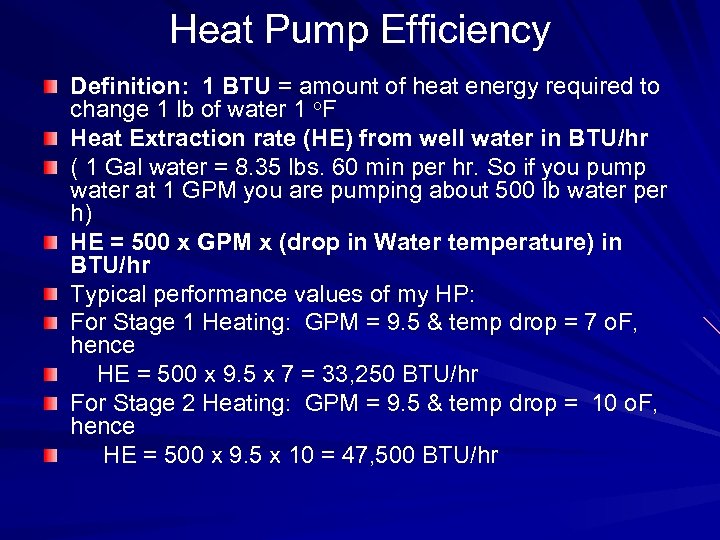 Heat Pump Efficiency Definition: 1 BTU = amount of heat energy required to change 1 lb of water 1 o. F Heat Extraction rate (HE) from well water in BTU/hr ( 1 Gal water = 8. 35 lbs. 60 min per hr. So if you pump water at 1 GPM you are pumping about 500 lb water per h) HE = 500 x GPM x (drop in Water temperature) in BTU/hr Typical performance values of my HP: For Stage 1 Heating: GPM = 9. 5 & temp drop = 7 o. F, hence HE = 500 x 9. 5 x 7 = 33, 250 BTU/hr For Stage 2 Heating: GPM = 9. 5 & temp drop = 10 o. F, hence HE = 500 x 9. 5 x 10 = 47, 500 BTU/hr
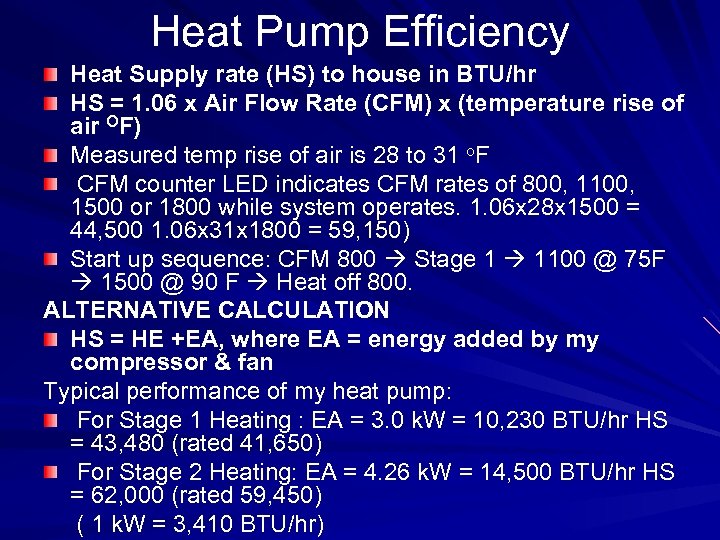 Heat Pump Efficiency Heat Supply rate (HS) to house in BTU/hr HS = 1. 06 x Air Flow Rate (CFM) x (temperature rise of air OF) Measured temp rise of air is 28 to 31 o. F CFM counter LED indicates CFM rates of 800, 1100, 1500 or 1800 while system operates. 1. 06 x 28 x 1500 = 44, 500 1. 06 x 31 x 1800 = 59, 150) Start up sequence: CFM 800 Stage 1 1100 @ 75 F 1500 @ 90 F Heat off 800. ALTERNATIVE CALCULATION HS = HE +EA, where EA = energy added by my compressor & fan Typical performance of my heat pump: For Stage 1 Heating : EA = 3. 0 k. W = 10, 230 BTU/hr HS = 43, 480 (rated 41, 650) For Stage 2 Heating: EA = 4. 26 k. W = 14, 500 BTU/hr HS = 62, 000 (rated 59, 450) ( 1 k. W = 3, 410 BTU/hr)
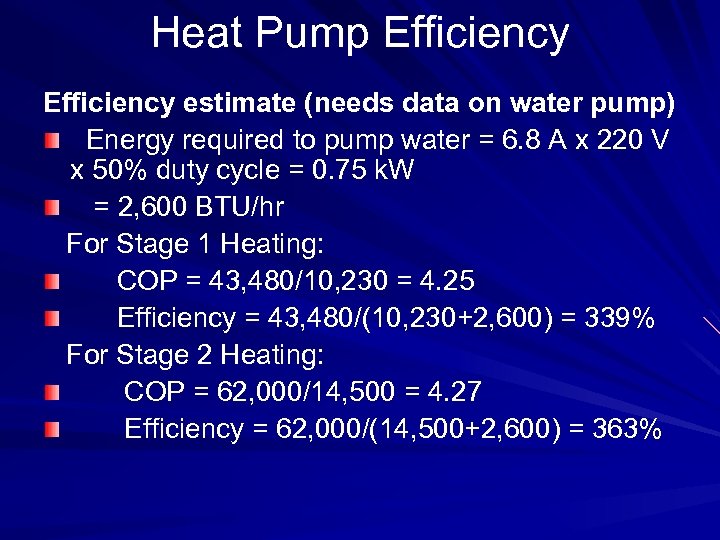 Heat Pump Efficiency estimate (needs data on water pump) Energy required to pump water = 6. 8 A x 220 V x 50% duty cycle = 0. 75 k. W = 2, 600 BTU/hr For Stage 1 Heating: COP = 43, 480/10, 230 = 4. 25 Efficiency = 43, 480/(10, 230+2, 600) = 339% For Stage 2 Heating: COP = 62, 000/14, 500 = 4. 27 Efficiency = 62, 000/(14, 500+2, 600) = 363%
 www. powernaturally. org
 SWIEP Small Wind Information Exchange Program http: //www. ualberta. ca/~mtyree/SWIEP/
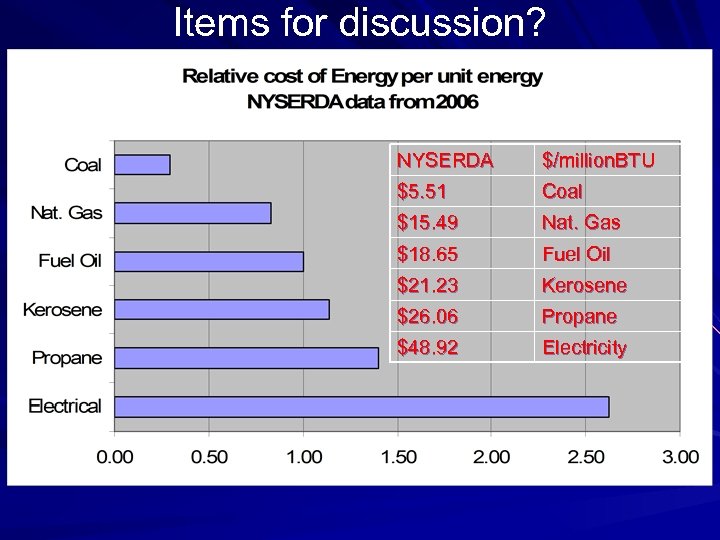 Items for discussion? NYSERDA $/million. BTU $5. 51 Coal $15. 49 Nat. Gas $18. 65 Fuel Oil $21. 23 Kerosene $26. 06 Propane $48. 92 Electricity