 Скачать презентацию Net-Zero Energy Homes The Basics of What You
d4fa9e0d910322619494f691529e4946.ppt
- Количество слайдов: 61



Net-Zero Energy Homes: The Basics of What You Need to Know Building Science Corporation Kohta Ueno, Senior Associate The 2010 HVACR & Plumbing Instructor Workshop: Advancing Green Mechanical Concepts March 24 -26, 2010 © 2009 Building Science Corporation 1

Background © 2009 Building Science Corporation
Definitions • NZE: A building that produces as much energy in a typical year as it consumes. – Consumes grid power when it needs it – Feed power to grid when it has extra • ALL energy considered – Electric is not special. • NOT Zero Carbon, or Zero GHG • NOT off-grid – Much more difficult © 2009 Building Science Corporation
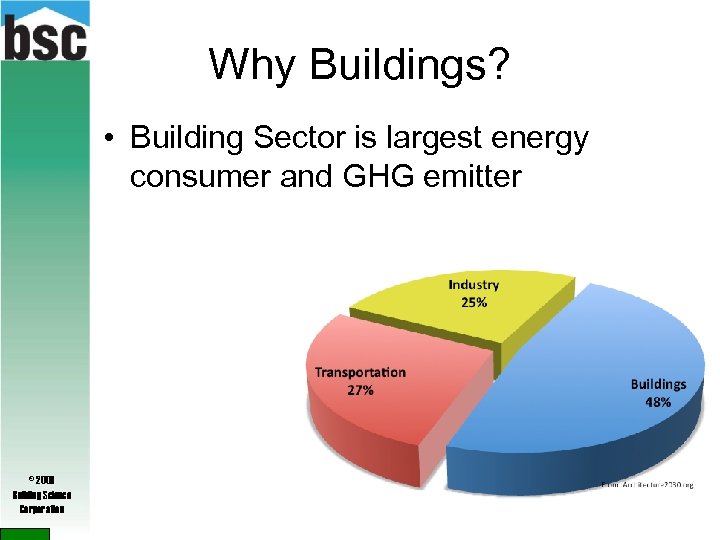
Why Buildings? • Building Sector is largest energy consumer and GHG emitter © 2009 Building Science Corporation
NZE Design Targets • Produce as much as we consume • Production is usually MUCH more expensive than reducing waste (efficiency/conservation) © 2009 Building Science Corporation – Hence the energy demanded by building should always be reduced, reduced before adding production – Check cost of reducing demand vs cost if supplying energy
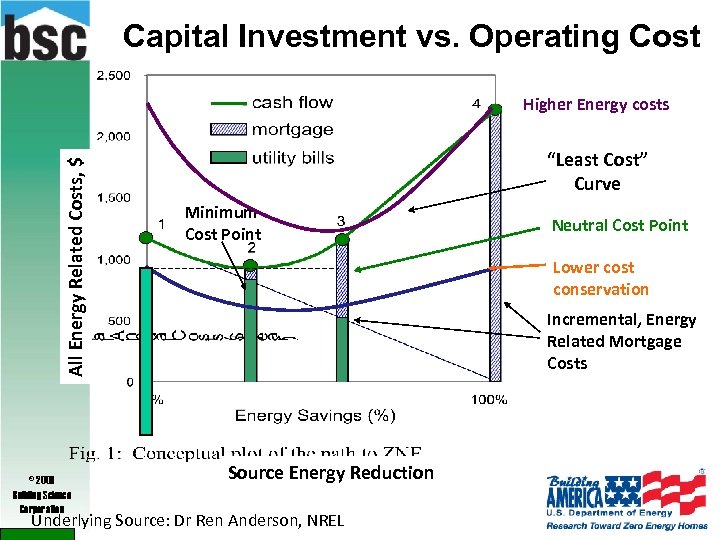
Capital Investment vs. Operating Cost All Energy Related Costs, $ Higher Energy costs © 2009 Building Science Corporation “Least Cost” Curve Minimum Cost Point Neutral Cost Point Lower cost conservation Incremental, Energy Related Mortgage Costs Source Energy Reduction Underlying Source: Dr Ren Anderson, NREL
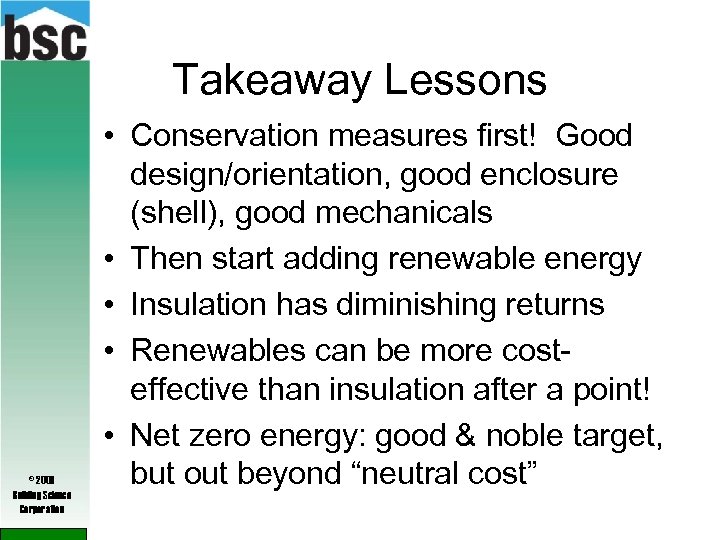
Takeaway Lessons © 2009 Building Science Corporation • Conservation measures first! Good design/orientation, good enclosure (shell), good mechanicals • Then start adding renewable energy • Insulation has diminishing returns • Renewables can be more costeffective than insulation after a point! • Net zero energy: good & noble target, but out beyond “neutral cost”

Renewables © 2009 Building Science Corporation
Energy Supply • Renewable energy (RE) or cleaner energy (CE) • Net Zero currently demands site production – This eliminates some good economical RE • Common choices © 2009 Building Science Corporation – Photovoltaic: Electricity – Solar thermal Warm / Hotwater – Combined heat and power – Wind electricity
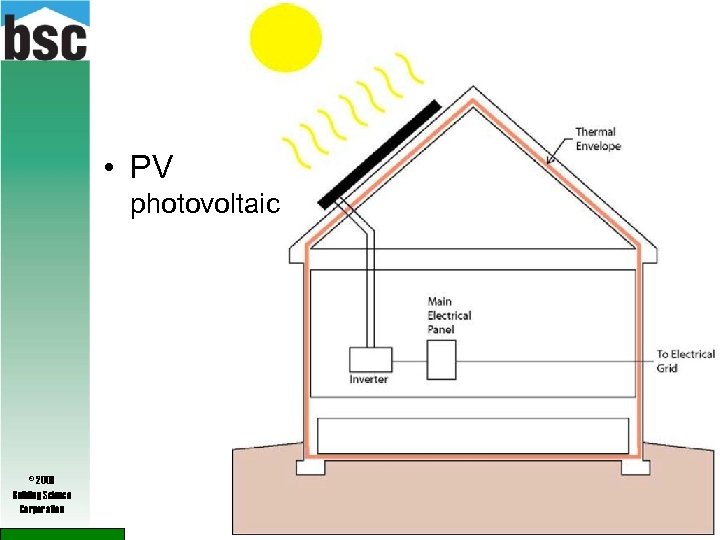
• PV photovoltaic © 2009 Building Science Corporation
Energy Supply (RE) • PV – Straightforward installation, easy to predict output – Expensive but electricity is very useful and excess can easily be sent to the grid (grid=battery) – Rated by peak output under standard solar conditions (“peak Watt” or Wp) – Costs now $8/Wp (before subsidy) installed © 2009 Building Science Corporation
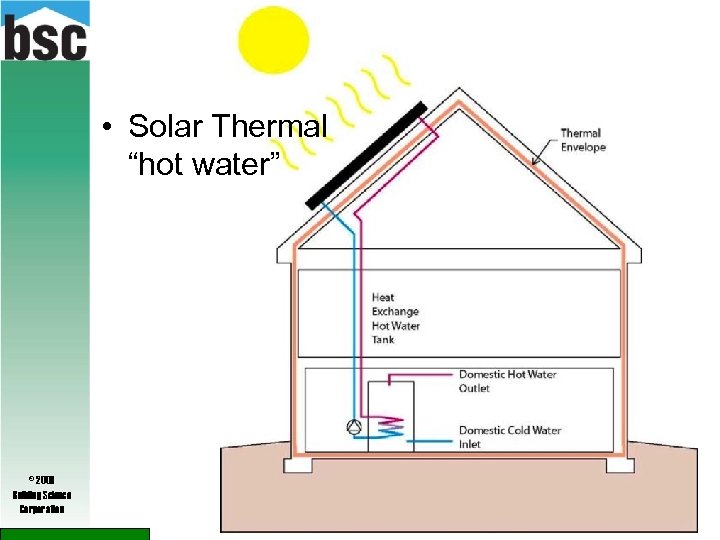
• Solar Thermal “hot water” © 2009 Building Science Corporation
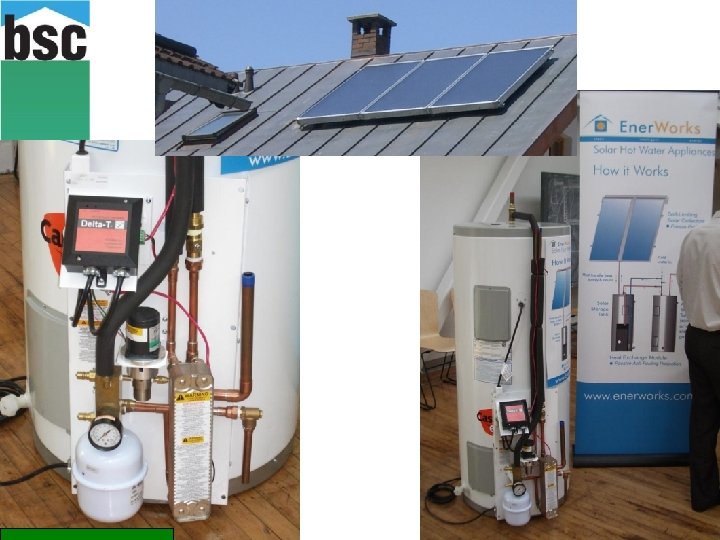
Solar thermal • Intermittent source of hot water • Well developed • Requires big storage tanks in most application • Freezing, over heating, glycol thickening failures, and low temperature efficiency are issues • Not the most economically-viable choice ($6 -10 K): but if going to net zero… © 2009 Building Science Corporation Building. Science. com
© 2009 Building Science Corporation Building. Science. com
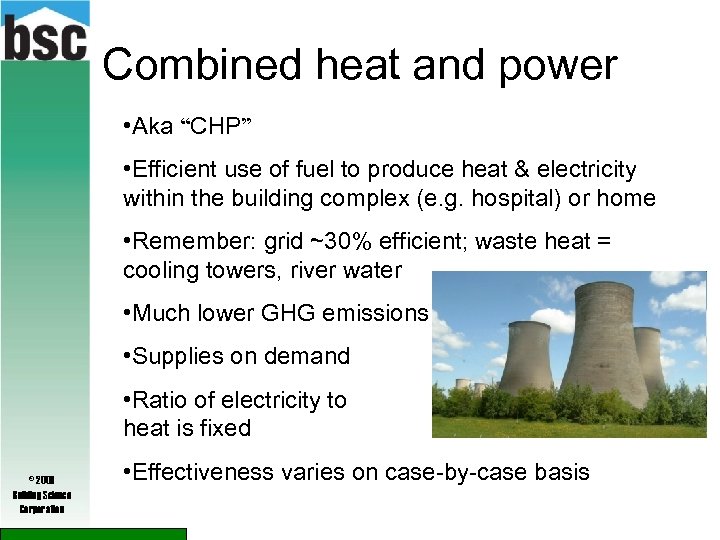
Combined heat and power • Aka “CHP” • Efficient use of fuel to produce heat & electricity within the building complex (e. g. hospital) or home • Remember: grid ~30% efficient; waste heat = cooling towers, river water • Much lower GHG emissions • Supplies on demand • Ratio of electricity to heat is fixed © 2009 Building Science Corporation • Effectiveness varies on case-by-case basis

Mechanical Systems © 2009 Building Science Corporation
Mechanical Systems Energy consuming functions • Heating • Cooling • Domestic Hot Water • Ventilation & Filtration Fundamental problem: small loads! © 2009 Building Science Corporation
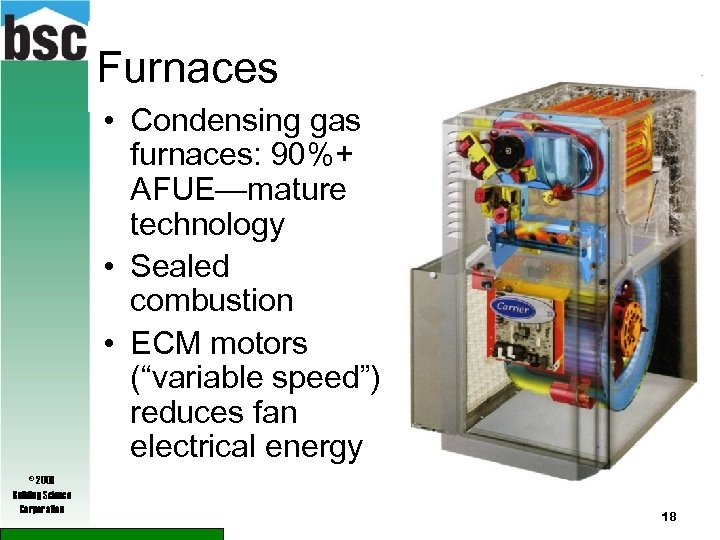
Furnaces • Condensing gas furnaces: 90%+ AFUE—mature technology • Sealed combustion • ECM motors (“variable speed”) reduces fan electrical energy © 2009 Building Science Corporation 18
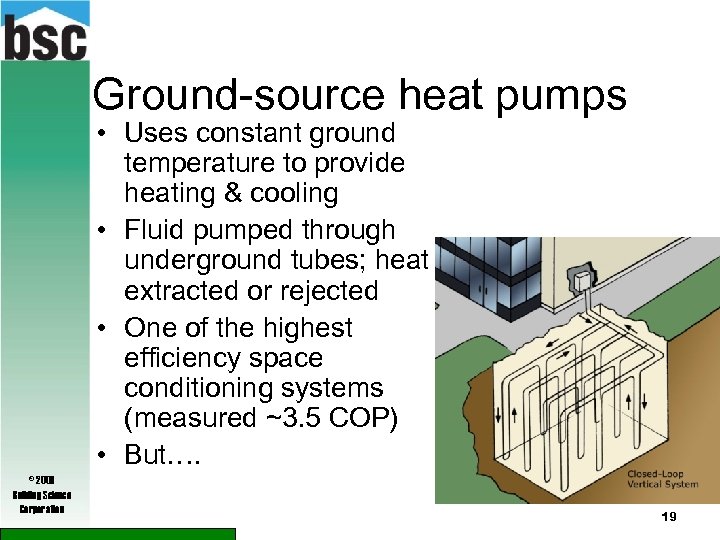
Ground-source heat pumps • Uses constant ground temperature to provide heating & cooling • Fluid pumped through underground tubes; heat extracted or rejected • One of the highest efficiency space conditioning systems (measured ~3. 5 COP) • But…. © 2009 Building Science Corporation 19
Ground-source heat pumps © 2009 Building Science Corporation • Installed cost of system very high (drilling ground loops) • Nameplate efficiency < actual efficiency (previous example: 5 COP rated number) • Pumping energy • Systems with problems—difficult to diagnose, expensive to fix • Can still suffer from normal ductwork-based system problems • For small loads, is it worthwhile? 20
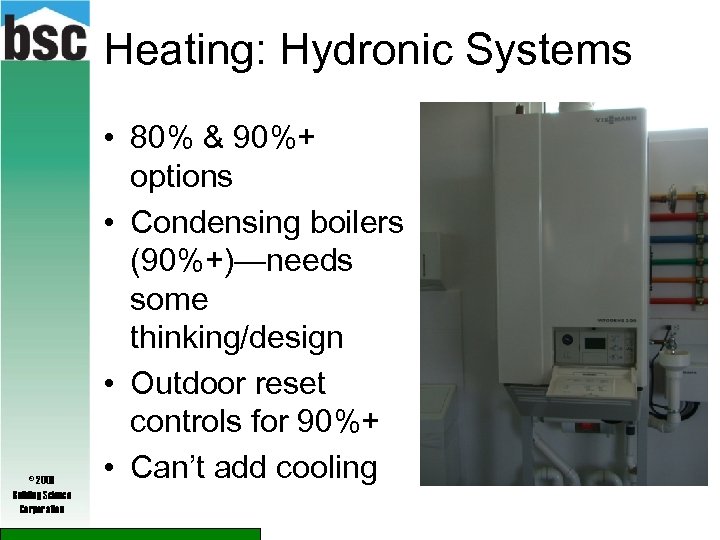
Heating: Hydronic Systems © 2009 Building Science Corporation • 80% & 90%+ options • Condensing boilers (90%+)—needs some thinking/design • Outdoor reset controls for 90%+ • Can’t add cooling
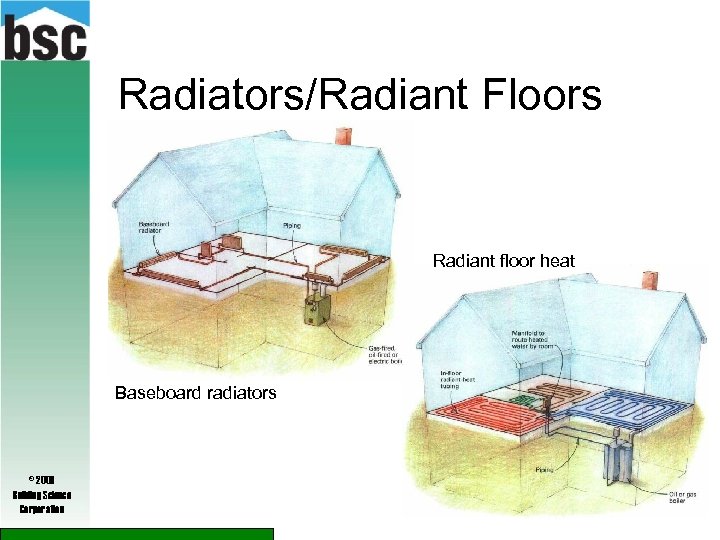
Radiators/Radiant Floors Radiant floor heat Baseboard radiators © 2009 Building Science Corporation 22
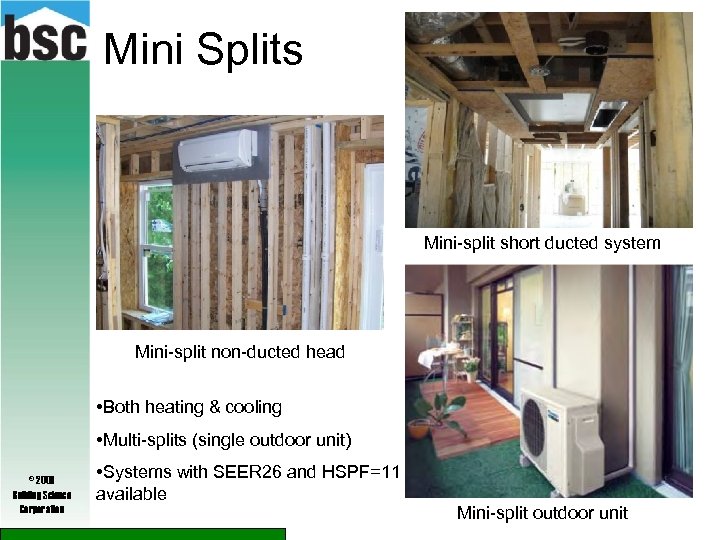
Mini Splits Mini-split short ducted system Mini-split non-ducted head • Both heating & cooling • Multi-splits (single outdoor unit) © 2009 Building Science Corporation • Systems with SEER 26 and HSPF=11 available Mini-split outdoor unit 23
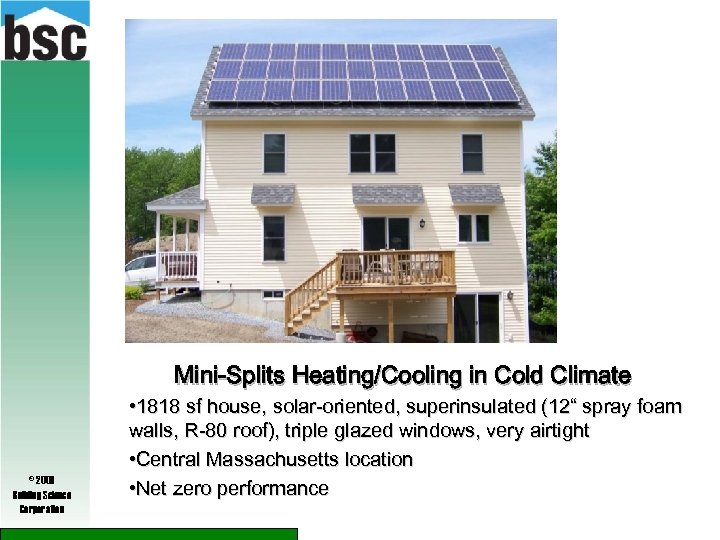
Mini-Splits Heating/Cooling in Cold Climate © 2009 Building Science Corporation • 1818 sf house, solar-oriented, superinsulated (12“ spray foam walls, R-80 roof), triple glazed windows, very airtight • Central Massachusetts location • Net zero performance
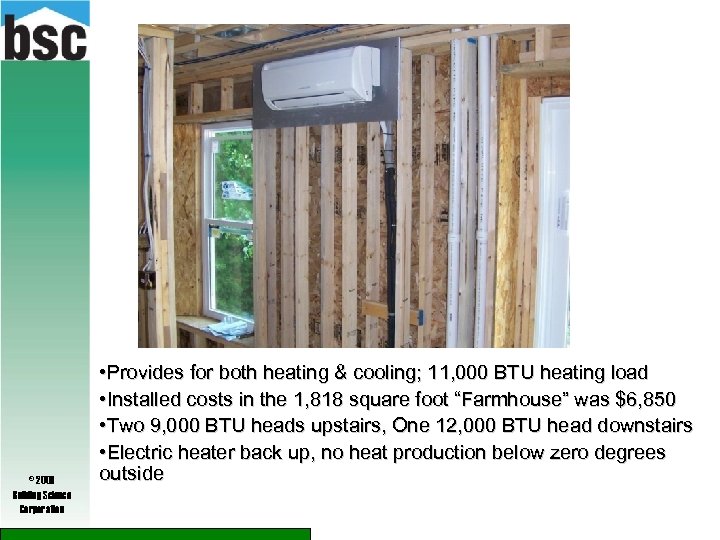
© 2009 Building Science Corporation • Provides for both heating & cooling; 11, 000 BTU heating load • Installed costs in the 1, 818 square foot “Farmhouse” was $6, 850 • Two 9, 000 BTU heads upstairs, One 12, 000 BTU head downstairs • Electric heater back up, no heat production below zero degrees outside
Ventilation © 2009 Building Science Corporation
Need for Ventilation • Greater airtightness for energy reasons, in net zero houses • Also improves sound, odor, pest control • But people still stink! (+ activities) • Controlled mechanical ventilation © 2009 Building Science Corporation – Point source control (exhaust fans) – General dilution ventilation
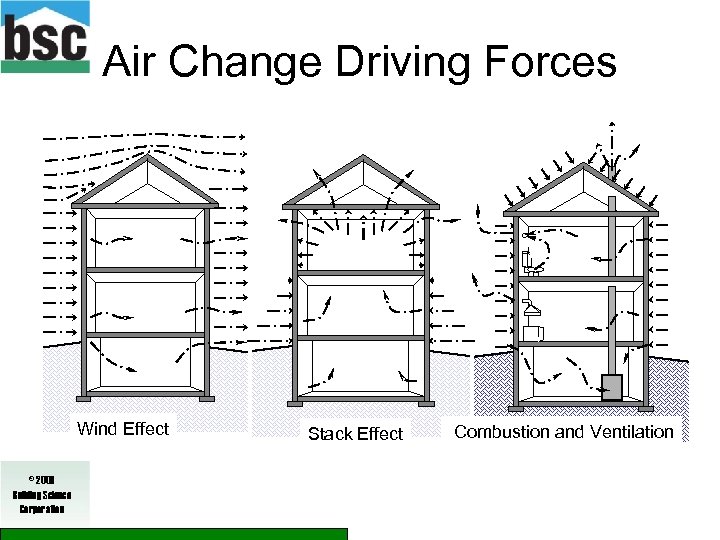
Air Change Driving Forces Wind Effect © 2009 Building Science Corporation Stack Effect Combustion and Ventilation
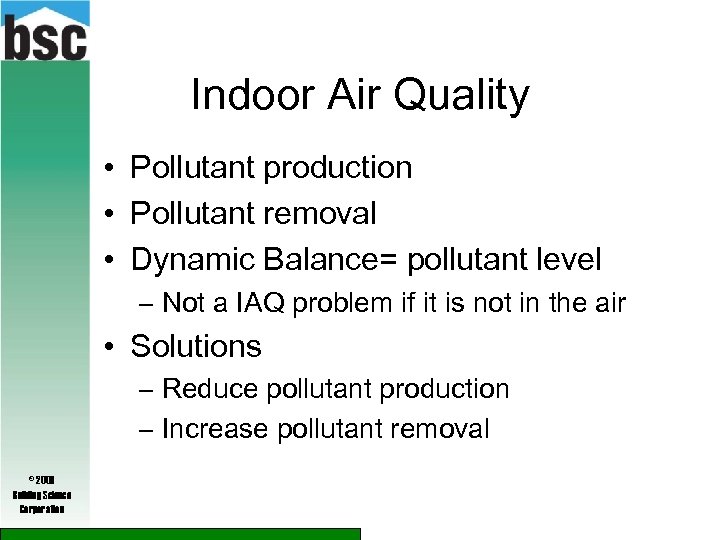
Indoor Air Quality • Pollutant production • Pollutant removal • Dynamic Balance= pollutant level – Not a IAQ problem if it is not in the air • Solutions – Reduce pollutant production – Increase pollutant removal © 2009 Building Science Corporation
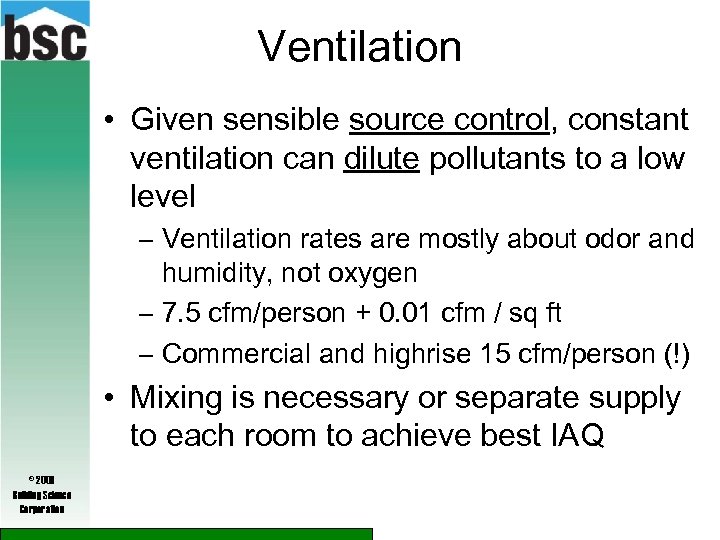
Ventilation • Given sensible source control, constant ventilation can dilute pollutants to a low level – Ventilation rates are mostly about odor and humidity, not oxygen – 7. 5 cfm/person + 0. 01 cfm / sq ft – Commercial and highrise 15 cfm/person (!) • Mixing is necessary or separate supply to each room to achieve best IAQ © 2009 Building Science Corporation
Types of Controlled Ventilation Systems • Exhaust Ventilation • Supply Ventilation • Balanced Ventilation © 2009 Building Science Corporation
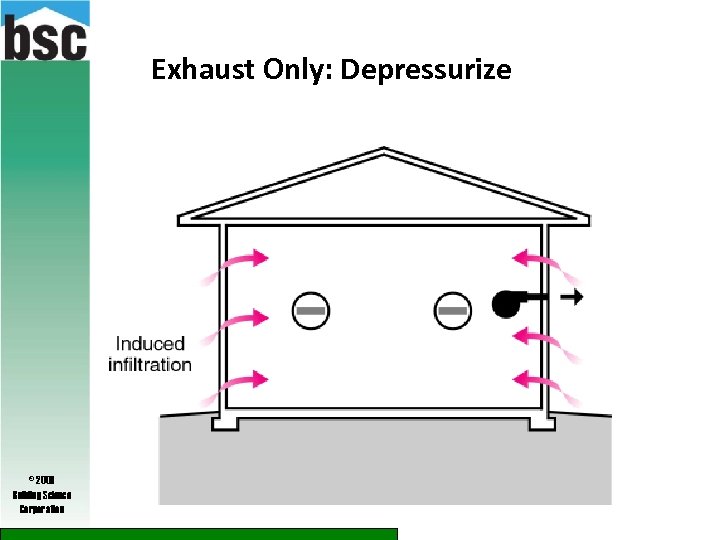
Exhaust Only: Depressurize © 2009 Building Science Corporation
Exhaust pros and cons • Lowest cost installed system (typical), but problems associated: • Carbon monoxide alarms • Lack of filtration • Dust marking on light carpets • Dirt/grit particles settling on horizontal surfaces • Lack of distribution • Moisture accumulation and odor buildup in rooms remote from exhaust fan © 2009 Building Science Corporation • Objections to fan noise
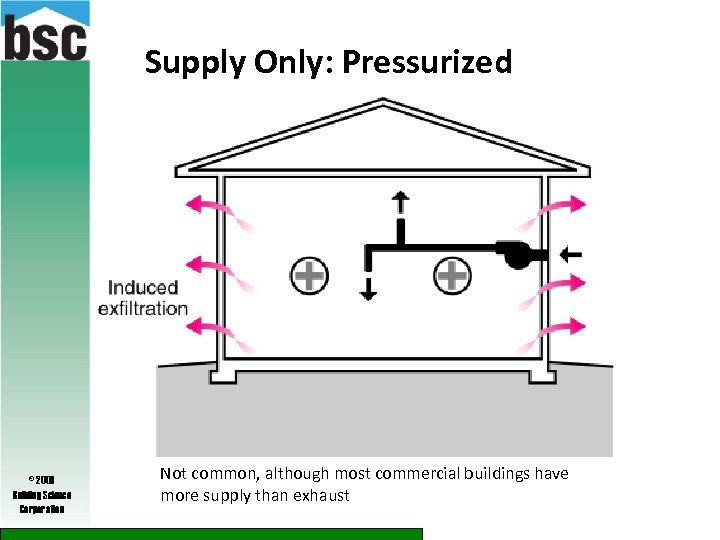
Supply Only: Pressurized © 2009 Building Science Corporation Not common, although most commercial buildings have more supply than exhaust
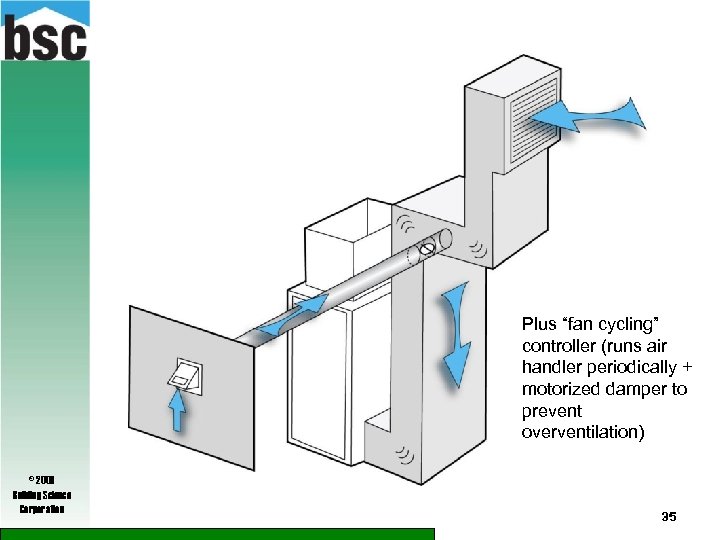
Plus “fan cycling” controller (runs air handler periodically + motorized damper to prevent overventilation) © 2009 Building Science Corporation 35
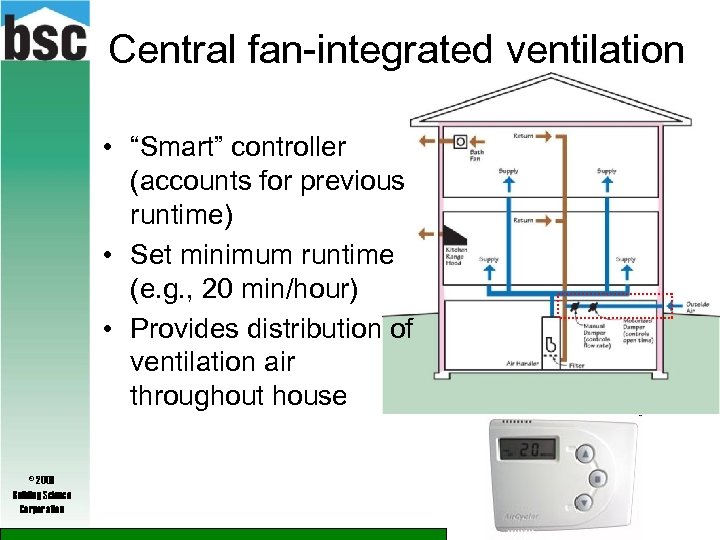
Central fan-integrated ventilation • “Smart” controller (accounts for previous runtime) • Set minimum runtime (e. g. , 20 min/hour) • Provides distribution of ventilation air throughout house © 2009 Building Science Corporation
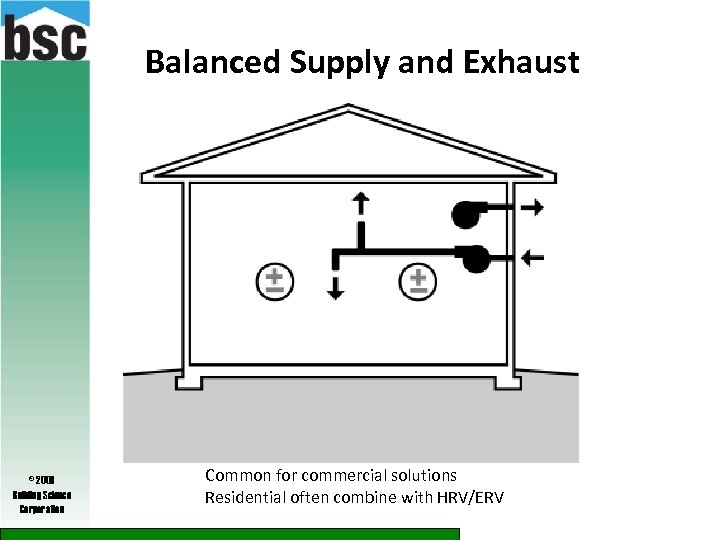
Balanced Supply and Exhaust © 2009 Building Science Corporation Common for commercial solutions Residential often combine with HRV/ERV
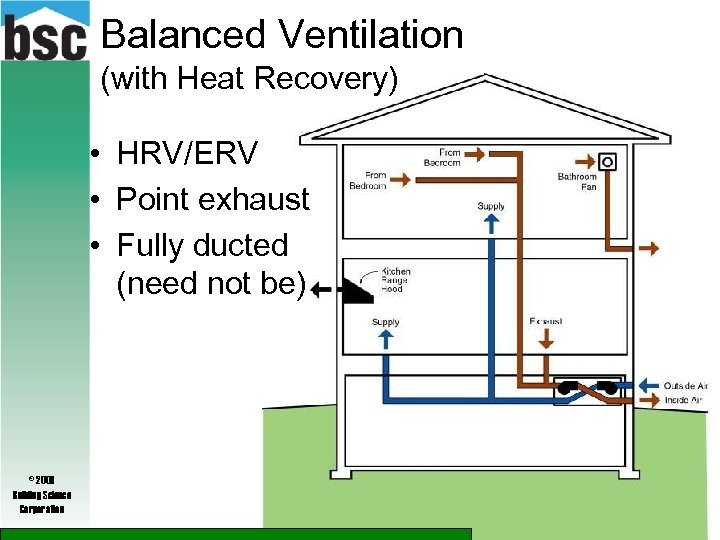
Balanced Ventilation (with Heat Recovery) • HRV/ERV • Point exhaust • Fully ducted (need not be) © 2009 Building Science Corporation
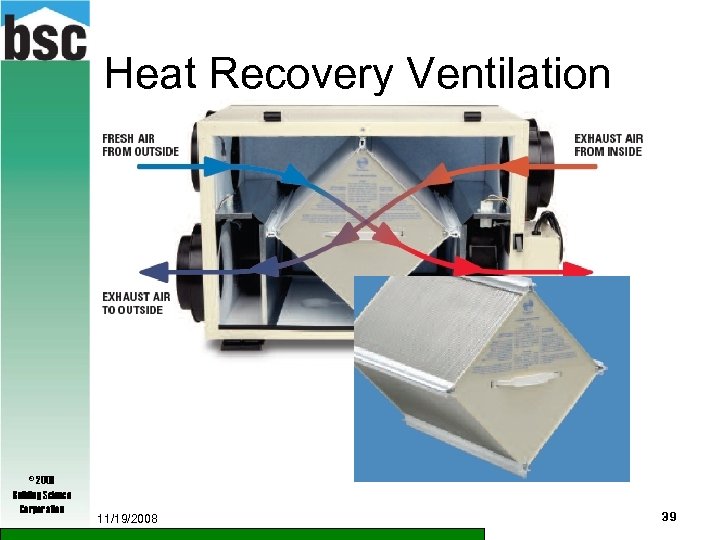
Heat Recovery Ventilation © 2009 Building Science Corporation 11/19/2008 39
Efficient Equipment • HRV/ERV always – choose better than 1 CFM/Watt (current high end ~2 CFM/Watt) – Choose > 60% efficient – Right size ventilation!—overventilation can defeat the benefits of adding heat recovery! © 2009 Building Science Corporation

Humidity © 2009 Building Science Corporation
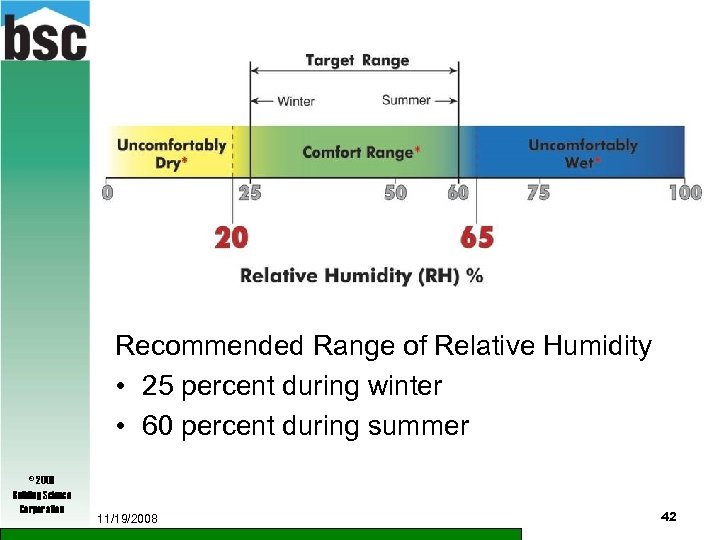
Recommended Range of Relative Humidity • 25 percent during winter • 60 percent during summer © 2009 Building Science Corporation 11/19/2008 42
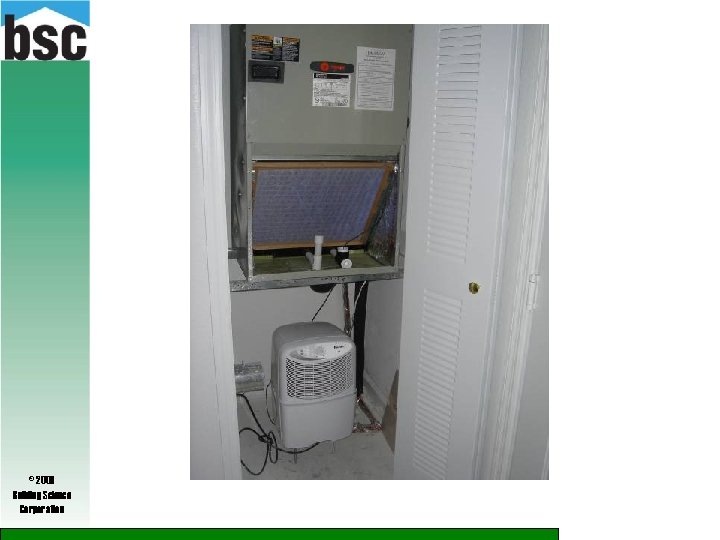
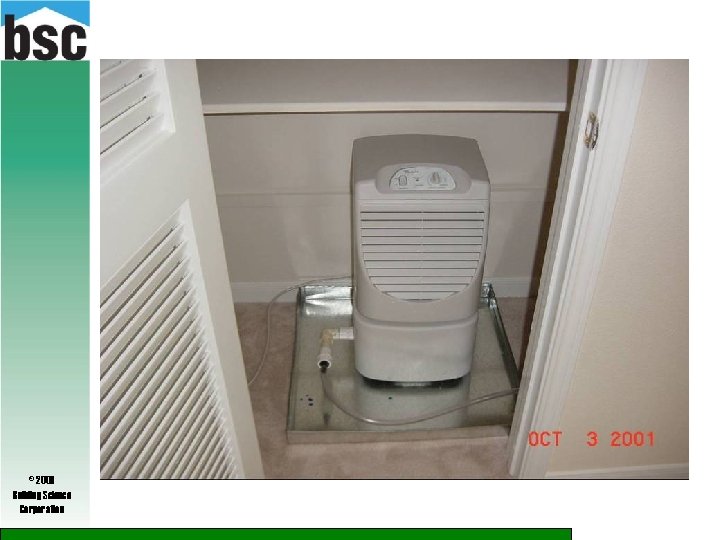
Supplemental Humidity Control • Good energy efficient design reduces sensible cooling loads—insulation, good windows, airtightness • Latent load remains the same! • Thermostat (temperature control) → humidity is not controlled • Need supplemental dehumidification in hothumid and mixed-humid climates (high performance houses) • Demonstrated in 20 research houses © 2009 Building Science Corporation Information Sheet 620: Supplemental Humidity Control RR-0505: Residential Dehumidification Systems Research for Hot. Humid Climates
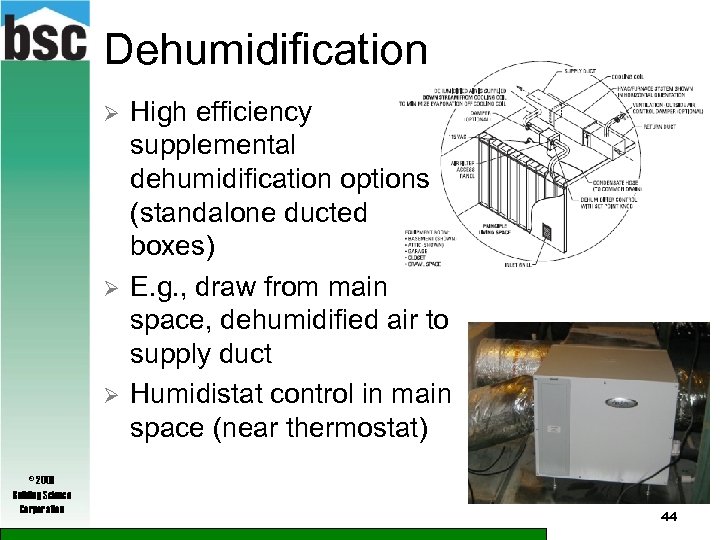
Dehumidification Ø Ø Ø © 2009 Building Science Corporation High efficiency supplemental dehumidification options (standalone ducted boxes) E. g. , draw from main space, dehumidified air to supply duct Humidistat control in main space (near thermostat) 44
© 2009 Building Science Corporation
© 2009 Building Science Corporation
Combustion Safety © 2009 Building Science Corporation
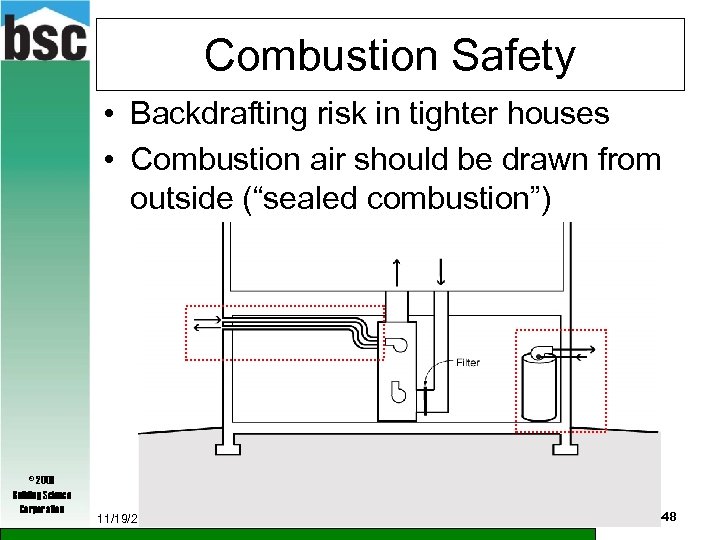
Combustion Safety • Backdrafting risk in tighter houses • Combustion air should be drawn from outside (“sealed combustion”) © 2009 Building Science Corporation 11/19/2008 48

Case Study: Westford © 2009 Building Science Corporation
Case Study House (Westford Habitat for Humanity) • • © 2009 Building Science Corporation Based on recently-built house Super-insulated enclosure Very airtight (1. 5 ACH 50) Best-in-class mechanical systems Energy Star appliances Compact fluorescent lighting No renewable energy added: not NZE (PVs or solar DHW)
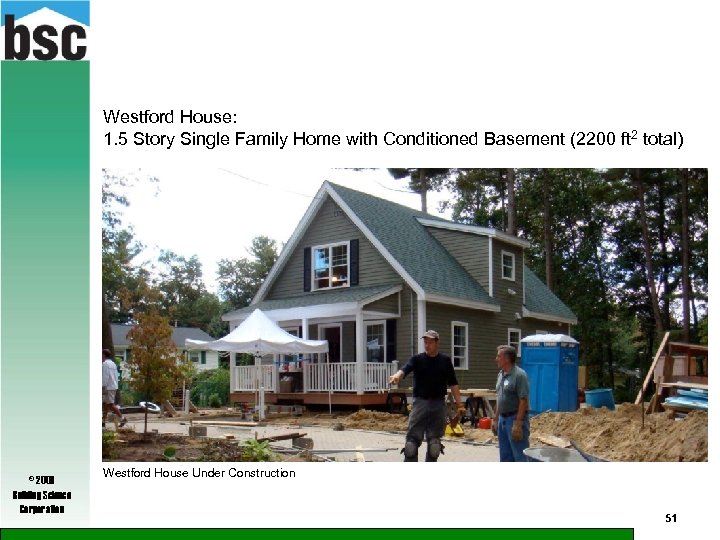
Westford House: 1. 5 Story Single Family Home with Conditioned Basement (2200 ft 2 total) © 2009 Building Science Corporation Westford House Under Construction 51
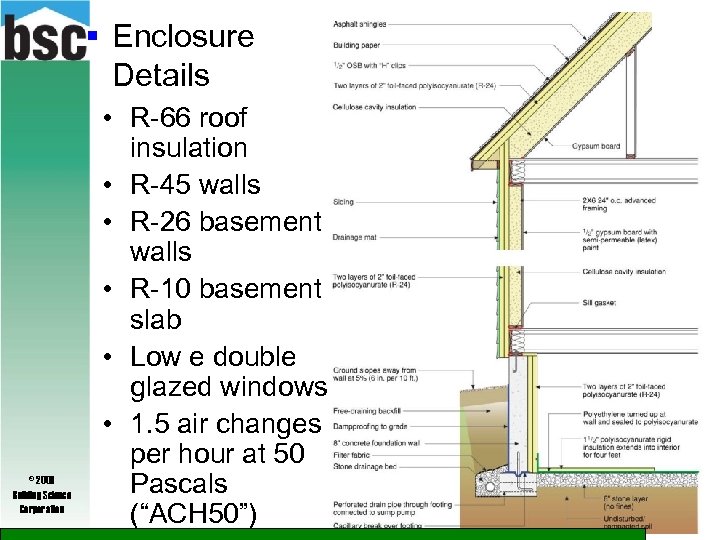
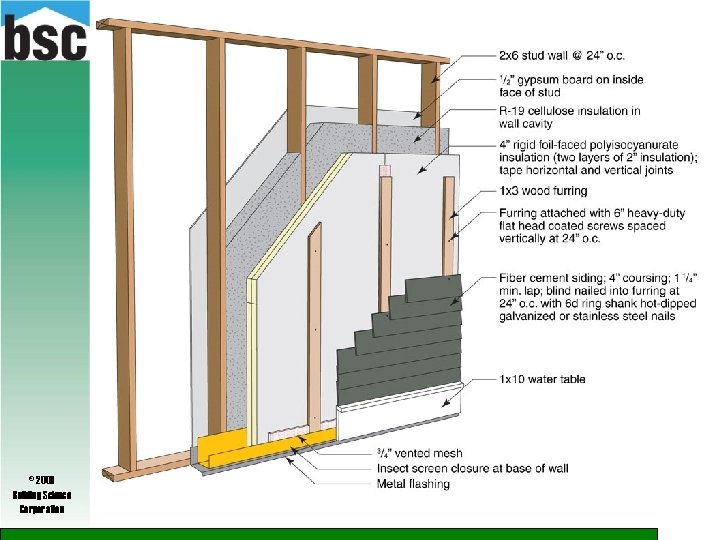
§ Enclosure Details © 2009 Building Science Corporation • R-66 roof insulation • R-45 walls • R-26 basement walls • R-10 basement slab • Low e double glazed windows • 1. 5 air changes per hour at 50 Pascals (“ACH 50”) 7 October 2008 52
© 2009 Building Science Corporation
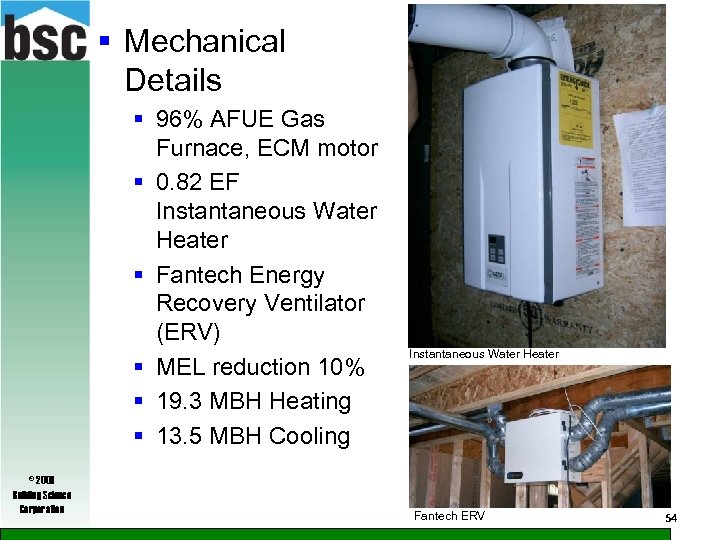
§ Mechanical Details § 96% AFUE Gas Furnace, ECM motor § 0. 82 EF Instantaneous Water Heater § Fantech Energy Recovery Ventilator (ERV) § MEL reduction 10% § 19. 3 MBH Heating § 13. 5 MBH Cooling © 2009 Building Science Corporation Instantaneous Water Heater Fantech ERV 54
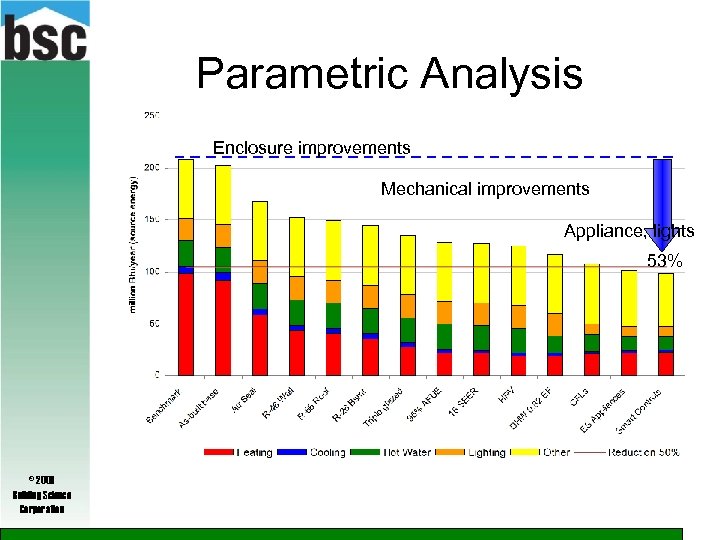
Parametric Analysis Enclosure improvements Mechanical improvements Appliance, lights 53% © 2009 Building Science Corporation

Final Points © 2009 Building Science Corporation
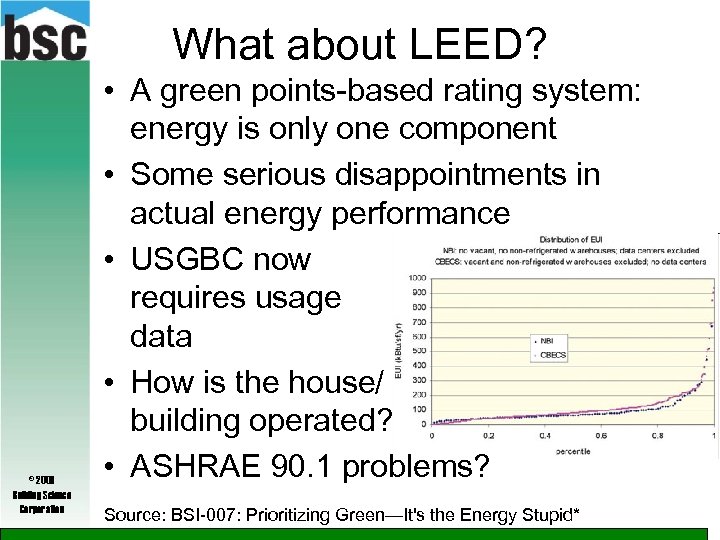
What about LEED? © 2009 Building Science Corporation • A green points-based rating system: energy is only one component • Some serious disappointments in actual energy performance • USGBC now requires usage data • How is the house/ building operated? • ASHRAE 90. 1 problems? Source: BSI-007: Prioritizing Green—It's the Energy Stupid*

Questions/ Comments © 2009 Building Science Corporation
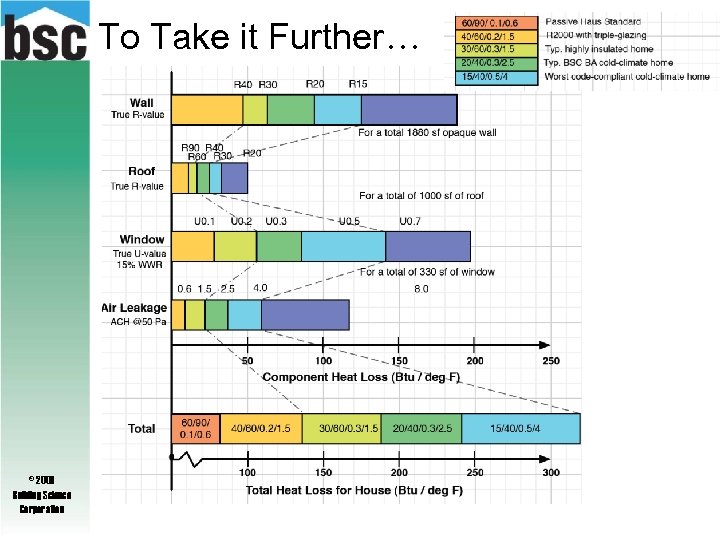
To Take it Further… © 2009 Building Science Corporation
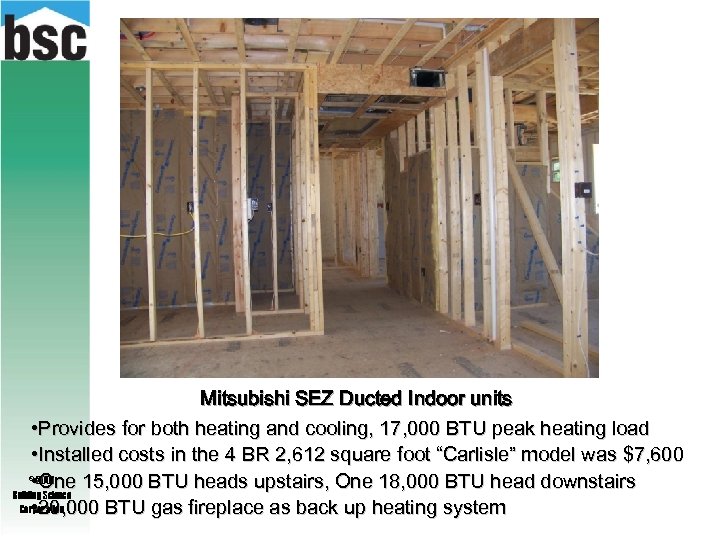
Mitsubishi SEZ Ducted Indoor units • Provides for both heating and cooling, 17, 000 BTU peak heating load • Installed costs in the 4 BR 2, 612 square foot “Carlisle” model was $7, 600 © 2009 • One 15, 000 BTU heads upstairs, One 18, 000 BTU head downstairs Building Science Corporation • 20, 000 BTU gas fireplace as back up heating system
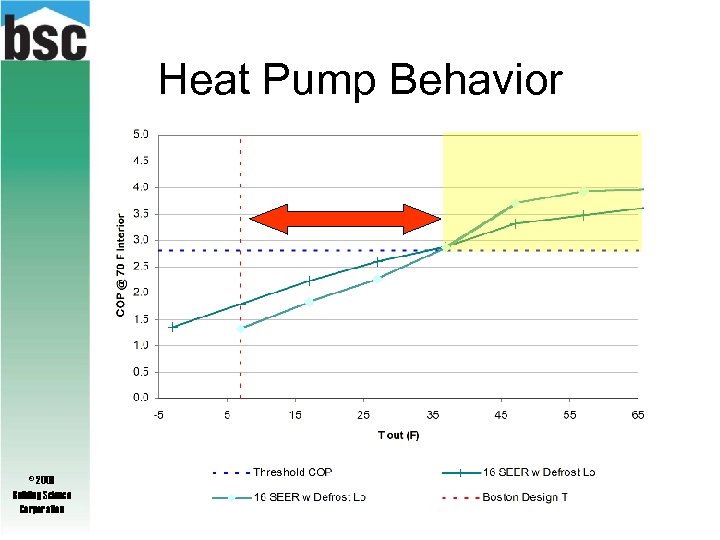
Heat Pump Behavior © 2009 Building Science Corporation
Скачать презентацию Net-Zero Energy Homes The Basics of What You
d4fa9e0d910322619494f691529e4946.ppt