


 Скачать презентацию Net Software Architects UG Meeting Methodology for
d997b91f6923da3b785e0db8b767533a.ppt
- Количество слайдов: 49
 . Net Software Architects UG Meeting Methodology for Use case development Arnon Rotem-Gal-Oz Product Line Architect arnon@rgoarchitects. com
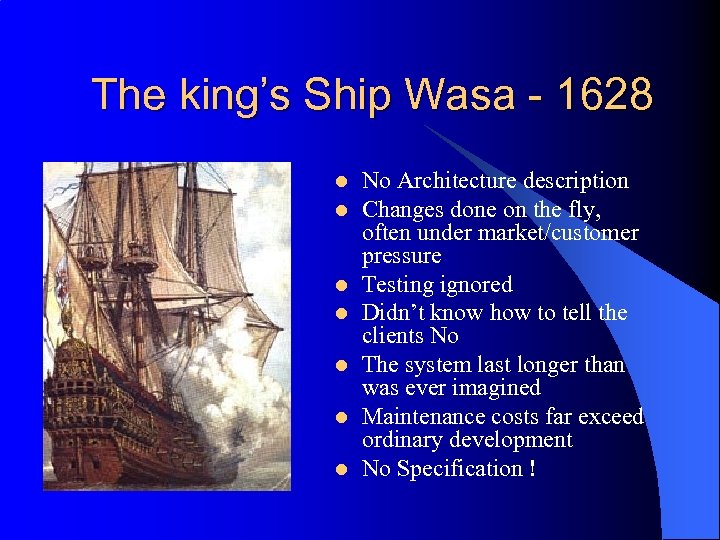 The king’s Ship Wasa - 1628 l l l l No Architecture description Changes done on the fly, often under market/customer pressure Testing ignored Didn’t know how to tell the clients No The system last longer than was ever imagined Maintenance costs far exceed ordinary development No Specification !
 Agenda Vocabulary l Why Use Cases? l Why should we care? l The challenges of UC modeling in large projects l The Methodology l Summary l
 Vocabulary l Actor – Role(s) external parties that interact with the system l Use Case – A sequence of actions that the system performs that yields an observable result of value to an actor. [Booch 1999] l Use Case Model - Bag that contains – Actors list, packages, diagrams, use cases, views
 Use Cases benefits l Promote customer involvement l Help manage complexity – Layers – Focus on real user needs l Groundwork for user manual, test cases l Help us work in iterations
 Use cases aren’t everything l Non-behavioral requirements – Performance – Design constrains – Etc. l Sometimes – an overkill
 Use cases & Architects!? l Requirements drive the design !!! l Help force designers focus on concrete issues l Help identifying technical and business risks l Can be used to help validate the architecture
 Use cases & Architects ? ! (cont. ) l Architects should be involved in (if not responsible for) - UC prioritization ! l Architectural design workflow (Kruchten 2003): – – – – Select scenarios : criticality and risk Identify main classes/components and their responsibility Distribute behavior Structure into subsystems, layers and define interfaces Define distribution and concurrency Implement architectural prototype Derive tests from use cases Evaluate architecture
 Overview Use case modeling for large projects is problematic l Most literature is lacking (too simplistic / not practical) l A practical reasonable process is needed! l
 Naïve approach l Find Actors l Find Use Cases l Describe Use Cases
 Challenges l Model – Duplicates – Explosion – Making sure the requirements are good l Team – Efficiency – Fragmentation l Process – Details too early – Quitting Time – Waterfall
 The Methodology l To resolve the challenges we need a process that is: – Ordered – Controlled – Not too complicated – Not too demanding – Flexible
 Methodology – Initialization Steps Define System Boundary l Organize the Team l Build a Problem Domain Object Model l
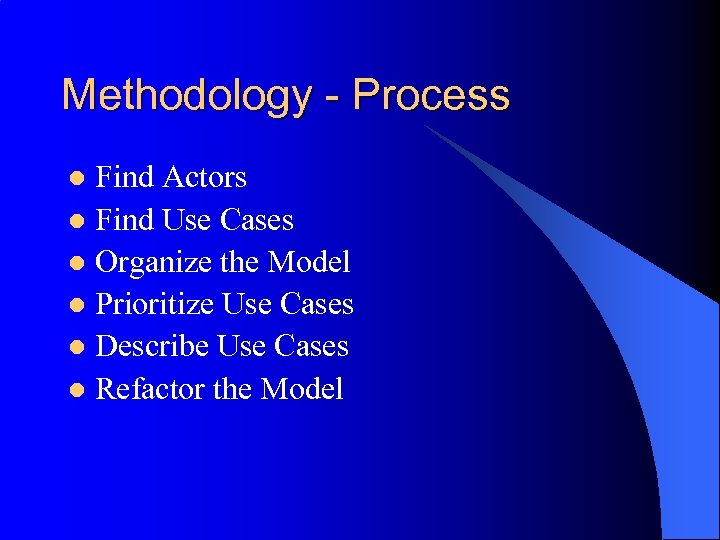 Methodology - Process Find Actors l Find Use Cases l Organize the Model l Prioritize Use Cases l Describe Use Cases l Refactor the Model l
 Methodology – Supporting Steps Verify and Validate l Add Future Requierments l
 Methodology – End Game l Knowing when to stop!
 Step 1: Define System Boundary l Vision and Scope – What problems are solved – Who are the stakeholders – Client’s Organization main goals – System main goals – Boundaries of the solution – Future Directions
 Step 2: Organize the Team Small teams l Heterogeneous l Multi-tier reviews l Requirements manager l
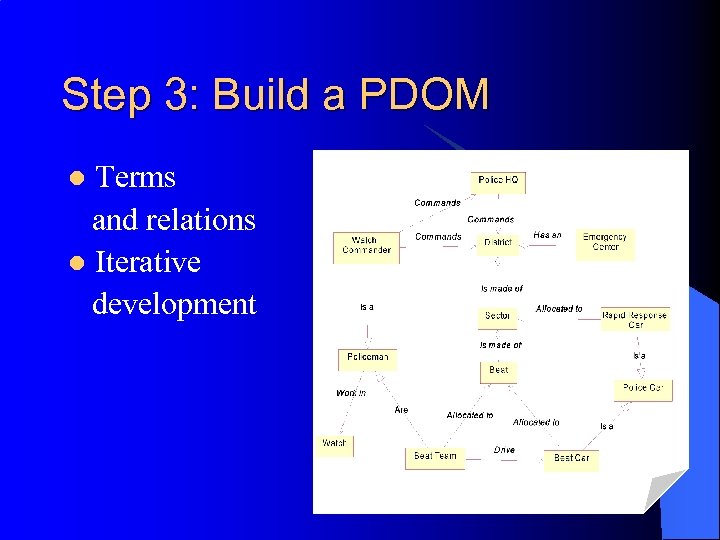 Step 3: Build a PDOM Terms and relations l Iterative development l
 Step 4: Find Actors l Identify – Ask the End-Users – Documentation l Issues – Roles Vs. Job Titles – The Clock
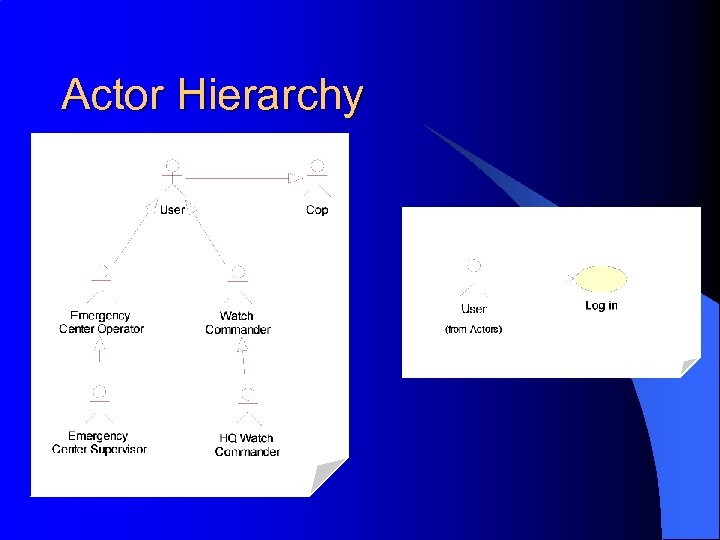 Actor Hierarchy
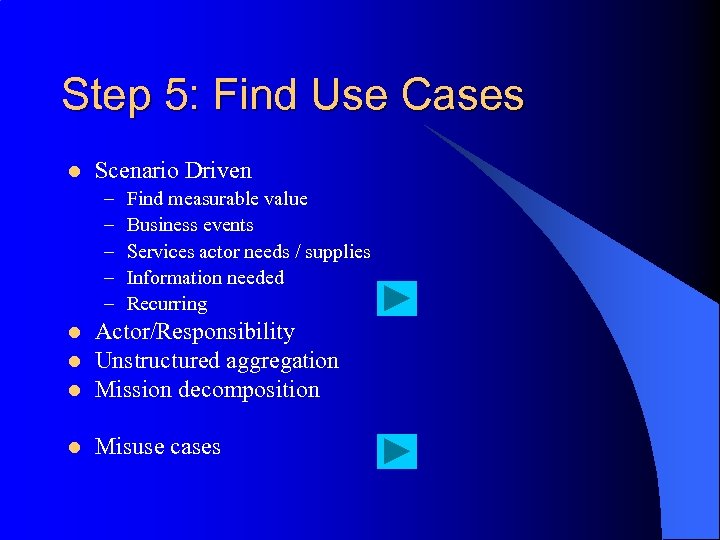 Step 5: Find Use Cases l Scenario Driven – – – Find measurable value Business events Services actor needs / supplies Information needed Recurring l Actor/Responsibility Unstructured aggregation Mission decomposition l Misuse cases l l
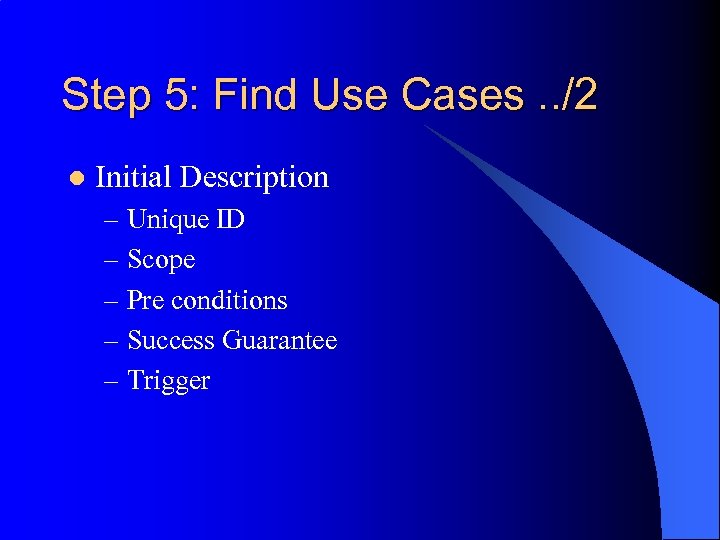 Step 5: Find Use Cases. . /2 l Initial Description – Unique ID – Scope – Pre conditions – Success Guarantee – Trigger
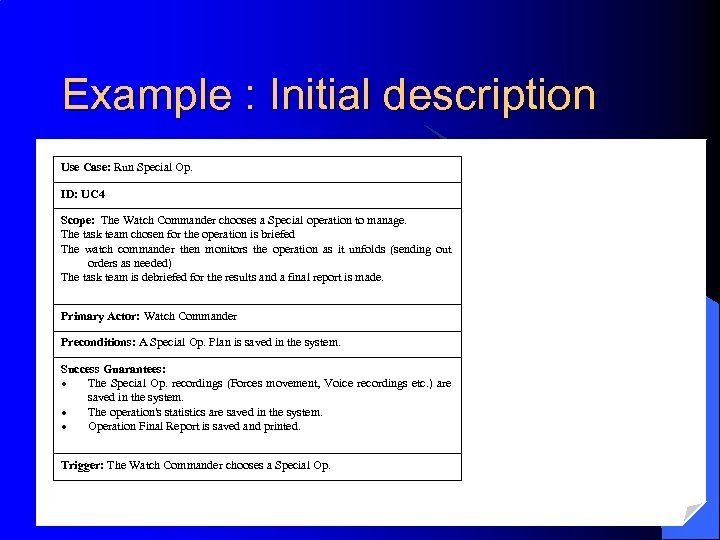 Example : Initial description Use Case: Run Special Op. ID: UC 4 Scope: The Watch Commander chooses a Special operation to manage. The task team chosen for the operation is briefed The watch commander then monitors the operation as it unfolds (sending out orders as needed) The task team is debriefed for the results and a final report is made. Primary Actor: Watch Commander Preconditions: A Special Op. Plan is saved in the system. Success Guarantees: The Special Op. recordings (Forces movement, Voice recordings etc. ) are saved in the system. The operation's statistics are saved in the system. Operation Final Report is saved and printed. Trigger: The Watch Commander chooses a Special Op.
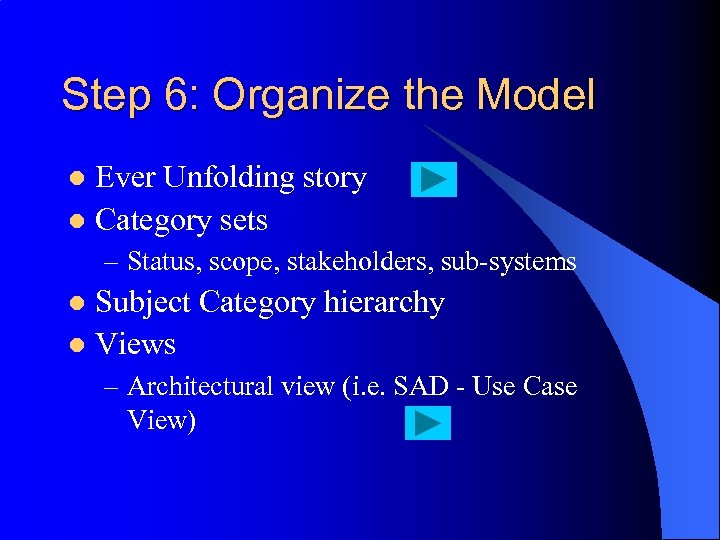 Step 6: Organize the Model Ever Unfolding story l Category sets l – Status, scope, stakeholders, sub-systems Subject Category hierarchy l Views l – Architectural view (i. e. SAD - Use Case View)
 Step 7: Prioritize Use Cases l Risk Classes – Business Risks – Architectural Risks – Logistical Risks l Iterative development – Small vs. Large projects
 Step 8: Describe Use Cases l Template – – – – – Main success Scenario Variations Exception Assumptions Status Priority Stakeholders and concerns Issues Non-behavioral reqs. Extension points.
 Step 8 : Describe Use Cases. . /2 l Focus l Technology neutral l Activity diagrams
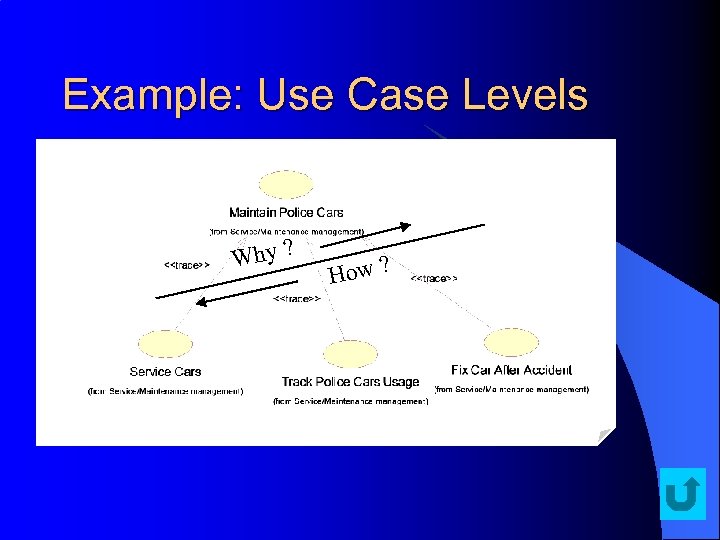
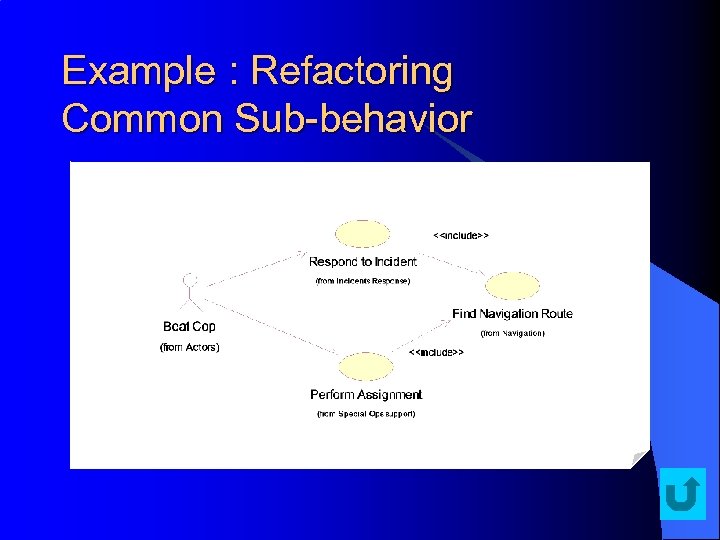
 Step 9: Refactor the Model l Relations – Trace (decomposition) – Include (common sub-behavior) – Extend (promoted alternatives) – Generalize l Merge droplets
 Step 10: Verify & Validate l l l l Verification – Making sure we build the product right Validation – Making sure we build the right product Traceability Inspection Reviews Walkthroughs Prototypes
 Step 10 : V&V. . /2 l Actors – Are all the actors abstractions of specific roles? – Are all the actors clearly described, and do you agree with the descriptions? – Is it clear which actors are involved in which use cases, and can this be clearly seen from the use case diagram and textual descriptions
 Step 10: V&V. . /3 l Use Cases – Does the use case make sense? – For each iteration: Are all the use cases described at the same level of detail? – Are there any superfluous use cases, that is, use cases that are outside the boundary of the system, do not lead to the fulfillment of a goal for an actor or duplicate functionality described in other use cases? – Do all the use cases lead to the fulfillment of exactly one goal for an actor, and is it clear from the use case name what is the goal
 Step 10: V&V. . /4 l The Scenarios – Are there any variants to the normal flow of events that have not been identified in the use cases, that is, are there any missing variations? (“happy days scenarios”, exceptions, variation, “soup-opera scenarios”) – Are the triggers, starting conditions, for each use case described at the correct level of detail? – Does the behavior of a use case conflict with the behavior of other use cases? – Is the number of steps in the complex scenarios excessive (12 to 15 is getting borderline)?
 Step 10: V&V. . /5 l Organization & Prioritization – Are all the use cases organized in an appropriate manner (e. g. by functional area, by dependency, by actor etc)? – Are all the use cases within a package consistent with theme of the package? – Is the priority mechanism documented? – Are the use cases prioritized correctly?
 Step 11: Add Future Requirements l Capture Change cases – Preparing for change – Impact analysis
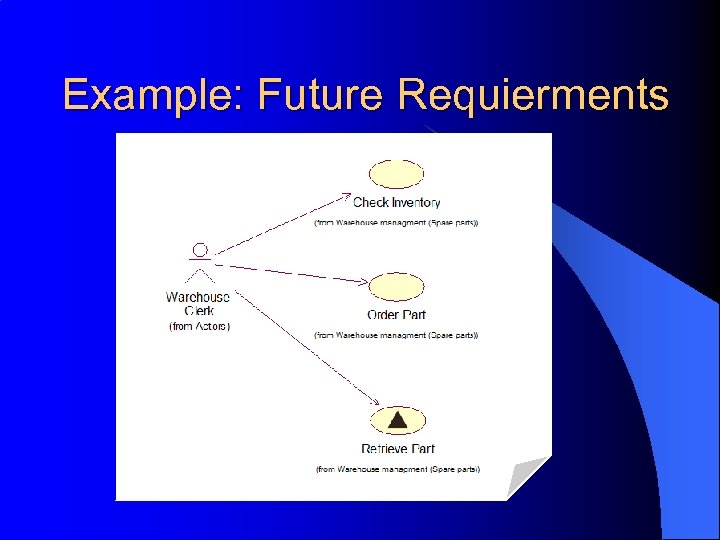 Example: Future Requierments
 Step 12: Knowing When to Stop l Project Level – Complete list of actors and goals – Customer approval – Design ready l Iteration Level – Covered all currently prioritized use cases – Level of detail
 Summary l What we have seen… l Additional Issues – Project Management – Requirements Management – Configuration Management
 Further Reading… Writing Effective Use Cases (Cockburn( l Patterns for Effective Use Cases (Adolph & Bramble( l Advanced Use Case Modeling (Armour & Miller( l
 The End… Questions/Full Article? arnonrgo@cool. as
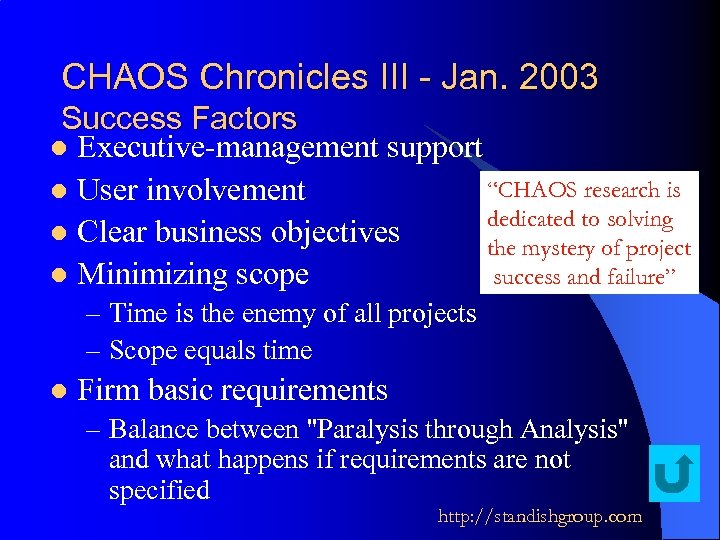 CHAOS Chronicles III - Jan. 2003 Success Factors l Executive-management support “CHAOS research is l User involvement dedicated to solving l Clear business objectives the mystery of project success and failure” l Minimizing scope – Time is the enemy of all projects – Scope equals time l Firm basic requirements – Balance between "Paralysis through Analysis" and what happens if requirements are not specified http: //standishgroup. com
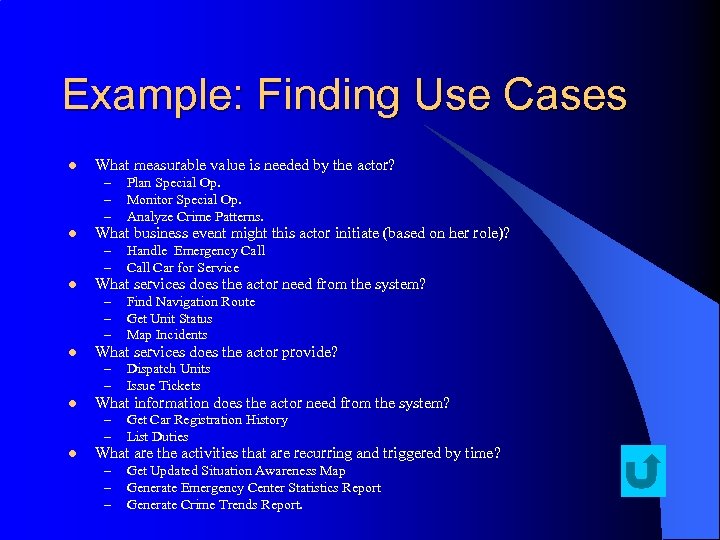 Example: Finding Use Cases l What measurable value is needed by the actor? – – – l l Dispatch Units Issue Tickets – – l Find Navigation Route Get Unit Status Map Incidents – – l Handle Emergency Call Car for Service – – – l Plan Special Op. Monitor Special Op. Analyze Crime Patterns. Get Car Registration History List Duties – – – Get Updated Situation Awareness Map Generate Emergency Center Statistics Report Generate Crime Trends Report. What business event might this actor initiate (based on her role)? What services does the actor need from the system? What services does the actor provide? What information does the actor need from the system? What are the activities that are recurring and triggered by time?
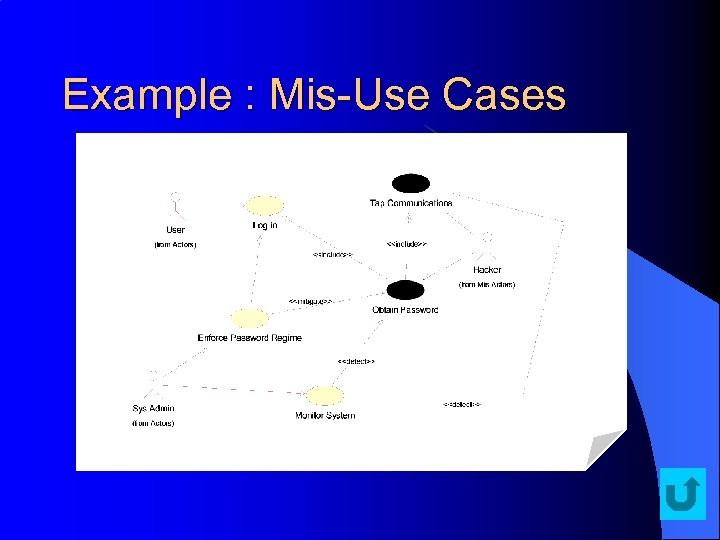 Example : Mis-Use Cases
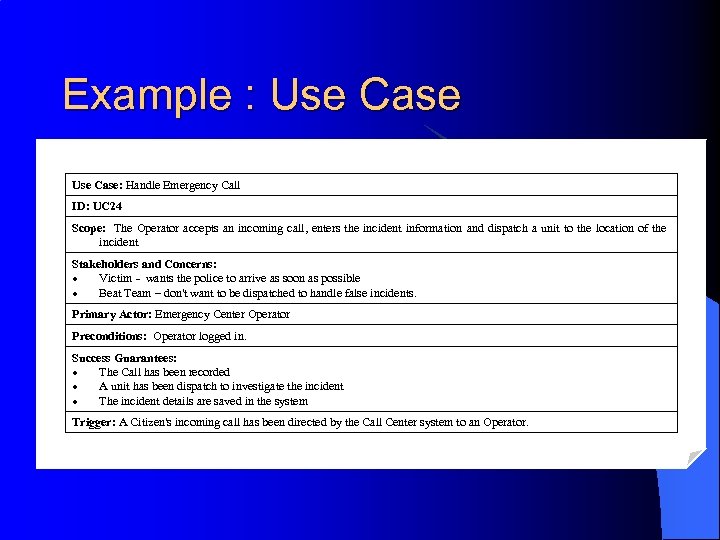 Example : Use Case: Handle Emergency Call ID: UC 24 Scope: The Operator accepts an incoming call, enters the incident information and dispatch a unit to the location of the incident Stakeholders and Concerns: Victim - wants the police to arrive as soon as possible Beat Team – don't want to be dispatched to handle false incidents. Primary Actor: Emergency Center Operator Preconditions: Operator logged in. Success Guarantees: The Call has been recorded A unit has been dispatch to investigate the incident The incident details are saved in the system Trigger: A Citizen's incoming call has been directed by the Call Center system to an Operator.
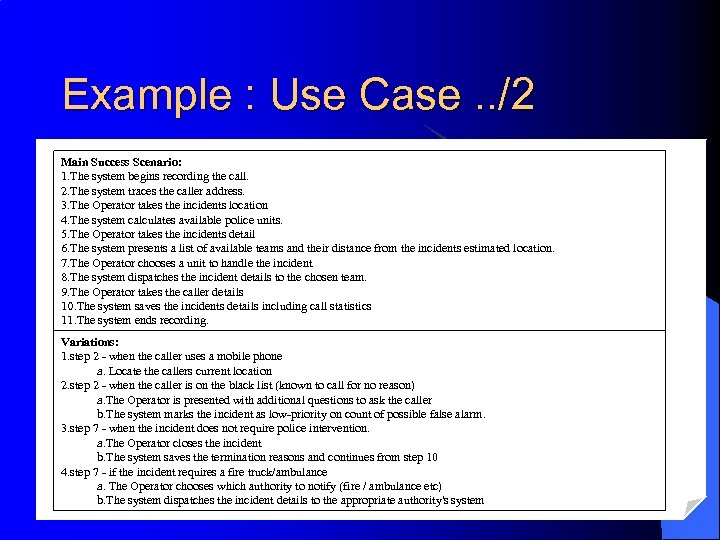 Example : Use Case. . /2 Main Success Scenario: 1. The system begins recording the call. 2. The system traces the caller address. 3. The Operator takes the incidents location 4. The system calculates available police units. 5. The Operator takes the incidents detail 6. The system presents a list of available teams and their distance from the incidents estimated location. 7. The Operator chooses a unit to handle the incident 8. The system dispatches the incident details to the chosen team. 9. The Operator takes the caller details 10. The system saves the incidents details including call statistics 11. The system ends recording. Variations: 1. step 2 - when the caller uses a mobile phone a. Locate the callers current location 2. step 2 - when the caller is on the black list (known to call for no reason) a. The Operator is presented with additional questions to ask the caller b. The system marks the incident as low-priority on count of possible false alarm. 3. step 7 - when the incident does not require police intervention. a. The Operator closes the incident b. The system saves the termination reasons and continues from step 10 4. step 7 - if the incident requires a fire truck/ambulance a. The Operator chooses which authority to notify (fire / ambulance etc) b. The system dispatches the incident details to the appropriate authority's system
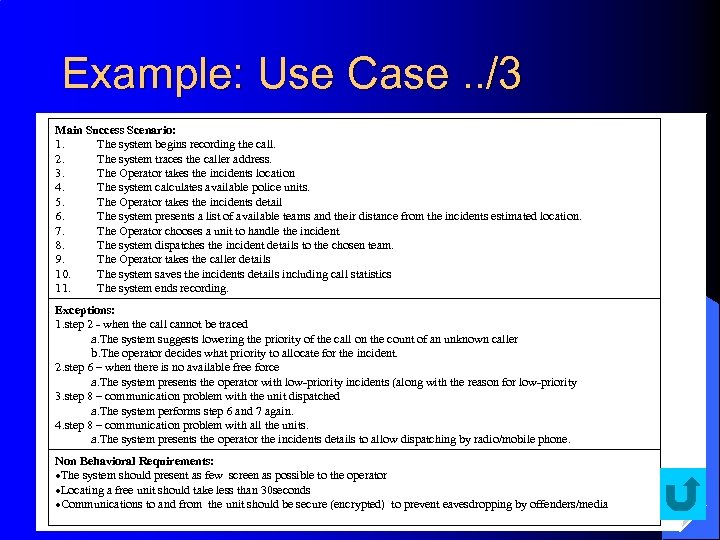 Example: Use Case. . /3 Main Success Scenario: 1. The system begins recording the call. 2. The system traces the caller address. 3. The Operator takes the incidents location 4. The system calculates available police units. 5. The Operator takes the incidents detail 6. The system presents a list of available teams and their distance from the incidents estimated location. 7. The Operator chooses a unit to handle the incident 8. The system dispatches the incident details to the chosen team. 9. The Operator takes the caller details 10. The system saves the incidents details including call statistics 11. The system ends recording. Exceptions: 1. step 2 - when the call cannot be traced a. The system suggests lowering the priority of the call on the count of an unknown caller b. The operator decides what priority to allocate for the incident. 2. step 6 – when there is no available free force a. The system presents the operator with low-priority incidents (along with the reason for low-priority 3. step 8 – communication problem with the unit dispatched a. The system performs step 6 and 7 again. 4. step 8 – communication problem with all the units. a. The system presents the operator the incidents details to allow dispatching by radio/mobile phone. Non Behavioral Requirements: The system should present as few screen as possible to the operator Locating a free unit should take less than 30 seconds Communications to and from the unit should be secure (encrypted) to prevent eavesdropping by offenders/media
 Example: Use Case Levels Why ? How ?
 Example : Refactoring Common Sub-behavior
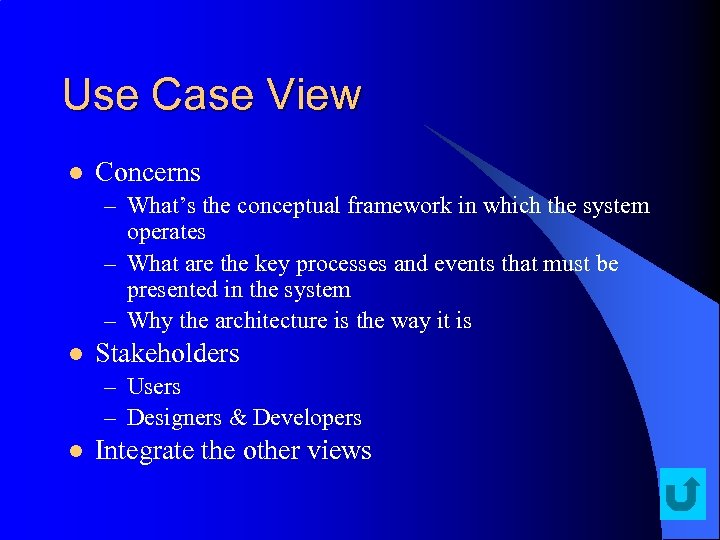 Use Case View l Concerns – What’s the conceptual framework in which the system operates – What are the key processes and events that must be presented in the system – Why the architecture is the way it is l Stakeholders – Users – Designers & Developers l Integrate the other views