 Скачать презентацию Net Present Value and Capital Budgeting CB Incremental
105bd3c410cccc747bcd7727c01f078b.ppt
- Количество слайдов: 10



Net Present Value and Capital Budgeting (CB) Incremental Cash Flows (CFs), Inflation in CB, and Unequal Lives Chhachhi/519/Ch. 7
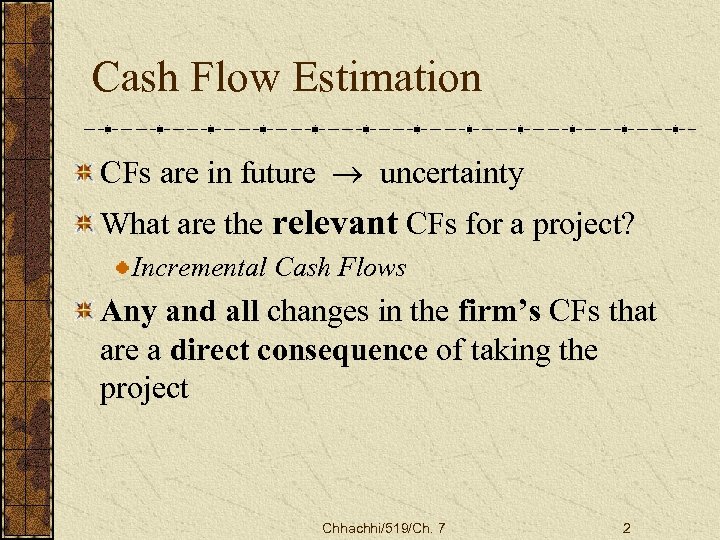
Cash Flow Estimation CFs are in future ® uncertainty What are the relevant CFs for a project? Incremental Cash Flows Any and all changes in the firm’s CFs that are a direct consequence of taking the project Chhachhi/519/Ch. 7 2
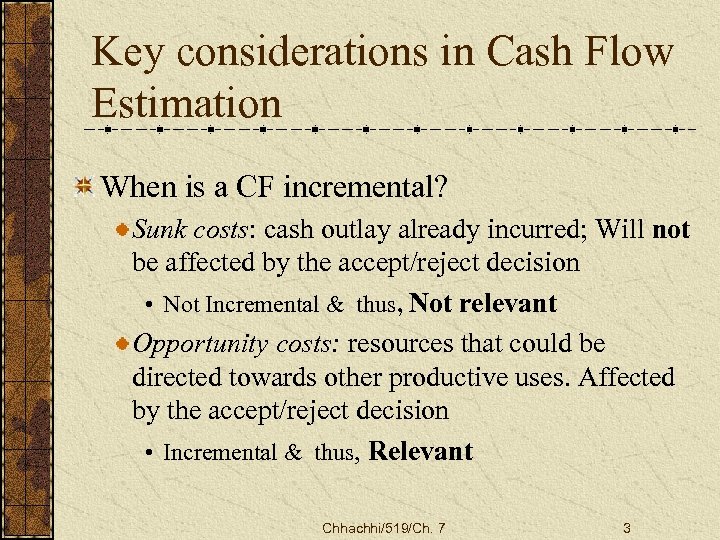
Key considerations in Cash Flow Estimation When is a CF incremental? Sunk costs: cash outlay already incurred; Will not be affected by the accept/reject decision • Not Incremental & thus, Not relevant Opportunity costs: resources that could be directed towards other productive uses. Affected by the accept/reject decision • Incremental & thus, Relevant Chhachhi/519/Ch. 7 3
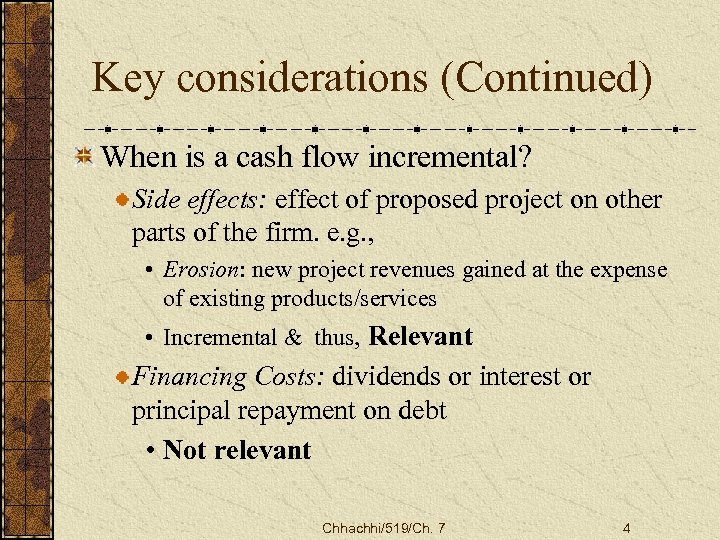
Key considerations (Continued) When is a cash flow incremental? Side effects: effect of proposed project on other parts of the firm. e. g. , • Erosion: new project revenues gained at the expense of existing products/services • Incremental & thus, Relevant Financing Costs: dividends or interest or principal repayment on debt • Not relevant Chhachhi/519/Ch. 7 4
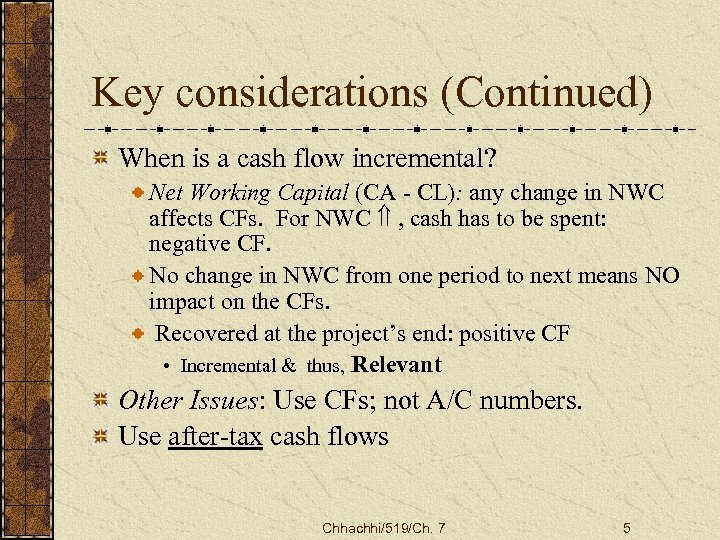
Key considerations (Continued) When is a cash flow incremental? Net Working Capital (CA - CL): any change in NWC affects CFs. For NWC , cash has to be spent: negative CF. No change in NWC from one period to next means NO impact on the CFs. Recovered at the project’s end: positive CF • Incremental & thus, Relevant Other Issues: Use CFs; not A/C numbers. Use after-tax cash flows Chhachhi/519/Ch. 7 5
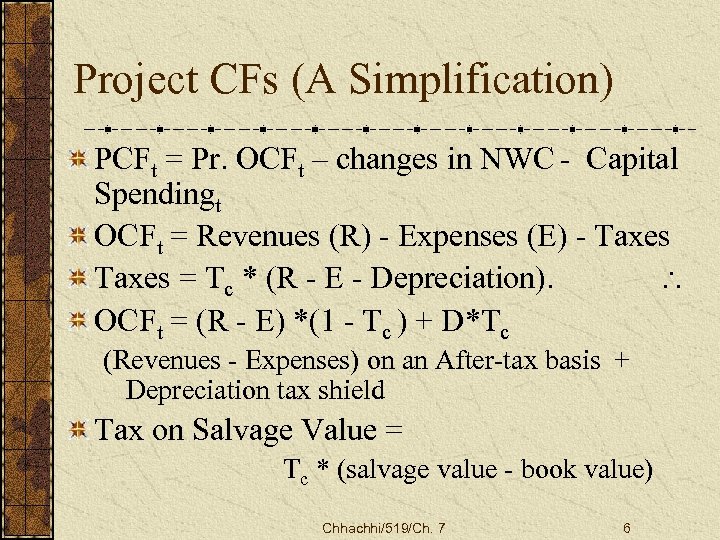
Project CFs (A Simplification) PCFt = Pr. OCFt – changes in NWC - Capital Spendingt OCFt = Revenues (R) - Expenses (E) - Taxes = Tc * (R - E - Depreciation). OCFt = (R - E) *(1 - Tc ) + D*Tc (Revenues - Expenses) on an After-tax basis + Depreciation tax shield Tax on Salvage Value = Tc * (salvage value - book value) Chhachhi/519/Ch. 7 6
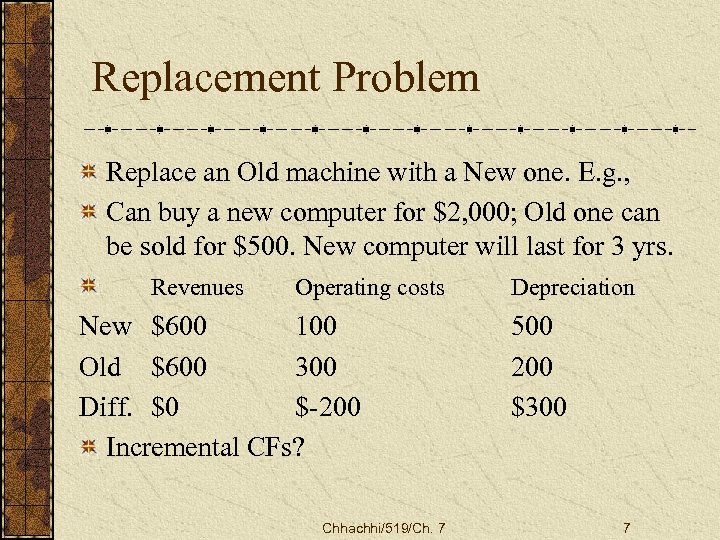
Replacement Problem Replace an Old machine with a New one. E. g. , Can buy a new computer for $2, 000; Old one can be sold for $500. New computer will last for 3 yrs. Revenues Operating costs New $600 100 Old $600 300 Diff. $0 $-200 Incremental CFs? Chhachhi/519/Ch. 7 Depreciation 500 200 $300 7
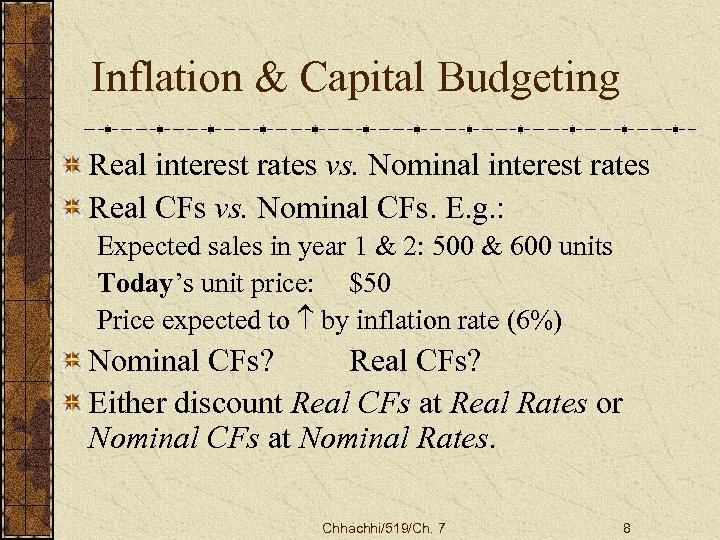
Inflation & Capital Budgeting Real interest rates vs. Nominal interest rates Real CFs vs. Nominal CFs. E. g. : Expected sales in year 1 & 2: 500 & 600 units Today’s unit price: $50 Price expected to by inflation rate (6%) Nominal CFs? Real CFs? Either discount Real CFs at Real Rates or Nominal CFs at Nominal Rates. Chhachhi/519/Ch. 7 8
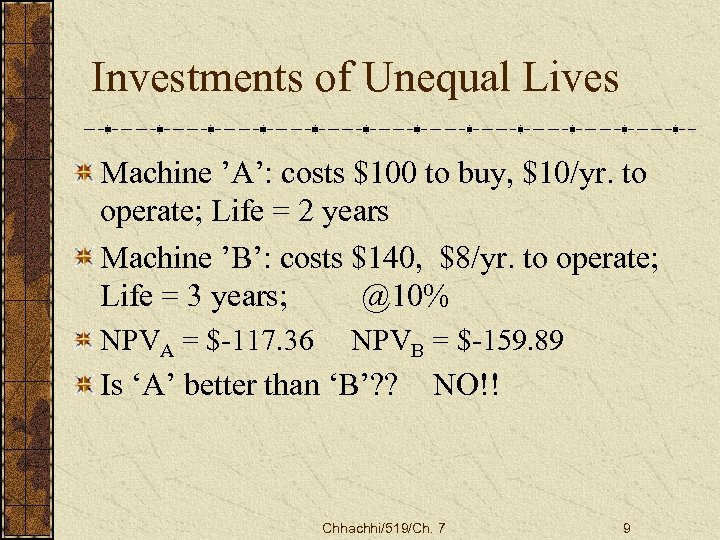
Investments of Unequal Lives Machine ’A’: costs $100 to buy, $10/yr. to operate; Life = 2 years Machine ’B’: costs $140, $8/yr. to operate; Life = 3 years; @10% NPVA = $-117. 36 NPVB = $-159. 89 Is ‘A’ better than ‘B’? ? NO!! Chhachhi/519/Ch. 7 9
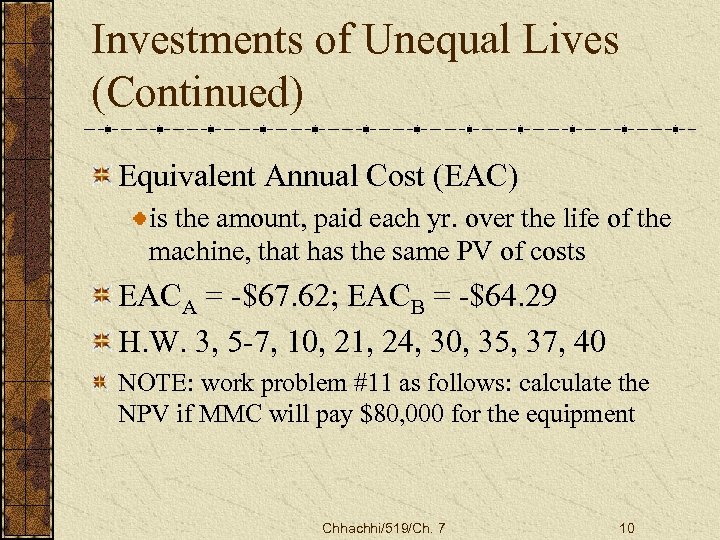
Investments of Unequal Lives (Continued) Equivalent Annual Cost (EAC) is the amount, paid each yr. over the life of the machine, that has the same PV of costs EACA = -$67. 62; EACB = -$64. 29 H. W. 3, 5 -7, 10, 21, 24, 30, 35, 37, 40 NOTE: work problem #11 as follows: calculate the NPV if MMC will pay $80, 000 for the equipment Chhachhi/519/Ch. 7 10
Скачать презентацию Net Present Value and Capital Budgeting CB Incremental
105bd3c410cccc747bcd7727c01f078b.ppt