


 Скачать презентацию Net Point Product Family Overview Wi-Fi Radio
a05255384ac6fa94f3493560d1e210b9.ppt
- Количество слайдов: 73
 Net. Point Product Family Overview
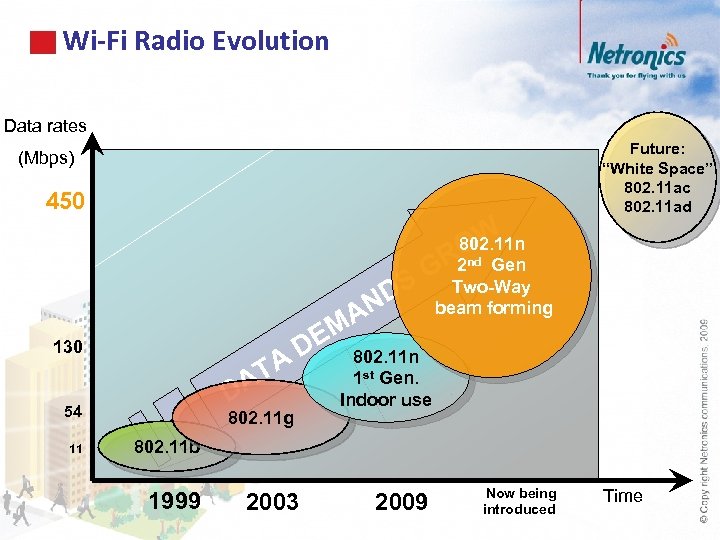 Wi-Fi Radio Evolution Data rates Future: “White Space” 802. 11 ac 802. 11 ad (Mbps) 450 DS AN 130 TA DA 54 11 802. 11 g EM D 802. 11 n OW GR 2 nd Gen Two-Way beam forming 1 st Gen. Indoor use 802. 11 b 1999 2003 2009 Now being introduced Time
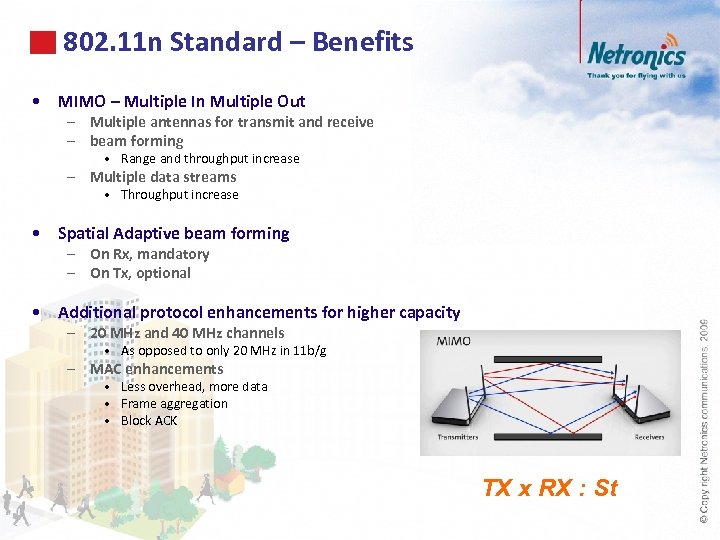 802. 11 n Standard – Benefits • MIMO – Multiple In Multiple Out – Multiple antennas for transmit and receive – beam forming • Range and throughput increase – Multiple data streams • Throughput increase • Spatial Adaptive beam forming – On Rx, mandatory – On Tx, optional • Additional protocol enhancements for higher capacity – 20 MHz and 40 MHz channels • As opposed to only 20 MHz in 11 b/g – MAC enhancements • Less overhead, more data • Frame aggregation • Block ACK TX x RX : St
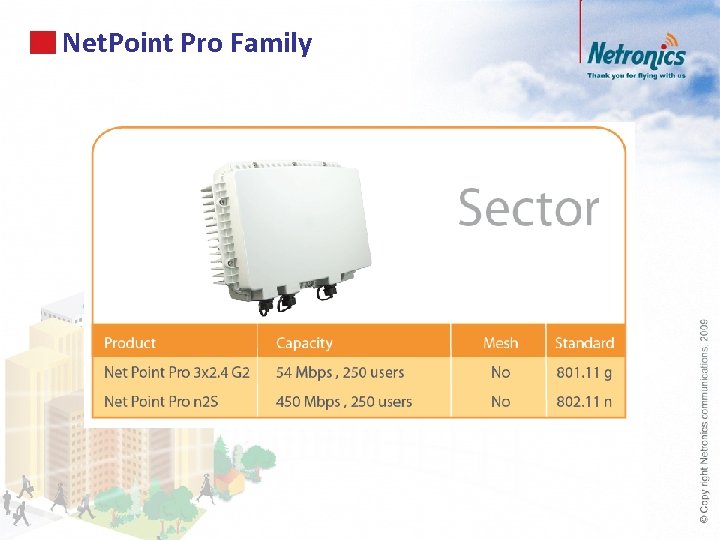
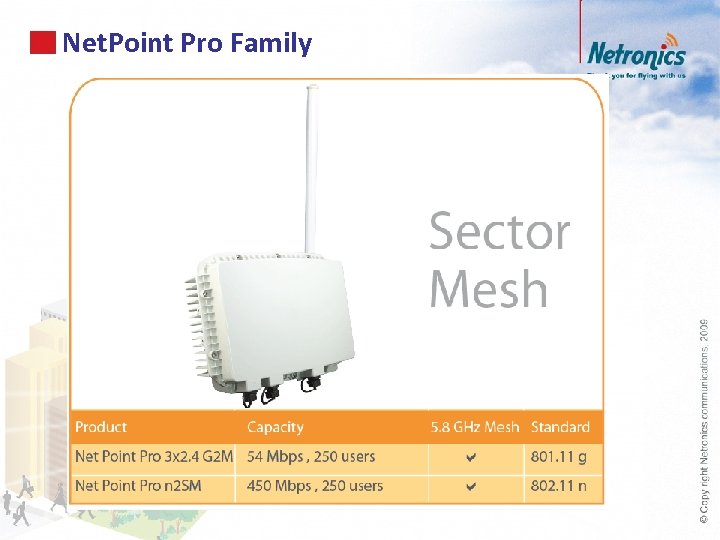
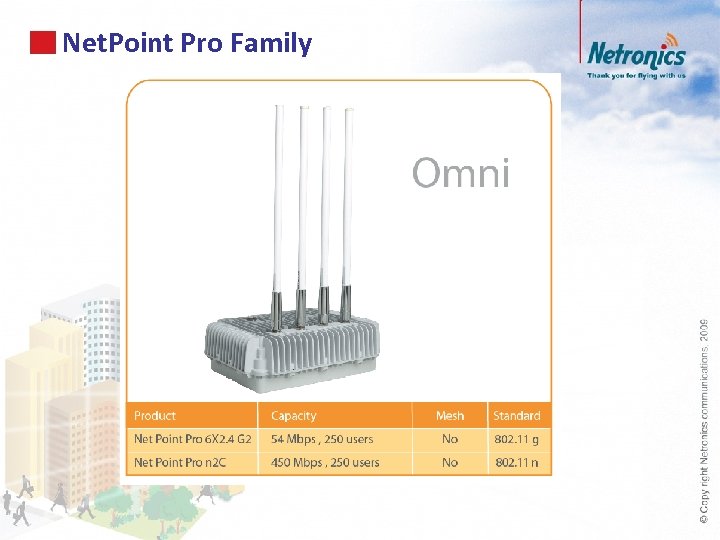
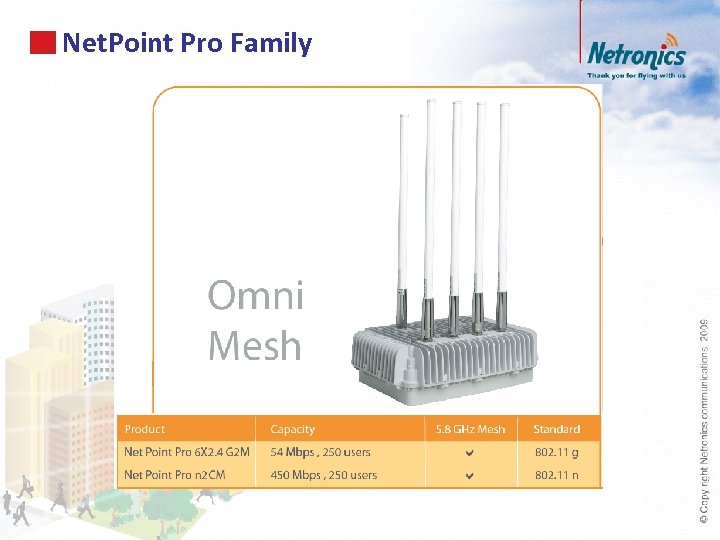
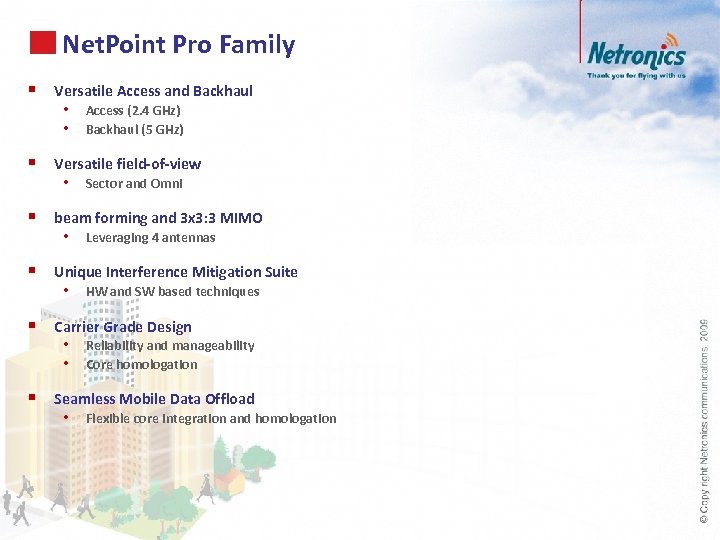 Net. Point Pro Family § § § Versatile Access and Backhaul • • Access (2. 4 GHz) Backhaul (5 GHz) Versatile field-of-view • Sector and Omni beam forming and 3 x 3: 3 MIMO • Leveraging 4 antennas Unique Interference Mitigation Suite • HW and SW based techniques Carrier Grade Design • • Reliability and manageability Core homologation Seamless Mobile Data Offload • Flexible core integration and homologation
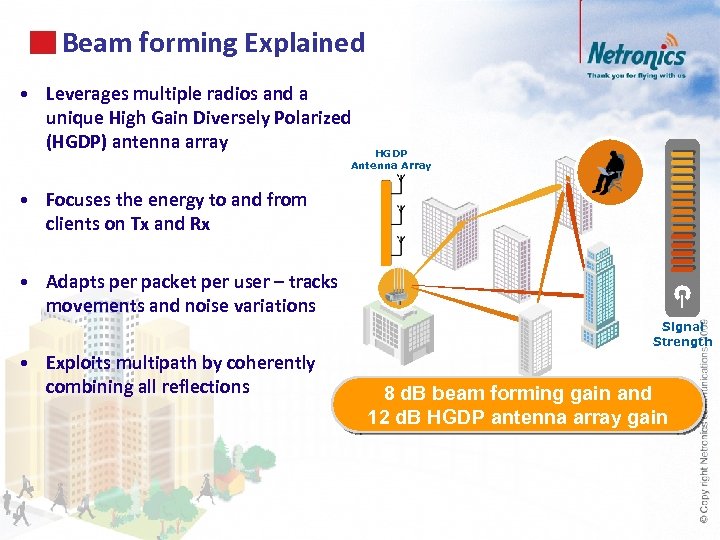 Beam forming Explained • Leverages multiple radios and a unique High Gain Diversely Polarized (HGDP) antenna array HGDP Antenna Array • Focuses the energy to and from clients on Tx and Rx • Adapts per packet per user – tracks movements and noise variations Signal Strength • Exploits multipath by coherently combining all reflections 8 d. B beam forming gain and 12 d. B HGDP antenna array gain
 Net. Point Pro Key Features • Gigabit Outdoor Wi-Fi – Two-Way beam forming and MIMO 3 x 3: 3 technology – High Gain Diversely Polarized (HGDP) antenna array – Up to 12 radios per box – 450 Mbps PHY rate • Interference Immunity Suite – Beam forming, Null forming, DIH and ACS – Field-proven mature algorithms from the Net. Point Pro family are embedded into the 11 n line of products • Carrier Grade – Quality, reliability and durability – IP-67, designed for harsh outdoor environments – Full FCAPS management – Unified NMS for all Net. Point Pro products
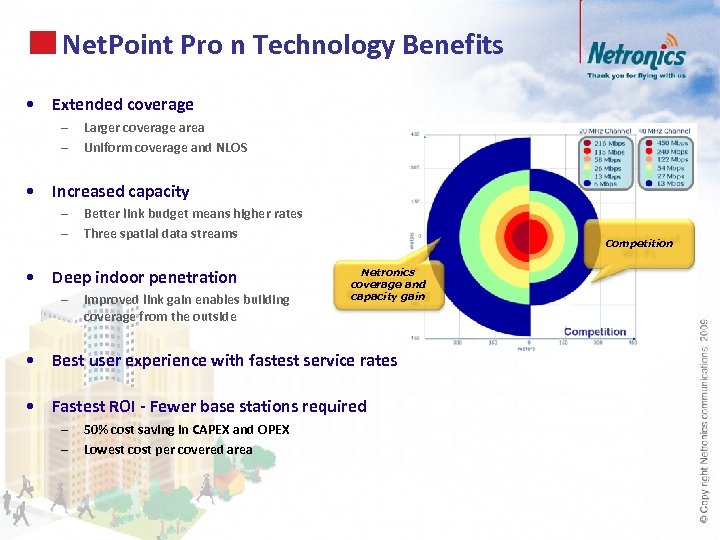 Net. Point Pro n Technology Benefits • Extended coverage – – Larger coverage area Uniform coverage and NLOS • Increased capacity – – Better link budget means higher rates Three spatial data streams • Deep indoor penetration – Improved link gain enables building coverage from the outside Competition Netronics coverage and capacity gain • Best user experience with fastest service rates • Fastest ROI - Fewer base stations required – – 50% cost saving in CAPEX and OPEX Lowest cost per covered area
 Net. Point Pro Key Benefits • Over a Decade of Outdoor Wi-Fi Experience – Numerous large scale projects in over 20 countries • Complete Solution – End to End solution: Access, Backhaul, CPEs, Management – 2. 4 GHz for access and 5 GHz for backhaul • Metro and Rural Wi-Fi Applications – Large metro zones, building coverage, 3 G offloading, digital divide and verticals • Seamless Cellular 3 G Offloading – Seamless user authentication with EAP-SIM/AKA – Service continuity – I-WLAN and EPC (roadmap)
 Net. Point Pro Family
 Net. Point Pro Family
 Net. Point Pro Family
 Net. Point Pro Family
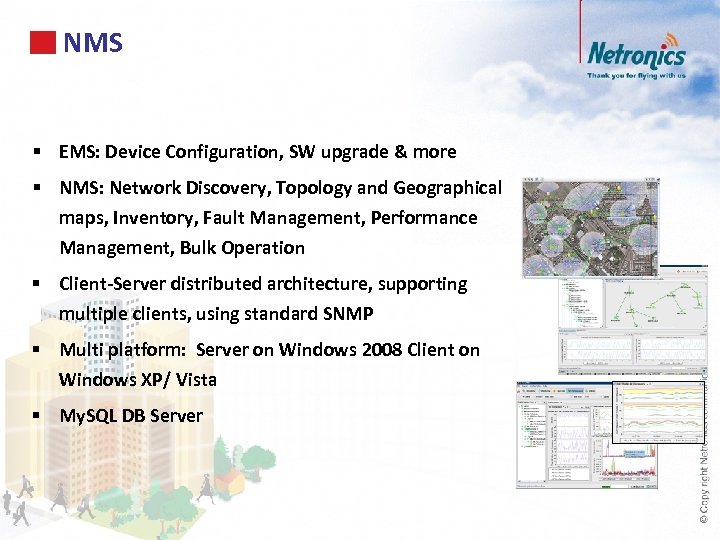 NMS § EMS: Device Configuration, SW upgrade & more § NMS: Network Discovery, Topology and Geographical maps, Inventory, Fault Management, Performance Management, Bulk Operation § Client-Server distributed architecture, supporting multiple clients, using standard SNMP § Multi platform: Server on Windows 2008 Client on Windows XP/ Vista § My. SQL DB Server
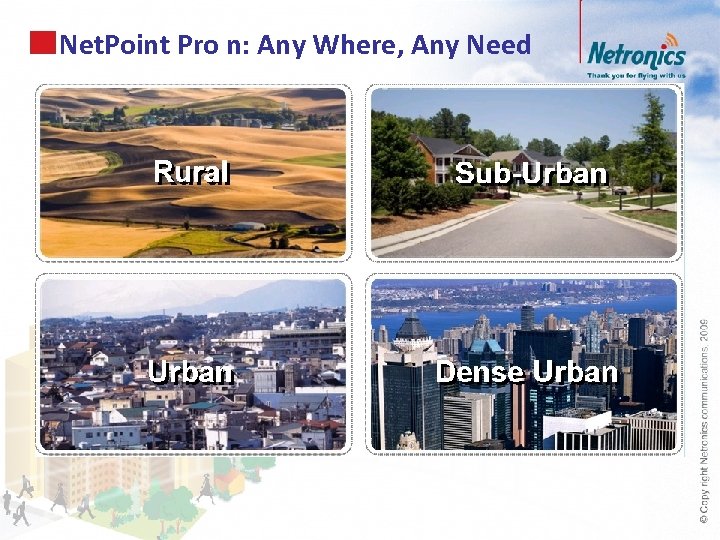 Net. Point Pro n: Any Where, Any Need
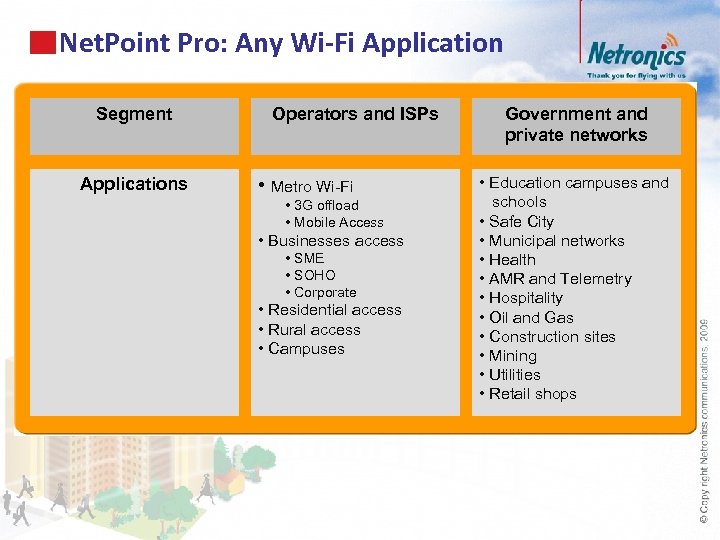 Net. Point Pro: Any Wi-Fi Application Segment Applications Operators and ISPs • Metro Wi-Fi • 3 G offload • Mobile Access • Businesses access • SME • SOHO • Corporate • Residential access • Rural access • Campuses Government and private networks • Education campuses and schools • Safe City • Municipal networks • Health • AMR and Telemetry • Hospitality • Oil and Gas • Construction sites • Mining • Utilities • Retail shops
 Field Proven Interference Immunity § § Critical for large scale outdoor Wi-Fi networks The key factor for performance in operation on the over occupied 2. 4 GHz Leveraging a decade of outdoor experience Interference Immunity Suite • beam forming inherent 5 d. B interference suppression • Enhances the link budget in both Uplink and Downlink increasing the signal to noise ratio • Dynamic Interference Handling (DIH) • Automatic Channel Selection (ACS) • Offline, and online with continuous scanning • Industry leading Null forming technology • Eliminates the effect of noise by making a null in the antenna beam
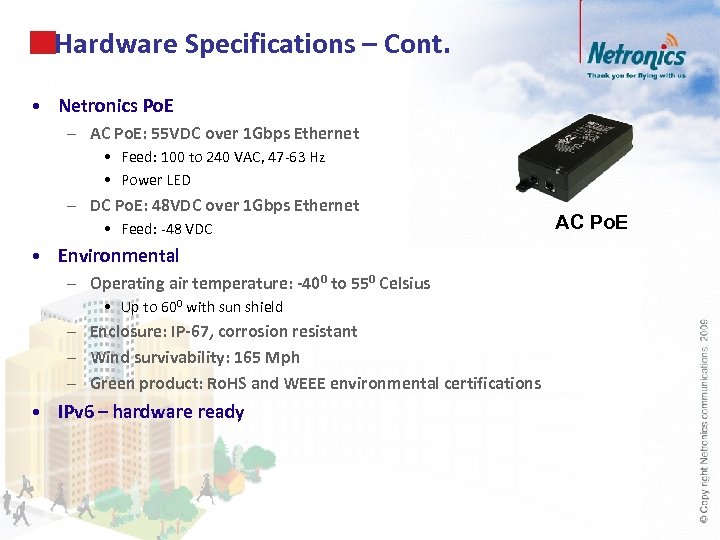 Hardware Specifications – Cont. • Netronics Po. E – AC Po. E: 55 VDC over 1 Gbps Ethernet • Feed: 100 to 240 VAC, 47 -63 Hz • Power LED – DC Po. E: 48 VDC over 1 Gbps Ethernet • Feed: -48 VDC • Environmental – Operating air temperature: -400 to 550 Celsius • Up to 600 with sun shield – Enclosure: IP-67, corrosion resistant – Wind survivability: 165 Mph – Green product: Ro. HS and WEEE environmental certifications • IPv 6 – hardware ready AC Po. E
 Security Features § § § Security modes • Open, WEP, WPA 2, WAPI* • • Pre-shared key 802. 1 x with RADIUS Server Authentication • EAP-TLS, PEAP, EAP-TTLS, EAP-SIM, EAP-AKA Hardware Encryptions • WEP, TKIP, AES • Per VAP MAC accept/reject lists Peer-to-peer blocking
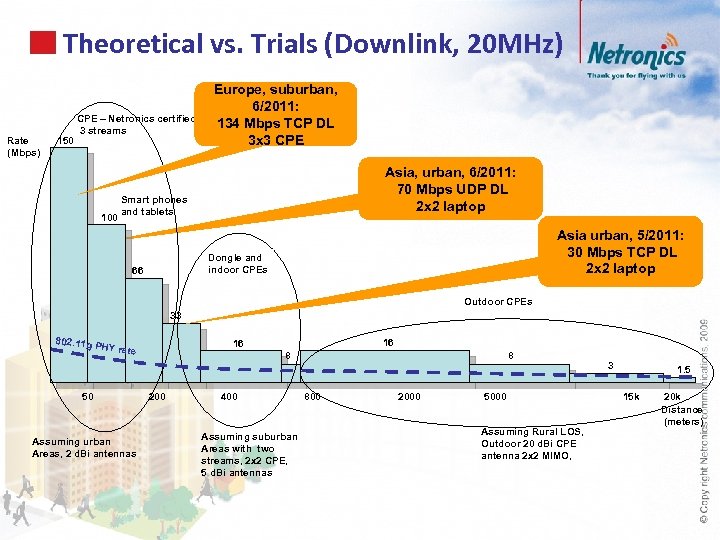 Theoretical vs. Trials (Downlink, 20 MHz) Rate (Mbps) 150 CPE – Netronics certified 3 streams 100 Europe, suburban, 6/2011: 134 Mbps TCP DL 3 x 3 CPE Asia, urban, 6/2011: 70 Mbps UDP DL 2 x 2 laptop Smart phones and tablets Asia urban, 5/2011: 30 Mbps TCP DL 2 x 2 laptop Dongle and indoor CPEs 66 Outdoor CPEs 33 802. 11 g 50 Assuming urban Areas, 2 d. Bi antennas 16 16 PHY rate 8 8 200 400 Assuming suburban Areas with two streams, 2 x 2 CPE, 5 d. Bi antennas 800 2000 5000 Assuming Rural LOS, Outdoor 20 d. Bi CPE antenna 2 x 2 MIMO, 3 1. 5 15 k 20 k Distance (meters) 19
 Beam Forming Technology
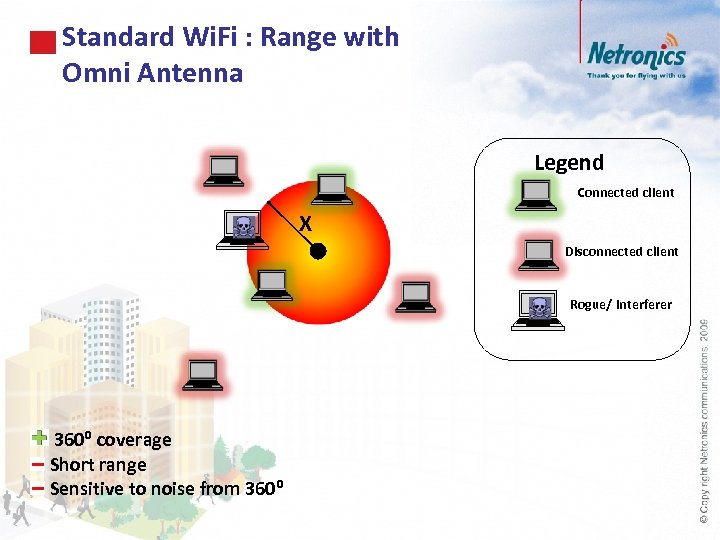 Standard Wi. Fi : Range with Omni Antenna Legend Connected client X Disconnected client Rogue/ Interferer 360⁰ coverage Short range Sensitive to noise from 360⁰
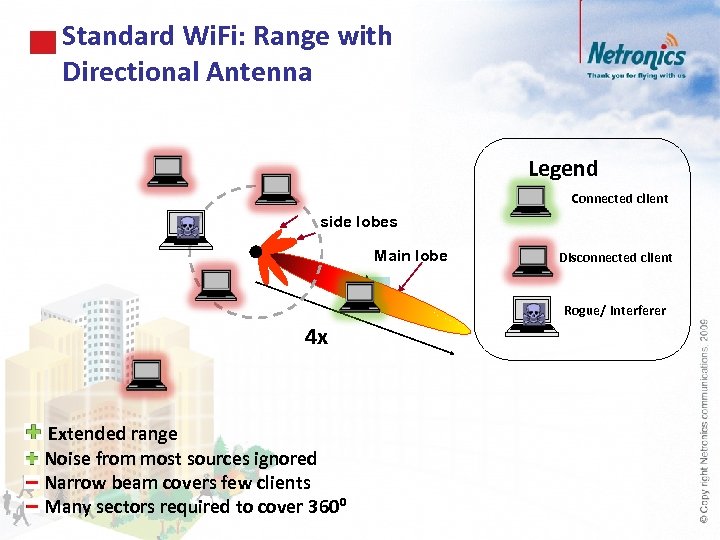 Standard Wi. Fi: Range with Directional Antenna Legend Connected client side lobes Main lobe Disconnected client Rogue/ Interferer 4 x Extended range Noise from most sources ignored Narrow beam covers few clients Many sectors required to cover 360⁰
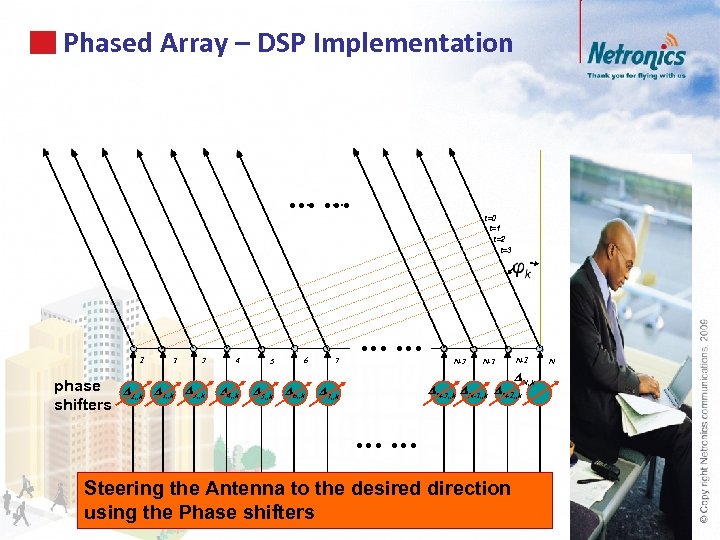 Phased Array – DSP Implementation …… 1 phase shifters 2 3 4 5 1, , k 2, , k 3, , k 4, , k 5, , k 6 6, , k 7 t=0 t=1 t=2 t=3 …… N-3 N-2 N-1 N, , k N-3, , k N-2, , k N-1, , k 7, , k …… Steering the Antenna to the desired direction using the Phase shifters N
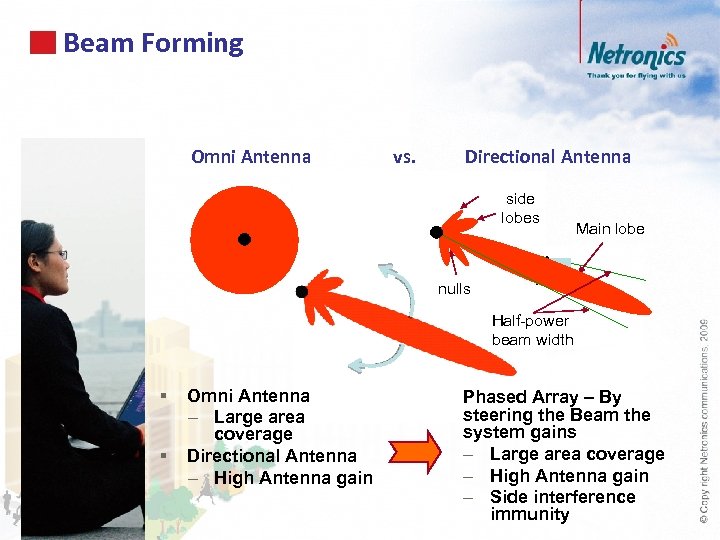 Beam Forming Omni Antenna vs. Directional Antenna side lobes Main lobe nulls Half-power beam width § § Omni Antenna – Large area coverage Directional Antenna – High Antenna gain Phased Array – By steering the Beam the system gains – Large area coverage – High Antenna gain – Side interference immunity
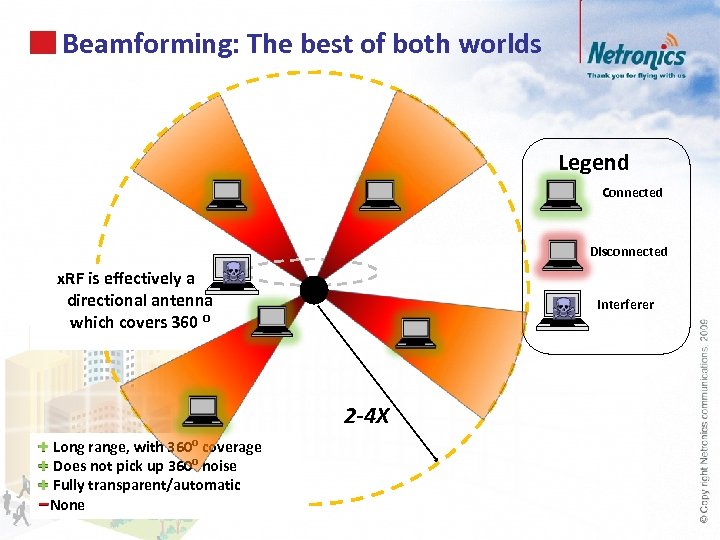 Beamforming: The best of both worlds Legend Connected Disconnected x. RF is effectively a directional antenna which covers 360 ⁰ Interferer 2 -4 X Long range, with 360⁰ coverage Does not pick up 360⁰ noise Fully transparent/automatic None
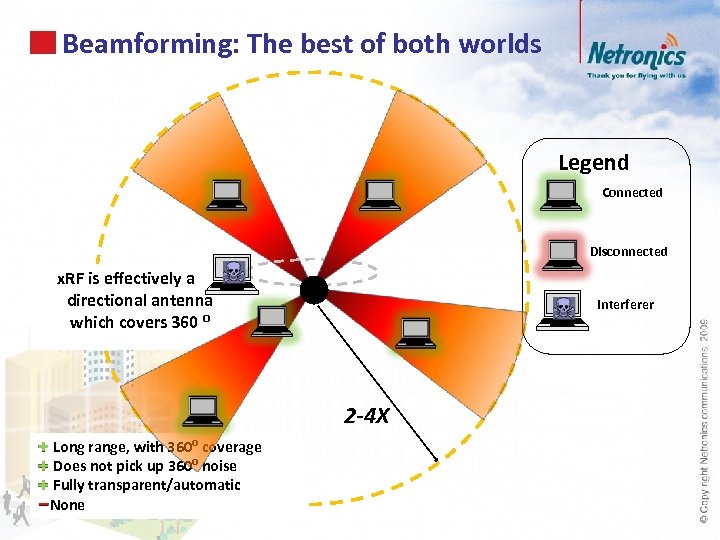 Beamforming: The best of both worlds Legend Connected Disconnected x. RF is effectively a directional antenna which covers 360 ⁰ Interferer 2 -4 X Long range, with 360⁰ coverage Does not pick up 360⁰ noise Fully transparent/automatic None
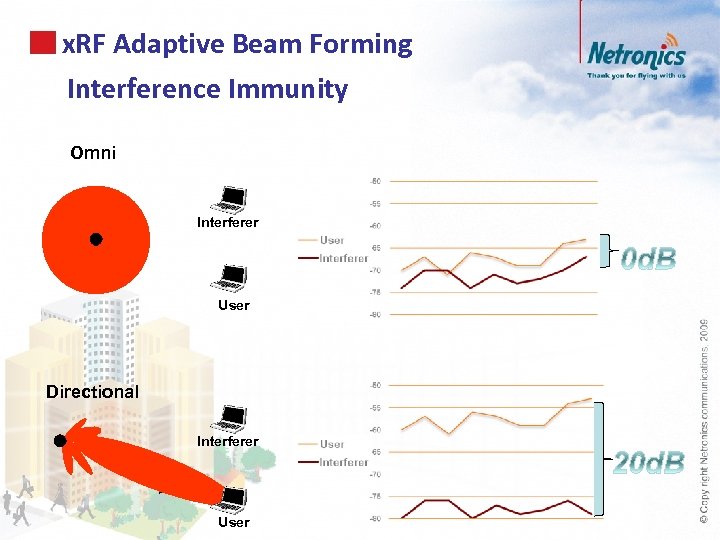 x. RF Adaptive Beam Forming Interference Immunity Omni Interferer User Directional Interferer User
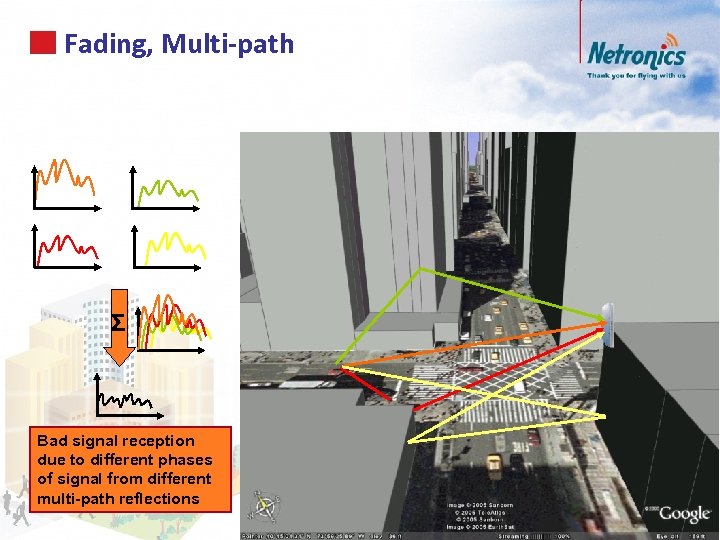 Fading, Multi-path Σ Bad signal reception due to different phases of signal from different multi-path reflections
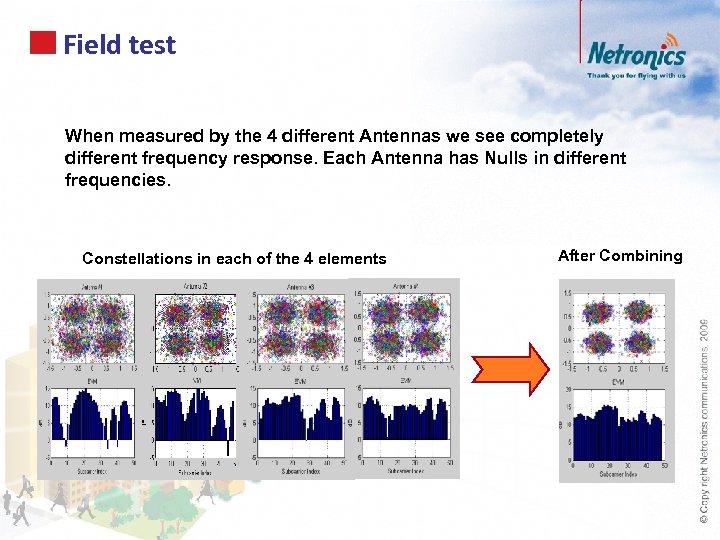 Field test When measured by the 4 different Antennas we see completely different frequency response. Each Antenna has Nulls in different frequencies. Constellations in each of the 4 elements After Combining
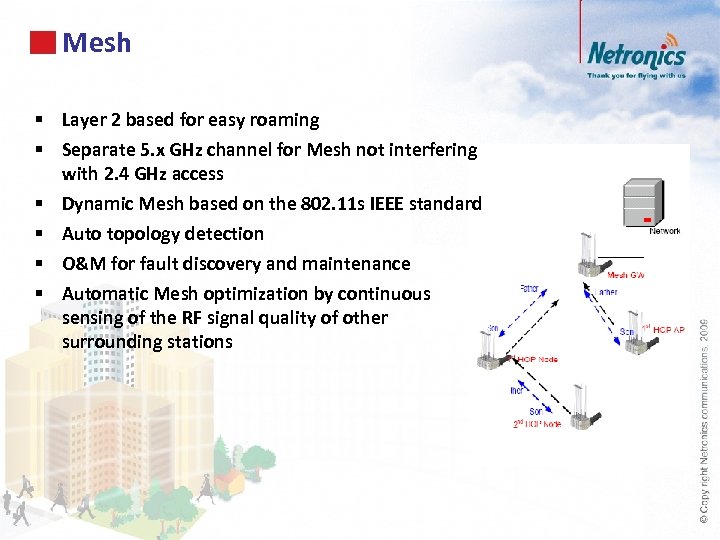 Mesh § Layer 2 based for easy roaming § Separate 5. x GHz channel for Mesh not interfering with 2. 4 GHz access § Dynamic Mesh based on the 802. 11 s IEEE standard § Auto topology detection § O&M for fault discovery and maintenance § Automatic Mesh optimization by continuous sensing of the RF signal quality of other surrounding stations
 Value Proposition § Superior coverage and capacity utilizing the industry leading digital beamforming solution (x. RF) § Unique interference mitigation technology § High-performance mesh architecture provides improved ROI with significant savings on the backhaul network § Designed for Co-location with 3 G base station equipment with specialized filters § Based on standard Wi-Fi § Designed for the harsh technology outdoor environment
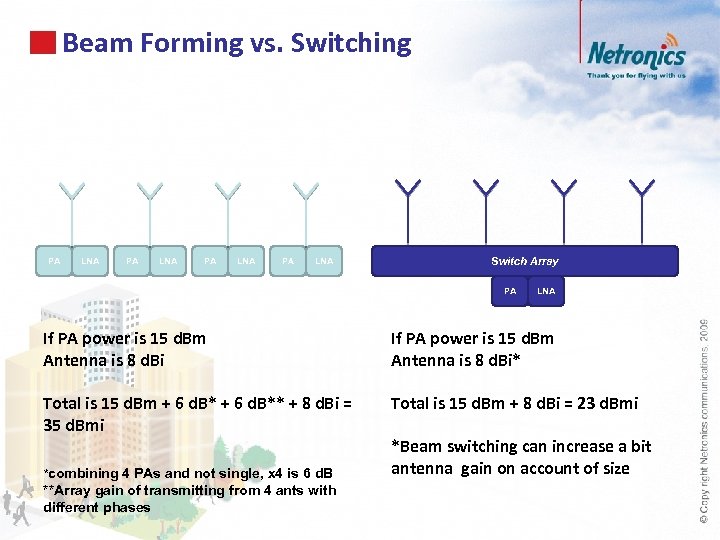 Beam Forming vs. Switching PA LNA Switch Array PA LNA If PA power is 15 d. Bm Antenna is 8 d. Bi* Total is 15 d. Bm + 6 d. B** + 8 d. Bi = 35 d. Bmi Total is 15 d. Bm + 8 d. Bi = 23 d. Bmi *combining 4 PAs and not single, x 4 is 6 d. B **Array gain of transmitting from 4 ants with different phases *Beam switching can increase a bit antenna gain on account of size
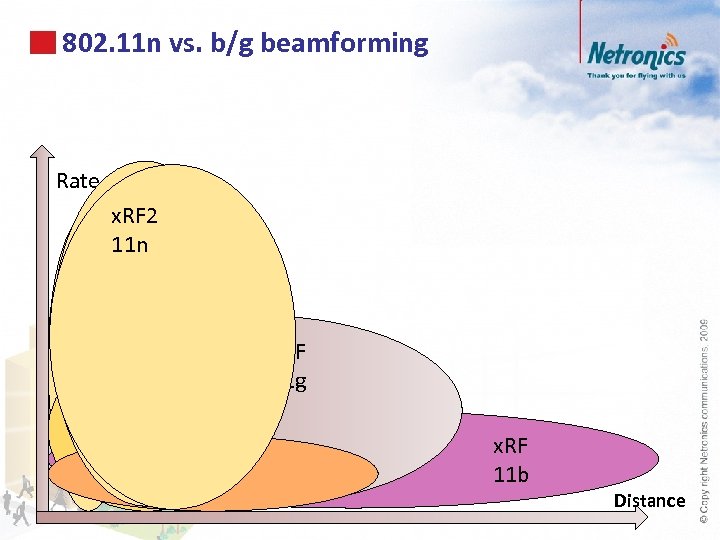 802. 11 n vs. b/g beamforming Rate x. RF 2 11 n 11 n x. RF 11 g 11 b x. RF 11 b Distance
 802. 11 n, The Outdoor Challenge
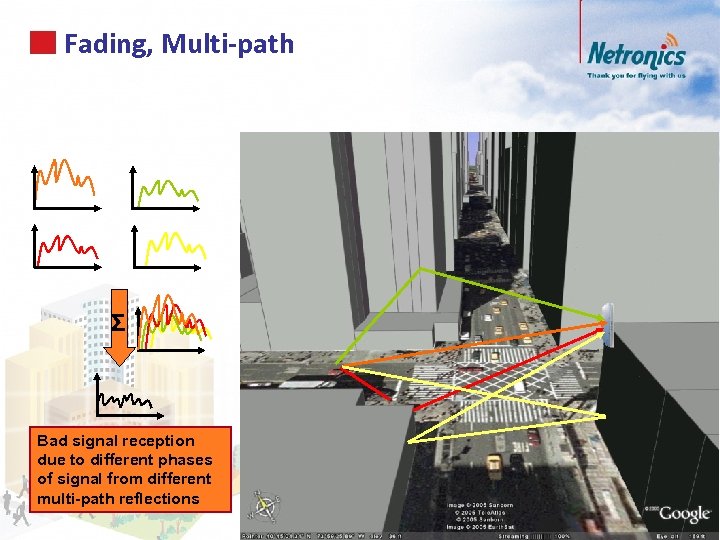 Fading, Multi-path Σ Bad signal reception due to different phases of signal from different multi-path reflections
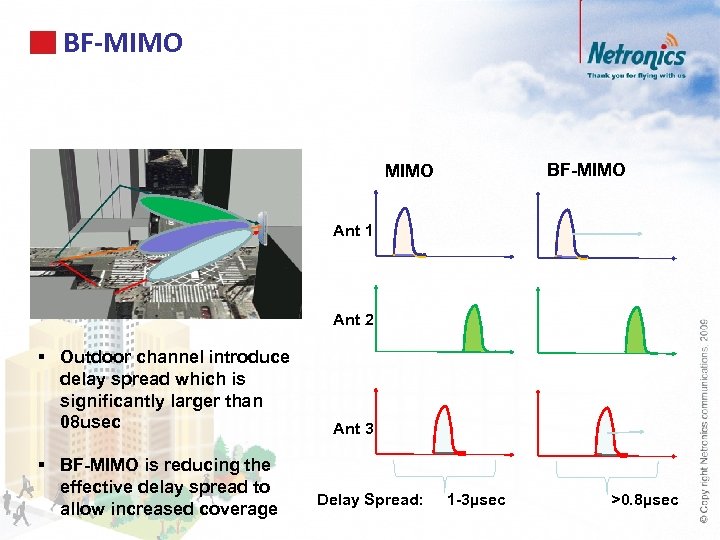 BF-MIMO Ant 1 Ant 2 § Outdoor channel introduce delay spread which is significantly larger than 08 usec § BF-MIMO is reducing the effective delay spread to allow increased coverage Ant 3 Delay Spread: 1 -3µsec >0. 8µsec
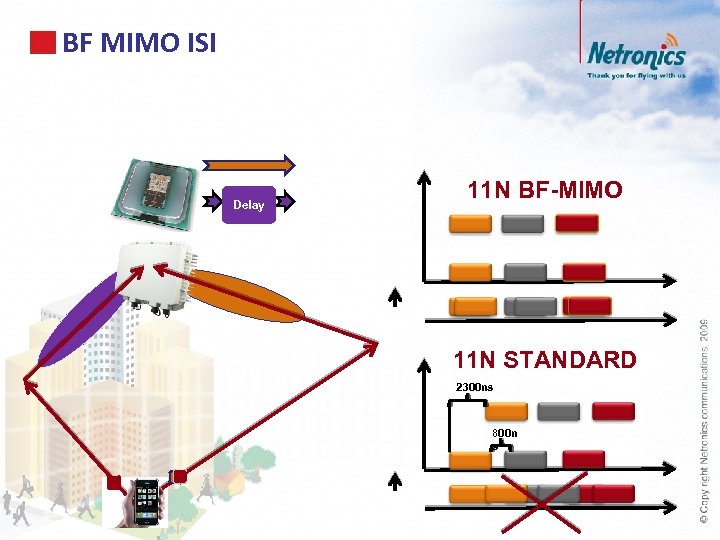 BF MIMO ISI Delay 11 N BF-MIMO 11 N STANDARD 2300 ns 800 n s
 BF-MIMO § § Enhancing MIMO effective range outdoor from few tenth of meters to over 100 m Improved 5 -9 d. B in downlink MIMO link budget / SNR Noise immunity GI of 800 nsec emulation for Qualcomm
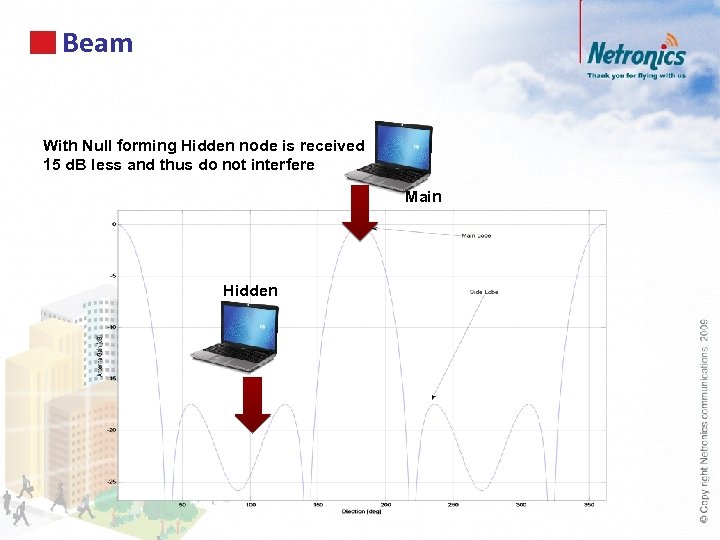 Beam With Null forming Hidden node is received 15 d. B less and thus do not interfere Main Hidden
 Null Forming Reducing the effect of interference
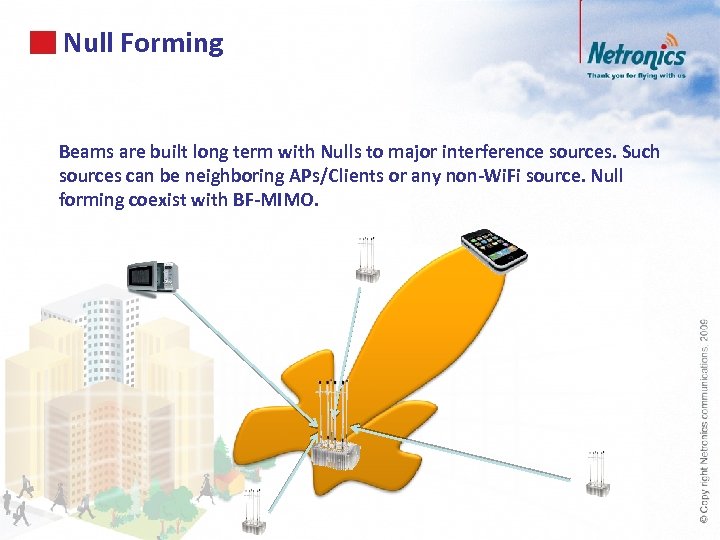 Null Forming Beams are built long term with Nulls to major interference sources. Such sources can be neighboring APs/Clients or any non-Wi. Fi source. Null forming coexist with BF-MIMO.
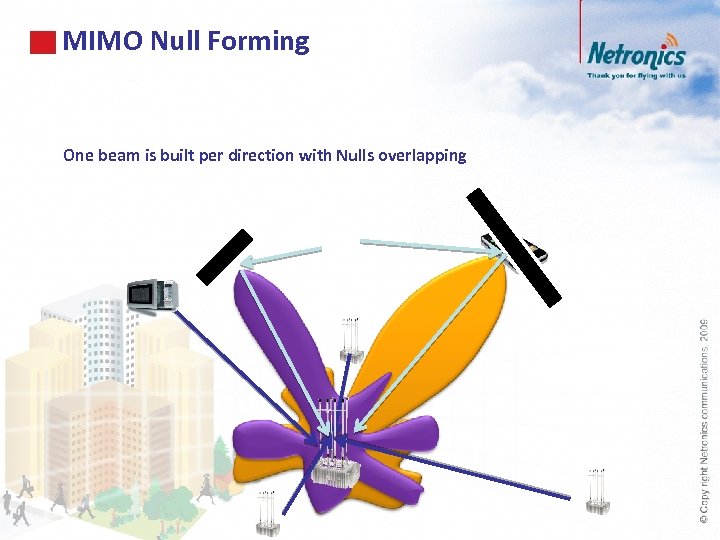 MIMO Null Forming One beam is built per direction with Nulls overlapping
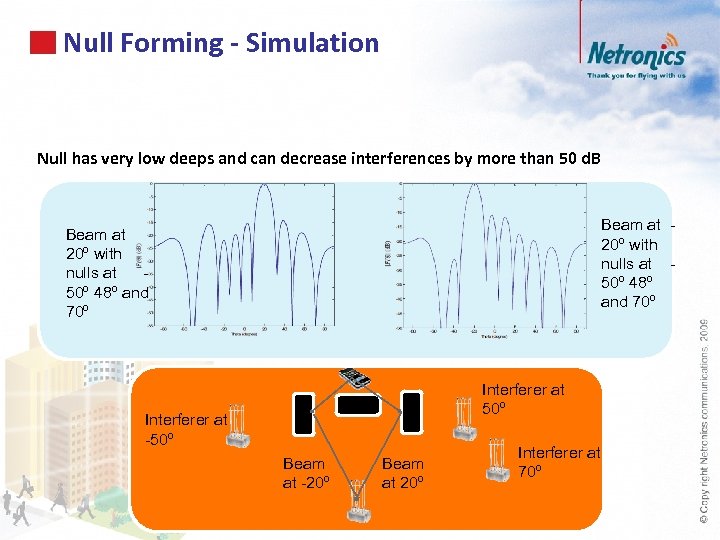 Null Forming - Simulation Null has very low deeps and can decrease interferences by more than 50 d. B Beam at 20º with nulls at 50º 48º and 70º Interferer at 50º Interferer at -50º Beam at -20º Beam at 20º Interferer at 70º
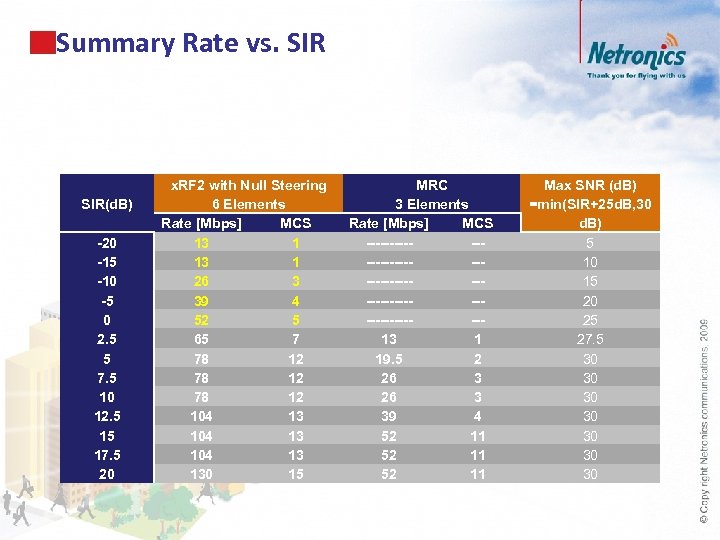 Summary Rate vs. SIR(d. B) -20 -15 -10 -5 0 2. 5 5 7. 5 10 12. 5 15 17. 5 20 x. RF 2 with Null Steering 6 Elements Rate [Mbps] MCS 13 1 26 3 39 4 52 5 65 7 78 12 104 13 130 15 MRC 3 Elements Rate [Mbps] MCS ----------------------------13 1 19. 5 2 26 3 39 4 52 11 Max SNR (d. B) =min(SIR+25 d. B, 30 d. B) 5 10 15 20 25 27. 5 30 30
![Rate vs. SIR 140 120 100 80 Rate [Mbps] x. RF 2 BF-Bull Omni](https://present5.com/presentation/a05255384ac6fa94f3493560d1e210b9/image-45.jpg "Rate vs. SIR 140 120 100 80 Rate [Mbps] x. RF 2 BF-Bull Omni") Rate vs. SIR 140 120 100 80 Rate [Mbps] x. RF 2 BF-Bull Omni 60 40 20 0 1 2 3 4 5 6 SIR [d. B] 7 8 9 10 11 12 13
Rate vs. SIR 140 120 100 80 Rate [Mbps] x. RF 2 BF-Bull Omni 60 40 20 0 1 2 3 4 5 6 SIR [d. B] 7 8 9 10 11 12 13
 Applications
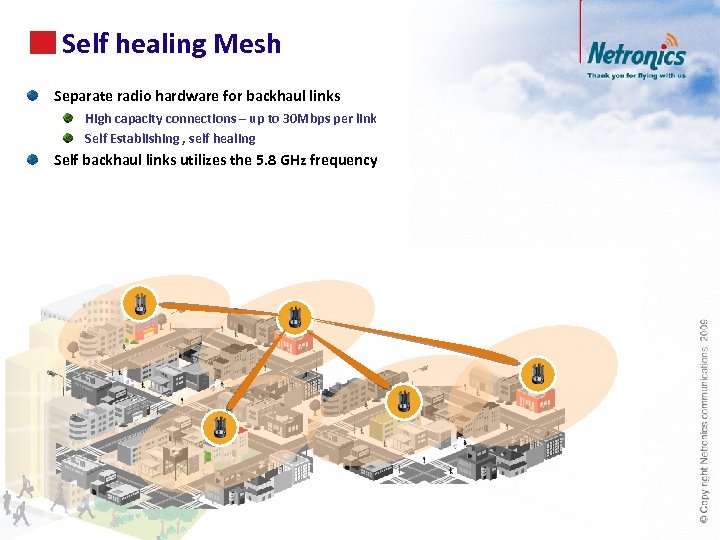 47 Self healing Mesh Separate radio hardware for backhaul links High capacity connections – up to 30 Mbps per link Self Establishing , self healing Self backhaul links utilizes the 5. 8 GHz frequency
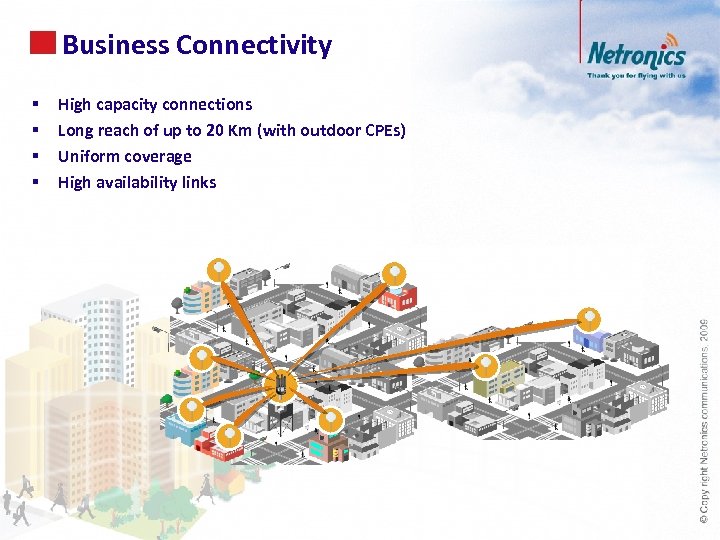 Business Connectivity 48 § § High capacity connections Long reach of up to 20 Km (with outdoor CPEs) Uniform coverage High availability links
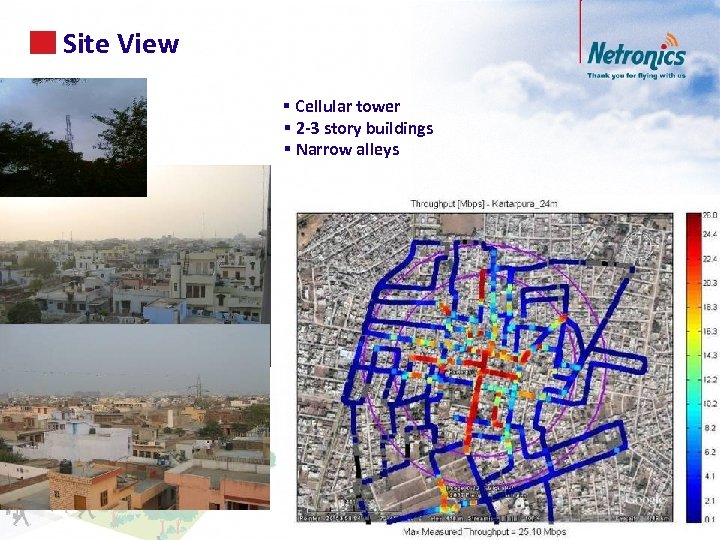 49 Site View § Cellular tower § 2 -3 story buildings § Narrow alleys
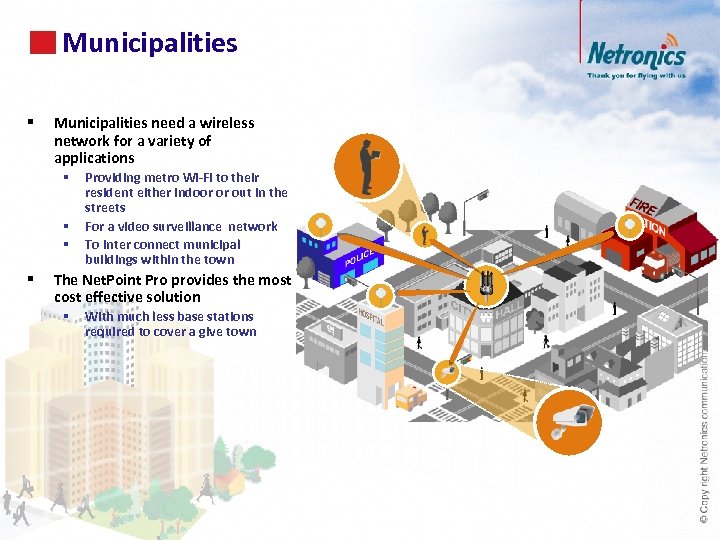 Municipalities 50 § Municipalities need a wireless network for a variety of applications § § Providing metro Wi-Fi to their resident either indoor or out in the streets For a video surveillance network To inter connect municipal buildings within the town The Net. Point Pro provides the most cost effective solution § With much less base stations required to cover a give town
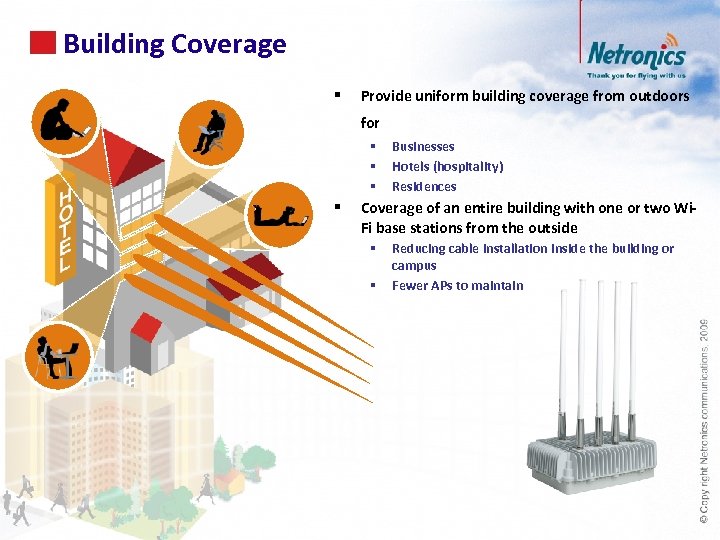 51 Building Coverage § Provide uniform building coverage from outdoors for § § Businesses Hotels (hospitality) Residences Coverage of an entire building with one or two Wi. Fi base stations from the outside § § Reducing cable installation inside the building or campus Fewer APs to maintain
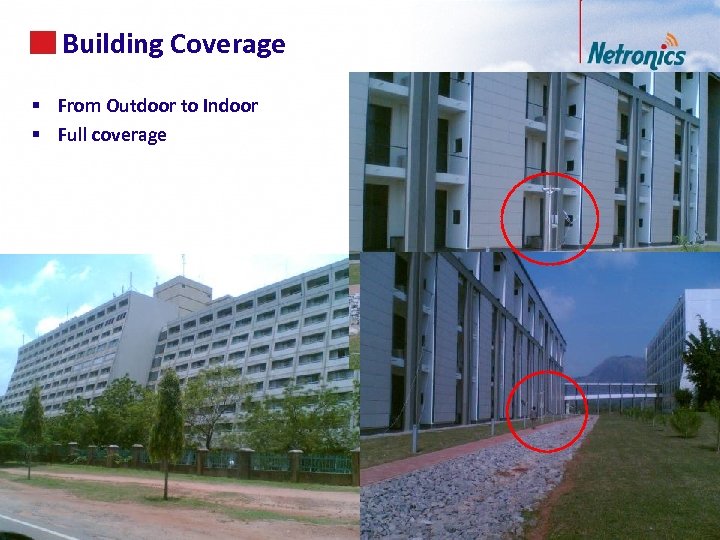 52 Building Coverage § From Outdoor to Indoor § Full coverage
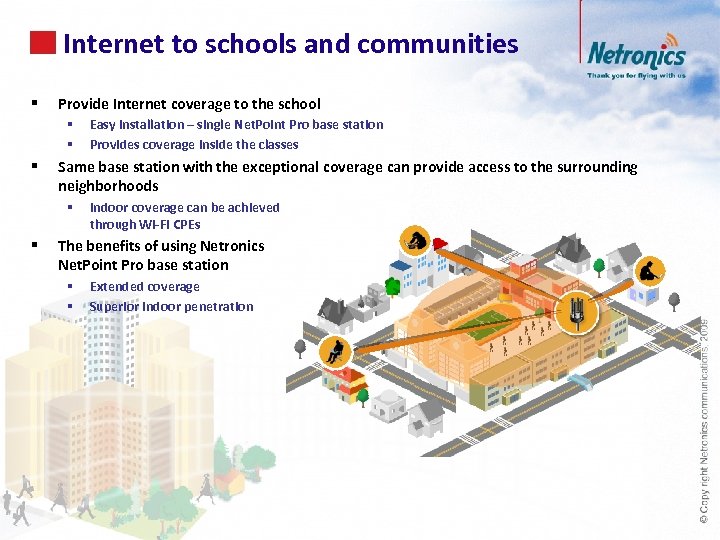 53 § Internet to schools and communities Provide Internet coverage to the school § § § Same base station with the exceptional coverage can provide access to the surrounding neighborhoods § § Easy installation – single Net. Point Pro base station Provides coverage inside the classes Indoor coverage can be achieved through Wi-Fi CPEs The benefits of using Netronics Net. Point Pro base station § § Extended coverage Superior indoor penetration
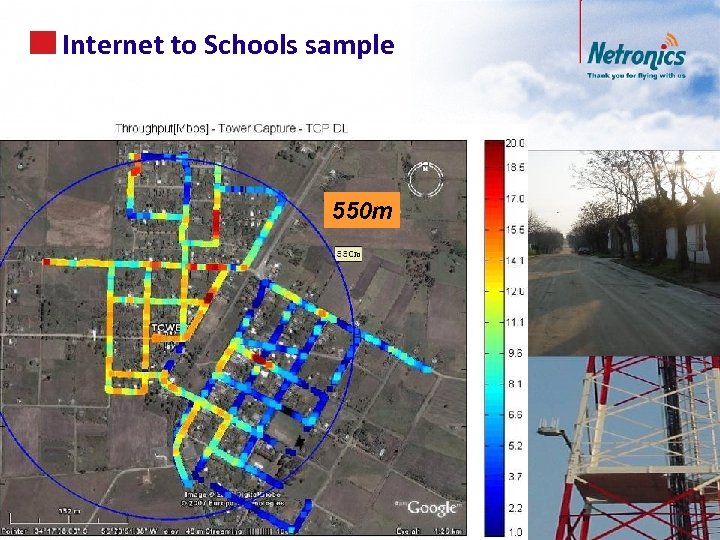 54 Internet to Schools sample 550 m
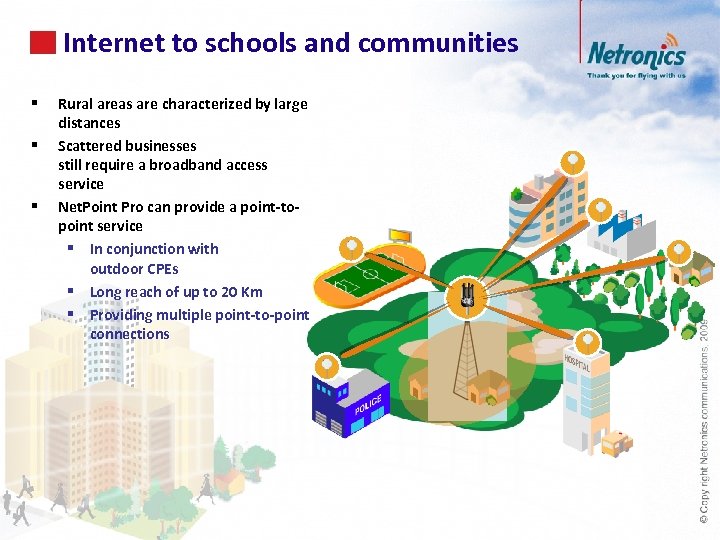 Internet to schools and communities 55 § § § Rural areas are characterized by large distances Scattered businesses still require a broadband access service Net. Point Pro can provide a point-topoint service § In conjunction with outdoor CPEs § Long reach of up to 20 Km § Providing multiple point-to-point connections
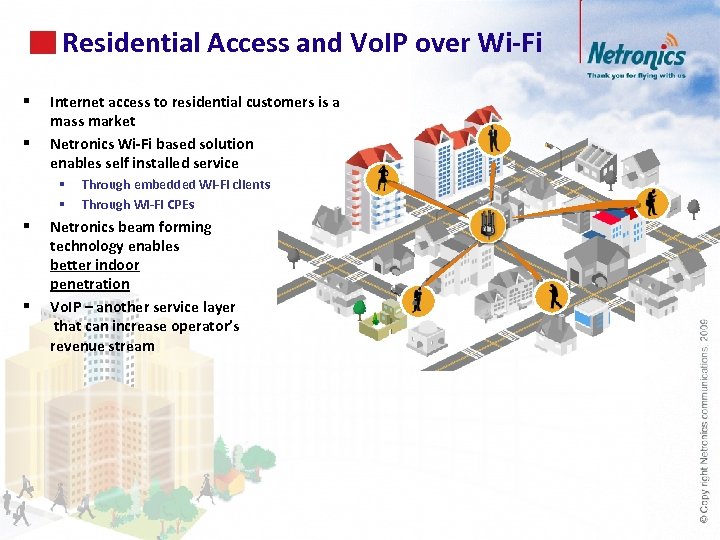 Residential Access and Vo. IP over Wi-Fi 56 § § Internet access to residential customers is a mass market Netronics Wi-Fi based solution enables self installed service § § Through embedded Wi-Fi clients Through Wi-Fi CPEs Netronics beam forming technology enables better indoor penetration Vo. IP – another service layer that can increase operator’s revenue stream
 Case Study
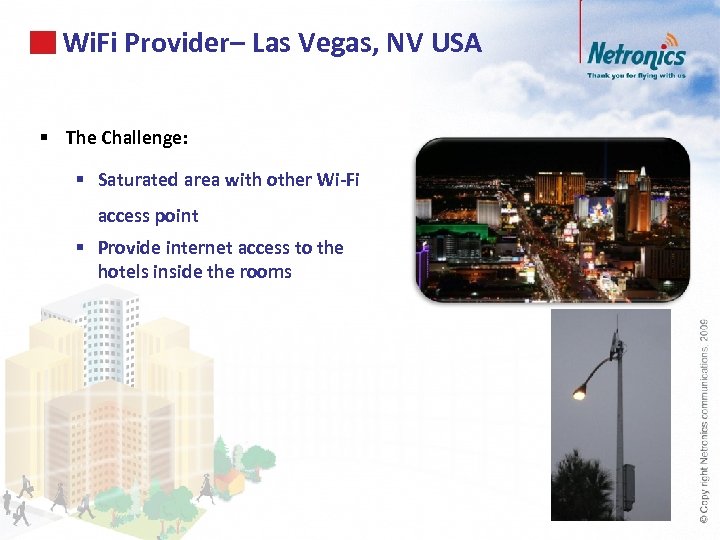 Wi. Fi Provider– Las Vegas, NV USA § The Challenge: § Saturated area with other Wi-Fi access point § Provide internet access to the hotels inside the rooms
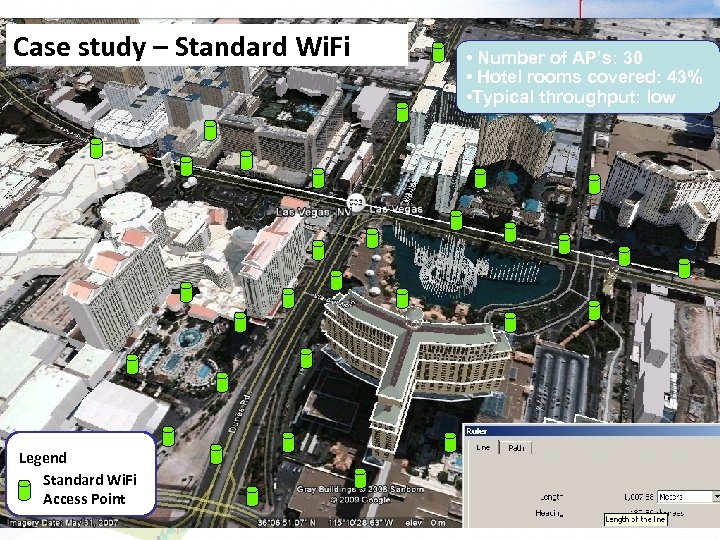 Case study – Standard Wi. Fi Legend Standard Wi. Fi Access Point • Number of AP’s: 30 • Hotel rooms covered: 43% • Typical throughput: low
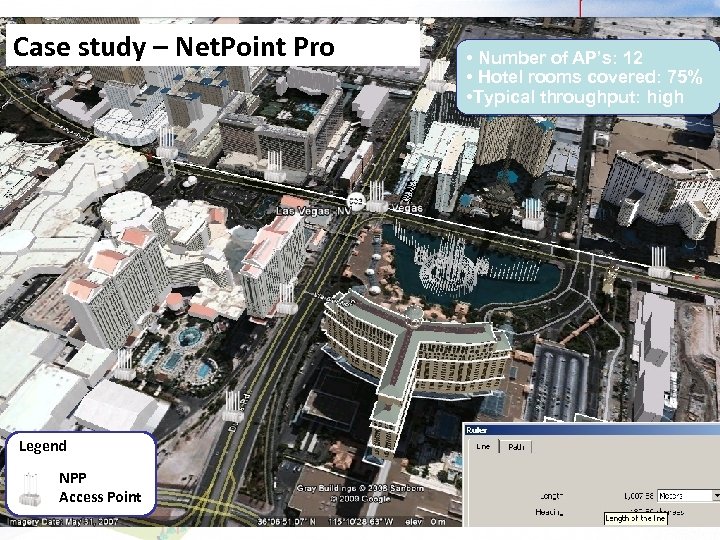 Case study – Net. Point Pro Legend NPP Access Point • Number of AP’s: 12 • Hotel rooms covered: 75% • Typical throughput: high
 Field Test Results 802. 11 g
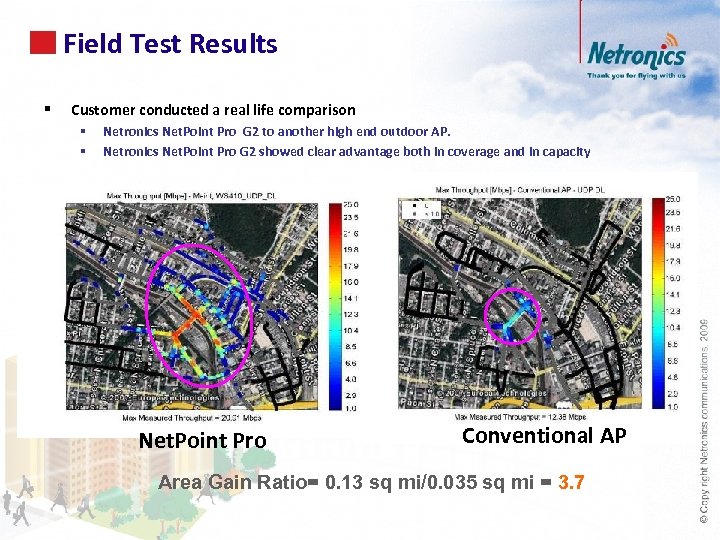 Field Test Results 62 § Customer conducted a real life comparison § § Netronics Net. Point Pro G 2 to another high end outdoor AP. Netronics Net. Point Pro G 2 showed clear advantage both in coverage and in capacity Net. Point Pro Conventional AP Area Gain Ratio= 0. 13 sq mi/0. 035 sq mi = 3. 7
 Field Test Results 802. 11 n
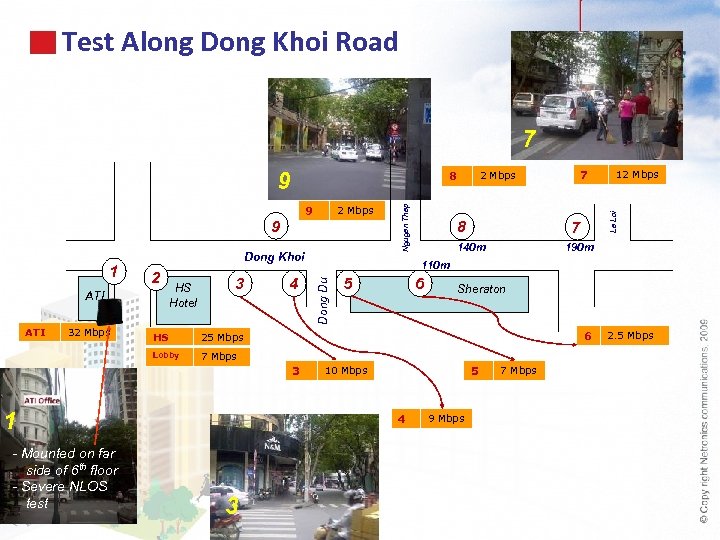 Test Along Dong Khoi Road 7 9 2 Mbps 9 2 ATI 32 Mbps HS Hotel 3 HS 7 140 m 5 6 Sheraton 7 Mbps 1 5 10 Mbps 4 3 12 Mbps 190 m 6 3 - Mounted on far side of 6 th floor - Severe NLOS test 8 25 Mbps Lobby 4 7 2 Mbps 110 m Dong Du 1 Dong Khoi Ngugen Thep 8 Le Loi 9 9 Mbps 7 Mbps 2. 5 Mbps
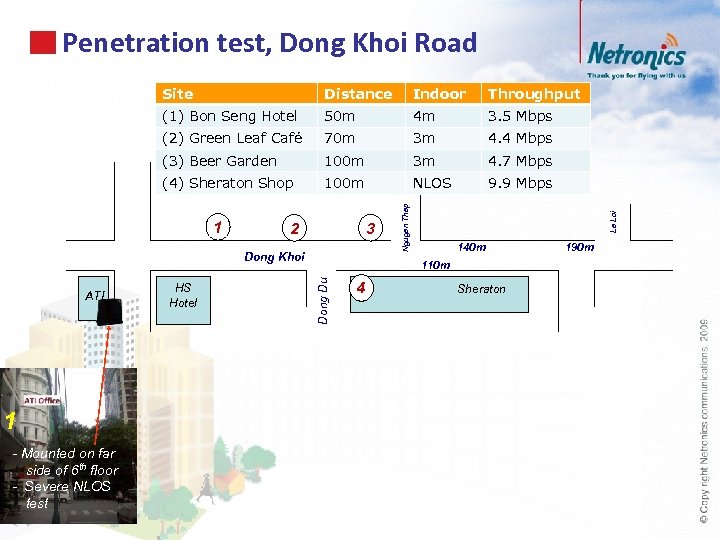 Penetration test, Dong Khoi Road Distance Indoor Throughput (1) Bon Seng Hotel 50 m 4 m 3. 5 Mbps (2) Green Leaf Café 70 m 3 m 4. 4 Mbps (3) Beer Garden 100 m 3 m 4. 7 Mbps (4) Sheraton Shop 100 m NLOS 9. 9 Mbps 3 2 Dong Khoi 1 - Mounted on far side of 6 th floor - Severe NLOS test HS Hotel 140 m 110 m Dong Du ATI Le Loi 1 Ngugen Thep Site 4 Sheraton 190 m
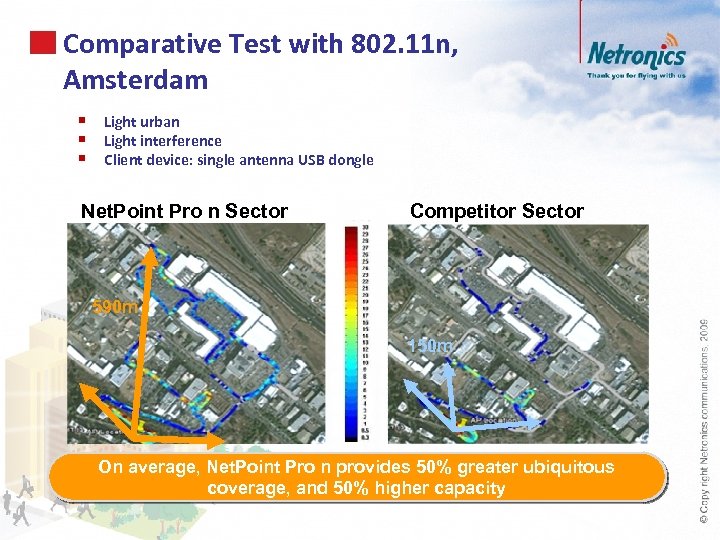 Comparative Test with 802. 11 n, Amsterdam § § § Light urban Light interference Client device: single antenna USB dongle Net. Point Pro n Sector Competitor Sector 590 m 150 m On average, Net. Point Pro n provides 50% greater ubiquitous coverage, and 50% higher capacity
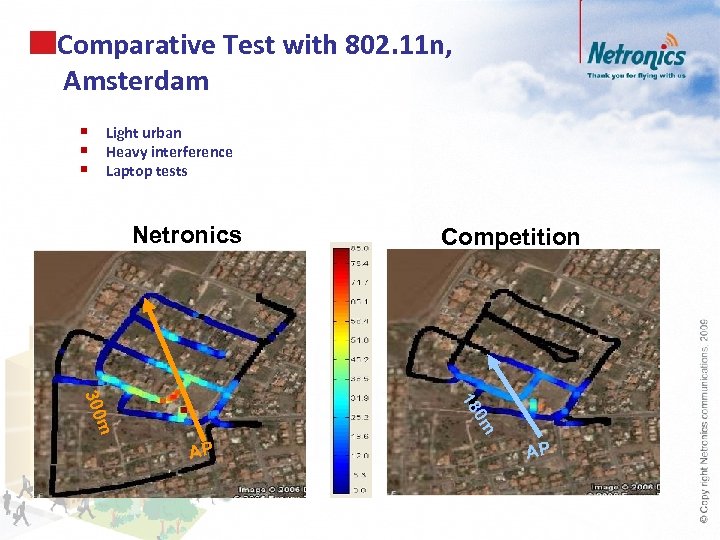 Comparative Test with 802. 11 n, Amsterdam § § § Light urban Heavy interference Laptop tests Netronics Competition m m 0 18 300 AP AP
 Summary
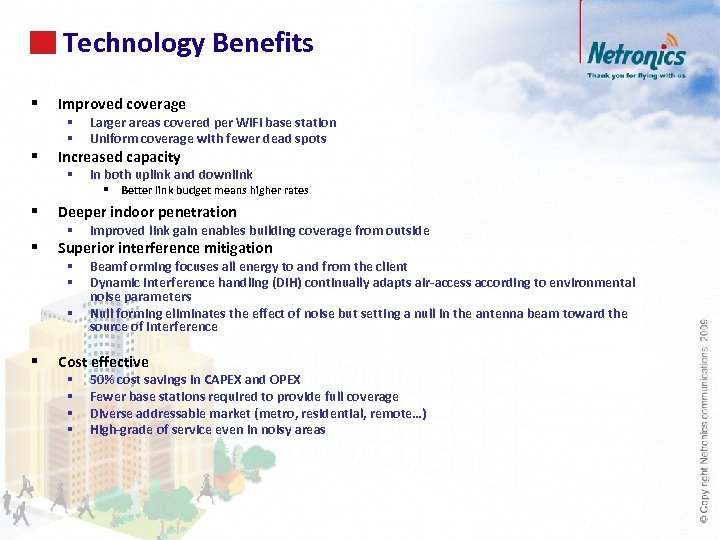 Technology Benefits 69 § Improved coverage § § § Larger areas covered per Wi. Fi base station Uniform coverage with fewer dead spots Increased capacity § In both uplink and downlink § Better link budget means higher rates § Deeper indoor penetration § § Superior interference mitigation § § Improved link gain enables building coverage from outside Beamf orming focuses all energy to and from the client Dynamic interference handling (DIH) continually adapts air-access according to environmental noise parameters Null forming eliminates the effect of noise but setting a null in the antenna beam toward the source of interference Cost effective § § 50% cost savings in CAPEX and OPEX Fewer base stations required to provide full coverage Diverse addressable market (metro, residential, remote…) High-grade of service even in noisy areas
 Competitive Landscape 70 § Standard Wi-Fi base stations § All based on the same RF technology and Wi-Fi chipset § With or without basic diversity § Originally designed for indoor applications § Differentiated in the mesh implementation and management tools § Netronics Wi-Fi NPP 6 X 2. 4 base station § Designed for outdoor Wi-Fi applications § Extended range: 1. 5 X-2 X § Higher throughput: 2 X-3 X § Uniform coverage § Improved indoors penetration § Superior interference resilience Ne oin t. P s Pr t is o na i las c f it o s wn o
 Summary • Net. Point Pro is a Carrier Grade Wi-Fi solution • Net. Point Pro revolutionizes the unlicensed WBA market – Two-way beam forming 802. 11 n – Widest and homogeneous coverage – Best indoor penetration – Highest capacity – Leading interference immunity – Fastest ROI: 50% CAPEX and 50% OPEX saving – Over a decade of outdoor experience
 Summary 72 § Netronics technology revolutionizes Wi-Fi infrastructure § § rural, outdoor and metro markets greater range and superior capacity high quality service Highly cost effective outdoor Wi-Fi solution § § Save 50% CAPEX – fewer base stations and fewer installations Reduce 50% OPEX – fewer sites, reduced infrastructure to maintain
 Thank you www. netronics-networks. com