 Скачать презентацию Nervous Systems Brain Development AP Biology 2007 -2008
f410ef4b207f3058adc6787ab05f2f0d.ppt
- Количество слайдов: 20



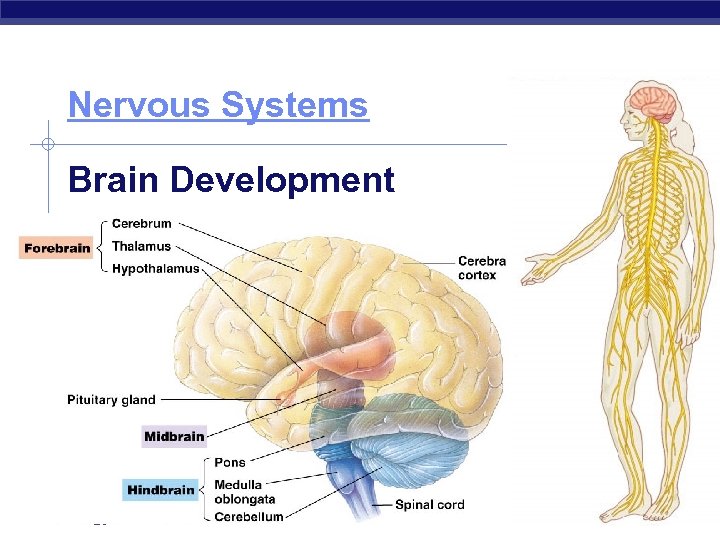
Nervous Systems Brain Development AP Biology 2007 -2008
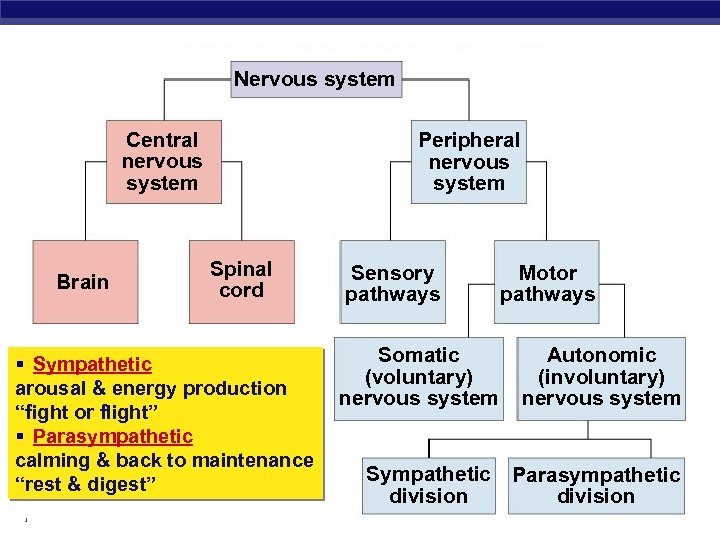
Nervous system Central nervous system Brain Peripheral nervous system Spinal cord § Sympathetic arousal & energy production “fight or flight” § Parasympathetic calming & back to maintenance “rest & digest” AP Biology Sensory pathways Somatic (voluntary) nervous system Sympathetic division Motor pathways Autonomic (involuntary) nervous system Parasympathetic division
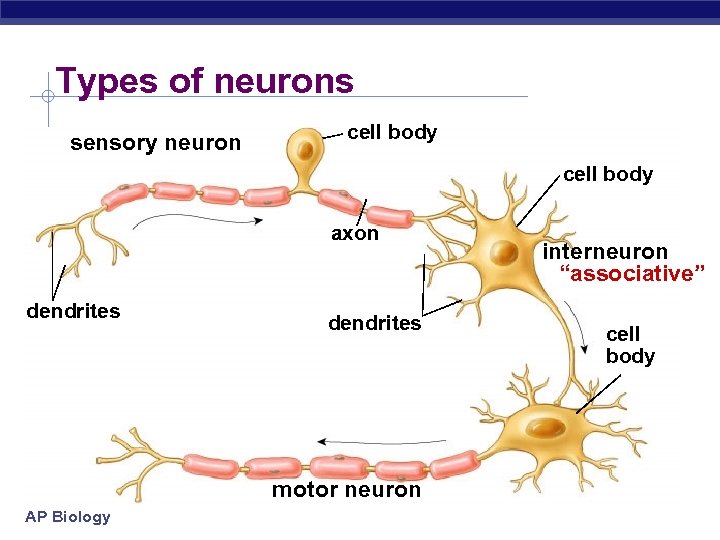
Types of neurons sensory neuron cell body axon dendrites motor neuron AP Biology interneuron “associative” cell body
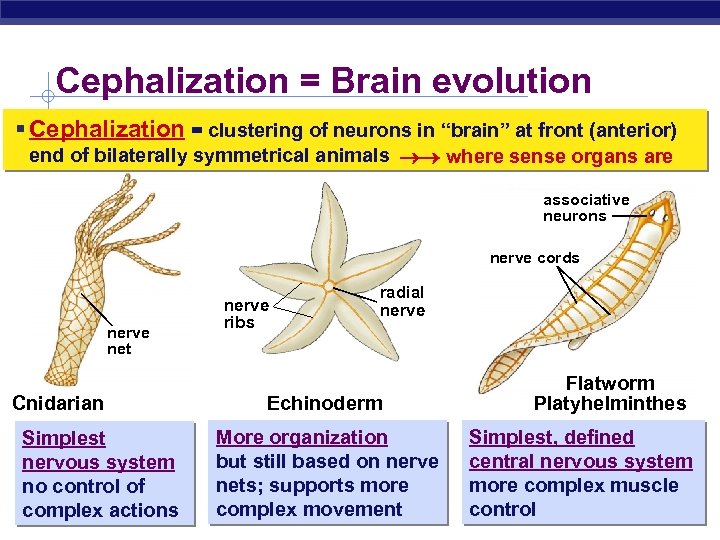
Cephalization = Brain evolution § Cephalization = clustering of neurons in “brain” at front (anterior) end of bilaterally symmetrical animals where sense organs are associative neurons nerve cords nerve net Cnidarian Simplest nervous system no control of complex actions AP Biology nerve ribs radial nerve Echinoderm More organization but still based on nerve nets; supports more complex movement Flatworm Platyhelminthes Simplest, defined central nervous system more complex muscle control
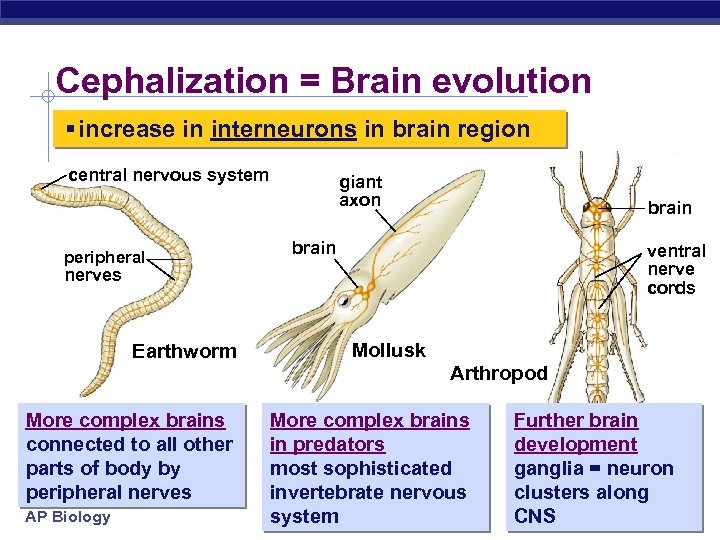
Cephalization = Brain evolution § increase in interneurons in brain region central nervous system peripheral giant axon brain ventral nerve cords nerves Earthworm More complex brains connected to all other parts of body by peripheral nerves AP Biology Mollusk Arthropod More complex brains in predators most sophisticated invertebrate nervous system Further brain development ganglia = neuron clusters along CNS
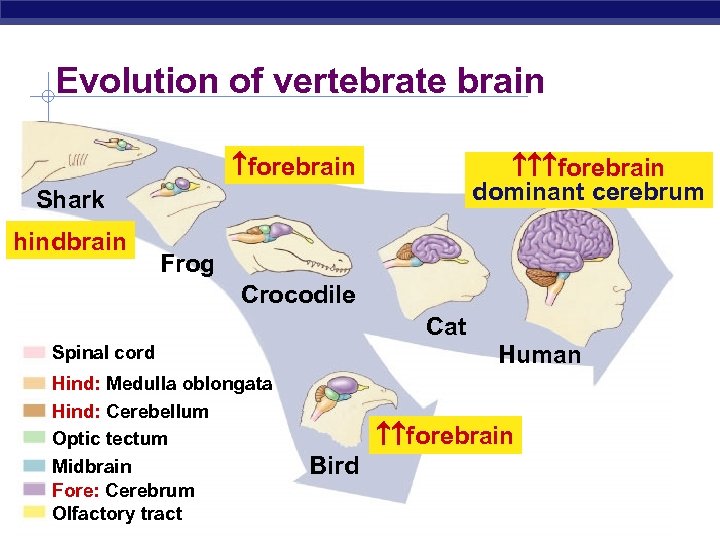
Evolution of vertebrate brain forebrain dominant cerebrum Shark hindbrain Frog Crocodile Cat Human Spinal cord Hind: Medulla oblongata Hind: Cerebellum Optic tectum Midbrain Fore: Cerebrum Olfactory tract AP Biology forebrain Bird
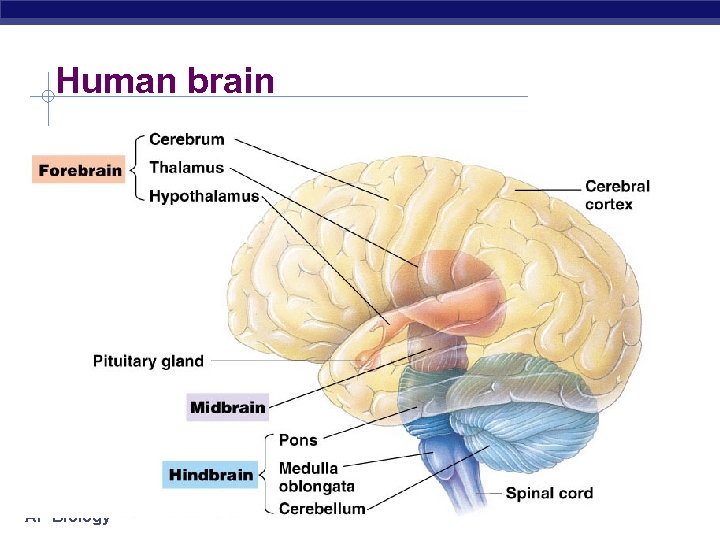
Human brain AP Biology
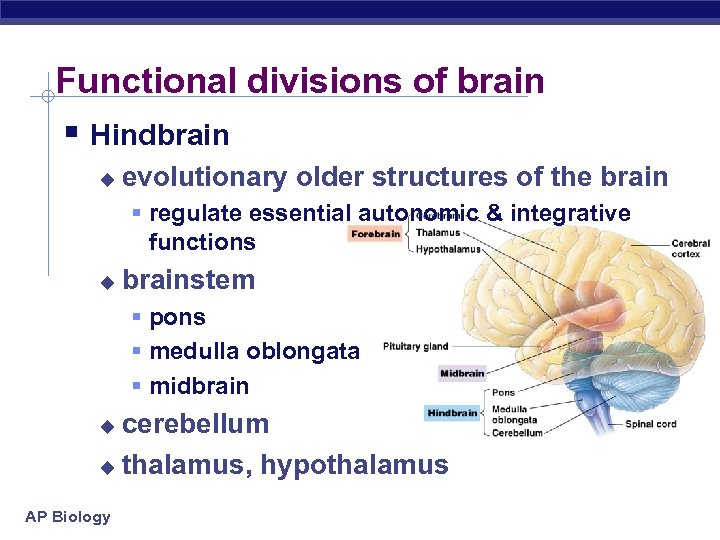
Functional divisions of brain § Hindbrain u evolutionary older structures of the brain § regulate essential autonomic & integrative functions u brainstem § pons § medulla oblongata § midbrain cerebellum u thalamus, hypothalamus u AP Biology
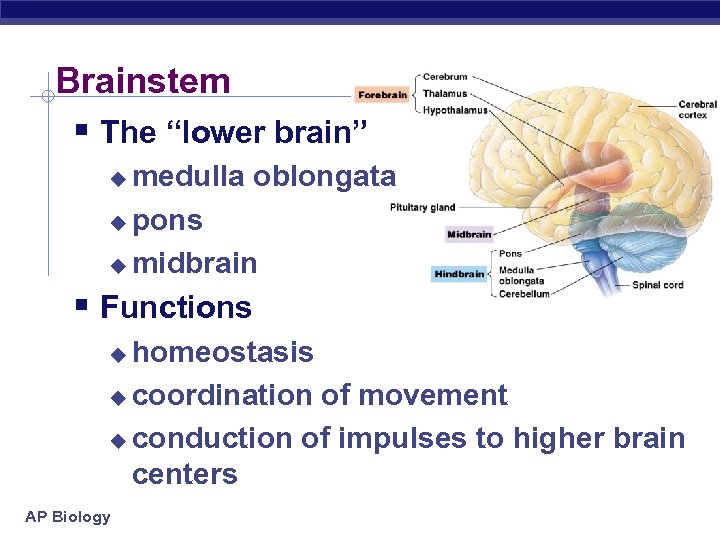
Brainstem § The “lower brain” medulla oblongata u pons u midbrain u § Functions homeostasis u coordination of movement u conduction of impulses to higher brain centers u AP Biology
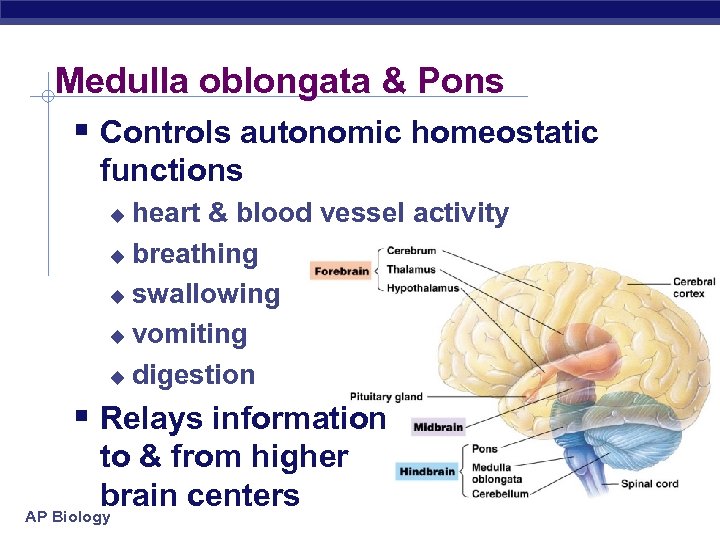
Medulla oblongata & Pons § Controls autonomic homeostatic functions heart & blood vessel activity u breathing u swallowing u vomiting u digestion u § Relays information to & from higher brain centers AP Biology
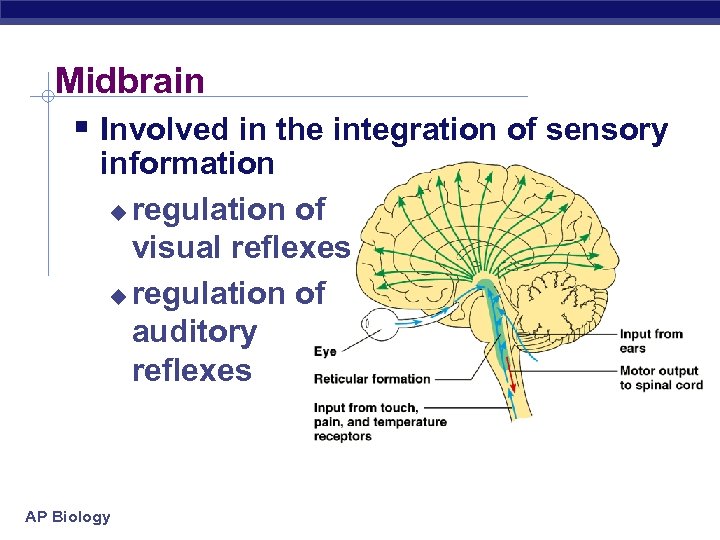
Midbrain § Involved in the integration of sensory information u regulation of visual reflexes u regulation of auditory reflexes AP Biology
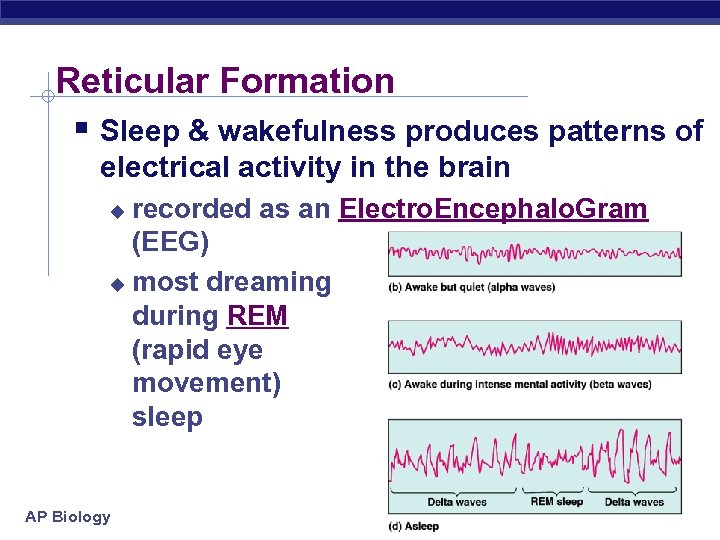
Reticular Formation § Sleep & wakefulness produces patterns of electrical activity in the brain recorded as an Electro. Encephalo. Gram (EEG) u most dreaming during REM (rapid eye movement) sleep u AP Biology
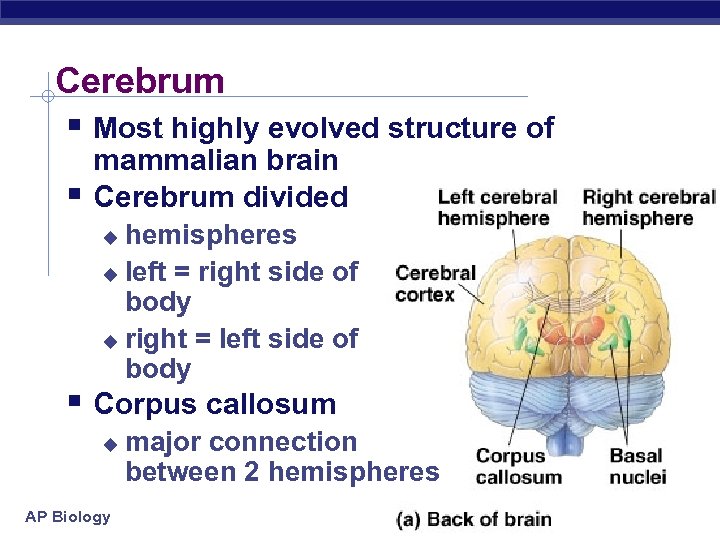
Cerebrum § Most highly evolved structure of § mammalian brain Cerebrum divided hemispheres u left = right side of body u right = left side of body u § Corpus callosum u AP Biology major connection between 2 hemispheres
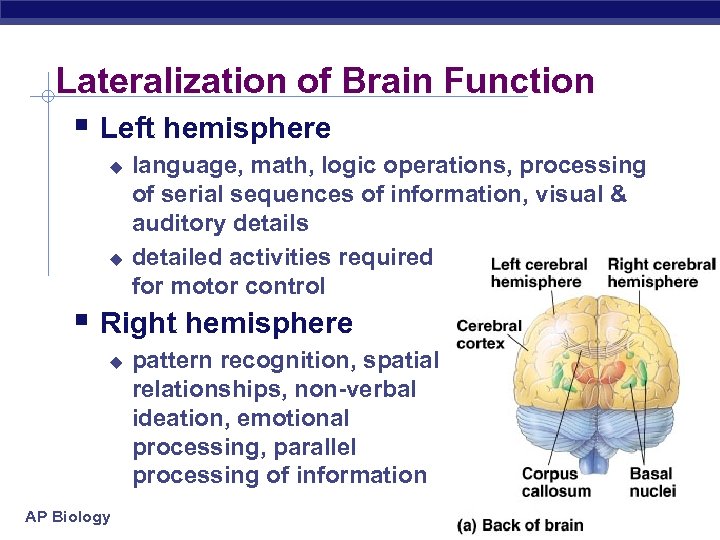
Lateralization of Brain Function § Left hemisphere u u language, math, logic operations, processing of serial sequences of information, visual & auditory details detailed activities required for motor control § Right hemisphere u AP Biology pattern recognition, spatial relationships, non-verbal ideation, emotional processing, parallel processing of information
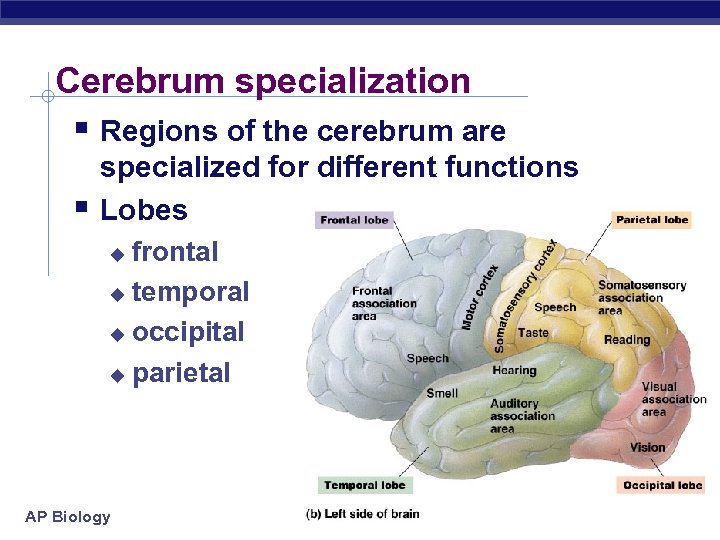
Cerebrum specialization § Regions of the cerebrum are § specialized for different functions Lobes frontal u temporal u occipital u parietal u AP Biology
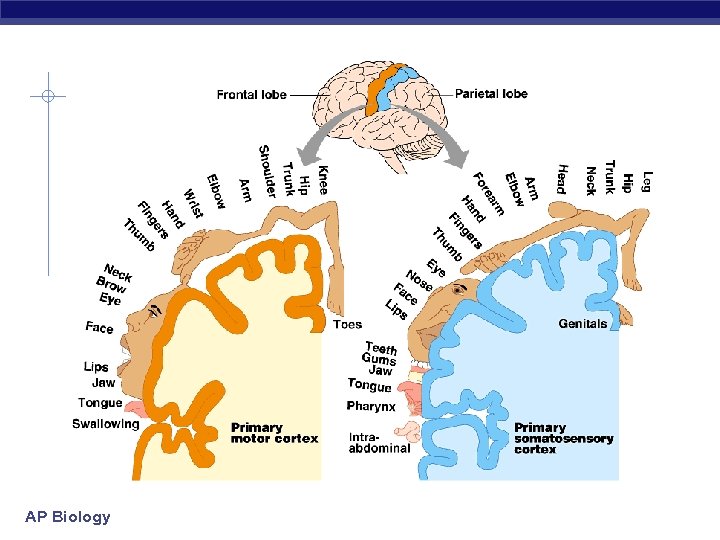
AP Biology
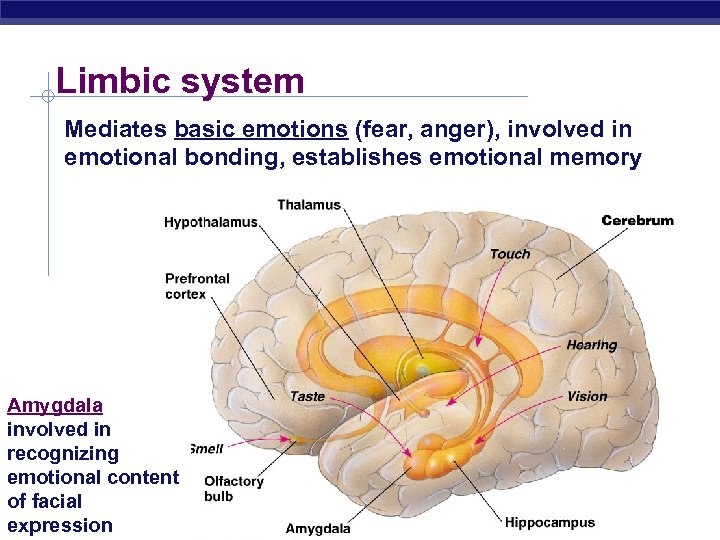
Limbic system Mediates basic emotions (fear, anger), involved in emotional bonding, establishes emotional memory Amygdala involved in recognizing emotional content of facial AP Biology expression
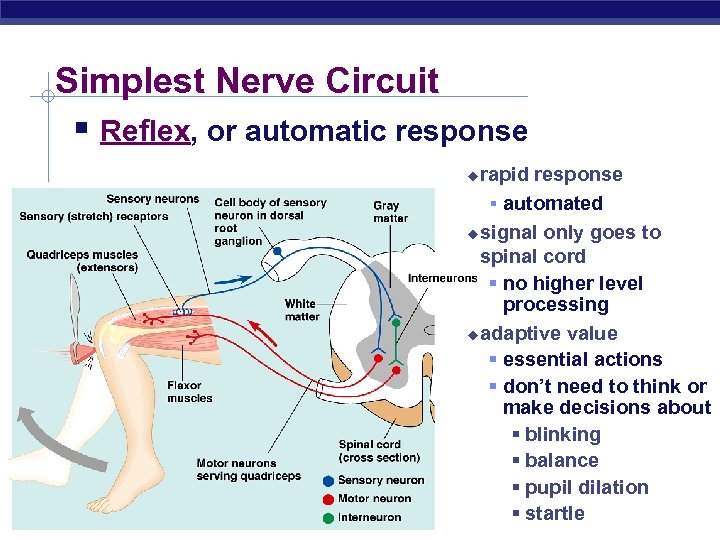
Simplest Nerve Circuit § Reflex, or automatic response rapid response § automated u signal only goes to spinal cord § no higher level processing u adaptive value § essential actions § don’t need to think or make decisions about § blinking § balance § pupil dilation § startle u AP Biology
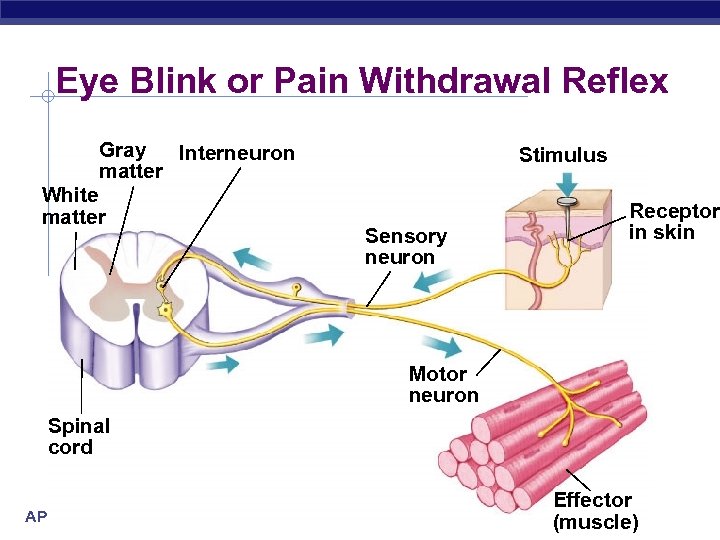
Eye Blink or Pain Withdrawal Reflex Gray Interneuron matter White matter Stimulus Sensory neuron Receptor in skin Motor neuron Spinal cord AP Biology Effector (muscle)
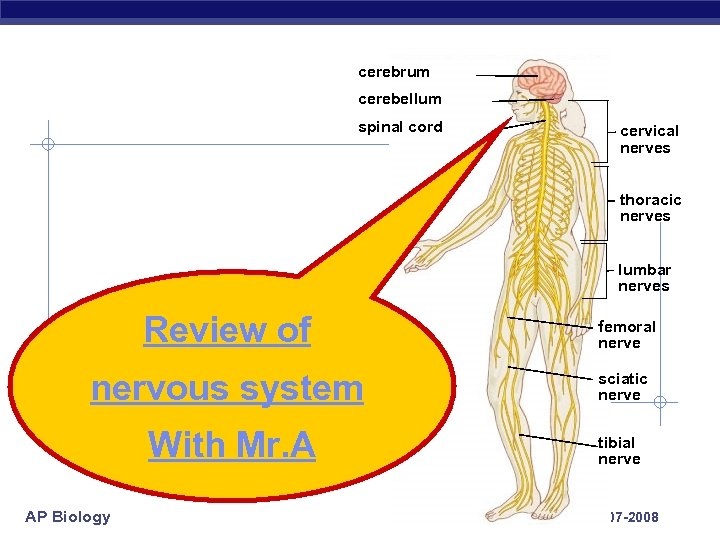
cerebrum cerebellum spinal cord cervical nerves thoracic nerves lumbar nerves Review of femoral nerve nervous system sciatic nerve With Mr. A AP Biology tibial nerve 2007 -2008
Скачать презентацию Nervous Systems Brain Development AP Biology 2007 -2008
f410ef4b207f3058adc6787ab05f2f0d.ppt