


 Скачать презентацию NERSA National Energy Regulator of South Africa Presentation
6a07d718f3b3dd4ec0819801bb4b713a.ppt
- Количество слайдов: 28
 NERSA National Energy Regulator of South Africa Presentation to the Portfolio Committee on Energy 17 September 2013 1
 AGENDA Energy Regulator Overview Regulation of the Electricity Supply Industry Current Structure of the Electricity Supply Industry Engaging Consumers and Stakeholders Challenges 2
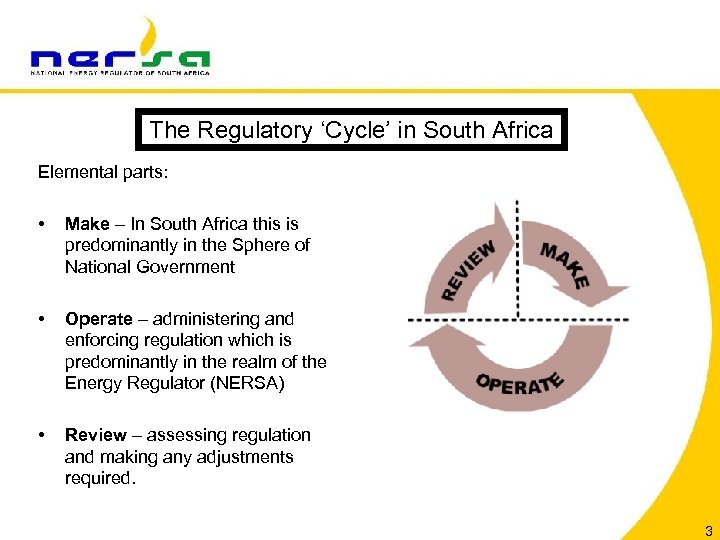 The Regulatory ‘Cycle’ in South Africa Elemental parts: • Make – In South Africa this is predominantly in the Sphere of National Government • Operate – administering and enforcing regulation which is predominantly in the realm of the Energy Regulator (NERSA) • Review – assessing regulation and making any adjustments required. 3
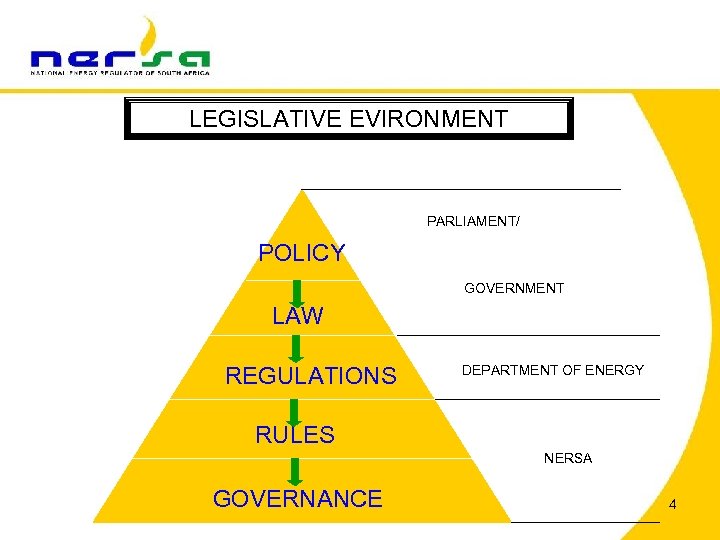 LEGISLATIVE EVIRONMENT PARLIAMENT/ POLICY GOVERNMENT LAW REGULATIONS DEPARTMENT OF ENERGY RULES NERSA GOVERNANCE 4
 Legislative Context • National Energy Regulator Act, Act No 40 of 2004; – Independent Regulator: 4 full time and 5 part time members – Responsible for the regulation of three energy industries: electricity; piped gas; petroleum pipelines – Decisions based on reasons, facts and evidence – Public meetings/hearings • Industry legislation – Electricity Regulation Act, 2006 (Act No. 4 of 2006) as amended in 2007 – Gas Act, 2001 (Act No. 48 of 2001); – Petroleum Pipelines Act, 2003 (Act No. 60 of 2003); • Electricity Regulations – Electricity Pricing Policy (EPP) GN 1398 19 December 2008 – Electricity Regulations on New Generation Capacity GN 399 4 May 2011 5
 The National Energy Regulator • Established 1 October 2005 by the NERSA Act. • The Minister of Energy designates the members as follows: – One part-time member as chairperson – One part-time member as deputy chairperson; – One full-time member as the Chief Executive Officer (CEO) – Three full-time members to be primarily responsible for each of the regulated industries. – Three other part time members 6
 Budget of the Energy Regulator • The budget for the regulation of the three industries is ring-fenced in order to reflect the cost of regulating each industry appropriately as required by the NERSA Act. • The budget is funded by the industries through levies – Electricity: a levy on power generated by licensed generators and other funds – Piped-gas industry: “gigajoules (GJ) entered in the system” determine the relative percentage contribution of each pipeline licensee to the levy; – Petroleum pipelines industry: the levy is payable by the holders of the title to petroleum as it enters the system licensed by NERSA and is based on litres transported 7
 The Regulatory Process • ER meetings are open to the public subject to Public Access to Information Act (PAIA) • Decisions of the Energy Regulator must be: – In writing, consistent with the Constitution and all applicable laws; – In the public interest; – Within the powers of the Energy Regulator as set out in the NERSA Act and the industry Acts. – Taken within a procedurally fair process in which affected persons have the opportunity to submit their views and present facts and evidence; – Based upon reasons, facts and evidence (summarised and recorded) – Explained clearly as to its factual and legal basis and reasons therefore Decisions and reasons must be available to the public in terms of the PAIA Persons affected by a decision of the ER may bring it under review by the High Court (provisions of PAJA) Decisions of the ER sitting as a Tribunal may be appealed to the High Court • • • 8
 Regulatory Principles Regulatory principles guide the Regulator’s conduct and service delivery: • • • Rule of Law: Law applies to everybody and provides a clear framework for everyone to operate. Review and appeal by high court Transparency: Reason for decisions and consultative processes; Neutrality: Neutral to all market players without favouring one or other groups (non-discrimination) Consistency: Explained decisions enabling stakeholders to take informed decisions – no surprises; predictability Independence: Independence from stakeholders and politicians; within legal framework and published Government policy) Accountability: Internal accountability – Regulator takes responsibility for actions and decisions. In addition, NERSA binds itself to carry out its business efficiently, economically and effectively, as required by legislation. 9
 Electricity Regulation 10
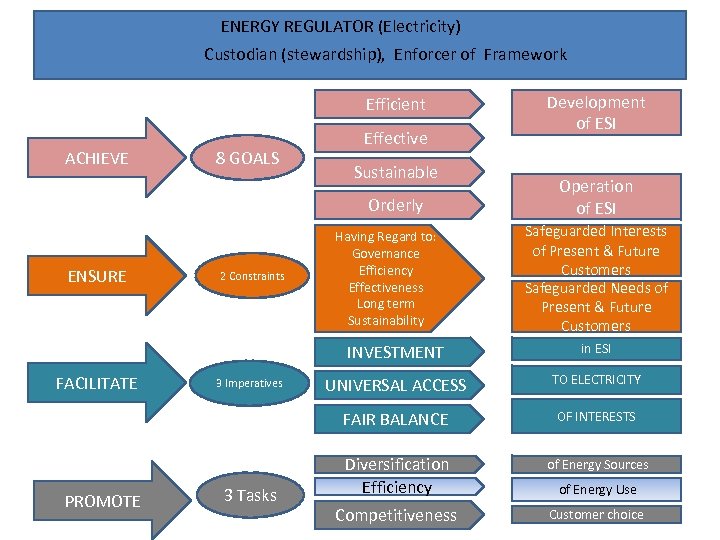 ENERGY REGULATOR (Electricity) Custodian (stewardship), Enforcer of Framework Efficient ACHIEVE 8 GOALS Effective Sustainable Orderly ENSURE 2 Constraints Having Regard to: Governance Efficiency Effectiveness Long term Sustainability Development of ESI Operation of ESI Safeguarded Interests of Present & Future Customers Safeguarded Needs of Present & Future Customers INVESTMENT PROMOTE 3 Imperatives 3 Tasks UNIVERSAL ACCESS TO ELECTRICITY FAIR BALANCE FACILITATE in ESI OF INTERESTS Diversification Efficiency of Energy Sources Competitiveness Customer choice of Energy Use
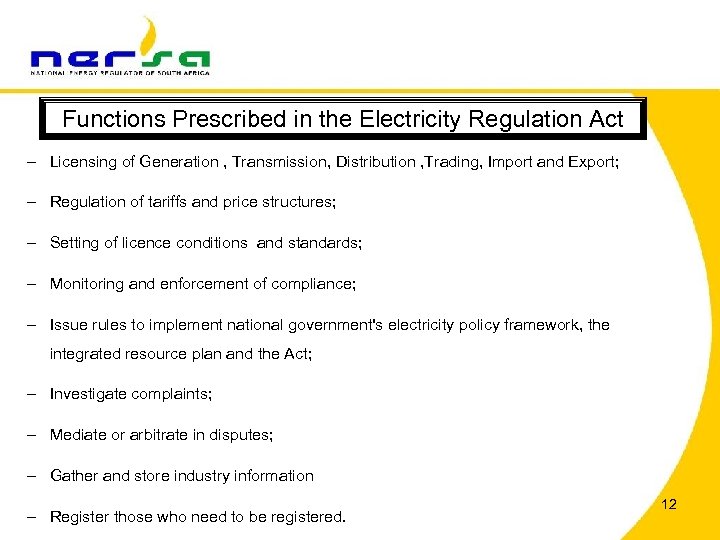 Functions Prescribed in the Electricity Regulation Act – Licensing of Generation , Transmission, Distribution , Trading, Import and Export; – Regulation of tariffs and price structures; – Setting of licence conditions and standards; – Monitoring and enforcement of compliance; – Issue rules to implement national government's electricity policy framework, the integrated resource plan and the Act; – Investigate complaints; – Mediate or arbitrate in disputes; – Gather and store industry information – Register those who need to be registered. 12
 REGULATION OF ELECTRICITY PRICES • Electricity Regulation Act, 2006 (Act No. 4 of 2006) • Section 4(a)(ii) says that the regulator must regulate prices and tariffs. • Section 15 (1) (a) says: - “must enable an efficient licensee to recover the full cost of its licensed activities, including a reasonable margin or return; ”. • Section 15 (1) (c) says: - “must give end users proper information regarding the costs that their consumption imposes on the licensee's business; ” • Section 15(1) (c) and (d) says: - “must avoid undue discrimination between customer categories” and “may permit the cross-subsidy of tariffs to certain classes of customers” • NERSA also has to comply with the Principles in the Electricity Pricing Policy document because Section 4 (a) (iv) says: - “issue rules designed to implement the national government's electricity policy framework, the integrated resource plan and this Act; ” 13
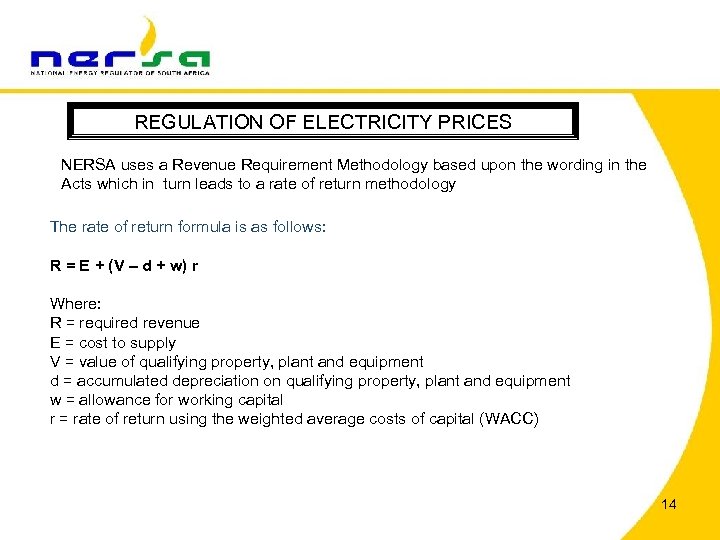 REGULATION OF ELECTRICITY PRICES NERSA uses a Revenue Requirement Methodology based upon the wording in the Acts which in turn leads to a rate of return methodology The rate of return formula is as follows: R = E + (V – d + w) r Where: R = required revenue E = cost to supply V = value of qualifying property, plant and equipment d = accumulated depreciation on qualifying property, plant and equipment w = allowance for working capital r = rate of return using the weighted average costs of capital (WACC) 14
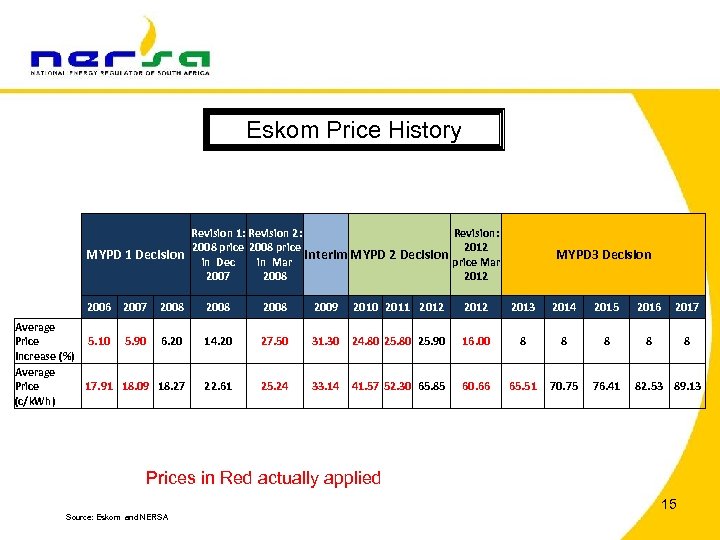 Eskom Price History Revision 1: Revision 2: Revision: 2008 price 2012 MYPD 1 Decision in Dec Interim MYPD 2 Decision price Mar in Mar 2007 2008 2012 2006 2007 2008 Average 5. 10 5. 90 6. 20 Price Increase (%) Average 17. 91 18. 09 18. 27 Price (c/k. Wh) MYPD 3 Decision 2008 2009 2010 2011 2012 2013 2014 2015 2016 2017 14. 20 27. 50 31. 30 24. 80 25. 90 16. 00 8 8 8 22. 61 25. 24 33. 14 41. 57 52. 30 65. 85 60. 66 65. 51 70. 75 76. 41 82. 53 89. 13 Prices in Red actually applied 15 Source: Eskom and NERSA
 Licensing and Compliance Monitoring The Act requires that anyone who is involved in Generation (Gx), Transmission (Tx), Distribution (Dx), Import/Exports and Trading should be licensed by NERSA With each and every licence granted NERSA imposes licence conditions which should be complied with. The ERA stipulates that the licensing process should not exceed 120 days After a licence has been issued NERSA has to monitor for compliance – more than 200 licensees. The Electricity Licensing and Compliance Department is responsible for these functions within NERSA. 16
 Industry Structure 17
 Industry Structure It is dominated by the vertically integrated incumbent – Eskom is responsible for the generation of 96% (~26 Power stations) of electricity in the RSA and 60% of Distribution There are 188 licensed distributors, including Eskom Distribution IPPs will sell to Eskom and not compete directly Total licensees = 188 including Eskom : 174 Municipalities 13 Private Distributor 1 Eskom Dx - distributes 60 % to end user customers Municipalities and some private distributors distribute 40 % to end user customers 18
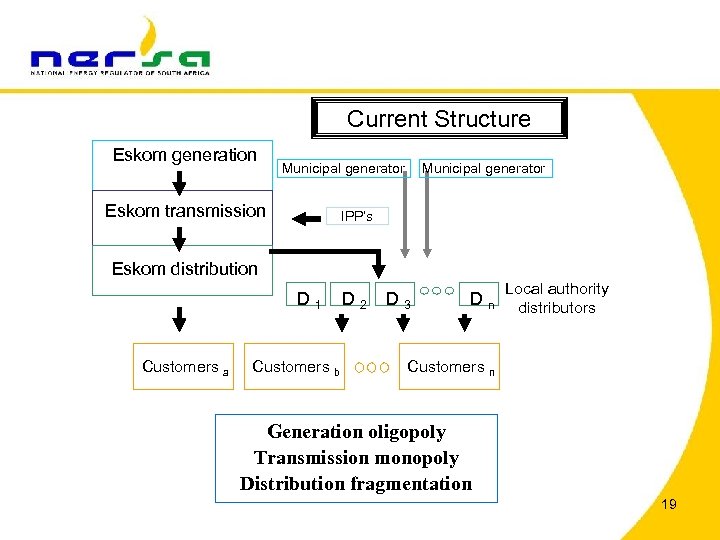 Current Structure Eskom generation Municipal generator Eskom transmission IPP’s Eskom distribution D 1 Customers a Customers b D 2 D 3 Dn Local authority distributors Customers n Generation oligopoly Transmission monopoly Distribution fragmentation 19
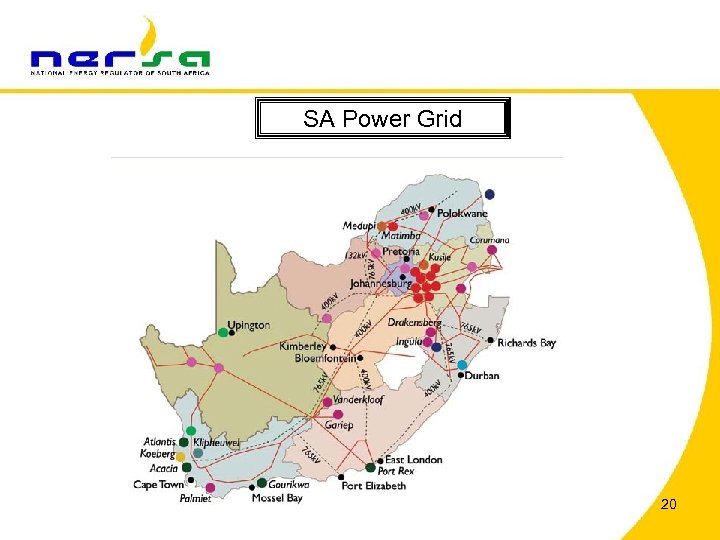 SA Power Grid 20
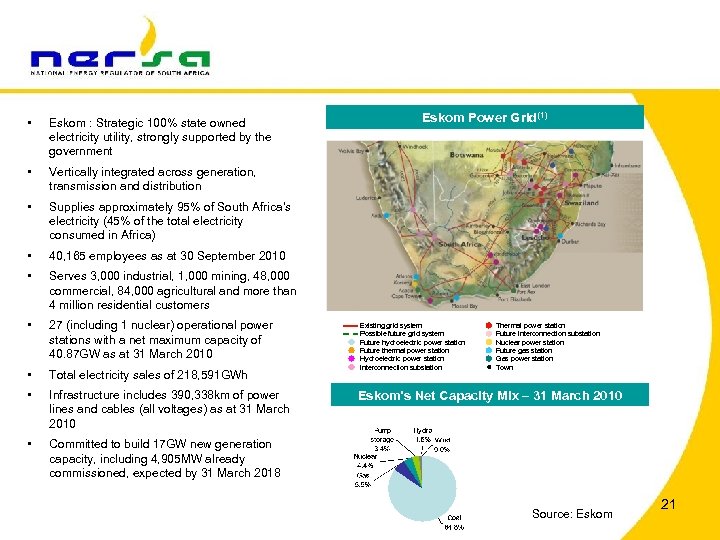 • Eskom : Strategic 100% state owned electricity utility, strongly supported by the government • Vertically integrated across generation, transmission and distribution • Supplies approximately 95% of South Africa’s electricity (45% of the total electricity consumed in Africa) • 40, 165 employees as at 30 September 2010 • Serves 3, 000 industrial, 1, 000 mining, 48, 000 commercial, 84, 000 agricultural and more than 4 million residential customers • 27 (including 1 nuclear) operational power stations with a net maximum capacity of 40. 87 GW as at 31 March 2010 • Total electricity sales of 218, 591 GWh • Infrastructure includes 390, 338 km of power lines and cables (all voltages) as at 31 March 2010 • Eskom Power Grid(1) Committed to build 17 GW new generation capacity, including 4, 905 MW already commissioned, expected by 31 March 2018 Existing grid system Possible future grid system Future hydroelectric power station Future thermal power station Hydroelectric power station Interconnection substation Thermal power station Future interconnection substation Nuclear power station Future gas station Gas power station Town Eskom’s Net Capacity Mix – 31 March 2010 Source: Eskom 21
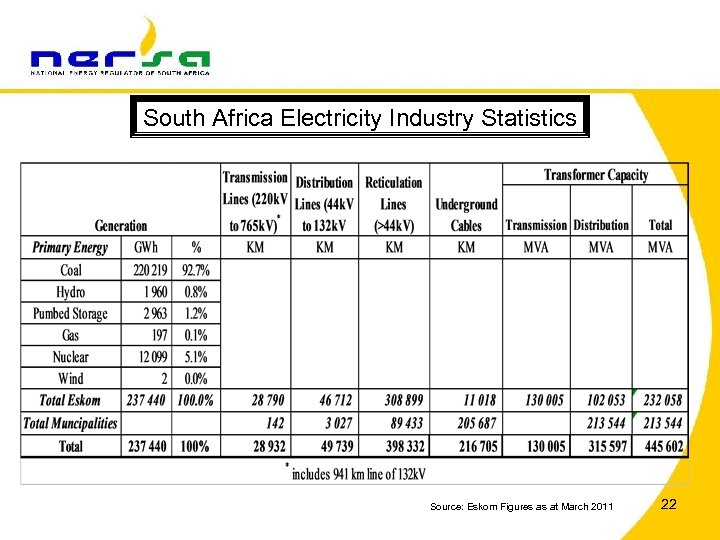 South Africa Electricity Industry Statistics Source: Eskom Figures as at March 2011 22
 Engaging Consumers and Stakeholders 23
 The Engagement Process Engagement takes the following forms: • Customer Education Forums ØNERSA staff conduct customer education forums where the customer is • Complaints resolution Ø NERSA has a department which sets out to resolve customer complaints and queries ØThis also tells us where the problems are 24
 The Engagement Process Cont. • Public Consultation ØImportant decisions are preceded by a public consultation paper and the opportunity to submit written comment ØPublic Hearings follow ØPublic consultation is very beneficial and a great source of information and NERSA pays attention to what is submitted and presented ØDecisions are then published on the website 25
 Challenges 26
 Challenges • Municipal Tariffs • Resellers • Accurate Information • Information Asymmetry with Eskom 27
 THANK YOU Website: www. nersa. org. za Tel: 012 - 401 4600 Fax: 012 - 401 4700 Email: info@nersa. org. za Kulawula House 526 Madiba Street Arcadia 0007 28