


 Скачать презентацию Nero Dr David W J Gill University of
204ad39000fee033bf59e0e8c7bbba54.ppt
- Количество слайдов: 28
 Nero Dr David W. J. Gill University of Wales Swansea
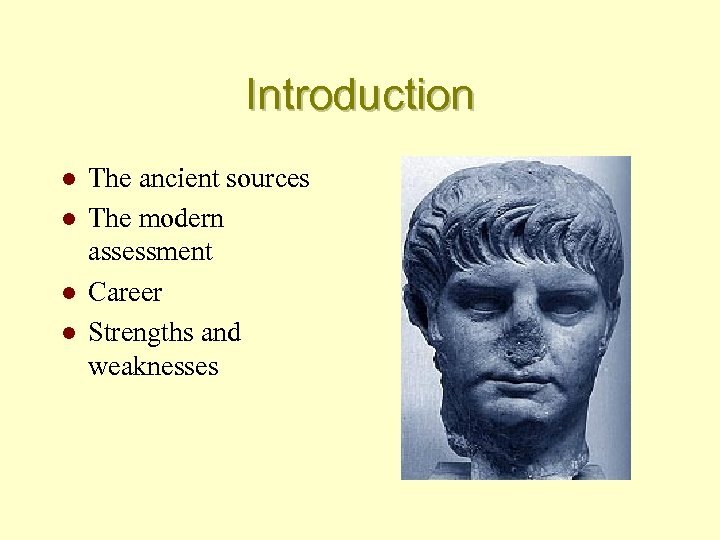 Introduction l l The ancient sources The modern assessment Career Strengths and weaknesses
 Ancient Sources Tacitus, Annals 13– 16 l Suetonius, Nero l
 Modern sources l Griffin, M. T. 1984. Nero: the end of a dynasty l Warmington, B. H. 1977. Suetonius’ Nero
 Suetonius as a source born c. AD 70, C. Suetonius Tranquillus l grandfather appears to have been familiar with the imperial court of Gaius l – freedman or praetorian guard l father: Suetonius Laetus – equestrian tribune with Legio XIII on the side of Otho – may have had links with Hippo Regius in Algeria (inscription)
 Suetonius’ background brought up in Rome l familiar with Domitian l friends with Pliny the Younger who became his patron l – 111 probably on staff of Pliny in Bithynia
 Suetonius’ background l probably worked at Rome on public pronouncements – 117: chief secretary to Hadrian – 121 or 122: fell from office l l too familiar with empress Sabina 130: still alive
 Structure of Suetonius’ life 1 -8 Life to accession l 9 -10 Early life l 20 -38 Follies and crimes l 39 -50 Disasters, death and funeral l 51 -56 Character l 57 Reaction l
 Tacitus’ background born c. 56 l senator under Domitian l 97: consul l governor of Asia l friend of Pliny the Younger l – therefore likely to have known Suetonius l probably survived the emperor Trajan
 Life of Nero l born 15 December 37 – son of Cn. Domitius Ahenobarbus and Iulia Agrippina (II) l consul AD 32
 Links with the imperial family His mother, Agrippina (II) had married Claudius l Betrothed to Claudius’ daughter Octavia (II) in 49 - and his adoptive sister (Suet. Nero 7) l – married in 53
 The youthful Nero l Tacitus, Ann. 13: – ‘But from early boyhood Nero’s mind, though lively, directed itself to other things — carving, painting, singing, and riding. Sometimes, too, he wrote verses, and thereby showed he possessed the rudiments of culture’
 Adoption l By Claudius in 50 – Ti. Claudius Nero Caesar – Suet. Nero 7: ‘When he reached the age of 11, Claudius adopted him and appointed Annaeus Seneca, who was already a senator, as his tutor’
 Seneca as tutor Exiled by Claudius for adultery with Iulia Livilla, daughter of Germanicus l Tacitus, Ann. 12. 8. 3 has Seneca recalled in 49: ‘Agrippina … now secured the recall of Lucius Annaeus Seneca from exile … She also had designs on him as a distinguished tutor for her young son Lucius Domitius Ahenobarbus … Seneca’s advice could serve their plans for supremacy …’ l
 Accession Claudius died 13 October 54 (Suet. Claud. 45) l Claudius declared a god (Suet. Claud. 45) l Agrippina became his priestess l Papyrus from Oxyrhynchus [LR ii. 9] l
 Acclamation l Suet. Nero 8: ‘After being acclaimed Emperor on the Palace steps, he was taken in a litter to the Guards’ Camp, where he briefly addressed the troops. He then visited the Senate House, where he remained until nightfall, refusing only one of the many high honours voted him, namely the title “Father of the Country”, and this because of his youth’.
 Proclamation of Nero as emperor l POxy 1021 l ‘Fulfilling the debt to his ancestors, the manifest god Caesar has departed to them, and the expected and hoped for imperator of the world has been proclaimed: the good spirit of the world, the origin of the greatest of all good things, Nero has been proclaimed Caesar. For this reason, all of us ought to wear wreaths and sacrifice oxen, to show all the gods our gratitude. Year 1 of Nero Claudius Caesar Augustus Germanicus, on the 21 st of the month New Augustus’ [17 Nov]
 The ‘quinquennium’ A golden age for the first five years l Trajan perceived it as a golden age of good government (Aur. Victor, Epitome 5) l – ‘Trajan justifiably said quite often that all emperors were far behind Nero’s quinquennium’
 Nero’s first speech to the Senate l Suetonius, Nero 10 – to rule according to Augustan precedent l Tacitus, Ann. 13. 4 – renunciation of the abuses of the Claudian regime – ‘From my house, bribery and favouritism will be excluded’ – ‘these promises were implemented’
 Ending administrative abuses in Egypt Edict of 68: Ti. Julius Alexander [LR ii. 295 – 98] l reaction to requirements under Nero l
 Tacitus on the end of the Golden Age l Tacitus, Ann. 13 – treason charge against Burrus, the emperor’s tutor – ‘Burrus’ death undermined the influence of Seneca’ – linked in an attempt to discredit Agrippina
 ‘Follies and crimes’ l Suetonius, Nero 19. 3 – ‘I have separated this catalogue of Nero’s less atrocious acts — some forgivable, some even praiseworthy — from the others; but I must begin to list his follies (probris) and crimes (scelerribus)’.
 Increasing debauchery l Tac. Ann. 13: ‘The year was a time of peace abroad, but disgusting excesses by Nero in Rome. Disguised as a slave, he ranged the streets, brothels, and taverns with his friends, who pilfered goods from shops and assaulted wayfarers: indeed, as marks on his face testified, Nero himself was struck’ – leads to an acceptance of disorder – senator forced to commit suicide
 Gang warfare l Tac. Ann. 13 – Nero encouraged gangs, enjoying the major fights – linked to theatre troops l dancers expelled from Italy
 Nero remarries divorced Octavia (in 62) l married Poppaea Sabina l – wife of M. Salvius Otho (future emperor) who was sent off to govern Lusitania – a daughter, Claudia (died in infancy)
 Introduction of Greek style games to be held every five years l 61 gymnasium established l
 Dissatisfaction l 65 conspiracy to make C. Calpurnius Piso emperor – Tacitus, Ann. 15. 54 ff – Plutarch, Moralia 505 C-D: ‘The talkativenesss of a single person prevented the city of Rome from becoming free after deliverance from Nero. For it was just one night before the tyrant was to die and everything had been readied …’
 Safety of the emperor l Inscription from Luna in Etruria (ILS 233) – ‘ … in fulfilment of a vow undertaken for the safety of Imperator Nero, which he had vowed for the Baliarians in the year in which Aulus Licinius Nerva had been consul (AD 65) …’ l no mention of Marcus Vestinus Atticus who was killed in the aftermath of Piso plot (Tactius, Ann. 15. 68 -69)