 Скачать презентацию Nehemiah ion iss ble M ssi po
3c8c7c1c767e8e2099c30755117604de.ppt
- Количество слайдов: 22



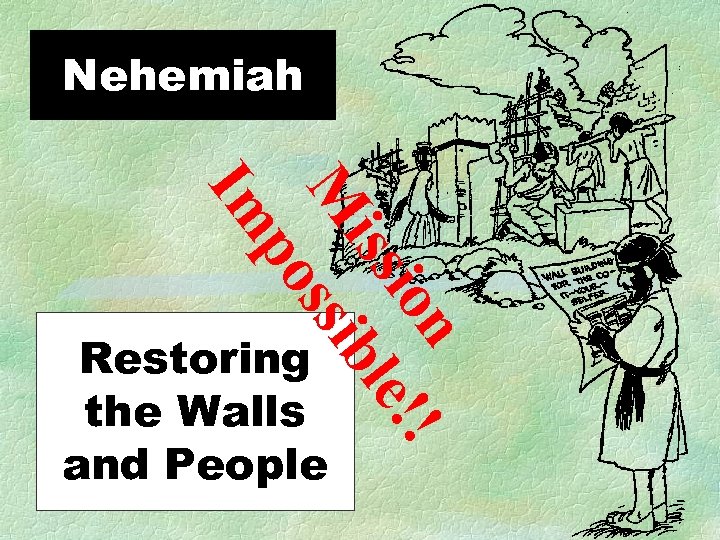
Nehemiah ion !! iss ble M ssi po Im Restoring the Walls and People
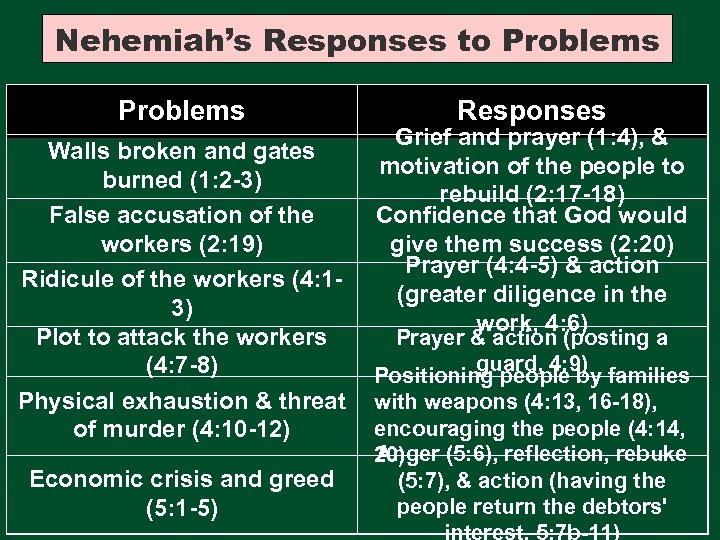
Nehemiah’s Responses to Problems Walls broken and gates burned (1: 2 -3) False accusation of the workers (2: 19) Ridicule of the workers (4: 13) Plot to attack the workers (4: 7 -8) Physical exhaustion & threat of murder (4: 10 -12) Economic crisis and greed (5: 1 -5) Responses Grief and prayer (1: 4), & motivation of the people to rebuild (2: 17 -18) Confidence that God would give them success (2: 20) Prayer (4: 4 -5) & action (greater diligence in the work, 4: 6) Prayer & action (posting a guard, 4: 9) Positioning people by families with weapons (4: 13, 16 -18), encouraging the people (4: 14, Anger (5: 6), reflection, rebuke 20) (5: 7), & action (having the people return the debtors'
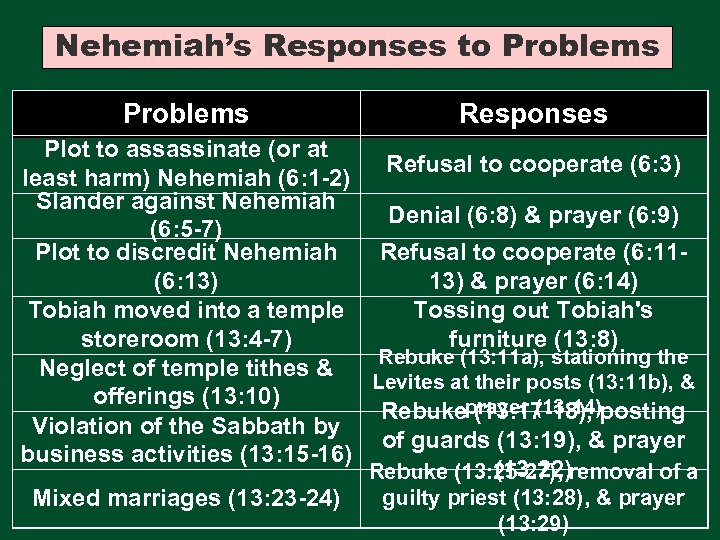
Nehemiah’s Responses to Problems Responses Plot to assassinate (or at Refusal to cooperate (6: 3) least harm) Nehemiah (6: 1 -2) Slander against Nehemiah Denial (6: 8) & prayer (6: 9) (6: 5 -7) Plot to discredit Nehemiah Refusal to cooperate (6: 11(6: 13) & prayer (6: 14) Tobiah moved into a temple Tossing out Tobiah's storeroom (13: 4 -7) furniture (13: 8) Rebuke (13: 11 a), stationing the Neglect of temple tithes & Levites at their posts (13: 11 b), & offerings (13: 10) prayer (13: 14) Rebuke (13: 17 -18), posting Violation of the Sabbath by of guards (13: 19), & prayer business activities (13: 15 -16) (13: 22) Rebuke (13: 25 -27), removal of a guilty priest (13: 28), & prayer Mixed marriages (13: 23 -24) (13: 29)

Key Word
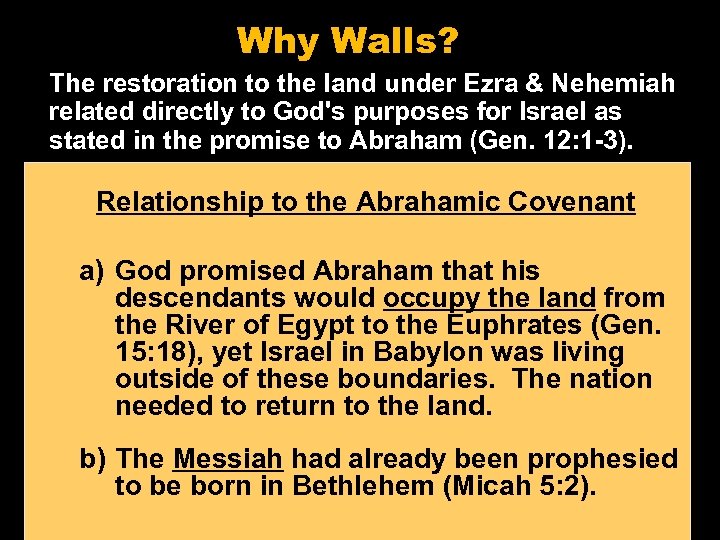
Why Walls? The restoration to the land under Ezra & Nehemiah related directly to God's purposes for Israel as stated in the promise to Abraham (Gen. 12: 1 -3). Relationship to the Abrahamic Covenant a) God promised Abraham that his descendants would occupy the land from the River of Egypt to the Euphrates (Gen. 15: 18), yet Israel in Babylon was living outside of these boundaries. The nation needed to return to the land. b) The Messiah had already been prophesied to be born in Bethlehem (Micah 5: 2).
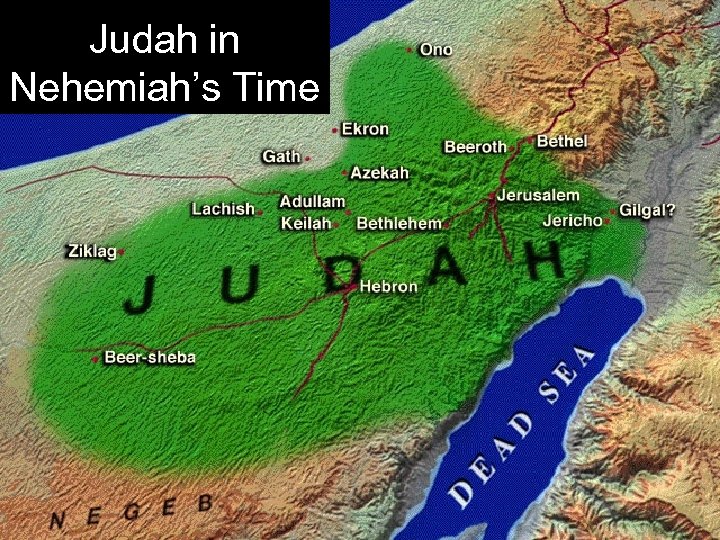
Judah in Nehemiah’s Time
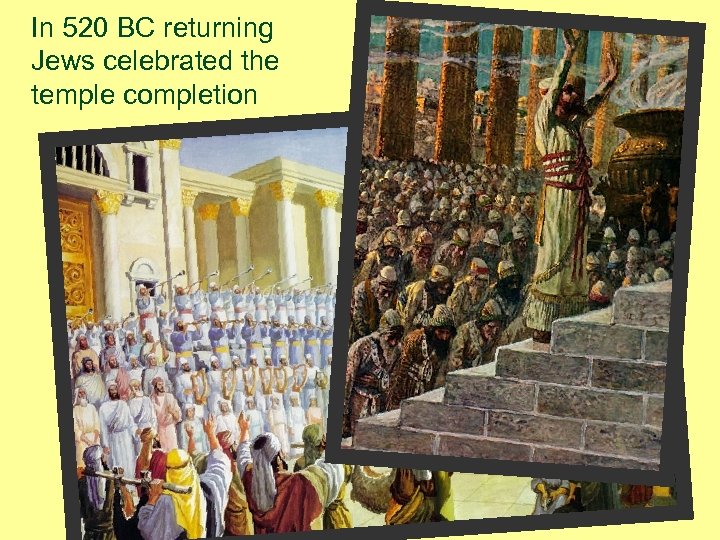
In 520 BC returning Jews celebrated the temple completion
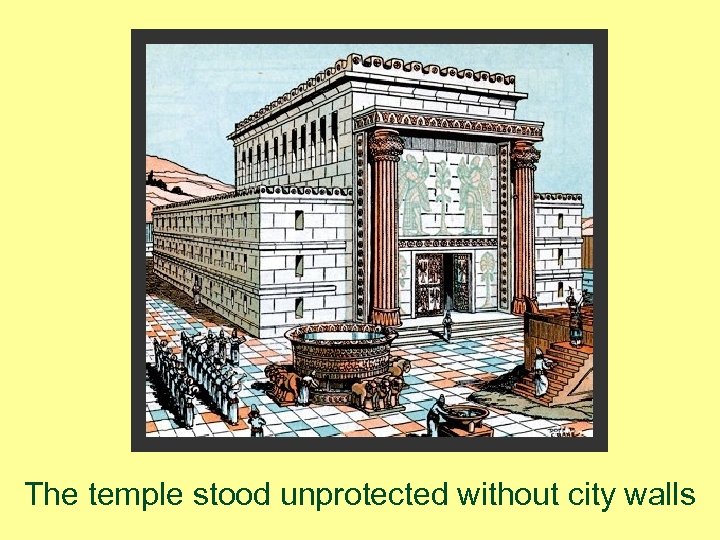
The temple stood unprotected without city walls
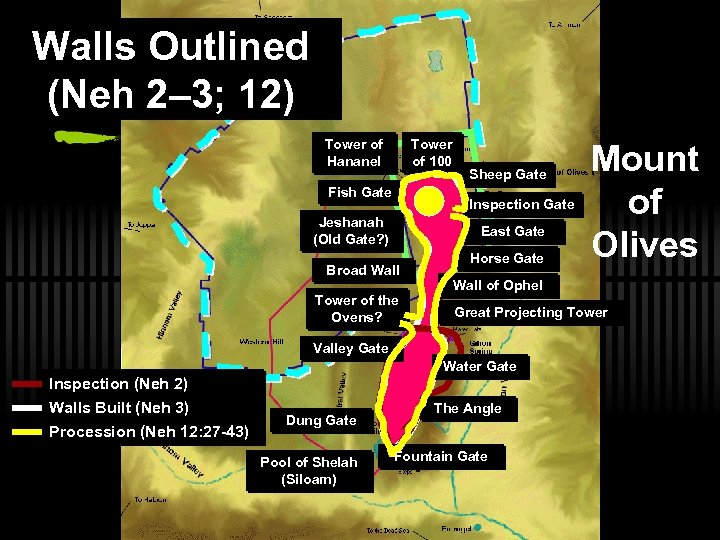
Walls Outlined (Neh 2– 3; 12) Tower of Hananel Tower of 100 Fish Gate Sheep Gate Inspection Gate Jeshanah (Old Gate? ) East Gate Broad Wall Tower of the Ovens? Horse Gate Wall of Ophel Great Projecting Tower Valley Gate Water Gate Inspection (Neh 2) Walls Built (Neh 3) Procession (Neh 12: 27 -43) Dung Gate Pool of Shelah (Siloam) Mount of Olives The Angle Fountain Gate
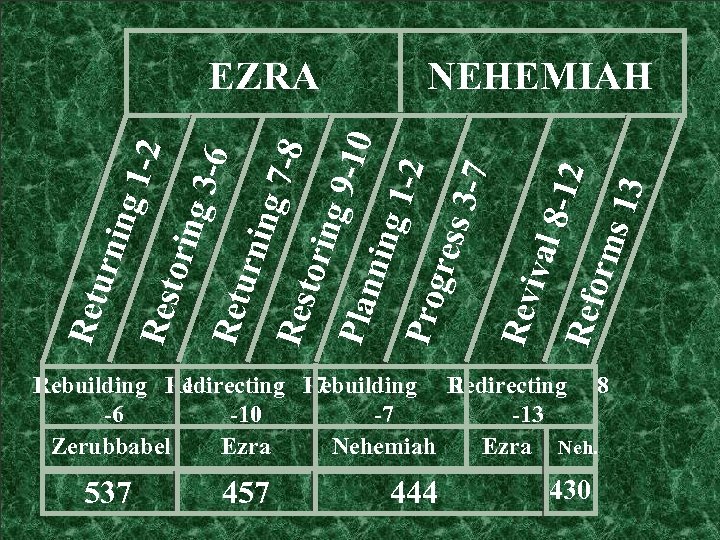
6 rnin g 78 Res tori ng 9 -10 Plan ning 1 -2 Prog ress 3 -7 Rev ival 8 -1 2 Refo rms 13 NEHEMIAH g 3 - Retu orin Rest Ret urn ing 1 -2 EZRA Rebuilding 1 Redirecting 7 Rebuilding 1 Redirecting 8 -6 -10 -7 -13 Zerubbabel Ezra Nehemiah Ezra Neh. 537 457 444 430
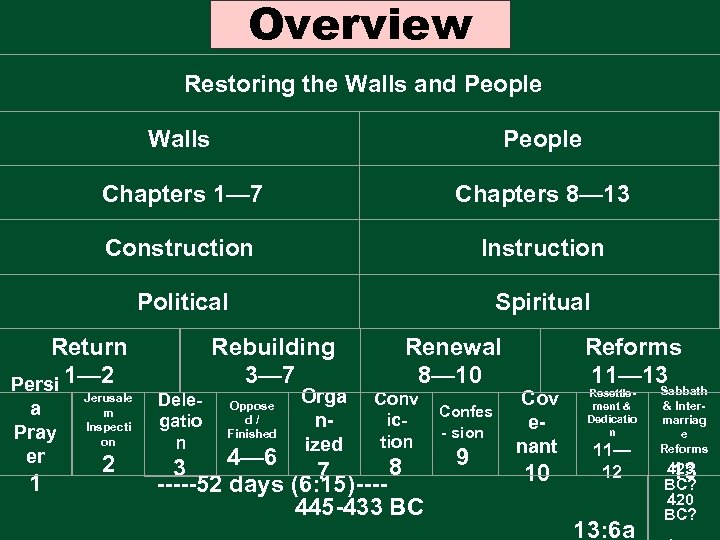
Overview Restoring the Walls and People Walls People Chapters 1— 7 Chapters 8— 13 Construction Instruction Political Spiritual Return Persi 1— 2 a Pray er 1 Jerusale m Inspecti on 2 Rebuilding 3— 7 Dele- gatio n Oppose d / Finished Orga nized Renewal Reforms 8— 10 11— 13 Cov Resettle- Sabbath Conv & Interment & Confes Dedicatio marriag ic- tion 4— 6 8 3 7 -----52 days (6: 15)---445 -433 BC - sion 9 e- nant 10 n 11— 12 13: 6 a e Reforms 425 13 BC? 420 BC?
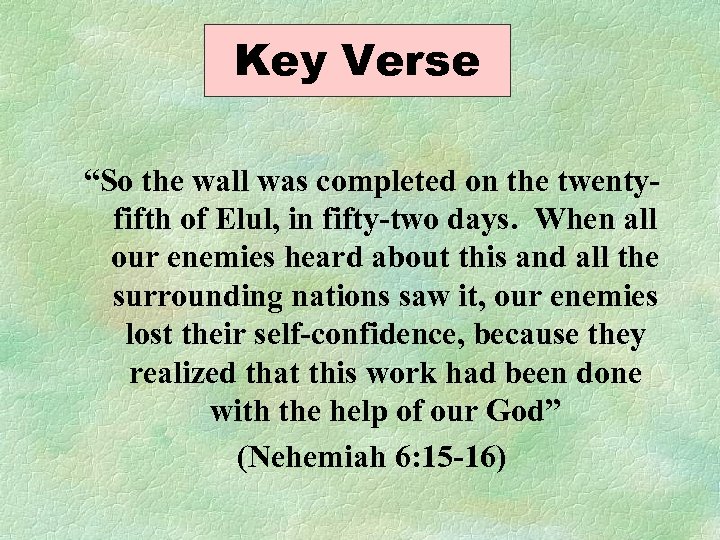
Key Verse “So the wall was completed on the twentyfifth of Elul, in fifty-two days. When all our enemies heard about this and all the surrounding nations saw it, our enemies lost their self-confidence, because they realized that this work had been done with the help of our God” (Nehemiah 6: 15 -16)
Title § Ezra & Nehemiah originally formed a single book according to Josephus, Jerome, & the Talmud. § The Hebrew Bible also has the 2 books together under the title Ezra Nehemiah (hy: m]j, n“ ar; z“[, ezra' nehemeyah). § However, the repetition of Ezra 2 in Nehemiah 7 may indicate that the two were originally separate works. § Nehemiah means "Yahweh comforts. " Once again the names are significant in that Nehemiah functioned as God's comfort through building Jerusalem's protective wall.
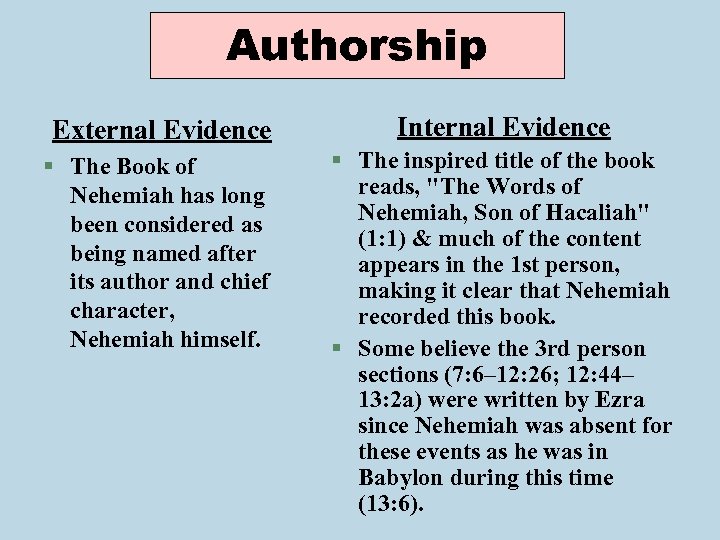
Authorship External Evidence Internal Evidence § The Book of Nehemiah has long been considered as being named after its author and chief character, Nehemiah himself. § The inspired title of the book reads, "The Words of Nehemiah, Son of Hacaliah" (1: 1) & much of the content appears in the 1 st person, making it clear that Nehemiah recorded this book. § Some believe the 3 rd person sections (7: 6– 12: 26; 12: 44– 13: 2 a) were written by Ezra since Nehemiah was absent for these events as he was in Babylon during this time (13: 6).
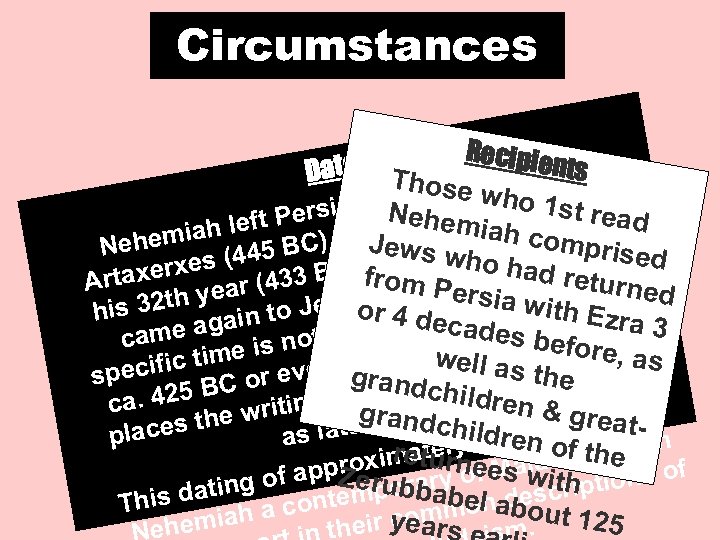
Circumstances Recipie f o Thoseh year nts in t the 20 w ho king n ersia i Nened to the 1 st " ead r hemiah cater r he left P h etu ) & r. Jews e time l ompri hemia C Ne w (445 B C). "Som ho h, a ut the sed xes d t r as rtaxer ear (433 B from P 3: 6 b) b reituwne A (1 rs m e a s 2 th y rusale ed. Pier haph gy d wit E o e his 3 nd in to J eorg 4 atecad hronolzra 3 a ec me ag s not d si ca This s befor e, en 0 BC. well, as rhaps vas time i pecific C or even 42 an 25 BC pe the s gr r 4 dc B e hild. ca. 425 e writing aft ra 400 BCr en & g es g rea e as ndchildr BC mak t- es th c lat pla 5 of as l tery 42 en ch ithehich r xima u ne Mala , w of ro et of es w p e icri tions t g of ap Zmrubbry ra ab in po s hp dat e e This o b a cont r ye mmelnad out 12 o 5 emiah eh thei c ars m. Date
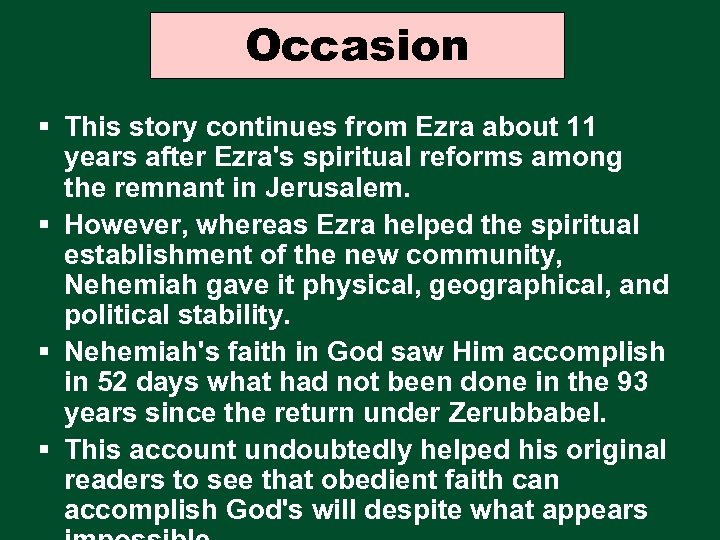
Occasion § This story continues from Ezra about 11 years after Ezra's spiritual reforms among the remnant in Jerusalem. § However, whereas Ezra helped the spiritual establishment of the new community, Nehemiah gave it physical, geographical, and political stability. § Nehemiah's faith in God saw Him accomplish in 52 days what had not been done in the 93 years since the return under Zerubbabel. § This account undoubtedly helped his original readers to see that obedient faith can accomplish God's will despite what appears
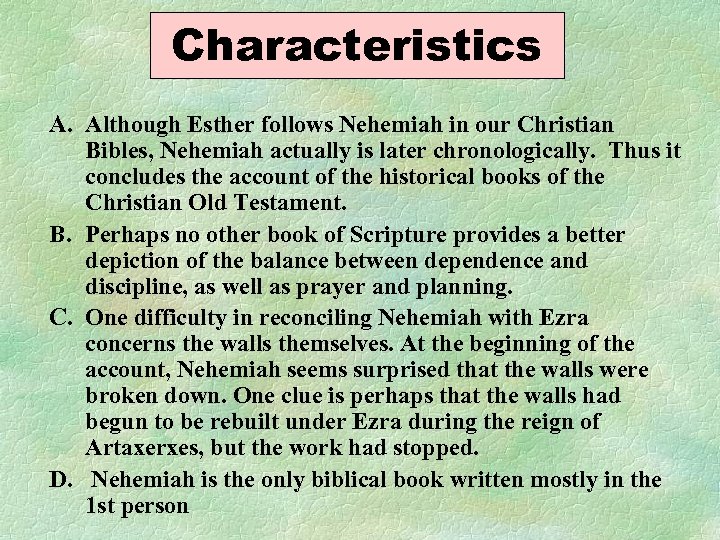
Characteristics A. Although Esther follows Nehemiah in our Christian Bibles, Nehemiah actually is later chronologically. Thus it concludes the account of the historical books of the Christian Old Testament. B. Perhaps no other book of Scripture provides a better depiction of the balance between dependence and discipline, as well as prayer and planning. C. One difficulty in reconciling Nehemiah with Ezra concerns the walls themselves. At the beginning of the account, Nehemiah seems surprised that the walls were broken down. One clue is perhaps that the walls had begun to be rebuilt under Ezra during the reign of Artaxerxes, but the work had stopped. D. Nehemiah is the only biblical book written mostly in the 1 st person
Argument § The Book of Nehemiah continues the account of Ezra. As they originally were a single work, they have the same theme: the restoration of God's people in the land. This was written to encourage the remnant in covenant obedience, especially true temple worship. § Nehemiah completes the restoration with the 3 rd & final return under Nehemiah to rebuild the walls (chs. 1— 7), followed by the restoration of the people (chs. 8 — 13). § The book also includes some very insightful teaching on leadership principles (chs. 1— 7), spiritual principles (chs. 8— 10), and moral and social principles (chs. 11— 13).
Summary Statement The restorations of the walls and people in the land under Nehemiah record God's faithfulness to His promise of restoration to encourage the remnant in covenant obedience rooted in temple worship at Jerusalem.
Outline I. (Chs. 1— 7) The rebuilding of the walls in the 3 rd return under Nehemiah's carefully executed plan despite opposition is given to encourage the remnant in covenant obedience rooted in temple worship at Jerusalem. II. (Chs. 8— 13) The restoration of the people through Nehemiah's leading Israel to obey its renewal of the covenant is provided as a stimulus to encourage the remnant in covenant obedience and commitment to the temple.

Application
Where is Jesus In Nehemiah was a man of prayer and he prayed passionately for his people (Nehemiah 1). His zealous intercession for God’s people foreshadows our great Intercessor, Jesus Christ, who prayed fervently for His people in His high-priestly prayer in John 17. Both Nehemiah and Jesus had a burning love for God’s people which they poured out in prayer to God, interceding for them before throne.
Скачать презентацию Nehemiah ion iss ble M ssi po
3c8c7c1c767e8e2099c30755117604de.ppt