 Скачать презентацию Negotiating the value of gas price By Hector
5efbcd289e007e918991e4f40ce78d91.ppt
- Количество слайдов: 32




Negotiating the value of gas price By: Hector M Lugo-Cordero, MS Saad A Khan, MS EEL 6788 1
Agenda • • • Problem statement Challenges Design Evaluation Conclusions 2
Agenda • • • Problem statement Challenges Design Evaluation Conclusions 3
Motivations • Gas prices change with some deviation over regions • How can we know which is the cheapest station? • Lets say we know it, how can we benefit others and ourselves from it? • Can there be an intelligent entity that negotiates with users providing them with the best options according to distance, time, and money? 4
Objectives • To provide a basic framework for researchers to study gas prices negotiation • To incorporate urban computing in the gas price problem in order to solve the lack of information on client’s side • To provide a possible new income source • To develop smart agents that can negotiate gas prices with uses successfully 5
Related Works • Automatic collection of fuel prices from a network of mobile camera • A service-oriented negotiation model between autonomous agents • Modeling Agents Behavior in Automated Negotiation • Netflix game 6
Assumptions • Users have the money and the will to participate on sharing the information • Users work on the weekdays and during the weekends may go shopping or stay at home 7
Agenda • • • Problem statement Challenges Design Evaluation Conclusions 8
No Existent Framework • Usage of software engineering to create an easy to use framework • Design patterns for code reusability 9
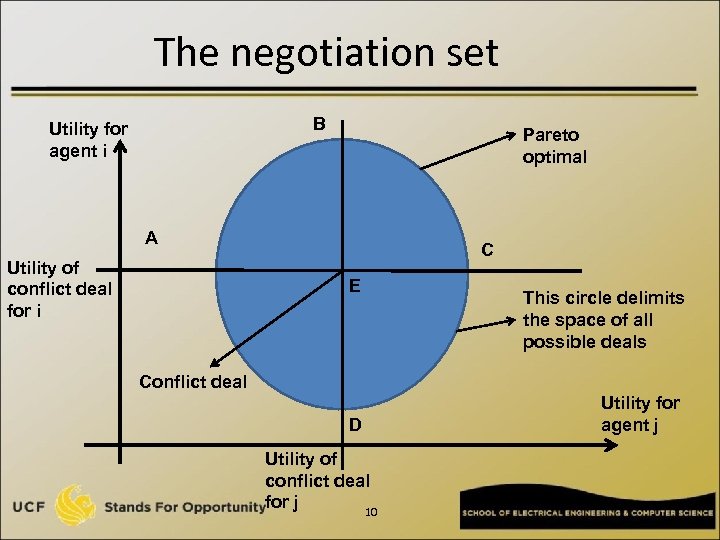
The negotiation set B Utility for agent i Pareto optimal A Utility of conflict deal for i C E This circle delimits the space of all possible deals Conflict deal D Utility of conflict deal for j 10 Utility for agent j
Real-life Scenarios • In order to obtain real results real data was needed • Certain locations were selected for source and destinations • Gas stations data abstracted from real observations, i. e. personal and http: //www. gasbuddy. com 11
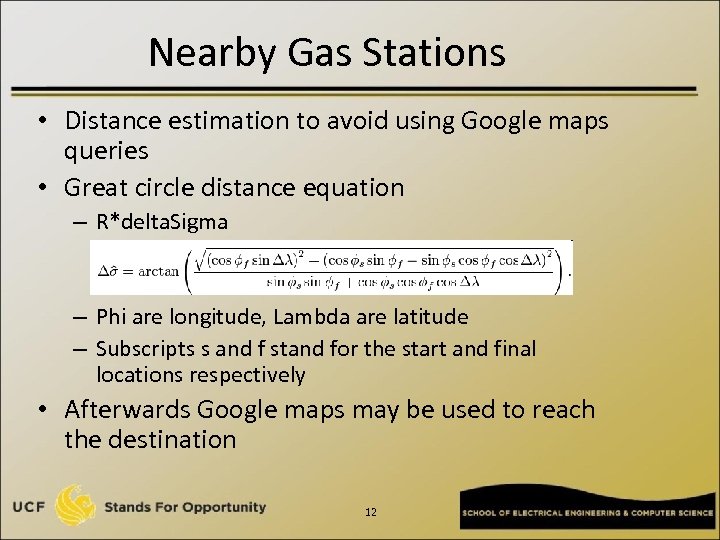
Nearby Gas Stations • Distance estimation to avoid using Google maps queries • Great circle distance equation – R*delta. Sigma – Phi are longitude, Lambda are latitude – Subscripts s and f stand for the start and final locations respectively • Afterwards Google maps may be used to reach the destination 12
Agenda • • • Problem statement Challenges Design Evaluation Conclusions 13
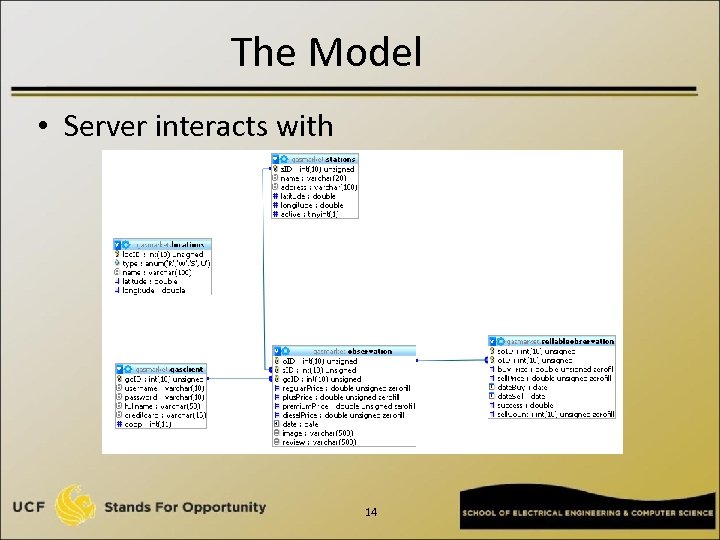
The Model • Server interacts with 14
Events • Basic simulation component used to generate messages for communication (negotiation) between server and client • Primary event types: – SEES, ARRIVES, DEPARTS, and NEEDS GAS • Stucture: – User, location, distance, timestamp 15
Scenario Generation • Selection of random locations to generate three sets – R: residential, W: work, S: shop • Usage of a transition matrix A(L, d, t) to decide the paths – L is current location – d is current day – t is current time 16
Scenario Generation (cont. ) • Consult Google to find out the distance, time, and stations on the way of the path • Merge different users according to timestamp 17
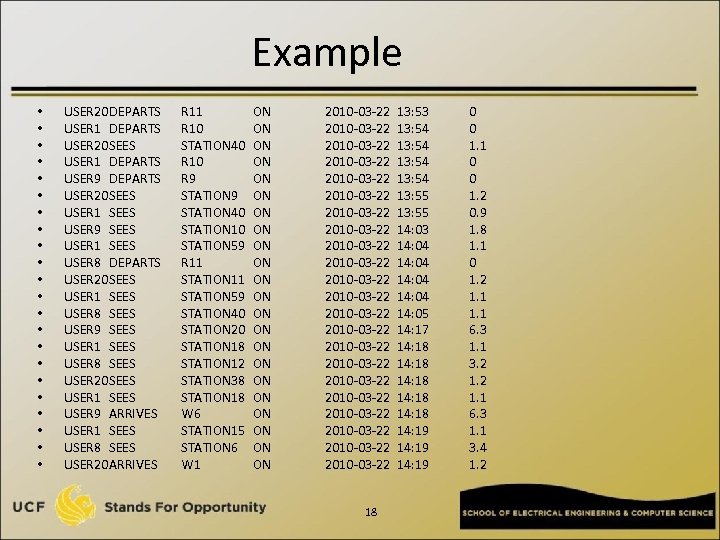
Example • • • • • • USER 20 DEPARTS USER 1 DEPARTS USER 20 SEES USER 1 DEPARTS USER 9 DEPARTS USER 20 SEES USER 1 SEES USER 9 SEES USER 1 SEES USER 8 DEPARTS USER 20 SEES USER 1 SEES USER 8 SEES USER 9 SEES USER 1 SEES USER 8 SEES USER 20 SEES USER 1 SEES USER 9 ARRIVES USER 1 SEES USER 8 SEES USER 20 ARRIVES R 11 R 10 STATION 40 R 10 R 9 STATION 40 STATION 10 STATION 59 R 11 STATION 59 STATION 40 STATION 20 STATION 18 STATION 12 STATION 38 STATION 18 W 6 STATION 15 STATION 6 W 1 ON ON ON ON ON ON 2010 -03 -22 2010 -03 -22 2010 -03 -22 2010 -03 -22 2010 -03 -22 2010 -03 -22 18 13: 53 13: 54 13: 55 14: 03 14: 04 14: 05 14: 17 14: 18 14: 18 14: 19 0 0 1. 1 0 0 1. 2 0. 9 1. 8 1. 1 0 1. 2 1. 1 6. 3 1. 1 3. 4 1. 2
Server Logic • Interest in mainly two events, i. e. SEES and NEEDS GAS • Receive request from client • Analyze for acceptance • Calculate new value if necessary • Post result to client • Client decides based on a probability, i. e. no intelligent acts on its behalf 19
Agenda • • • Problem statement Challenges Design Evaluation Conclusions 20
Types of Servers • • Baseline Simple Fuzzy Logic Probabilistic Neural Network 21
Baseline Simulation • Its serves as a based for additional simulations • No server exists • Users get gas from the next station they see when needed • Event is triggered when less than 2 gallons remain 22
Simple Simulation • Both server and users accept offer with a probability of p • Concept of entropy – minp(-plog(p)) • Values of probabilities represent interest and affect the outcome of the negotiations, i. e. earnings 23
Fuzzy Simulation • Tries to model the partial agreements using fuzzy sets • Price its changed according to how good or bad was the offer • Acceptance its done through a threshold of agreement • Conditions adapt to a variety of values 24
PNN Simulation • An approximation of the Bayesian networks • Takes into account the history (statistics) of data • Intelligence its done by layers – Input: one neuron for each controlling parameter (i. e. {buy price, sell price} = 2) – Hidden: one neuron for each training sample, uses radial basis functions – Classifier: one neuron for output class (i. e. {reject, accept} = 2) – Output: the class with the highest contribution is the winner 25
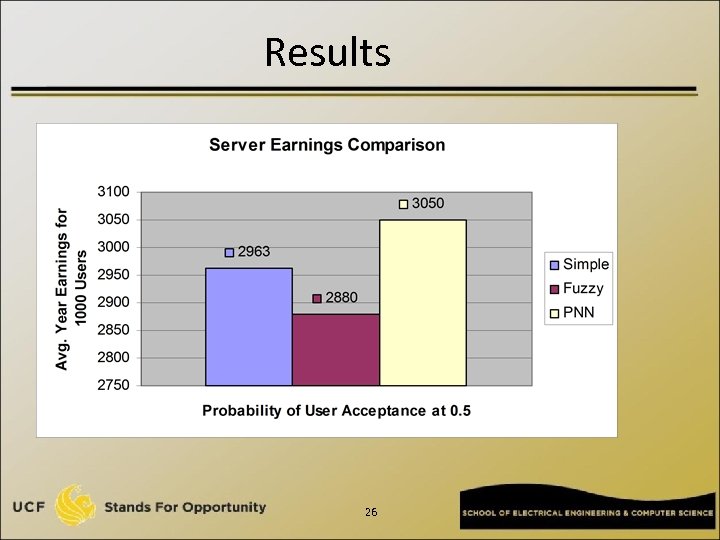
Results 26
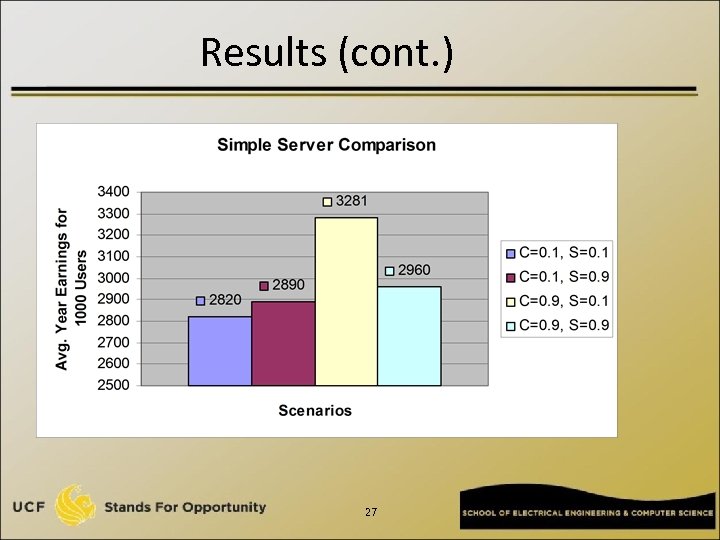
Results (cont. ) 27
Agenda • • • Problem statement Challenges Design Evaluation Conclusions 28
Observations • The ideal case it’s an easy to convince user with a good negotiator server • PNN its reliable for the server side since it considers the whole history • Fuzzy logic did not performed well for the server because sets are static and don’t have memory – Maybe using adaptation processes like genetic algorithms to adjust the sets could improve this • Negotiation of gas prices can help users to spend less money while servers gain some 29
Future Work • Add some intelligence to the user side (e. g. Fuzzy Logic) • Give more analysis to the client’s side • Extend our studies with other real scenarios (e. g. include vacation time, seasonal routes, etc. ) 30
References • • An introduction to multiagent systems, Wooldridge, 2009 Wiley Automated negotiations: A survey of the state of the , Beam, C. and Segev, A, Wirtschaftsinformatik, v 39, n 3, pg 263— 268, 1997 Multiagent systems, Sycara, K. P. } AI magazine, v 19, n 2, pages 79 --92, 1998 Bayesian learning in negotiation, Zeng, D. and Sycara, K. , International Journal of Human-Computers Studies, v 48, n 1, pages=125— 141, 1998 31

Questions 32
Скачать презентацию Negotiating the value of gas price By Hector
5efbcd289e007e918991e4f40ce78d91.ppt