


 Скачать презентацию Negligence Kate Astapchik Negligence is the
Negligence.pptx
- Количество слайдов: 7
 Negligence Kate Astapchik
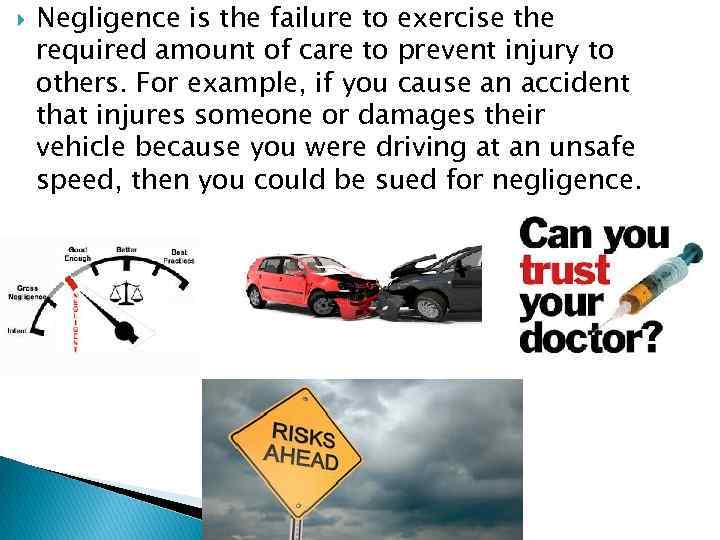 Negligence is the failure to exercise the required amount of care to prevent injury to others. For example, if you cause an accident that injures someone or damages their vehicle because you were driving at an unsafe speed, then you could be sued for negligence.
 Types Gross Negligence – In these cases the negligence was so careless it showed a complete lack of concern for the safety of others. Gross negligence is a much more serious form of negligence that goes a step further than simple careless action. Example: Hospital staff does not change a surgery patient’s bandages for several days, resulting in a serious infection.
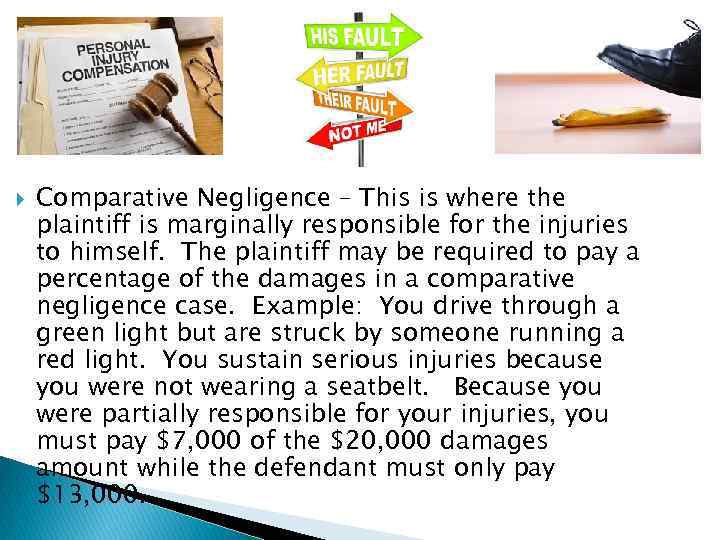 Comparative Negligence – This is where the plaintiff is marginally responsible for the injuries to himself. The plaintiff may be required to pay a percentage of the damages in a comparative negligence case. Example: You drive through a green light but are struck by someone running a red light. You sustain serious injuries because you were not wearing a seatbelt. Because you were partially responsible for your injuries, you must pay $7, 000 of the $20, 000 damages amount while the defendant must only pay $13, 000.
 Medical negligence BIRTH INJURY COMPENSATION Birth injury compensation may be awarded where your child suffers any avoidable injury during pregnancy or childbirth due to medical negligence – examples include cerebral palsy and forceps delivery injuries. ORTHOPEDIC CLAIMS Orthopedic claims in relation to medical negligence are most commonly associated with instances of any injury to the patient’s bones, joints, muscles, or ligaments – these injuries could be due to surgery or failure to diagnose and promptly treat the initial injury. FATAL INJURY CLAIMS Fatal injury claims concern the loss of a loved one due to negligence on behalf of a medical professional. BLOOD TRANSFUSION COMPENSATION Blood transfusion compensation may be available if you have received an incorrect blood transfusion, or if you have received blood that was not screened against pathogens such as HIV, Hepatitis B, and Hepatitis C.
 Examles Kim Tutt was getting her jaw x-rayed at the dentist, when they noticed a large lump on the left side of her jaw. After undergoing further examinations, she was told she had 36 months to live. The doctors told her she could possibly get an extra three months if they removed the left side of her chin, right up to her ear, and replaced it with her fibula. Desperate to spend more time with her 10 and 12 year old sons, she underwent the procedure. The lump was removed, and although slightly disfigured, Tutt was grateful to have extra time with her sons. Three months later, she was called to the doctors office, who gave her the good news that she was cancer free. The bad news was that she had in fact never had cancer at all. There had been a mix up in the lab, and Kim Tutt had gone through five surgeries and been left disfigured for nothing.
 Thank you for your attention!