


 Скачать презентацию Neer Nirmal Pariyojana-NNP RWSSP -LIS Welcome Component
757beddf52b66de4ed36aa967b344d66.ppt
- Количество слайдов: 43
 Neer Nirmal Pariyojana-NNP RWSSP -LIS Welcome
 Component: B Infrastructure Development Piped Water Supply Nainital 18 -02 -2015 Vijendra Vikramaditya A K Srivastava
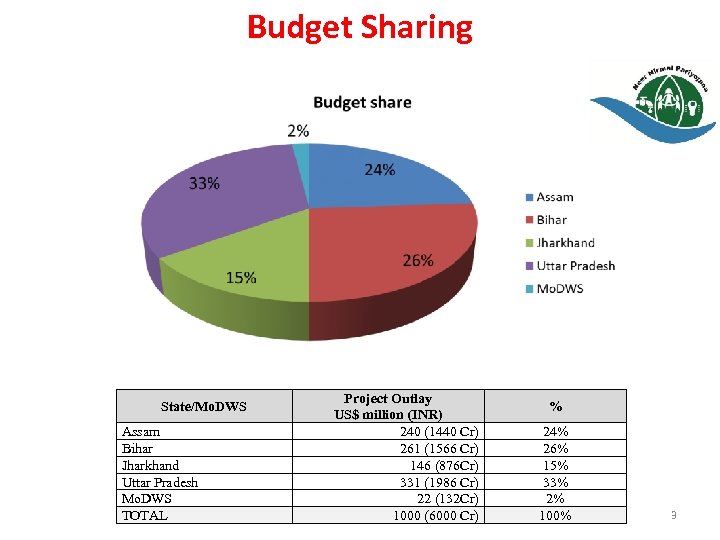 Budget Sharing State/Mo. DWS Assam Bihar Jharkhand Uttar Pradesh Mo. DWS TOTAL Project Outlay US$ million (INR) 240 (1440 Cr) 261 (1566 Cr) 146 (876 Cr) 331 (1986 Cr) 22 (132 Cr) 1000 (6000 Cr) % 24% 26% 15% 33% 2% 100% 3
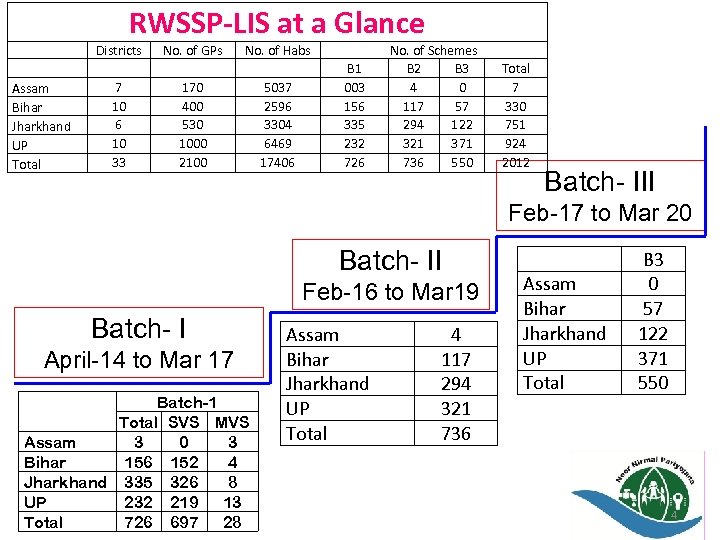 RWSSP-LIS at a Glance Assam Bihar Jharkhand UP Total Districts 7 10 6 10 33 No. of GPs 170 400 530 1000 2100 No. of Habs 5037 2596 3304 6469 17406 B 1 003 156 335 232 726 No. of Schemes B 2 B 3 4 0 117 57 294 122 321 371 736 550 Total 7 330 751 924 2012 Batch- III Feb-17 to Mar 20 Batch- II Feb-16 to Mar 19 Batch- I April-14 to Mar 17 Batch-1 Total SVS MVS Assam 3 0 3 Bihar 156 152 4 Jharkhand 335 326 8 UP 232 219 13 Total 726 697 28 Assam Bihar Jharkhand UP Total 4 117 294 321 736 Assam Bihar Jharkhand UP Total B 3 0 57 122 371 550 4
 Category of PWS Schemes • Single Habitation Schemes (SHS) • Single GP Scheme (SGS)- have more than one habitations but all within the same GP • Small MVS-covering a few GPs (typically 2 -4) • Large MVS- covering many GPs (typically more than 5)
 Components of W S S • SHS/SGS/ Small MVS § Tube Well : Source (Ground Water), § Pumping Plant (Motor and Pump) for Tube Well, • Submersible Pump, V T Pump, etc. § § § Pump House Reservoir, (storage and service) Over Head Tank Pumping (Rising) Main, Distribution system (pipe network), Disinfection with Chlorinator (addition of bleaching powder or Sodium hypo chlorite) solution.
 Components of W S S contd… SHS/SGS/ Small MVS §House connection with saddle, ferrule and 10 m long pipe §Power connection §Electrical Panel, Switch Gear etc. § Allied works such as Duty Room, site development works including Boundary Wall/Fencing, Gate etc. §Fittings in Distribution System such as Fire Hydrant, Sluice/Air/Scour valves with chambers. §Automation [Simple SCADA (optional)-SMVS] §Bulk water meter
 Components of W S S (contd. . ) • Large Multi Village Water Supply Schemes (LMVS): • Source: Surface water (River/Canal/lake), {some times Ground water} • Intake [Well, Barge (floating)] • Water Treatment Plant, • CWR and Pumping station • Over Head Tanks for each GP • Pumping Main, Feeder Main, Distribution Mains (Pipe Network),
 Components of W S S (contd. . ) § Bulk flow meters at each the inlets of GP/ village OHT. § Disinfection by chlorination systems. § LMVS also, House connection with saddle, ferrule , 10 m long pipe and domestic water meter. § Power connection, Power Sub station with transformers, Electrical Panel, Switch Gear etc.
 Components of W S S (contd. . ) § Allied works such as Duty Room, site development works including Boundary Wall/Fencing, Gate etc. § Fittings in Distribution System such as Fire Hydrant, Sluice/Air/Scour valves with chambers. § SCADA § Laboratory § Others
 Design Considerations/Criteria Population Projections: • 2011 Census population considered forecasting population. • Probable year of commissioning of the schemes (Base Year) is 2015, • Prospective year will be 2030. • Design year will be 2045.
 Design Considerations/Criteria(Contd. ) • Ultimate year population will be used for o Design of Intake, o Rising Main, o Distribution system. • Prospective year population will be used for o Design of Water Treatment Plant (WTP), o Storage o Pumping Plants.
 Design Considerations/Criteria(Contd. ) • All water supply schemes (SHS/SGS and MVS) will be designed for a service level of 70 lpcd and with 100 % Household connections. • All SHS/SGS will be only Ground Water based. • Stand-by pumps may be provided • As far as feasible Dedicated Power Supply be preferred for LMVS.
 Design Considerations/Criteria(Contd. ) • Pumping hours for SHS/SGS will be 816 hours and 16 -20 hours for MVS and WTP. • Solar power will be provided wherever power is not available or is unreliable. • Over Head Tank capacity will be provided with minimum of 8 hours and maximum of 12 hours based on the mass curve.
 Design Considerations/Criteria(Contd. ) • Pipe Network System shall ensure water supply to all households. o Pipe network will be designed for supply of 6 hours with peak factor of 4 for SHS/SGS and 8 -24 hrs supply with peak factor of 3 for MVS. o Terminal pressures of 7 meters at Household. o Minimum size of distribution system of 63 mm
 Design Considerations/Criteria(Contd. ) • House connections to all households. • No public taps • SCADA will be provided for LMVS to better optimum functioning of the system. • Solar power may be provided wherever power is not available or is unreliable • Rising Mains with DI K-7 or K-9 depending on head/pressure in pipe line;
 Design Considerations/Criteria(Contd. ) • Distribution system with PE 100 (HDPE), PVC pipes class 6 Kg/Cm 2 where appropriate. GI pipes can be used in rocky strata. – Type of valves: (a) Non Return valves (b) BF Valves; (c) Air Valves: • DI – K 7 for all pipe connections in OHT.
 Design Considerations/Criteria(Contd. ) • The following to be considered wherever WTP is required: – Clarifloculators; – Rapid sand filters; – Clear Water Reservoir with Pumping station; – Chemical dosing: – Manometers for loss of head; – Operation of valves – Back wash arrangement;
 Components Design Criteria (Contd. ) • Mechanical Turbine flow type bulk water meters may be provided with 5 years guarantee for measurement of flow at entry to each storage/ service Reservoir. • Environmental/Eco-friendly RO plants for quality problems may be provided except Arsenic and Fluoride removal. • Gaseous chlorinators may be provided for LMVS ensuring the supply chain.
 Detailed Project Report (DPR) • Compilation of above components size determination and their cost is DPR
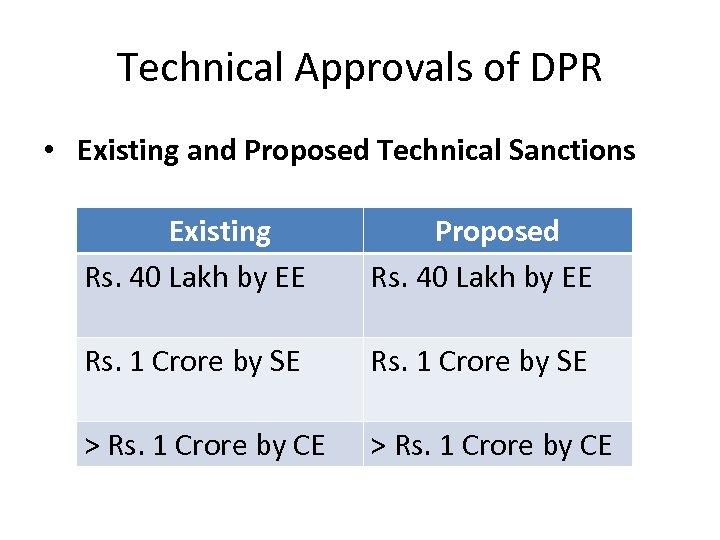 Technical Approvals of DPR • Existing and Proposed Technical Sanctions Existing Rs. 40 Lakh by EE Proposed Rs. 40 Lakh by EE Rs. 1 Crore by SE > Rs. 1 Crore by CE
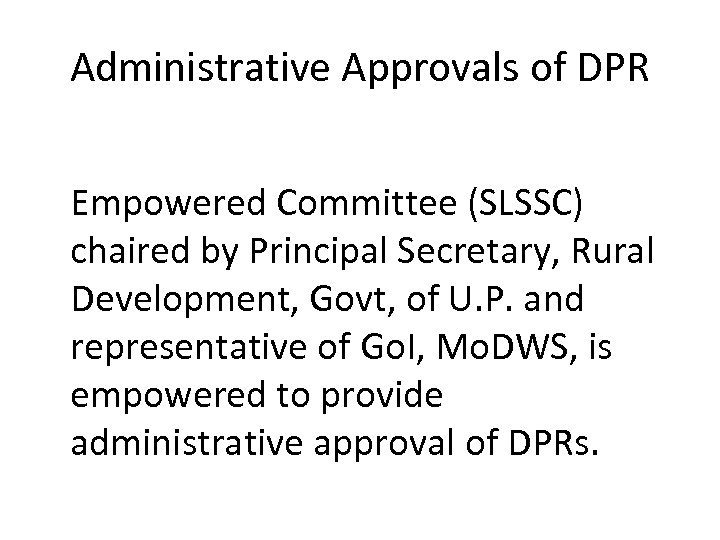 Administrative Approvals of DPR Empowered Committee (SLSSC) chaired by Principal Secretary, Rural Development, Govt, of U. P. and representative of Go. I, Mo. DWS, is empowered to provide administrative approval of DPRs.
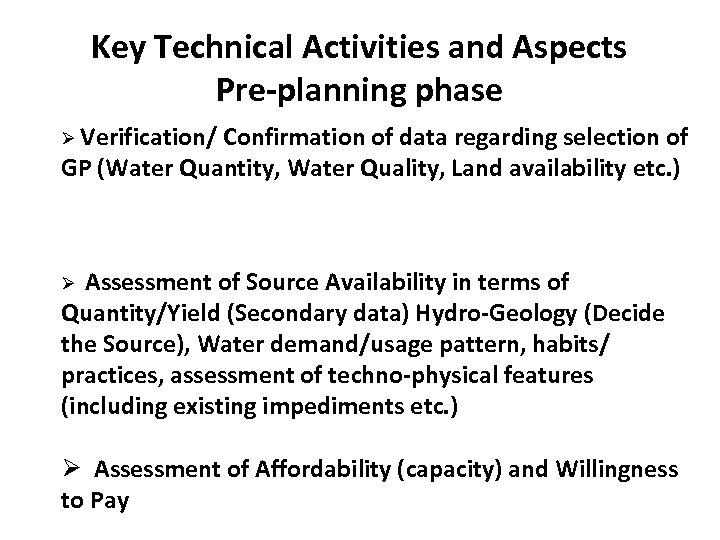 Key Technical Activities and Aspects Pre-planning phase Ø Verification/ Confirmation of data regarding selection of GP (Water Quantity, Water Quality, Land availability etc. ) Assessment of Source Availability in terms of Quantity/Yield (Secondary data) Hydro-Geology (Decide the Source), Water demand/usage pattern, habits/ practices, assessment of techno-physical features (including existing impediments etc. ) Ø Ø Assessment of Affordability (capacity) and Willingness to Pay 23
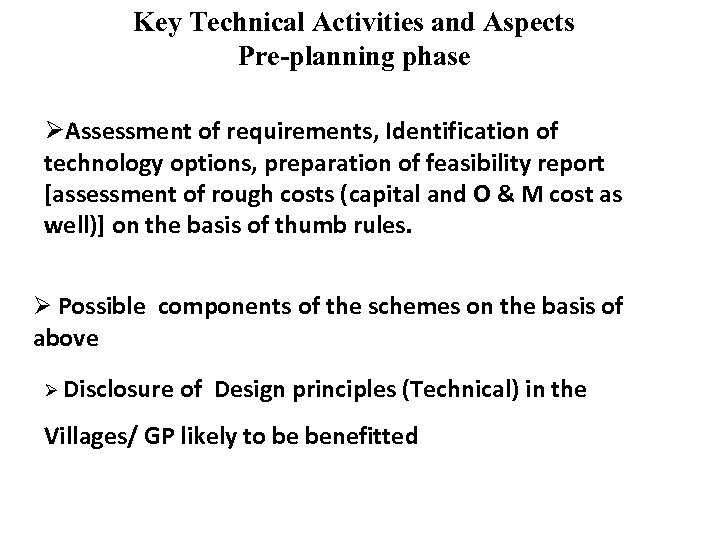 Key Technical Activities and Aspects Pre-planning phase ØAssessment of requirements, Identification of technology options, preparation of feasibility report [assessment of rough costs (capital and O & M cost as well)] on the basis of thumb rules. Ø Possible components of the schemes on the basis of above Ø Disclosure of Design principles (Technical) in the Villages/ GP likely to be benefitted 24
 Key Activities and Technical Aspects Planning Phase Ø Mobilization of communities, and Trainings on community development for GP/GPWSC members. Collection of Primary data and Detailed Survey (TSS, correlation to GPS data) etc. In case of small Schemes (less than Rs. 62 lacs) consideration of relaxation in Total Station Survey Ø Preparation of Water Security and Safety Plan for the GP (with inputs from overall Water Security Plans for the Block/ District (Guidelines of Mo. DWS) Ø 25
 Key Technical Activities and Aspects Planning Phase Disclosure of water security plan details within the GP Ø Preparation of SHS/SGS plans by GPWSC (with support from SO/Engineers)- preliminary designs and estimates (and specifically including coverage for all section of population including the SC/ ST/ vulnerable/ marginalised ) Ø Ø Gram Sabha Resolution approving the scheme technology and estimates (for SHS/ SGS) and give go ahead for Water Schemes 26
 KEY TECHNICAL ACTIVITIES AND ASPECTS Ø Submission of brief proposals by GP to DWSC/SPMU PLANNING PHASE for technical and administrative approval as per delegation of powers Ø Preparation of detailed technical designs of all components and detailed cost estimates with technical specifications (lump sum provisions be avoided) for Detailed Project Report. Realistic assessment of O & M costs be done 27
 Key Technical Activities and Aspects Planning Phase Ø Submission for Technical Sanction Ø Receipt of Technical Sanction of SHS/SGS Bid document: Scope of work with technical specifications and detailed Bo. Q with complete technical specification and reference relevant BIS /NBC - Defect Liability Period – preferably 12 months. - Liquidated damages clause for delay, performance, environmental and social safeguard. Ø 28
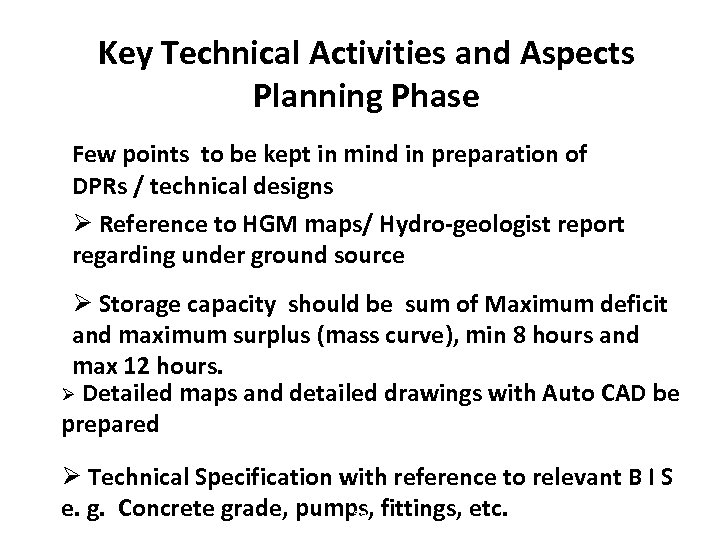 Key Technical Activities and Aspects Planning Phase Few points to be kept in mind in preparation of DPRs / technical designs Ø Reference to HGM maps/ Hydro-geologist report regarding under ground source Ø Storage capacity should be sum of Maximum deficit and maximum surplus (mass curve), min 8 hours and max 12 hours. Ø Detailed maps and detailed drawings with Auto CAD be prepared Ø Technical Specification with reference to relevant B I S e. g. Concrete grade, pumps, fittings, etc. 29
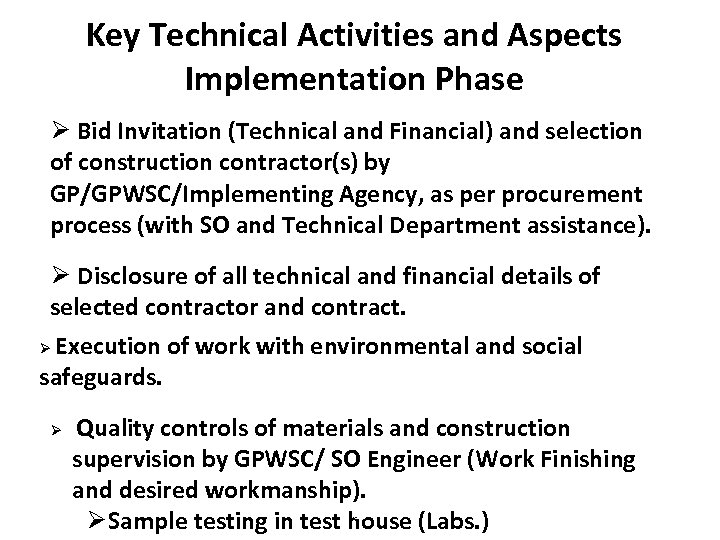 Key Technical Activities and Aspects Implementation Phase Ø Bid Invitation (Technical and Financial) and selection of construction contractor(s) by GP/GPWSC/Implementing Agency, as per procurement process (with SO and Technical Department assistance). Ø Disclosure of all technical and financial details of selected contractor and contract. Ø Execution of work with environmental and social safeguards. Ø Quality controls of materials and construction supervision by GPWSC/ SO Engineer (Work Finishing and desired workmanship). 30 Ø Sample testing in test house (Labs. )
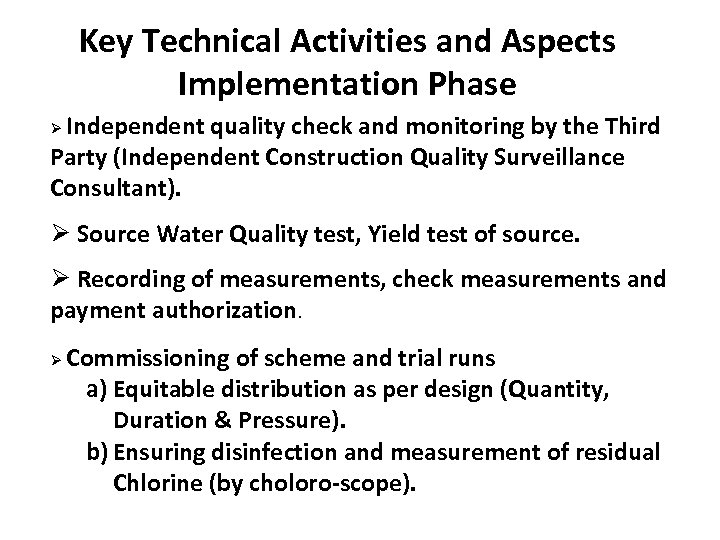 Key Technical Activities and Aspects Implementation Phase Independent quality check and monitoring by the Third Party (Independent Construction Quality Surveillance Consultant). Ø Ø Source Water Quality test, Yield test of source. Ø Recording of measurements, check measurements and payment authorization. Ø Commissioning of scheme and trial runs a) Equitable distribution as per design (Quantity, Duration & Pressure). b) Ensuring disinfection and measurement of residual Chlorine (by choloro-scope). 31
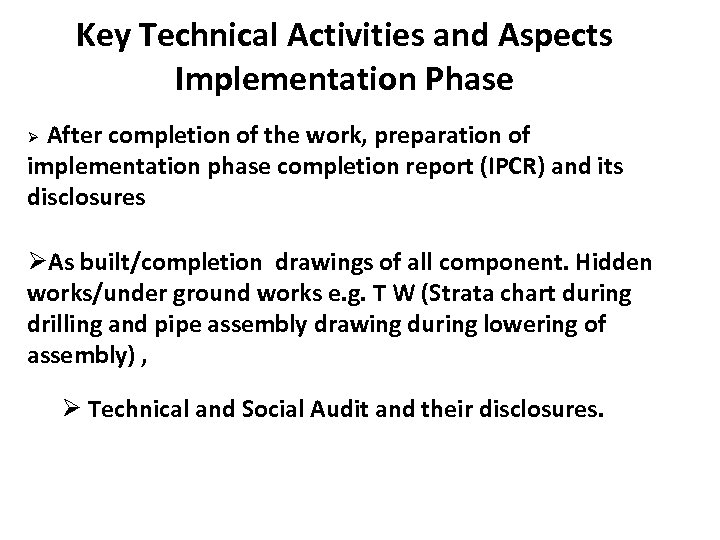 Key Technical Activities and Aspects Implementation Phase After completion of the work, preparation of implementation phase completion report (IPCR) and its disclosures Ø ØAs built/completion drawings of all component. Hidden works/under ground works e. g. T W (Strata chart during drilling and pipe assembly drawing during lowering of assembly) , Ø Technical and Social Audit and their disclosures. 32
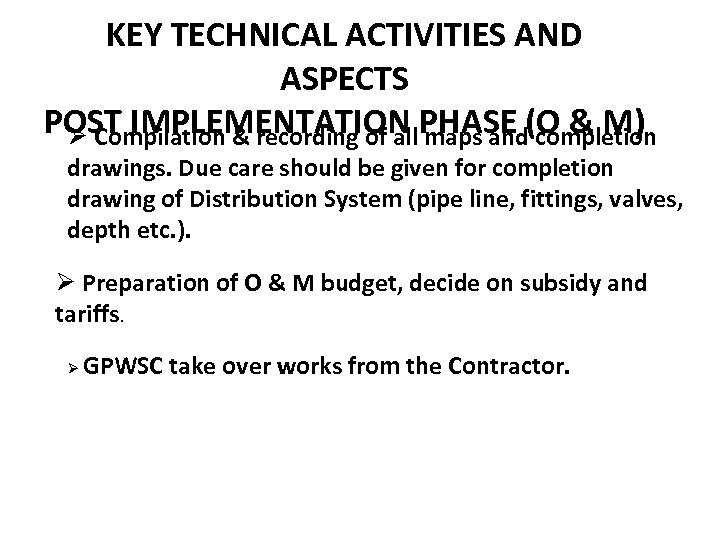 KEY TECHNICAL ACTIVITIES AND ASPECTS POST IMPLEMENTATION PHASE (O & M) Ø Compilation & recording of all maps and completion drawings. Due care should be given for completion drawing of Distribution System (pipe line, fittings, valves, depth etc. ). Ø Preparation of O & M budget, decide on subsidy and tariffs. Ø GPWSC take over works from the Contractor. 33
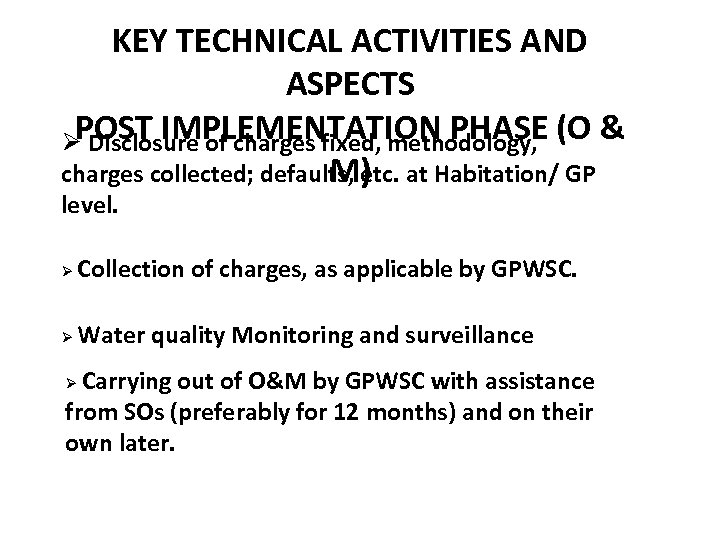 KEY TECHNICAL ACTIVITIES AND ASPECTS POST IMPLEMENTATION PHASE Ø Disclosure of charges fixed, methodology, (O & charges collected; defaults, etc. at Habitation/ GP M) level. Ø Collection of charges, as applicable by GPWSC. Ø Water quality Monitoring and surveillance Carrying out of O&M by GPWSC with assistance from SOs (preferably for 12 months) and on their own later. Ø 34
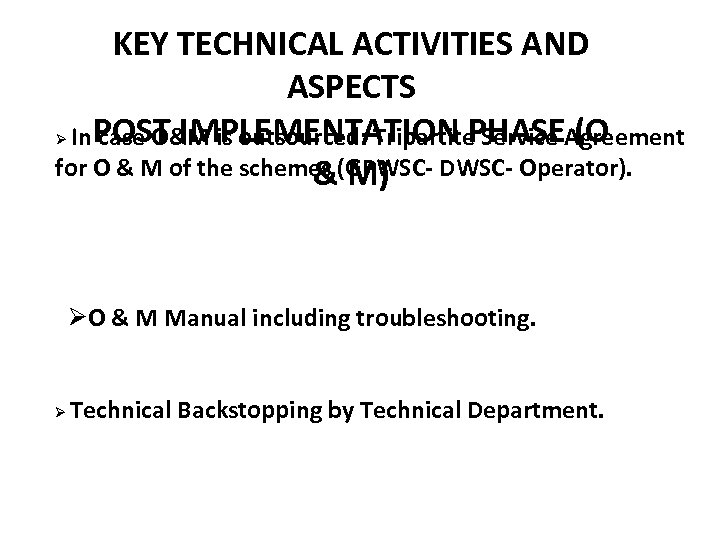 KEY TECHNICAL ACTIVITIES AND ASPECTS Ø In. POST IMPLEMENTATION PHASEAgreement case O&M is outsourced: Tripartite Service (O for O & M of the schemes (GPWSC- DWSC- Operator). & M) ØO & M Manual including troubleshooting. Ø Technical Backstopping by Technical Department. 35
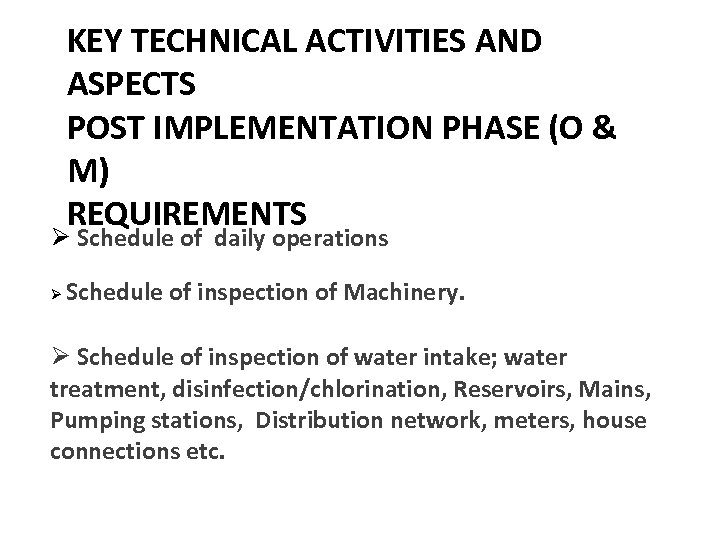 KEY TECHNICAL ACTIVITIES AND ASPECTS POST IMPLEMENTATION PHASE (O & M) REQUIREMENTS Ø Schedule of daily operations Ø Schedule of inspection of Machinery. Ø Schedule of inspection of water intake; water treatment, disinfection/chlorination, Reservoirs, Mains, Pumping stations, Distribution network, meters, house connections etc. 36
 KEY TECHNICAL ACTIVITIES AND ASPECTS POST IMPLEMENTATION PHASE (O & M) Ø Record of Equipments REQUIREMENTS Ø Records of Water quality (raw, Treated and supplied) Ø Records of key activities of Staff Ø Staff charts and working schedule Ø Inventory of stores 37
 O&M activities for Tube-well The O&M activities of the pump operator should include: Operate pump starter Open isolation valve ·Check reading on ammeter is normal – stop pump if electric motor is drawing too much current and report problems Confirm water is being delivered Check for leaks in the rising main Continue to check voltmeter and ammeter readings during the day
 Weekly activities at the w/w should include: § Clean the pump house § Testing water quality using a Field Test Kit § Monthly activities should include: § Billing and collection, and deposit with the GPWSC Annual activities should include: § Remove the pump from the well disconnect the fittings and inspect § Check pipe threads and re-cut corroded or damaged threads § Replace badly corroded pipes, if piping is of MS/GI § Inspect electric cables and check insulation between cables § Record servicing and maintenance in log book § De-silt borehole, if required § Check screen and clear as needed
 Water Conservation Methods Structural Flow Control Devices Metering Recycling Operational (Leak Detection) Unaccounted-for Water (UFW) [ net water production less Legitimate consumption, metered or not Bulk Water metering- Metered consumption Unmetered consumptions, unmetered public consumptions E. g. fire fighting, public toilets, street / markets cleaning, etc.
 Contd…. . Financial Method for water conservation and leak detection Tariff setting Based on affordability and willingness Telescopic Flat rate per tap Based on different usage Social-legal Public education and awareness Water use restriction Horticulture
 Cont…. . • Kitchen Gardening, Irrigation (Agricultural Use) • Washing of vehicles • Bathing of Buffaloes, Cows, etc. • Very high rate or penalties for excessive use/consumption – Building Codes • Plumbing • Materials to be used • Flow control devices (ferrules)
 Thank you for your patience listening