


 Скачать презентацию Néel people involved in NIKA Researchers Engineers Technicians Alain
169cc3e20d729dd5e5327e58139a9ff9.ppt
- Количество слайдов: 19
 Néel people involved in NIKA Researchers: Engineers/Technicians: Alain Benoit Aurelien Bideaud Philippe Camus Xavier Desert (LAOG) Christian Hoffmann Alessandro Monfardini Markus Roesch (IRAM Ph. D) Loren Swenson Gregory Garde (mechanics) Julien Minet (FPGA) Henri Rodenas (cryogenics) Coming soon (Ph. D): A. Cruciani (now at Roma) 1
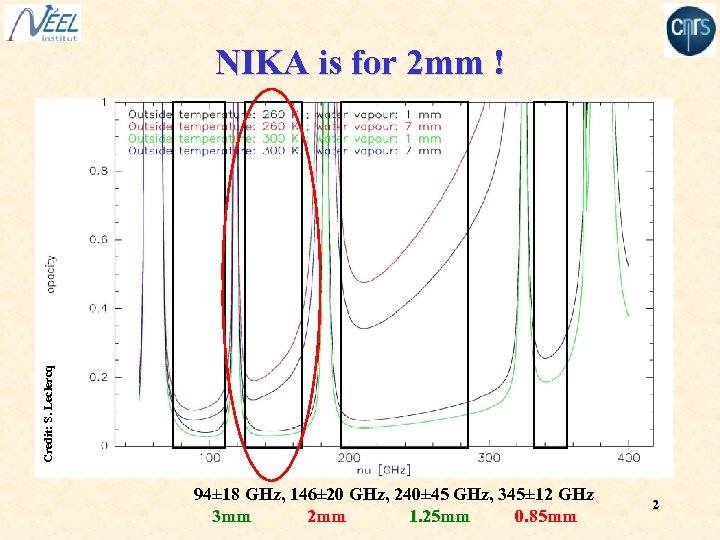 Credit: S. Leclercq NIKA is for 2 mm ! 94± 18 GHz, 146± 20 GHz, 240± 45 GHz, 345± 12 GHz 3 mm 2 mm 1. 25 mm 0. 85 mm 2
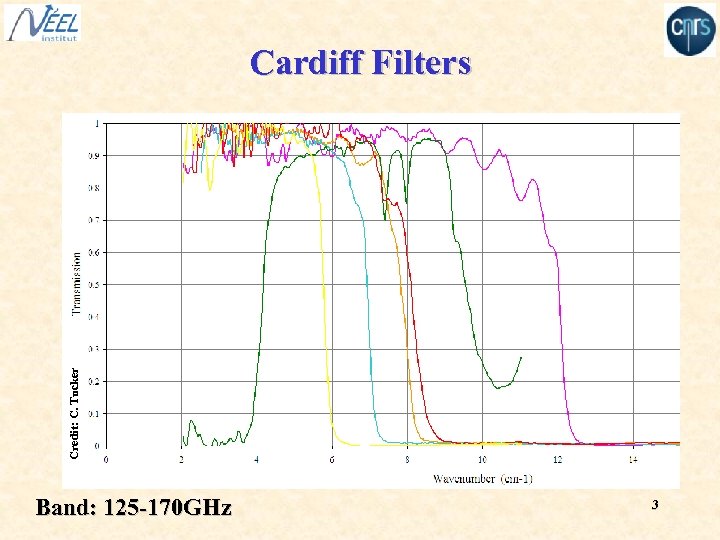 Credit: C. Tucker Cardiff Filters Band: 125 -170 GHz 3
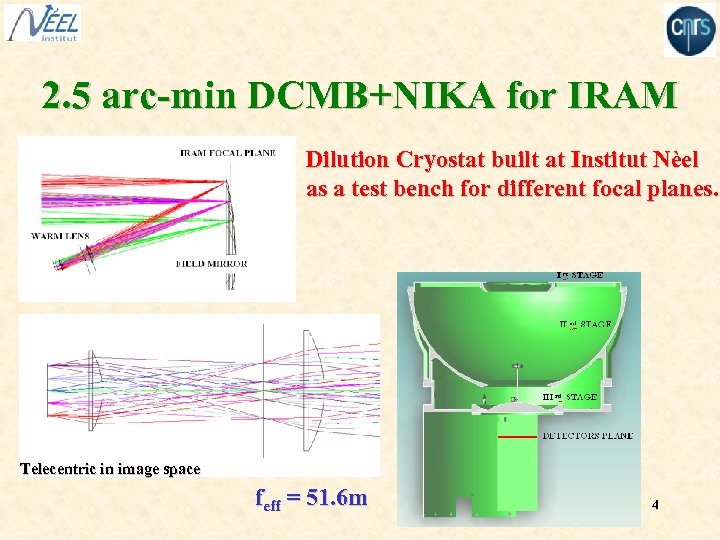 2. 5 arc-min DCMB+NIKA for IRAM Dilution Cryostat built at Institut Nèel as a test bench for different focal planes. Telecentric in image space feff = 51. 6 m 4
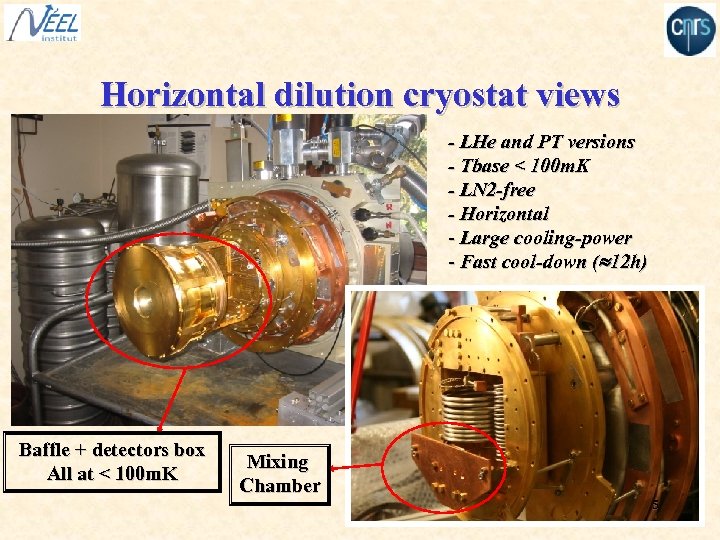 Horizontal dilution cryostat views - LHe and PT versions - Tbase < 100 m. K - LN 2 -free - Horizontal - Large cooling-power - Fast cool-down ( 12 h) Baffle + detectors box All at < 100 m. K Mixing Chamber 5
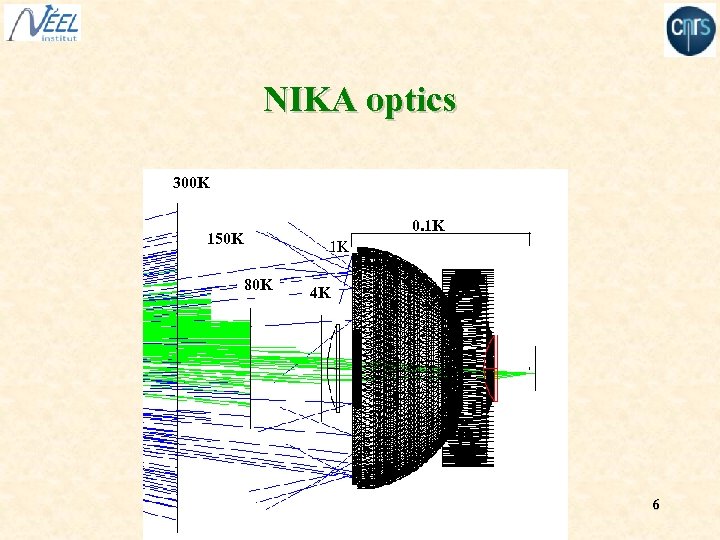 NIKA optics 300 K 0. 1 K 150 K 1 K 80 K 4 K 6
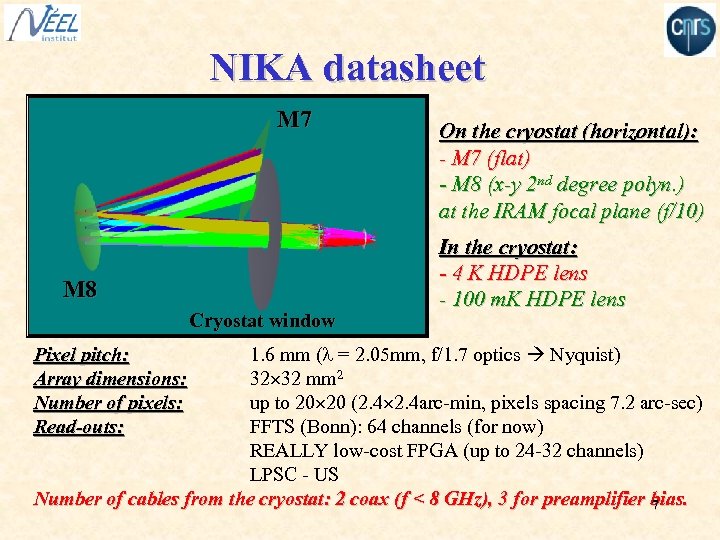 NIKA datasheet M 7 M 8 Cryostat window On the cryostat (horizontal): - M 7 (flat) - M 8 (x-y 2 nd degree polyn. ) at the IRAM focal plane (f/10) In the cryostat: - 4 K HDPE lens - 100 m. K HDPE lens 1. 6 mm ( = 2. 05 mm, f/1. 7 optics Nyquist) 32 32 mm 2 up to 20 20 (2. 4 arc-min, pixels spacing 7. 2 arc-sec) FFTS (Bonn): 64 channels (for now) REALLY low-cost FPGA (up to 24 -32 channels) LPSC - US Number of cables from the cryostat: 2 coax (f < 8 GHz), 3 for preamplifier bias. 7 Pixel pitch: Array dimensions: Number of pixels: Read-outs:
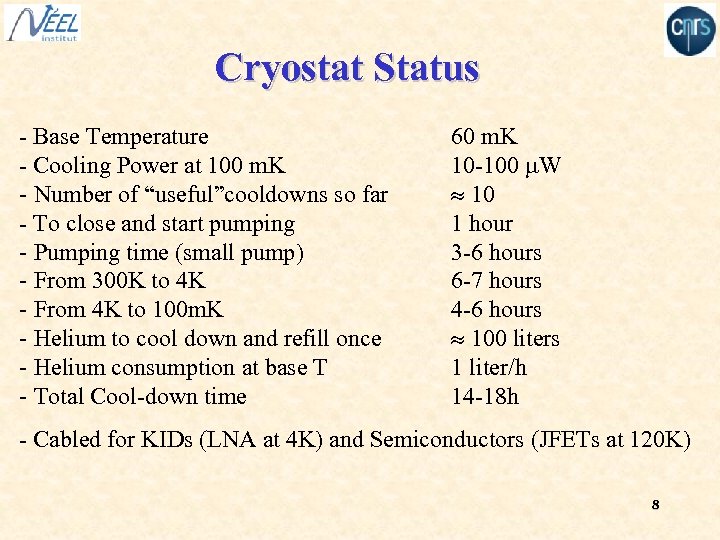 Cryostat Status - Base Temperature - Cooling Power at 100 m. K - Number of “useful”cooldowns so far - To close and start pumping - Pumping time (small pump) - From 300 K to 4 K - From 4 K to 100 m. K - Helium to cool down and refill once - Helium consumption at base T - Total Cool-down time 60 m. K 10 -100 W 10 1 hour 3 -6 hours 6 -7 hours 4 -6 hours 100 liters 1 liter/h 14 -18 h - Cabled for KIDs (LNA at 4 K) and Semiconductors (JFETs at 120 K) 8
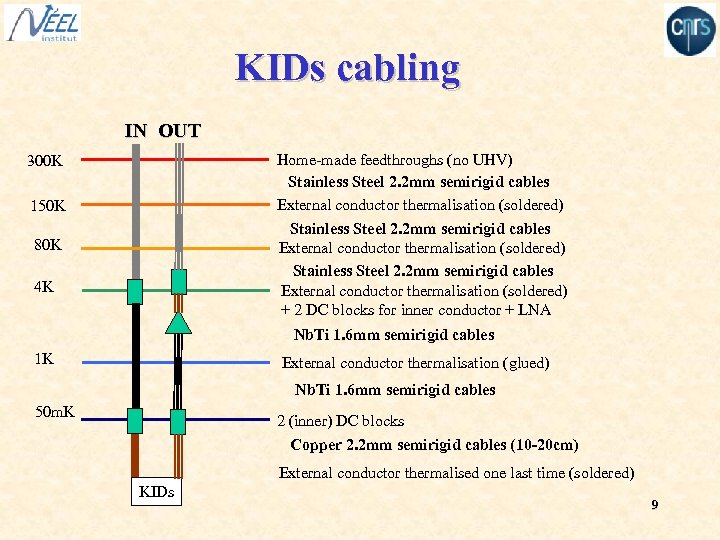 KIDs cabling IN OUT Home-made feedthroughs (no UHV) Stainless Steel 2. 2 mm semirigid cables External conductor thermalisation (soldered) + 2 DC blocks for inner conductor + LNA 300 K 150 K 80 K 4 K Nb. Ti 1. 6 mm semirigid cables 1 K External conductor thermalisation (glued) Nb. Ti 1. 6 mm semirigid cables 50 m. K 2 (inner) DC blocks Copper 2. 2 mm semirigid cables (10 -20 cm) External conductor thermalised one last time (soldered) KIDs 9
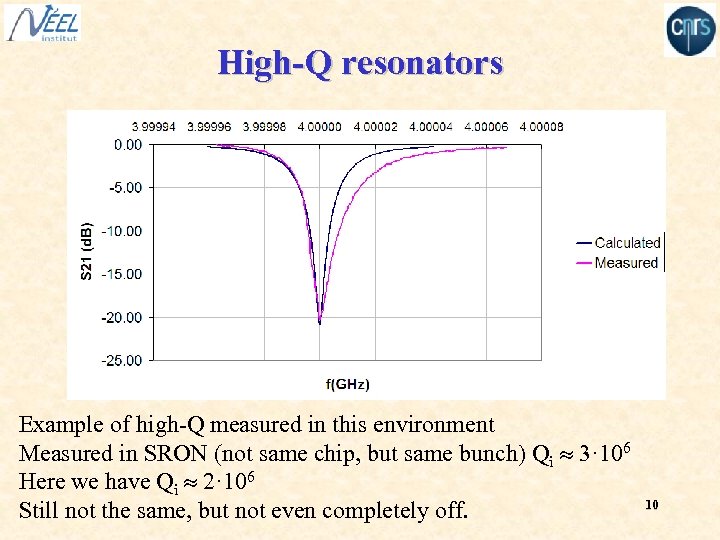 High-Q resonators Example of high-Q measured in this environment Measured in SRON (not same chip, but same bunch) Qi 3· 106 Here we have Qi 2· 106 Still not the same, but not even completely off. 10
 Something to discuss ? Waiting for the real filters …. Everything to be measured again. With the old DIABOLO filters + a single layer 2 -mm passband mesh we estimate the following. From a well-known (dark R-T, I-V etc. ) Nb. Si antenna-coupled array: When Tbase= 75 m. K we see that: - if 77 K at cryostat input Tbolos= 95 m. K - if 300 K at cryostat input Tbolos= 110 m. K P 1=2. 4 p. W P 2=5 p. W In the ideal World P 1 P 2/4=1. 25 p. W. So we have a kind of plateau of 1 -1. 2 p. W (absorbed !) that remain somewhat unexplained. But: 1) The 77 K ECOSORB was a bit smaller than the window 2) In any case the 300 K HDPE window is emitting Let see with the new filters… 11
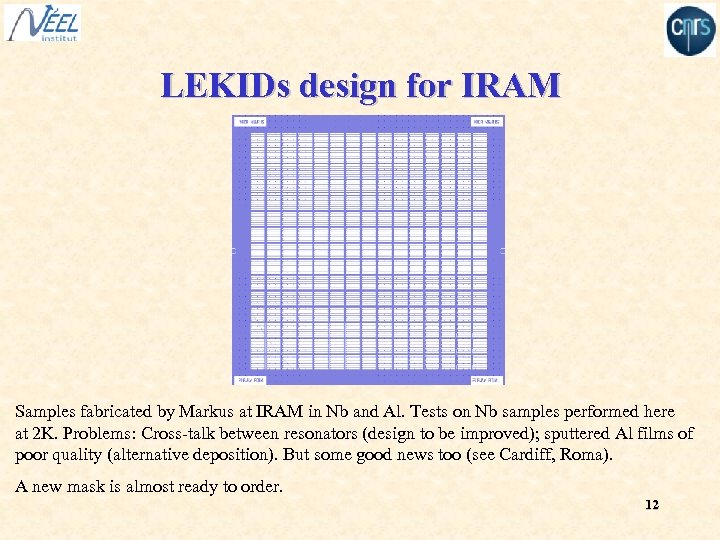 LEKIDs design for IRAM Samples fabricated by Markus at IRAM in Nb and Al. Tests on Nb samples performed here at 2 K. Problems: Cross-talk between resonators (design to be improved); sputtered Al films of poor quality (alternative deposition). But some good news too (see Cardiff, Roma). A new mask is almost ready to order. 12
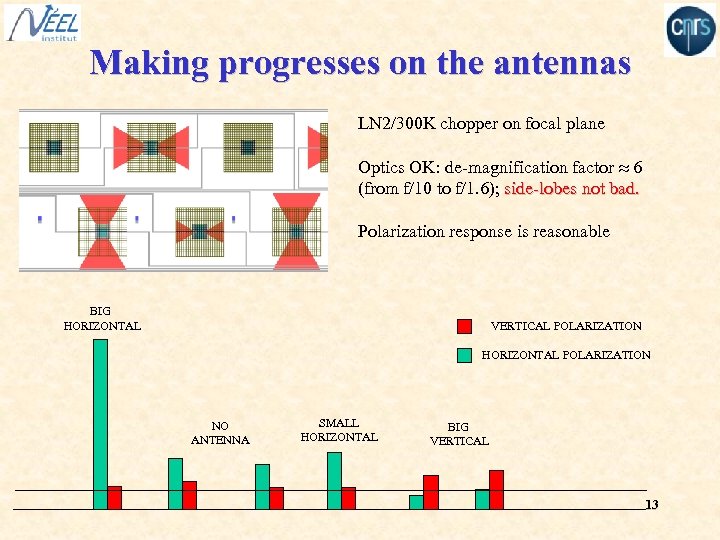 Making progresses on the antennas LN 2/300 K chopper on focal plane Optics OK: de-magnification factor 6 (from f/10 to f/1. 6); side-lobes not bad. Polarization response is reasonable BIG HORIZONTAL VERTICAL POLARIZATION HORIZONTAL POLARIZATION NO ANTENNA SMALL HORIZONTAL BIG VERTICAL 13
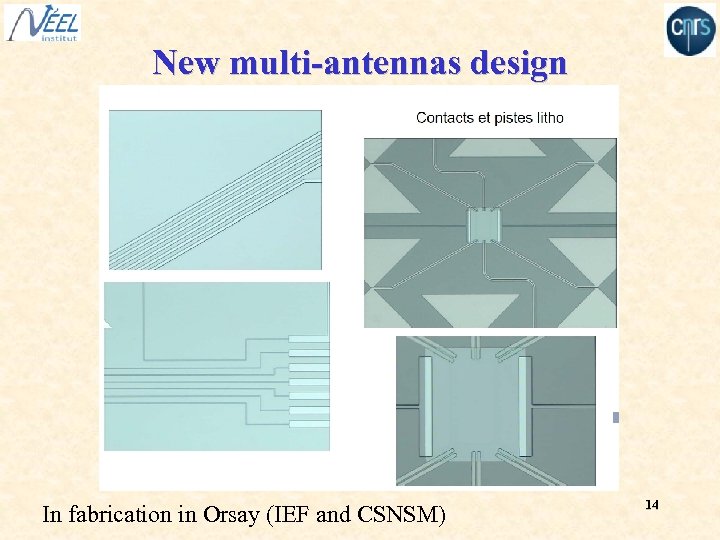 New multi-antennas design In fabrication in Orsay (IEF and CSNSM) 14
 Electronics for NIKA 15
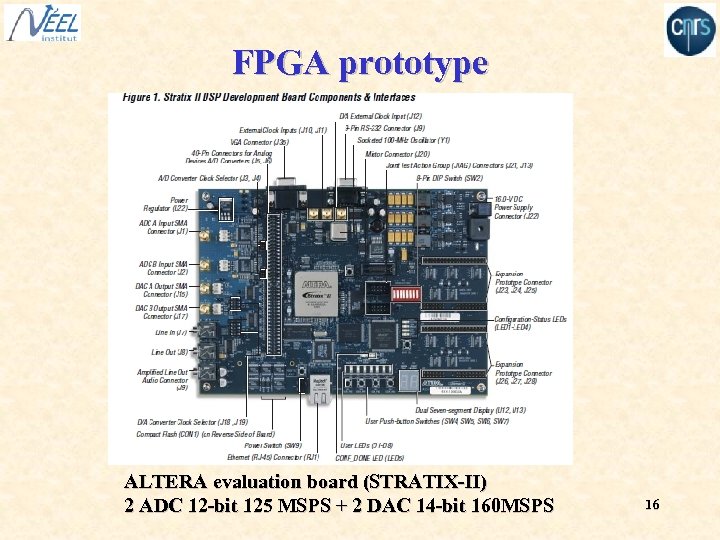 FPGA prototype ALTERA evaluation board (STRATIX-II) 2 ADC 12 -bit 125 MSPS + 2 DAC 14 -bit 160 MSPS 16
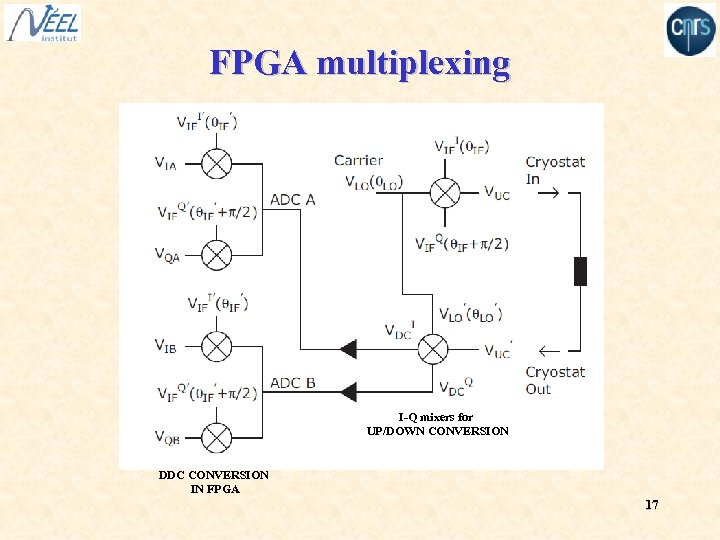 FPGA multiplexing I-Q mixers for UP/DOWN CONVERSION DDC CONVERSION IN FPGA 17
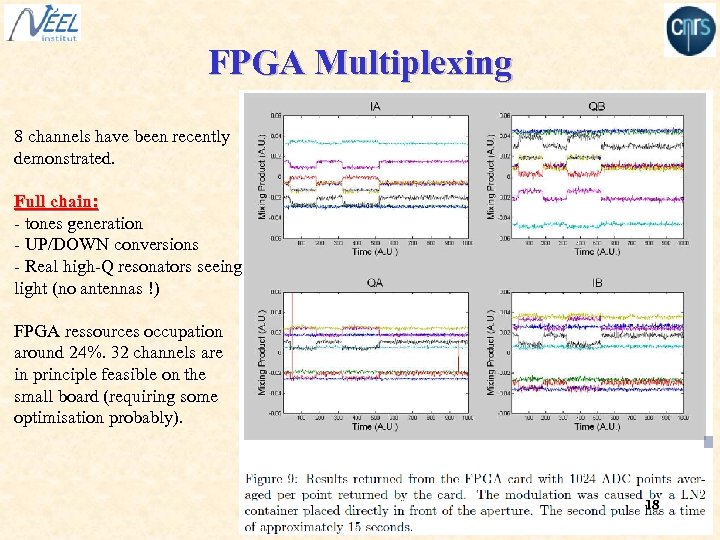 FPGA Multiplexing 8 channels have been recently demonstrated. Full chain: - tones generation - UP/DOWN conversions - Real high-Q resonators seeing light (no antennas !) FPGA ressources occupation around 24%. 32 channels are in principle feasible on the small board (requiring some optimisation probably). 18
 Plans for MUX readout - Bonn FFTS board + new DAC board of course. 64 -128 channels are ALREADY feasible. But not available yet in Grenoble for testing and interfacing with the acquisition software. Problem should be fixed in the next month. - Our small FPGA board should be OK for up to 24 channels at least. Using it also for other resonators applications. - A similar (but 400 MHz and bigger FPGA) custom board is under development at LPSC Grenoble. Will work for 64 -128 channels. Fully Grenoble designed and realised in-house, so potentially allows to be adapted for any new application we might imagine in the future (and open to hardware improvements). - IRAM is participating to the Mazin Open Source project for developing a 128 channels module. Expected in Autumn 2009. 19