 Скачать презентацию NEEDS SMETE ORG and Educational Digital Libraries Brandon
ba2554053f22c8b0fa4bf6a316ccd753.ppt
- Количество слайдов: 30



NEEDS, SMETE. ORG and Educational Digital Libraries Brandon Muramatsu NEEDS/SMETE at UC Berkeley mura@needs. org Originally Published 2003. Republished 2013. This work is licensed under a Creative Commons Attribution. Noncommercial-Share Alike 3. 0 United States License (http: // creativecommons. org/licenses/by-nc-sa/3. 0/us/)
Key Topics • Evolution of NEEDS • “Educational” Digital Libraries Muramatsu 2
NEEDS: A Project of Synthesis
Synthesis Coalition • Reform of undergraduate education – Mechatronics became key focus • 8 Universities across the US • First of many Coalitions (SUCCEED, ECSEL) • Funded by the National Science Foundation 1989 -1998 Muramatsu 4
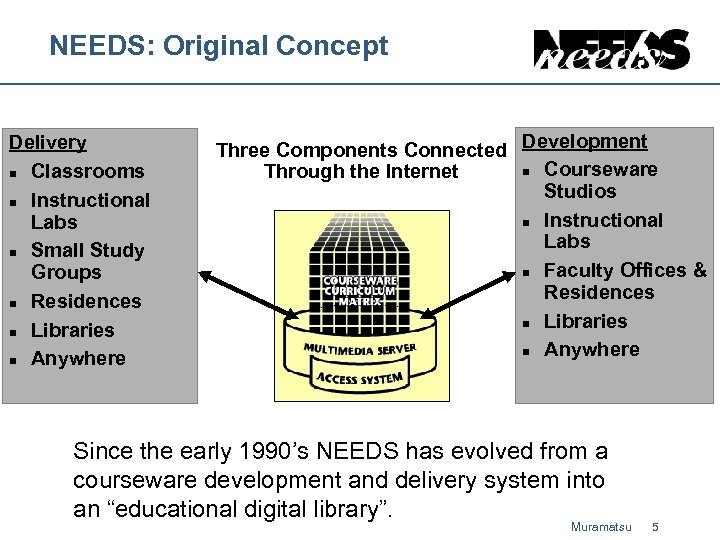
NEEDS: Original Concept Delivery n Classrooms n Instructional Labs n Small Study Groups n Residences n Libraries n Anywhere Three Components Connected Development n Courseware Through the Internet Studios n Instructional Labs n Faculty Offices & Residences n Libraries n Anywhere Since the early 1990’s NEEDS has evolved from a courseware development and delivery system into an “educational digital library”. Muramatsu 5
NEEDS: Circa 1993
NEEDS: Circa 1993 • Primary Audience: – Engineering educators • Systems: – Iowa State OPAC special collection – Gopher and Telnet versions • Metadata and Cataloging: – US MARC, 856 field – Focuses on bibliographic description of the resource • Contents: – Almost exclusively internal to Synthesis Coalition – “Archives” available from NEEDS FTP servers: Mostly relatively small courseware and software (a few hundred KB) – Some multimedia courseware only available on CD-ROM (1 x or 2 x speeds) Muramatsu 7
NEEDS Circa 1997 The World Wide Web Happened…
NEEDS: Circa 1997 • Primary Audience: – Engineering educators • Secondary Audience(s) – Undergraduate engineering students – Expanding to educators and students in Science, mathematics and technology (e. g. , Chemistry, Physics) • Systems: – Web-based access to relational database • Metadata and Cataloging: – Evolved from USMARC bibliographic description – Beginnings of “use” and “context” in Learning Object Metadata • Contents: – Mostly references to external websites – Some historical “archives” (Synthesis) Muramatsu 9
Looking Toward the Future: NEEDS Circa 1997 • Expansion of Cataloging – Physical sciences and mathematics – Tackling problem of everything that’s out there now—trying to help users identify and select those resources • New Services Under Development – – – Display of results User Comments (Amazon. com) “Peer Review” Beginnings of recommender systems “Self-cataloging” A number of others possible… • Using Web technologies, taking cue from what access and systems Web makes possible Muramatsu 10
Issues in Providing Access to Educational Resources • Ever expanding number and scope of resources being developed and made available – Variety of technical and pedagogical formats – Transient nature and half-life of content and technology • Varying definition of “quality” • Parallel efforts in other domains and for other audiences • Increasing clarity of specific needs of endusers – Specifically K-12 Muramatsu 11
Issues in Providing Access to Educational Resources (cont. ) • New expectations from users (for content and services) – Web technologies (& CS/DL research) enables new services • Specific standards and specifications efforts for education initiated – IEEE Learning Technology Standards Committee, IMS Global Learning Consortium, Dublin Core Muramatsu 12
…and now for something different… SMETE. ORG …and “Educational” Digital Libraries
From NEEDS to SMETE How did we get from NEEDS to SMETE? • NSF and National Research Council examine a digital library for undergraduate science education from 1996 -1998 – New funding under Special Emphasis in DLI 2 and now NSDL programs • NEEDS already beginning to expand into physical sciences and mathematics in cataloging • NEEDS as a technology-base through which we can extend to other disciplines Muramatsu 14
Background on Our Efforts • To build a successful National STEM Education Digital Library … – We focus on science, mathematics, engineering and technology at all levels – And more important, it focuses on education • …we needed to develop a collaborative team… – To overcome the challenges we face in developing a National SMETE Digital Library – To cover target audiences and disciplines – To share in the development efforts Muramatsu 15
Shared Vision • The SMETE Open Federation is committed to providing a service… – to support learning – across disciplines in science, mathematics, engineering and technology – providing access to high-quality resources – in support of education reform and crossdisciplinary learning – from K-12 to higher education to professional development Muramatsu 16
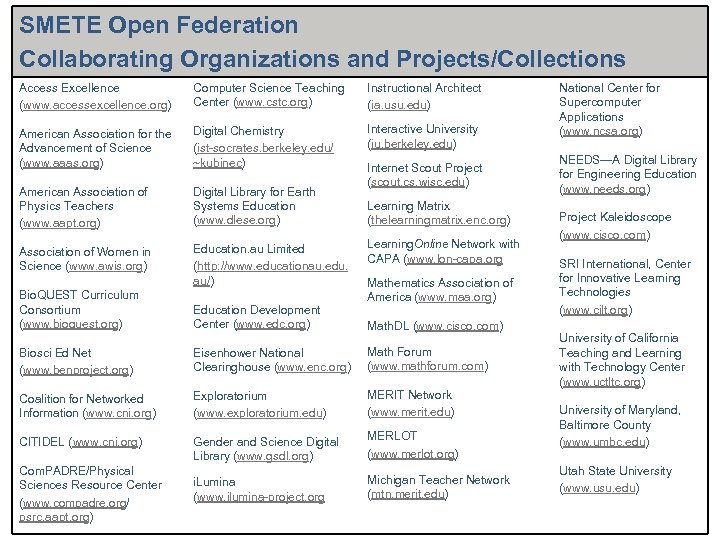
SMETE Open Federation Collaborating Organizations and Projects/Collections Access Excellence (www. accessexcellence. org) Computer Science Teaching Center (www. cstc. org) Instructional Architect (ia. usu. edu) American Association for the Advancement of Science (www. aaas. org) Digital Chemistry (ist-socrates. berkeley. edu/ ~kubinec) Interactive University (iu. berkeley. edu) American Association of Physics Teachers (www. aapt. org) Digital Library for Earth Systems Education (www. dlese. org) Association of Women in Science (www. awis. org) Education. au Limited (http: //www. educationau. edu. au/) Bio. QUEST Curriculum Consortium (www. bioquest. org) Education Development Center (www. edc. org) Internet Scout Project (scout. cs. wisc. edu) Learning Matrix (thelearningmatrix. enc. org) Learning. Online Network with CAPA (www. lon-capa. org Mathematics Association of America (www. maa. org) Math. DL (www. cisco. com) Biosci Ed Net (www. benproject. org) Eisenhower National Clearinghouse (www. enc. org) Math Forum (www. mathforum. com) Coalition for Networked Information (www. cni. org) Exploratorium (www. exploratorium. edu) MERIT Network (www. merit. edu) CITIDEL (www. cni. org) Gender and Science Digital Library (www. gsdl. org) MERLOT (www. merlot. org) i. Lumina (www. ilumina-project. org Michigan Teacher Network (mtn. merit. edu) Com. PADRE/Physical Sciences Resource Center (www. compadre. org/ psrc. aapt. org) National Center for Supercomputer Applications (www. ncsa. org) NEEDS—A Digital Library for Engineering Education (www. needs. org) Project Kaleidoscope (www. cisco. com) SRI International, Center for Innovative Learning Technologies (www. cilt. org) University of California Teaching and Learning with Technology Center (www. uctltc. org) University of Maryland, Baltimore County (www. umbc. edu) Utah State University (www. usu. edu)
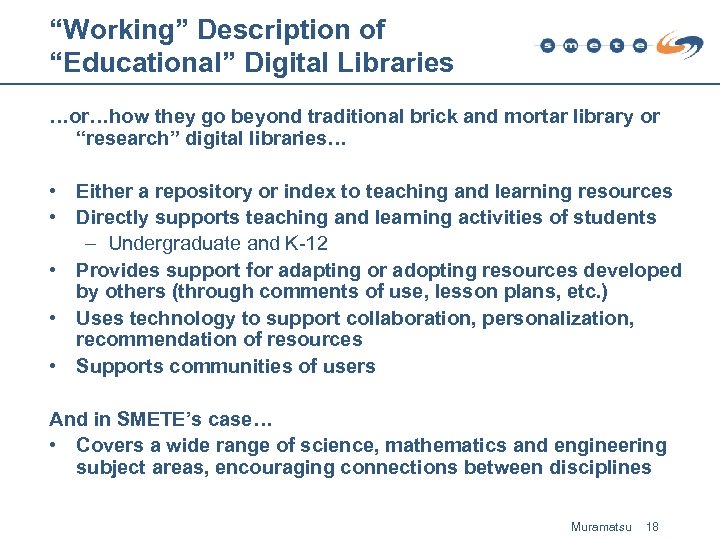
“Working” Description of “Educational” Digital Libraries …or…how they go beyond traditional brick and mortar library or “research” digital libraries… • Either a repository or index to teaching and learning resources • Directly supports teaching and learning activities of students – Undergraduate and K-12 • Provides support for adapting or adopting resources developed by others (through comments of use, lesson plans, etc. ) • Uses technology to support collaboration, personalization, recommendation of resources • Supports communities of users And in SMETE’s case… • Covers a wide range of science, mathematics and engineering subject areas, encouraging connections between disciplines Muramatsu 18
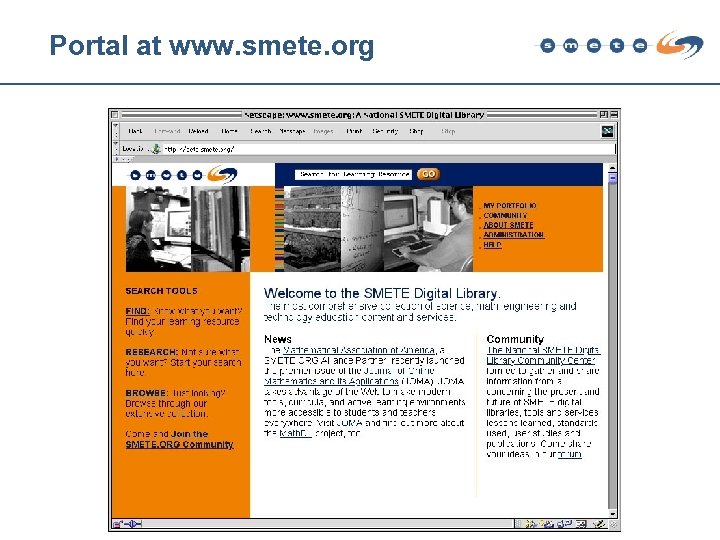
Portal at www. smete. org
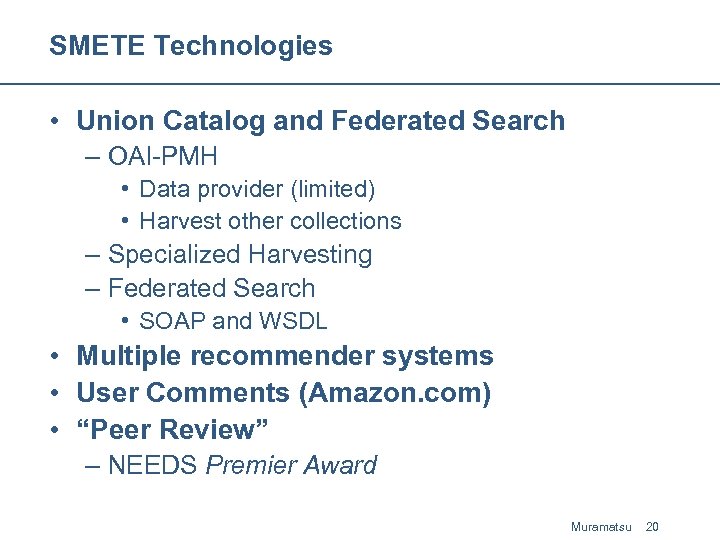
SMETE Technologies • Union Catalog and Federated Search – OAI-PMH • Data provider (limited) • Harvest other collections – Specialized Harvesting – Federated Search • SOAP and WSDL • Multiple recommender systems • User Comments (Amazon. com) • “Peer Review” – NEEDS Premier Award Muramatsu 20
SMETE and NEEDS: Today
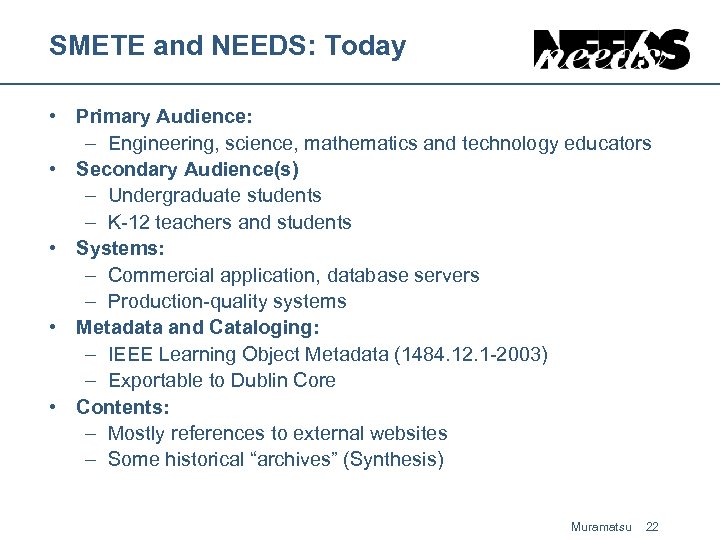
SMETE and NEEDS: Today • Primary Audience: – Engineering, science, mathematics and technology educators • Secondary Audience(s) – Undergraduate students – K-12 teachers and students • Systems: – Commercial application, database servers – Production-quality systems • Metadata and Cataloging: – IEEE Learning Object Metadata (1484. 12. 1 -2003) – Exportable to Dublin Core • Contents: – Mostly references to external websites – Some historical “archives” (Synthesis) Muramatsu 22
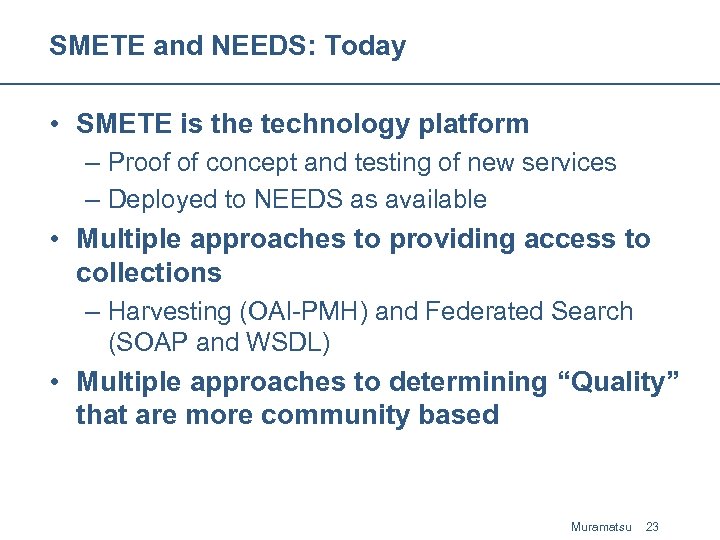
SMETE and NEEDS: Today • SMETE is the technology platform – Proof of concept and testing of new services – Deployed to NEEDS as available • Multiple approaches to providing access to collections – Harvesting (OAI-PMH) and Federated Search (SOAP and WSDL) • Multiple approaches to determining “Quality” that are more community based Muramatsu 23
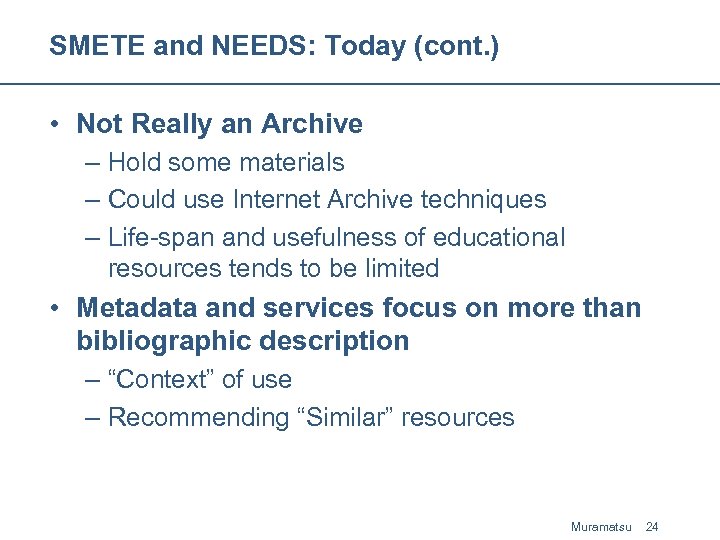
SMETE and NEEDS: Today (cont. ) • Not Really an Archive – Hold some materials – Could use Internet Archive techniques – Life-span and usefulness of educational resources tends to be limited • Metadata and services focus on more than bibliographic description – “Context” of use – Recommending “Similar” resources Muramatsu 24
Lessons Learned • Transitions – There will be a lot of change, evolving standards and specifications • Collaboration necessary – One group can’t do it all – Recognize strengths and history of partners, build upon those strengths • Build upon strengths of partners – While SMETE. ORG can be a portal, it doesn’t try to be the be all, end all Muramatsu 25
Lessons Learned (cont. ) • Community and social aspects as important, if not more important, as technical aspects • Focus on unique qualities of work – Key recommendation to other “Educational Digital Libraries” and collections – Track work of others Muramatsu 26
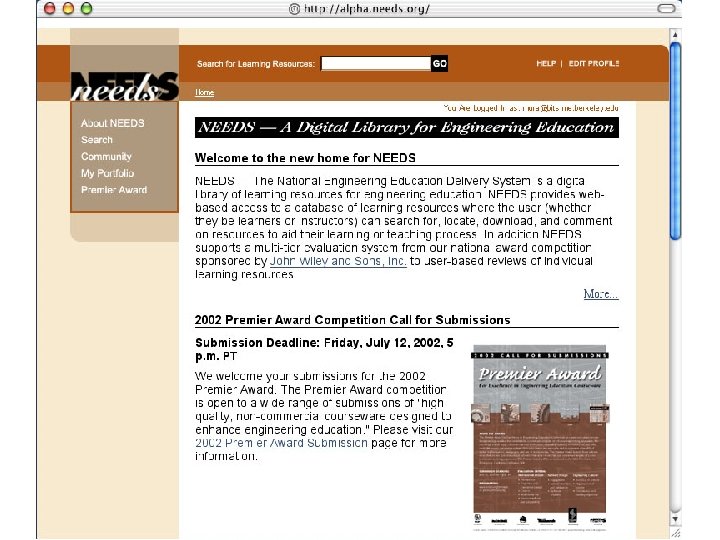
Homepage
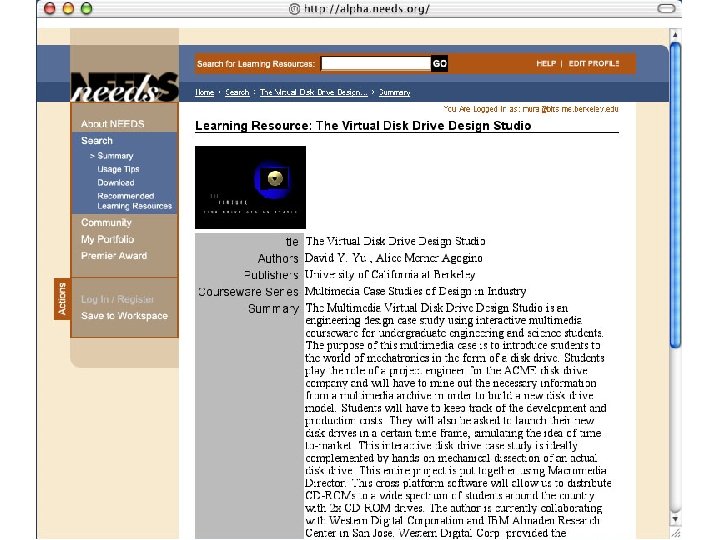
Details
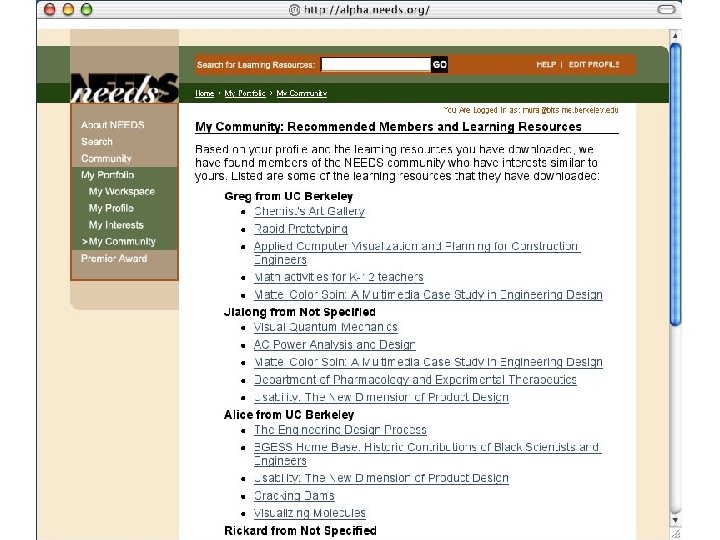
Recommendations
Contact Info Brandon Muramatsu Project Director mura@needs. org mura@smete. org NEEDS/SMETE University of California, Berkeley 3115 Etcheverry Hall Berkeley, CA 94720 -1750 USA (510) 643 -1817 Muramatsu 30
Скачать презентацию NEEDS SMETE ORG and Educational Digital Libraries Brandon
ba2554053f22c8b0fa4bf6a316ccd753.ppt