


 Скачать презентацию Need for Rulemaking Harmonization Supporting the Future
475723b54ebf0d24b7215bfc035e6b04.ppt
- Количество слайдов: 21
 Need for Rulemaking Harmonization – Supporting the Future Global Air Transport System EASA/FAA Annual Conference, St Petersburg, Florida, 4 th June 2008 European Airlines’ View and a Perspective from IATA Vincent De Vroey General Manager Technical & Operations Association of European Airlines (AEA) Peter Sørensen Assistant Director Safety, Operations & Infrastructure International Air Transport Association (IATA)
 Overview ì AEA Harmonization Priorities § ATM § Maintenance § Operations § Flight crew training ì IATA Perspective § Personnel licensing 2008 US/Europe International Aviation Safety Conference, St Petersburg, Florida, 4 th June 20082
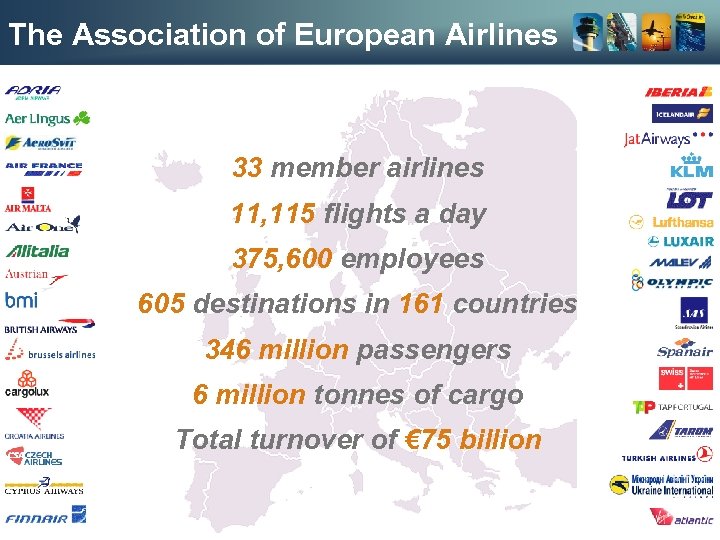 The Association of European Airlines 33 member airlines 11, 115 flights a day 375, 600 employees 605 destinations in 161 countries 346 million passengers 6 million tonnes of cargo Total turnover of € 75 billion 2008 US/Europe International Aviation Safety Conference, St Petersburg, Florida, 4 th June 20083
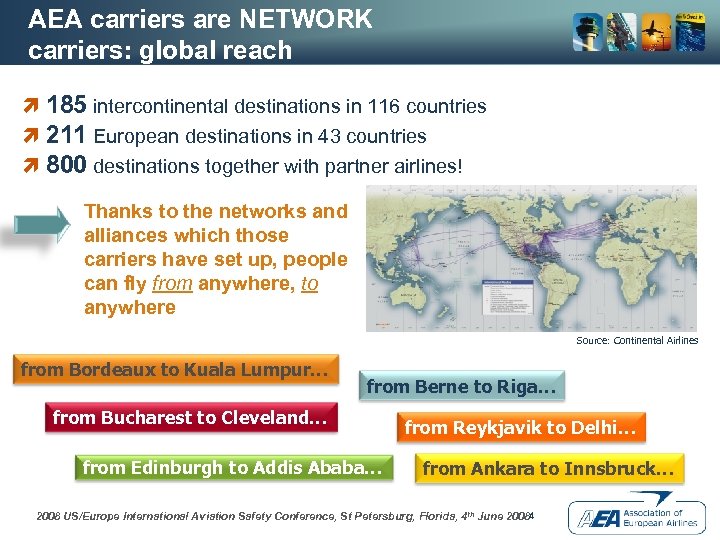 AEA carriers are NETWORK carriers: global reach ì 185 intercontinental destinations in 116 countries ì 211 European destinations in 43 countries ì 800 destinations together with partner airlines! Thanks to the networks and alliances which those carriers have set up, people can fly from anywhere, to anywhere Source: Continental Airlines from Bordeaux to Kuala Lumpur… from Berne to Riga… from Bucharest to Cleveland… from Edinburgh to Addis Ababa… from Reykjavik to Delhi… from Ankara to Innsbruck… 2008 US/Europe International Aviation Safety Conference, St Petersburg, Florida, 4 th June 20084
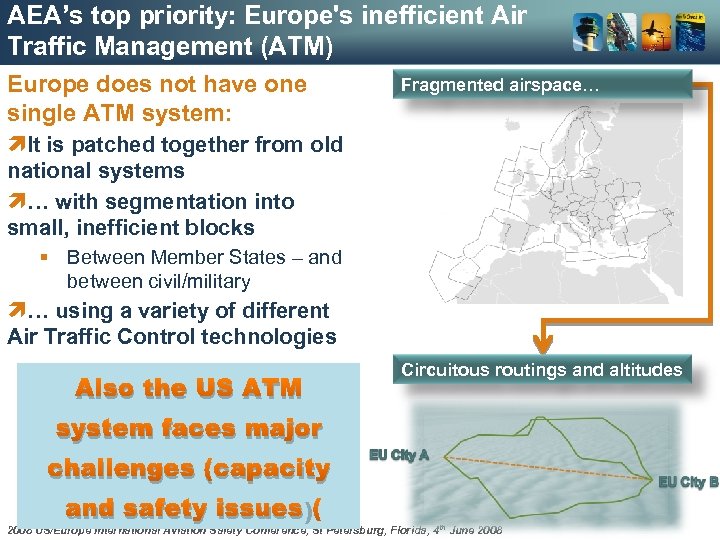 AEA’s top priority: Europe's inefficient Air Traffic Management (ATM) Europe does not have one single ATM system: Fragmented airspace… ìIt is patched together from old national systems ì… with segmentation into small, inefficient blocks § Between Member States – and between civil/military ì… using a variety of different Air Traffic Control technologies Also the US ATM Circuitous routings and altitudes system faces major challenges (capacity and safety issues) 2008 US/Europe International Aviation Safety Conference, St Petersburg, Florida, 5 4 th June 2008
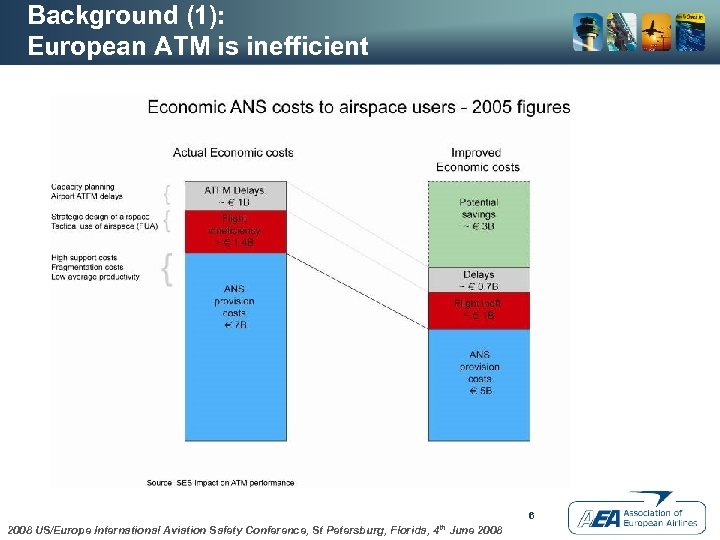 Background (1): European ATM is inefficient 6 2008 US/Europe International Aviation Safety Conference, St Petersburg, Florida, 4 th June 2008
 Background (2): US ATM system faces safety issues ì TCAS RA’s § AEA members flying to the USA have analyzed TCAS RA’s on approach comparing major US airports with European major airports § The rate at some US airports (Newark, LAX, Denver, Philadelphia, SFO) is 100 times the rate at major European airports (LHR, CDG, SPL, FRA etc) ì Compliance with ICAO § Various serious safety incidents linked to the US ATM environment with loss of separation or near collision. In light of the Ueberlingen accident, all TCAS RA’s have to be complied with (ICAO), a modus operandi which is not fully understood in the USA ì US ATM safety issues need to be tackled with urgency 7 2008 US/Europe International Aviation Safety Conference, St Petersburg, Florida, 4 th June 2008
 ATM: implications for rulemaking ì Root of ATM problems in Europe, USA and other areas of the world might not be the same ì However, where it implies rulemaking to mandate for capacity or safety reasons, new systems on the aircraft (avionics) or operational procedures, the AEA members expect: ì Identical technical solutions for similar ATM problems ì Harmonized approach on ATM operational procedures ì Globally valid operational & airworthiness approval for airlines/aircraft (ia datalink, ADS-B, RVSM etc) with approvals issued by the local Authority based on globally harmonized requirements ì Global interoperability in ATM solutions and approvals is essential for globally operating airlines (= cost issue!) ì Harmonized operational procedures are essential for safety 8 2008 US/Europe International Aviation Safety Conference, St Petersburg, Florida, 4 th June 2008
 Maintenance: mutual recognition rather than full harmonization of rules ì Globally recognized Part-145 approvals § Airline MROs expect globally recognized Part-145 approvals which recognize equivalent safety oversight and reduce the number of unnecessary audits or certificates ì Harmonization / Recognition § Full harmonization of the relevant rules is not realistic because of the cost implications or different legal environment (f. e. drug and alcohol testing is illegal in Europe, required in the USA) § Mutual recognition of each other system (based on equivalent safety) might be more realistic (i. e. through BASA) than full harmonization ì This should not prevent new rules to be harmonized where possible and beneficial to the industry 9 2008 US/Europe International Aviation Safety Conference, St Petersburg, Florida, 4 th June 2008
 Operations: harmonizing existing rules would be extremely costly ì Mutual Recognition of AOCs § Global Airlines expect mutual recognition of AOCs rather than the current proliferation of Part 129 requirements which create unnecessary bureaucracy for no added safety value ì Harmonization / Recognition § Full harmonization of existing operational rules for AOC holders (EU-OPS, Part 121) is not needed from the airlines point of view since it would be extremely costly due to the legacy and different legal systems and cultural environment § Operational equipment related requirements for newly build aircraft should be harmonized wherever possible (e. g. FDR/CVR, TCAS etc). § AWO requirements to be harmonized as well § New rules to be harmonized where possible and where there is a value for the airlines 10 2008 US/Europe International Aviation Safety Conference, St Petersburg, Florida, 4 th June 2008
 Flight Crew Training ì Separate business § The Flight Crew Training business is increasingly becoming a separate business competing in the global market ì International trade § Some current rules (FAA) or rulemaking proposals (EASA) are a barrier to international trade § For safety and efficiency reasons, European airlines need access to flight crew training resources around the world i. a in Europe, USA and elsewhere ì Harmonization / Recognition § Different authorities to recognize each other systems’ without imposing additional restrictions or duplicate requirements for personnel licensing or approvals (flight simulators) ì The planned BASAs are an opportunity to solve this problem Aviation Safety Conference, St Petersburg, Florida, 4 June 2008 11 2008 US/Europe International th
 Conclusion ì ATM rules: new systems on the aircraft (avionics) or operational procedures should be harmonized with globally valid approvals (= cost and safety issue), ì Maintenance rules: need mutual recognition of the relevant approvals allowing international trade without barriers and reducing unnecessary audits, ì Operational rules for AOC holders: no need for full harmonization which would be costly and might not be feasible (different cultures etc). Need for mutual recognition of AOCs rather than proliferation of Part 129, ì Flight Crew Training rules: BASA’s should remove current restrictions to international trade 12 2008 US/Europe International Aviation Safety Conference, St Petersburg, Florida, 4 th June 2008
 The challenge of licensed personnel shortages 2008 US/Europe International Aviation Safety Conference, St Petersburg, Florida, 4 th June 2008
 Why Harmonization is Critical for Personnel Licensing ì The aviation industry has realized that there will be a global ì ì ì shortage of engineers, licensed mechanics as well as pilots § e. g. an estimated shortage of 3. 600 pilots annually The aviation industry estimate a fleet growth of 17650 aircraft by 2018 In times of high training demand, training quality is at stake and consequently negative impact on flight safety Variations in training standards worldwide add to the problem Quality level of key personnel must be maintained Risks for delayed aircraft introductions and missed opportunities for growth and ROE 14 2008 US/Europe International Aviation Safety Conference, St Petersburg, Florida, 4 th June 2008 .
 Industry’s Initiative – IATA Training and Qualification Initiative (ITQI) IATA’s initiative to 1) review the airline industry training needs for licensed personnel (pilots, mechanics / engineers) and 2) develop recommendations for meeting these needs with no compromise to safety and quality. 15 2008 US/Europe International Aviation Safety Conference, St Petersburg, Florida, 4 th June 2008
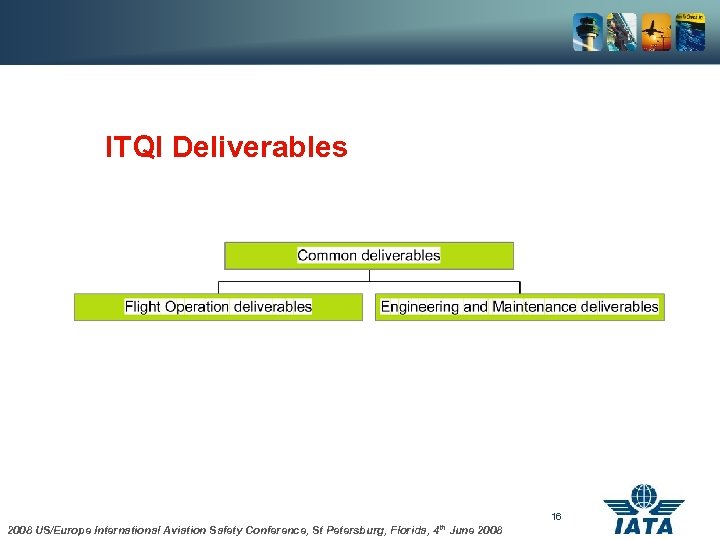 ITQI Deliverables 16 2008 US/Europe International Aviation Safety Conference, St Petersburg, Florida, 4 th June 2008
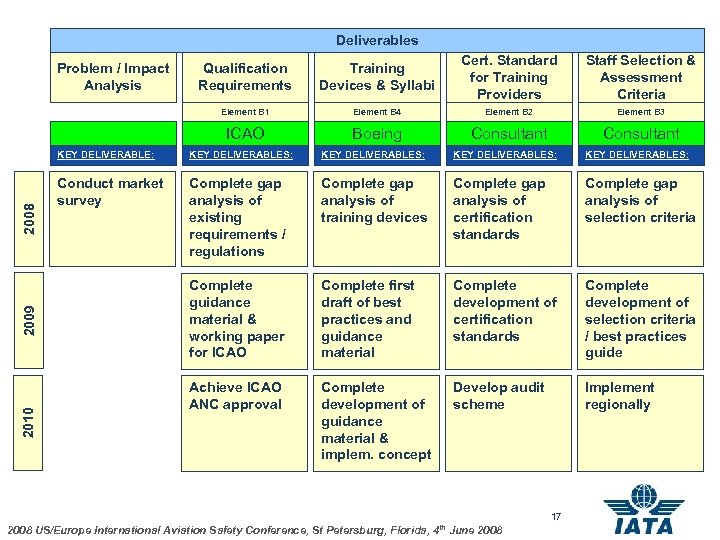 Deliverables Qualification Requirements Training Devices & Syllabi Cert. Standard for Training Providers Staff Selection & Assessment Criteria Element B 1 Element B 4 Element B 2 Element B 3 ICAO Problem / Impact Analysis Boeing Consultant 2010 2009 2008 KEY DELIVERABLE: KEY DELIVERABLES: Conduct market survey Complete gap analysis of existing requirements / regulations Complete gap analysis of training devices Complete gap analysis of certification standards Complete gap analysis of selection criteria Complete guidance material & working paper for ICAO Complete first draft of best practices and guidance material Complete development of certification standards Complete development of selection criteria / best practices guide Achieve ICAO ANC approval Complete development of guidance material & implem. concept Develop audit scheme Implement regionally 17 2008 US/Europe International Aviation Safety Conference, St Petersburg, Florida, 4 th June 2008
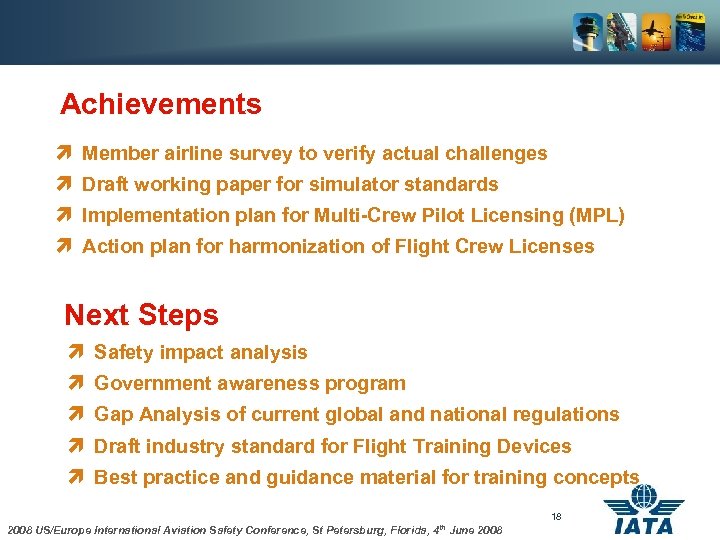 Achievements ì Member airline survey to verify actual challenges ì Draft working paper for simulator standards ì Implementation plan for Multi-Crew Pilot Licensing (MPL) ì Action plan for harmonization of Flight Crew Licenses Next Steps ì Safety impact analysis ì Government awareness program ì Gap Analysis of current global and national regulations ì Draft industry standard for Flight Training Devices ì Best practice and guidance material for training concepts 18 2008 US/Europe International Aviation Safety Conference, St Petersburg, Florida, 4 th June 2008
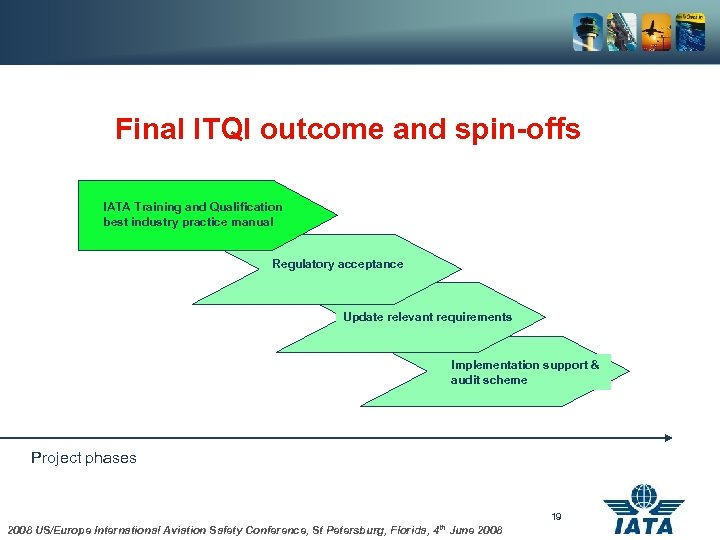 Final ITQI outcome and spin-offs IATA Training and Qualification best industry practice manual Regulatory acceptance Update relevant requirements Implementation support & audit scheme Project phases 19 2008 US/Europe International Aviation Safety Conference, St Petersburg, Florida, 4 th June 2008
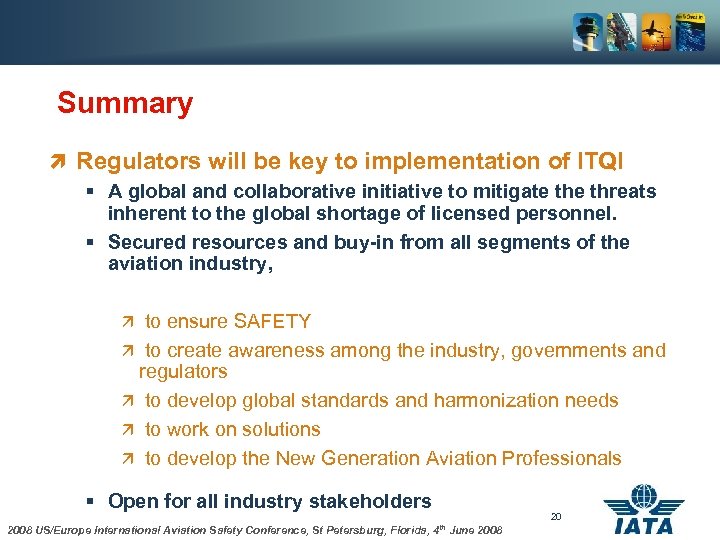 Summary ì Regulators will be key to implementation of ITQI § A global and collaborative initiative to mitigate threats inherent to the global shortage of licensed personnel. § Secured resources and buy-in from all segments of the aviation industry, ä to ensure SAFETY ä to create awareness among the industry, governments and regulators ä to develop global standards and harmonization needs ä to work on solutions ä to develop the New Generation Aviation Professionals § Open for all industry stakeholders 2008 US/Europe International Aviation Safety Conference, St Petersburg, Florida, 20 4 th June 2008
 Industry Stakeholders ì ICAO, FSF, IFALPA, EASA, Transport Canada, CASA, NCAA, ATA, ì JAL, CAL, EVA, SIA, MES, SAS, LH, ANA, Delta, IB, Fedex, AF, SAA, KLM, Qantas, ì Airbus, Boeing, ATR, Embraer, Bombardier ì LFT, LTT, CAE, Alteon, FSEMC ì MSI, Thales 21 2008 US/Europe International Aviation Safety Conference, St Petersburg, Florida, 4 th June 2008