


 Скачать презентацию nd Law of Thermodynamics 2 Lecturer Professor Stephen
8b806bd6325714355929b2483c3e01ca.ppt
- Количество слайдов: 36
 nd Law of Thermodynamics 2 Lecturer: Professor Stephen T. Thornton
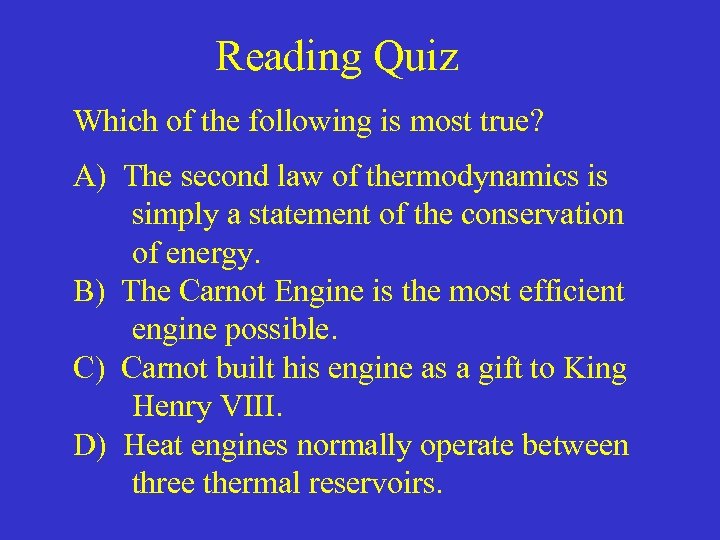 Reading Quiz Which of the following is most true? A) The second law of thermodynamics is simply a statement of the conservation of energy. B) The Carnot Engine is the most efficient engine possible. C) Carnot built his engine as a gift to King Henry VIII. D) Heat engines normally operate between three thermal reservoirs.
 Answer: B The Carnot cycle and Carnot engine is it!
 Last Time Adiabatic expansion Heat transfer Conduction Convection Radiation
 Today Second Law of Thermodynamics Heat engines Carnot cycle and Carnot engine
 If the first law of thermodynamics is about energy conservation, then the 2 nd law is about the way in which energy flows. Examples: A bowl of water sitting in this room does not spontaneously freeze. It is impossible to construct an engine that can extract thermal energy from a system and turn all that energy into work. Thermal systems spontaneously change in only certain ways.
 2 nd Law of Thermodynamics We can discuss this law in a number of ways. The law basically states the way in which heat flow occurs. Heat flow between two objects brought together in thermal contact always goes from the hotter object to the colder object. Lots of ways to say the same thing!
 Heat Engines An engine is a device that converts heat into mechanical work. Engines must operate in cycles in order to be useful. A piston and cylinder must return to original position. The change in internal energy is zero. An engine operates between two thermal reservoirs.
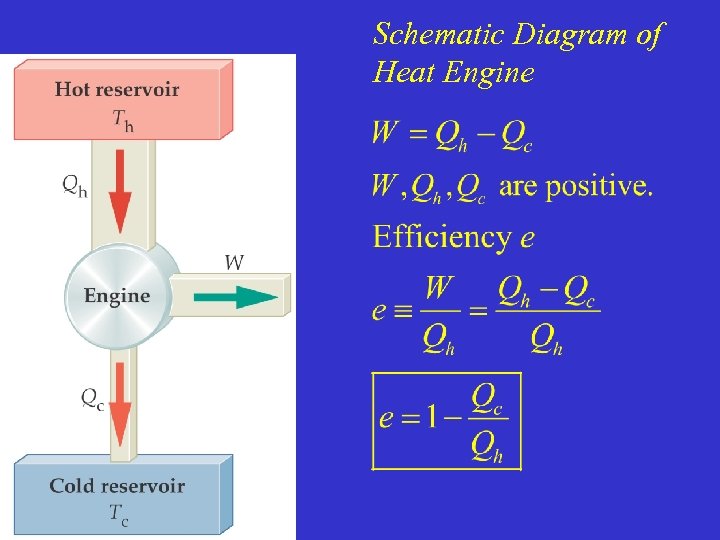 Schematic Diagram of Heat Engine
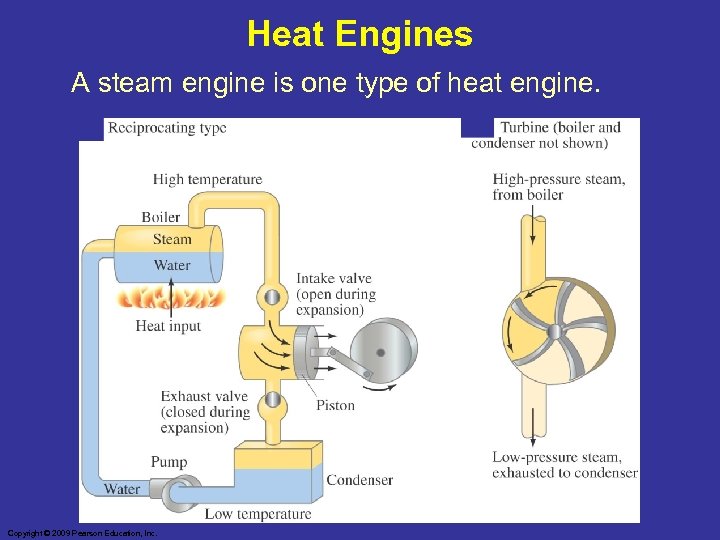 Heat Engines A steam engine is one type of heat engine. Copyright © 2009 Pearson Education, Inc.
 Do demos • Heat engine • Steam engine
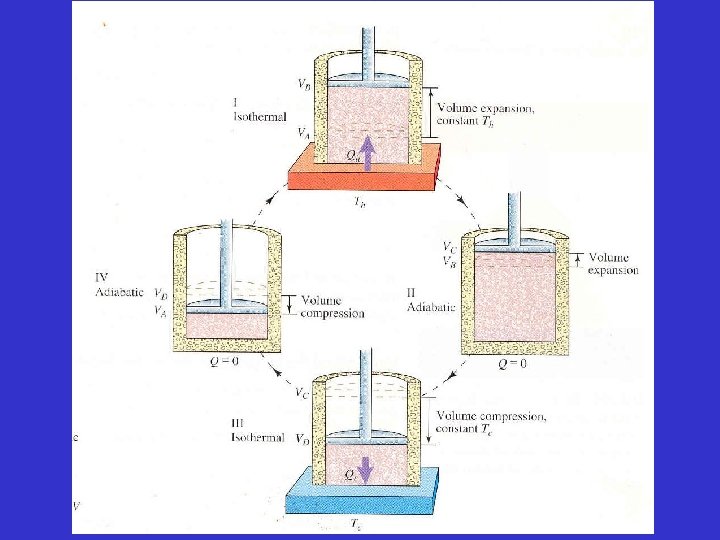
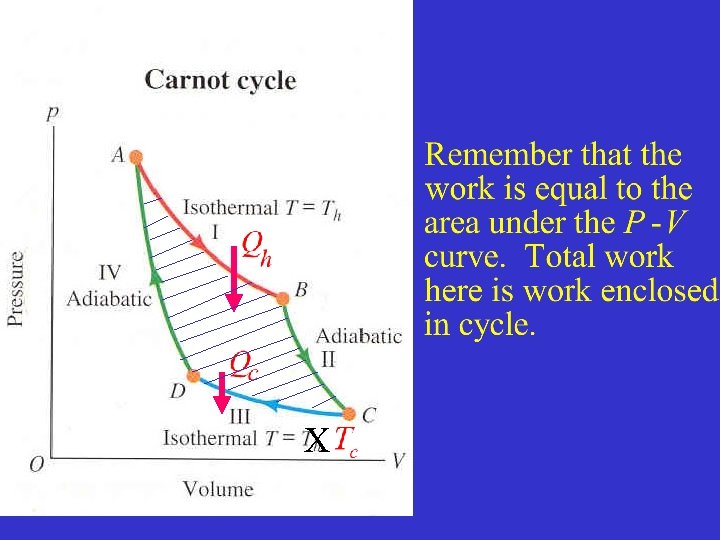
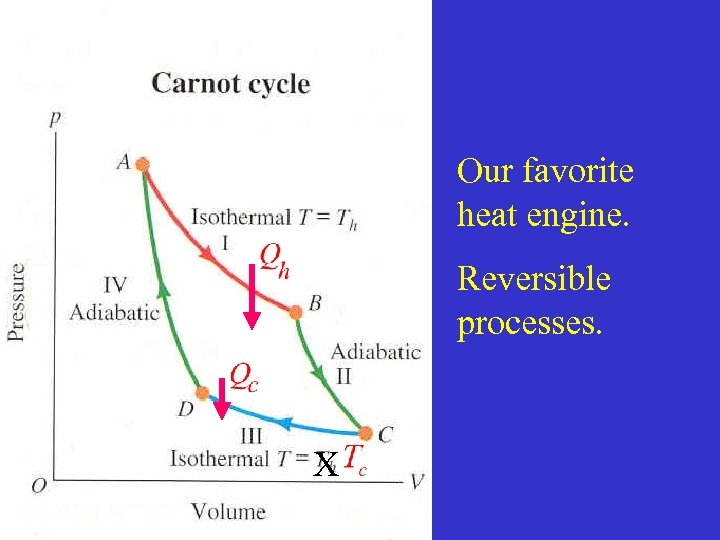 Our favorite heat engine. Reversible processes. X
 X
X
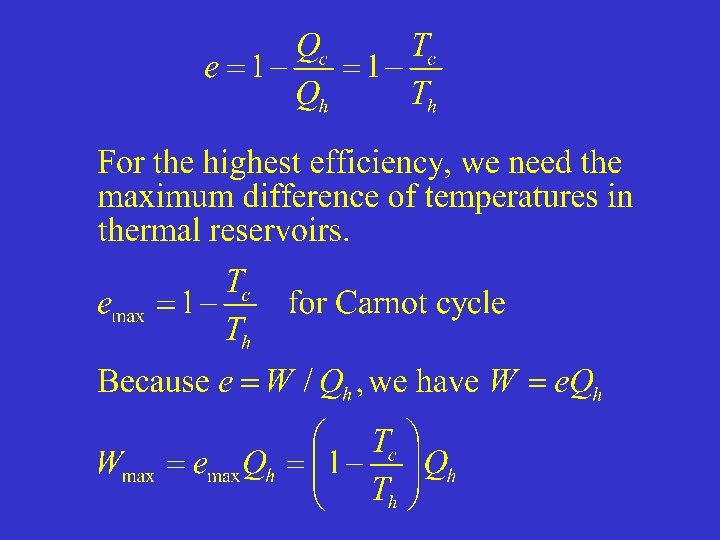
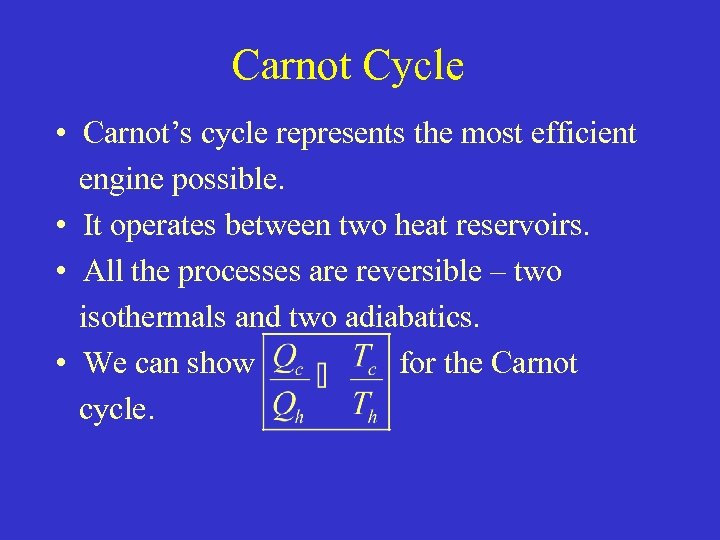 Carnot Cycle • Carnot’s cycle represents the most efficient engine possible. • It operates between two heat reservoirs. • All the processes are reversible – two isothermals and two adiabatics. • We can show for the Carnot cycle.
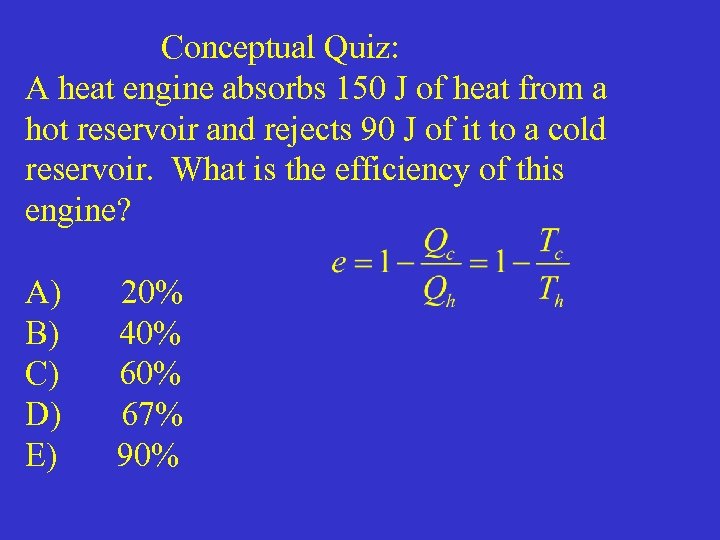 Conceptual Quiz: A heat engine absorbs 150 J of heat from a hot reservoir and rejects 90 J of it to a cold reservoir. What is the efficiency of this engine? A) 20% B) 40% C) 60% D) 67% E) 90%
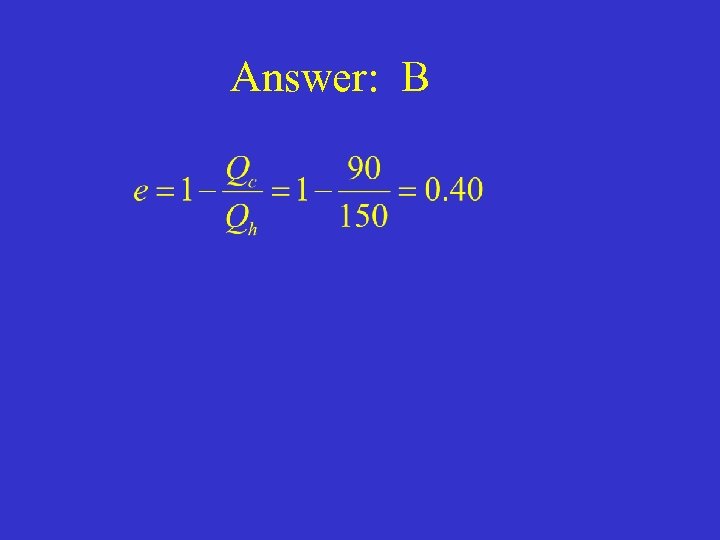 Answer: B
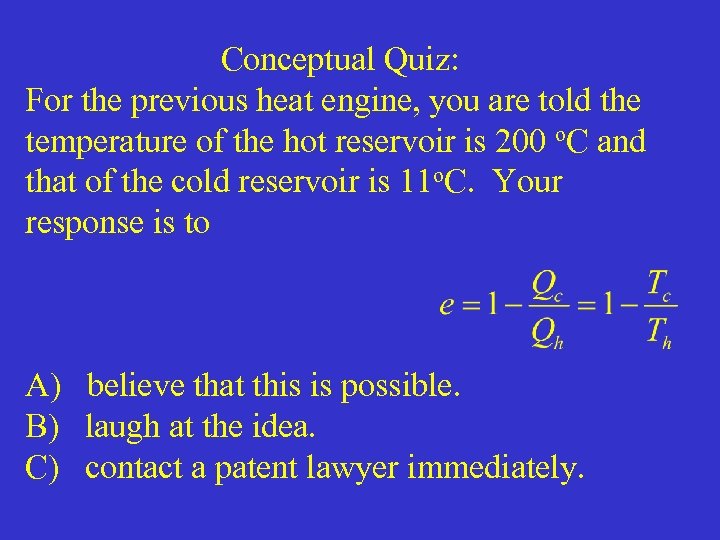 Conceptual Quiz: For the previous heat engine, you are told the temperature of the hot reservoir is 200 o. C and that of the cold reservoir is 11 o. C. Your response is to A) believe that this is possible. B) laugh at the idea. C) contact a patent lawyer immediately.
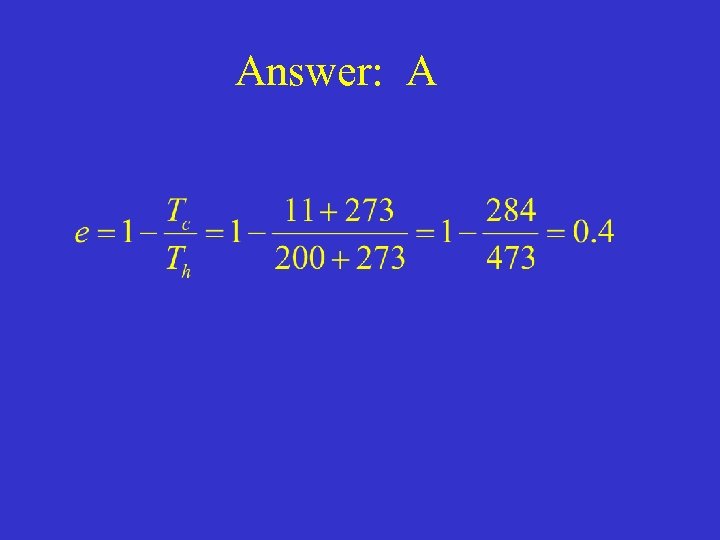 Answer: A
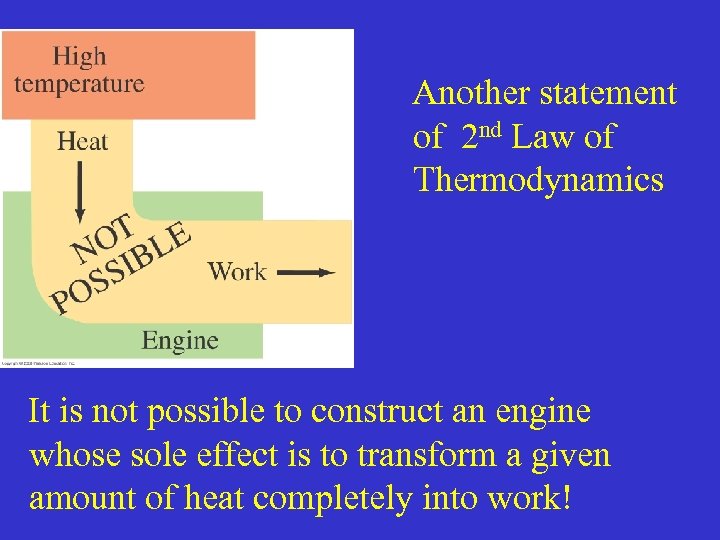 Another statement of 2 nd Law of Thermodynamics It is not possible to construct an engine whose sole effect is to transform a given amount of heat completely into work!
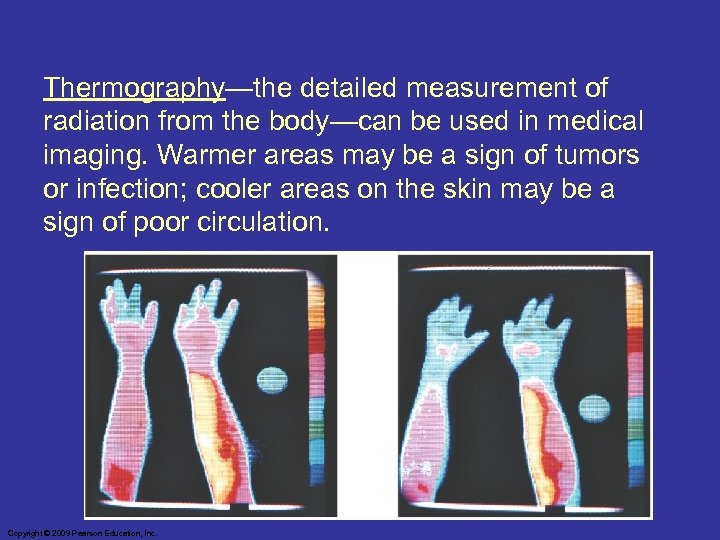 Thermography—the detailed measurement of radiation from the body—can be used in medical imaging. Warmer areas may be a sign of tumors or infection; cooler areas on the skin may be a sign of poor circulation. Copyright © 2009 Pearson Education, Inc.
 Conceptual Quiz Given your experience of what feels colder when you walk on it, which of the surfaces would have the highest thermal conductivity? A) a rug B) a steel surface C) a concrete floor D) has nothing to do with thermal conductivity
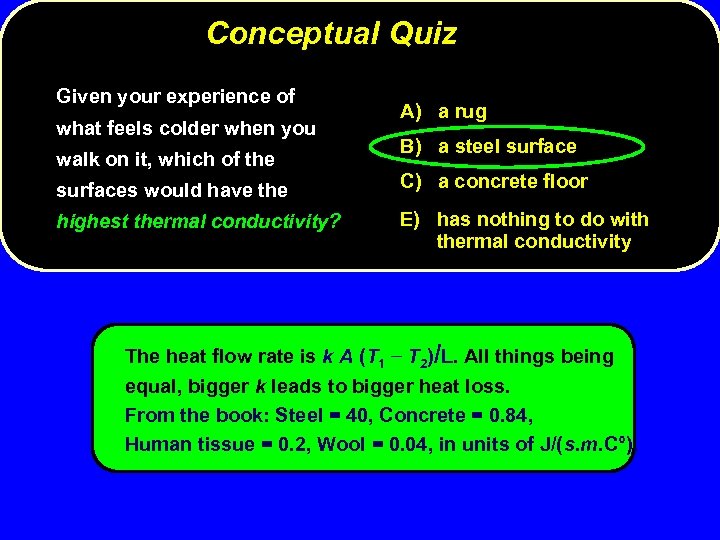 Conceptual Quiz Given your experience of what feels colder when you walk on it, which of the A) a rug B) a steel surfaces would have the C) a concrete floor highest thermal conductivity? E) has nothing to do with thermal conductivity The heat flow rate is k A (T 1 − T 2)/L. All things being equal, bigger k leads to bigger heat loss. From the book: Steel = 40, Concrete = 0. 84, Human tissue = 0. 2, Wool = 0. 04, in units of J/(s. m. C°).
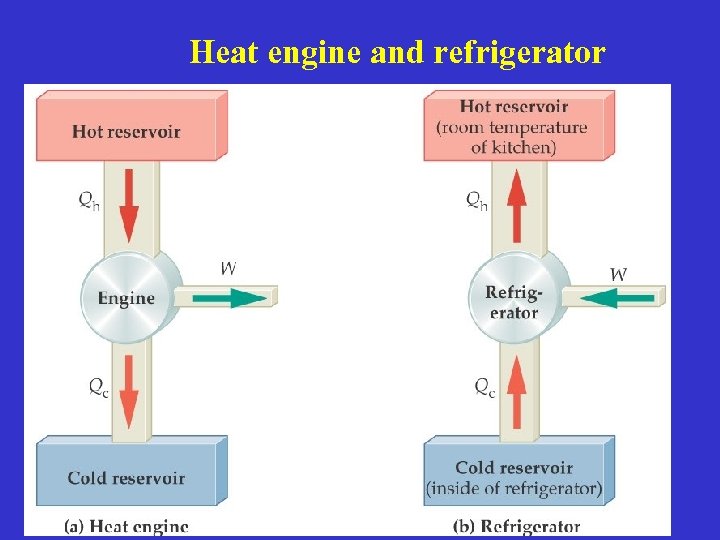 Heat engine and refrigerator
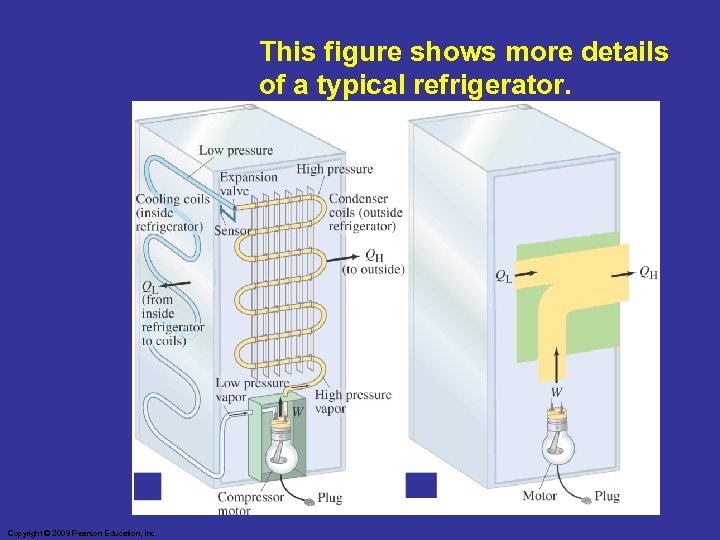 This figure shows more details of a typical refrigerator. Copyright © 2009 Pearson Education, Inc.
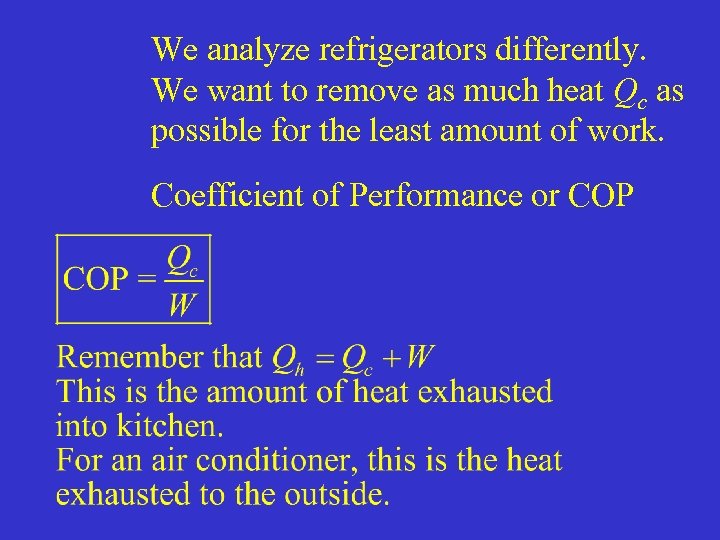 We analyze refrigerators differently. We want to remove as much heat Qc as possible for the least amount of work. Coefficient of Performance or COP
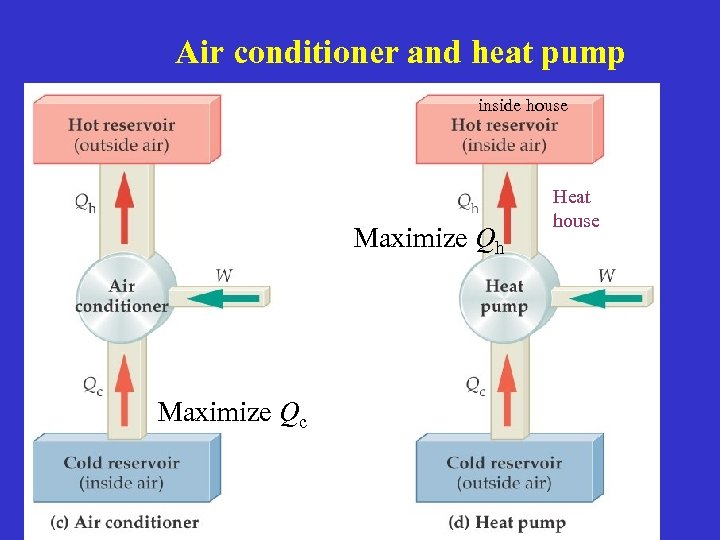 Air conditioner and heat pump inside house Maximize Qh Maximize Qc Heat house
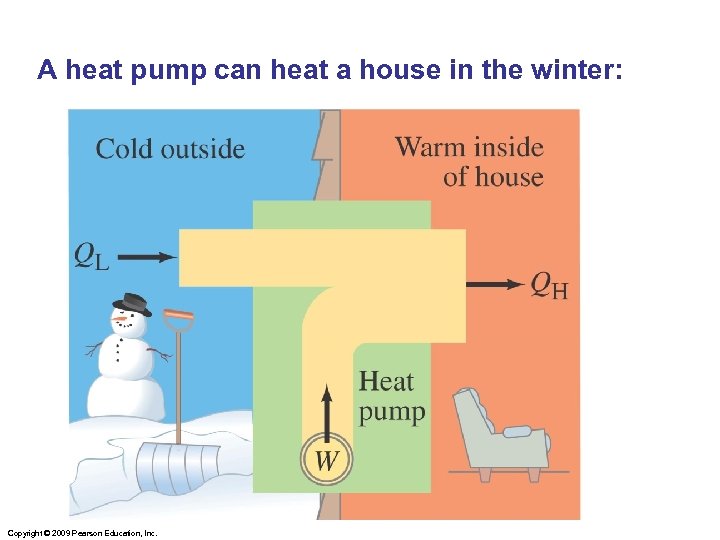 A heat pump can heat a house in the winter: Copyright © 2009 Pearson Education, Inc.
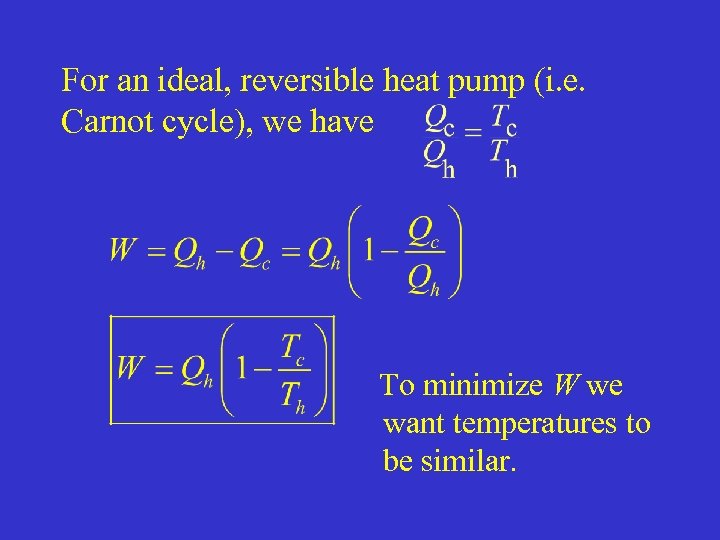 For an ideal, reversible heat pump (i. e. Carnot cycle), we have To minimize W we want temperatures to be similar.
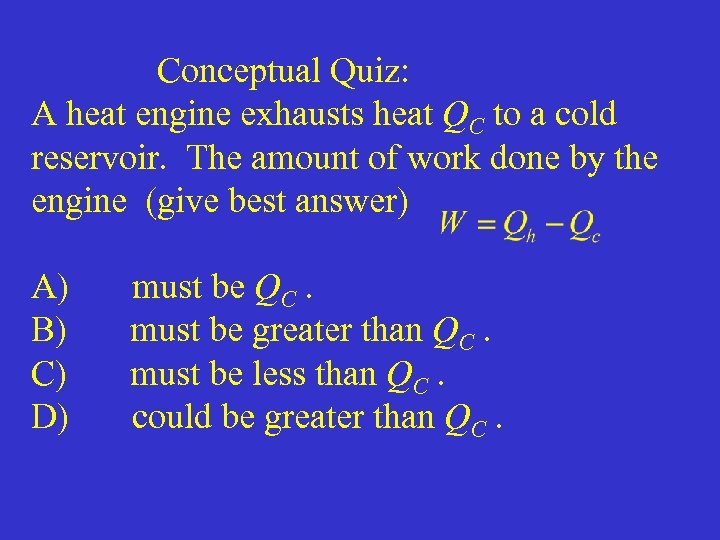 Conceptual Quiz: A heat engine exhausts heat QC to a cold reservoir. The amount of work done by the engine (give best answer) A) must be QC. B) must be greater than QC. C) must be less than QC. D) could be greater than QC.
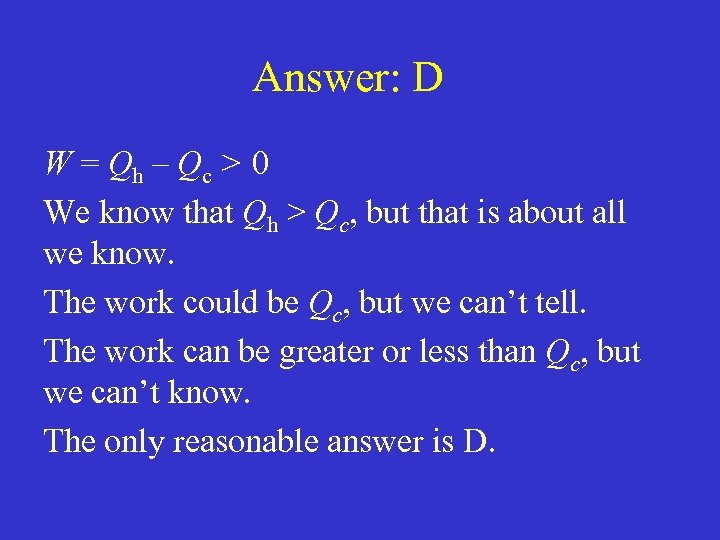 Answer: D W = Qh – Qc > 0 We know that Qh > Qc, but that is about all we know. The work could be Qc, but we can’t tell. The work can be greater or less than Qc, but we can’t know. The only reasonable answer is D.
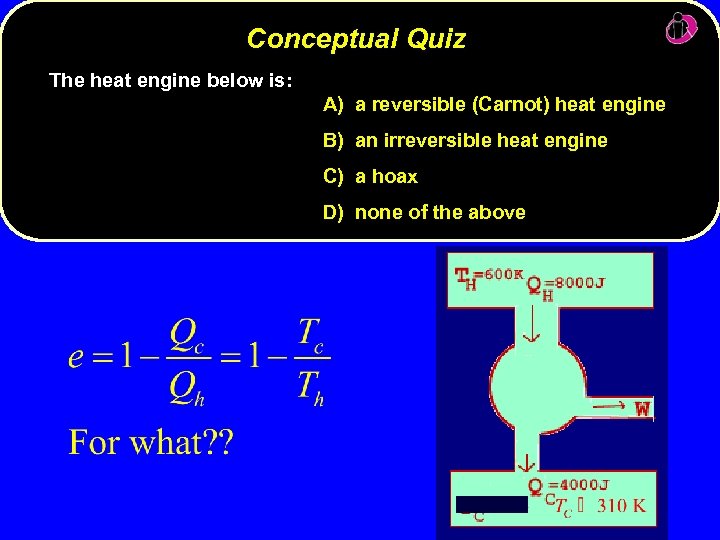 Conceptual Quiz The heat engine below is: A) a reversible (Carnot) heat engine B) an irreversible heat engine C) a hoax D) none of the above
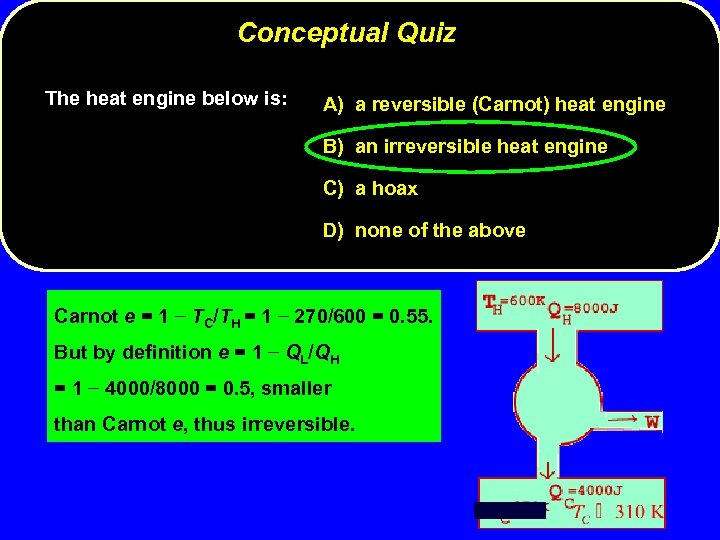 Conceptual Quiz The heat engine below is: A) a reversible (Carnot) heat engine B) an irreversible heat engine C) a hoax D) none of the above Carnot e = 1 − TC/TH = 1 − 270/600 = 0. 55. But by definition e = 1 − QL/QH = 1 − 4000/8000 = 0. 5, smaller than Carnot e, thus irreversible.
 Hiker as Heat Engine. Assume that a 65 kg hiker needs 4. 3 x 10³ kcal of energy to supply a day’s worth of metabolism. Estimate the maximum height the person can climb in one day, using only this amount of energy. As a rough prediction, treat the person as an isolated heat engine, operating between the internal temperature of 37°C (98. 6°F) and the ambient air temperature of 20°C.
 Heat Pump. A heat pump is used to keep a house warm at 22°C. How much work is required of the pump to deliver 3100 J of heat into the house if the outdoor temperature is (a) 0°C, (b) -15°C. Assume ideal (Carnot) behavior.