 Скачать презентацию nd Great Britain in the 2 World War
Britain in rhe 2nd world war.pptx
- Количество слайдов: 12



nd Great Britain in the 2 World War Great Britain took part in the Second World War on September 1, 1939 to September 2, 1945, ie almost from the first day to the last. Although the country has escaped the war on its territory and the occupation, in the end in the conflict has deprived its superpower status.
In the second half of the 30 -ies of XX century Britain actively made concessions to Germany, believing that Germans could counterbalance the growing "Soviet threat", remaining controlled Western Allies. The result of this policy was the signing of the Munich Agreement in 1938, which concerned the transfer of Czechoslovakia Sudetenland to Germany. However, Hitler was playing his games and did not limit the Sudetenland. In March 1939, it was divided and conquered Czechoslovakia, and in August of that year, signed the Treaty of Non-Aggression between Germany and the USSR. Britain is rapidly losing control of the situation. September 3, 1939, after the invasion of Poland, Great Britain declared war on Germany. In many ways, the declaration of war was made under pressure from the U. S. , which demanded that Britain promised performance agreements.
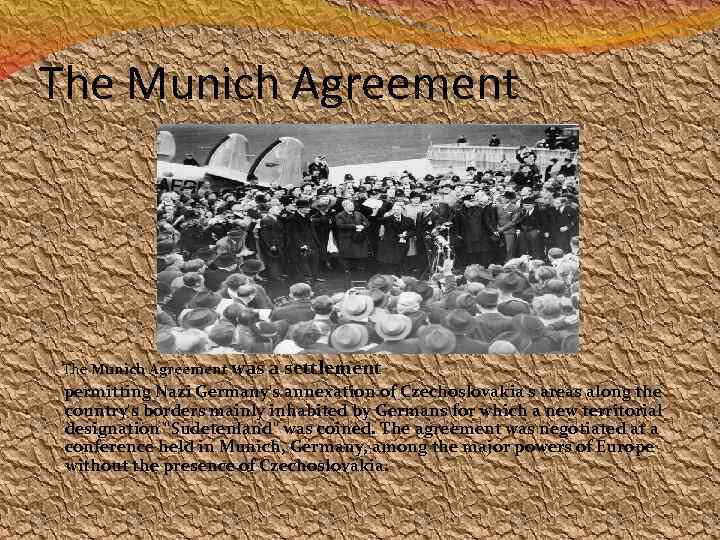
The Munich Agreement was a settlement permitting Nazi Germany's annexation of Czechoslovakia's areas along the country's borders mainly inhabited by Germans for which a new territorial designation "Sudetenland" was coined. The agreement was negotiated at a conference held in Munich, Germany, among the major powers of Europe without the presence of Czechoslovakia.
. The agreement was signed in the early hours of 30 September 1938 (but dated 29 September). The purpose of the conference was to discuss the future of the Sudetenland in the face of territorial demands made by Adolf Hitler. The agreement was signed by Germany, France, the United Kingdom, and Italy. The Sudetenland was of immense strategic importance to Czechoslovakia, as most of its border defenses were situated there, and many of its banks were located there as well.
A deal was reached on September 29, and at about 1: 30 am on September 30, 1938, Adolf Hitler, Neville Chamberlain, Benito Mussolini and Édouard Daladier signed the Munich Agreement. The agreement was officially introduced by Mussolini although in fact the so-called Italian plan had been prepared in the German Foreign Office. It was nearly identical to the Godesberg proposal: the German army was to complete the occupation of the Sudetenland by October 10, and an international commission would decide the future of other disputed areas. Czechoslovakia was informed by Britain and France that it could either resist Nazi Germany alone or submit to the prescribed annexations. The Czechoslovak government, realizing the hopelessness of fighting the Nazis alone, reluctantly capitulated (September 30) and agreed to abide by the agreement. The settlement gave Germany the Sudetenland starting October 10, and de facto control over the rest of Czechoslovakia as long as Hitler promised to go no further. On September 30 after some rest, Chamberlain went to Hitler and asked him to sign a peace treaty between the United Kingdom and Germany. After Hitler's interpreter translated it for him, he happily agreed. On September 30, upon his return to Britain, Chamberlain delivered his famous "peace for our time" speech to delighted crowds in London.
The Reactions after the Agreement Though the British and French were pleased, as were the Nazi military and German diplomatic leadership, Hitler was furious. He felt as though he had been forced into acting like a bourgeois politician by his diplomats and generals. Joseph Stalin was also upset by the results of the Munich conference. The Soviets, who had a mutual military assistance treaty with Czechoslovakia, felt betrayed by France, which also had a mutual military assistance treaty with Czechoslovakia. The Czechoslovaks were greatly dismayed with the Munich settlement. With Sudetenland gone to Germany, Czecho-Slovakia (as the state was now renamed) lost its defensible border with Germany and its fortifications. Without them its independence became more nominal than real. In fact, Edvard Beneš, the President of Czechoslovakia, had the military print the march orders for his army and put the press on standby for a declaration of war. Czechoslovakia also lost 70% of its iron/steel, 70% of its electrical power, 3. 5 million citizens to Germany as a result of the settlement.
The “Phony war” "Phony war, " as it was called, did not end with the defeat of the bourgeois-landlord Poland - it lasted until the beginning of April 1940. fairly close connection policy of 1939 -1940 with the Munich policy, stressing that the strategy of "phony war" if there any changes in the autumn of 1939, it is not in the content but in the form, or rather in the conditions of the old policy. was actually developed in 1938. It was also called "Pacification war"
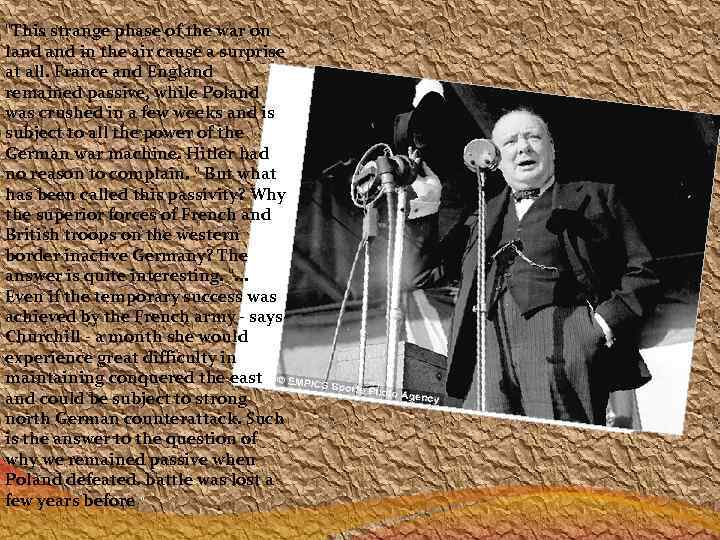
"This strange phase of the war on land in the air cause a surprise at all. France and England remained passive, while Poland was crushed in a few weeks and is subject to all the power of the German war machine. Hitler had no reason to complain. " But what has been called this passivity? Why the superior forces of French and British troops on the western border inactive Germany? The answer is quite interesting. ". . . Even if the temporary success was achieved by the French army - says Churchill - a month she would experience great difficulty in maintaining conquered the east and could be subject to strong north German counterattack. Such is the answer to the question of why we remained passive when Poland defeated. battle was lost a few years before "
The Battle of Britain literally "Air battle for England" or "Air battle for Great Britain") is the name given to the Second World War air campaign waged by the German Air Force against the United Kingdom during the summer and autumn of 1940. The objective of the campaign was to gain air superiority over the Royal Air Force (RAF), especially Fighter Command. The name derives from a famous speech delivered by Prime Minister Winston Churchill in the House of Commons: "…the Battle of France is over. I expect that the Battle of Britain is about to begin. “The failure of Germany to achieve its objectives of destroying Britain's air defences, or forcing Britain to negotiate an armistice or an outright surrender, is considered its first major defeat and a turning point in the Second World War. By preventing Germany from gaining air superiority, the battle ended the threat that Hitler would launch Operation Sea Lion, a proposed amphibious and airborne invasion of Britain.
The bombing strategy Strategic bombing theory The British had their own very well-developed theory of strategic bombing, and built the long-range bombers to implement it. [37] Before 1944, however, the main German industrial targets were out of range, so the RAF bombers concentrated on military and transportation targets in France and Belgium. The Allies won air supremacy in Europe in 1944. [40] That meant that Allied supplies and reinforcements would get through to the battlefront, but not the enemy's. It meant the Allies could concentrate their strike forces wherever they pleased, and overwhelm the enemy with a preponderance of firepower. This was the basic Allied strategy, and it worked. Air superiority depended on having the fastest, most maneuverable fighters, in sufficient quantity, based on well-supplied airfields, within range. The RAF demonstrated the importance of speed and maneuverability in the Battle of Britain(1940), when its fast Spitfire and Hawker Hurricane fighters easily riddled the clumsy Stukas as they were pulling out of dives. The race to build the fastest fighter became one of the central themes of World War II. The RAF underwent rapid expansion following the outbreak of war against Germany in 1939. This included the training in Canada of half of British and Commonwealth aircrews, some 167, 000 men in all. The RAF also integrated Polish and other airmen who had escaped from Hitler's Europe.
Battle of Britain Day Winston Churchill summed up the effect of the battle and the contribution of Fighter Command with the words, "Never in the field of human conflict was so much owed by so many to so few". Pilots who fought in the Battle have been known as The Fewever since. Battle of Britain Day is commemorated in the United Kingdom on 15 September. Within the Commonwealth, Battle of Britain Day is usually observed on the third Sunday in September. In some areas in the British Channel Islands, it is celebrated on the second Thursday in September.
The main outcome of the war from the point of view of the UK was to preserve the country's independence. At the same time, the UK has spent on the war, more than half of its foreign investment, external debt by the end of the war has reached 3 billion pounds. It’s in need of outside assistance for their recovery. Many international markets have lost it. So Britain has lost its global leadership role, and in the first row of the superpowers USA and USSR emerged. By the end of World War II include the collapse of the British Empire. Declining prestige of the British Empire in the period of failure cost her dearly. After the war, most of the British colonies became independent, although certain links with the former metropolis remain in the Commonwealth.
Скачать презентацию nd Great Britain in the 2 World War
Britain in rhe 2nd world war.pptx