 Скачать презентацию nd 2 Parameters of SPL feasibility study A
0027426f59e9606b865242598b83b34c.ppt
- Количество слайдов: 29



nd 2 Parameters of SPL feasibility study A. M. Lombardi (reporting for the working group)
![Contents Ø what has changed with respect to CDR 1 [=conceptual design report] Ø](https://present5.com/presentation/0027426f59e9606b865242598b83b34c/image-2.jpg "Contents Ø what has changed with respect to CDR 1 [=conceptual design report] Ø")
Contents Ø what has changed with respect to CDR 1 [=conceptual design report] Ø frequency/ length /RF power/reliability and cost Ø energy and synergy Ø contributors to CDR 2 Ø planning and conclusions
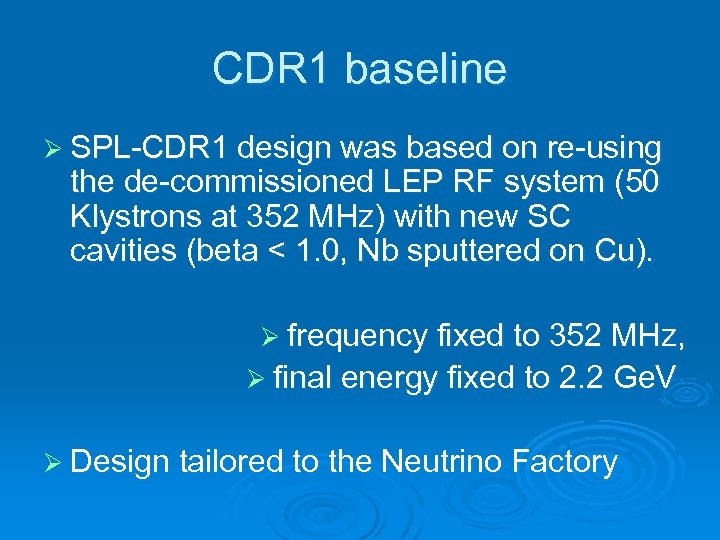
CDR 1 baseline Ø SPL-CDR 1 design was based on re-using the de-commissioned LEP RF system (50 Klystrons at 352 MHz) with new SC cavities (beta < 1. 0, Nb sputtered on Cu). Ø frequency fixed to 352 MHz, Ø final energy fixed to 2. 2 Ge. V Ø Design tailored to the Neutrino Factory
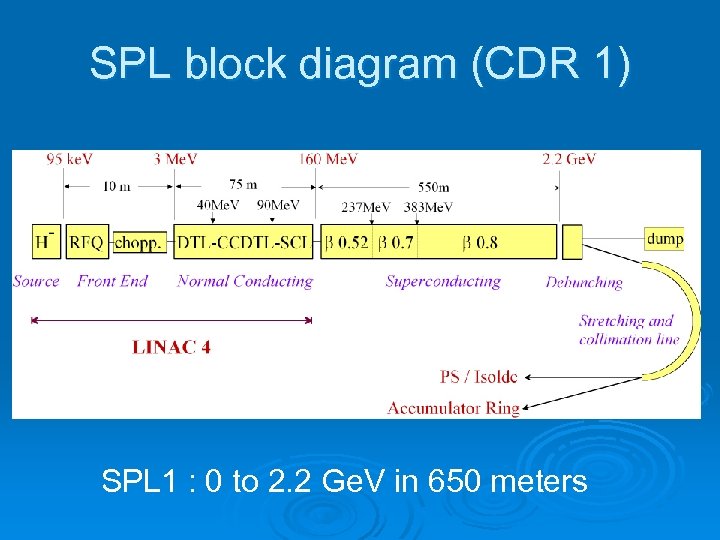
SPL block diagram (CDR 1) SPL 1 : 0 to 2. 2 Ge. V in 650 meters
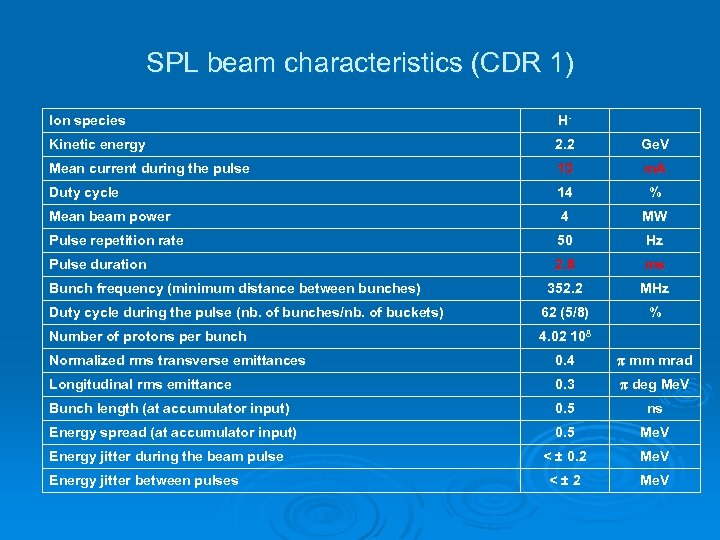
SPL beam characteristics (CDR 1) Ion species H- Kinetic energy 2. 2 Ge. V Mean current during the pulse 13 m. A Duty cycle 14 % Mean beam power 4 MW Pulse repetition rate 50 Hz Pulse duration 2. 8 ms 352. 2 MHz Duty cycle during the pulse (nb. of bunches/nb. of buckets) 62 (5/8) % Number of protons per bunch 4. 02 108 Bunch frequency (minimum distance between bunches) Normalized rms transverse emittances 0. 4 p mm mrad Longitudinal rms emittance 0. 3 p deg Me. V Bunch length (at accumulator input) 0. 5 ns Energy spread (at accumulator input) 0. 5 Me. V < ± 0. 2 Me. V <± 2 Me. V Energy jitter during the beam pulse Energy jitter between pulses
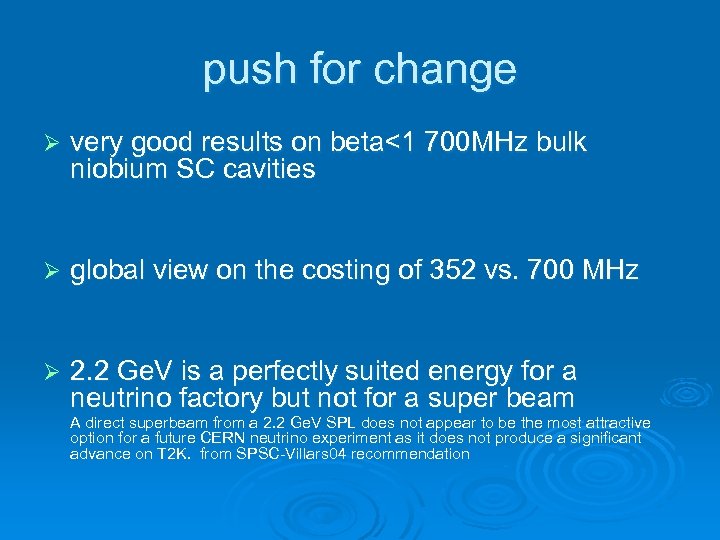
push for change Ø very good results on beta<1 700 MHz bulk niobium SC cavities Ø global view on the costing of 352 vs. 700 MHz Ø 2. 2 Ge. V is a perfectly suited energy for a neutrino factory but not for a super beam A direct superbeam from a 2. 2 Ge. V SPL does not appear to be the most attractive option for a future CERN neutrino experiment as it does not produce a significant advance on T 2 K. from SPSC-Villars 04 recommendation
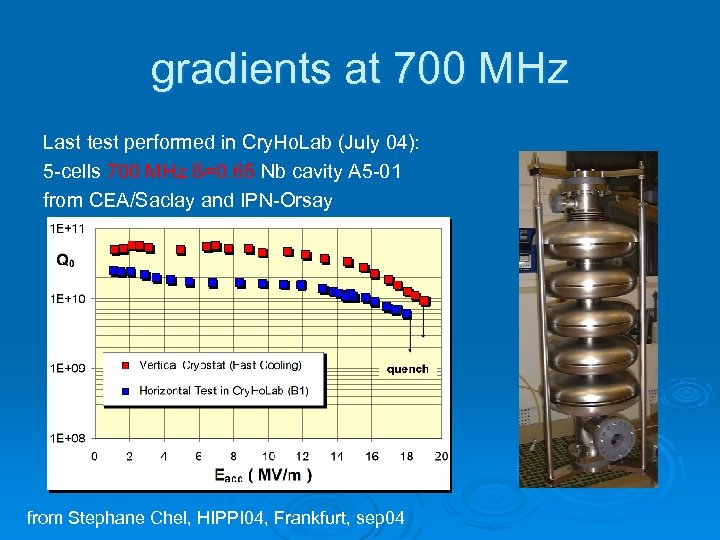
gradients at 700 MHz Last test performed in Cry. Ho. Lab (July 04): 5 -cells 700 MHz ß=0. 65 Nb cavity A 5 -01 from CEA/Saclay and IPN-Orsay from Stephane Chel, HIPPI 04, Frankfurt, sep 04
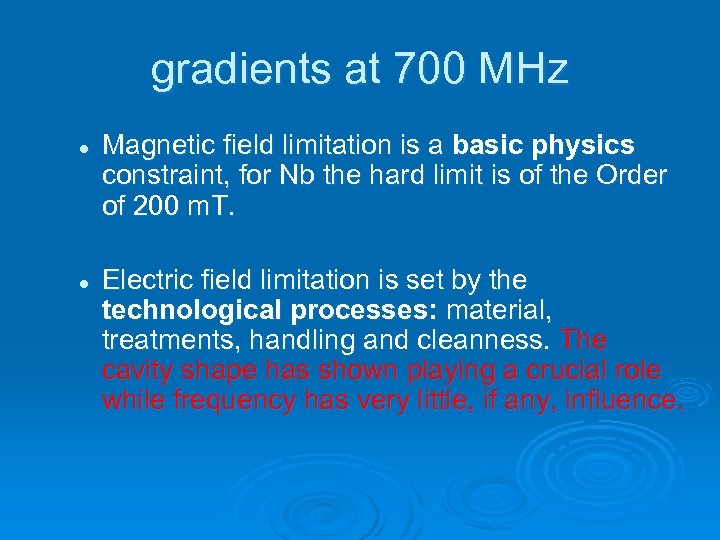
gradients at 700 MHz l l Magnetic field limitation is a basic physics constraint, for Nb the hard limit is of the Order of 200 m. T. Electric field limitation is set by the technological processes: material, treatments, handling and cleanness. The cavity shape has shown playing a crucial role while frequency has very little, if any, influence.
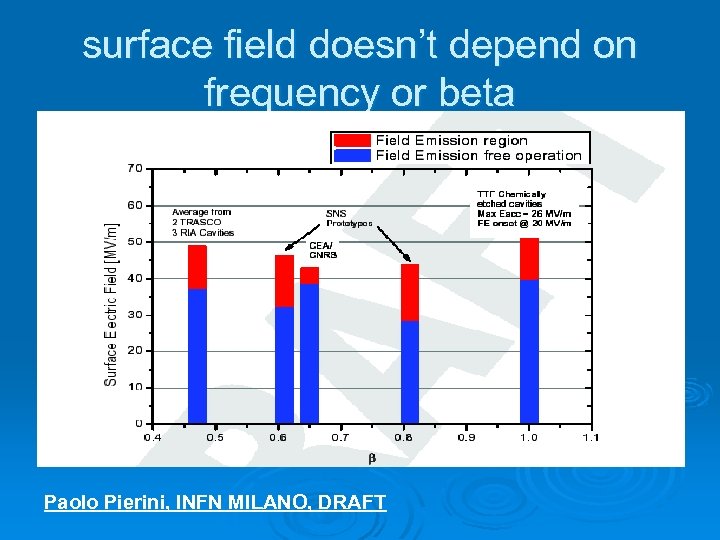
surface field doesn’t depend on frequency or beta Paolo Pierini, INFN MILANO, DRAFT
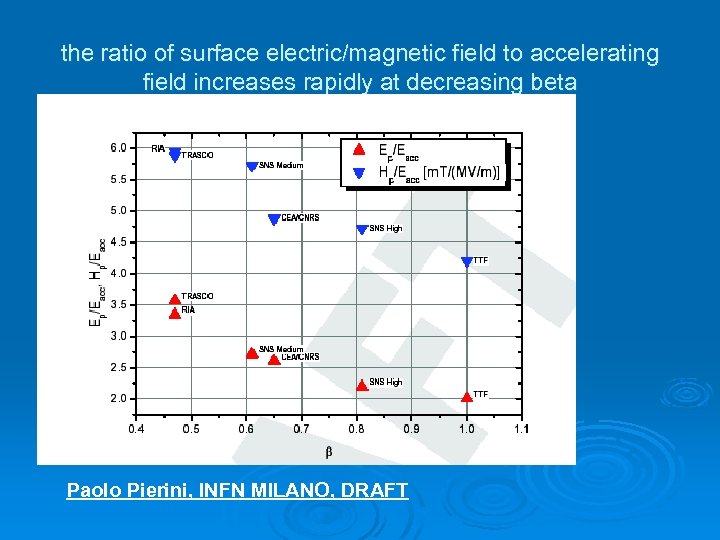
the ratio of surface electric/magnetic field to accelerating field increases rapidly at decreasing beta Paolo Pierini, INFN MILANO, DRAFT
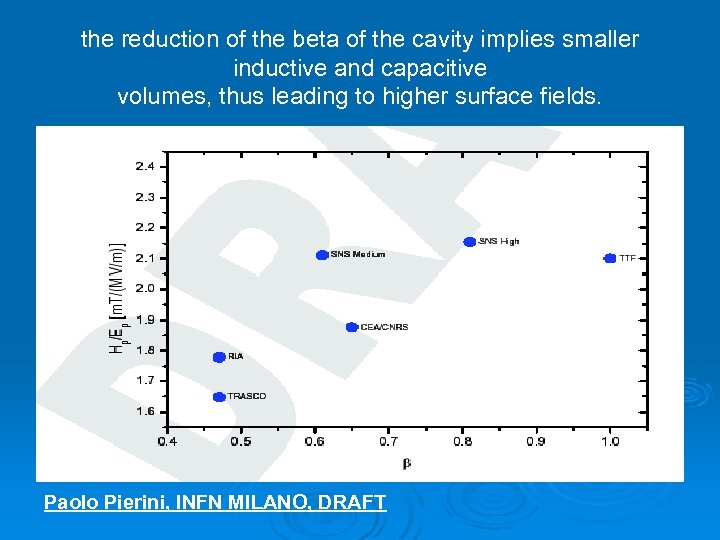
the reduction of the beta of the cavity implies smaller inductive and capacitive volumes, thus leading to higher surface fields. Paolo Pierini, INFN MILANO, DRAFT
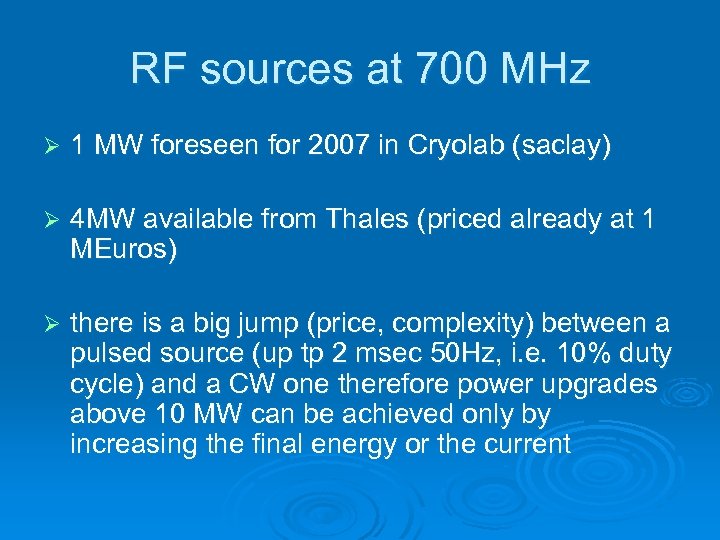
RF sources at 700 MHz Ø 1 MW foreseen for 2007 in Cryolab (saclay) Ø 4 MW available from Thales (priced already at 1 MEuros) Ø there is a big jump (price, complexity) between a pulsed source (up tp 2 msec 50 Hz, i. e. 10% duty cycle) and a CW one therefore power upgrades above 10 MW can be achieved only by increasing the final energy or the current
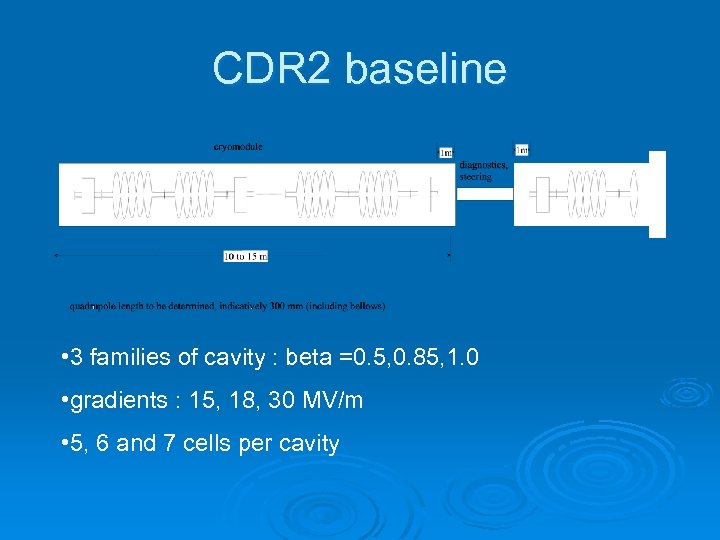
CDR 2 baseline • 3 families of cavity : beta =0. 5, 0. 85, 1. 0 • gradients : 15, 18, 30 MV/m • 5, 6 and 7 cells per cavity
CDR 2 baseline Ø Use cold (2 K) quadrupoles in the cryomodules, independently aligned from the cavities (+: minimise cold/warm transitions and maximize real estate gradient, TESLA experience, large aperture). Ø Use cryomodules of maximum length (between 10 and 15 m), containing n cavities and (n+1) quadrupoles. Diagnostics, steering etc. between cryomodules. Ø The length of the cavities should be limited by fabrication and handling considerations. The proposed number of cells per cavity is therefore 5, 6 and 7 for the three sections. Ø 2 MW max power /coupler Ø standardisation of the design after 2 Ge. V
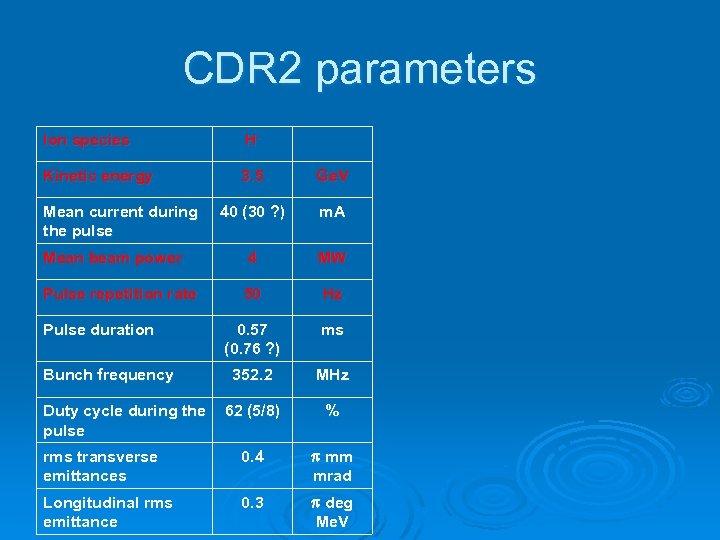
CDR 2 parameters Ion species H- Kinetic energy 3. 5 Ge. V 40 (30 ? ) m. A Mean beam power 4 MW Pulse repetition rate 50 Hz 0. 57 (0. 76 ? ) ms 352. 2 MHz 62 (5/8) % rms transverse emittances 0. 4 p mm mrad Longitudinal rms emittance 0. 3 p deg Me. V Mean current during the pulse Pulse duration Bunch frequency Duty cycle during the pulse
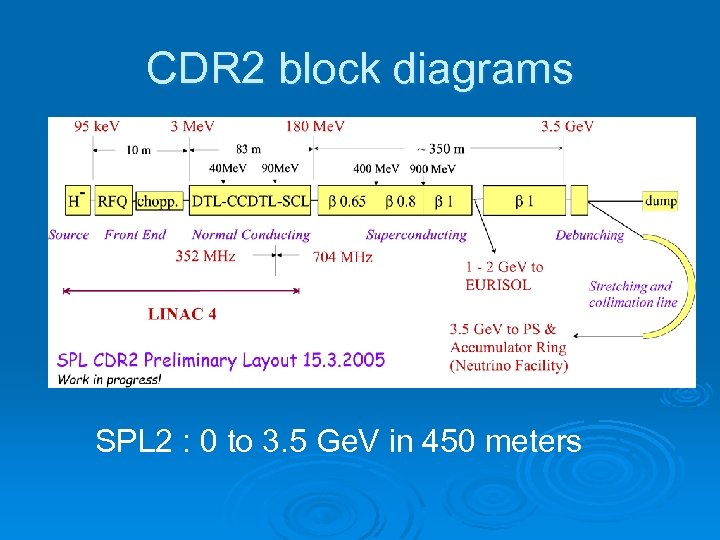
CDR 2 block diagrams SPL 2 : 0 to 3. 5 Ge. V in 450 meters
why not 704 from the start ? Ø acceptance at 100 k. V 700 MHz too small Ø focusing from the RFQ too weak Ø Drift tube linac miniature dimensions Ø 90 Me. V is an optimal energy for the frequency jump
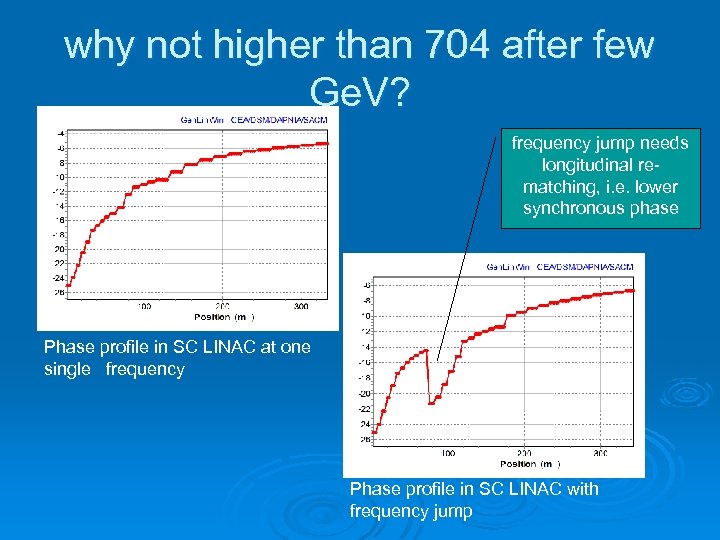
why not higher than 704 after few Ge. V? frequency jump needs longitudinal rematching, i. e. lower synchronous phase Phase profile in SC LINAC at one single frequency Phase profile in SC LINAC with frequency jump
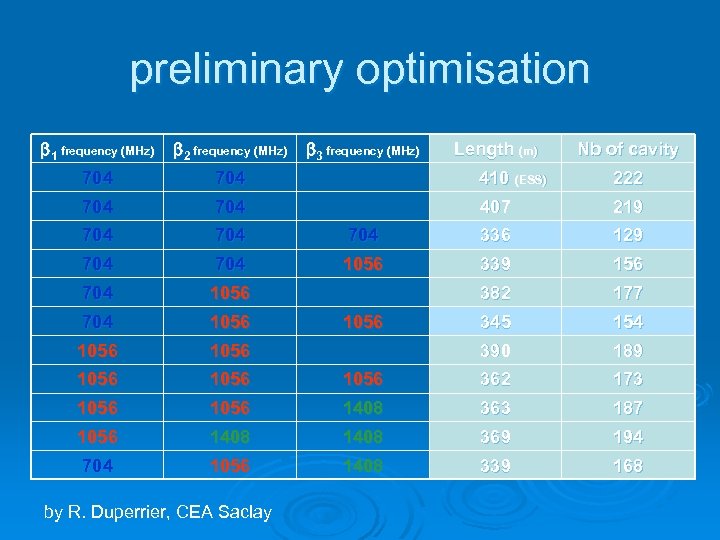
preliminary optimisation 1 frequency (MHz) 2 frequency (MHz) 704 410 (ESS) 222 704 407 219 704 704 336 129 704 1056 339 156 704 1056 382 177 704 1056 345 154 1056 390 189 1056 362 173 1056 1408 363 187 1056 1408 369 194 704 1056 1408 339 168 by R. Duperrier, CEA Saclay 3 frequency (MHz) 1056 Length (m) Nb of cavity
gradient/power/length/cost Ø total cost in a linac is generally proportional to length Ø reliability is increased if the system has less components and the components are standardized Ø the fact of having in house the 352 RF power source is out weighted by the gain in lenght and reliability. Ø 352 bulk niobium cavity are not a good economical choice Ø we can’t reach above 2. 2 Ge. V by re-using the LEP klystrons
energy and synergy Ø Ø SPL must be a multi-user facility. Each user has a specific request on intensity/beam power/energy. Whilst intensity and beam power can be easily varied within the same machine (change of source current, change of duty cycle) the choice of the final energy must be such as to accommodate the max number of possible users.
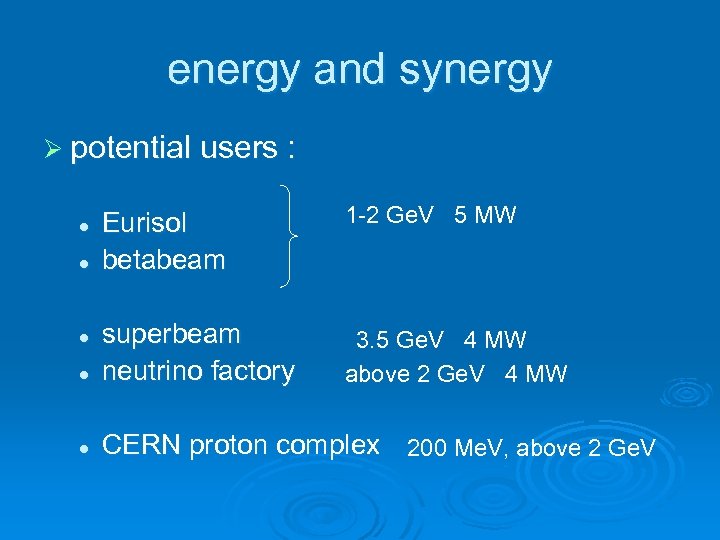
energy and synergy Ø potential users : Eurisol betabeam 1 -2 Ge. V 5 MW l superbeam neutrino factory 3. 5 Ge. V 4 MW above 2 Ge. V 4 MW l CERN proton complex 200 Me. V, above 2 Ge. V l l l
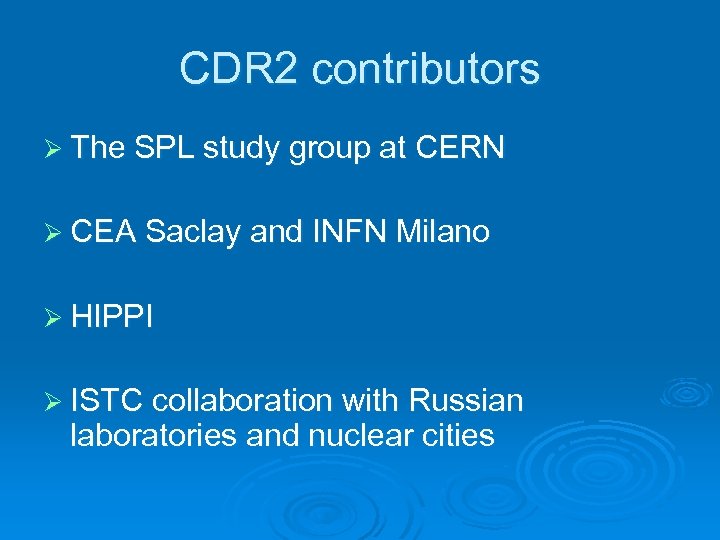
CDR 2 contributors Ø The SPL study group at CERN Ø CEA Saclay and INFN Milano Ø HIPPI Ø ISTC collaboration with Russian laboratories and nuclear cities
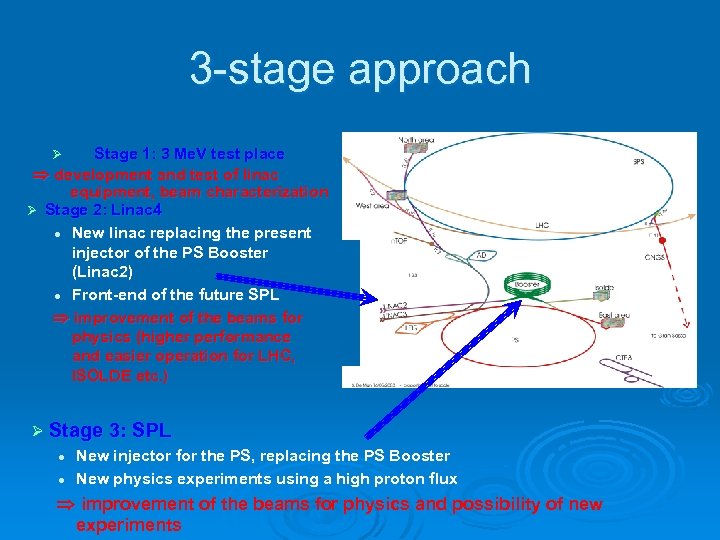
3 -stage approach Stage 1: 3 Me. V test place Þ development and test of linac equipment, beam characterization Ø Stage 2: Linac 4 l New linac replacing the present injector of the PS Booster (Linac 2) l Front-end of the future SPL Þ improvement of the beams for physics (higher performance and easier operation for LHC, ISOLDE etc. ) Ø Ø Stage 3: SPL l New injector for the PS, replacing the PS Booster l New physics experiments using a high proton flux Þ improvement of the beams for physics and possibility of new experiments
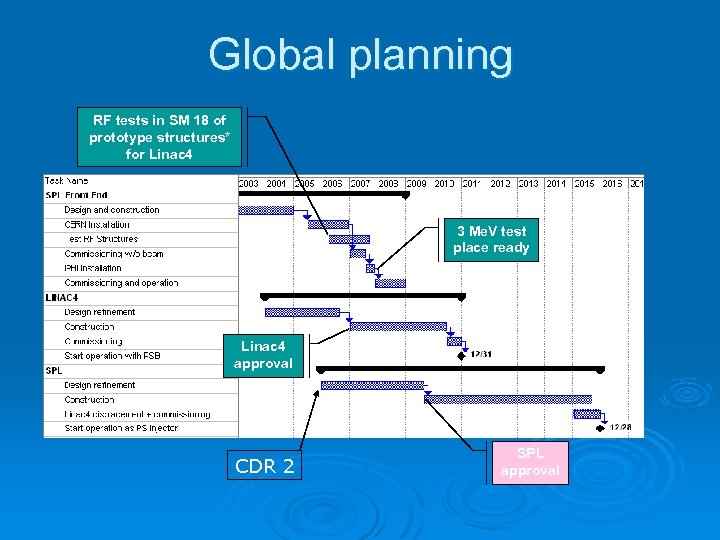
Global planning RF tests in SM 18 of prototype structures* for Linac 4 3 Me. V test place ready Linac 4 approval CDR 2 SPL approval
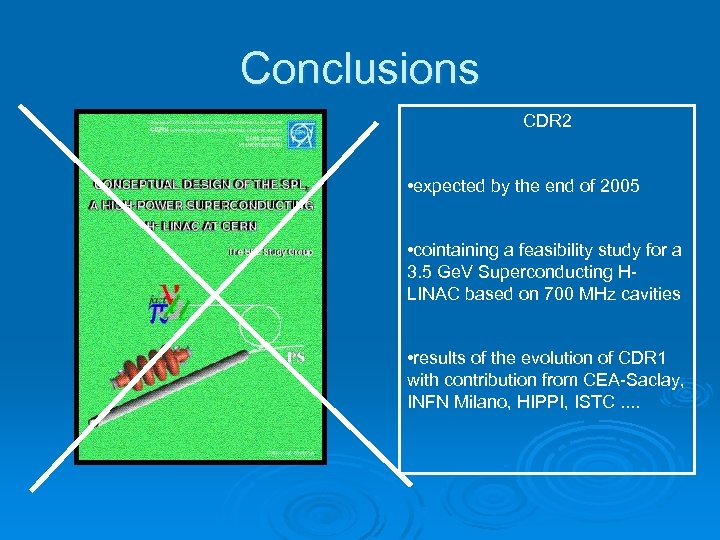
Conclusions CDR 2 • expected by the end of 2005 • cointaining a feasibility study for a 3. 5 Ge. V Superconducting HLINAC based on 700 MHz cavities • results of the evolution of CDR 1 with contribution from CEA-Saclay, INFN Milano, HIPPI, ISTC. .
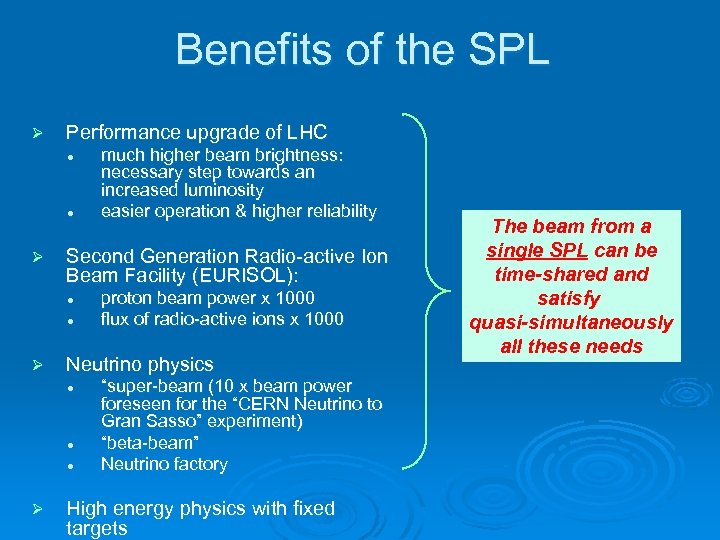
Benefits of the SPL Ø Performance upgrade of LHC l l Ø Second Generation Radio-active Ion Beam Facility (EURISOL): l l Ø proton beam power x 1000 flux of radio-active ions x 1000 Neutrino physics l l l Ø much higher beam brightness: necessary step towards an increased luminosity easier operation & higher reliability “super-beam (10 x beam power foreseen for the “CERN Neutrino to Gran Sasso” experiment) “beta-beam” Neutrino factory High energy physics with fixed targets The beam from a single SPL can be time-shared and satisfy quasi-simultaneously all these needs
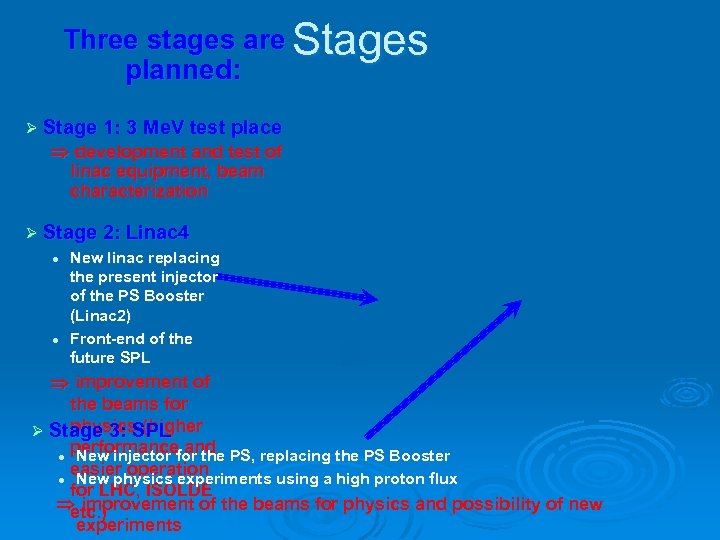
Three stages are Stages planned: Ø Stage 1: 3 Me. V test place Þ development and test of linac equipment, beam characterization Ø Stage 2: Linac 4 l New linac replacing the present injector of the PS Booster (Linac 2) l Front-end of the future SPL Þ improvement of the beams for physics (higher Ø Stage 3: SPL performance and l New injector for the PS, replacing the PS Booster easier operation l New physics experiments using a high proton flux for LHC, ISOLDE Þ improvement of the beams for physics and possibility of new etc. ) experiments
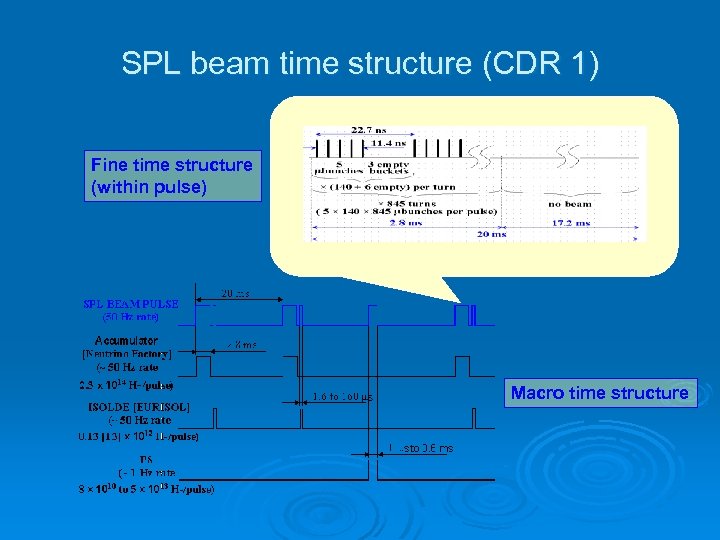
SPL beam time structure (CDR 1) Fine time structure (within pulse) Macro time structure
Скачать презентацию nd 2 Parameters of SPL feasibility study A
0027426f59e9606b865242598b83b34c.ppt